New Semester
Started
Get
50% OFF
Study Help!
--h --m --s
Claim Now
Question Answers
Textbooks
Find textbooks, questions and answers
Oops, something went wrong!
Change your search query and then try again
S
Books
FREE
Study Help
Expert Questions
Accounting
General Management
Mathematics
Finance
Organizational Behaviour
Law
Physics
Operating System
Management Leadership
Sociology
Programming
Marketing
Database
Computer Network
Economics
Textbooks Solutions
Accounting
Managerial Accounting
Management Leadership
Cost Accounting
Statistics
Business Law
Corporate Finance
Finance
Economics
Auditing
Tutors
Online Tutors
Find a Tutor
Hire a Tutor
Become a Tutor
AI Tutor
AI Study Planner
NEW
Sell Books
Search
Search
Sign In
Register
study help
business
logic functions and equations
A Concise Introduction To Logic 11th Edition Patrick J. Hurley - Solutions
2. (∼P ⊃ Q) ∨ (P ⊃ R) Use conditional proof or indirect proof and the eighteen rules of inference to establish the truth of the following tautologies.
★1. P ⊃ [(P ⊃ Q) ⊃ Q] Use conditional proof or indirect proof and the eighteen rules of inference to establish the truth of the following tautologies.
5. Either deposits should be required on beer and soft drink containers, or these containers will be discarded along highways and the countryside will look like a dump. If these containers will be discarded either in parks or along highways, then deposits should be required on soft drink
★4. If astronauts spend long periods in zero gravity only if calcium is resorbed in their bodies, then astronauts on a Mars voyage will arrive with brittle bones. If astronauts attempt a voyage to Mars only if they spend long periods in zero gravity, then astronauts on a Mars voyage will arrive
3. If asbestos workers sue their employers, then if punitive damages are awarded, then their employers will declare bankruptcy. If asbestos workers sue their employers, then punitive damages will be awarded. If asbestos workers contract asbestosis, then either they will sue their employers or their
2. If either the sea turtle population continues to decrease or rescue eff orts are commenced to save the sea turtle from extinction, then nesting sanctuaries will be created and the indiscriminate slaughter of these animals will be halted. If either nesting sanctuaries are created or poachers are
★1. If government deficits continue at their present rate and a recession sets in, then interest on the national debt will become unbearable and the government will default on its loans. If a recession sets in, then the government will not default on its loans. Therefore, either government
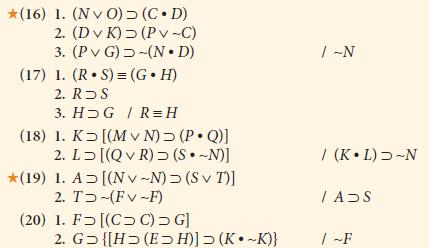
6. Use either indirect proof or conditional proof (or both) and the eighteen rules of inference to derive the conclusions of the following symbolized arguments.Having done so, attempt to derive the conclusions without using indirect proof or conditional proof. (16) 1. (NvO)>(CD) 2. (DvK) (PV-C) 3.
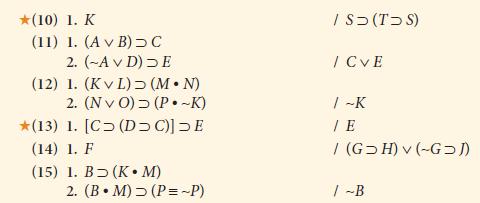
6. Use either indirect proof or conditional proof (or both) and the eighteen rules of inference to derive the conclusions of the following symbolized arguments.Having done so, attempt to derive the conclusions without using indirect proof or conditional proof. *(10) 1. K (11) 1. (Av B)>C 2. (-A v
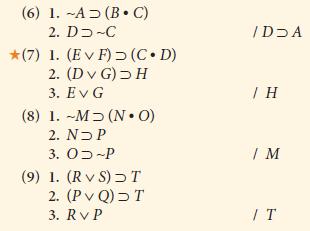
6. Use either indirect proof or conditional proof (or both) and the eighteen rules of inference to derive the conclusions of the following symbolized arguments.Having done so, attempt to derive the conclusions without using indirect proof or conditional proof. (6) 1. A(BC) 2. D=-C *(7) 1. (Ev F)
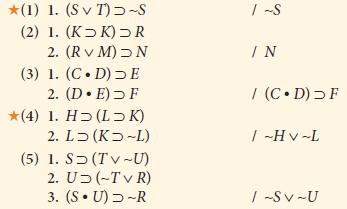
6. Use either indirect proof or conditional proof (or both) and the eighteen rules of inference to derive the conclusions of the following symbolized arguments.Having done so, attempt to derive the conclusions without using indirect proof or conditional proof. *(1) 1. (SvT)-S (2) 1. (KK) R 2. (RvM)
6. Use either indirect proof or conditional proof (or both) and the eighteen rules of inference to derive the conclusions of the following symbolized arguments.Having done so, attempt to derive the conclusions without using indirect proof or conditional proof.
5. If astronauts attempt interplanetary space travel, then heavy shielding will be required to protect them from solar radiation. If massive amounts of either fuel or water are carried, then the spacecraft must be very large. Th erefore, if heavy shielding is required to protect the astronauts from
★4. If jails are overcrowded, then dangerous suspects will be released on their own recognizance. If jails are overcrowded and dangerous suspects are released on their own recognizance, then crime will increase. If no new jails are built and crime increases, then innocent victims will pay the
3. A doctor must disconnect a dying patient from a respirator if and only if the fact that patients are self-determining implies that the doctor must follow the patient’s orders. If a dying patient refuses treatment, then the doctor must disconnect the patient from a respirator and the patient
2. If the police take you into custody, then if they inform you that you have the right to remain silent, then whatever you say will be used against you. If the police inform you that you have the right to remain silent, then if whatever you say will be used against you, then you should not say
★1. If high-tech products are exported to Russia, then domestic industries will benefi t. If the Russians can eff ectively utilize high-tech products, then their standard of living will improve. Th erefore, if high-tech products are exported to Russia and the Russians can eff ectively utilize
11. Use conditional proof and the eighteen rules of inference to derive the conclusions of the following symbolized arguments. Having done so, attempt to derive the conclusions without using conditional proof. *(16) 1. Q>(R>S) 2. Q(T-U) 3. U> (RvT) (17) 1. N(OP) 2. Q> (RS) (18) 1. E(FG) 2. H>(G>I)
11. Use conditional proof and the eighteen rules of inference to derive the conclusions of the following symbolized arguments. Having done so, attempt to derive the conclusions without using conditional proof. (10) 1. C (AD) 2. B>(AE) (11) 1. M>(KL) 2. (Lv N)>J (12) 1. F>(GH) *(13) 1. RB 2. R (BF)
11. Use conditional proof and the eighteen rules of inference to derive the conclusions of the following symbolized arguments. Having done so, attempt to derive the conclusions without using conditional proof. (5) 1. A (AVE) (6) 1. J> (KL) 2. J (M>L) 3.-L *(7) 1. Mv (NO) (8) 1. P(Qv R) 2. (PR)(S T)
11. Use conditional proof and the eighteen rules of inference to derive the conclusions of the following symbolized arguments. Having done so, attempt to derive the conclusions without using conditional proof. *(1) 1. NO 2. N-P /N>(OP)
★10. Vitamin E is an antioxidant and a useless food supplement if and only if it does not reduce heart disease. It is not the case either that vitamin E does not reduce heart disease or is not an antioxidant. Th erefore, vitamin E is not a useless food supplement. (A, U, R) Translate the
9. If parents are told that their unborn child has Tay-Sachs disease, then if they go ahead with the birth, then they are responsible for their child’s pain and suff ering. Th erefore, if parents are not responsible for their child’s pain and suff ering, then if they go ahead with the birth,
8. If a superconducting particle collider is built, then the data yielded will benefi t scientists of all nations and it deserves international funding. Either a superconducting particle collider will be built, or the ultimate nature of matter will remain hidden and the data yielded will benefi t
★7. If grade-school children are assigned daily homework, then their achievement level will increase dramatically. But if grade-school children are assigned daily homework, then their love for learning may be dampened. Th erefore, if grade-school children are assigned daily homework, then their
6. If cigarette smokers are warned of the hazards of smoking and they continue to smoke, then they cannot sue tobacco companies for any resulting lung cancer or emphysema. Cigarette smokers are warned of the hazards of smoking.Th erefore, if cigarette smokers continue to smoke, they cannot sue
5. If Congress enacts a law that either establishes a religion or prohibits the free exercise of religion, then that law is unconstitutional. Therefore, if Congress enacts a law that establishes a religion, then that law is unconstitutional.(E, P, U) Translate the following arguments into symbolic
★4. If birth control devices are made available in high school clinics, then the incidence of teenage pregnancy will decrease. Th erefore, if both birth control information and birth control devices are made available in high school clinics, then the incidence of teenage pregnancy will decrease.
3. It is not the case that strict controls exist on either the manufacture or the sale of handguns. Th erefore, if strict controls exist on the sale of handguns, then the use of handguns in the commission of crimes has decreased. (M, S, U) Translate the following arguments into symbolic form and
2. If there is a direct correlation between what a nation spends for health care and the health of its citizens, then America has the lowest incidence of disease and the lowest mortality rates of any nation on earth. But America does not have the lowest mortality rates of any nation on earth. Th
★1. If sports shoe manufacturers decline to use kangaroo hides in their products, then Australian hunters will cease killing millions of kangaroos yearly. It is not the case that both Australian hunters will cease killing millions of kangaroos yearly and the kangaroo will not be saved from
12. Use the eighteen rules of inference to derive the conclusions of the following symbolized arguments. (42) 1. G=M 2. Gv M 3. G(MT) (43) 1. O>(Q N) 2. (NvE)>S (44) 1. H=I 2. H>(IF) 3. -(HvI) F *(45) 1. PA 2. Q-B / T 10 S / F 1 (PvQ) (Av B)
12. Use the eighteen rules of inference to derive the conclusions of the following symbolized arguments. (38) 1. (OR)>S 2. (POR)>-S (39) 1. (LvP) U 2. (MU)>I 3. P (40) 1. A W 2.-Av-W 3. R-A 1-R /I (41) 1. (SvT)>(S>-T) /-(WvR) 2. (S-T)>(T>K) 3. Sv T I Sv K
12. Use the eighteen rules of inference to derive the conclusions of the following symbolized arguments. (33) 1. (EA) (FA) 2. EvG 3. Fv-G (34) 1. (FH) N 2. FvS 3. H (35) 1. T>(HJ) / A / NvS | T=H (36) 1. T (AN) 2. Tv N | T=~N 2. (HvN)>T *(37) 1. (DE)>(ED) 2. (DE)-(G.-H) 3. E. G 1G H
12. Use the eighteen rules of inference to derive the conclusions of the following symbolized arguments. (26) 1. HU (27) 1. Q(W. D) (28) 1. P(-E>B) 2. (BvE) |H>(UVT) IQ-W 1-P (29) 1. (GJ) (H>Q) 2. J.-Q 1 -H (30) 1. Iv (NF) 2. IF F *(31) 1. K=R 3. -P 2. K(RP) (32) 1. C>(-L>Q) 2. LD-C 3. -Q 1-R 1-C
12. Use the eighteen rules of inference to derive the conclusions of the following symbolized arguments. (20) 1.-H B 2. -H-D 3. -(BD) (21) 1. J(GL) (22) 1. S>(LM) 2. M>(LR) (23) 1. F(A K) 2. G(-A-K) 3. FvG (24) 1. (IE) C 2. CO-C (25) 1. TOG 2. SUG / H / G (JL) / S R 1 A = K /1 / (TVS) > G
12. Use the eighteen rules of inference to derive the conclusions of the following symbolized arguments. (12) 1. T IS T *(13) 1. K>(B>-M) 2. D>(KM) (14) 1. (OC) (~S~D) 2. (ED) (-E>-C) (15) 1. (U W)>X ID-B 10 S 2. U>-U 1-(Uv-X) *(16) 1. TOR 2. T-R -T (17) 1. Sv-N 2. -SVQ / N Q (18) 1. M(U>H) 2.
12. Use the eighteen rules of inference to derive the conclusions of the following symbolized arguments. (7) 1. (BM). (DM) 2. BvD (8) 1. Q(FA) I M 2. R>(AF) 3. QR (9) 1. T>(-Tv G) 2.-G *(10) 1. (BG). (F>N) 2. (GN) (11) 1. (JR)>H 2. (RH)>M 3. ~(PV-J) | F= A 1-T 1-(B.F) M.-P
12. Use the eighteen rules of inference to derive the conclusions of the following symbolized arguments. *(1) 1. (SK)>R 2. K (2) 1. T>(FVF) 2. (FF) / S R 1-T (3) 1. GE 2. H>-E | GO-H (4) 1. S=Q 2. -S 1-Q (5) 1. NvP 2. (NP)>T (6) 1. F>B 2. B (BJ) T / F-J
12. In the following symbolized arguments, derive the line needed to obtain the conclusion(last line), and supply the justifi cation for both lines. (12) 1. M (M>D) 2. 3. MOD *(13) 1. (NA)(-N>-A) 2. 3. N=A (14) 1. E R 2. 3. E = R (15) 1. Q(-W>-G) 2. 3. (QG)> W
12. In the following symbolized arguments, derive the line needed to obtain the conclusion(last line), and supply the justifi cation for both lines. *(7) 1. H>(-CVR) 2. 3. (H.C)>R (8) 1. -G-T 2. GON 3. 4. T-N (9) 1. K(AF) 2.-F 3. 4. -(KA) *(10) 1. H-H 2. 3. -H (11) 1. -S 2. 3. S-K
12. In the following symbolized arguments, derive the line needed to obtain the conclusion(last line), and supply the justifi cation for both lines. (4) 1. (GK) (TK) 2. Gv T 3. 4. K (5) 1. (GB) (-C>-H) 2. Gv H 3. 4. Bv C (6) 1. J>(MQ) 2. J.M 3. 4. Q
12. In the following symbolized arguments, derive the line needed to obtain the conclusion(last line), and supply the justifi cation for both lines. *(1) 1. -Jv M 2. M>B 3. 4. J B (2) 1. (JF)>N 2. J 3. 4. FIN (3) 1. CA 2. A C 3. 4. C = A
11. For each of the following lists of premises, derive the indicated conclusion and complete the justifi cation. *(13) 1. (A-C) (C>-A) 2. (W-T) (-TW) 3. (M-E) (-M>E) 4. (14) 1. (-Kv M) = S 2. Tv (F.G) 3. R= (N-H) 4. (15) 1. (SvS)>D 2. K>(T-T) , Impl 3. (QQ)>M 4. Taut Equiv
11. For each of the following lists of premises, derive the indicated conclusion and complete the justifi cation. (9) 1. (DH)v (-D-H) 2. (FJ) (-F>-J) 3. (NVT) (-NV-T) 4. *(10) 1. L(ADA) 2. K (RV-R) 3. S>(G.G) 4. (11) 1. K (Sv B) 2.-F-J 3.-Ev-M 4. (12) 1. H(KJ) 2. (NvE) > B 3. C (HA) 4. Taut Trans
11. For each of the following lists of premises, derive the indicated conclusion and complete the justifi cation. (5) 1. Ev-E 2. AvA 3. G.-G 4. (6) 1. Sv-M 2.-N-T 3. -LIQ 4. (7) 1. -CO-F 2. Dv-P 3.-R.Q 4. (8) 1. E>(RQ) 2. (GN) Z 3. (SM)>P 4. Taut Trans Impl Exp
11. For each of the following lists of premises, derive the indicated conclusion and complete the justifi cation. *(1) 1. Hv F 2. Nv-S 3. -GvQ 4. (2) 1. R(SN) 2. T> (UvM) 3. K(LOW) 4. (3) 1. G=R Impl Exp 2. H>P 3. -Fv T 4. Trans (4) 1. (BN) (NB) 2. (Rv F) (FvR) 3. (KC) v (CK) 4. Equiv
★10. Either school dropout programs are not as eff ective as they could be, or they provide basic thinking skills and psychological counseling to their students.Either school dropout programs are not as eff ective as they could be, or they adequately prepare their students for getting a job and
9. It is not the case that either the sun’s interior rotates faster than its surface or Einstein’s general theory of relativity is wrong. If the sun’s interior does not rotate faster than its surface and eccentricities in the orbit of Mercury can be explained by solar gravitation, then
8. If women are by nature either passive or uncompetitive, then it is not the case that there are lawyers who are women. If men are by nature either insensitive or without the ability to nurture, then it is not the case that there are kindergarten teachers who are men. Th ere are lawyers who are
★7. If Japan is to reduce its huge trade surplus, then it must either convince its citizens to spend more or it must move its manufacturing facilities to other countries.It is not the case that Japan will either increase its imports or convince its citizens to spend more. Furthermore, it is not
6. If workers have a fundamental right to a job, then unemployment will be virtually nonexistent but job redundancy will become a problem. If workers have no fundamental right to a job, then production effi ciency will be maximized but job security will be jeopardized. Workers either have or do not
5. Protein engineering will prove to be as successful as genetic engineering, and new enzymes will be developed for producing food and breaking down industrial wastes. If protein engineering proves to be as successful as genetic engineering and new enzymes are developed for breaking down industrial
★4. Either mosquito genes can be cloned or mosquitoes will become resistant to all insecticides and the incidence of encephalitis will increase. If either mosquito genes can be cloned or the incidence of encephalitis increases, then mosquitoes will not become resistant to all insecticides. Th
3. It is not the case that either the earth’s molten core is stationary or that it contains no iron. If it is not the case that both the earth’s molten core is stationary and has a regular topography, then either the earth’s core contains no iron or the direction of the earth’s magnetic fi
2. Either the ancient Etruscans were experienced city planners and they invented the art of writing or they were highly skilled engineers and they invented the art of writing. If the ancient Etruscans were bloodthirsty numskulls (as scholars once thought), they did not invent the art of writing. Th
★1. Either health care costs are skyrocketing and they are attributable to greedy doctors, or health care costs are skyrocketing and they are attributable to greedy hospitals. If health care costs are skyrocketing, then both the government should intercede and health care may have to be rationed.
14. Use the fi rst thirteen rules of inference to derive the conclusions of the following symbolized arguments. (27) 1. (TR) P 2. (-PR) G 3. (-TvN) H H (28) 1. Pv (IL) 2. (PVI)~(Lv C) 3. (PC)(EF) (29) 1. Bv (S N) 2. B-S FvD 3. S-N | Bv W (30) 1. (-MVE)>(SU) 2. (-QvE)(UH) 3. -(MvQ) 2. (FR)>S /S H
14. Use the fi rst thirteen rules of inference to derive the conclusions of the following symbolized arguments. (16) 1. (QN) v (NT) 2. (QVC)-N IT (17) 1. -(UVR) 2. (-RvN)(P.H) 3. Q-H (18) 1. -(FA) 2. ~(LV-A) 3. D>(FvL) 1-Q 1-D *(19) 1. [(IVM) v G]-G 2. MvG IM (20) 1. E-B 2. US-C 3. -(-E-U) 1-(BC)
14. Use the fi rst thirteen rules of inference to derive the conclusions of the following symbolized arguments. (9) 1. Qv (Lv C) 2. ~C *(10) 1. (KH) v(KL) 2.-L (11) 1. (EN)>T / LvQ | H 2. G> (NvE) I GOT (12) 1. H (CT) 2.-(-FT) | F (13) 1. (EI)v (MU) 2.-E |-(Ev-M) (14) 1. (JvK) 2. B K 3. S>B 1-S-J
14. Use the fi rst thirteen rules of inference to derive the conclusions of the following symbolized arguments. *(1) 1. (MP) (-N>Q) 2.-(MN) (2) 1. -S (3) 1. Jv (KL) 2. -K (4) 1. (NT) 2. T (5) 1. H-A 2. A (6) 1. R-B 2. DVR / PvQ 1-(FS) "J / -N 1-(HV-A) 3. B / D (7) 1. T (BvE) 2.-E T 1 B (8) 1. (OvM)
13. In the following symbolized arguments, derive the line needed to obtain the conclusion (last line), and supply the justifi cation for both lines. *(10) 1. Dv (NH) 2. 3. Dv N (11) 1. (KvE) (KVG) 2. -K 3. 4. E.G (12) 1. (NT) (F>Q) 2. Fv N 3. 4. Tv Q (13) 1. (Mv G) vT 2. -M 3. 4. Gv T (14) 1.
13. In the following symbolized arguments, derive the line needed to obtain the conclusion (last line), and supply the justifi cation for both lines. (1) 1. Kv C 2. -C 3. 4. K (RvN) (2) 1. G 2.-R -N 3. 4.-G
12. For each of the following lists of premises, derive the indicated conclusion and complete the justification. For double negation, avoid the occurrence of triple tildes. *(7) 1. ~(G-Q) 2. ~(K=-B) 3.-TO-F 4. (8) 1. G(LT) 2. L = (-R>~C) DM 3. J> (Sv~N) 4. Com (9) 1. S>(MD) 2. (K.G) v B 3. (EH) Q
11. For each of the following lists of premises, derive the indicated conclusion and complete the justification. For double negation, avoid the occurrence of triple tildes. *(1) 1. ~(E>H) 2. ~(NVG) 3. A v D 4. (2) 1. G> (N>K) 2. Rv (DOF) DM 3. S(Tv U) 4. Dist (3) 1. Mv (GvT) 2. P. (SIN) 3. D(Rv K)
★10. If the assassination of terrorist leaders violates civilized values and also is not eff ective in the long run, then if it prevents terrorist atrocities, then it is eff ective in the long run. If the assassination of terrorist leaders violates civilized values, then it is not eff ective in
9. If we are less than certain the human fetus is a person, then we must give it the benefi t of the doubt. If we are certain the human fetus is a person, then we must accord it the right to live. If either we must give the fetus the benefi t of the doubt or accord it the right to live, then we are
8. If either medical fees or malpractice awards escape restrictions, then health care costs will soar and millions of poor will go uninsured. If the lawyers get their way, then malpractice awards will escape restrictions. If the doctors get their way, then medical fees will escape restrictions.
★7. If either manufacturers will not concentrate on producing a superior product or they will not market their product abroad, then if they will not concentrate on producing a superior product, then the trade defi cit will worsen. Either manufacturers will concentrate on producing a superior
6. If either parents get involved in their children’s education or the school year is lengthened, then if the children learn phonics, their reading will improve and if they are introduced to abstract concepts earlier, their math will improve. If either parents get involved in their children’s
5. If half the nation suff ers from depression, then if either the insurance companies have their way or the psychiatrists have their way, then everyone will be taking antidepressant drugs. If either half the nation suff ers from depression or suff erers want a real cure, then it is not the case
★4. Either animals are mere mechanisms or they feel pain. If either animals feel pain or they have souls, then they have a right not to be subjected to needless pain and humans have a duty not to infl ict needless pain on them. It is not the case that animals are mere mechanisms. Th erefore,
3. If either executive salaries are out of control or exorbitant bonuses are paid, then either shareholders will be cheated or ordinary workers will be paid less. Executive salaries are out of control and the rich are getting richer. If shareholders are cheated, then future investors will stay
2. If clear-cutting continues in primary forests and the Endangered Species Act is not repealed, then either the Endangered Species Act will be repealed or thousands of animal species will become extinct. Clear-cutting continues in primary forests. Th e Endangered Species Act will not be repealed.
★1. If topaz is harder than quartz, then it will scratch quartz and also feldspar.Topaz is harder than quartz and it is also harder than calcite. Th erefore, either topaz will scratch quartz or it will scratch corundum. (T, Q, F, C, O) Translate the following arguments into symbolic form and use
13. Use the fi rst eight rules of inference to derive the conclusions of the following symbolized arguments: *(28) 1. (DB). (CD) 2. (BD) (EC) 3. Bv E | Dv B (29) 1. (RH) (SI) 2. (HL)(RVS) 3.-H. (K-T) 4. Hy L (30) 1. (W.X) / IvM (QR) 2. (SvF)(Qv W) 3. (SVG)(~QX) 4. QvS 5.-Q.H | R
13. Use the fi rst eight rules of inference to derive the conclusions of the following symbolized arguments: (24) 1. (JK) (~>~P) 2. (LJ) (~M~0) 3. ~K>(Lv-M) 4.-K.G -P *(25) 1. (~M~N)>[(~MvH)>(KL)] 2. ~M (COD) 3.-N-(F-G) / K.-N (26) 1. (PVS) (EF) 2. (PVT)>(GH) 3.(PVU)>(EVG) 4. P / Fv H (27) 1. (SQ)
13. Use the fi rst eight rules of inference to derive the conclusions of the following symbolized arguments: (14) 1. F(-T A) 2. (~Tv G)>(HT) 3. F.O -H.-T (15) 1. (Sv B) (SVK) 2. (Kv-D)>(HS) 1-H *(16) 1. (Cv~G)>(~PL) 3.-S.W 2. (PC) (CD) 3. C.-R / DVR (17) 1. [Av (K)]>(~E~~F) 2. MA (PVR)] 3. M.U 1-E
13. Use the fi rst eight rules of inference to derive the conclusions of the following symbolized arguments: *(1) 1. -M>Q 2. R-T 3. -MvR (2) 1. N-(DW) 2. DOK 3. N (3) 1. E>(AC) 2. A> (FE) 3. E *(4) 1. (Hv-B)>R 2. (Hv-M)>P 3. H (5) 1. G(ST) 2. (SVT)>J 3. G /Qv-T /N K F /R P (6) 1. (Lv T)(BG) 2. L
12. In the following symbolized arguments, derive the line needed to obtain the conclusion(last line), and supply the justifi cation for both lines. (6) 1. N 2. N-F 3. (NA) (FC) 4. 5. Av C *(7) 1. J 2.-L 3. F-L 4. 5. F J (8) 1. (EB) (QN) 2. K-E 3. B K 4. 5. E-K (9) 1. Gv N 2.-G 3. G (HR) 4. 5. H
12. In the following symbolized arguments, derive the line needed to obtain the conclusion(last line), and supply the justifi cation for both lines. *(1) 1. GON 2. G.K 3. 4. GvT (2) 1.-A 2. AvE 3. 4.A E (3) 1. B N 2. Bv K 3. K-R 4. 5. Nv R *(4) 1. T 2. T-G 3. (Tv U) H 4. 5. H (5) 1. SE 2. Ev (S P)
11. For each of the following lists of premises, derive the indicated conclusion and complete the justifi cation. In problems 4 and 8 you can add any statement you choose. *(1) 1. Sv H 2. B.E (3) 1. D 2. W 3. 3. R G Conj 4. Simp *(4) 1. H 2. Add (2) 1. (NT) (F>Q) 2. (NR)v (FM) 3. Nv F 4. (5) 1. R.
★10. If the death penalty is not cruel and unusual punishment, then either it is cruel and unusual punishment or if society is justifi ed in using it, then it will deter other criminals. If the death penalty is cruel and unusual punishment, then it is both cruel and unusual and its use degrades
9. If the drug interdiction program is strengthened only if cocaine becomes more readily available, then either the number of addicts is decreasing or the war on drugs is failing. If the drug interdiction program is strengthened, then smugglers will shift to more easily concealable drugs. If
8. Either we take recycling seriously or we will be buried in garbage. If we incinerate our garbage only if our health is jeopardized, then we do not take recycling seriously. If our landfi lls are becoming exhausted, then if we incinerate our garbage, then toxic ash will be produced. If toxic ash
★7. If terrorists take more hostages, then terrorist demands will be met if and only if the media give full coverage to terrorist acts. Either the media will voluntarily limit the fl ow of information or if the media will recognize they are being exploited by terrorists, they will voluntarily
6. Either the continents are not subject to drift or if Antarctica was always located in the polar region, then it contains no fossils of plants from a temperate climate. If the continents are not subject to drift , then Antarctica contains no fossils of plants from a temperate climate. But it is
5. Either funding for nuclear fusion will be cut or if suffi ciently high temperatures are achieved in the laboratory, nuclear fusion will become a reality.Either the supply of hydrogen fuel is limited, or if nuclear fusion becomes a reality, the world’s energy problems will be solved. Funding
★4. If teachers are allowed to conduct random drug searches on students only if teachers are acting in loco parentis, then if teachers are acting in loco parentis, then students have no Fourth Amendment protections. Either students have no Fourth Amendment protections or if teachers are allowed
3. If quotas are imposed on textile imports only if jobs are not lost, then the domestic textile industry will modernize only if the domestic textile industry is not destroyed. If quotas are imposed on textile imports, the domestic textile industry will modernize. Th e domestic textile industry
2. If a ninth planet exists, then its orbit is perpendicular to that of the other planets. Either a ninth planet is responsible for the death of the dinosaurs, or its orbit is not perpendicular to that of the other planets. A ninth planet is not responsible for the death of the dinosaurs. Th
★1. If the average child watches more than fi ve hours of television per day, then either his power of imagination is improved or he becomes conditioned to expect constant excitement. Th e average child’s power of imagination is not improved by watching television. Also, the average child does
13. Use the first four rules of inference to derive the conclusions of the following symbolized arguments. (21) 1. B[(AK)>(BV-K)] 2.-JUK 3. A-J 4.-B /-A (22) 1. (CM)>(NP) 2. (CN) (NM) 3. (COP)>-M 4. CON 1-C (23) 1. (RF)>[(R>~G)>(SQ)] 2. (QF)>(R>Q) 3. G-F 4. Q-G SOF (24) 1. -A [Av (TR)] 2. R [RV
13. Use the first four rules of inference to derive the conclusions of the following symbolized arguments. (16) 1. (B-M)>(T>~S) 2. B-K 3. K-M 4. SN (17) 1. Hv (QvF) 2. Rv (QR) 3. Rv H 4. R TON / F (18) 1. A(B>-C) 2. ~D>(~C>A) 3. Dv-A 4.-D 1-B *(19) 1. -G [Gv (S> G)] 2. (SvL)>-G 3. SvL / L (20) 1.
13. Use the first four rules of inference to derive the conclusions of the following symbolized arguments. (11) 1. G-0 (GD)] 2. OvG 3.-0 (12) 1. D Mv (BV-T) 2. B W 3. M 4.-W 1-T *(13) 1. R>(GV-A) 2. (GV-A)-S 3. G-S 4. R /-A (14) 1. (LN) C 2. (L=N) v (P-E) 3. E C 4.-C J-P (15) 1.-J-A>(DA)] 2. Jv-A
13. Use the first four rules of inference to derive the conclusions of the following symbolized arguments. *(1) 1. C(A>C) 2.-C 1-A (2) 1. Fv (DT) 2.-F 3. D T
12. Th e following symbolized arguments are missing a premise. Write the premise needed to derive the conclusion (last line), and supply the justifi cation for the conclusion.Try to construct the simplest premise needed to derive the conclusion. *(1) 1. Bv K 2. 3. K (2) 1. N-S 2. 3. S (3) 1. K-T 2.
11. For each of the following lists of premises, derive the conclusion and supply the justifi cation for it. Th ere is only one possible answer for each problem. *(16) 1. -K 2.-K3-P 3. -KVG 4. G Q 5. (17) 1. Fv (A>C) 2. Av (CUF) 3. A 4. F 5. (18) 1. (RM) D 2. M-C 3. D> (MVE) 4. -M 5. (19) 1.
11. For each of the following lists of premises, derive the conclusion and supply the justifi cation for it. Th ere is only one possible answer for each problem. *(10) 1. H>A 2. A 3. Av M 4. G H 5. (11) 1. Wv B 2. W 3. B-T 4. W>A 5. (12) 1. K>-R 2.-R 3. Rv S 4. R-T 5. *(13) 1. -C>-F 2. LOF 3. F 4.
11. For each of the following lists of premises, derive the conclusion and supply the justifi cation for it. Th ere is only one possible answer for each problem. (6) 1.-Jv P 2. ~J 3. S-1 4. +(7) 1. H>D 2. FOT 3. F H 4. (8) 1. S-W 2. -S 3. Sv N 4. (9) 1. F-A 2. NA 3. -F 4. -A 5.
Showing 700 - 800
of 2473
1
2
3
4
5
6
7
8
9
10
11
12
13
14
15
Last
Step by Step Answers

 Get 50% OFF
Claim Now
Get 50% OFF
Claim Now