New Semester
Started
Get
50% OFF
Study Help!
--h --m --s
Claim Now
Question Answers
Textbooks
Find textbooks, questions and answers
Oops, something went wrong!
Change your search query and then try again
S
Books
FREE
Study Help
Expert Questions
Accounting
General Management
Mathematics
Finance
Organizational Behaviour
Law
Physics
Operating System
Management Leadership
Sociology
Programming
Marketing
Database
Computer Network
Economics
Textbooks Solutions
Accounting
Managerial Accounting
Management Leadership
Cost Accounting
Statistics
Business Law
Corporate Finance
Finance
Economics
Auditing
Tutors
Online Tutors
Find a Tutor
Hire a Tutor
Become a Tutor
AI Tutor
AI Study Planner
NEW
Sell Books
Search
Search
Sign In
Register
study help
business
logic functions and equations
A Concise Introduction To Logic 12th Edition Patrick J. Hurley - Solutions
In the following symbolized arguments, derive the line needed to obtain the conclusion (last line), and supply the justification for both lines. *(1) 1. ~JvM 2. MB 3. 4. J>B (2) 1. (JF)N 2. J 3. 4. FIN (3) 1. CA 2. AC 3. 4. C=A (4) 1. (GK) (TK) 2. Gv T 3. 4. K (5) 1. (GB) (~C~H) 2. Gv H 3. 4. Bv C
For each of the following lists of premises, derive the indicated conclusion and complete the justification. For tautology, derive a conclusion that is simpler than the premise.★(1) 1. H ⋁ F 2. N ⋁ ∼S 3. ∼G ⋁ Q 4. ______ ____ , Impl(2) 1. R ⊃ (S ⊃ N )2. T ⊃ (U ⋁ M )3. K (L ⊃ W
The following dialogue contains eight arguments. Translate each into symbolic form and then use the first thirteen rules of inference to derive the conclusion of each.With This Ring“Hi. I didn’t expect to see you here,” says Ken as he catches sight of Gina on the steps of the church. “You
Translate the following arguments into symbolic form and then use the first thirteen rules of inference to derive the conclusion of each. Use the translation letters in the order in which they are listed.★1. Either health-care costs are skyrocketing and they are attributable to greedy doctors, or
Use the first thirteen rules of inference to derive the conclusions of the following symbolized arguments: (1) 1. (MP) (~N>Q) 2. ~(MN) (2) 1. ~S (3) 1. Jv (KL) 2. ~K IPvQ *(4) 1. ~(NT) 2. T /~N ~(FS) (5) 1. H~A 2. A ~(H~A) IJ
In the following symbolized arguments, derive the line needed to obtain the conclusion(last line ), and supply the justification for both lines. *(1) 1. Kv C 2. C 3. 4. K (2) 1. G (RvN) 2. ~R~N 3. 4. ~G (3) 1. HT 2. 3. T *(4) 1. (LS) F 2. 3. L (5) 1. ~BvK 2. 3. ~(BK) (6) 1. C~A 2. A 3. 4. C - (7)
For each of the following lists of premises, derive the indicated conclusion and complete the justification. For double negation, avoid the occurrence of triple tildes.Exercise 6 has two possible answers.★(1) 1. ∼(E ⊃ H )2. ∼(N ⋁ G )3. ∼A ⋁ D 4. _______ ____ , DM(2) 1. G ⊃ (N ⊃ K
Translate the following arguments into symbolic form and use the first eight rules of inference to derive the conclusion of each. Use the letters in the order in which they are listed.★1. If topaz is harder than quartz, then it will scratch quartz and also feldspar.Topaz is harder than quartz and
Use the first eight rules of inference to derive the conclusions of the following symbolized arguments: (24) 1. (JK) (~0~P) 2. (LJ) (~M~0) 3. ~K (Lv~M) 4. ~K G ~P (25) 1. (~M~N)>[(~MvH)>(KL)] 2. M (COD) 3. ~N (FG) / K~N (26) 1. (PVS) (28) 1. (DB) (CD) 2. (BD) (EC) 3. Bv E I Dv B (29) 1. (RH) (SI)
Use the first eight rules of inference to derive the conclusions of the following symbolized arguments: (20) 1. (MvN) (FG) 2. D~C 3. CB 4. M. H 5. DvF Bv G (21) 1. (FM) (SvT) 2. (~SVA) F 3. (~SVB) M 4.S.G / T *(22) 1. (~K~N)> [(~PK) (~RG)] 2. KN 3. N B 4. ~P~R | G (23) 1. (~AvD) > (BF) 2. (BVC) 3.
Use the first eight rules of inference to derive the conclusions of the following symbolized arguments: (14) 1. F(~T.A) 2. (~Tv G) 3. F.O (HOT) ~H~T (15) 1. (~Sv B) (SVK) 2. (Kv D) (HS) 3. ~S W ~H (16) 1. (CVG)>(~PL) 2. (~P C) 3. C. R (CD) 1 Dv R (17) 1. [Av (KJ)]>(~E~F) 2. M[A (PVR)] 3. M. U ~E A
Use the first eight rules of inference to derive the conclusions of the following symbolized arguments: (8) 1. (NB) (OC) 2. Q> (NvO) 3. Q 1 Bv C (9) 1. (UvW)>(T>R 2. U H 3. ~R~J (10) 1. (DvE)>(GH) 2. G~D U~T 3. DF IM (11) 1. (BvF) (AG) 2. (BvE) (GK) 3. B. H /A K (12) 1. (PR) (MP) 2. (PvM) (PR) | Rv
Use the first eight rules of inference to derive the conclusions of the following symbolized arguments: (1) 1. MQ 2. RU~T 3. MVR (2) 1. N(D W) 2. DOK 3. N (3) 1. E (AC) 2. A> (FE) 3. E (4) 1. (Hv~B) R 2. (Hv~M)>P 3. H (5) 1. G> (ST) 2. (SvT) J IQV~T IN K | F IR P 3. G (6) 1. (LT) (BG) 2. L. (K=R)
In the following symbolized arguments, derive the line needed to obtain the conclusion (last line), and supply the justification for both lines. *(1) 1. GON 2. G.K 3. 4. GvT (2) 1. A 2. AvE 3. 4. A E (3) 1. BON 2. Bv K 3. KR 4. 5. Nv R (4) 1. T 2. TOG 3. (Tv U) > H 4. 5. H (5) 1. SE 2. Ev (SP) 3. E
For each of the following lists of premises, derive the indicated conclusion and complete the justification. In problems 4 and 8 you can add any statement you choose. *(1) 1. Sv H 2. B.E (3) 1. D 2. W 3. 3. R G Conj 4. Simp *(4) 1. H 2. Add (2) 1. (NT) (FQ) 2. (NR) v (FM) 3. Nv F 4. CD (5) 1. R
Translate the following arguments into symbolic form and use the first four rules of inference to derive the conclusion of each. The letters to be used for the simple statements are given in parentheses after each exercise. Use these letters in the order in which they are listed.★1. If the
Use the first four rules of inference to derive the conclusions of the following symbolized arguments. (1) 1. C (AC) 2. C (2) 1. Fv (DT) 2. ~F 3. D T A (3) 1. (K B) (LE) 2. ~(KB) 3. ~E 1~L *(4) 1. P (GOT) 2. Q (TE) 3. P 4. Q (5) 1. 2. ~W IGDE W[~W> (XW)] 1~X (6) 1. J (KL) 2. Lv] 3. L | ~K *(7) 1.
The following symbolized arguments are missing a premise. Write the premise needed to derive the conclusion (last line ), and supply the justification for the conclusion. Try to construct the simplest premise needed to derive the conclusion. *(1) 1. Bv K 2. 3. K (2) 1. NS 2. 3. S (3) 1. KOT 2. 3.
For each of the following lists of premises, derive the conclusion and supply the justification for it. There is only one possible answer for each problem. (1) 1. GOF 2. 3. (2) 1. S ~F 2. SOM 3. (3) 1. RD 2. ER 3. *(4) 1. Bv C 2. ~B 3. (5) 1. N 2. Nv F 3. NOK 4. (6) 1. ~JVP 2. ~J 3. SIJ 4. *(7) 1.
The following selections were taken from letters-to-the-editors newspaper columns. Each contains one or more arguments, but the exact form of the argument may be hidden or ambiguous. Use the argument forms presented in this section to structure the selections as specifically named arguments.★1.
The following dialogue contains at least fifteen arguments. Translate each into symbolic notation, and then interpret them in light of the eight argument forms presented in this section.A Little Help from a Friend“I can only talk for a minute,” Liz says to her friend Amy. “I have this bio
Identify the following dilemmas as either constructive or destructive. Then suggest a refutation for each by escaping between the horns, grasping by the horns, or constructing a counterdilemma.★1. If Melinda spends the night studying, she will miss the party; but if she does not spend the night
Translate the following arguments into symbolic notation and then interpret them in light of the eight argument forms presented in this section. In some cases a symbolized argument must be rewritten using commutativity or double negation before it becomes an instance of one of these forms. Those
Interpret the following symbolized arguments in light of the eight argument forms presented in this section. In some cases a symbolized argument must be rewritten using commutativity or double negation before it becomes an instance of one of these forms. Those not having a named form are invalid.
Use indirect truth tables to determine whether the following groups of statements are consistent or inconsistent. 1. K (RvM) K.-R M-K 2. F= (A~P) A> (PS) SD-F A -F 3. (Gv-Q) (Fv B) ~(FvQ) BON (FvN) >Q *4. (NvC)=E NO -(Cv H) HDE CH 5. Pv S Sv-T Tv-X *7. S(RA) AJ (W.-R) R=(WVT) S.U UT 8. (EvH)(KD) DJ
Use indirect truth tables to determine whether the following arguments are valid or invalid. 1. BC -C ~B 2. Ev F -E -F 3. PO (QR) ROS POS 4. ~(I= J) ~(101) 5 W> (X>Y) X (YZ) WU (XUZ) 6. A (BVC) C(DE) ~B AD E *7. GH HI ~JUG -I 10. (MvN) 0 0> (NvP) MU (-QUN) (QM)-P N = O 11. (AB) (CD) (-Av-B)E
When possible, compute the truth values of the simple components in the following compound propositions. If no truth value can be computed, write a question mark (?) under the letter or letters with unknown truth value. 1. Kv D FT 2. QN T 3. B = D T F 4. NG TT 5. SB TF 6. K.B *10. HvJ TT 11. E=P TF
The following dialogue contains eleven arguments. Translate each into symbolic form, and then use truth tables to determine whether each is valid or invalid.Romance with an Android“I just came from Professor Shaw’s class on the philosophy of human nature,” Nick says to his friend Erin, as he
Determine whether the following symbolized arguments are valid or invalid by constructing a truth table for each. 1. K-K ~K 2. R R R 3. P=~N NvP 4. ~(GM) Mv-G -G 5. K=~L ~(L~K) KL 6. Z E (ZE) 7. (W-X) ~(X-W) Xv W 8. C=D Ev D E C 9. A = (BVC) -CvB AB 10. JO (KL) K(JL) (JvK) L 11. ~(K=S) S-(RVK) Rv-S
Translate the following arguments into symbolic form. Then determine whether each is valid or invalid by constructing a truth table for each.★1. If national elections deteriorate into TV popularity contests, then smooth-talking morons will get elected. Therefore, if national elections do not
Use truth tables to obtain the answers to the following exercises:★1. Renowned economist Harold Carlson makes the following prediction:“The balance of payments will decrease if and only if interest rates remain steady; however, it is not the case that either interest rates will not remain
Use truth tables to determine whether the following pairs of symbolized statements are logically equivalent, contradictory, consistent, or inconsistent. First, determine whether the pairs of propositions are logically equivalent or contradictory; then, if these relations do not apply, determine if
Use truth tables to determine whether the following symbolized statements are tautologous, self-contradictory, or contingent.★1. N ⊃ (N ⊃ N )2. (G ⊃ G) ⊃ G 3. (S ⊃ R) (S ∼R)★4. [(E ⊃ F ) ⊃ F ] ⊃ E 5. (∼K ⊃ H ) ≡ ∼(H ⋁ K )6. (M ⊃ P ) ⋁ (P ⊃ M )★7. [(Z ⊃ X )
When possible, determine the truth values of the following symbolized statements.Let A and B be true, Y and Z false. P and Q have unknown truth value. If the truth value of the statement cannot be determined, write “undetermined.”★1. A ⋁ P 2. Q ⋁ Z 3. Q Y★4. Q A 5. P ⊃ B 6. Z ⊃
Determine the truth values of the following symbolized statements. Let A, B, and C be true and X, Y, and Z be false. Circle your answer.★1. A X 2. B ∼Y 3. X ⋁ ∼Y★4. ∼C ⋁ Z 5. B ⊃ ∼Z 6. Y ⊃ ∼A★7. ∼X ⊃ Z 8. B ≡ Y 9. ∼C ≡ Z★10. ∼(A ∼Z )11. ∼B ⋁ (Y ⊃ A)12.
Write the following compound statements in symbolic form, then use your knowledge of the historical events referred to by the simple statements to determine the truth value of the compound statements.★1. It is not the case that Hitler ran the Third Reich.2. Nixon resigned the presidency and
Identify the main operator in the following propositions.★1. ∼(A ⋁ M ) ∼(C ⊃ E )2. (G ∼P ) ⊃ ∼(H ⋁ ∼W )3. ∼[P (S ≡ K )]★4. ∼(K ∼O) ≡ ∼(R ⋁ ∼B)5. (M B) ⋁ ∼[E ≡ ∼(C ⋁ I )]6. ∼[(P ∼R) ⊃ (∼E ⋁ F )]★7. ∼[(S ⋁ L) M] ⊃ (C ⋁ N )8. [∼F
Determine which of the following are not well-formed formulas.1. (S ∼T ) ⋁ (∼U W )2. ∼(K ⋁ L) (⊃ G ⋁ H )3. (E ∼F ) ⋁ (W ≡ X )4. (B ⊃ ∼T ) ≡ ∼(∼C ⊃ U )5. (F ≡ ∼Q) (A ⊃ E ⋁ T )6. ∼D ⋁ ∼[(P ⊃ Q) (T ⊃ R)]7. [(D ⋁ Q) ⊃ (P ⋁ E )] ⋁ [A ⊃ ( H )]8.
Translate the following statements into symbolic form using capital letters to represent affirmative English statements.★1. Unless we reduce the incidence of child abuse, future crime rates will increase.2. If pharmaceutical makers conceal test results, they are subject to substantial fines.3.
Translate the following statements into symbolic form using capital letters to represent affirmative English statements.★1. Cartier does not make cheap watches.2. Arizona has a national park but Nebraska does not.3. Either Stanford or Tulane has an architecture school.★4. Both Harvard and
The following sorites are taken from Lewis Carroll’s Symbolic Logic. All are valid.Rewrite each sorites in standard form, using letters to represent the terms and reducing the number of terms whenever necessary. Then use Venn diagrams or the rules method to prove each one valid.★1. No ducks
The following sorites are valid. Rewrite each sorites in standard form, using letters to represent the terms and reducing the number of terms whenever necessary.Then use Venn diagrams or the rules method to prove each one valid.★1. Whatever produces oxygen supports human life.Rain forests produce
Rewrite the following sorites in standard form, reducing the number of terms when necessary. Then supply the intermediate conclusions and test with Venn diagrams.1. No B are C.Some D are C.All A are B.Some D are not A.2. No C are D.All A are B.Some C are not B.Some D are not A.3. No S are M.All F
The following enthymemes were originally submitted in letters to the editors of various magazines and newspapers. Convert them into valid standard-form syllogisms. In some cases two syllogisms may be required.★1. If the Defense Department is so intent on fighting alcohol abuse, why does it make
In the following enthymemes, determine whether the missing statement is a premise or a conclusion. Then supply the missing statement, attempting whenever possible to convert the enthymeme, into a valid argument. The missing statement need not be expressed as a standard-form categorical
Translate the following arguments into standard-form categorical syllogisms, then use Venn diagrams or the rules for syllogisms to determine whether each is valid or invalid.See Section 4.7 for help with the translation.★1. Physicists are the only scientists who theorize about the nature of time,
Rewrite the following arguments using letters to represent the terms, reduce the number of terms, and put the arguments into standard form. Then test the new forms with Venn diagrams or by means of the five rules for syllogisms to determine the validity or invalidity of the original arguments.★1.
Answer “true” or “false” to the following statements:1. If a standard-form categorical syllogism violates one of the first four rules, it may still be valid.2. If a valid standard-form syllogism has an E statement as its conclusion, then both the major and minor terms must be distributed in
Use the five rules to determine whether the following standard-form syllogisms are valid from the Boolean standpoint, valid from the Aristotelian standpoint, or invalid. For those that are invalid from either the Boolean or Aristotelian standpoint, name the fallacy or fallacies committed. Check
Reconstruct the following syllogistic forms and use the five rules for syllogisms to determine if they are valid from the Boolean standpoint, conditionally valid from the Aristotelian standpoint, or invalid. For those that are conditionally valid, identify the condition that must be fulfilled. For
Reconstruct the following syllogistic forms and use the five rules for syllogisms to determine if they are valid from the Boolean standpoint, conditionally valid from the Aristotelian standpoint, or invalid. For those that are conditionally valid, identify the condition that must be fulfilled. For
Answer “true” or “false” to the following statements:1. In the use of Venn diagrams to test the validity of syllogisms, marks are sometimes entered in the diagram for the conclusion.2. When an X is placed on the arc of a circle, it means that the X could be in either (or both) of the two
Use Venn diagrams to obtain the conclusion that is validly implied by each of the following sets of premises. If no conclusion can be validly drawn, write “no conclusion.” *1. No P are M. All S are M. 2. Some P are not M. Some M are S. 3. Some M are P. All S are M. *4. Some M are not P. All M
Use Venn diagrams to determine whether the following standard-form categorical syllogisms are valid from the Boolean standpoint, valid from the Aristotelian standpoint, or invalid. Then, identify the mood and figure, and cross-check your answers with the tables of valid syllogisms found in Section
Answer “true” or “false” to the following statements:1. Every syllogism is a categorical syllogism.2. Some categorical syllogisms cannot be put into standard form.3. The statements in a categorical syllogism need not be expressed in standard form.4. The statements in a standard-form
Construct the following syllogisms.★1. An EIO-2 syllogism with these terms—major—dogmatists; minor—theologians;middle—scholars who encourage freethinking.2. An unconditionally valid syllogism in the first figure with a particular affirmative conclusion and these terms: major—people
Reconstruct the syllogistic forms from the following combinations of mood and figure:★1. OAE-3 2. EIA-4 3. AII-3★4. IAE-1 5. AOO-2 6. EAO-4★7. AAA-1 8. EAO-2 9. OEI-3 ★10. OEA-4
Put the following syllogisms into standard form, using letters to represent the terms, and name the mood and figure. Then use the two lists of valid syllogistic forms to determine whether each is valid from the Boolean standpoint, valid from the Aristotelian standpoint, or invalid.★1. No
The following syllogisms are in standard form. Identify the major, minor, and middle terms, as well as the mood and figure of each. Then use the two lists of valid syllogistic forms to determine whether each is valid from the Boolean standpoint, valid from the Aristotelian standpoint, or
Translate the premise and conclusion of the following immediate inferences into standard-form categorical propositions. Then use conversion, obversion, contraposition, or the traditional square of opposition to determine whether each is valid or invalid. For those that are invalid, name the fallacy
The following exercises contain typical mistakes that students make in attempting to translate statements into standard form. Correct the errors and redundancies in these attempted translations.★1. Some of the figure-skating finalists are performers who are athletes that may win medals.2. All
Translate the following into standard-form categorical propositions.★1. Any bank that makes too many risky loans will fail.2. Temporary workers are not eligible for fringe benefits.3. Terrorist attacks succeed whenever security measures are lax.★4. Bromine is extractable from seawater.5. Not
Use the modified Venn diagram technique to determine if the following immediate inferences are valid from the Boolean standpoint, valid from the Aristotelian standpoint, or invalid. Identify any inferences that commit the existential fallacy from either standpoint.★1. No summer romances are banal
Use the modified Venn diagram technique to determine if the following immediate inference forms are valid from the Boolean standpoint, conditionally valid from the Aristotelian standpoint, or invalid.★1. Some A are not B.Therefore, no A are B.2. It is false that some A are B.Therefore, it is
Use the traditional square of opposition together with conversion, obversion, and contraposition to prove that the following immediate inferences are valid. Show each intermediate step in the deduction.★1. All insurance policies are cryptically written documents.Therefore, some cryptically
Use either the traditional square of opposition or conversion, obversion, or contraposition to determine whether the following immediate inferences are valid or invalid. For those that are invalid, name the fallacy committed.★1. It is false that some jogging events are not aerobic
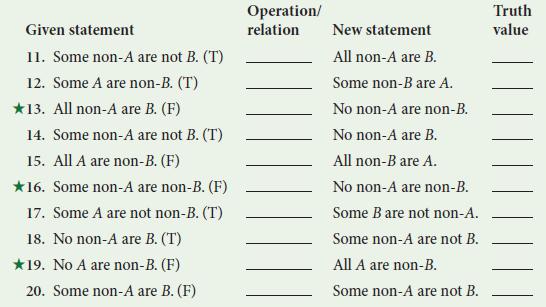
Exercises 11 through 20 provide a statement, its truth value in parentheses, and a new statement. Determine how the new statement was derived from the given statement and supply the truth value of the new statement. Take the Aristotelian standpoint in working these exercises and assume that the
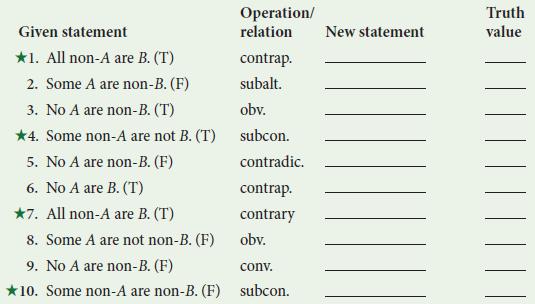
Exercises 1 through 10 provide a statement, its truth value in parentheses, and an operation to be performed on that statement. Supply the new statement and the truth value of the new statement. Operation/ Truth Given statement 1. All non-A are B. (T) 2. Some A are non-B. (F) relation New statement
Use the traditional square of opposition to determine whether the following immediate inferences are valid or invalid and sound or unsound. Name any fallacies that are committed.★1. All dolphins are polar bears.Therefore, it is false that no dolphins are polar bears.2. It is false that some
Use the traditional square of opposition to determine whether the following immediate inferences are valid or invalid. Name any fallacies that are committed.★1. All advocates of school prayer are individuals who insist on imposing their views on others.Therefore, some advocates of school prayer
Use the traditional square of opposition to find the answers to these problems.When a statement is given as false, simply enter an “F” into the square of opposition and compute (if possible) the other truth values.★1. If “All fashion fads are products of commercial brainwashing” is true,
Use conversion, obversion, and contraposition to determine whether the following arguments are valid or invalid. For those that are invalid, name the fallacy committed.★1. All commodity traders are gamblers who risk sudden disaster.Therefore, all gamblers who risk sudden disaster are commodity
Perform the operations of conversion, obversion, and contraposition as indicated.1. Convert the following propositions and state whether the converse is logically equivalent or not logically equivalent to the given proposition.★a. All hurricanes are storms intensified by global warming.b. No
Exercises 7 through 12 provide a statement, its truth value in parentheses, and a new statement. Determine how the new statement was derived from the given statement and supply the truth value of the new statement. (Hint: For number 7, first compare the terms in the given statement with the terms
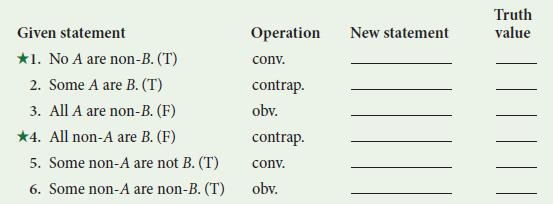
Exercises 1 through 6 provide a statement, its truth value in parentheses, and an operation to be performed on that statement. Supply the new statement and the truth value of the new statement. (Hint: For number 1, first obtain the converse of“No A are non-B”; then, since the given statement is
Use the modern square of opposition to determine whether the following immediate inferences are valid or invalid from the Boolean standpoint.★1. No sculptures by Rodin are boring creations.Therefore, all sculptures by Rodin are boring creations.2. It is false that some lunar craters are volcanic
Draw Venn diagrams for the following propositions.★1. No life decisions are happenings based solely on logic.2. All electric motors are machines that depend on magnetism.3. Some political campaigns are mere attempts to discredit opponents.★4. Some rock-music lovers are not fans of Madonna.5.
Change both the quality and the quantity of the following statements:★1. All oil spills are events catastrophic to the environment.2. No alcoholics are people with a healthy diet.3. Some Mexican vacations are episodes that end with gastrointestinal distress.★4. Some corporate lawyers are not
Change the quantity but not the quality of the following statements:★1. All owners of pit bull terriers are people who can expect expensive lawsuits.2. No tax proposals that favor the rich are fair proposals.3. Some grade-school administrators are people who choke the educational process.★4.
Change the quality but not the quantity of the following statements:★1. All drunk drivers are threats to others on the highway.2. No wildlife refuges are locations suitable for condominium developments.3. Some slumlords are people who eventually wind up in jail.★4. Some CIA operatives are not
For each of the following categorical propositions identify the letter name, quantity, and quality. Then state whether the subject and predicate terms are distributed or undistributed.★1. No vampire movies are films without blood.2. All governments that bargain with terrorists are governments
In the following categorical propositions identify the quantifier, subject term, copula, and predicate term.★1. Some executive-pay packages are insults to ordinary workers.2. No stressful jobs are occupations conducive to a healthy lifestyle.3. All oil-based paints are products that contribute to
Turn to the editorial pages of a newspaper or the letters column of a magazine and find an instance of a fallacious argument in the editorials or letters to the editor.Identify the premises and conclusion of the argument and write an analysis at least one paragraph in length identifying the fallacy
Most of the following selections were taken from letters-to-the-editors columns of newspapers and magazines. Identify any fallacies that may be committed, giving a brief explanation for your answer. Then, if a fallacy is identified, discuss the possible factors that led the arguer to commit the
Identify the fallacies committed in the following dialogue. You should be able to find at least one case of each fallacy presented in this section and a few of the fallacies presented in the two previous sections.Personal Paper Mill Carly catches sight of Brad as the two head for their class in
Identify the fallacies of relevance, weak induction, presumption, ambiguity, and illicit transference committed by the following arguments, giving a brief explanation for your answer. If no fallacy is committed, write “no fallacy.”★1. In his History of the American Civil War, Jeffry Noland
Answer “true” or “false” to the following statements:1. Arguments that commit the fallacy of begging the question are normally valid.2. The effect of begging the question is to hide the fact that a premise may not be true.3. The correct way of responding to a complex question is to divide
Identify the fallacies of presumption, ambiguity, and illicit transference committed by the following arguments, giving a brief explanation for your answer. If no fallacy is committed, write “no fallacy.”★1. Either we require forced sterilization of Third World peoples or the world population
Identify the fallacies committed in the following dialogue. You should be able to find at least one case of each fallacy presented in this section and one case of a fallacy presented in the previous section.Gun Love Holly and her friend Ben have just attended a panel discussion in response to a
Identify the fallacies of relevance and weak induction committed by the following arguments. If no fallacy is committed, write “no fallacy.”★1. On our first date, George had his hands all over me, and I found it nearly impossible to keep him in his place. A week ago Tom gave me that stupid
Answer “true” or “false” to the following statements:1. If an arguer cites a statement by a recognized expert in support of a conclusion and the statement falls within the expert’s range of expertise, then the arguer commits an appeal to unqualified authority.2. If an arguer cites a
Identify the fallacies of weak induction committed by the following arguments, giving a brief explanation for your answer. If no fallacy is committed, write “no fallacy.”★1. The Daily News carried an article this morning about three local teenagers who were arrested on charges of drug
Identify the fallacies committed in the following dialogue. You should be able to find at least one case of each fallacy presented in this section.Food for Thought“Let’s hit the produce section first,” Curtis says to his fiancée Talia, as they enter Payless grocery store.“Okay,” she
Answer “true” or “false” to the following statements:1. In the appeal to force, the arguer physically attacks the listener.2. In the direct variety of the appeal to the people, the arguer attempts to create a kind of mob mentality.3. If an arguer attempts to discredit court room testimony
Identify the fallacies of relevance committed by the following arguments, giving a brief explanation for your answer. If no fallacy is committed, write “no fallacy.”★1. The position open in the accounting department should be given to Frank Thompson. Frank has six hungry children to feed, and
Determine whether the fallacies committed by the following arguments are formal fallacies or informal fallacies.★1. If Rasputin was really mad, then he deceived Czar Nicholas II. Rasputin was not really mad. Therefore, he did not deceive Czar Nicholas II.2. Everything that runs has feet. The
Criticize the following definitions in light of the eight rules for lexical definitions:★1. A sculpture is a three-dimensional image made of marble.2. “Elusory” means elusive.3. “Birdie” means sinking the ball in one stroke under par.★4. A cynic is a person who knows the price of
Answer “true” or “false” to the following statements:1. The technique of extensional definition may be used to produce precising definitions.2. The technique of extensional definition may be used to produce stipulative and lexical definitions.3. Most extensional definitions convey the
The following exercises involve constructing definitions:1. Construct a partial enumerative definition for the following terms by naming three members of the class the term denotes. Then find a nonsynonymous term that these members serve equally well to define. Example: “Poet” means a person
Determine whether the following are demonstrative definitions, enumerative definitions, definitions by subclass, synonymous definitions, etymological definitions, operational definitions, or definitions by genus and difference.★1. “Plant” means something such as a tree, a flower, a vine, or a
Showing 100 - 200
of 2473
1
2
3
4
5
6
7
8
9
10
11
12
13
14
15
Last
Step by Step Answers

 Get 50% OFF
Claim Now
Get 50% OFF
Claim Now