New Semester
Started
Get
50% OFF
Study Help!
--h --m --s
Claim Now
Question Answers
Textbooks
Find textbooks, questions and answers
Oops, something went wrong!
Change your search query and then try again
S
Books
FREE
Study Help
Expert Questions
Accounting
General Management
Mathematics
Finance
Organizational Behaviour
Law
Physics
Operating System
Management Leadership
Sociology
Programming
Marketing
Database
Computer Network
Economics
Textbooks Solutions
Accounting
Managerial Accounting
Management Leadership
Cost Accounting
Statistics
Business Law
Corporate Finance
Finance
Economics
Auditing
Tutors
Online Tutors
Find a Tutor
Hire a Tutor
Become a Tutor
AI Tutor
AI Study Planner
NEW
Sell Books
Search
Search
Sign In
Register
study help
business
macroeconomics
Macroeconomics 15th Edition Christopher T S Ragan - Solutions
As we saw in the text, the expenditure approach to measuring GDP shows thata. Is this equation a causal relationship, suggesting that an increase in any one of the right-hand-side terms causes an increase in GDP?b. It is common to hear commentators suggest that an increase in imports reduces
A company's wages and salaries are part of its value added. Suppose, however, that the cleaning and machinery maintenance that its own employees used to do are now contracted out to specialist firms who come in to do the same work more cheaply.a. What happens to the company's value added when it
For each of the following events, describe the likely effect on real GDP in Canada.a. A major ice storm in Quebec damages homes and thus increases the demand for building materials.b. A flood on the Red River destroys the annual barley crop on hundreds of thousands of acres of Manitoba farmland.c.
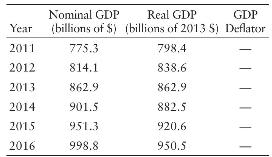
The table below shows data for real and nominal GDP for a hypothetical economy over several years.a. Compute the GDP deflator for each year.b. Compute the total percentage change in nominal GDP from 201 1 to 201 6. How much of this change was due to increases in prices and how much was due to
Would inflation, as measured by the rate of change in the GDP deflator, ever be different from inflation as measured by the rate of change in the Consumer Price Index? Would it ever be the same? Explain.
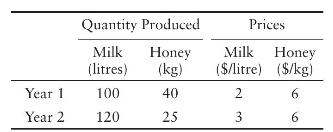
Consider the following data for a hypothetical economy that produces two goods, milk and honey.a. Compute nominal GDP for each year in this economy.b. Using year 1 as the base year, compute real GDP for each year. What is the percentage change in real GDP from year 1 to year 2 ?c. Using year 1 as
In 201 4, the United Nations ranked Norway first on the Human Development Index-a ranking of the "quality of life" in many countries. Yet Norway was not ranked first in terms of real per capita GDP. Explain how the two rankings can be different.
Fill in the blanks to make the following statements correct.a. The equation for actual national income from the expenditure side is written as GDP = __________ .b. The equation for desired aggregate expenditure is written as AE = ___________ .c. National income accounts measure expenditures in four
Fill in the blanks to make the following statements correct.a. If actual national income is $200 billion and desired aggregate expenditure is $180 billion, inventories may begin to ________ , firms will ________ the level of output, and national income will ___________ .b. If actual national income
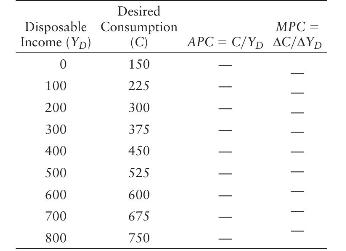
Consider the following table showing aggregate consumption expenditures and disposable income. All values are expressed in billions of constant dollars.a. Compute the average propensity to consume for each level of income and fill in the table.b. Compute the marginal propensity to consume for each
This question relates to desired saving, and is based on the table in Question 3 .a. Compute desired saving at each level of disposable income. Plot the saving function on a scale diagram. What is its slope?b. Show algebraically that the average propensity to save plus the average propensity to
Relate the following newspaper headlines to shifts in the \(C, S, I\), and \(A E\) functions and to changes in equilibrium national income.a. "Revival of consumer confidence leads to increased spending."b. "High mortgage rates discourage new house purchases."c. "Concern over future leads to a
In the chapter we explained the difference between desired expenditures and actual expenditures.a. Is national income accounting based on desired or actual expenditures? Explain.b. Suppose there were a sudden decrease in desired consumption expenditure. Explain why this would likely be followed by
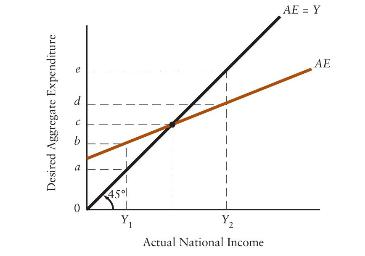
Consider the following diagram of the \(A E\) function and the \(45^{\circ}\) line.a. Suppose the level of actual national income is \(Y_{1}\). What is the level of desired aggregate expenditure? Is it greater or less than actual output? Are inventories being depleted or accumulated?b. If actual
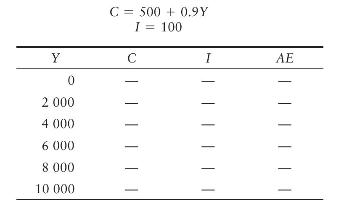
Consider a simple model like the one developed in this chapter. The following equations show the levels of desired consumption and investment:a. Complete the table above.b. What is the equilibrium level of national income in this model? Why? I AE Y 0 2 000 4 000 6.000 8.000 10 000 C 500 +0.9Y C I =
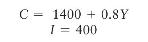
Suppose you are given the following information for an economy without government spending, exports, or imports. \(C\) is desired consumption, \(I\) is desired investment, and \(Y\) is income. \(C\) and \(I\) are given bya. What is the equation for the aggregate expenditure \((A E)\) function?b.
For each of the following aggregate expenditure \((A E)\) functions, identify the marginal propensity to spend (z) and calculate the simple multiplier.a. \(A E=150+0.4 Y\)b. \(A E=900+0.62 Y\)c. \(A E=6250+0.92 Y\)d. \(A E=457+0.57 Y\)e. \(A E=500+0.2 Y\)f. \(A E=1000+0.35 Y\)g. Explain why the
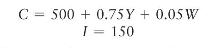
Consider an economy characterized by the following equations:where \(C\) is desired consumption, \(I\) is desired investment, \(W\) is household wealth, and \(Y\) is national income.a. Suppose wealth is constant at \(\mathrm{W}=10000\). Draw the aggregate expenditure function on a scale diagram
The "Paradox of Thrift" is a famous idea in macroeconomics-one that we will discuss in later chapters. The basic idea is that if every household in the economy tries to increase its level of desired saving, the level of national income will fall and they will end up saving no more than they were
In the simple model of this chapter, aggregate investment was assumed to be autonomous with respect to national income. The simple multiplier was \(1 /(1-z)\), where \(z\) was the marginal propensity to spend. And with autonomous investment, the marginal propensity to spend is simply the marginal
Fill in the blanks to make the following statements correct.a. In our macro model, government purchases ( G ), is __________ with respect to national income.b. G does not include ____________ . Net tax revenue ( T ), is total tax revenue collected by all governments, minus ___________ .c. The net
Fill in the blanks to make the following statements correct.a. In our macro model exports ( X ) are _________ with respect to domestic national income, but the X function will shift in response to changes in _________ and __________ .b. The marginal propensity to import ( m ), indicates the
Fill in the blanks to make the following statements correct.a. Our simple macro model in Chapters 21 and 22 has made an important assumption that the price level is ___________ . We say that output, or national income, is _____________ determined.b. The assumption that the price level ____________
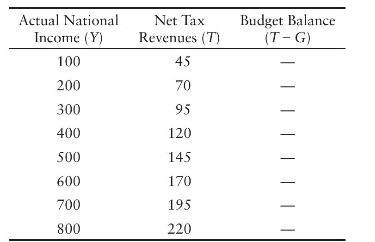
Consider the following table showing national income and government net tax revenues in billions of dollars. Assume that the level of government purchases is \(\$ 155 \) billion.a. Compute the government's budget balance for each level of national income and fill in the table.b. Suppose that net
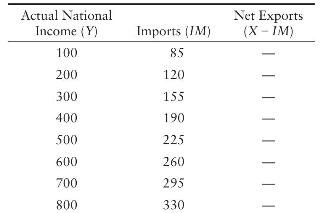
Consider the following table showing national income and imports in billions of dollars. Assume that the level of exports is \(\$ 300 \) billion.a. Compute the level of net exports for each level of national income and fill in the table.b. Plot the net export function on a scale diagram. Explain
Each of the following headlines describes an event that will have an effect on desired aggregate expenditure. What will be the effect on equilibrium national income? In each case, describe how the event would be illustrated in the \(45^{\circ}\)-line diagram.a. "Minister takes an axe to the armed
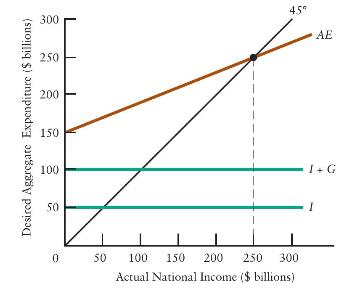
The following diagram shows desired aggregate expenditure for the economy of Sunset Island. The \(A E\) curve assumes a net tax rate \((t)\) of 10 percent, autonomous exports of \(\$ 25 \) billion, and a marginal propensity to import \((m)\) of 15 percent.a. What is the level of desired investment
The economy of Sunrise Island has the following features:- fixed price level- no foreign trade- autonomous desired investment \((I)\) of \(\$ 20 \) billion- autonomous government purchases \((G)\) of \(\$ 30 \) billion- autonomous desired consumption (C) of \$15 billion- marginal propensity to
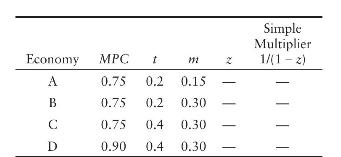
The following table shows alternative hypothetical economies and the relevant values for the marginal propensity to consume out of disposable income (MPC), the net tax rate \((t)\), and the marginal propensity to import, \(m\).a. Recall that \(z\), the marginal propensity to spend out of national
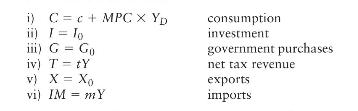
This question requires you to solve a macro model algebraically. Reading the appendix to this chapter will help you to answer this question. But, just in case, we lead you through it step by step. The equations for the model are as follows:a. Step 1 : Recall that \(Y_{D}=Y-T\). By using this fact,
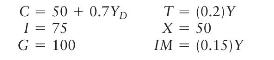
This question repeats the exercise of Question 10 , but for specific numerical values. The equations of the model area. Compute the \(A E\) function and plot it in a diagram. What is total autonomous expenditure?b. What is the slope of the \(A E\) function?c. Compute the equilibrium level of
For the 200 9 and 201 0 Canadian federal budgets, during a major global recession, the minister of finance presented a plan to stimulate the economy.a. Describe the basic fiscal tools at his disposal.b. Using the model from this chapter, explain the effect on GDP from an increase in \(G\) by \(\$ 5
Classify each of the following government activities as either government purchases or transfers.a. Welfare payments for the poorb. Payments to teachers in public schoolsc. Payments to teachers at a military colleged. Payments to hospitals and physicianse. Public vaccination programs
In Chapter 20 we examined how national income was measured. By using the expenditure approach, we showed that GDP is always equal to the sum of consumption, investment, government purchases, and net exports. In Chapters 21 and 22 we examined the determination of national income. We showed that
Fill in the blanks to make the following statements correct.a. In the simple macro model of the previous two chapters, the price level was _______ to the model. In the macro model of this chapter, the price level is _______ to the model.b. A change in the price level shifts the \(A E\) curve
Fill in the blanks to make the following statements correct.a. The __________ curve relates the price level to the quantity of output that firms would like to produce and sell.b. Each aggregate supply curve is drawn under the assumption that _______ and _______ remain constant.c. The aggregate
Fill in the blanks to make the following statements correct.a. Macroeconomic equilibrium occurs at the intersection of and rium levels of _______and _______ and determines equilibrium levels of _________ and ___________. b. If the \(A S\) curve is upward sloping, a positive \(A D\) shock will
Consider the effects of an exogenous increase in the domestic price level. For each of the assets listed, explain how the change in the price level would affect the wealth of the asset holder. Then explain the effect on aggregate (private sector) wealth. The footnote on page 535 will help to answer
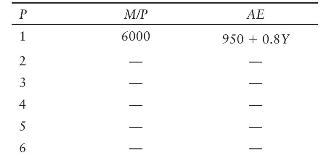
Consider the following simplified \(A E\) function:where \(A E\) is desired aggregate expenditure, \(Y\) is real GDP, \(M\) is the private sector's nominal wealth, and \(P\) is the price level. Suppose that \(M\) is constant and equal to 600 0.a. Fill in the table below:b. Plot each of the \(A E\)
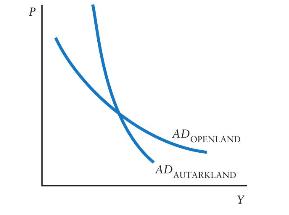
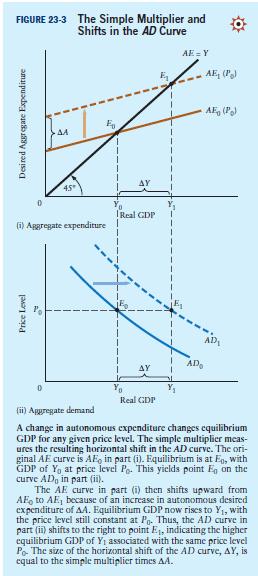
Consider the following diagram showing the \(A D\) curves in two different economies. One economy is Autarkland - it does not trade with the rest of the world (autarky is a situation in which a country does not trade with other countries). The other economy is Openland-it exports to and imports
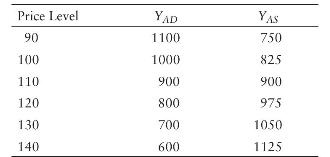
The economy of Neverland has the following \(A D\) and \(A S\) schedules. Denote \(\mathrm{Y}_{A D}\) as the level of real GDP along the \(A D\) curve; let \(\mathrm{Y}_{A S}\) be the level of real GDP along the \(A S\) curve. GDP is shown in billions of 200 2 dollars.a. Plot the \(A D\) and \(A
Each of the following events caused a shift in the \(A D\) or \(A S\) curve in Canada. Identify which curve was affected and describe the effect on equilibrium real GDP and the price level.a. OPEC's actions to restrict oil output significantly increased the world price of oil in 197 9-1980.b. World
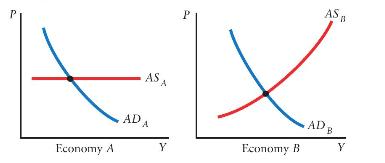
The following diagrams show the \(A D\) and \(A S\) curves in two different economies.a. Explain what aspect of firms' behaviour might give rise to the horizontal \(A S\) curve in Economy \(A\).b. Explain what aspect of firms' behaviour gives rise to the upward-sloping \(A S\) curve in Economy
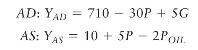
This question involves algebraically solving the system of two equations given by the \(A D\) and \(A S\) curves. The equations for the curves are given bya. Explain the various terms in the \(A D\) curve. Explain why \(G\) enters positively.b. What is the value of the simple multiplier? (Hint:
Fill in the blanks to make the following statements correct.a. In our short-run macro model, it is assumed that factor prices are ________ and the level of potential output is ________ Changes in real GDP are caused by fluctuations in _______ and ________b. During the adjustment process highlighted
Fill in the blanks to make the following statements correct.a. When actual GDP is higher than potential GDP, we say that there is \(a(n)\)________ gap. When actual GDP is less than potential GDP we say there is a(n) _________ gap.b. An inflationary gap leads to excess demand for labour, which
Fill in the blanks to make the following statements correct.a. Beginning with output equal to potential, suppose there is a sudden increase in demand for Canadian exports. This is a(n) __________ shock to the Canadian economy, which will result in the __________ curve shifting to the ________ and
Fill in the blanks to make the following statements correct.a. In the long run, total output is determined only by __________. In the long run, aggregate demanddetermines the __________ .b. Permanent increases in real GDP are possible only if __________ is increasing.c. Suppose illiteracy in
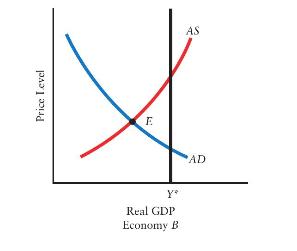
The following diagram shows two economies, \(A\) and \(B\). Each are in short-run equilibrium at point \(E\), where the \(A D\) and \(A S\) curves intersect.a. Explain why in Economy \(A\) wages and other factor prices will begin to rise, and why this will increase firms' unit costs.b. Following
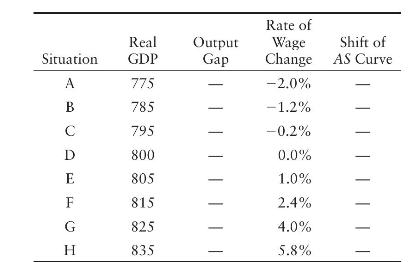
The table shows several possible situations for the economy in terms of output gaps and the rate of change of wages. Real GDP is measured in billions of dollars. Assume that potential output is \(\$ 800 \) billion.a. Compute the output gap \(\left(Y-Y^{*}ight)\) for each situation and fill in the
Consider an economy that is in equilibrium with output equal to \(Y^{*}\). There is then a significant reduction in the world's demand for this country's goods.a. Illustrate the initial equilibrium in a diagram.b. What kind of shock occurred-aggregate demand or aggregate supply? Show the effects of
Consider an economy that is in equilibrium with output equal to \(Y^{*}\). There is then a significant reduction in the world price of an important raw material, such as iron ore. (Assume that this country produces no iron ore domestically.)a. Illustrate the initial equilibrium in a diagram.b. What
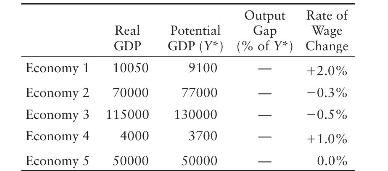
The table below shows hypothetical data for five economies. Real GDP is measured in millions of dollars.a. Fill in the missing data. Which economies have an inflationary gap? Which have a recessionary gap?b. Which economies likely have the most unused capacity? Explain.c. In which economies are
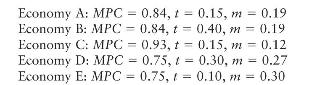
Consider the following sets of values for MPC, \(t\), and \(m\), and recall that the simple multiplier is given by \(1 /\) \([1-M P C(1-t)-m]\). Assume the \(A S\) curve is upward sloping and identical in each economy.a. For each economy, calculate the simple multiplier.b. Which economy would
In our discussion of automatic fiscal stabilizers, we argued that income taxes and transfers increased the stability of real GDP in the face of \(A D\) and \(A S\) shocks. Recall from Chapter 22 that the simple multiplier is given by \(1 /[1-M P C(1-t)-m]\).a. Explain how the size of the simple
Which of the following would be automatic stabilizers? Explain why.a. Employment-insurance paymentsb. Cost-of-living escalators in government contracts and pensionsc. Income taxesd. Free university tuition for unemployed workers after six months of unemployment, provided that they are under 30
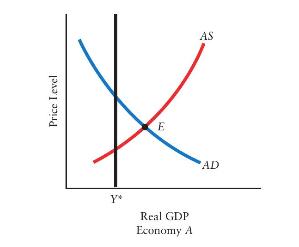
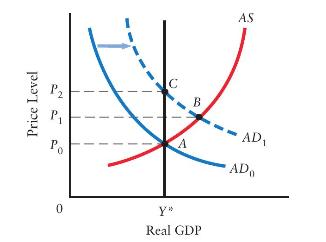
The following diagram shows the \(A D, A S\), and \(Y *\) curves for an economy. Suppose the economy begins at point \(A\). Then the government increases its level of purchases \((G)\).a. Describe the short-run effects of this fiscal expansion.b. Describe the adjustment process, and the new longrun
Between 200 6 and 201 2, the Canadian government reduced both personal and corporate income taxes. Is this a demand-side or a supply-side policy? Explain.
Fill in the blanks to make the following statements correct.a. Long-run, sustained increases in potential output are called .b. Increases in material living standards occur with increases in real __________ .c. An important cost of economic growth is the sacrifice of current __________ in exchange
In this chapter, we developed a theory of the market for financial capital. Using that theory, fill in the blanks to make the following statements correct.a. An increase in the real interest rate leads to a(n) ___________in the amount of national saving as households reduce their ____________ .b.
Fill in the blanks to make the following statements correct.a. An important aspect of Neoclassical growth theory is that increases in the supply of one factor, all else held constant, imply eventually _________ marginal returns to that factor.b. In Neoclassical growth theory, an increase in the
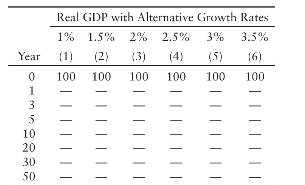
In the text we said that, over many years, small differences in growth rates can have large effects on the level of income. This question will help you understand this important point. Consider an initial value of real GDP equal to \(Y_{0}\). If real GDP grows at a rate of \(g\) percent annually,
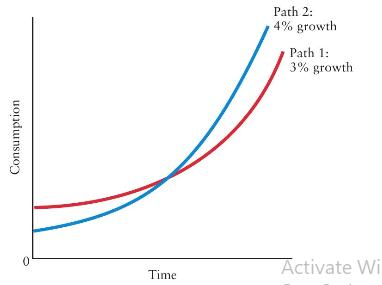
The diagram below shows two paths for aggregate consumption. One grows at a rate of 3 percent per year; the other grows at 4 percent per year but begins at a lower level.a. Suppose the economy jumps from Path 1 to Path 2 in Year 0 because its rate of capital accumulation increases. What is the
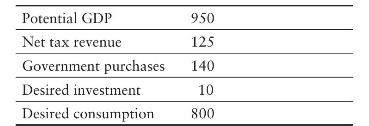
The table below shows aggregate values for a hypothetical economy. Real GDP is equal to potential GDP. Figures are billions of dollars.a. What is the level of private saving?b. What is the level of public saving?c. What is the level of national saving?d. Is the interest rate at its equilibrium
Consider an economy in the long run with real GDP equal to the level of potential output, \(Y^{*}\).a. Draw the diagram of the market for financial capital. Explain the slopes of the investment demand curve and the national saving curve.b. Suppose the government pursued a fiscal contraction by
Consider the market for financial capital and the relationship among saving, investment, and the interest rate. In what follows, assume that the economy is in a long-run equilibrium with \(Y=Y^{*}\).a. Suppose the government wants to encourage national saving. How could it do this, and what would
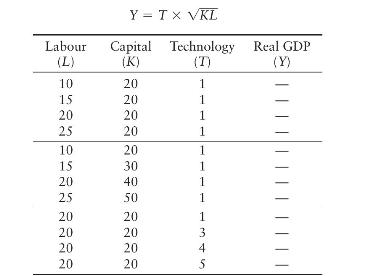
The Neoclassical growth theory is based on the existence of an aggregate production function-showing the relationship between labour \((L)\), capital \((K)\), technology \((T)\), and real GDP \((Y)\). The table below shows various values for \(L, K\), and \(T\). In all cases, the aggregate
In this chapter we discussed four major determinants of growth in real output: increases in the labour force, increases in the stock of physical capital, increases in human capital, and improvements in technology.a. For each of the four determinants, give an example of a government policy that is
In the early 197 0s the Club of Rome, extrapolating from the rates of resource use at the time, predicted that the supply of natural resources (especially oil) would be used up within a few decades. Subsequent events appear to have proven them wrong.a. What is predicted to happen to the price of
Dr. David Suzuki, an opponent of further economic growth, has argued that despite the fact that "in the twentieth century the list of scientific and technological achievements has been absolutely dazzling, the costs of such progress are so large that negative economic growth may be right for the
Fill in the blanks to make the following statements correct.a. Money serves three functions: __________,________and _________.b. Suppose children at a summer camp are each given a credit of \(\$ 20 \) at the snack shop, where purchases are recorded but no cash is exchanged. This is an example of
Fill in the blanks to make the following statements correct. Answer these questions in the sequence given.a. Suppose the Bank of Canada purchases a \(\$ 100 0\) bond from Bob's Financial Firm, and Bob's deposits its cheque at the CIBC. This is \(\mathrm{a}(\mathrm{n})\) ________ deposit to the
Which of the following items can be considered money in the Canadian economy? Explain your answers by discussing the three functions of money-medium of exchange, store of value, and unit of account.a. A Canadian \(\$ 100 \) billb. A Visa credit cardc. A well-known painting by Robert Batemand. The
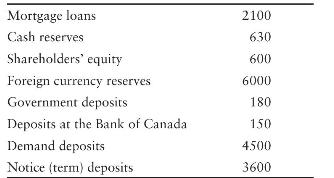
Sunshine Bank has the following list of entries on its balance sheet. All figures are in millions of dollars.a. Draw the balance sheet for Sunshine Bank and record the entries appropriately in the asset or liability column.b. What are total assets and liabilities for this commercial bank?c. What is
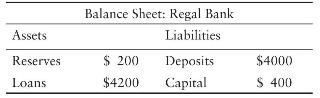
The table below shows the balance sheet for the Regal Bank, a hypothetical commercial bank. Assume that the Regal Bank has achieved its target reserve ratio.a. What is the Regal Bank's target reserve ratio?b. What is the value of the owners' investment in the bank?c. Suppose someone makes a new
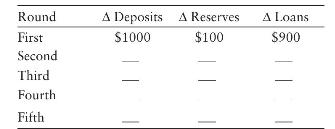
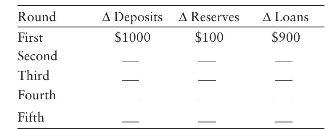
Consider a new deposit to the Canadian banking system of \(\$ 100 0\). Suppose that all commercial banks have a target reserve ratio of 10 percent and there is no cash drain. The following table shows how deposits, reserves, and loans change as the new deposit permits the banks to "create" money.a.
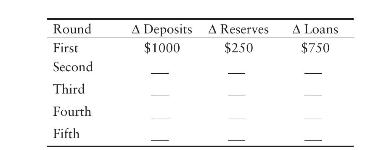
Consider a withdrawal of \(\$ 500 0\) from the Canadian banking system. Suppose all commercial banks have a target reserve ratio of 8 percent and there is no cash drain.a. Using a table like that shown in the previous question, show the change in deposits, reserves, and loans for the first three
Consider an individual who immigrates to Canada and deposits \(\$ 300 0\) in Canadian currency into the Canadian banking system. Suppose all commercial banks have a target reserve ratio of 10 percent and individuals choose to hold cash equal to 10 percent of their bank deposits.a. In the text, we
Consider an individual who moves to Canada and brings with him \(\$ 400 00\) in Canadian currency, which he deposits in a Canadian bank. For each of the cases below, compute the overall change in deposits and reserves in the Canadian banking system as a result of this new deposit.a. 10 percent
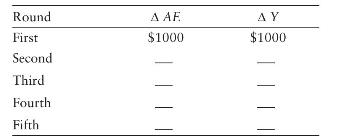
This question is intended to illustrate the similarity between the simple income-expenditure multiplier from Chapters 21 and 22 and the deposit multiplier that we examined in this chapter.a. Recalling the macro model of Chapters 21 and 22 , suppose the marginal propensity to spend out of GDP,
Suppose that on January 1 , 201 1, a household had \(\$ 300 \) 000 , which it wanted to hold for use one year later. Calculate, by using resources available online or in your university library, which of the following would have been the best store of value over that period.a. The (Canadian)
During 201 1, after the worst of the global financial crisis was over, the governor of the Bank of Canada expressed concern that the commercial banks were still "hoarding" cash rather than extending a more appropriate volume of loans. Why might the banks do this, and what is the implication for the
Fill in the blanks to make the following statements correctly reflect the theory developed in this chapter.a. Monetary equilibrium occurs when the quantity of _________ equals the quantity of _______ Monetary equilibrium determines theb. When there is an excess supply of money, households and firms
Fill in the blanks to make the following statements correctly reflect the theory developed in this chapter.a. If money is neutral in the long run, then changes in the money supply have no effect on __________ in the long run.b. If the demand for money is not very sensitive to changes in the
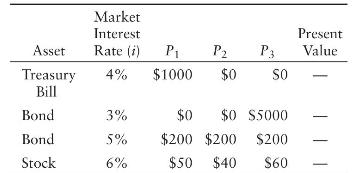
The following table shows the stream of income produced by several different assets. In each case, \(P_{1}, P_{2}\), and \(P_{3}\) are the payments made by the asset in Years 1 , 2 , and 3 .a. For each asset, compute the asset's present value. (Note that the market interest rate, \(i\), is not the
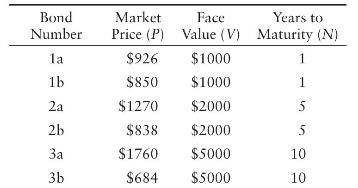
The table below provides information for six different bonds: current market price \((P)\), the face value of the bond \((V)\), and the number of years before the bond matures \((N)\).a. In each case, compute the bond's yield, assuming that you buy the bond at its current market price and hold the
Consider a bond that promises to make coupon payments of \(\$ 100 \) one year from now and \(\$ 100 \) two years from now, and to repay the principal of \(\$ 100 0\) three years from now. Suppose also that the market interest rate is 8 percent per year, and that no perceived risk is associated with
What motives for holding money-transactions, precautionary, or speculative-do you think explain the following holdings? Explain.a. Currency in the cash register of the local grocery store at the start of each working day.b. Money to meet Queen's University's biweekly payroll deposited in the local
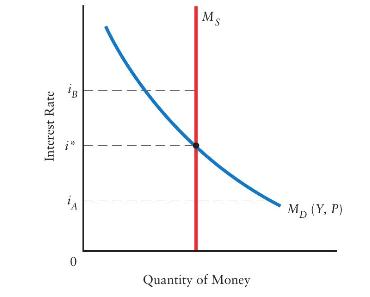
The diagram below shows the demand for money and the supply of money.a. Explain why the \(M_{D}\) function is downward sloping.b. Suppose the interest rate is at \(i_{A}\). Explain how firms and households attempt to satisfy their excess demand for money. What is the effect of their actions?c.
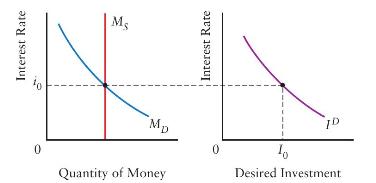
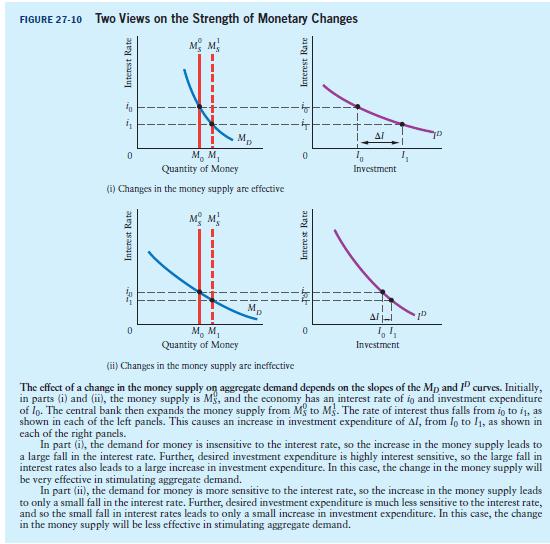
The following diagrams show the determination of monetary equilibrium and the demand for investment. The economy begins with money supply \(M_{S}\), money demand \(M_{D}\), and investment demand \(I^{D}\). The interest rate is \(i_{0}\) and desired investment is \(I_{0}\).a. Beginning at the
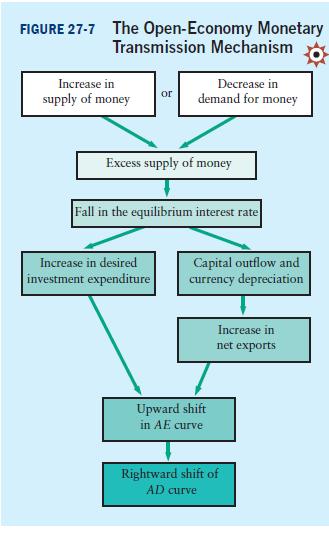
In the text we discussed why, in an open economy with international capital mobility, there is a second part to the monetary transmission mechanism. (It may be useful to review Figure 27 -7 when answering this question.)a. Explain why an increase in Canada's money supply makes investors shift their
In the text we discussed the historical debate between Keynesians and Monetarists regarding the effectiveness of monetary policy in changing real GDP (see Figure 27 -10 to review). Using the same sort of diagram, discuss two conditions in which a change in the money supply would have no short-run
In 200 8, stock markets in Canada and other developed countries experienced very large declines, largely in response to the failure of several large U.S. and European banks and the resulting disruption in global financial markets.a. Explain how such stock-market declines affect wealth and thus are
Consider the effects of events in the U.S. economy on the Canadian economy and on Canadian monetary policy.a. If a serious recession begins in the United States, what is the likely effect on Canadian aggregate demand? Explain.b. If Canadian real GDP was equal to \(Y^{*}\) before the U.S. recession
Fill in the blanks to make the following statements correct.a. In general, there are two approaches to implementing monetary policy. The central bank can attempt to influence __________ directly or to influence ____________ directly.b. The Bank of Canada chooses to implement its monetary policy by
Fill in the blanks to make the following statements correct.a. The interest rate that commercial banks charge each other for overnight loans is called the _____________b. The bank rate is __________ points above the target overnight interest rate. At this interest rate, the Bank stands ready to
Fill in the blanks to make the following statements correct.a. The long-run policy target for the Bank of Canada is the _______________. The current target is to keep the inflation rate at ____________ present . b. In the short run, the Bank of Canada closely monitors the __________.c. The
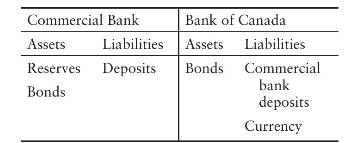
Read Applying Economic Concepts 28 -1, which discusses the Bank of Canada's open-market operations and how these influence the amount of currency in circulation in the Canadian economy. Using simplified balance sheets like the ones shown below, suppose that a commercial bank uses \(\$ 100 000\) of
In the text we stated that the Bank of Canada's longrun policy target is the rate of inflation.a. What observations have led many central banks to choose this long-run policy target?b. The Bank of Canada closely monitors the level of real GDP and the output gap in the short run. How does it use
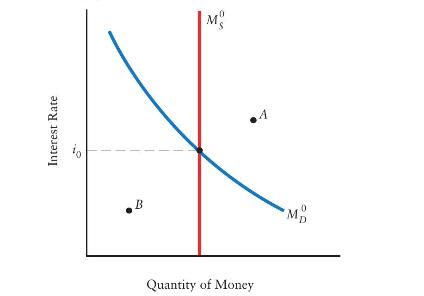
The diagram below shows the demand for money and the supply of money.a. Given the position of the \(M_{D}\) curve, explain why it is not possible for the Bank of Canada to set the money supply and the interest rate at point \(A\) or at point \(B\).b. In the diagram, draw a new money demand curve,
Showing 5000 - 5100
of 7318
First
44
45
46
47
48
49
50
51
52
53
54
55
56
57
58
Last
Step by Step Answers

 Get 50% OFF
Claim Now
Get 50% OFF
Claim Now