New Semester
Started
Get
50% OFF
Study Help!
--h --m --s
Claim Now
Question Answers
Textbooks
Find textbooks, questions and answers
Oops, something went wrong!
Change your search query and then try again
S
Books
FREE
Study Help
Expert Questions
Accounting
General Management
Mathematics
Finance
Organizational Behaviour
Law
Physics
Operating System
Management Leadership
Sociology
Programming
Marketing
Database
Computer Network
Economics
Textbooks Solutions
Accounting
Managerial Accounting
Management Leadership
Cost Accounting
Statistics
Business Law
Corporate Finance
Finance
Economics
Auditing
Tutors
Online Tutors
Find a Tutor
Hire a Tutor
Become a Tutor
AI Tutor
AI Study Planner
NEW
Sell Books
Search
Search
Sign In
Register
study help
business
management and artificial intelligence
Artificial Intelligence A Modern Approach 1st Edition Stuart Russell, Peter Norvig - Solutions
19.5 Implement a data structure for layered, feed-forward neural networks, remembering to provide the information needed for both forward evaluation and backward propagation. Using this data structure, write a function NEURAL-NETWORK-OUTPUT that takes an example and a network and computes the
19.4 Considerthe following set of examples. Each example has six inputs and one target output:/Ih hh Is/6 T1 1 0 0 1 1 0 1 0 0 0 0 1 1 1010101 11 0011 11 11100 11 1 0 0 0 0 0 0 1 1 1 0 1 0 011 10 11 01101 10 00 0110 00 1010 10 00 010 10 0 0 1 1 1 1 0 1 1 0 1 0 0 0a. Run the perceptron learning rule
19.2 We know that a simple perceptron cannot represent XOR (or, generally, the parity function of its inputs). Describe what happens to the weights of a four-input, step-function perceptron, beginning with all weights set to 0.1, as examples of the parity function arrive.
19.1 Construct by hand a neural network that computes the XOR function of two inputs. Make sure to specify what sort of units you are using.
18.14 We have shown how a learning element can improve the performance element. What if we wanted to improve the learning element (or the critic or the problem generator)? Give some examples of this kind of improvement in the taxi domain. Is it possible to represent this kind of learning with our
18.13 In this ^exercise, we will consider the expressiveness of decision lists, as defined in Section 18.6.a. Show that if the tests can be of any size, decision lists can represent any Boolean function.b. Show that if the tests can contain at most k literals each, then decision lists can represent
18.10 Modify DECISION-TREE-LEARNING to include x2-pruning. You may wish to consult Quinlan (1986) for details.
18.9 Suppose that an attribute splits the set of examples E into subsets £,, and that each subset has pi positive examples and «, negative examples. Show that unless the ratio />//(/?,• + «,) is the same for all /, the attribute has strictly positive information gain.
18.8 Suppose that a learning algorithm is trying to find a consistent hypothesis when the classifications of examples are actually being generated randomly. There are n Boolean attributes, and examples are drawn uniformly from the set of 2" possible examples. Calculate the number of examples
18.7 In the recursive construction of decision trees, it sometimes occurs that a mixed set of positive and negative examples remains at a leaf node, even after all the attributes have been used.Suppose that we have/) positive examples and n negative examples.a. Show that the solution used by
18.6 Look back at Exercise 3.16, which asked you to predict from a sequence of numbers(such as [1,4,9,16]) the function underlying the sequence. What techniques from this chapter are applicable to this problem? How would they allow you to do better than the problem-solving approach of Exercise 3.16?
18.5 A good "straw man" learning algorithm is as follows: create a table out of all the training examples. Determine which output occurs most often among the training examples; call it d.Then when given an input that is not in the table, just returnd. For inputs that are in the table, return the
18.4 We never test the same attribute twice along one path in a decision tree. Why not?
18.3 Draw a decision tree for the problem of deciding whether or not to move forward at a road intersection given that the light has just turned green.
18.2 Repeat Exercise 18.1 for the case of learning to play tennis (or some other competitive sport with which you are familiar). Is this supervised learning or reinforcement learning?
18.1 Consider the problem faced by an infant learning to speak and understand a language.Explain how this process fits into the general learning model, identifying each of the components of the model as appropriate.
17.5 Prove that the calculations in the prediction and estimation phases of the basic decision cycle (Equations (17.8) and (17.9)) do in fact yield the correct value for5e/(X,), given assumptions(17.5), (17.6), and (17.7).
17.4 For the environment shown in Figure 17.1, find all the threshold values for the cost of a step, such that the optimal policy changes when the threshold is crossed.
17.2 For a specific environment (which you can make up), construct a utility function on histories that is not separable. Explain how the concept of utility on states fails in this case.
17.1 For the stochastic version of the world shown in Figure 17.1, calculate which squares can be reached by the action sequence [Up,Right], and with what probabilities.
16.12 How much is a micromort worth to you? Devise a protocol to determine this.
16.11 Prove that the value of information is nonnegative, as stated in Section 16.6.
16.9 For either of the airport-siting diagrams constructed in Exercises 16.7 and 16.8, to which conditional probability table entry is the utility most sensitive, given the available evidence?
16.8 Repeat Exercise 16.7, using the action-utility representation shown in Figure 16.5.
16.7 Encode the airport-siting problem as shown in Figure 16.4, provide reasonable probabilities and utilities, and solve the problem for the case of choosing among three sites. What happens if changes in technology mean that each aircraft generates half as much noise? What if noise avoidance
16.6 Show that if X{ and X2 are preferentially independent of X3, and X2 and X3 are preferentially independent of X|, then it follows that X3 and Xi are preferentially independent of X2.
16.5 It has sometimes been suggested that lexicographic preference is a form of rational behavior that is not captured by utility theory. Lexicographic preferences rank attributes in some order X i , ..., Xn, and treat each attribute as infinitely more important than attributes later in the order.
16.4 Write a computer program to automate the process in Exercise 16.3. Try your program out on several people of different net worth and political outlook. Comment on the consistency of your results, both across individuals and within the set of choices made by a single individual.
16.3 Assess your own utility for different incremental amounts of money. Do this by running a series of preference tests between some definite amount M\ and a lottery [p,M2', (1 — p), 0].Choose different values of M\ 1 and A/2, and vary p until you are indifferent between the two choices. Plot
16.2 Tickets to the state lottery cost $1. There are two possible prizes: a $10 payoff with probability 1/50, and a $1,000,000 payoff with probability 1/2,000,000. What is the expected monetary value of a lottery ticket? When (if ever) is it rational to buy a ticket? Be precise—show an equation
15.6 Is probabilistic reasoning monotonic or nonmonotonic? Do these concepts even apply to probabilities?
14.15 Prove that the three axioms of probability are necessary for rational behavior in betting situations, as shown by de Finetti
14.14 In previous chapters, we found the technique of reiflcation useful in creating representations in first-order logic. For example, we handled change by reifying situations, and belief by reifying sentences. Suppose we try to do this for uncertain reasoning by reifying probabilities, thus
14.13 This exercise concerns Bayesian updating in the meningitis example. Starting with a patient about whom we know nothing, show how the probability of having meningitis, P(M), is updated after we find the patient has a stiff neck. Next, show how P(M) is updated again when we find the patient has
14.12 (Adapted from Pearl (1988).) Three prisoners, A, B, and C, are locked in their cells. It is common knowledge that one of them will be executed the next day and the others pardoned.Only the governor knows which one will be executed. Prisoner A asks the guard a favor: "Please ask the governor
14.11 (Adapted from Pearl (1988).) You are a witness of a night-time hit-and-run accident involving a taxi in Athens. All taxis in Athens are blue or green. You swear, under oath, that the taxi was blue. Extensive testing shows that under the dim lighting conditions, discrimination between blue and
14.10 Express the statement that X and Y are conditionally independent given Z as a constraint on the joint distribution entries for P(X, Y, Z).
14.9 This exercise investigates the way in which conditional independence relationships affect the amount of information needed for probabilistic calculations.a. Suppose we wish to calculate P(H\E\,E2), and we have no conditional independence information. Which of the following sets of numbers are
14.8 Show that the degree of belief after applying the Bayesian updating process is independent of the order in which the pieces of evidence arrive. That is, show that P(A\B, C) = P(A\C,B)using the Bayesian updating rule.
14.7 In this exercise, you will complete the normalization calculation for the meningitis example.First, make up a suitable value for P(S|->A/), and use it to calculate unnormalized values for P(M\S) and P(-iM|S) (i.e., ignoring the P(S) term in the Bayes' rule expression). Now normalize these
14.6 Show that the statement P(A,B\C) = P(A\C)P(B\C)is equivalent to the statement P(A|fi,C) = P(A|C)and also to P(fi|A,C) = P(fi|C)
14.5 It is quite often useful to consider the effect of some specific propositions in the context of some general background evidence that remains fixed, rather than in the complete absence of information. The following questions ask you to prove more general versions of the product rule and Bayes'
14.4 Would it be rational for an agent to hold the three beliefs P(A) = OA, P(B) = 0.3, and P(A V B) = 0.5? If so, what range of probabilities would be rational for the agent to hold for A A Bl Make up a table like the one in Figure 14.3 and show how it supports your argument about rationality.
14.3 After your yearly checkup, the doctor has bad news and good news. The bad news is that you tested positive for a serious disease, and that the test is 99% accurate (i.e., the probability of testing positive given that you have the disease is 0.99, as is the probability of testing negative
14.2 Consider the domain of dealing five-card poker hands from a standard deck of 52 cards, under the assumption that the dealer is fair.a. How many atomic events are there in the joint probability distribution (i.e., how many five-card hands are there)?b. What is the probability of each atomic
14.1 Show from first principles that P(A|BAA)= 1
13.6 Softbots construct and execute plans in software environments. One typical task for softbots is to find copies of technical reports that have been published at some other institution.Suppose that the softbot is given the task "Get me the most recent report by X on topic Y.Relevant actions
13.5 In this exercise, we will add nondeterminism to the environment from Exercise 13.4.a. Modify your environment so that with probability 0.1, an action fails—that is, one of the effects does not occur. Show an example of a plan not working because of an action failure.b. Modify your planning
13.4 This exercise involves the use of POP to actually fix a flat tire (in simulation).a. Build an environment simulator for the flat-tire world. Your simulator should be able to update the state of the environment according to the actions taken by the agent. The easiest way to do this is to take
13.3 Represent the actions for the flat-tire domain in the appropriate format, formulate the initial and goal state descriptions, and use the POP algorithm to solve the problem.
13.2 Discuss the application of conditional planning and replanning techniques to the vacuum world and wumpus world.
13.1 Consider how one might use a planning system to play chess.a. Write action schemata for legal moves. Make sure to include in the state description some way to indicate whose move it is. Will basic STRIPS actions suffice?b. Explain how the opponent's moves can be handled by conditional steps.c.
12.10 Some of the operations in standard programming languages can be modelled as actions that change the state of the world. For example, the assignment operation changes the contents of a memory location; the print operation changes the state of the output stream. A program consisting of these
12.9 Some domains have resources that are monotonically decreasing or increasing. For example, time is monotonically increasing, and if there is a Buy operator, but no Earn, Beg, Borrow, or Steal, then money is monotonically decreasing. Knowing this can cut the search space: if you have a partial
12.8 We said in Section 11.6 that the SELECT-SUB-GOAL part of the POP algorithm was not a backtrack point—that we can work on subgoals in any order without affecting completeness (although the choice certainly has an effect on efficiency). When we change the SELECT-SUB-GOAL part to handle
12.7 Write operators for the shopping domain that will enable the planner to achieve the goal of having three oranges by grabbing a bag, going to the store, grabbing the oranges, paying for them, and returning home. Model money as a resource. Use universal quantification in the operators, and show
12.6 Add existential quantifiers (3) to the plan language, using whatever syntax restrictions you find reasonable, and extend the planner to accommodate them.
12.5 Prove that the upward solution property always holds for approximation hierarchy planning(see page 380). You may use Tenenberg (1988) for hints.
12.4 Construct an example of the violation of the downward solution property. That is, find an abstract solution such that, when one of the steps is decomposed, the plan becomes inconsistent in that one of its threats cannot be resolved.
12.3 Give an example in the house-building domain of two abstract subplans that cannot be merged into a consistent plan without sharing steps. (Hint: Places where two physical parts of the house come together are also places where two subplans tend to interact.)
12.2 Rework the previous exercise using an approximation hierarchy. That is, assign criticality levels to each precondition of each step. How did you decide which preconditions get higher criticality levels?
12.1 Give decompositions for the Hire Builder and Obtain Permit steps in Figure 12.1, and show how the decomposed subplans connect into the overall plan.
11.9 In this exercise we will consider the monkey-and-bananas problem, in which there is a monkey in a room with some bananas hanging out of reach from the ceiling, but a box is available that will enable the monkey to reach the bananas if he climbs on it. Initially, the monkey is at A, the bananas
11.8 POP is a nondeterministic algorithm, and has a choice about which operator to add to the plan at each step and how to resolve each threat. Can you think of any domain-independent heuristics for ordering these choices that are likely to improve POP's efficiency? Will they help in Shakey's
11.7 In this exercise, we will look at planning in Shakey's world.a. Describe Shakey's six actions in situation calculus notation.b. Translate them into the STRIPS language.c. Either manually or using a partial-order planner, construct a plan for Shakey to get Box2 into Room! from the starting
11.6 The POP algorithm shown in the text is a regression planner, because it adds steps whose effects satisfy unsatisfied conditions in the plan. Progression planners add steps whose preconditions are satisfied by conditions known to be true in the plan. Modify POP so that it works as a progression
11.4 Figure 11.16 shows a blocks-world planning problem known as the Sussman anomaly.The problem was considered anomalous because the noninterleaved planners of the early 1970s could not solve it. Encode the problem using STRIPS operators, and use POP to solve it.can perform actions that affect
11.3 There are many ways to characterize planners. For each of the following dichotomies, explain what they mean, and how the choice between them affects the efficiency and completeness of a planner.a. Situation space vs. plan space.b. Progressive vs. regressivec. Refinement vs. debugging.d. Least
11.2 Let us consider a version of the milk/banana/drill shopping problem in which money is included, at least in a simple way.a. Let CC denote a credit card that the agent can use to buy any object. Modify the description!of Buy so that the agent has to have its credit card in order to buy
11.1 Define the operator schemata for the problem of putting on shoes and socks and a hat and |coat, assuming that there are no preconditions for putting on the hat and coat. Give a partial-order plan that is a solution, and show that there are 180 different linearizations of this solution.
10.9 The code repository contains a logical reasoning system whose components can be replaced by other versions. Re-implement some or all of the following components, and make sure that the resulting system works using the circuit example from Chapter 8.a. Basic data types and access functions for
10.6 Why do you think that Prolog includes no heuristics for guiding the search for a solution to the query?10.8 We wouldn't want a semantic network to contain both Age(Bill, 12) and Age(Bill, 10), but its fine if it contains both Friend(Bill, Opus) and Friend(Bill, Steve). Modify the functions in
10.5 In this exercise, we will consider the implementation of search algorithms in Prolog.Suppose that successor (X, Y) is true when state Y is a successor of state X; and that goal (X)is true when X is a goal state. Write a definition for solve (X, P ) , which means that P is a path(list of
9.10 In this exercise, you will complete the proof of the ground resolution theorem given in the chapter. The proof rests on the claim that if T is the resolution closure of a set of ground clauses S', and T does not contain the clause False, then a satisfying assignment can be constructed for S'
9.8 From "Horses are animals," it follows that "The head of a horse is the head of an animal."Demonstrate that this inference is valid by carrying out the following steps:a. Translate the premise and the conclusion into the language of first-order logic. Use three predicates: HeadOf(h,x), Horse(x),
9.7 How can resolution be used to show that a sentence isa. Valid?b. Unsatisfiable?
9.6 A popular children's riddle is "Brothers and sisters have I none, but that man's father is my father's son." Use the rules of the family domain (Chapter 7) to show who that man is. You may use any of the inference methods described in this chapter.
9.5 In this question we will use the sentences you wrote in Exercise 9.4 to answer a question using a backward-chaining algorithm.a. Draw the proof tree generated by an exhaustive backward-chaining algorithm for the query 3h Horse(h).b. What do you notice about this domain?c. How many solutions for
9.4 Write down logical representations for the following sentences, suitable for use with Generalized Modus Ponens:a. Horses, cows, and pigs are mammals.b. An offspring of a horse is a horse.c. Bluebeard is a horse.d. Bluebeard is Charlie's parent.e. Offspring and parent are inverse relations.f.
9.3 Show that the final state of the knowledge base after a series of calls to FORWARD-CHAIN is i independent of the order of the calls. Does the number of inference steps required depend on the)order in which sentences are added? Suggest a useful heuristic for choosing an order.
9.2 One might suppose that we can avoid the problem of variable conflict in unification by standardizing apart all of the sentences in the knowledge base once and for all. Show that for some sentences, this approach cannot work. (Hint: Consider a sentence, one part of which unifies with another.)
9.1 For each of the following pairs of atomic sentences, give the most general unifier, if it exists.a. P(A,B,B),P(x,y,z).b. QKy,G(A,B)),Q(G(x,x),y).c. Older(Father(y),y), Older(Father(x),John).d. Knows(Father(y),y), Knows(x,x).
8.14 Figure 8.2 shows the top levels of a hierarchy for everything. Extend it to include as many real categories as possible. A good way to do this is to cover all the things in your everyday life.This includes objects and events. Start with waking up, proceed in an orderly fashion noting
8.13 You are to create a system for advising computer science undergraduates on what courses to take over an extended period in order to satisfy the program requirements. (Use whatever requirements are appropriate for your institution.) First, decide on a vocabulary for representing all the
8.12 The exercises on buying and trading used a fairly primitive notion of ownership. For example, the buyer starts by owning the dollar bills. This picture begins to break down when, for example, one's money is in the bank, because there is no longer any specific collection of dollar bills that
8.11 Describe the event of trading something for something else. Describe buying as a kind of trading where one of the objects is a sum of money.
8.10 In this chapter, we sketched some of the properties of buying events. Provide a formal logical description of buying using event calculus.
8.9 Construct a representation for exchange rates between currencies that allows fluctuations on a daily basis.
8.8 Define the predicates Before, After, During, and Overlap using the predicate Meet and the j functions Start and End, but not the function Time or the predicate
8.7 Define the predicate Fixed, where Fixed(Location(x)) means that the location of object x is fixed over time.
8.6 This exercise concerns the relationships between event categories and the time intervals in which they occur.a. Define the predicate T(c, i) in terms of SubEvent and G .b. Explain precisely why we do not need two different notations (A and A) to describe conjunctive event categories.c. Give a
8.5 Write a set of sentences that allows one to calculate the price of an individual tomato (or other object), given the price per pound. Extend the theory to allow the price of a bag of tomatoes to be calculated.
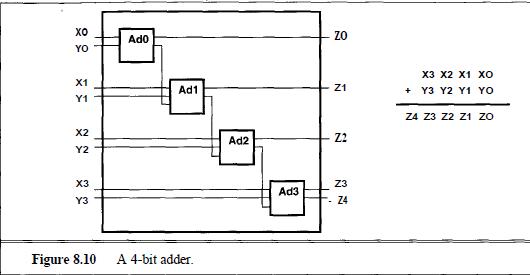
8.3 Encode the description of the 4-bit adder in Figure 8.10 and pose queries to verify that it is in fact correct.8.4 Write definitions for the following:a. ExhaustivePartDecompositionb. PartPartitionc. PartwiseDisjoint These should be analogous to those for ExhaustiveDecomposition, Partition, and
8.2 Represent the following six sentences using the representations developed in the chapter.a. Water is a liquid between 0 and 100 degrees.b. Water boils at 100 degrees.c. The water in John's water bottle is frozen.d. Perrier is a kind of water.e. John has Perrier in his water bottle.f. All
8.1 Extend the vocabulary from Section 8.3 to define addition and an adder circuit.
7.16 A reflex agent is one whose action is always a function of its percepts in the current time step. That is, the agent's action cannot be based on anything it learned in the past, and it cannot carry over any internal state information from one time step to the next. In the wumpus world, there
7.15 Sketch an argument to the effect that a logical agent using the axioms and action preferences given in the chapter will always succeed in finding the gold safely whenever there is a safe sequence of actions that does so.
7.14 How hard would it be to build a successful wumpus world agent by writing a program in your favorite programming language? Compare this to the logical reasoning agent.
7.13 Using the wumpus world simulator and the logical reasoning system in the code repository, implement a working agent for the wumpus world. You will need all of the wumpus-related axioms in the chapter, and perhaps more besides. Evaluate the performance of your agent.
7.12 In this exercise, you will extend situation calculus to allow for actions that take place simultaneously. You will use a function called Simultaneously, which takes two actions as arguments and denotes the combined action. Consider a grid world containing two agents. Write axioms describing
Showing 4300 - 4400
of 4756
First
34
35
36
37
38
39
40
41
42
43
44
45
46
47
48
Step by Step Answers

 Get 50% OFF
Claim Now
Get 50% OFF
Claim Now