New Semester
Started
Get
50% OFF
Study Help!
--h --m --s
Claim Now
Question Answers
Textbooks
Find textbooks, questions and answers
Oops, something went wrong!
Change your search query and then try again
S
Books
FREE
Study Help
Expert Questions
Accounting
General Management
Mathematics
Finance
Organizational Behaviour
Law
Physics
Operating System
Management Leadership
Sociology
Programming
Marketing
Database
Computer Network
Economics
Textbooks Solutions
Accounting
Managerial Accounting
Management Leadership
Cost Accounting
Statistics
Business Law
Corporate Finance
Finance
Economics
Auditing
Tutors
Online Tutors
Find a Tutor
Hire a Tutor
Become a Tutor
AI Tutor
AI Study Planner
NEW
Sell Books
Search
Search
Sign In
Register
study help
business
statistics for experimentert
Matrices With Applications In Statistics 2nd Edition Franklin A Graybill - Solutions
Look at figure 1, then fill in the blanks: person B is ______ and ______, while D is ______ and ______. Options: short, tall, skinny, chubby. pl875
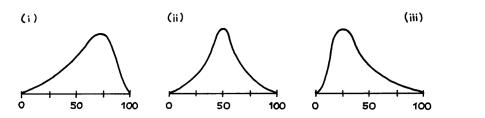
Below are sketches of histograms for three lists.(a) In scrambled order, the averages are 40, 50, 60. Match the histograms with the averages.(b) Match the histogram with the description:the median is less than the average the median is about equal to the average the median is bigger than the
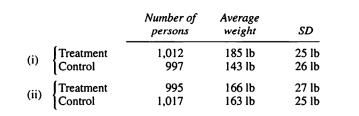
(Hypothetical). In a clinical trial, data collection usually starts at "baseline," when the subjects are recruited into the trial but before they are randomized to treatment or control. Data collection continues until the end of followup. Two clinical trials on prevention of heart attacks report
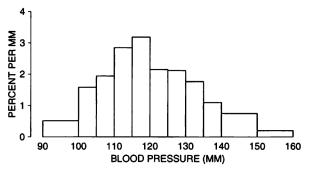
The figure below is a histogram showing the distribution of blood pressure for all 14,148 women in the Drug Study (section 5). Use the histogram to answer the following questions: (a) Is the percentage of women with blood pressures above 130 mm around 25%, 50%, or 75%? (b) Is the percentage of
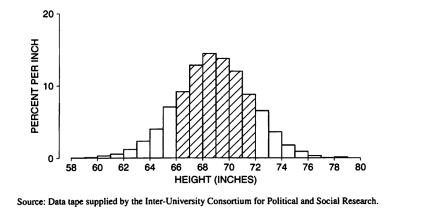
The figure below shows a histogram for the heights of a representative sample of men. The shaded area represents the percentage of men whose heights were between Fill in the blanks. and. P-968 PERCENT PER INCH 10 20 0 58 60 62 64 66 68 70 72 74 76 HEIGHT (INCHES) 78 80 Source: Data tape supplied by
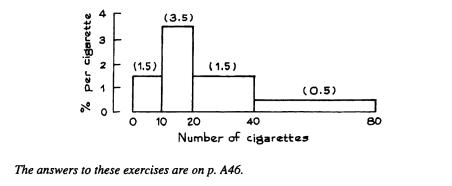
In a Public Health Service study, a histogram was plotted showing the number of cigarettes per day smoked by each subject (male current smokers), as shown below. The density is marked in parentheses. The class intervals include the right endpoint, not the left.(a) The percentage who smoked 10
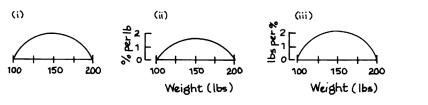
Three people plot histograms for the weights of subjects in a study, using the den- sity scale. Only one is right. Which one, and why? P-968 100 (i) 150 200 8- % per lb (i) E 100 150 200 Weight (lbs) 21 lbs per% (iii) E 100 150 200 Weight (lbs)
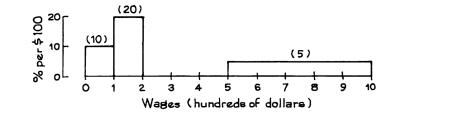
A histogram of monthly wages for part-time employees is shown below (densities are marked in parentheses). Nobody earned more than $1,000 a month. The block over the class interval from $200 to $500 is missing. How tall must it be? P-968 20 20 % per $100 10 (10) (20) (5) 2 3 4 5 6 7 8 9 10 Wages
28. Let A, B, and AB be symmetric n x n matrices aod let A and B be positive definite.Show that
27. Let A and B be n x n symmetric matrices such that ||I - xA|| ||I - yB|| =||I - xA|| ||I - yB|| for all x and y such that |x|
26. If A and B are n x n positive definite matrices and A = CC', show that∫...∫ e^(-x'C'BCx) dx₁...dxₙ = π^(n/2)|AB|^(-1/2).
25. In Prob. 23 show that the value of the integral is π^(n/2)|A + θB|^(-1/2) for all |θ| < θ₀.
24. In Prob. 23 find θ₀ as a function of the characteristic roots of A and B.
23. If A is an n x n positive definite matrix and B is a symmetric matrix, show that the integral∫...∫ e^(-x'Ax + x'Bx) dx₁...dxₙexists for all θ such that |θ| < θ₀, for a suitable positive number θ₀.
22. If x,a, and b are n x 1 vectors and A and B are n x n matrices such that A + B is nonsingular, show that(x - a)'A(x -a) + (x - b)'B(x - b)= (x - c)'(A + B)'(x -c) + (a - b)'A(A + B)'B'(a - b), where c = (A + B)'(Aa + Bb).
21. Let the n x 1 random vector x have a normal density given by Eq. (10.6.2) and let A be a symmetric n x n matrix of constants. Find the set of numbers (values of λ) such that the following expected value exists: ????[????^(λx’Ax)].
20. Let R be a positive definite n x n matrix and A be a symmetric n x n matrix.Show that, for some positive value of the real number λ, the matrix B is a positive definite matrix, where B = R - λA.
19. In Prob. 18 show that ????(yz) = 0 if and only if a'b = 0.
18. In Prob. 17 let the two scalar random variables y and z be defined by y = a'x, z = b'x, where a and b are vectors of constants. Find ????(y), ????(z), ????(yz).
17. Let the n x Irandom vector x have a normal density given by Eq. (10.6.2) with JI=0 and V = I. Find the matrix C, where C = 8(xx').
16. Let the n x 1 random vector x have a normal density with mean vector equal to zero and with covariance matrix I; that is, by Eq. (10.6.2) the density is denoted by N(x; 0, I). Show that
15. Let the n x 1 random vector x have a normal density with mean vector equal to μand covariance matrix equal to D, where D is a diagonal matrix. Show that$$8[(x - \mu)'A(x - \mu)] = \sum_{i=1}^{n} a_{ii}d_i$$where $d_i$ is the i-th diagonal element of D.
14. In Prob. 13 let Q = (x - \mu)'A(x - \mu) and show that$$8[(Q - 8(Q))^2] = 8(Q^2) - [8(Q)]^2 = 2 \text{tr} [(AV)^2].$$
13. Let the n x 1 random vector x have a normal density defined by Eq. (10.6.2).Find 8(Q) where$$Q = (x - \mu)'V(x - \mu).$$
12. Find the number K such that the function defined by$$Ke^{-(1/2)Q}$$is a normal density function where Q is defined in Prob. 11.
11. Evaluate the integral$$\int_{-\infty}^{\infty}\int_{-\infty}^{\infty}\int_{-\infty}^{\infty}\int_{-\infty}^{\infty}(x_1^2-2x_1x_4)e^{-(1/2)Q}dx_1 dx_2 dx_3 dx_4$$where$$Q = 3x_1^2 + 2x_2^2 + 2x_3^2 + x_4^2 + 2x_1x_2 + 2x_3x_4 - 6x_1 - 2x_2 - 6x_3 - 2x_4 + 8.$$
10. In Prob. 9 show that the mean vector of the density of the random vector y is B$\mu$
9. If the k x 1 vector x has a normal density and B is an m x k matrix of rank m, then use Theorem 10.3.1 to show that the density of the m x 1 random vector y has a normal density, where y = Bx.
8. In the normal density given by Eq. (10.6.2) show that $\phi(x)$ is the vector $\mu$ that satisfies $\frac{\partial}{\partial x}N(x; \mu, V) = 0$.
7. Find the constant K such that the following function is a normal density$$f(x_1, x_2) = Ke^{-(2x_1^2+4x_2^2-2x_1x_2-6x_1-4x_2+8)}.$$
6. Define a vector z as z = P'(x - $\mu$), where x is a random n x 1 vector with a normal density given by Eq. (10.6.2) and P is an orthogonal matrix of constants such that P'VP = D, a diagonal matrix. Show that$$\phi(z'z) = \sum_{i=1}^n d_{ii}.$$where $d_{ii}$ is the i-th diagonal element of D.
5. Use Theorem 10.5.1 to evaluate $\phi(xy)$ for the random vector with density given in Prob. 1.
4. Use the results of Prob. 3 to find an orthogonal matrix P such that P'RP is a diagonal matrix (see Corollary 10.3.1.1).
3. Find the characteristic roots and characteristic vectors of R in Prob. 1.
2. In Prob. 1 find V and hence show that the covariance of x and y is equal to $ho\sigma_x\sigma_y$.
1. The bivariate normal density can be written as$$N(x, y) = \frac{1}{2\pi\sigma_x\sigma_y\sqrt{1-ho^2}}$$$$\times exp\left[-\frac{1}{2(1-ho^2)}\left[\left(\frac{x-\mu_x}{\sigma_x}\right)^2 - 2ho\left(\frac{x-\mu_x}{\sigma_x}\right)\left(\frac{y-\mu_y}{\sigma_y}\right) +
41. If A is given by$$A = \begin{bmatrix} 2 & 1 & 0 \\\ 1 & 3 & 1 \end{bmatrix}$$find the commutation matrix K23 such that K23 vec(A) = vec(A').
40. If A is an n × n idempotent matrix of rank k, show that [vec(A')]'[vec(A)] = k.
39. If P is an n × n orthogonal matrix, show that [vec(P)]'[vec(P)] = n.
38. Prove Corollary 9.3.6.3.
37. If$$A = \begin{bmatrix} 1 & 0 \\\ 2 & 3 \end{bmatrix}; B = \begin{bmatrix} 1 \\\ 1 \end{bmatrix}.$$find the commutation matrices K22 and K21 such that K22(A × B)K21 = B × A.
36. Prove Corollary 9.2.4.
35. If A and B are given by$$A = \begin{bmatrix} 3 & 2 \\\ 0 & 1 \\\ 1 & -1 \end{bmatrix}; B = \begin{bmatrix} 0 & 1 & -2 \\\ 1 & 3 & 1 \end{bmatrix}.$$show that [vec(A')]'[vec(B)] = tr(AB).
34. Prove Theorem 9.2.1.
33. In Theorem 9.2.2, if A = a' and C = c', where a and c are q x 1 and s x 1 vectors, respectively, and if B is a q X s matrix, show that (a' x c')vec(B) =a'Bc.
32. If A is an m x n matrix with columns ai, show that vec(A) = Σni=1 (ai x ei)= vec[Σni=1 aiei], where ei is the i-th column of the n x n identity matrix.
31. If A is an n x n matrix, show that tr[{vec(A)}{vec(I)}'] = tr(A).
30. Let A and B be m x n matrices. Show that tr (A'B) = tr (AB').
29. If A is an n x n matrix show that tr (A²) ≤ tr (AA').
28. If A is a symmetric n x n matrix and B is an n x n skew-symmetric matrix, show that tr (AB) = 0.
27. If A is an n x n matrix, show that tr (Ak) = 0 for k = 1, 2, 3, ..., if and only if At = 0 for some positive integer t.
26. Let A and B' be m x n matrices such that AB = 0. Show that tr (BCA) = 0 for any m x m matrix C.
25. Let V, A, B be non-negative n x n matrices. Show that AVB = 0 if and only if tr (VAVB) = 0 but that tr (AVB) = 0 does not imply that AVB = 0.
24. Use Prob. 23 to show that A'A = A², if and only if A is symmetric.
23. If A is an n x n matrix and A'A = A², show that tr [(A'A)(AA)] = 0.
22. Let A be an n x n symmetric matrix. Show that A is a positive definite matrix if and only if tr (AB) > 0 for every non-negative matrix B of rank 1.
21. Let A be any n x n matrix of rank k. Show that there exists a nonsingular n x n matrix B such that tr (BA) = k.
20. Let h(x) = Σni=0 aixi be a polynomial. Define h(A) by h(A)= Σni=0 aiAi.where A0 = I and ai are scalars. If λ1, λ2, ..., λn are the characteristic roots of the n x n matrix A, show that tr [h(A)] = Σni=1 h(λi).
19. IfA and A + I are nonsingular 11 x )I matrices, show that
18. Let A be an orthogonal n x n matrix such that det (A + I) ≠ 0. Show that tr [2(A + I)⁻¹ - I] = 0.
17. If A and B are n x n matrices, show that tr [(AB - BA)(AB + BA)] = 0.
16. Let X be an n x p matrix of rank p. Partition X such that X = [X₁, X₂], where X₁ has size n x p₁ and X₂ has size n x p₂ where p₁ + p₂ = p. Show that the rank of B is p₂ where B is defined by B = X(X'X)⁻¹X' - X₁(X₁'X₁)⁻¹X₁'.
15. If A and B are n x n matrices such that AB = 0, show that tr [(A + B)²] = tr (A²) + tr (B²).
14. Let A and B be two n x n matrices such that AB' = 0. Is B'A necessarily equal to zero? Show that tr (B'A) = 0.
13. Let A be an n x n (real) matrix with characteristic roots λ₁, λ₂, ..., λₙ, where anyλᵢ, may not be a real number. Denote λᵢ by xᵢ + iyᵢ, where xᵢ and yᵢ are real numbers and where i = √-1. Show that:(a) Σ yᵢ = 0.(b) Σ xᵢyᵢ = 0.(c) tr (A²) = Σ xᵢ² - Σ
12. If A is defined below, find a 4 x 4 matrix B such that tr (AB) = rank (A).$$A =\begin{bmatrix}3 & 1 & -2 & 0 \\1 & 2 & 3 & -1 \\-2 & 1 & 3 & 4 \\6 & 2 & -2 & -2\end{bmatrix}$$
11. Prove Theorem 9.1.16.
10. Prove Theorem 9.1.14.
9. If A is an n x n symmetric idempotent matrix and V is an nxn positive definite matrix, show that rank (AVA)^-1 = tr(A).
8. If x, is an n x 1 vector for each i = 1, 2, ..., k, and A is an nxn symmetric matrix, show that$$tr \left[A\sum_{i=1}^{k} x_i x_i^T \right] = \sum_{i=1}^{k} x_i^T A x_i.$$
7. Prove Theorem 9.1.13.
6. Prove Theorem 9.1.29.
5. If A, B, and AB are symmetric n x n matrices and the characteristic roots of A are a1, a2,...,a, and of B are b₁, b2,..., bn, show that$$tr (AB) = \sum_{i=1}^{n} a_{j_i} b_i,$$where ajı, aj..., a; is some ordering of a1, a2,..., a.
4. Prove Theorem 9.1.10.
3. Prqve Theorem 9.1.9.
2. Show that tr (al) = na where I is the n x n identity matrix.
1. Prove Theorem 9.1.5.
82. If A is a regular circulant, show that A is also aT-matrix.
81. If A is a regular circulant, show that A' A and AA' are symmetric regular circulants.
79. Prove Corollary 8.10.22.SO. Prove Theorem 8.10.23 by using the fact that P' AP = A for an appropriate permutation (and bence onbogonal) matrix P and Q'BQ .=; B for an appropriate permutation matrix Q.
78. Prove Theorem 8.10.22.
77. Show that if A is a k x k symmetric circulant, then P' AP = A, where P is the permutation matrix in Problem 74.
76. If A is a symmetric circulant, show that A2 is a Tvmatrix and a Csmatrix.
75. In Prob. 74, show that P is a symmetric circulant and that P' = p-l.
74. If A is a k x k regular circulant then B is a k x k symmetric circulant, where P' A = B and hence A = PR, where P = [e .. e*, ek_1> ...• ~, e:zl, where e, is the i-th unit vector (the i-th column of the k x k: identity matrix I). Note that P is a permutation matrix. Prove this result.
73. If A is a *k* x *k* symmetric regular circulant and *k* is an even integer, exhibit the first row of A in terms of *a0*, *a1*, ..., *am*, where *m* = *k*/2.
72. If A and B are *k* x *k* symmetric circulants, show that A2B2 = B2A2, but AB may not equal BA.
71. If A is a symmetric circulant, show that A2 is a symmetric regular circulant.
70. If T is an upper (lower) triangular *n* x *n* matrix and D is a diagonal *n* x *n* matrix, show that DT and TD are upper (lower) triangular matrices.
69. Show that any square matrix A can be written as the sum of a symmetric and a skew-symmetric matrix.
68. If R and T are lower and upper triangular nonsingular matrices, respectively, and if RT = D where D is diagonal, show that R and T are also diagonal.
67. If each entry *pij* of an *n* x *n* correlation matrix R satisfies -1 ≤ *pij* ≤ 1, show that|R| = 0 if and only if at least one *pij* for *i ≠ j* is equal to plus or minus unity.
66. If R is an *n* x *n* correlation matrix, show that |R| attains its maximum value when*pij* = 0 for all *i ≠ j*.
65. Let V be an *n* x *n* covariance matrix and R the corresponding correlation matrix.Show that |V| = *v11* *v22* ... *vnn*.
64. Show that the largest characteristic root of a correlation matrix is less than or equal to *n*, the size of the matrix.
63. Let R be an *n* x *n* correlation matrix and let θ2 be such that θ2 ≤ *pij* for all*i ≠ j*. Show that |R| ≤ 1 - θ2.
62. In the quadratic forms of Eq. (8.8.1), show that each matrix is idempotent and that the product of each pair is equal to the null matrix.
61. Let C be defined by$$C = \begin{bmatrix}2B & -B & -B \\-B & 2B & -B \\-B & -B & 2B\end{bmatrix},$$where B =$$\begin{bmatrix}-1 & -1\end{bmatrix}$$;find the characteristic roots of C.
60. If A is any *k* x *k* matrix, show that there exists a diagonal matrix D where *dii* = +1 or *dii* = -1 such that |A + D| ≠ 0.
59. If either A or B is the null matrix, show that(a) A x B = 0--- OCR End ---
Showing 1200 - 1300
of 5401
First
6
7
8
9
10
11
12
13
14
15
16
17
18
19
20
Last
Step by Step Answers

 Get 50% OFF
Claim Now
Get 50% OFF
Claim Now