New Semester
Started
Get
50% OFF
Study Help!
--h --m --s
Claim Now
Question Answers
Textbooks
Find textbooks, questions and answers
Oops, something went wrong!
Change your search query and then try again
S
Books
FREE
Study Help
Expert Questions
Accounting
General Management
Mathematics
Finance
Organizational Behaviour
Law
Physics
Operating System
Management Leadership
Sociology
Programming
Marketing
Database
Computer Network
Economics
Textbooks Solutions
Accounting
Managerial Accounting
Management Leadership
Cost Accounting
Statistics
Business Law
Corporate Finance
Finance
Economics
Auditing
Tutors
Online Tutors
Find a Tutor
Hire a Tutor
Become a Tutor
AI Tutor
AI Study Planner
NEW
Sell Books
Search
Search
Sign In
Register
study help
computer science
modern systems analysis and design
Modern Systems Analysis And Design 8th Edition Joseph Valacich, Joey George - Solutions
Through a contact you have in some organization that uses packaged software, interview an IS manager responsible for systems in an area that uses packaged application software. What contractual limitations, if any, has the organization encountered with using the package? If possible, review the
Network with a contact you have in some organization that conducts projects (these might be information systems projects, but they could be construction, product development, research and development, or any type of project). Interview a project manager and find out what type of BPP is constructed.
For each project from the previous question, assess the feasibility in terms of economic, operational, technical, scheduling, legal and contractual, as well as political aspects.
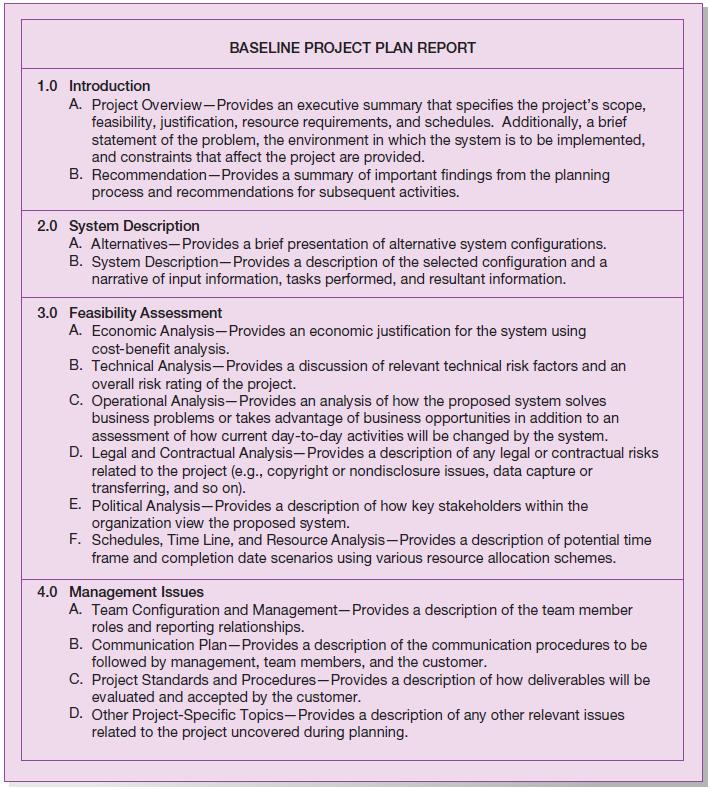
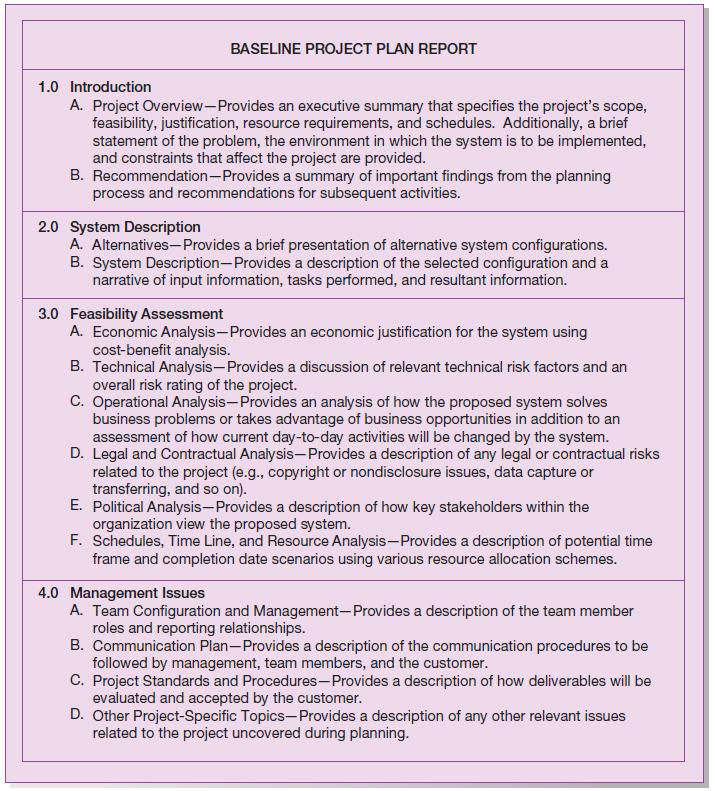
Describe several projects you are involved in or plan to undertake, whether they are related to your education or to your professional or personal life (e.g., purchasing a new vehicle, learning a new language, renovating a home). For each project, sketch out a BPP like that outlined in Figure 5-9.
For the system you chose for Problem and Exercise 5-35, complete section 4.0, A–C, Management Issues, of the BPP Report. Why might people sometimes feel that these additional steps in the project plan are a waste of time? What would you say to convince them that these steps are important?Problem
For the system you chose for Problem and Exercise 5-35, complete section 3.0, A–F, Feasibility Analysis, of the BPP Report. How does this feasibility analysis compare with your gut feeling from the previous question? What might go wrong if you rely on your gut feeling in determining system
For the system you chose for Problem and Exercise 5-35, complete section 2.0, A, Alternatives, of the BPP Report. Without conducting a full-blown feasibility analysis, what is your gut feeling as to the feasibility of this system?Problem and Exercise 5-35.Consider your use of a PC at either home or
For the system you chose for Problem and Exercise 5-35, complete section 1.0, A, Project Overview, of the BPP Report. How important is it that this initial section of the BPP Report is done well? What could go wrong if this section is incomplete or incorrect?Problem and Exercise 5-35.Consider your
Change the recurring costs in Problem and Exercise 5-43 to $40,000 and redo the analysis.Problem and Exercise 5-43Change the time horizon in Problem and Exercise 5-35 to three years and redo the analysis.Problem and Exercise 5-35.Consider your use of a PC at either home or work and list tangible
Change the discount rate for Problem and Exercise 5-43 to 12 percent and redo the analysis.Problem and Exercise 5-43Change the time horizon in Problem and Exercise 5-35 to three years and redo the analysis.Problem and Exercise 5-35.Consider your use of a PC at either home or work and list tangible
Assume monetary benefits of an information system of $40,000 the first year and increasing benefits of $10,000 a year for the next five years (year 1 = $50,000, year 2 = $60,000, year 3 = $70,000, year 4 = $80,000, year 5 = $90,000). Onetime development costs were $80,000 and recurring costs were
Consider the situation you addressed in Problem and Exercise 5-35. Create numeric cost estimates for each of the costs you listed. Calculate the net present value and return on investment. Include a break-even analysis. Assume a 10 percent discount rate and a five-year time horizon.Problem and
Change the time horizon in Problem and Exercise 5-35 to three years and redo the analysis.Problem and Exercise 5-35.Consider your use of a PC at either home or work and list tangible benefits from an information system. Based on this list, does your use of a PC seem to be beneficial? Why or why
Change the recurring costs in Problem and Exercise 5-35 to $40,000 and redo the analysis.Problem and Exercise 5-35.Consider your use of a PC at either home or work and list tangible benefits from an information system. Based on this list, does your use of a PC seem to be beneficial? Why or why not?
Change the discount rate for Problem and Exercise 5-35 to 10 percent and redo the analysis.Problem and Exercise 5-35.Consider your use of a PC at either home or work and list tangible benefits from an information system. Based on this list, does your use of a PC seem to be beneficial? Why or why
Use the outline for the BPP provided in Figure 5-9 to present the system specifications for the information system you chose for Problem and Exercise 5-35.Problem and Exercise 5-35.Consider your use of a PC at either home or work and list tangible benefits from an information system. Based on this
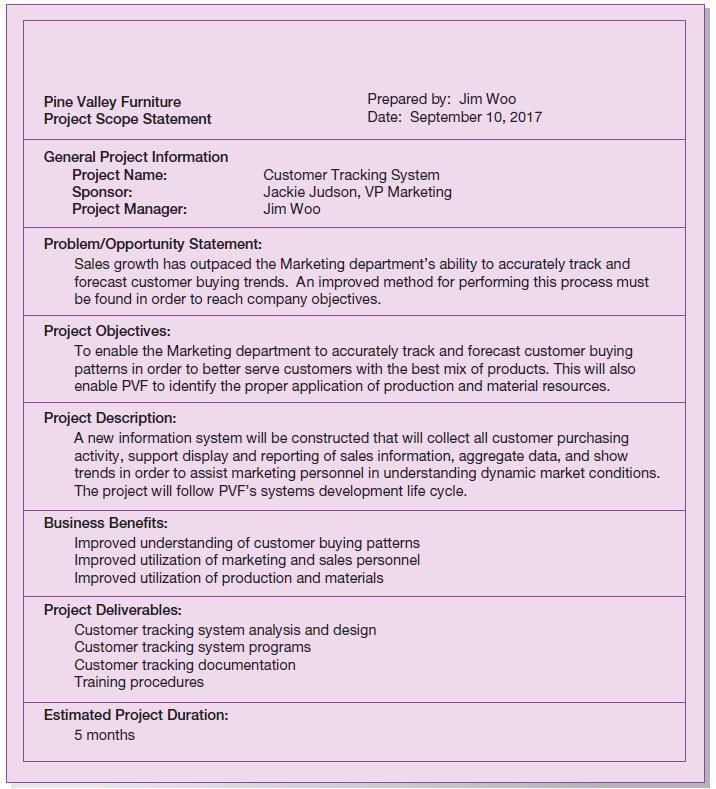
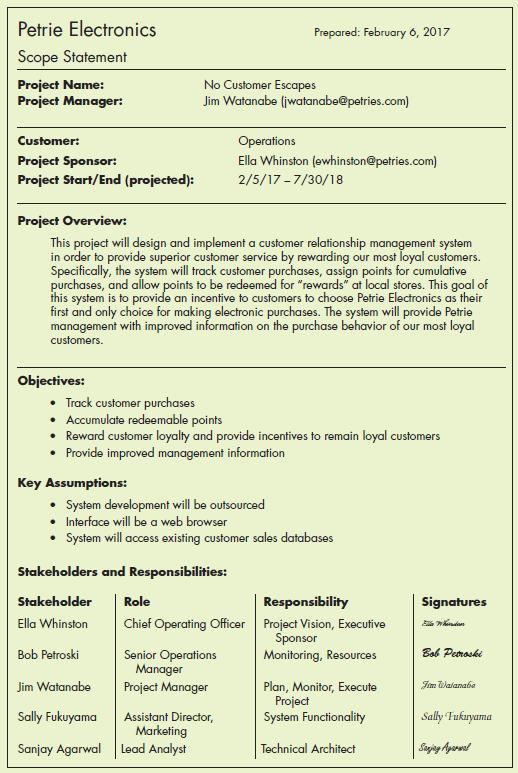
Consider the situation you addressed in Problem and Exercise 5-35. Create a sample Project Scope Statement following the structure shown in Figure 5-10.Problem and Exercise 5-35.Consider your use of a PC at either home or work and list tangible benefits from an information system. Based on this
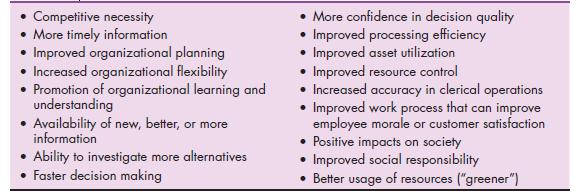
Consider your use of a PC at either home or work and list tangible benefits from an information system. Based on this list, does your use of a PC seem to be beneficial? Why or why not? Now do the same using Table 5-3, the intangible benefits from an information system. Does this analysis support or
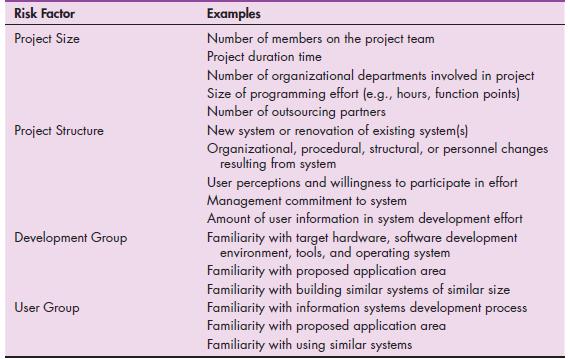
Consider the purchase of a PC and laser printer for use at your home and assess the risk for this project using the project risk assessment factors in Table 5-7.Table 5-7. Risk Factor Examples Project Size Number of members on the project team Project duration time Number of organizational
Describe the structured walk-through process. What roles need to be performed during a walk through?
What intangible benefits might an organization obtain from the development of an information system?
What are the types or categories of benefits of an IS project?
In what ways could you identify that one IS project is riskier than another?
What are the potential consequences of not assessing the technical risks associated with an information systems development project?
Briefly describe nine planning matrices that are used in ISP and project identification and selection.
Write a mission statement for a business that you would like to start. The mission statement should state the area of business you will be in and what aspect of the business you value highly.
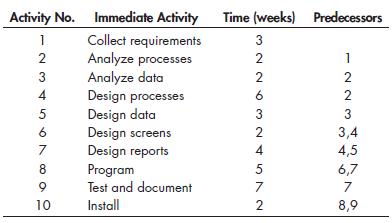
Look again at the activities outlined in Problem and Exercise 3-40. Assume that your team is in its first week of the project and has discovered that each of the activity duration estimates is wrong. Activity 2 will take only two weeks to complete. Activities 4 and 7 will each take three times
Construct a Gantt chart and network diagram for a project you are or will be involved in. Choose a project of sufficient depth from work, home, or school. Identify the activities to be completed, determine the sequence of the activities, and construct a diagram reflecting the starting times, ending
For the project you described in Problem and Exercise 3-43, assume that the worst has happened. A key team member has dropped out of the project and has been assigned to another project in another part of the country. The remaining team members are having personality clashes. Key deliverables for
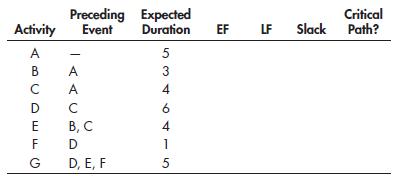
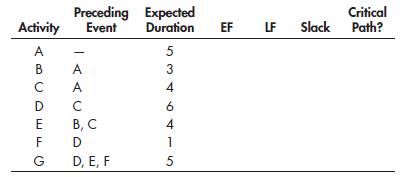
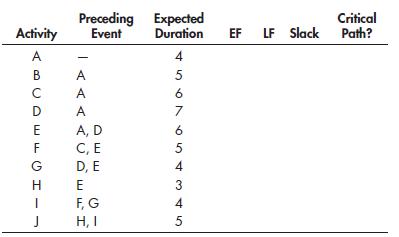
Assume that you have a project with seven activities labeled A–G (below). Derive the earliest completion time (or early finish—EF), latest completion time (or late finish—LF), and slack for each of the following tasks (begin at time = 0). Which tasks are on the critical path? Draw a Gantt
Draw a network diagram for the tasks shown in Problem and Exercise 3-45. Highlight the critical path.Problem and Exercise 3-45.Assume that you have a project with seven activities labeled A–G (below). Derive the earliest completion time (or early finish—EF), latest completion time (or late
Draw a Gantt chart for the tasks shown in Problem and Exercise 3-47. Problem and Exercise 3-47.Assume you have a project with ten activities labeled A–J, as shown. Derive the earliest completion time (or early finish—EF), latest completion time (or late finish—LF), and slack for each of
Make a list of the tasks that you performed when designing your schedule of classes for this term. Develop a table showing each task, its duration, preceding event(s), and expected duration. Develop a network diagram for these tasks. Highlight the critical path on your network diagram.
Fully decompose a project you’ve done in another course (e.g., a semester project or term paper). Discuss the level of detail where you stopped decomposing and explain why.
Create a work breakdown structure based on the decomposition you carried out for Problem and Exercise 3-51.Problem and Exercise 3-51.Fully decompose a project you’ve done in another course (e.g., a semester project or term paper). Discuss the level of detail where you stopped decomposing and
Working in a small group, pick a project (it could be anything, such as planning a party, writing a group term paper, developing a database application, etc.) and then write the various tasks that need to be done to accomplish the project on Post-it Notes (one task per Post-it Note). Then use the
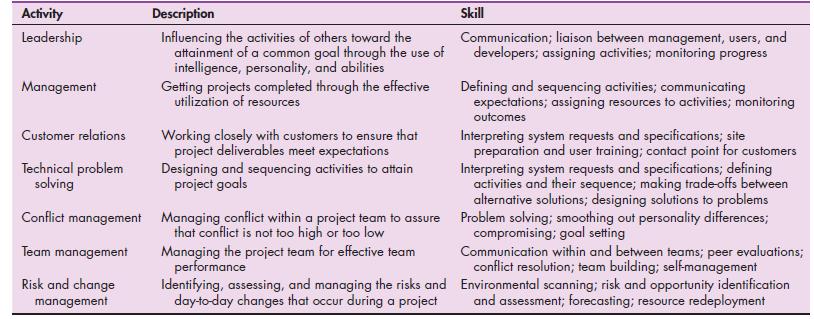
Identify someone who manages an information systems project in an organization. Describe to him or her each of the skills and activities listed in Table 3-1. Determine which items he or she is responsible for on the project. Of those he or she is responsible for, determine which are more
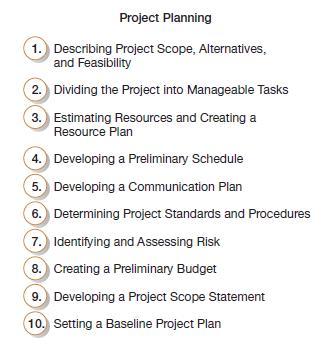
Identify someone who manages an information systems project in an organization. Describe to him or her each of the project planning elements in Figure 3-9. Determine the extent to which each of these elements is part of that person’s project planning process. If that person is not able to perform
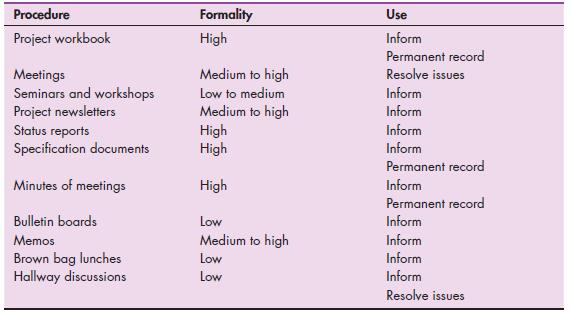
Identify someone who manages an information systems project (or other team-based project) in an organization. Describe to him or her each of the project team communication methods listed in Table 3-2. Determine which types of communication methods are used for team communication and describe which
Identify someone who manages an information systems project in an organization. Describe to him or her each of the project execution elements in Figure 3-13. Determine the extent to which each of these elements is part of that person’s project execution process. If that person does not perform
Interview a sample of project managers. Divide your sample into two small subsamples: one for managers of information systems projects and one for managers of other types of projects. Ask each respondent to identify personal leadership attributes that contribute to successful project management and
Observe a real information systems project team in action for an extended period of time. Keep a notebook as you watch individual members performing their individual tasks, as you review the project management techniques used by the team’s leader, and as you sit in on some of their meetings. What
J. K. Choi, chief financial officer for Petrie Electronics, came early to the quarterly IS Steering Committee meeting. Choi, who was the chair of the committee, took his seat at the head of the big table in the corporate conference room. He opened the cover on his tablet PC and looked at the agenda
Contrast the following terms:a. Mission; objective statements; competitive strategyb. Corporate strategic planning; ISPc. Top-down planning; bottom-up planningd. Low-cost producer; product differentiation; product focus or niche
Describe the project identification and selection process.
Describe several project evaluation criteria.
Describe what is meant by ISP and the steps involved in the process.
List and describe the advantages of top-down planning over other planning approaches.
Discuss some of the factors that must be considered when designing and building Internet applications.
When you are happy with the mission statement you have developed in response to the prior question, describe the objectives and competitive strategy for achieving that mission.
Consider an organization that you believe does not conduct adequate strategic IS planning. List at least six reasons why this type of planning is not done appropriately (or is not done at all). Are these reasons justifiable? What are the implications of this inadequate strategic IS planning? What
In those organizations that do an excellent job of IS planning, why might projects identified from a bottom-up process still find their way into the project initiation and planning phase of the life cycle?
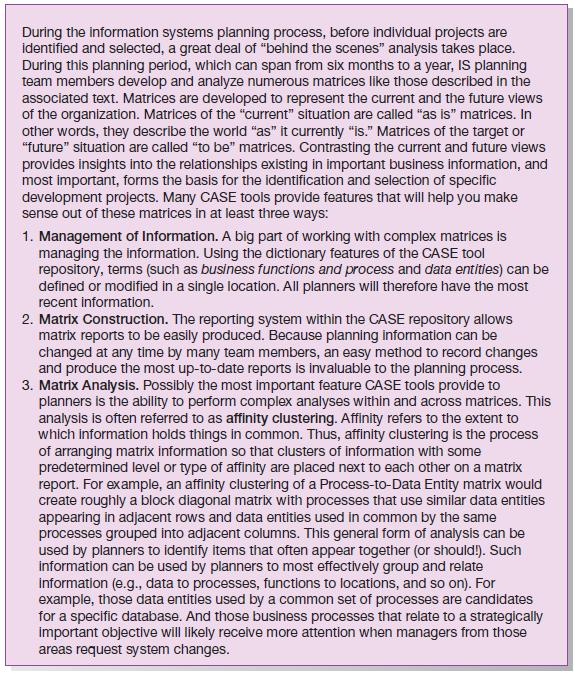
Figure 4-14 introduces the concept of affinity clustering. Suppose that through affinity clustering it was found that three business functions provided the bulk of the use of five data entities. What implications might this have for project identification and subsequent steps in the systems
Timberline Technology manufactures membrane circuits in its Northern California plant. In addition, all circuit design and research and development work occur at this site. All finance, accounting, and human resource functions are headquartered at the parent company in the upper Midwest. Sales take
For each of the following categories, create the most plausible planning matrices for Timberline Technology, described in Problem and Exercise 4-35: function-to-data entity, process-to-data entity, process-to-information system, data entity-to-information system. What other information systems not
The owners of Timberline Technology (described in Problem and Exercise 4-35) are considering adding a plant in Montana and one in Arizona and six more sales representatives at various sites across the country. Update the matrices from Problem and Exercise 4-36 so that the matrices account for these
Obtain a copy of an organization’s mission statement. (One can typically be found in an organization’s annual report. Such reports are often available in university libraries or in corporate marketing brochures. If you are finding it difficult to locate this material, write or call the
Interview the managers of the information systems department of an organization to determine the level and nature of their strategic ISP. Does it appear to be adequate? Why or why not? Obtain a copy of that organization’s mission statement. To what degree do the strategic IS plan and the
Describe value chain analysis and how organizations use this technique to evaluate and compare projects.
Discuss several factors that provide evidence for the need for improved ISP today.
Describe the steps involved in corporate strategic planning.
What are three generic competitive strategies?
IS planning, as depicted in this chapter, is highly related to corporate strategic planning. What might those responsible for IS planning have to do if they operate in an organization without a formal corporate planning process?
The economic analysis carried out during the project identification and selection phase of the systems development life cycle is rather cursory. Why is this? Consequently, what factors do you think tend to be most important for a potential project to survive this first phase of the life cycle?
Choose an organization that you have contact with, perhaps your employer or university. Follow the “Outline of an information systems plan” shown in Figure 4-15 and complete a short information systems plan for the organization you chose. Write at least a brief paragraph for each of the seven
Choose an organization that you have contact with, perhaps your employer or university. List significant examples for each of the items used to create planning matrices. Next, list possible relationships among various items and display these relationships in a series of planning matrices.
Write separate mission statements that you believe would describe Microsoft, IBM, and AT&T. Compare your mission statements with the real mission statements of these companies. Their mission statements can typically be found in their annual reports. Were your mission statements comparable to
Choose an organization that you have contact with, perhaps your employer or university. Determine how information systems projects are identified. Are projects identified adequately? Are they identified as part of the ISP or the corporate strategic planning process? Why or why not?
Contrast the following terms:a. Break-even analysis; present value; net present value; return on investmentb. Economic feasibility; legal and contractual feasibility; operational feasibility; political feasibility; schedule feasibilityc. Intangible benefit; tangible benefitd. Intangible cost;
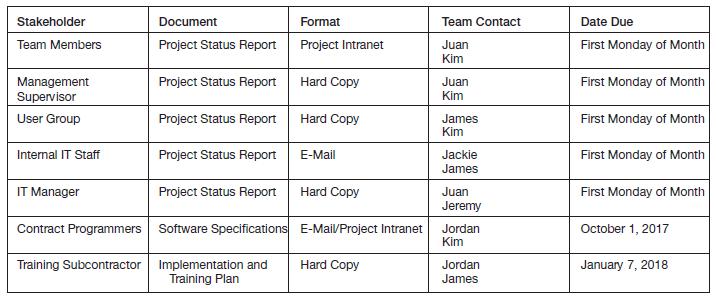
Now that the “No Customer Escapes” project team has been formed and a plan has been developed for distributing project information, Jim can begin working on the project’s scope statement, workbook, and Baseline Project Plan. He first drafted the project’s scope statement and posted it on
List and describe the steps in the project initiation and planning process.
What is contained in a BPP? Are the content and format of all baseline plans the same? Why or why not?
Describe three commonly used methods for performing economic cost–benefit analysis.
List and discuss the different types of project feasibility factors. Is any factor most important? Why or why not?
What is information systems analysis and design?
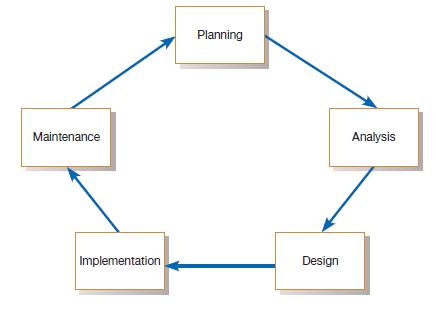
List and explain the different phases in the SDLC.
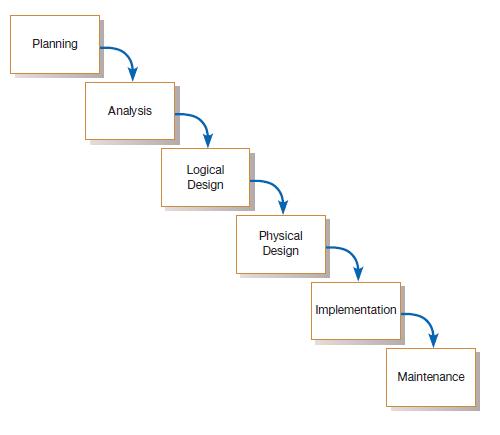
List and explain some of the problems with the traditional waterfall SDLC.
Describe each major component of a comprehensive CASE system. Is any component more important than any other?
Describe how CASE is used to support each phase of the SDLC.
Explain what is meant by Agile Methodologies.
When would you use Agile Methodologies versus an engineering-based approach to development?
What is object-oriented analysis and design?
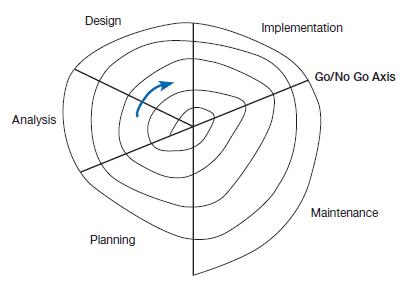
Compare Figures 1-2 and 1-3. What similarities and differences do you see?Figures 1-2Figure 1-3 Design Implementation Go/No Go Axis Analysis Maintenance Planning
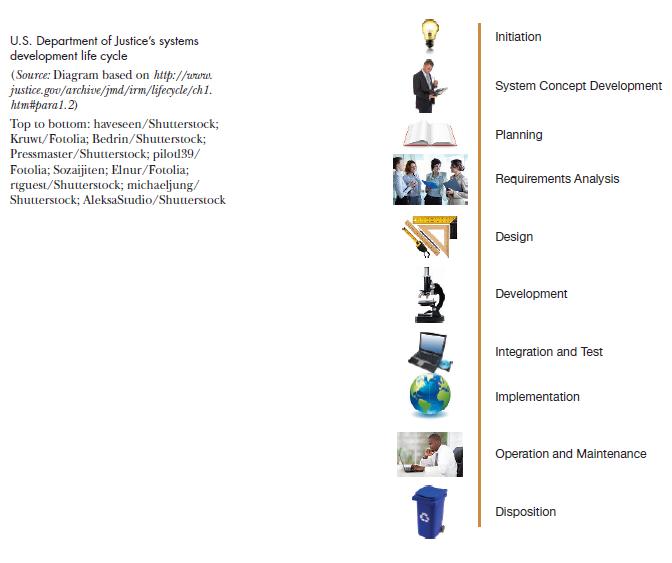
Compare Figures 1-2 and 1-4. Can you match steps in Figure 1-4 with phases in Figure 1-2? How might you explain the differences between the two figures?Figure 1-2Figure 1-4 U.S. Department of Justice's systems development life cycle (Source: Diagram based on http://unww. justice,
Compare Figures 1-2 and 1-10. How does Figure 1-10 illustrate some of the problems of the traditional waterfall approach that are not illustrated in Figure 1-2? How does converting Figure 1-10 into a circle (like Figure 1-2) fix these problems?Figure 1-2Figure 1-10 Planning Analysis Logical Design
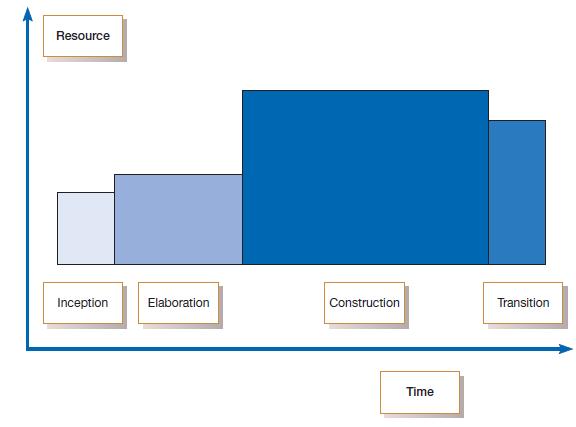
Explain how object-oriented analysis and design differs from the traditional approach. Why isn’t RUP (Figure 1-11) represented as a cycle? Is that good or bad? Explain your response.Figure 1-11 Resource Inception Elaboration Construction Transition Time
Imagine an information system built without using a systems analysis and design methodology and without any thinking about the SDLC. Use your imagination and describe any and all problems that might occur, even if they seem a bit extreme or absurd.
Choose a relatively small organization that is just beginning to use information systems. What types of systems are being used? For what purposes? To what extent are these systems integrated with one another? With systems outside the organization? How are these systems developed and controlled? Who
Interview information systems professionals who use CASE tools and find out how they use the tools throughout the SDLC process. Ask them what advantages and disadvantages they see in using the tools that they do.
Go to a CASE tool vendor’s website and determine the product’s price, functionality, and advantages. Try to find information related to any future plans for the product. If changes are planned, what changes and/or enhancements are planned for future versions? Why are these changes being made?
Use the web to find out more about the Agile Methodologies. Write a report on what the movement toward agility means for the future of systems analysis and design.
You may want to keep a personal journal of ideas and observations about systems analysis and design while you are studying this book. Use this journal to record comments you hear, summaries of news stories or professional articles you read, original ideas or hypotheses you create, and questions
Describe and compare the various sources of software.
Jim Watanabe looked around his new office. He couldn’t believe that he was the assistant director of information technology at Petrie Electronics, his favorite consumer electronics retail store. He always bought his new DVDs and video games for his Xbox 360 at Petrie. In fact, he bought his
How can you decide among various off-the-shelf software options? What criteria should you use?
What is an RFP, and how do analysts use one to gather information on hardware and system software?
What methods can a systems analyst employ to verify vendor claims about a software package?
What are ERP systems? What are the benefits and disadvantages of such systems as a design strategy?
Explain reuse and its advantages and disadvantages.
Compare and contrast the four approaches to reuse.
Showing 900 - 1000
of 1024
1
2
3
4
5
6
7
8
9
10
11
Step by Step Answers

 Get 50% OFF
Claim Now
Get 50% OFF
Claim Now