New Semester
Started
Get
50% OFF
Study Help!
--h --m --s
Claim Now
Question Answers
Textbooks
Find textbooks, questions and answers
Oops, something went wrong!
Change your search query and then try again
S
Books
FREE
Study Help
Expert Questions
Accounting
General Management
Mathematics
Finance
Organizational Behaviour
Law
Physics
Operating System
Management Leadership
Sociology
Programming
Marketing
Database
Computer Network
Economics
Textbooks Solutions
Accounting
Managerial Accounting
Management Leadership
Cost Accounting
Statistics
Business Law
Corporate Finance
Finance
Economics
Auditing
Tutors
Online Tutors
Find a Tutor
Hire a Tutor
Become a Tutor
AI Tutor
AI Study Planner
NEW
Sell Books
Search
Search
Sign In
Register
study help
engineering
engineering mechanics dynamics
Engineering Mechanics Dynamics 8th Edition James L. Meriam, L. G. Kraige, J. N. Bolton - Solutions
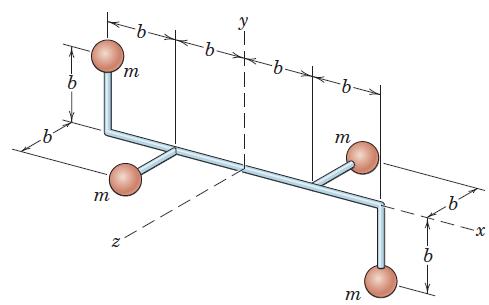
Determine the products of inertia about the coordinate axes for the unit which consists of four small particles, each of mass m, connected by the light but rigid slender rods. 9- 9- m т x m
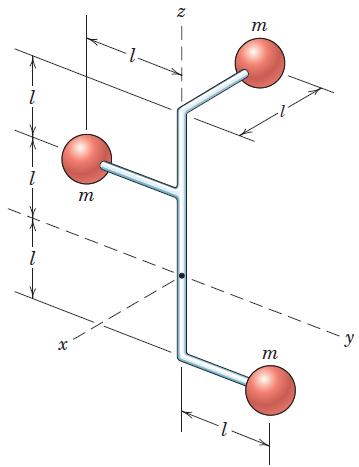
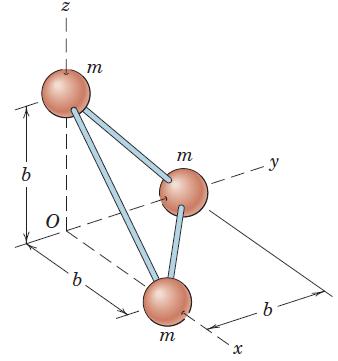
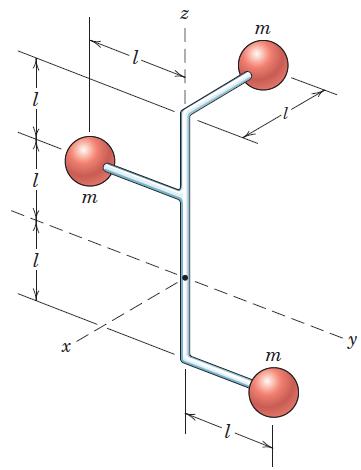
Determine the products of inertia about the coordinate axes for the unit which consists of three small spheres, each of mass m, connected by the light but rigid slender rods. m m | y m
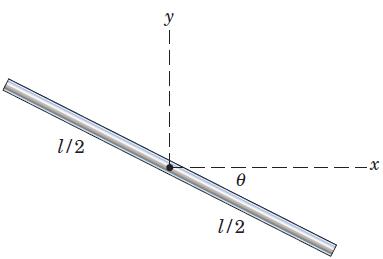
Determine the product of inertia Ixy for the slender rod of mass m. y 1/2 1/2
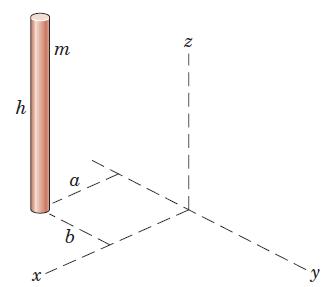
Determine the products of inertia of the uniform slender rod of mass m about the coordinate axes shown. т h b
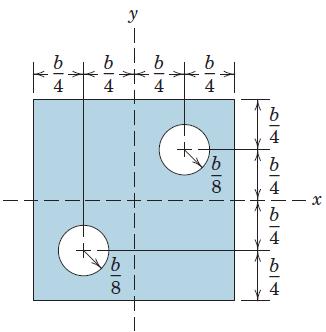
Determine the products of inertia about the coordinate axes for the thin square plate with two circular holes. The mass of the plate material per unit area is ρ. y 이4.6_4|614.6-4 |
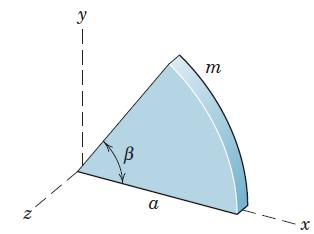
Determine the products of inertia about the coordinate axes for the thin plate of mass m which has the shape of a circular sector of radius a and angle β as shown. y | m a
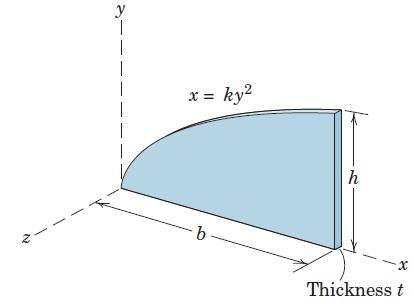
The homogeneous plate of Prob. B/7 is repeated here. Determine the product of inertia for the plate about the x-y axes. The plate has mass m and uniform thickness t. y x = ky? h Thickness t
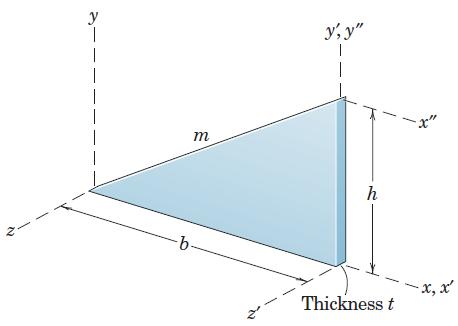
Determine by direct integration the product of inertia of the thin homogeneous triangular plate of mass m about the x-y axes. Then, use the parallel-axis theorem to determine the product of inertia for the plate about the x′-y' axes and the x″-y″ axes. What is the product of inertia about the
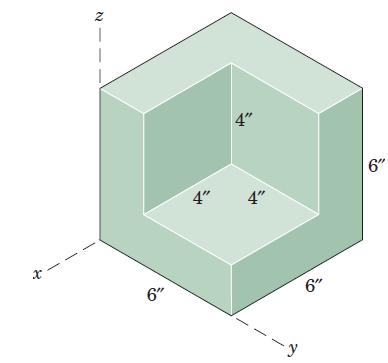
The aluminium casting consists of a 6-in. cube with a 4-in. cubical recess. Calculate the products of inertia of the casting about the axes shown. 4" 6" 4" 6" 6
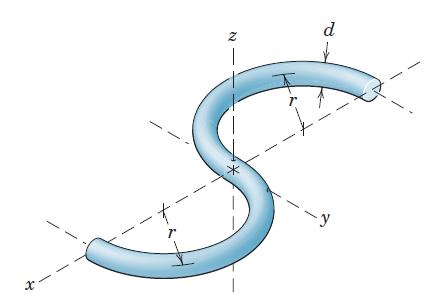
The S-shaped piece is formed from a rod of diameter d and bent into the two semicircular shapes. Determine the products of inertia for the rod, for which d is small compared with r. d トく
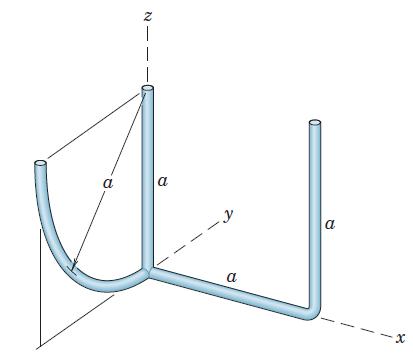
Determine the products of inertia about the coordinate axes for the assembly which consists of uniform slender rods. Each rod has a mass ρ per unit length. a a a a
Prove that the moment of inertia of the rigid assembly of three identical balls, each of mass m and radius r, has the same value for all axes through O. Neglect the mass of the connecting rods. m m - y т
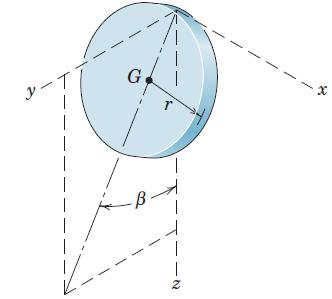
The plane of the thin circular disk of mass m and radius r makes an angle β with the x-z plane. Determine the product of inertia of the disk with respect to the y-z plane. yー 1. G
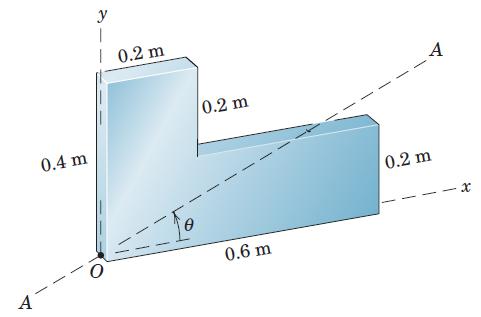
The L-shaped piece is cut from steel plate having a mass per unit area of 160 kg/m2. Determine and plot the moment of inertia of the piece about axis A-A as a function of θ from θ = 0 to θ = 90° and fi nd its minimum value. y | 0.2 m A 0.2 m 0.4 m 0.2 m 0.6 m A
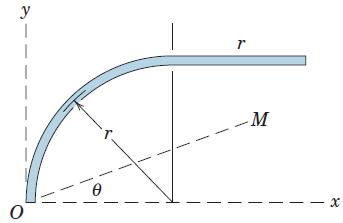
Determine the moment of inertia I about axis O-M for the uniform slender rod bent into the shape shown. Plot I versus θ from θ = 0 to θ = 90° and determine the minimum value of I and the angle a which its axis makes with the x-direction. (Note: Because the analysis does not involve the
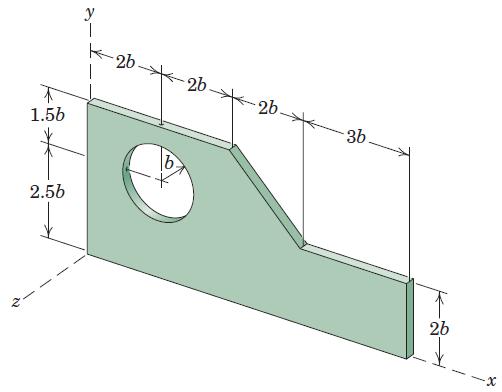
Determine the inertia tensor for the homogeneous thin plate about the x-, y-, and z-axes. The plate has a mass m and uniform thickness t. What is the minimum angle, measured from the x-axis, which will rotate the plate into principal directions? y 2b -2b. 2b 3b 1.56 b 2.56 26
The assembly of three small spheres connected by light rigid bars of Prob. B/58 is repeated here. Determine the principal moments of inertia and the direction cosines associated with the axis of maximum moment of inertia. m m y m
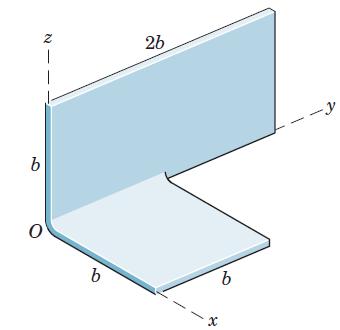
The thin plate has a mass ρ per unit area and is formed into the shape shown. Determine the principal moments of inertia of the plate about axes through O. 26 -y b
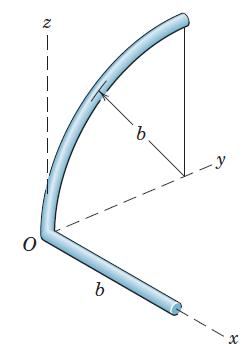
The slender rod has a mass ρ per unit length and is formed into the shape shown. Determine the principal moments of inertia about axes through O and calculate the direction cosines of the axis of minimum moment of inertia. 9. -y b
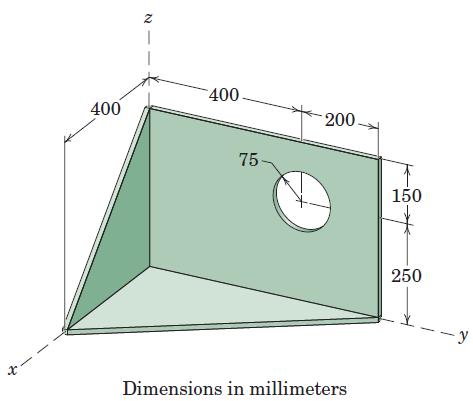
The welded assembly is formed from uniform sheet metal with a mass of 32 kg/m2. Determine the principal mass moments of inertia for the assembly and the corresponding direction cosines for each principal axis. 400- 400 200 75- 150 250 -y Dimensions in millimeters
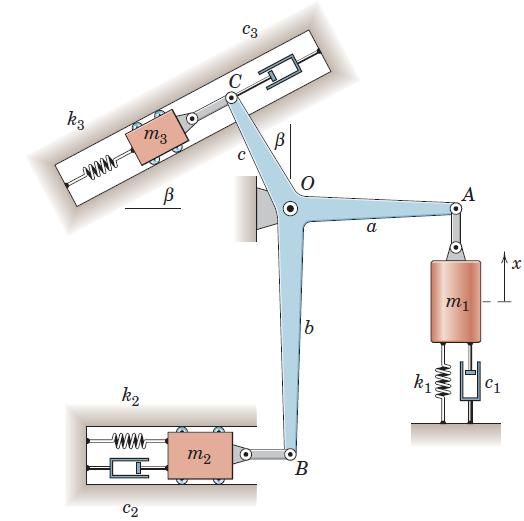
Derive the equation of motion for the system shown in terms of the displacement x. The masses are coupled through the light connecting rod ABC which pivots about the smooth bearing at point O. Neglect all friction, consider the rollers on m2 and m3 to be light, and assume small oscillations about
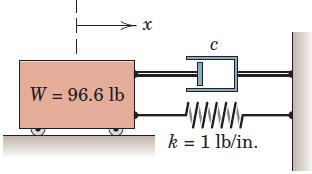
The mass of the system shown is released from rest at x0 = 6 in. when t = 0. Determine the displacement x at t = 0.5 sec if (a) c = 12 lb-sec/ft (b) c = 18 lb-sec/ft. W = 96.6 lb www. k = 1 lb/in.
The mass of a g en critically damped system is released at time t-o rrom the posit on xo = 40 mm with a negative initial velocity. The mass m is 13 kg and the spring constant k is 836 N m. Determine the critical value or the initial velocity Gode below which the mass will pass through the
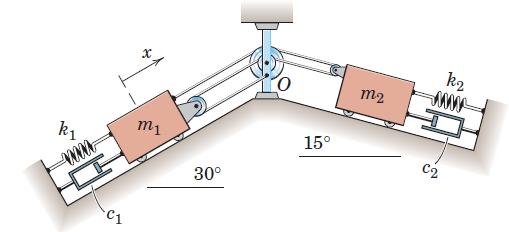
Determine the equation of motion for the system in terms of the variable x. The cables remain taut at all times, and the pulleys turn independently. Neglect friction and the mass of the pulleys. Additionally, determine expressions for the natural circular frequency wn and the damping ratio ζ. k2
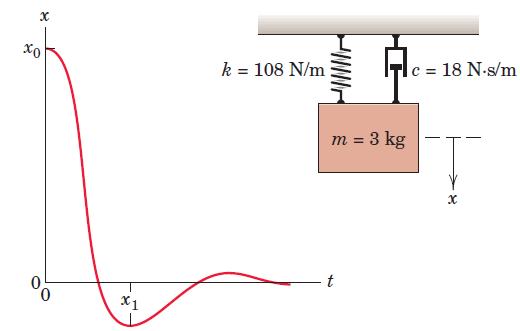
The system shown is released from rest from an initial position x0. Determine the overshoot displacement x1. Assume translational motion in the x-direction. k = 108 N/m c 18 N.s/m m = 3 kg t X1
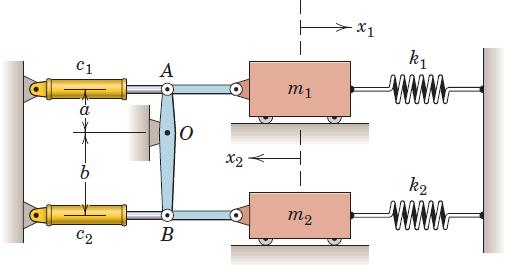
Derive the differential equation of motion for the system shown in terms of the variable x1. Neglect friction and the mass of the linkage. >x1 k1 C1 А www X2 k2 m2 C2 B
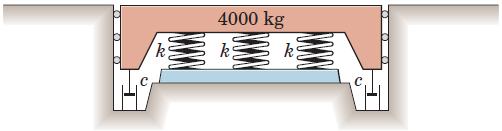
Further design refinement for the weighing platform of Prob. 8/15 is shown here where two viscous dampers are to be added to limit the ratio of successive positive amplitudes of vertical vibration in the unloaded condition to 4. Determine the necessary viscous damping coefficient c for each of the
Determine the damping ratio ζ for the system shown. The system parameters are m = 4 kg, k = 500 N/m, and c = 100 N∙ s/m. Neglect the mass and friction of all pulleys, and assume that the cord remains taut throughout a motion cycle. m
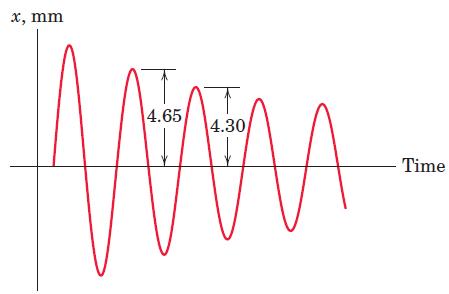
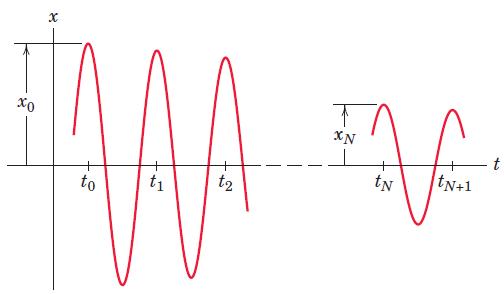
A linear harmonic oscillator having a mass of 1.10 kg is set into motion with viscous damping. If the frequency is 10 Hz and if two successive amplitudes a full cycle apart are measured to be 4.65 mm and 4.30 mm as shown, compute the viscous damping coefficient c. x, mm 4.65 4.30 Time
The figure represents the measured displacement-time relationship for a vibration with small damping where it is impractical to achieve accurate results by measuring the nearly equal amplitudes of two successive cycles. Modify the expression for the viscous damping factor ζ based on the measured
The period τd of damped linear oscillation for a certain 1-kg mass is 0.3 s. If the stiffness of the supporting linear spring is 800 N/m, calculate the damping coefficient c.
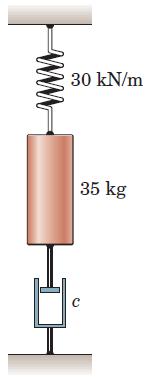
Determine the value of the viscous damping coefficient c for which the system shown is critically damped. 30 kN/m 35 kg ww
The addition of damping to an undamped spring-mass system causes its period to increase by 25 percent. Determine the damping ratio ζ.
Viscous damping is added to an initially undamped spring-mass system. For what value of the damping ratio ζ will the damped natural frequency wd be equal to 90 percent of the natural frequency of the original undamped system?
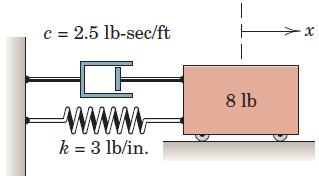
Determine the value of the damping ratio ζ for the simple spring-mass-dashpot system shown. c = 2.5 lb-sec/ft 8 lb www k = 3 lb/in.
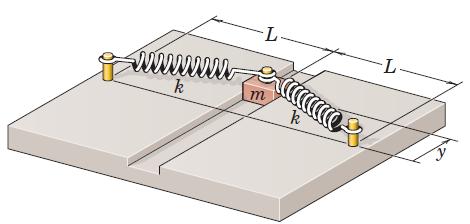
The slider of mass m is confined to the horizontal slot shown. The two springs each of constant k are linear. Derive the nonlinear equation of motion for small values of y, retaining terms of order y3 and larger. Both springs are unstretched when y = 0. Neglect friction. 7- L- m k
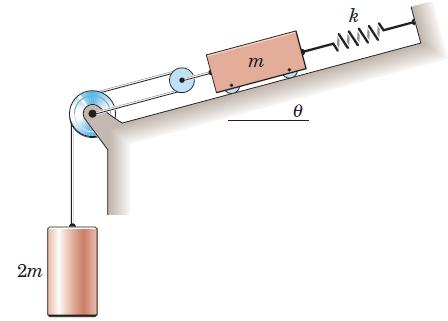
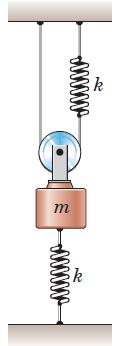
Calculate the natural circular frequency wn of the system shown in the figure. The mass and friction of the pulleys are negligible. k m 2m
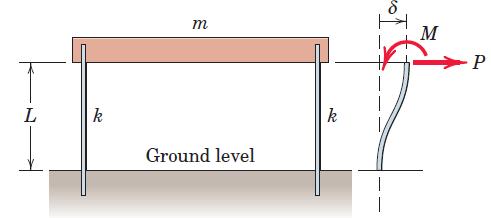
Shown in the figure is a model of a one-story building. The bar of mass m is supported by two light elastic upright columns whose upper and lower ends are fixed against rotation. For each column, if a force P and corresponding moment M were applied as shown in the right-hand part of the figure, the
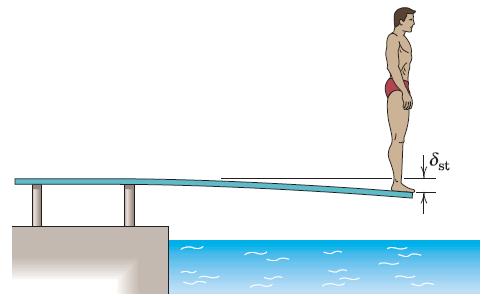
A 90-kg man stands at the end of a diving board and causes a vertical oscillation which is observed to have a period of 0.6 s. What is the static deflection δst at the end of the board? Neglect the mass of the board. öst
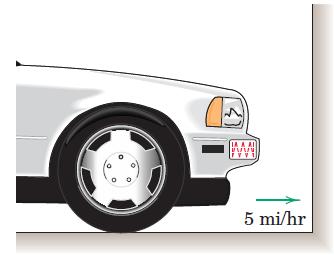
An energy-absorbing car bumper with its springs initially undeformed has an equivalent spring constant of 3000 lb/in. If the 2500-lb car approaches a massive wall with a speed of 5 mi/hr, determine (a) The velocity v of the car as a function of time during contact with the wall, where t = 0 is
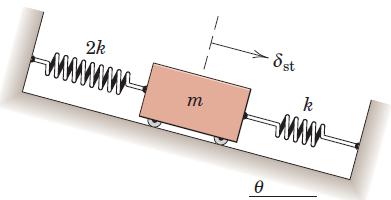
If both springs are unstretched when the mass is in the central position shown, determine the static deflection δst of the mass. What is the period of oscillatory motion about the position of static equilibrium? Sst 2k k m
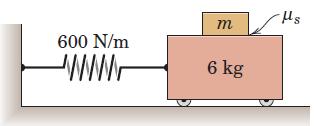
With the assumption of no slipping, determine the mass m of the block which must be placed on the top of the 6-kg cart in order that the system period be 0.75 s. What is the minimum coefficient μs of static friction for which the block will not slip relative to the cart if the cart is displaced 50
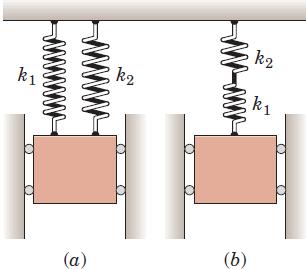
Replace the springs in each of the two cases shown by a single spring of stiffness k (equivalent spring stiffness) which will cause each mass to vibrate with its original frequency. k2 k2 k1 k1 (b) (a)
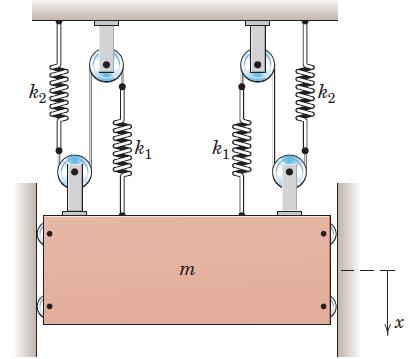
Calculate the natural frequency ƒn of vibration if the mass is deflected from its equilibrium position and released from rest. Each pair of springs is connected by an inextensible cable. Evaluate your results for m = 15 kg, k1 = 225 N/m, and k2 = 150 N/m. k2 m
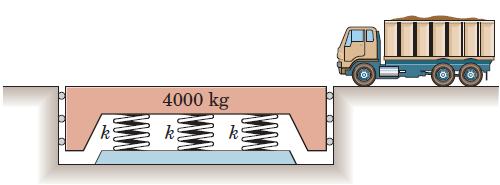
During the design of the spring-support system for the 4000-kg weighing platform, it is decided that the frequency of free vertical vibration in the unloaded condition shall not exceed 3 cycles per second. (a) Determine the maximum acceptable spring constant k for each of the three identical
The 4-oz slider oscillates in the fixed slot under the action of the three springs, each of stiffness k = 0.5 lb/in. If the initial conditions at time t = 0 are x0 = 0.1 in. and x˙0 = 0.5 in./sec, determine the position and velocity of the slider at time t = 2 sec. What is the system period? Aww k
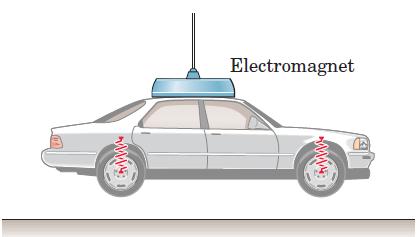
An old car being moved by a magnetic crane pickup is dropped from a short distance above the ground. Neglect any damping effects of its worn-out shock absorbers and calculate the natural frequency ƒn in cycles per second (Hz) of the vertical vibration which occurs after impact with the ground.
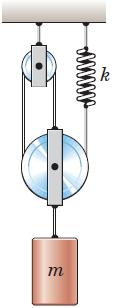
Determine the natural frequency in radians per second for the system shown. Neglect the mass and friction of the pulleys. m
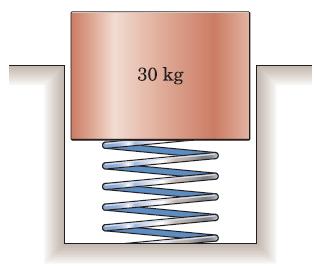
In the equilibrium position, the 30-kg cylinder causes a static deflection of 50 mm in the coiled spring. If the cylinder is depressed an additional 25 mm and released from rest, calculate the resulting natural frequency ƒn of vertical vibration of the cylinder in cycles per second (Hz). 30 kg
Determine the period τ for the system shown. The cable is always taut, and the mass and friction of the pulley are to be neglected. m
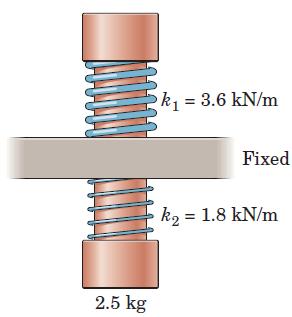
The vertical plunger has a mass of 2.5 kg and is supported by the two springs, which are always in compression. Calculate the natural frequency ƒn of vibration of the plunger if it is deflected from the equilibrium position and released from rest. Friction in the guide is negligible. k = 3.6 kN/m
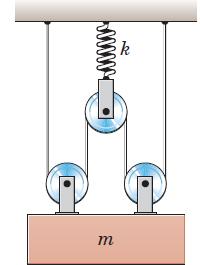
Determine the natural frequency in cycles per second for the system shown. Neglect the mass and friction of the pulleys. Assume that the block of mass m remains horizontal. m
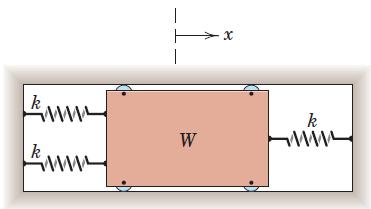
For the system of Prob. 8/2, determine the position x as a function of time if the mass is released at time t = 0 from a position 2 inches to the right of the equilibrium position with an initial velocity of 9 in./sec to the left. Determine the amplitude C and period τ of the motion.
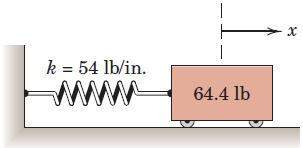
Determine the natural frequency of the spring-mass system in both radians per second and cycles per second (Hz). k = 54 lb/in. www 64.4 lb
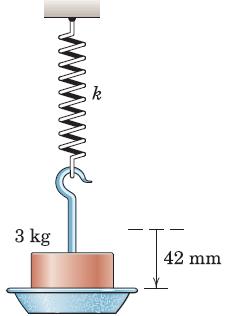
When a 3-kg collar is placed upon the pan which is attached to the spring of unknown constant, the additional static deflection of the pan is observed to be 42 mm. Determine the spring constant k in N/m, lb/in., and lb/ft. k 3 kg 42 mm
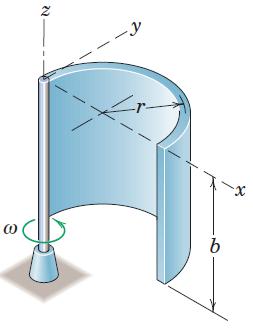
The half-cylindrical shell of mass m, radius r, and length b revolves about one edge along the z-axis with a constant rate w as shown. Determine the angular momentum H of the shell with respect to the x-y-z axes.
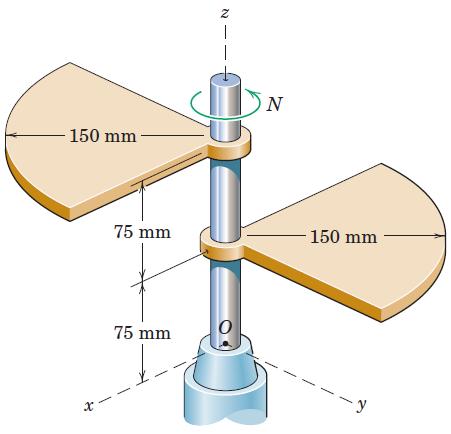
Each of the quarter-circular plates has a mass of 2 kg and is secured to the vertical shaft mounted in the fixed bearing at O. Calculate the magnitude M of the bending moment in the shaft at O for a constant rotational speed N = 300 rev/min. Treat the plates as exact quarter-circular shapes. N 150
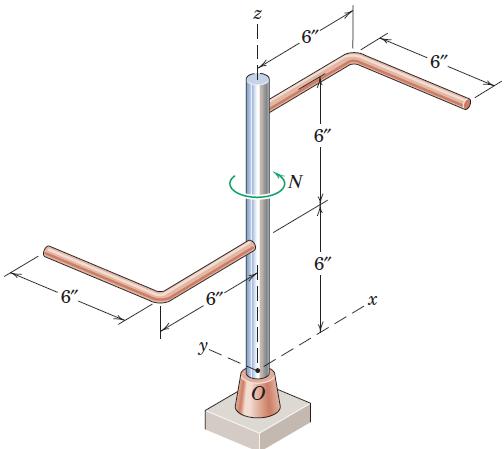
Each of the two right-angle bent rods weighs 2.80 lb and is parallel to the horizontal x-y plane. The rods are welded to the vertical shaft, which rotates about the z-axis with a constant angular speed N = 1200 rev/ min. Calculate the bending moment M in the shaft at its base O. 6" 6". 6" ON 6" y.
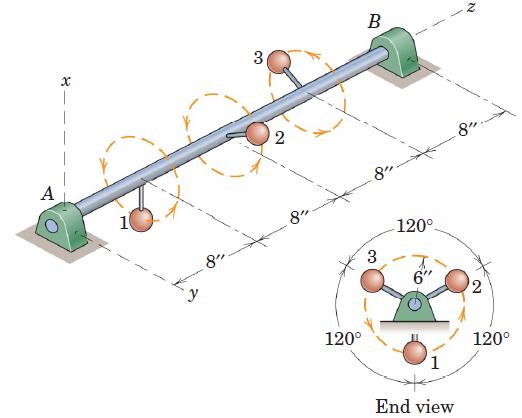
The dynamic imbalance of a certain crankshaft is approximated by the physical model shown, where the shaft carries three small 1.5-lb spheres attached by rods of negligible mass. If the shaft rotates at the constant speed of 1200 rev/min, calculate the forces RA and RB acting on the bearings.
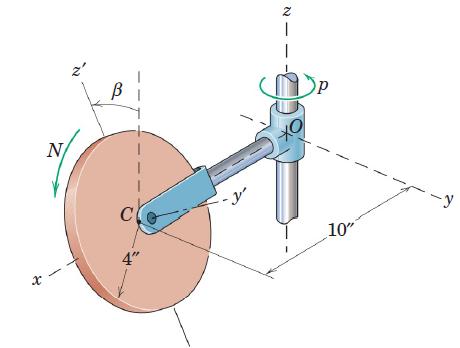
The uniform circular disk of 4-in. radius and small thickness weighs 8 lb and is spinning about its y′- axis at the rate N = 300 rev/min with its plane of rotation tilted at a constant angle β = 20° from the vertical x-z plane. Simultaneously, the assembly rotates about the fixed z-axis at the
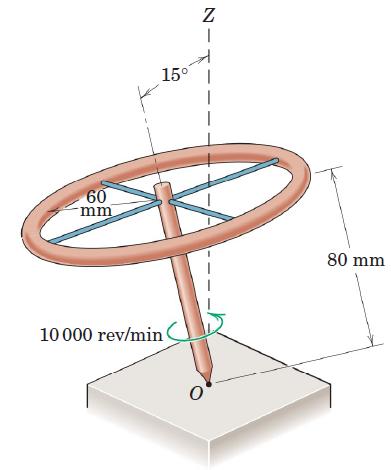
A top consists of a ring of mass m = 0.52 kg and mean radius r = 60 mm mounted on its central pointed shaft with spokes of negligible mass. The top is given a spin velocity of 10 000 rev/min and released on the horizontal surface with the point O remaining in a fixed position. The axis of the top
The thin circular disk of mass m and radius R is hinged about its horizontal tangent axis to the end of a shaft rotating about its vertical axis with an angular velocity w. Determine the steady-state angle β assumed by the plane of the disk with the vertical axis. Observe any limitation on w to
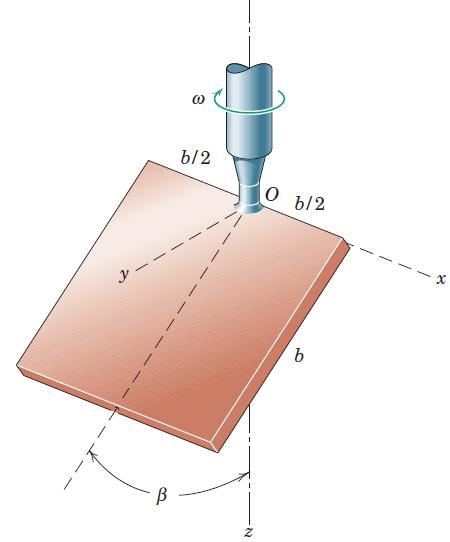
The uniform square plate of mass m is welded at O to the end of the shaft, which rotates about the vertical z-axis with a constant angular velocity w. Determine the moment applied to the plate by the weld due only to the rotation. b/2 b/2 1.
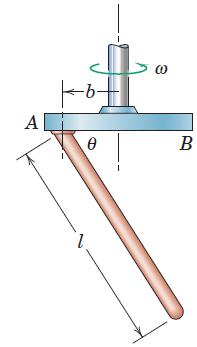
The uniform slender rod of length l is welded to the bracket at A on the underside of the disk B. The disk rotates about a vertical axis with a constant angular velocity w. Determine the value of w which will result in a zero moment supported by the weld at A for the position θ = 60° with b =
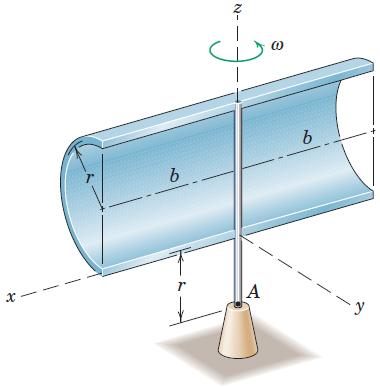
The half-cylindrical shell of radius r, length 2b, and mass m revolves about the vertical z-axis with a constant angular velocity w as indicated. Determine the magnitude M of the bending moment in the shaft at A due to both the weight and the rotational motion of the shell. A
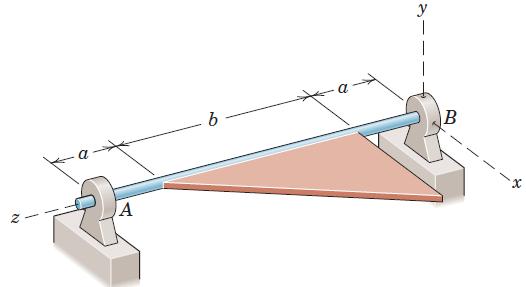
The homogeneous thin triangular plate of mass m is welded to the horizontal shaft, which rotates freely in the bearings at A and B. If the plate is released from rest in the horizontal position shown, determine the magnitude of the bearing reaction at A for the instant just after release. A
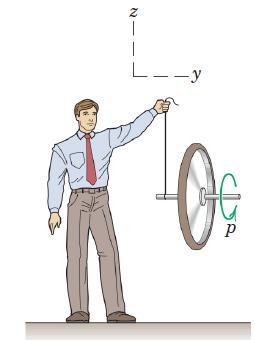
A dynamics instructor demonstrates gyroscopic principles to his students. He suspends a rapidly spinning wheel with a string attached to one end of its horizontal axle. Describe the precession motion of the wheel. L--y
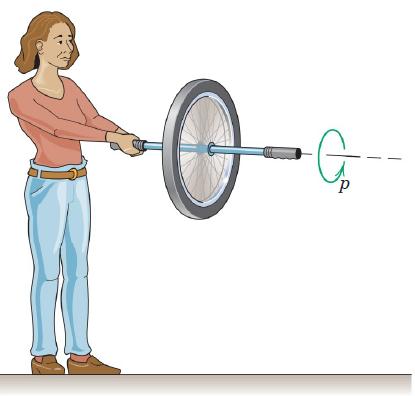
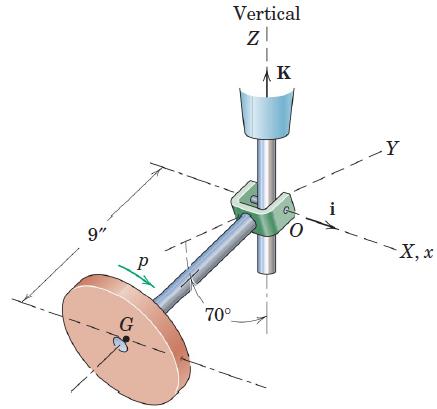
The student has volunteered to assist in a classroom demonstration involving a momentum wheel which is rapidly spinning with angular speed p as shown. The instructor has asked her to hold the axle of the wheel in the horizontal position shown and then attempt to tilt the axis upward in a vertical
A car makes a turn to the right on a level road. Determine whether the normal reaction under the right rear wheel is increased or decreased as a result of the gyroscopic effect of the precessing wheels.
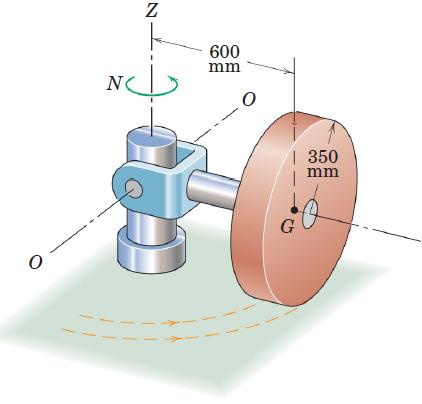
The 50-kg wheel is a solid circular disk which rolls on the horizontal plane in a circle of 600-mm radius. The wheel shaft is pivoted about the axis O-O and is driven by the vertical shaft at the constant rate N = 48 rev/min about the Z-axis. Determine the normal force R between the wheel and the
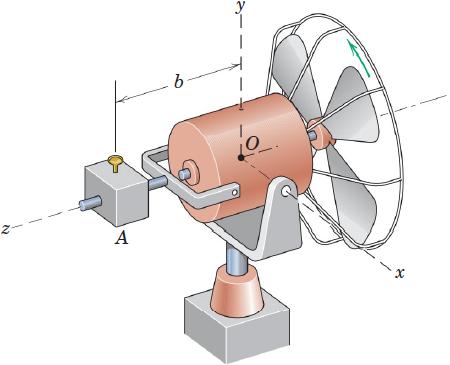
The special-purpose fan is mounted as shown. The motor armature, shaft, and blades have a combined mass of 2.2 kg with radius of gyration of 60 mm. The axial position b of the 0.8-kg block A can be adjusted. With the fan turned off, the unit is balanced about the x-axis when b = 180 mm. The motor
An airplane has just cleared the runway with a takeoff speed v. Each of its freely spinning wheels has a mass m, with a radius of gyration k about its axle. As seen from the front of the airplane, the wheel precesses at the angular rate Ω as the landing strut is folded into the wing about its
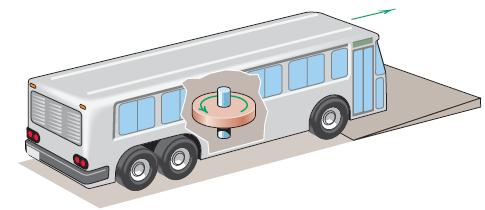
An experimental antipollution bus is powered by the kinetic energy stored in a large flywheel which spins at a high speed p in the direction indicated. As the bus encounters a short upward ramp, the front wheels rise, thus causing the flywheel to precess. What changes occur to the forces between
The 210-kg rotor of a turbojet aircraft engine has a radius of gyration of 220 mm and rotates counterclockwise at 18 000 rev/min as viewed from the front. If the aircraft is traveling at 1200 km/h and starts to execute an inside vertical loop of 3800-m radius, compute the gyroscopic moment M
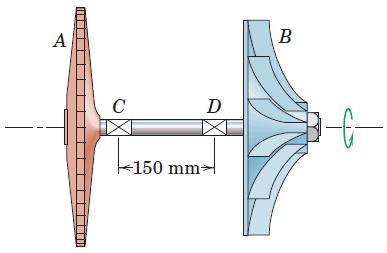
A small air compressor for an aircraft cabin consists of the 3.50-kg turbine A which drives the 2.40-kg blower B at a speed of 20 000 rev/min. The shaft of the assembly is mounted transversely to the direction of flight and is viewed from the rear of the aircraft in the figure. The radii of
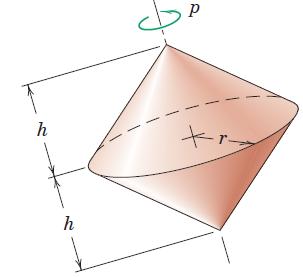
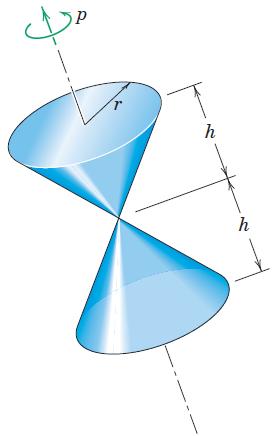
The two solid cones with the same base and equal altitudes are spinning in space about their common axis at the rate p. For what ratio h/r will precession of their spin axis be impossible? h キャー
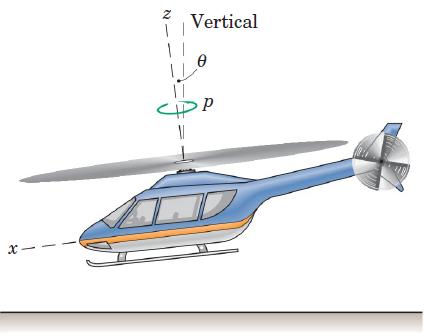
The blades and hub of the helicopter rotor weigh 140 lb and have a radius of gyration of 10 ft about the z-axis of rotation. With the rotor turning at 500 rev/min during a short interval following vertical liftoff, the helicopter tilts forward at the rate θ˙ = 10 deg/sec in order to acquire
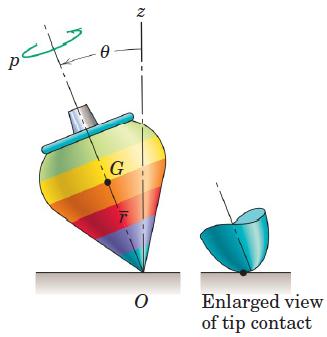
The 4-oz top with radius of gyration about its spin axis of 0.62 in. is spinning at the rate p = 3600 rev/min in the sense shown, with its spin axis making an angle θ = 20° with the vertical. The distance from its tip O to its mass center G is r̅ = 2.5 in. Determine the precession Ω of the top
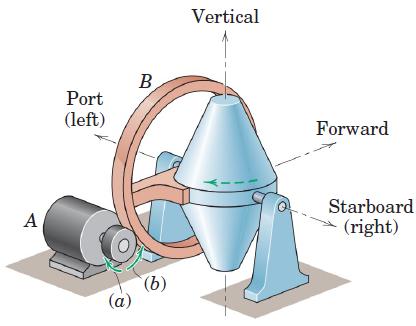
The figure shows a gyro mounted with a vertical axis and used to stabilize a hospital ship against rolling. The motor A turns the pinion which precesses the gyro by rotating the large precession gear B and attached rotor assembly about a horizontal transverse axis in the ship. The rotor turns
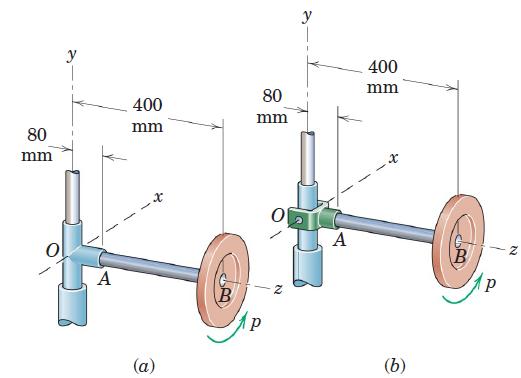
Each of the identical wheels has a mass of 4 kg and a radius of gyration kz = 120 mm and is mounted on a horizontal shaft AB secured to the vertical shaft at O. In case (a) The horizontal shaft is fixed to a collar at O which is free to rotate about the vertical y-axis. In case (b) The
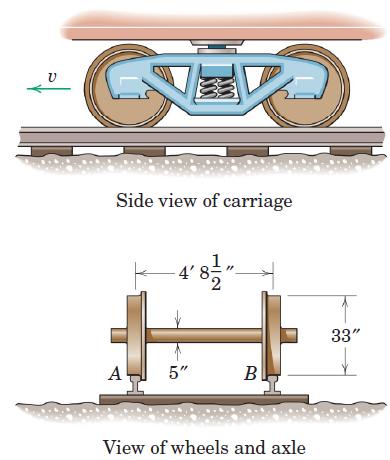
The figure shows the side view of the wheel carriage (truck) of a railway passenger car where the vertical load is transmitted to the frame in which the journal wheel bearings are located. The lower view shows only one pair of wheels and their axle which rotates with the wheels. Each of the 33-in.-
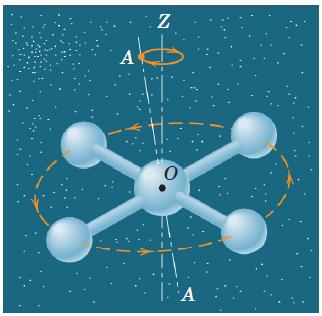
The primary structure of a proposed space station consists of five spherical shells connected by tubular spokes. The moment of inertia of the structure about its geometric axis A-A is twice as much as that about any axis through O normal to A-A. The station is designed to rotate about its geometric
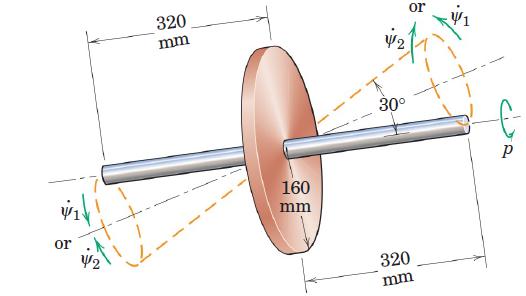
The uniform 640-mm rod has a mass of 3 kg and is welded centrally to the uniform 160-mm-radius circular disk which has a mass of 8 kg. The unit is given a spin velocity p = 60 rad/s in the direction shown. The axis of the rod is seen to wobble through a total angle of 30°. Calculate the angular
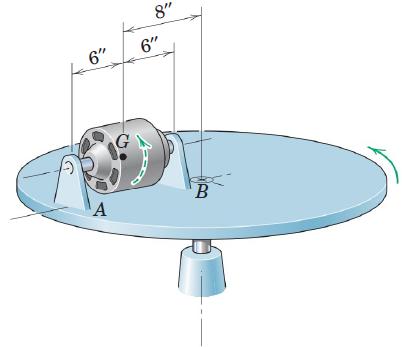
The electric motor has a total weight of 20 lb and is supported by the mounting brackets A and B attached to the rotating disk. The armature of the motor has a weight of 5 lb and a radius of gyration of 1.5 in. and turns counterclockwise at a speed of 1725 rev/min as viewed from A to B. The
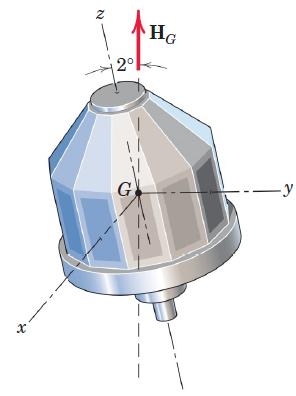
The spacecraft shown is symmetrical about its z-axis and has a radius of gyration of 720 mm about this axis. The radii of gyration about the x- and y-axes through the mass center are both equal to 540 mm. When moving in space, the z-axis is observed to generate a cone with a total vertex angle of
The 8-lb rotor with radius of gyration of 3 in. rotates on ball bearings at a speed of 3000 rev/min about its shaft OG. The shaft is free to pivot about the X-axis, as well as to rotate about the Z-axis. Calculate the vector Ω for precession about the Z-axis. Neglect the mass of shaft OG and
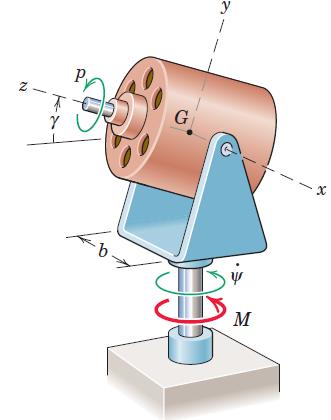
The housing of the electric motor is freely pivoted about the horizontal x-axis, which passes through the mass center G of the rotor. If the motor is turning at the constant rate Φ˙ = p, determine the angular acceleration Ψ¨ which will result from the application of the moment M about the
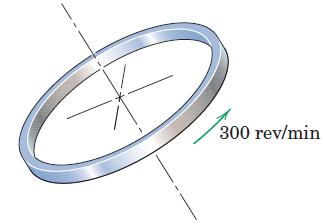
The thin ring is projected into the air with a spin velocity of 300 rev/min. If its geometric axis is observed to have a very slight precessional wobble, determine the frequency ƒ of the wobble. 300 rev/min
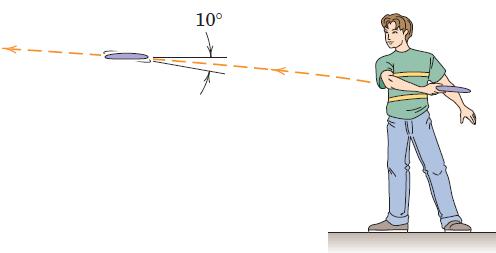
A boy throws a thin circular disk (like a Frisbee) with a spin rate of 300 rev/min. The plane of the disk is seen to wobble through a total angle of 10°. Calculate the period τ of the wobble and indicate whether the precession is direct or retrograde. 10°
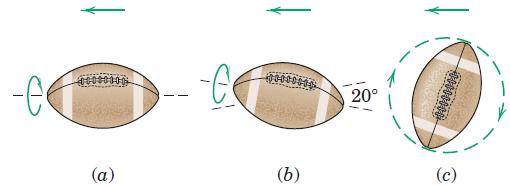
The figure shows a football in three common inflight configurations. Case (a) is a perfectly thrown spiral pass with a spin rate of 120 rev/min. Case (b) is a wobbly spiral pass again with a spin rate of 120 rev/min about its own axis, but with the axis wobbling through a total angle of
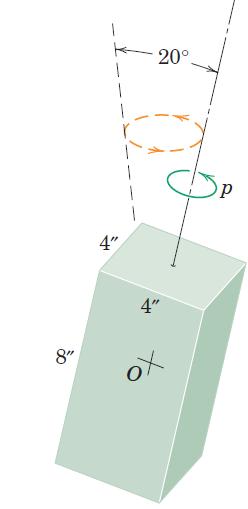
The rectangular bar is spinning in space about its longitudinal axis at the rate p = 200 rev/min. If its axis wobbles through a total angle of 20° as shown, calculate the period τ of the wobble. 20°. 4" 4" 8" of
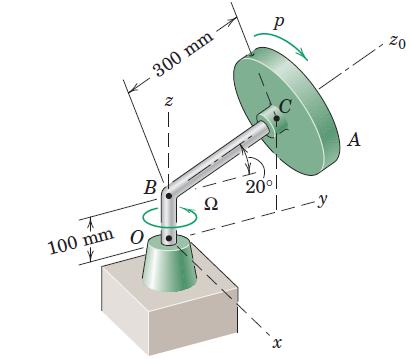
The 5-kg disk and hub A have a radius of gyration of 85 mm about the z0-axis and spin at the rate p = 1250 rev/min. Simultaneously, the assembly rotates about the vertical z-axis at the rate Ω = 400 rev/min. Calculate the gyroscopic moment M exerted on the shaft at C by the disk and the bending
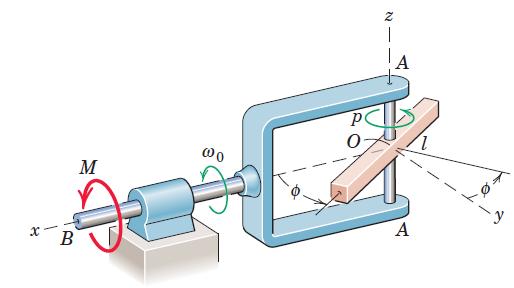
The uniform slender bar of mass m and length l is centrally mounted on the shaft A-A, about which it rotates with a constant speed Φ˙ = p. Simultaneously, the yoke is forced to rotate about the x-axis with a constant speed w0. As a function of Φ, determine the magnitude of the torque M required
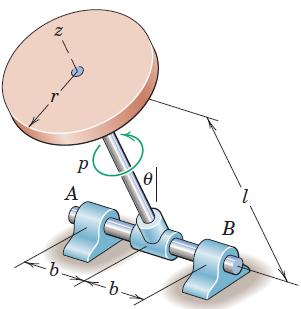
The solid circular disk of mass m and small thickness is spinning freely on its shaft at the rate p. If the assembly is released in the vertical position at θ = 0 with θ˙ = 0, determine the horizontal components of the forces A and B exerted by the respective bearings on the horizontal shaft as
The two solid homogeneous right-circular cones, each of mass m, are fastened together at their vertices to form a rigid unit and are spinning about their axis of radial symmetry at the rate p = 200 rev/min. (a) Determine the ratio h/r for which the rotation axis will not process. (b)
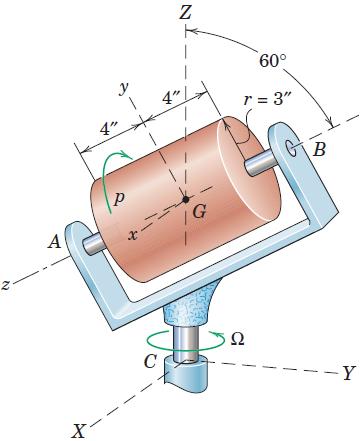
The solid cylindrical rotor weighs 64.4 lb and is mounted in bearings A and B of the frame which rotates about the vertical Z-axis. If the rotor spins at the constant rate p = 50 rad/sec relative to the frame and if the frame itself rotates at the constant rate Ω = 30 rad/sec, compute the bending
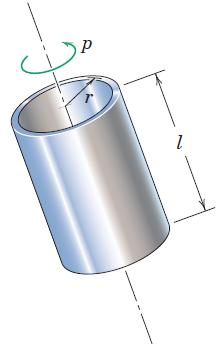
The cylindrical shell is rotating in space about its geometric axis. If the axis has a slight wobble, for what ratios of l/r will the motion be direct or retrograde precession?
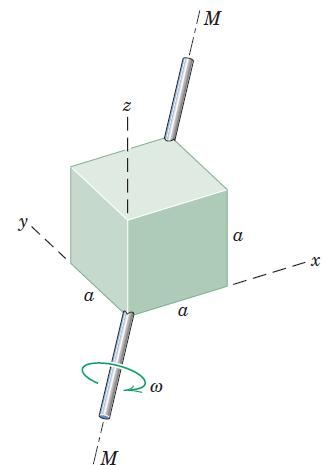
The solid cube of mass m and side a revolves about an axis M-M through a diagonal with an angular velocity w. Write the expression for the angular momentum H of the cube with respect to the axes indicated. IM a ター a a の IM
An experimental car is equipped with a gyro stabilizer to counteract completely the tendency of the car to tip when rounding a curve (no change in normal force between tires and road). The rotor of the gyro has a mass m0 and a radius of gyration k, and is mounted in fixed bearings on a shaft which
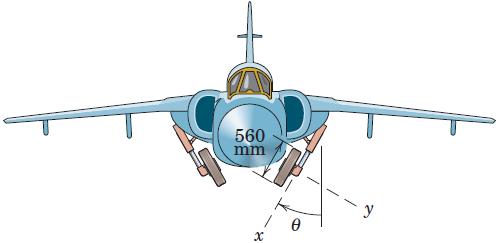
The wheels of the jet plane are spinning at their angular rate corresponding to a takeoff speed of 150 km/h. The retracting mechanism operates with θ increasing at the rate of 30° per second. Calculate the angular acceleration a of the wheels for these conditions. 560 mm y
Showing 1400 - 1500
of 2550
First
8
9
10
11
12
13
14
15
16
17
18
19
20
21
22
Last
Step by Step Answers

 Get 50% OFF
Claim Now
Get 50% OFF
Claim Now