New Semester
Started
Get
50% OFF
Study Help!
--h --m --s
Claim Now
Question Answers
Textbooks
Find textbooks, questions and answers
Oops, something went wrong!
Change your search query and then try again
S
Books
FREE
Study Help
Expert Questions
Accounting
General Management
Mathematics
Finance
Organizational Behaviour
Law
Physics
Operating System
Management Leadership
Sociology
Programming
Marketing
Database
Computer Network
Economics
Textbooks Solutions
Accounting
Managerial Accounting
Management Leadership
Cost Accounting
Statistics
Business Law
Corporate Finance
Finance
Economics
Auditing
Tutors
Online Tutors
Find a Tutor
Hire a Tutor
Become a Tutor
AI Tutor
AI Study Planner
NEW
Sell Books
Search
Search
Sign In
Register
study help
engineering
engineering mechanics dynamics
Engineering Mechanics Dynamics 8th Edition James L. Meriam, L. G. Kraige, J. N. Bolton - Solutions
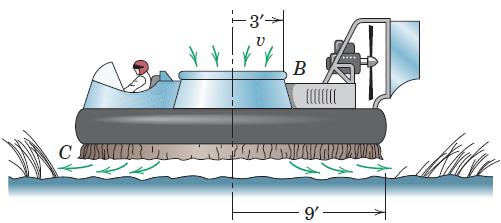
The experimental ground-effect machine has a total weight of 4200 lb. It hovers 1 or 2 ft off the ground by pumping air at atmospheric pressure through the circular intake duct at B and discharging it horizontally under the periphery of the skirt C. For an intake velocity v of 150 ft/sec, calculate
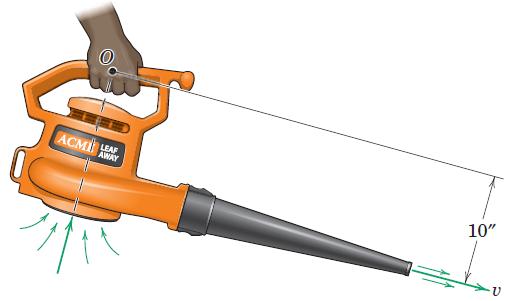
The leaf blower draws in air at a rate of 400 ft3/min and discharges it at a speed v = 240 mi / hr. If the specific weight of the air being drawn into the blower is 7.53(10−2) lb /ft3, determine the added torque which the man must exert on the handle of the blower when it is running, compared
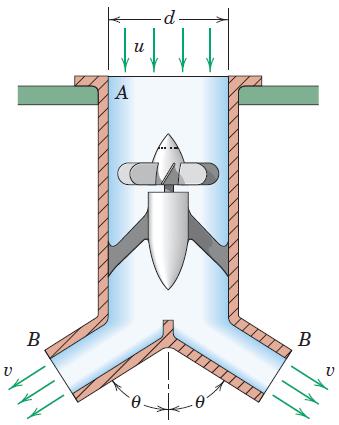
The ducted fan unit of mass m is supported in the vertical position on its flange at A. The unit draws in air with a density ρ and a velocity u through section A and discharges it through section B with a velocity v. Both inlet and outlet pressures are atmospheric. Write an expression for the
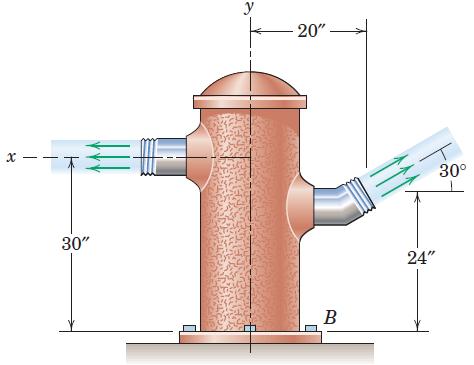
The fi re hydrant is tested under a high standpipe pressure. The total flow of 10 ft3/sec is divided equally between the two outlets, each of which has a cross-sectional area of 0.040 ft2. The inlet cross-sectional area at the base is 0.75 ft2. Neglect the weight of the hydrant and water within it
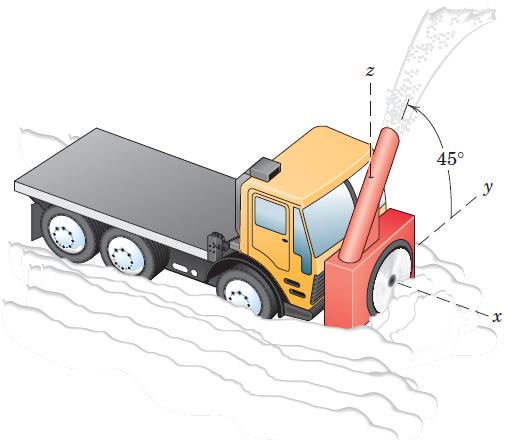
A rotary snow plow mounted on a large truck eats its way through a snow drift on a level road at a constant speed of 20 km/h. The plow discharges 60 Mg of snow per minute from its 45° chute with a velocity of 12 m/s relative to the plow. Calculate the tractive force P on the tires in the direction
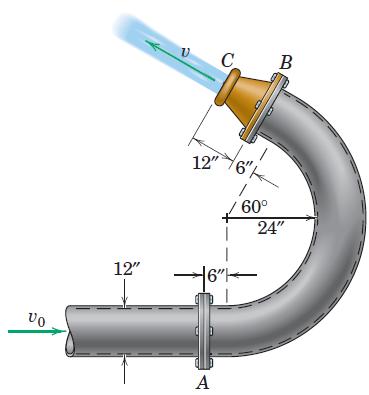
Salt water flows through the fixed 12-in.-insidediameter pipe at a speed v0 = 4 ft/sec and enters the 150° bend with inside radius of 24 in. The water exits to the atmosphere through the 6-in.-diameter nozzle C. Determine the shear force V, axial force P, and bending moment M at flanges A and B
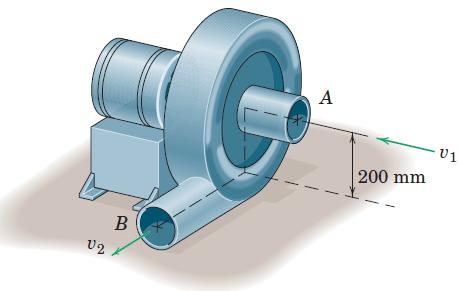
The industrial blower sucks in air through the axial opening A with a velocity v1 and discharges it at atmospheric pressure and temperature through the 150-mm-diameter duct B with a velocity v2. The blower handles 16 m3 of air per minute with the motor and fan running at 3450 rev/min. If the motor
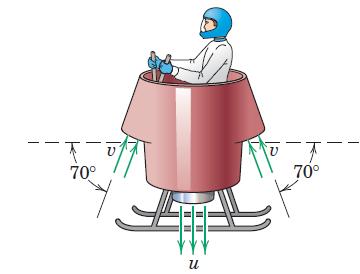
The feasibility of a one-passenger VTOL (vertical takeoff and landing) craft is under review. The preliminary design calls for a small engine with a high power-to-weight ratio driving an air pump that draws in air through the 70° ducts with an inlet velocity v = 40 m/s at a static gage pressure of
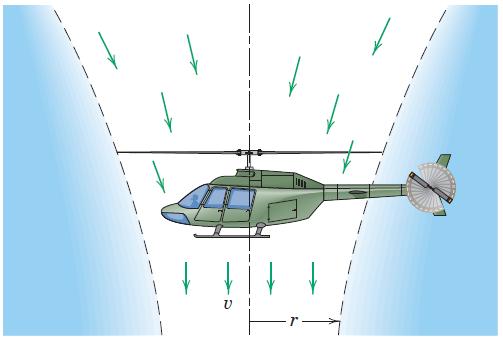
The helicopter shown has a mass m and hovers in position by imparting downward momentum to a column of air defined by the slipstream boundary shown. Find the downward velocity v given to the air by the rotor at a section in the stream below the rotor, where the pressure is atmospheric and the
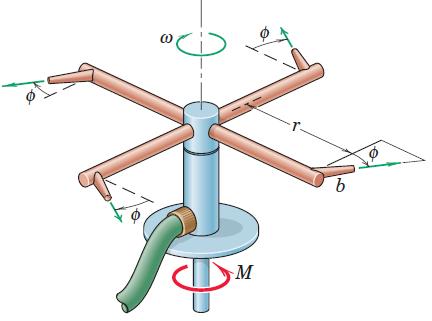
The sprinkler is made to rotate at the constant angular velocity ω and distributes water at the volume rate Q. Each of the four nozzles has an exit area A. Water is ejected from each nozzle at an angle Φ that is measured in the horizontal plane as shown. Write an expression for the torque M on
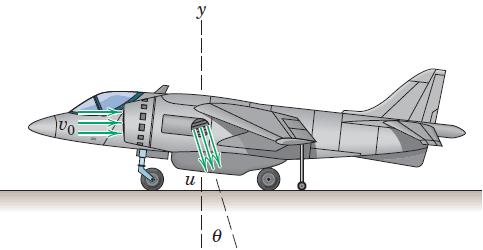
The VTOL (vertical takeoff and landing) military aircraft is capable of rising vertically under the action of its jet exhaust, which can be “vectored” from θ ≅ 0 for takeoff and hovering to θ = 90° for forward flight. The loaded aircraft has a mass of 8600 kg. At full takeoff power, its
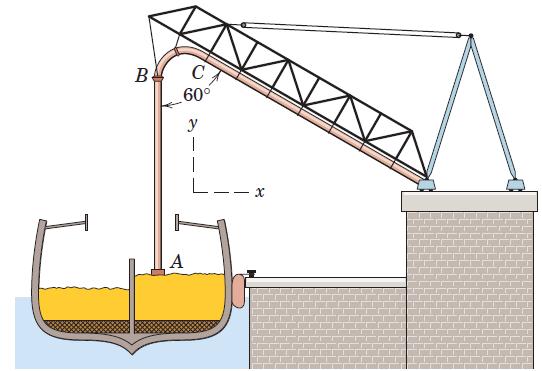
A marine terminal for unloading bulk wheat from a ship is equipped with a vertical pipe with a nozzle at A which sucks wheat up the pipe and transfers it to the storage building. Calculate the x- and y components of the force R required to change the momentum of the flowing mass in rounding the
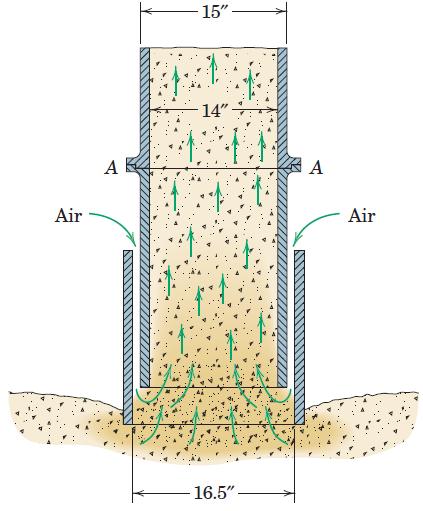
An axial section of the suction nozzle A for a bulk wheat unloader is shown here. The outer pipe is secured to the inner pipe by several longitudinal webs which do not restrict the flow of air. A vacuum of 9 in. of mercury (p = −4.42 lb/in.2 gage) is maintained in the inner pipe, and the pressure
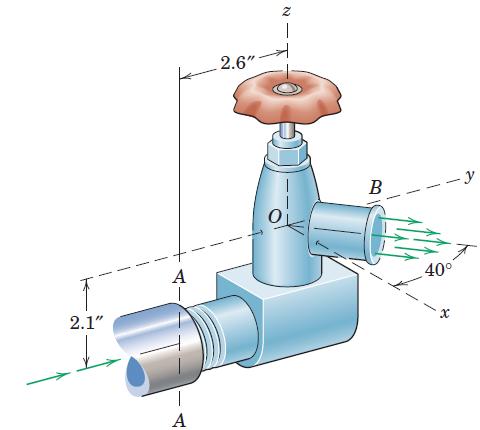
The valve, which is screwed into the fixed pipe at section A-A, is designed to discharge fresh water at the rate of 340 gal/min into the atmosphere in the x-y plane as shown. Water pressure at A-A is 150 lb/in.2 gage. The flow area at A-A has a diameter of 2 in., and the diameter of the discharge
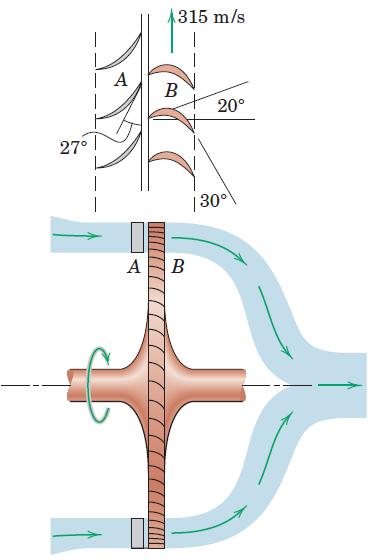
In the figure is shown a detail of the stationary nozzle diaphragm A and the rotating blades B of a gas turbine. The products of combustion pass through the fixed diaphragm blades at the 27° angle and impinge on the moving rotor blades. The angles shown are selected so that the velocity of the gas
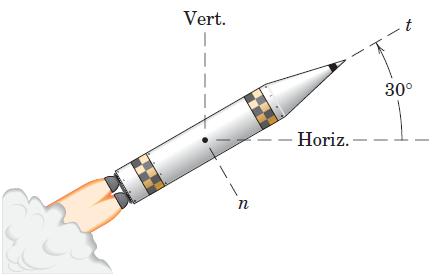
When the rocket reaches the position in its trajectory shown, it has a mass of 3 Mg and is beyond the effect of the earth’s atmosphere. Gravitational acceleration is 9.60 m/s2. Fuel is being consumed at the rate of 130 kg/s, and the exhaust velocity relative to the nozzle is 600 m/s. Compute the
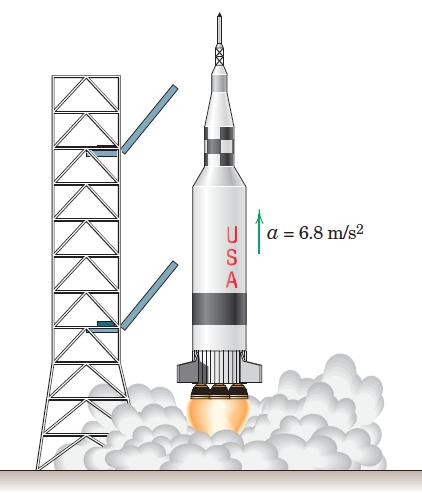
At the instant of vertical launch the rocket expels exhaust at the rate of 220 kg/s with an exhaust velocity of 820 m/s. If the initial vertical acceleration is 6.80 m/s2, calculate the total mass of the rocket and fuel at launch. a = 6.8 m/s2 USA KKKKKKKKKK
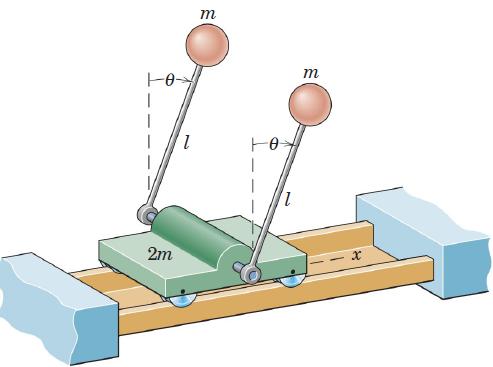
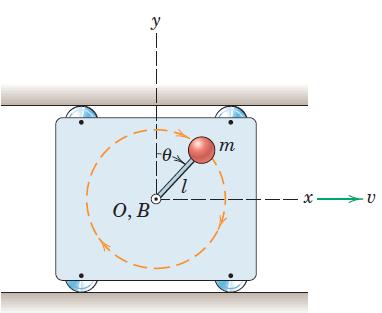
Consider the system of Prob. 3/311 where the mass of the ball is m = 10 kg and the length of the light rod is l = 0.8 m. The ball–rod assembly is free to rotate about a vertical axis through O. The carriage, rod, and ball are initially at rest with θ = 0 when the carriage is given a constant
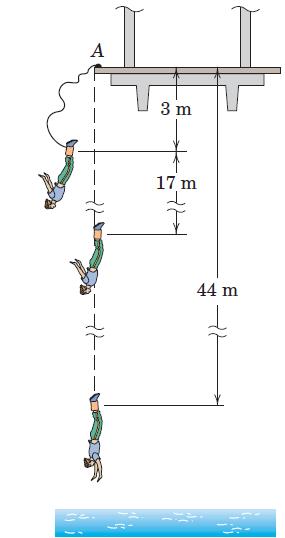
The bungee jumper, an 80-kg man, falls from the bridge at A with the bungee cord secured to his ankles. He falls 20 m before the 17-m length of elastic bungee cord begins to stretch. The 3 m of rope above the elastic cord has no appreciable stretch. The man is observed to drop a total of 44 m
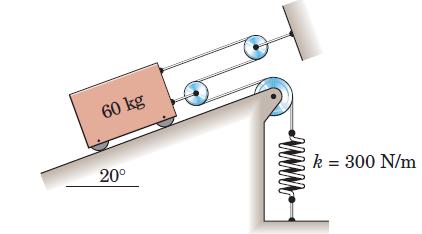
The system is released from rest with the spring initially stretched 25 mm. Calculate the velocity v of the 60-kg cart after it has moved 100 mm down the incline. Also determine the maximum distance traveled by the cart before it stops momentarily. Neglect the mass and friction of the pulleys and
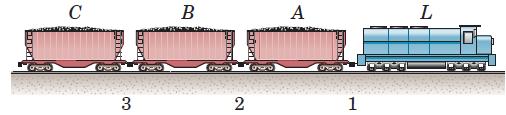
A short train consists of a 400,000-lb locomotive and three 200,000-lb hopper cars. The locomotive exerts a constant friction force of 40,000 lb on the rails as the train starts from rest. (a) If there is 1 ft of slack in each of the three couplers before the train begins moving, estimate the
A car of mass m is traveling at a road speed vr along an equatorial east–west highway at sea level. If the road follows the curvature of the earth, derive an expression for the difference ΔP between the total force exerted by the road on the car for eastward travel and the total force for
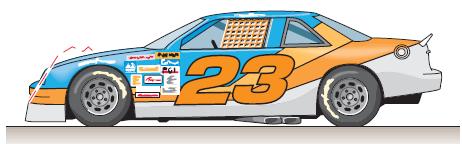
The retarding forces which act on the race car are the drag force FD and a nonaerodynamic force FR. The drag force is FD = CD (1/2 ρv2)S, where CD is the drag coefficient, ρ is the air density, v is the car speed, and S = 30 ft2 is the projected frontal area of the car. The nonaerodynamic force
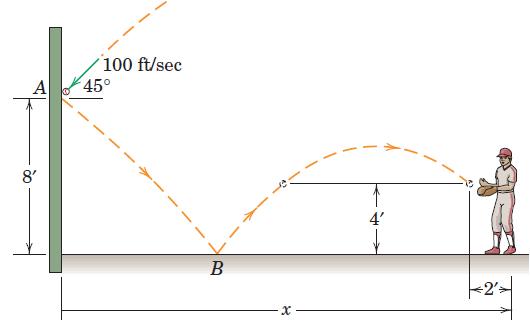
A long fly ball strikes the wall at point A (where e1= 0.5) and then hits the ground at B (where e2 = 0.3). The outfielder likes to catch the ball when it is 4ft above the ground and 2ft in front of him as shown. Determine the distance x from the wall where he can catch the ball as described.
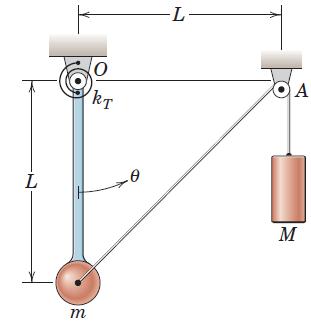
The system is released from rest while in the position shown with the torsional spring undeflected. The rod has negligible mass, and all friction is negligible. Determine (a) The value of θ˙ when θ is 30° (b) The maximum value of θ. Use the values m = 5 kg, M = 8 kg, L = 0.8 m, and
The cylinder of the previous problem is now replaced by a linear spring of constant k as shown. The system is released from rest in the position shown with the torsional spring undeflected but with the linear spring stretched 500 mm. Determine (a) The value of θ˙ when θ is 30° (b) The
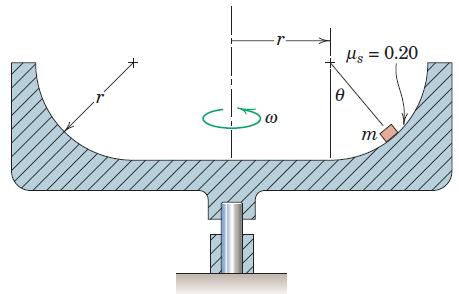
The bowl-shaped device rotates about a vertical axis with a constant angular velocity ω = 6 rad/s. The value of r is 0.2 m. Determine the range of the position angle θ for which a stationary value is possible if the coefficient of static friction between the particle and the surface is μs =
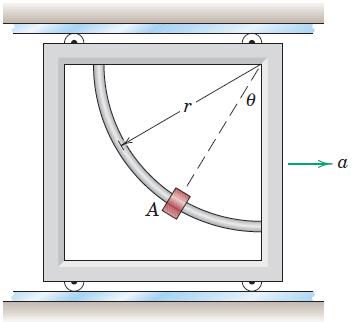
If the vertical frame starts from rest with a constant acceleration a and the smooth sliding collar A is initially at rest in the bottom position θ = 0, plot θ˙ as a function of θ and find the maximum position angle θmax reached by the collar. Use the values a = g/2 and r = 0.3 m. a A
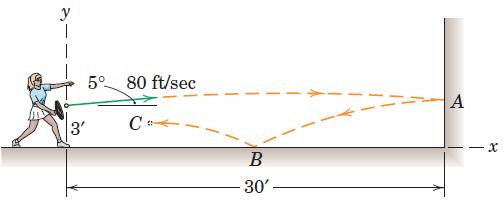
The tennis player practices by hitting the ball against the wall at A. The ball bounces off the court surface at B and then up to its maximum height at C. For the conditions shown in the figure, plot the location of point C for values of the coefficient of restitution in the range 0.5 ≤ e ≤
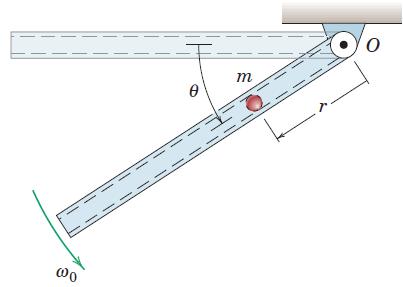
A particle of mass m is introduced with zero velocity at r = 0 when θ = 0. It slides outward through the smooth hollow tube, which is driven at the constant angular velocity ω0 about a horizontal axis through point O. If the length l of the tube is 1 m and ω0 = 0.5 rad /s, determine the time t
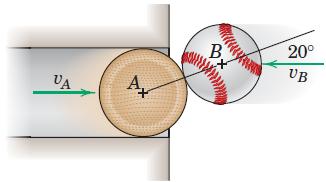
The elements of a device designed to measure the coefficient of restitution of bat–baseball collisions are repeated here from Prob. 3/265. The 1-lb “bat” A is a length of wood or aluminum which is projected to the right with a speed vA = 60 ft/sec and is confined to move horizontally in the
For the conditions stated in the previous problem, determine the time t at which the velocity of the block is a maximum.
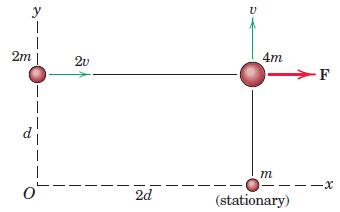
The system of three particles has the indicated particle masses, velocities, and external forces. Determine r̅, r̅̇, r̅̈, T, HO, and H˙ O for this two-dimensional system. y 2m | 20 4m -F m — х 2d (stationary)
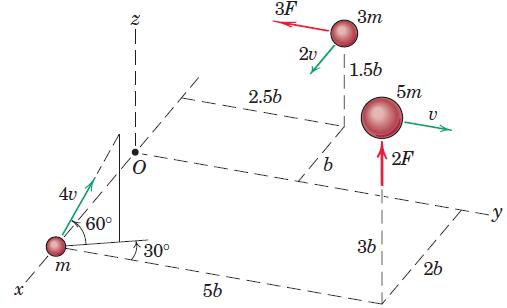
The system of three particles has the indicated particle masses, velocities, and external forces. Determine r̅, r̅̇, r̅̈ , T, HO, and H˙ O for this three-dimensional system. 3F 3m 2v 1.56 2.56 5m 2F 0. 60° 30° 36 m 26 56
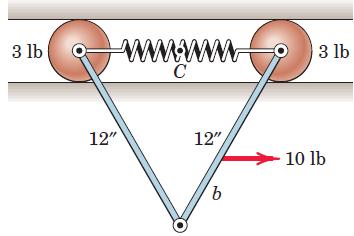
The system consists of the two smooth spheres, each weighing 3 lb and connected by a light spring, and the two bars of negligible weight hinged freely at their ends and hanging in the vertical plane. The spheres are confined to slide in the smooth horizontal guide. If a horizontal force F = 10 lb
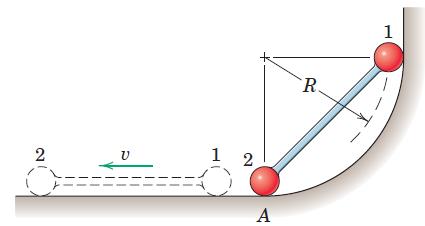
The two small spheres, each of mass m, are rigidly connected by a rod of negligible mass and are released from rest in the position shown and slide down the smooth circular guide in the vertical plane. Determine their common velocity v as they reach the horizontal dashed position. Also fi nd the
The angular momentum of a system of six particles about a fixed point O at time t = 4 s is H4 = 3.65i + 4.27j − 5.36k kg∙m2/s. At time t = 4.1 s, the angular momentum is H4.1 = 3.67i + 4.30j − 5.20k kg∙m2/s. Determine the average value of the resultant moment about point O of all forces
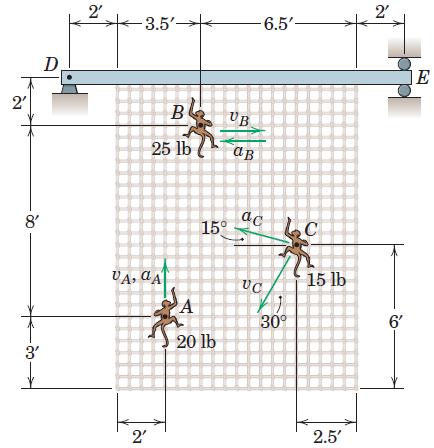
The monkeys of Prob. 4 /9 are now climbing along the heavy rope wall suspended from the uniform beam. If monkeys A, B, and C have velocities of 5, 3, and 2 ft/sec, and accelerations of 1.5, 0.5, and 2 ft/sec2, respectively, determine the changes in the reactions at D and E caused by the motion and
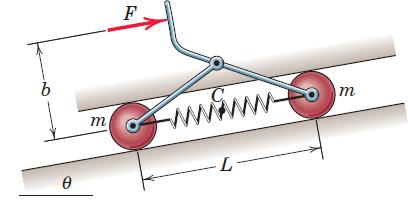
The two spheres, each of mass m, are connected by the spring and hinged bars of negligible mass. The spheres are free to slide in the smooth guide up the incline θ. Determine the acceleration aC of the center C of the spring. F m т Vww. m -
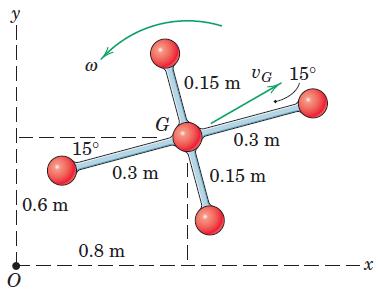
Each of the five connected particles has a mass of 0.5 kg, and G is the mass center of the system. At a certain instant the angular velocity of the body is ω = 2 rad/s and the linear velocity of G is vG = 4 m/s in the direction shown. Determine the linear momentum of the body and its angular
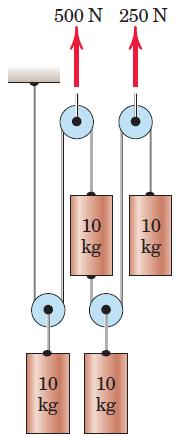
Calculate the acceleration of the center of mass of the system of the four 10-kg cylinders. Neglect friction and the mass of the pulleys and cables. 500 N 250 N 10 10 kg kg 10 kg 10 kg
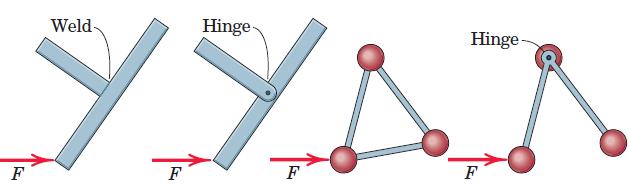
The four systems slide on a smooth horizontal surface and have the same mass m. The configurations of mass in the two pairs are identical. What can be said about the acceleration of the mass center for each system? Explain any difference in the accelerations of the members. Weld Hinge- Hinge- F F F
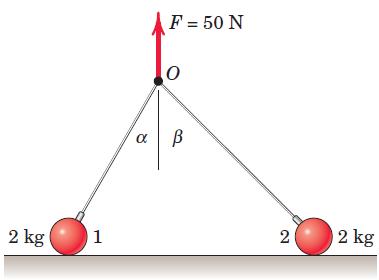
Calculate the vertical acceleration of the system mass center and the individual vertical accelerations of spheres 1 and 2 for the cases (a) α = β and (b) α ≠ β. Each sphere has a mass of 2 kg, and the 50-N force is applied vertically to the junction O of the two light wires. The spheres are
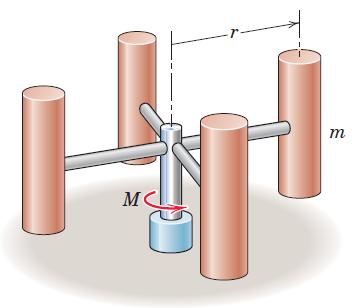
A centrifuge consists of four cylindrical containers, each of mass m, at a radial distance r from the rotation axis. Determine the time t required to bring the centrifuge to an angular velocity ω from rest under a constant torque M applied to the shaft. The diameter of each container is small
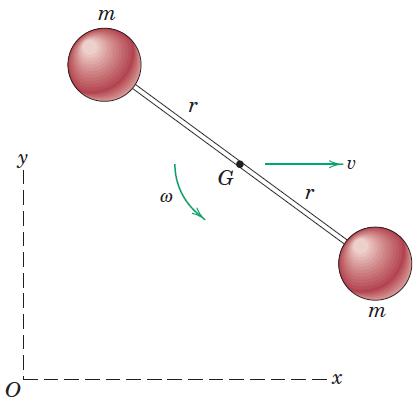
The two small spheres, each of mass m, and their connecting rod of negligible mass are rotating about their mass center G with an angular velocity ω. At the same instant the mass center has a velocity v in the x-direction. Determine the angular momentum HO of the assembly at the instant when G has
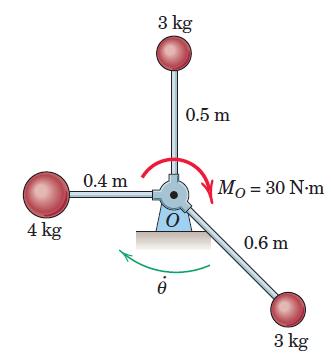
The three small spheres are welded to the light rigid frame which is rotating in a horizontal plane about a vertical axis through O with an angular velocity θ˙ = 20 rad/s. If a couple MO = 30 N∙m is applied to the frame for 5 seconds, compute the new angular velocity θ˙′. 3 kg 0.5 m 0.4 m
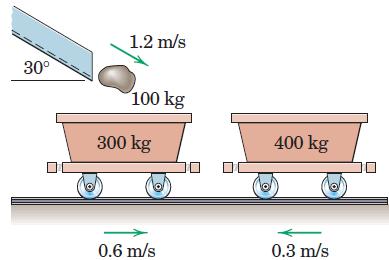
The 300-kg and 400-kg mine cars are rolling in opposite directions along the horizontal track with the respective speeds of 0.6 m/s and 0.3 m/s. Upon impact the cars become coupled together. Just prior to impact, a 100-kg boulder leaves the delivery chute with a velocity of 1.2 m/s in the direction
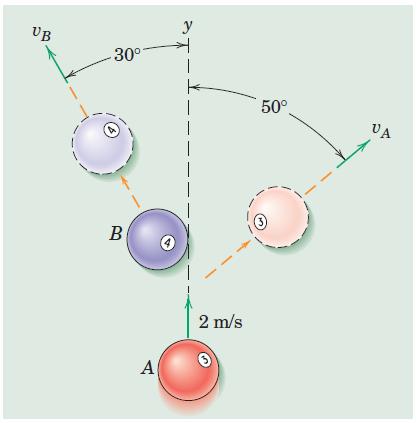
Billiard ball A is moving in the y-direction with a velocity of 2 m/s when it strikes ball B of identical size and mass initially at rest. Following the impact, the balls are observed to move in the directions shown. Calculate the velocities vA and vB which the balls have immediately after the
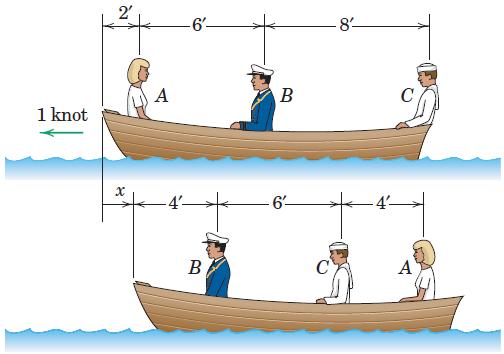
The woman A, the captain B, and the sailor C weigh 120, 180, and 160 lb, respectively, and are sitting in the 300-lb skiff, which is gliding through the water with a speed of 1 knot. If the three people change their positions as shown in the second figure, find the distance x from the skiff to the
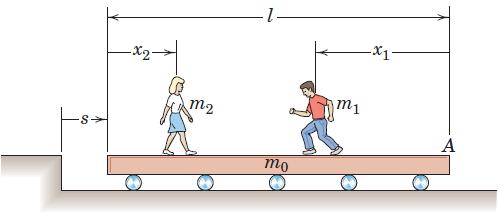
The man of mass m1 and the woman of mass m2 are standing on opposite ends of the platform of mass m0 which moves with negligible friction and is initially at rest with s = 0. The man and woman begin to approach each other. Derive an expression for the displacement s of the platform when the two
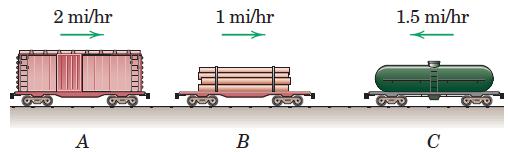
The three freight cars are rolling along the horizontal track with the velocities shown. After the impacts occur, the three cars become coupled together and move with a common velocity v. The weights of the loaded cars A, B, and C are 130,000, 100,000, and 150,000 lb, respectively. Determine v and
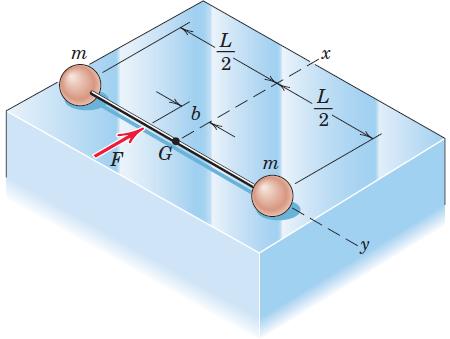
Two steel balls, each of mass m, are welded to a light rod of length L and negligible mass and are initially at rest on a smooth horizontal surface. A horizontal force of magnitude F is suddenly applied to the rod as shown. Determine (a) The instantaneous acceleration a̅ of the mass center
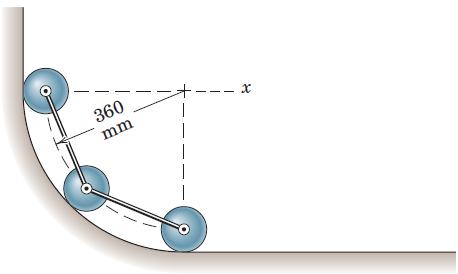
The three small steel balls, each of mass 2.75 kg, are connected by the hinged links of negligible mass and equal length. They are released from rest in the positions shown and slide down the quarter-circular guide in the vertical plane. When the upper sphere reaches the bottom position, the
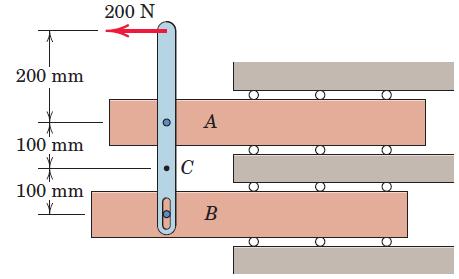
Each of the bars A and B has a mass of 10 kg and slides in its horizontal guideway with negligible friction. Motion is controlled by the lever of negligible mass connected to the bars as shown. Calculate the acceleration of point C on the lever when the 200-N force is applied as indicated. To
The carriage of mass 2m is free to roll along the horizontal rails and carries the two spheres, each of mass m, mounted on rods of length l and negligible mass. The shaft to which the rods are secured is mounted in the carriage and is free to rotate. If the system is released from rest with the
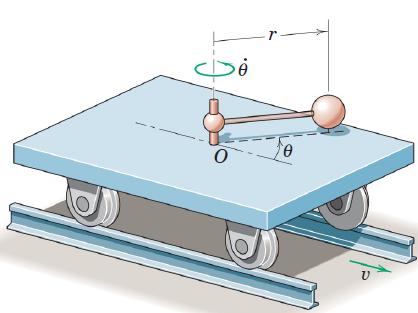
The small car, which has a mass of 20 kg, rolls freely on the horizontal track and carries the 5-kg sphere mounted on the light rotating rod with r = 0.4 m. A geared motor drive maintains a constant angular speed θ˙ = 4 rad /s of the rod. If the car has a velocity v = 0.6 m /s when θ = 0,
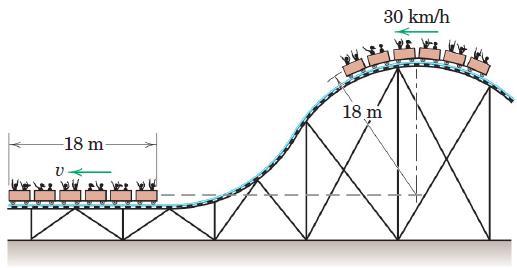
The cars of a roller-coaster ride have a speed of 30 km/h as they pass over the top of the circular track. Neglect any friction and calculate their speed v when they reach the horizontal bottom position. At the top position, the radius of the circular path of their mass centers is 18 m, and all six
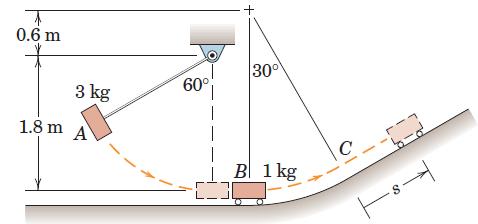
The 3-kg block A is released from rest in the 60° position shown and subsequently strikes the 1-kg cart B. If the coefficient of restitution for the collision is e = 0.7, determine the maximum displacement s of cart B beyond point C. Neglect friction. 0.6 m 300 3 kg 60° 1.8 m A B 1 kg
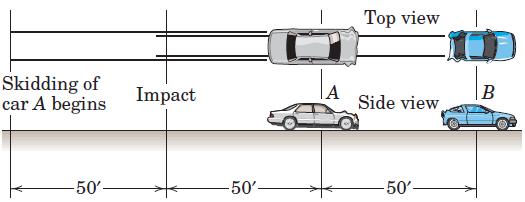
An automobile accident occurs as follows: The driver of a full-size car (vehicle A, 4000 lb) is traveling on a dry, level road and approaches a stationary compact car (vehicle B, 2000 lb). Just 50 feet before collision, he applies the brakes, skidding all wheels. After impact, vehicle A skids an
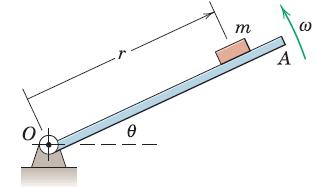
The member OA rotates about a horizontal axis through O with a constant counterclockwise angular velocity ω = 3 rad /sec. As it passes the position θ = 0, a small block of mass m is placed on it at a radial distance r = 18 in. If the block is observed to slip at θ = 50°, determine the
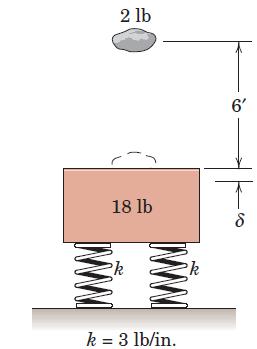
The 2-lb piece of putty is dropped 6 ft onto the 18-lb block initially at rest on the two springs, each with a stiffness k = 3 lb/in. Calculate the additional deflection δ of the springs due to the impact of the putty, which adheres to the block upon contact. 2 lb 6' 18 lb k = 3 lb/in.
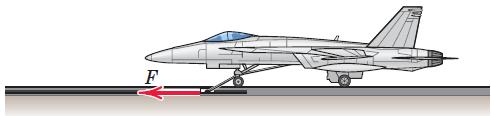
An electromagnetic catapult system is being designed to replace a steam-driven system on an aircraft carrier. The requirements include accelerating a 12 000-kg aircraft from rest to a speed of 70 m/s over a distance of 90 m. What constant force F must the catapult exert on the aircraft? F
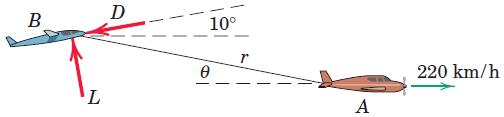
The 200-kg glider B is being towed by airplane A, which is flying horizontally with a constant speed of 220 km / h. The tow cable has a length r = 60 m and may be assumed to form a straight line. The glider is gaining altitude and when θ reaches 15°, the angle is increasing at the constant rate
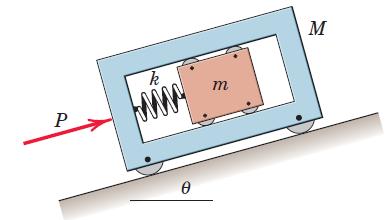
For a given value of the force P, determine the steady-state spring compression δ, which is measured relative to the unstretched length of the spring of modulus k. The mass of the cart is M and that of the slider is m. Neglect all friction. State the values of P and δ associated with the
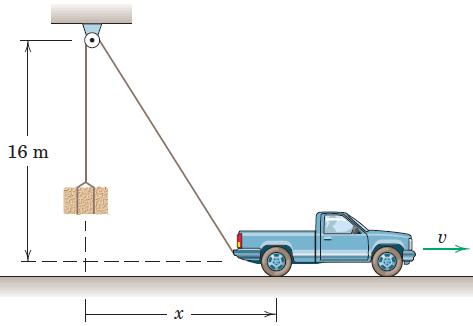
The pickup truck is used to hoist the 40-kg bale of hay as shown. If the truck has reached a constant velocity v = 5 m/s when x = 12 m, compute the corresponding tension T in the rope. 16 m
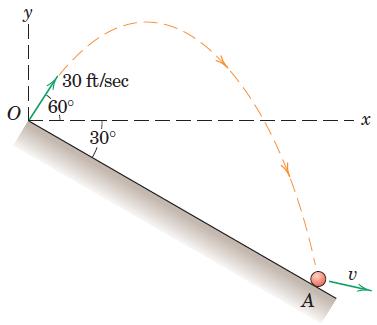
A ball is thrown from point O with a velocity of 30 ft/sec at a 60° angle with the horizontal and bounces on the inclined plane at A. If the coefficient of restitution is 0.6, calculate the magnitude v of the rebound velocity at A. Neglect air resistance. y 30 ft/sec 60° 30° A |
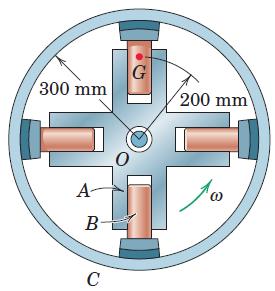
The figure shows a centrifugal clutch consisting in part of a rotating spider A which carries four plungers B. As the spider is made to rotate about its center with a speed ω, the plungers move outward and bear against the interior surface of the rim of wheel C, causing it to rotate. The wheel and
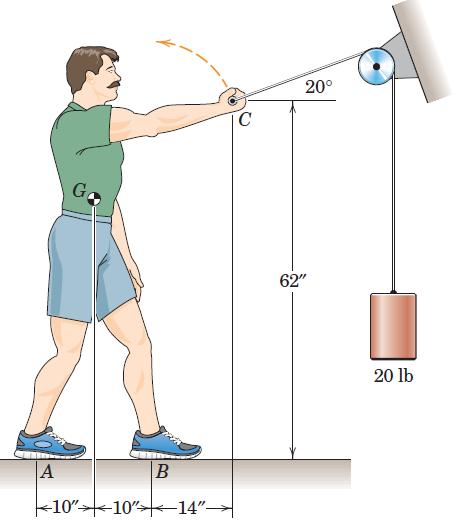
The 180-lb exerciser is beginning to execute a bicep curl. When in the position shown with his right elbow fixed, he causes the 20-lb cylinder to accelerate upward at the rate g/4. Neglect the effects of the mass of his lower arm and estimate the normal reaction forces at A and B. Friction is
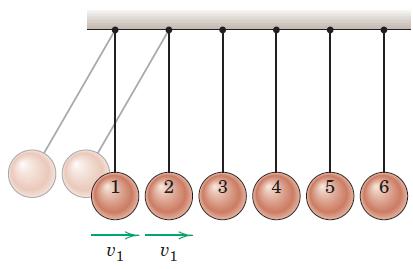
Six identical spheres are arranged as shown in the figure. The two spheres at the left end are released from the displaced positions and strike sphere 3 with speed v1. Assuming that the common coefficient of restitution is e = 1, explain why two spheres leave the right end of the row with speed v1
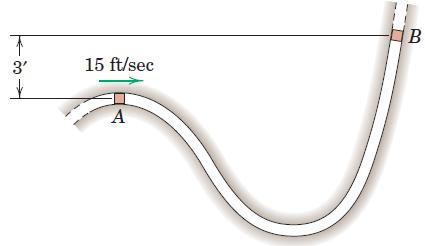
The small slider has a speed vA = 15 ft/sec as it passes point A. Neglecting friction, determine its speed as it passes point B. 3' 15 ft/sec A
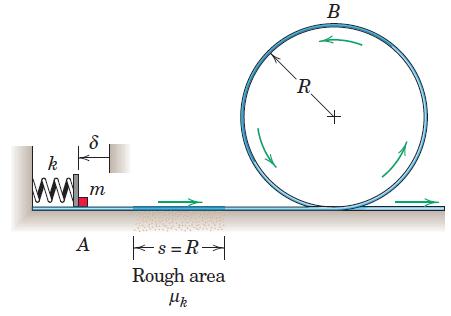
The spring of stiffness k is compressed and suddenly released, sending the particle of mass m sliding along the track. Determine the minimum spring compression δ for which the particle will not lose contact with the loop-the-loop track. The sliding surface is smooth except for the rough portion of
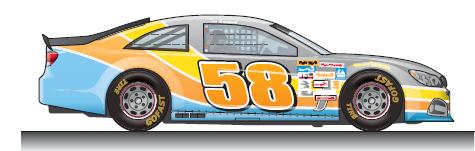
At a steady speed of 200 mi/hr along a level track, the racecar is subjected to an aerodynamic force of 900 lb and an overall rolling resistance of 200 lb. If the drivetrain efficiency is e = 0.90, what power P must the motor produce? 589 GOFM ISVOS TIRE
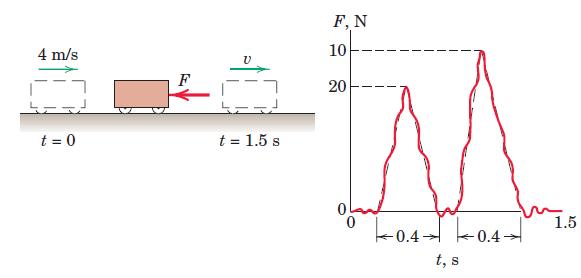
The small 2-kg carriage is moving freely along the horizontal with a speed of 4 m/s at time t = 0. A force applied to the carriage in the direction opposite to motion produces two impulse “peaks,” one after the other, as shown by the graphical plot of the readings of the instrument that
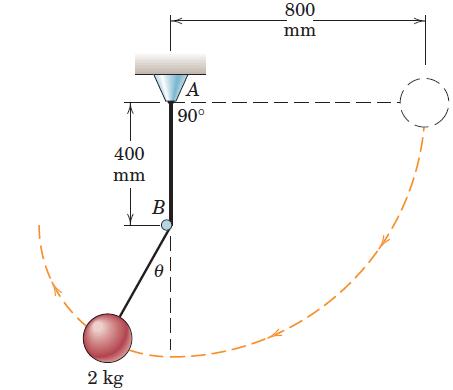
The simple 2-kg pendulum is released from rest in the horizontal position. As it reaches the bottom position, the cord wraps around the smooth fixed pin at B and continues in the smaller arc in the vertical plane. Calculate the magnitude of the force R supported by the pin at B when the pendulum
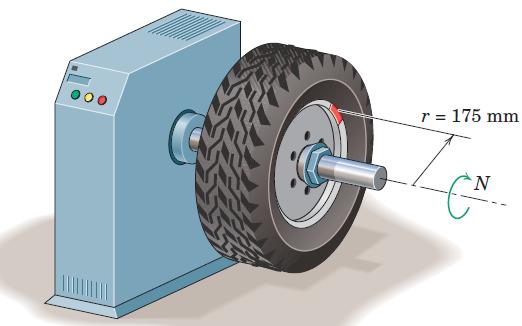
A 30-g tire-balance weight is attached to a vertical surface of the wheel rim by means of an adhesive backing. The tire–wheel unit is then given a final test on the tire-balance machine. If the adhesive can support a maximum shear force of 80 N, determine the maximum rotational speed N for which
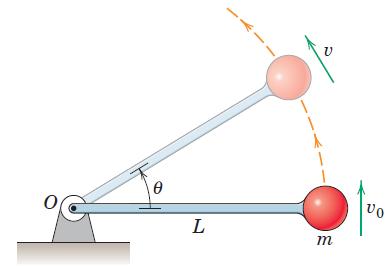
A particle of mass m is attached to the end of the light rigid rod of length L, and the assembly rotates freely about a horizontal axis through the pivot O. The particle is given an initial speed v0 when the assembly is in the horizontal position θ = 0. Determine the speed v of the particle as a
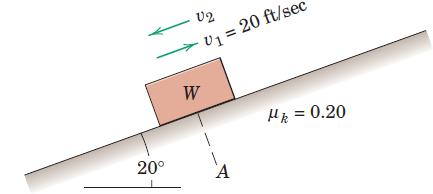
The block of weight W is given an initial velocity v1 = 20 ft/sec up the 20° incline at point A. Calculate the velocity v2 with which the block passes A as it slides back down. U2 V1 = 20 ft/sec W Hk = 0.20 20° A
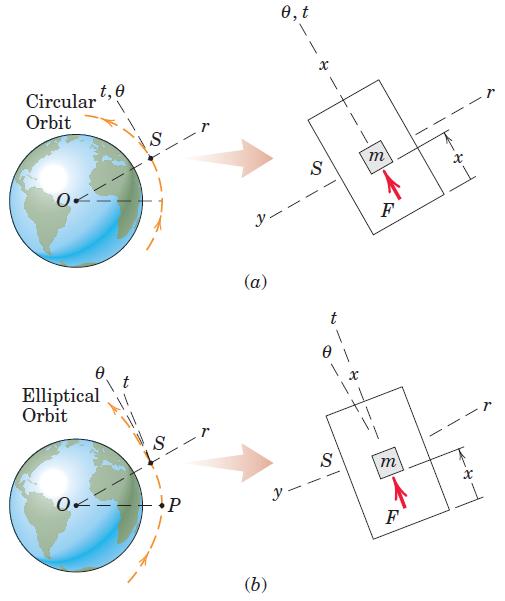
The figure represents the space shuttle S, which is (a) In a circular orbit about the earth (b) In an elliptical orbit where P is its perigee position. The exploded views on the right represent the cabin space with its x-axis oriented in the direction of the orbit. The astronauts
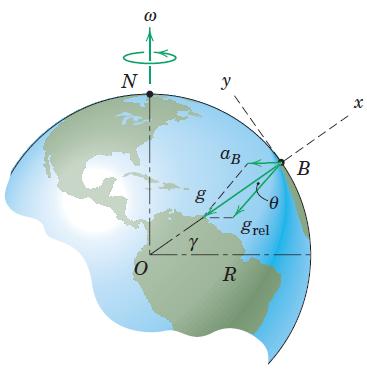
When a particle is dropped from rest relative to the surface of the earth at a latitude , the initial apparent acceleration is the relative acceleration due to gravity grel. The absolute acceleration due to gravity g is directed toward the center of the earth. Derive an expression for grel in terms
The small slider A moves with negligible friction down the tapered block, which moves to the right with constant speed v = v0. Use the principle of work-energy to determine the magnitude vA of the absolute velocity of the slider as it passes point C if it is released at point B with no velocity
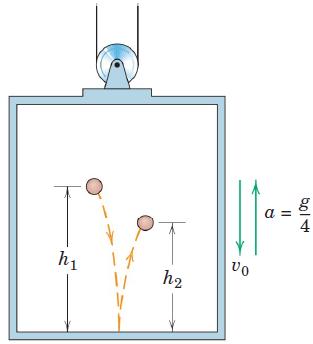
A ball is released from rest relative to the elevator at a distance h1 above the floor. The speed of the elevator at the time of ball release is v0. Determine the bounce height h2 of the ball (a) If v0 is constant (b) If an upward elevator acceleration a = g/4 begins at the instant
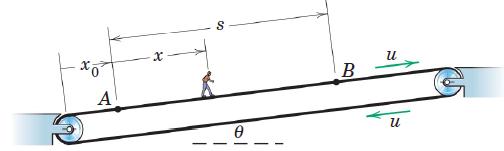
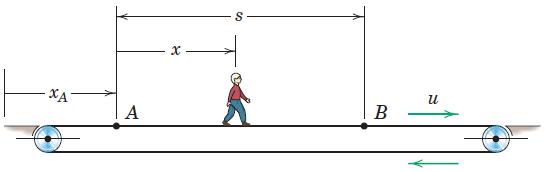
A boy of mass m is standing initially at rest relative to the moving walkway inclined at the angle θ and moving with a constant speed u. He decides to accelerate his progress and starts to walk from point A with a steadily increasing speed and reaches point B with a speed vr relative to the
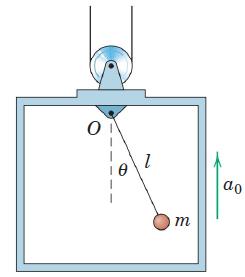
A simple pendulum is placed on an elevator, which accelerates upward as shown. If the pendulum is displaced an amount θ0 and released from rest relative to the elevator, find the tension T0 in the supporting light rod when θ = 0. Evaluate your result for θ0 = π/2. ao т
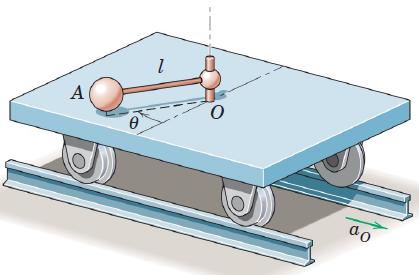
The ball A of mass 10 kg is attached to the light rod of length l = 0.8 m. The mass of the carriage alone is 250 kg, and it moves with an acceleration aO as shown. If θ˙ = 3 rad/s when θ = 90°, fi nd the kinetic energy T of the system if the carriage has a velocity of 0.8 m/s (a) In the
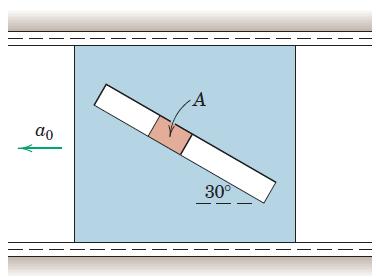
The slider A has a mass of 2 kg and moves with negligible friction in the 30° slot in the vertical sliding plate. What horizontal acceleration a0 should be given to the plate so that the absolute acceleration of the slider will be vertically down? What is the value of the corresponding force
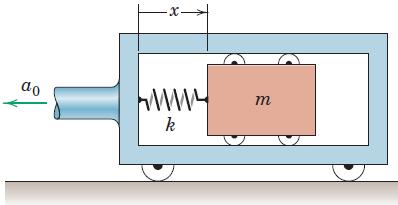
The block of mass m is attached to the frame by the spring of stiffness k and moves horizontally with negligible friction within the frame. The frame and block are initially at rest with x = x0, the uncompressed length of the spring. If the frame is given a constant acceleration a0, determine the
A boy of mass m is standing initially at rest relative to the moving walkway, which has a constant horizontal speed u. He decides to accelerate his progress and starts to walk from point A with a steadily increasing speed and reaches point B with a speed x˙ = v relative to the walkway. During his
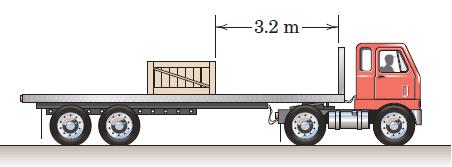
The coefficients of friction between the flatbed of the truck and crate are μs = 0.80 and μk = 0.70. The coefficient of kinetic friction between the truck tires and the road surface is 0.90. If the truck stops from an initial speed of 15 m/s with maximum braking (wheels skidding), determine where
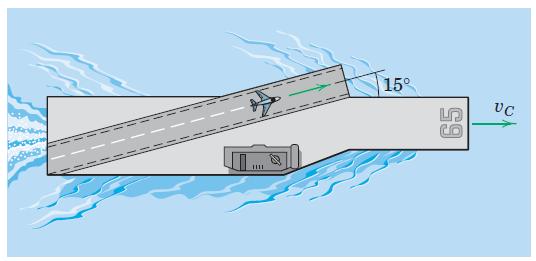
The launch catapult of the aircraft carrier gives the 7-Mg jet airplane a constant acceleration and launches the airplane in a distance of 100 m measured along the angled takeoff ramp. The carrier is moving at a steady speed vC = 16 m/s. If an absolute aircraft speed of 90 m /s is desired for
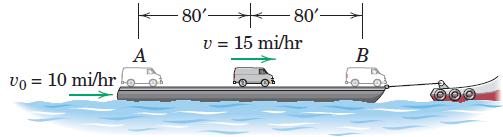
The 4000-lb van is driven from position A to position B on the barge, which is towed at a constant speed v0 = 10 mi/hr. The van starts from rest relative to the barge at A, accelerates to v = 15 mi/hr relative to the barge over a distance of 80 ft, and then stops with a deceleration of the same
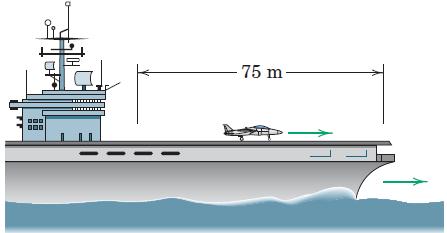
The aircraft carrier is moving at a constant speed and launches a jet plane with a mass of 3 Mg in a distance of 75 m along the deck by means of a steam-driven catapult. If the plane leaves the deck with a velocity of 240 km/h relative to the carrier and if the jet thrust is constant at 22 kN
The cart with attached x-y axes moves with an absolute speed v = 2 m/s to the right. Simultaneously, the light arm of length l = 0.5 m rotates about point B of the cart with angular velocity θ˙ = 2 rad/s. The mass of the sphere is m = 3 kg. Determine the following quantities for the sphere when
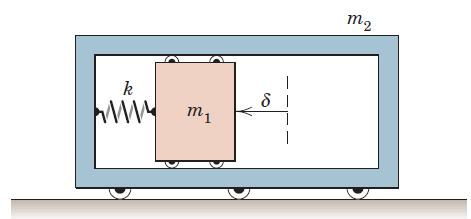
If the spring of constant k is compressed a distance δ as indicated, calculate the acceleration arel of the block of mass m1 relative to the frame of mass m2 upon release of the spring. The system is initially stationary. m2 k www W m1
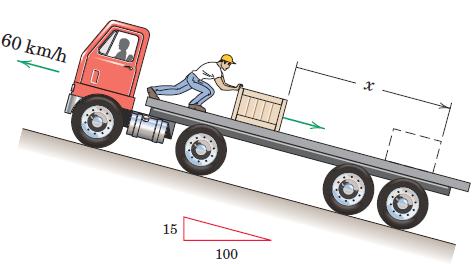
The flatbed truck is traveling at the constant speed of 60 km/h up the 15-percent grade when the 100-kg crate which it carries is given a shove which imparts to it an initial relative velocity x˙ = 3 m/s toward the rear of the truck. If the crate slides a distance x = 2 m measured on the truck bed
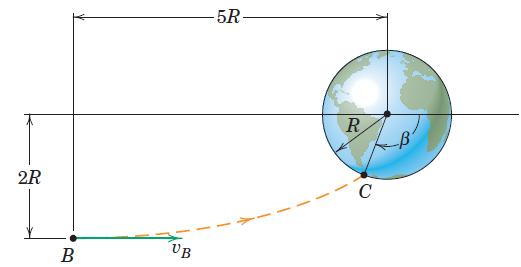
The satellite has a velocity at B of 3200 m/s in the direction indicated. Determine the angle β which locates the point C of impact with the earth. 5R R 2R B UB
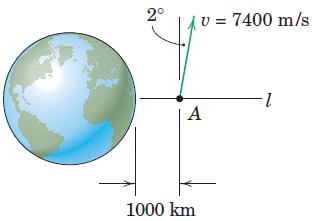
A spacecraft in an elliptical orbit has the position and velocity indicated in the figure at a certain instant. Determine the semimajor axis length a of the orbit and find the acute angle α between the semimajor axis and the line l. Does the spacecraft eventually strike the earth? 2° v = 7400 m/s
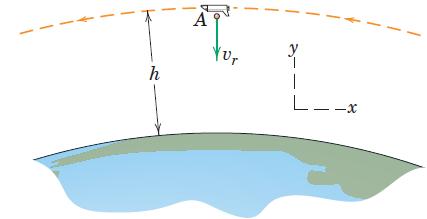
At the instant represented in the figure, a small experimental satellite A is ejected from the shuttle orbiter with a velocity vr = 100 m /s relative to the shuttle, directed toward the center of the earth. The shuttle is in a circular orbit of altitude h = 200 km. For the resulting elliptical
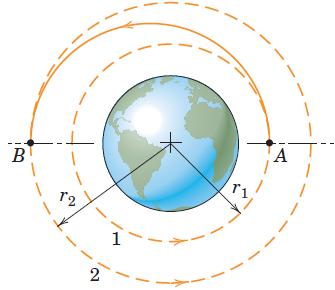
A space vehicle moving in a circular orbit of radius r1 transfers to a larger circular orbit of radius r2 by means of an elliptical path between A and B. (This transfer path is known as the Hohmann transfer ellipse.) The transfer is accomplished by a burst of speed ΔvA at A and a second burst
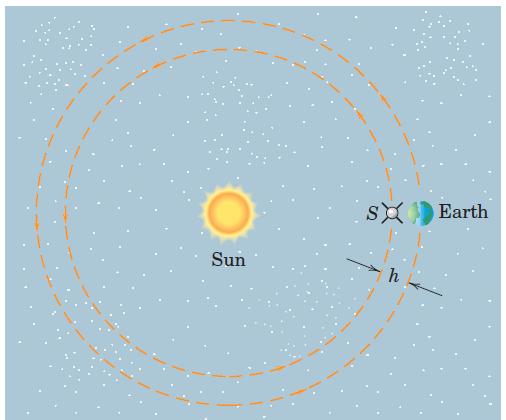
In 1995 a spacecraft called the Solar and Helio-spheric Observatory (SOHO) was placed into a circular orbit about the sun and inside that of the earth as shown. Determine the distance h so that the period of the spacecraft orbit will match that of the earth, with the result that the spacecraft will
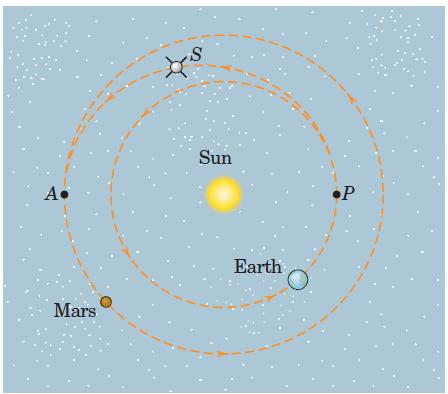
Sometime after launch from the earth, a spacecraft S is in the orbital path of the earth at some distance from the earth at position P. What velocity boost Δv at P is required so that the spacecraft arrives at the orbit of Mars at A as shown? Sun •P Earth Mars
Showing 1900 - 2000
of 2550
First
12
13
14
15
16
17
18
19
20
21
22
23
24
25
26
Step by Step Answers

 Get 50% OFF
Claim Now
Get 50% OFF
Claim Now