New Semester
Started
Get
50% OFF
Study Help!
--h --m --s
Claim Now
Question Answers
Textbooks
Find textbooks, questions and answers
Oops, something went wrong!
Change your search query and then try again
S
Books
FREE
Study Help
Expert Questions
Accounting
General Management
Mathematics
Finance
Organizational Behaviour
Law
Physics
Operating System
Management Leadership
Sociology
Programming
Marketing
Database
Computer Network
Economics
Textbooks Solutions
Accounting
Managerial Accounting
Management Leadership
Cost Accounting
Statistics
Business Law
Corporate Finance
Finance
Economics
Auditing
Tutors
Online Tutors
Find a Tutor
Hire a Tutor
Become a Tutor
AI Tutor
AI Study Planner
NEW
Sell Books
Search
Search
Sign In
Register
study help
engineering
engineering mechanics dynamics
Engineering Mechanics Dynamics 8th Edition James L. Meriam, L. G. Kraige, J. N. Bolton - Solutions
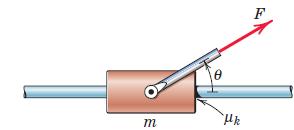
The collar of mass m slides on the rough horizontal shaft under the action of the force F of constant magnitude F ≤ mg but variable direction. If θ = kt where k is a constant, and if the collar has a speed v1 to the right when θ = 0, determine the velocity v2 of the collar when θ reaches 90°.
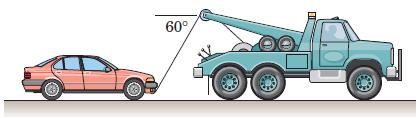
The tow truck with attached 1200-kg car accelerates uniformly from 30 km/h to 70 km/h over a 15-s interval. The average rolling resistance for the car over this speed interval is 500 N. Assume that the 60° angle shown represents the time average configuration and determine the average tension in
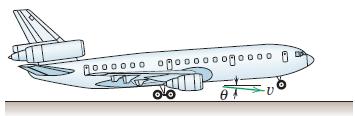
The 600,000-lb jet airliner has a touchdown velocity v = 120 mi/hr directed θ = 0.5° below the horizontal. The touchdown process of the eight main wheels takes 0.6 sec to complete. Treat the aircraft as a particle and estimate the average normal reaction force at each wheel during this 0.6-sec
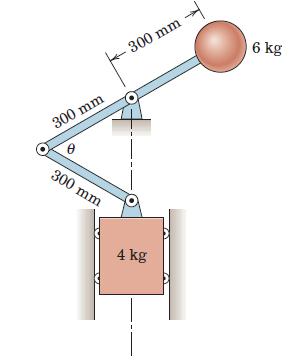
When the mechanism is released from rest in the position where θ = 60°, the 4-kg carriage drops and the 6-kg sphere rises. Determine the velocity v of the sphere when θ = 180°. Neglect the mass of the links and treat the sphere as a particle. 300 mm 6 kg 300 mm 300 mm 4 kg
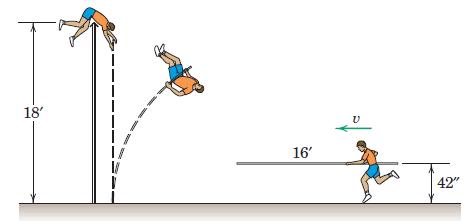
A 175-lb pole vaulter carrying a uniform 16-ft, 10-lb pole approaches the jump with a velocity v and manages to barely clear the bar set at a height of 18 ft. As he clears the bar, his velocity and that of the pole are essentially zero. Calculate the minimum possible value of v required for him to
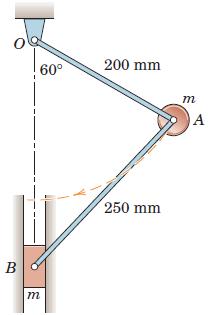
The small bodies A and B each of mass m are connected and supported by the pivoted links of negligible mass. If A is released from rest in the position shown, calculate its velocity vA as it crosses the vertical centerline. Neglect any friction. 60° 200 mm m A 250 mm B m
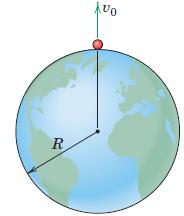
The projectile of Prob. 3/124 is repeated here. By the method of this article, determine the vertical launch velocity v0 which will result in a maximum altitude of R/3. The launch is from the north pole and aerodynamic drag can be neglected. Use g = 9.825 m/s2 as the surface-level acceleration due
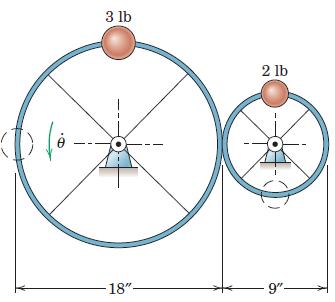
The two wheels consisting of hoops and spokes of negligible mass rotate about their respective centers and are pressed together sufficiently to prevent any slipping. The 3-lb and 2-lb eccentric masses are mounted on the rims of the wheels. If the wheels are given a slight nudge from rest in the
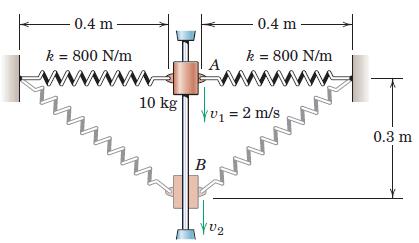
The 10-kg collar slides on the smooth vertical rod and has a velocity v1 = 2 m /s in position A where each spring is stretched 0.1 m. Calculate the velocity v2 of the collar as it passes point B. 0.4 m- 0.4 m k = 800 N/m k = 800 N/m www 10 kg = 2 m/s 0.3 m B
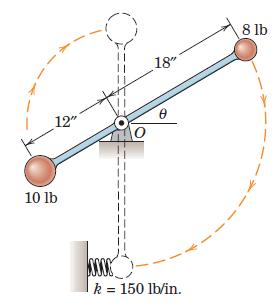
The light rod is pivoted at O and carries the 8- and 10-lb particles. If the rod is released from rest at θ = 30° and swings in the vertical plane, calculate (a) The velocity v of the 8-lb particle just before it hits the spring (b) The maximum compression x of the spring. Assume that x
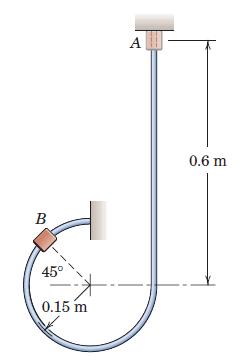
A bead with a mass of 0.25 kg is released from rest at A and slides down and around the fixed smooth wire. Determine the force N between the wire and the bead as it passes point B. A 0.6 m B 45° 0.15 m
A railroad car of mass m and initial speed v collides with and becomes coupled with the two identical cars. Compute the final speed v′ of the group of three cars and the fractional loss n of energy if (a) The initial separation distance d = 0 (that is, the two stationary cars are initially
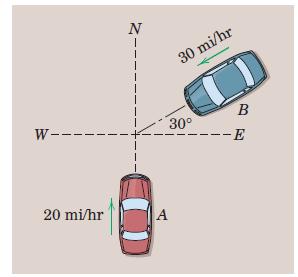
Car A weighing 3200 lb and traveling north at 20 mi/hr collides with car B weighing 3600 lb and traveling at 30 mi/hr as shown. If the two cars become entangled and move together as a unit after the crash, compute the magnitude v of their common velocity immediately after the impact and the angle
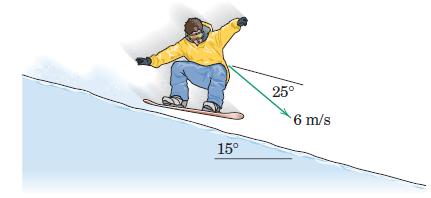
The snowboarder is traveling with a velocity of 6 m/s as shown when he lands on the incline with no rebound. If the impact has a time duration of 0.1 s, determine his speed v along the incline just after impact and the total time-average normal force exerted by the incline on the snowboard during
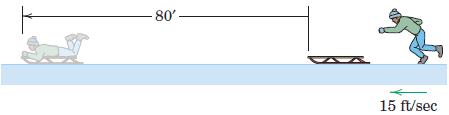
A boy weighing 100 lb runs and jumps on his 20-lb sled with a horizontal velocity of 15 ft/sec. If the sled and boy coast 80 ft on the level snow before coming to rest, compute the coefficient of kinetic friction μk between the snow and the runners of the sled. -80'- 15 ft/sec
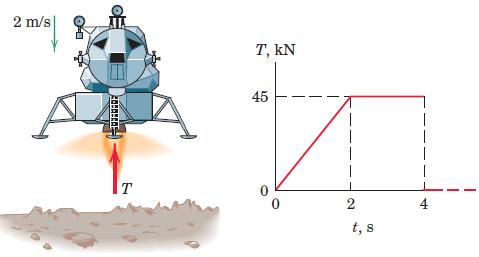
The 15 200-kg lunar lander is descending onto the moon’s surface with a velocity of 2 m/s when its retro-engine is fired. If the engine produces a thrust T for 4 s which varies with time as shown and then cuts off, calculate the velocity of the lander when t = 5 s, assuming that it has not yet
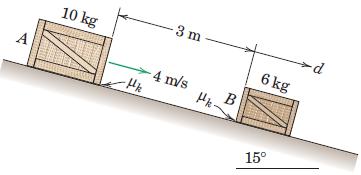
Crate A is traveling down the incline with a speed of 4 m/s when in the position shown. It later strikes and becomes attached to crate B. Determine the distance d moved by the pair after the collision. The coefficient of kinetic friction is μk = 0.40 for both crates. -3 m p- 6 kg 10 kg A 4 m/s В
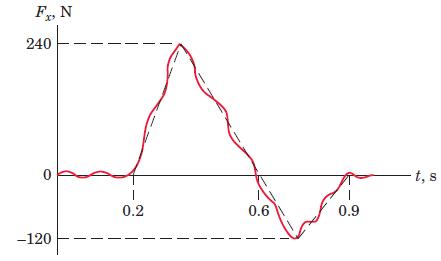
A 4-kg object, which is moving on a smooth horizontal surface with a velocity of 10 m/s in the−x-direction, is subjected to a force Fx which varies with time as shown. Approximate the experimental data by the dashed line and determine the velocity of the object (a) At t = 0.6 s (b) At t
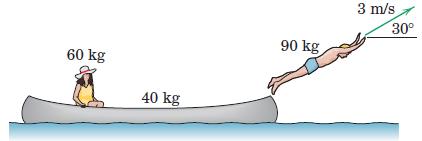
The 90-kg man dives from the 40-kg canoe. The velocity indicated in the figure is that of the man relative to the canoe just after loss of contact. If the man, woman, and canoe are initially at rest, determine the horizontal component of the absolute velocity of the canoe just after separation.
A 0.25-kg particle is moving with a velocity v1 = 2i + j − k m/s at time t1 = 2 s. If the single force F = (4 + 2t)i + (t2 − 2)j + 5k N acts on the particle, determine its velocity v2 at time t2 = 4 s.
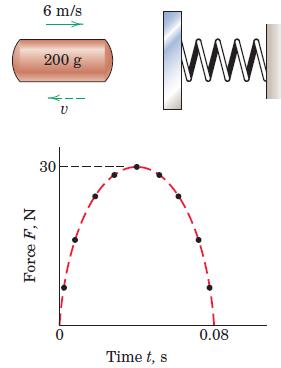
Careful measurements made during the impact of the 200-g metal cylinder with the spring-loaded plate reveal a semielliptical relation between the contact force F and the time t of impact as shown. Determine the rebound velocity v of the cylinder if it strikes the plate with a velocity of 6 m/s. 6
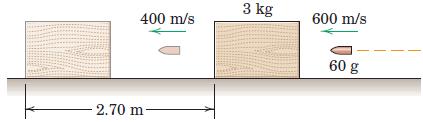
A 60-g bullet is fired horizontally with a velocity v1 = 600 m/s into the 3-kg block of soft wood initially at rest on the horizontal surface. The bullet emerges from the block with the velocity v2 = 400 m/s, and the block is observed to slide a distance of 2.70 m before coming to rest. Determine
A 75-g projectile traveling at 600 m/s strikes and becomes embedded in the 40-kg block, which is initially stationary. Compute the energy lost during the impact. Express your answer as an absolute value ΔE| and as a percentage n of the original system energy E. 600 m/s 40 kg 75 g
The velocity of a 1.2-kg particle is given by v = 1.5t3i + (2.4 − 3t2)j + 5k, where v is in meters per second and the time t is in seconds. Determine the linear momentum G of the particle, its magnitude G, and the net force R which acts on the particle when t = 2 s.
A jet-propelled airplane with a mass of 10 Mg is flying horizontally at a constant speed of 1000 km/h under the action of the engine thrust T and the equal and opposite air resistance R. The pilot ignites two rocket-assist units, each of which develops a forward thrust T0 of 8 kN for 9 s. If the
The two orbital maneuvering engines of the space shuttle develop 26 kN of thrust each. If the shuttle is traveling in orbit at a speed of 28 000 km/h, how long would it take to reach a speed of 28 100 km/h after the two engines are fi red? The mass of the shuttle is 90 Mg.
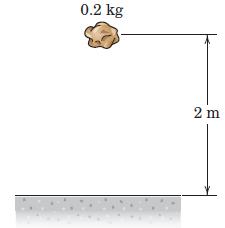
A 0.2-kg wad of clay is released from rest and drops 2 m to a concrete floor. The clay does not rebound, and the collision lasts 0.04 s. Determine the time average of the force which the floor exerts on the clay during the impact. 0.2 kg 2 m
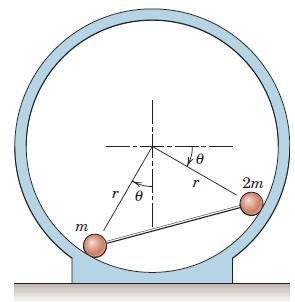
The two particles of mass m and 2m, respectively, are connected by a rigid rod of negligible mass and slide with negligible friction in a circular path of radius r on the inside of the vertical circular ring. If the unit is released from rest at θ = 0, determine (a) The velocity v of the
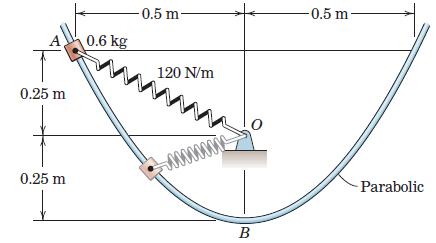
The 0.6-kg slider is released from rest at A and slides down the smooth parabolic guide (which lies in a vertical plane) under the influence of its own weight and of the spring of constant 120 N/m. Determine the speed of the slider as it passes point B and the corresponding normal force exerted on
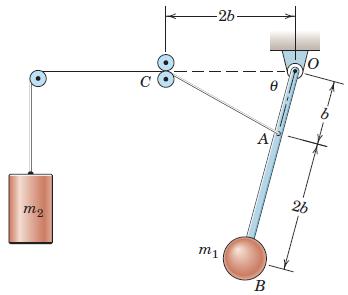
The system is released from rest with the angle θ = 90°. Determine θ˙ when θ reaches 60°. Use the values m1 = 1 kg, m2 = 1.25 kg, and b = 0.40 m. Neglect friction and the mass of bar OB, and treat the body B as a particle. -26 A 26 m2 m1
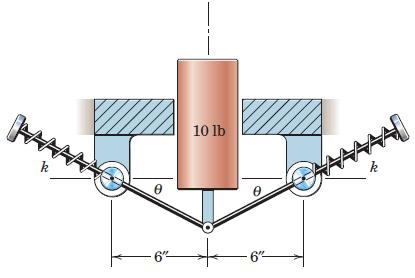
When the 10-lb plunger is released from rest in its vertical guide at θ = 0, each spring of stiffness k = 20 lb /in. is uncompressed. The links are free to slide through their pivoted collars and compress their springs. Calculate the velocity v of the plunger when the position θ = 30° is passed.
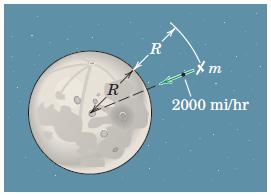
A spacecraft m is heading toward the center of the moon with a velocity of 2000 mi/hr at a distance from the moon’s surface equal to the radius R of the moon. Compute the impact velocity v with the surface of the moon if the spacecraft is unable to fi re its retro-rockets. Consider the moon fixed
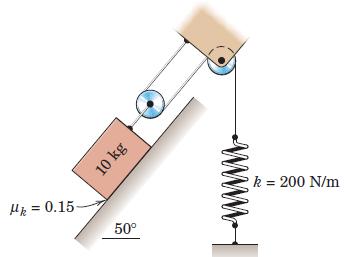
The system is initially moving with the cable taut, the 10-kg block moving down the rough incline with a speed of 0.3 m/s, and the spring stretched 25 mm. By the method of this article, (a) Determine the velocity v of the block after it has traveled 100 mm. (b) Calculate the distance
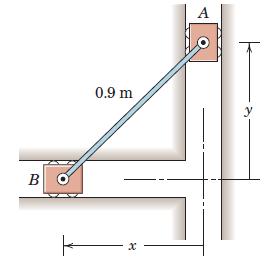
Calculate the maximum velocity of slider B if the system is released from rest with x = y. Motion is in the vertical plane. Assume that friction is negligible. The sliders have equal masses, and the motion is restricted to y ≥ 0. 0.9 m B
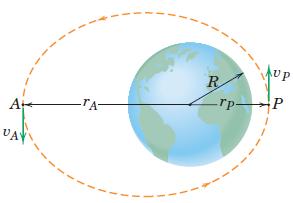
A satellite is put into an elliptical orbit around the earth and has a velocity vP at the perigee position P. Determine the expression for the velocity vA at the apogee position A. The radii to A and P are, respectively, rA and rP. Note that the total energy remains constant. up R P rp- TA A VA
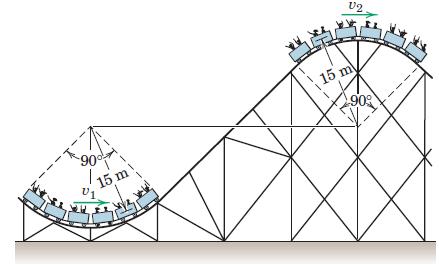
The cars of an amusement-park ride have a speed v1 = 90 km/h at the lowest part of the track. Determine their speed v2 at the highest part of the track. Neglect energy loss due to friction. (Caution: Give careful thought to the change in potential energy of the system of cars.) U2 15 m 90 06- 15 m
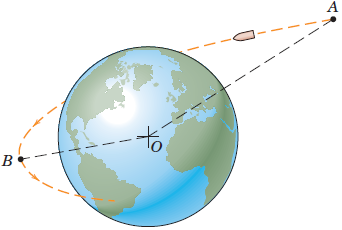
Upon its return voyage from a space mission, the spacecraft has a velocity of 24 000 km /h at point A, which is 7000 km from the center of the earth. Determine the velocity of the spacecraft when it reaches point B, which is 6500 km from the center of the earth. The trajectory between these two
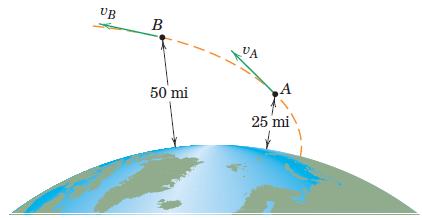
A rocket launches an unpowered space capsule at point A with an absolute velocity vA = 8000 mi/hr at an altitude of 25 mi. After the capsule has traveled a distance of 250 mi measured along its absolute space trajectory, its velocity at B is 7600 mi/hr and its altitude is 50 mi. Determine the
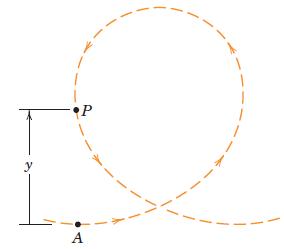
In the design of an inside loop for an amusementpark ride, it is desired to maintain the same centripetal acceleration throughout the loop. Assume negligible loss of energy during the motion and determine the radius of curvature ρ of the path as a function of the height y above the low point A,
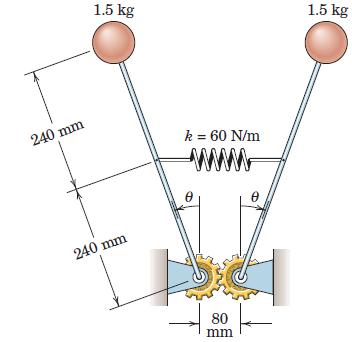
The two 1.5-kg spheres are released from rest and gently nudged outward from the position θ = 0 and then rotate in a vertical plane about the fixed centers of their attached gears, thus maintaining the same angle θ for both rods. Determine the velocity v of each sphere as the rods pass the
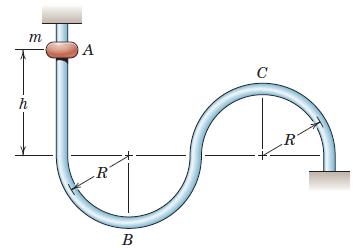
The slider of mass m is released from rest in position A and slides without friction along the vertical-plane guide shown. Determine the height h such that the normal force exerted by the guide on the slider is zero as the slider passes point C. For this value of h, determine the normal force as
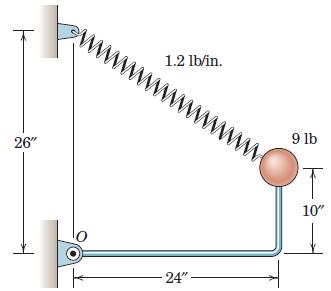
The spring has an unstretched length of 25 in. If the system is released from rest in the position shown, determine the speed v of the ball (a) When it has dropped a vertical distance of 10 in. (b) When the rod has rotated 35°. 1.2 lb/in. 9 lb wwww 26" 10" 24"
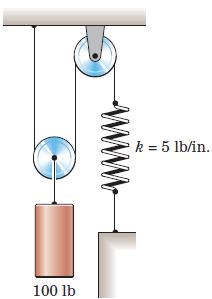
The system is released from rest with the spring initially stretched 2 in. Calculate the velocity of the 100-lb cylinder after it has dropped 6 in. Also determine the maximum drop distance of the cylinder. Neglect the mass and friction of the pulleys. k = 5 lb/in. 100 lb ww
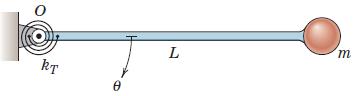
The particle of mass m = 1.2 kg is attached to the end of the light rigid bar of length L = 0.6 m. The system is released from rest while in the horizontal position shown, at which the torsional spring is undeflected. The bar is then observed to rotate 30° before stopping momentarily. (a)
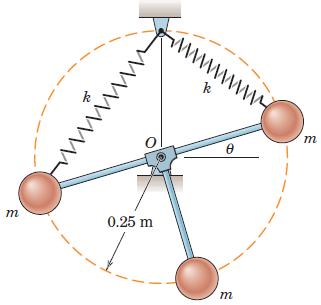
The two springs, each of stiffness k = 1.2 kN/m, are of equal length and undeformed when θ = 0. If the mechanism is released from rest in the position θ = 20°, determine its angular velocity θ˙ when θ = 0. The mass m of each sphere is 3 kg. Treat the spheres as particles and neglect the
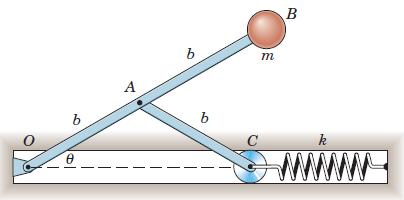
The 0.8-kg particle is attached to the system of two light rigid bars, all of which move in a vertical plane. The spring is compressed an amount b/2 when θ = 0, and the length b = 0.30 m. The system is released from rest in a position slightly above that for θ = 0. (a) If the maximum value
The system is released from rest with the spring initially stretched 3 in. Calculate the velocity v of the cylinder after it has dropped 0.5 in. The spring has a stiffness of 6 lb /in. Neglect the mass of the small pulley. k = 6 lb/in. 100 lb
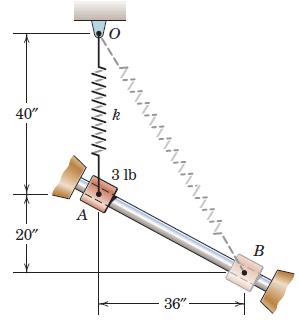
The 3-lb collar is released from rest at A and slides freely down the inclined rod. If the spring constant k = 4 lb/ft and the unstretched length of the spring is 50 in., determine the speed of the collar as it passes point B. 40" 3 lb A 20" B 36" ww
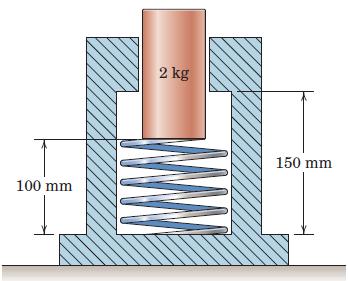
The 2-kg plunger is released from rest in the position shown where the spring of stiffness k = 500 N /m has been compressed to one-half its uncompressed length of 200 mm. Calculate the maximum height h above the starting position reached by the plunger. 2 kg 150 mm 100 mm
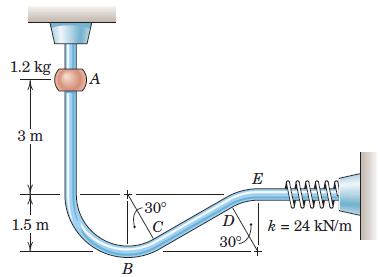
The 1.2-kg slider is released from rest in position A and slides without friction along the vertical-plane guide shown. Determine (a) the speed vB of the slider as it passes position B and (b) the maximum deflection δ of the spring. 1.2 kg A 3 m E 30° 1.5 m C. D k = 24 kN/m 30°
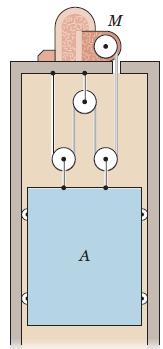
Once under way at a steady speed, the 1000-kg elevator A rises at the rate of 1 story (3 m) per second. Determine the power input Pin into the motor unit M if the combined mechanical and electrical efficiency of the system is e = 0.8. M A
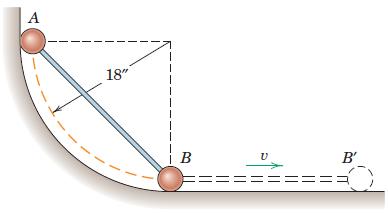
The two particles of equal mass are joined by a rod of negligible mass. If they are released from rest in the position shown and slide on the smooth guide in the vertical plane, calculate their velocity v when A reaches B’s position and B is at B′. A 18" B B'
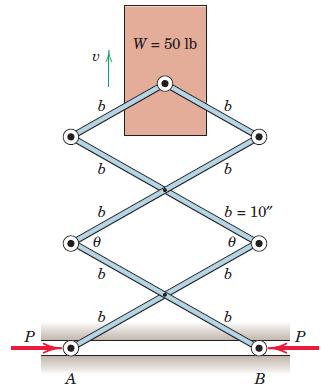
The vertical motion of the 50-lb block is controlled by the two forces P applied to the ends A and B of the linkage, where A and B are constrained to move in the horizontal guide. If forces P = 250 lb are applied with the linkage initially at rest with θ = 60°, determine the upward velocity v of
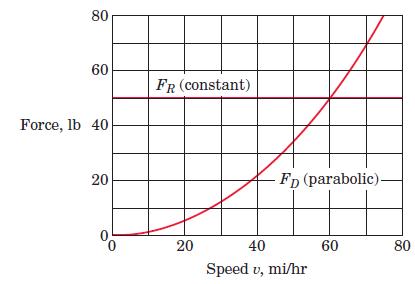
Extensive testing of an experimental 2000-lb automobile reveals the aerodynamic drag force FD and the total nonaerodynamic rolling-resistance force FR to be as shown in the plot. Determine (a) The power required for steady speeds of 30 and 60 mi/hr on a level road.(b) The power required
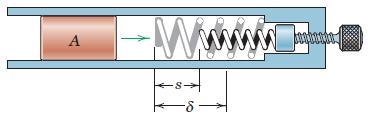
The nest of two springs is used to bring the 0.5-kg plunger A to a stop from a speed of 5 m/s and reverse its direction of motion. The inner spring increases the deceleration, and the adjustment of its position is used to control the exact point at which the reversal takes place. If this point is
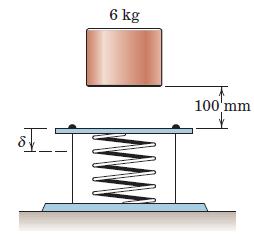
The 6-kg cylinder is released from rest in the position shown and falls on the spring, which has been initially precompressed 50 mm by the light strap and restraining wires. If the stiffness of the spring is 4 kN/m, compute the additional deflection δ of the spring produced by the falling cylinder
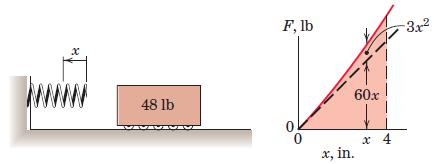
Calculate the horizontal velocity v with which the 48-lb carriage must strike the spring in order to compress it a maximum of 4 in. The spring is known as a “hardening” spring, since its stiffness increases with deflection as shown in the accompanying graph. F, lb -3x2 48 lb 60x x 4 x, in.
It is experimentally determined that the drive wheels of a car must exert a tractive force of 560 N on the road surface in order to maintain a steady vehicle speed of 90 km/h on a horizontal road. If it is known that the overall drivetrain efficiency is em = 0.70, determine the required motor power
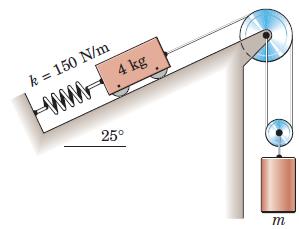
The system is released from rest with no slack in the cable and with the spring stretched 200 mm. Determine the distance s traveled by the 4-kg cart before it comes to rest (a) If m approaches zero (b) If m = 3 kg. Assume no mechanical interference and no friction, and state whether the
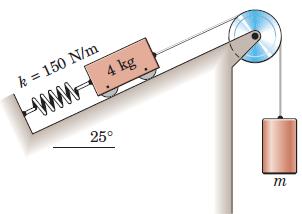
The system is released from rest with no slack in the cable and with the spring unstretched. Determine the distance s traveled by the 4-kg cart before it comes to rest (a) If m approaches zero (b) If m = 3 kg. Assume no mechanical interference and no friction, and state whether the
In a railroad classification yard, a 68-Mg freight car moving at 0.5 m/s at A encounters a retarder section of track at B which exerts a retarding force of 32 kN on the car in the direction opposite to motion. Over what distance x should the retarder be activated in order to limit the speed of the
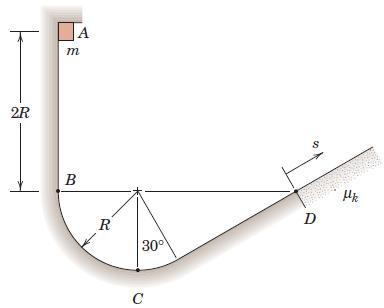
The small slider of mass m is released from rest while in position A and then slides along the vertical-plane track. The track is smooth from A to D and rough (coefficient of kinetic friction μk) from point D on. Determine (a) The normal force NB exerted by the track on the slider just after
The third stage of a rocket fired vertically up over the north pole coasts to a maximum altitude of 500 km following burnout of its rocket motor. Calculate the downward velocity v of the rocket when it has fallen 100 km from its position of maximum altitude. (Use the mean value of 9.825 m/s2 for g
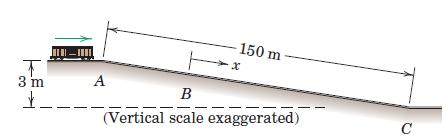
A car with a mass of 1500 kg starts from rest at the bottom of a 10-percent grade and acquires a speed of 50 km/h in a distance of 100 m with constant acceleration up the grade. What is the power P delivered to the drive wheels by the engine when the car reaches this speed?
Two 425,000-lb locomotives pull fifty 200,000-lb coal hoppers. The train starts from rest and accelerates uniformly to a speed of 40 mi/hr over a distance of 8000 ft on a level track. The constant rolling resistance of each car is 0.005 times its weight. Neglect all other retarding forces and
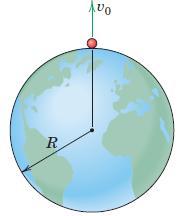
A projectile is launched from the north pole with an initial vertical velocity v0. What value of v0 will result in a maximum altitude of R/3? Neglect aerodynamic drag and use g = 9.825 m/s2 as the surface- level acceleration due to gravity. R
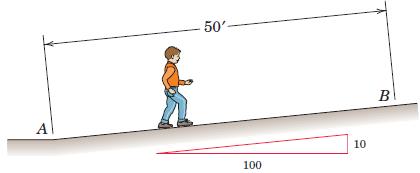
A 90-lb boy starts from rest at the bottom A of a 10-percent incline and increases his speed at a constant rate to 5 mi / hr as he passes B, 50 ft along the incline from A. Determine his power output as he approaches B. 50 B A 10 100
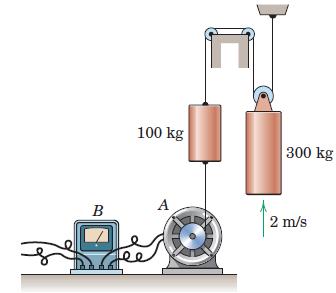
The motor unit A is used to elevate the 300-kg cylinder at a constant rate of 2 m/s. If the power meter B registers an electrical input of 2.20 kW, calculate the combined electrical and mechanical efficiency e of the system. 100 kg 300 kg B 2 m/s
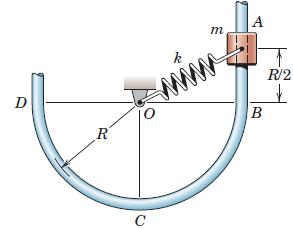
The collar of mass m is released from rest while in position A and subsequently travels with negligible friction along the vertical-plane circular guide. Determine the normal force (magnitude and direction) exerted by the guide on the collar (a) just before the collar passes point
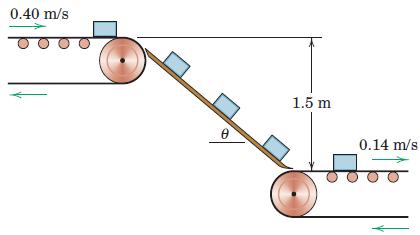
In the design of a conveyor-belt system, small metal blocks are discharged with a velocity of 0.4 m/s onto a ramp by the upper conveyor belt shown. If the coefficient of kinetic friction between the blocks and the ramp is 0.30, calculate the angle θ which the ramp must make with the horizontal so
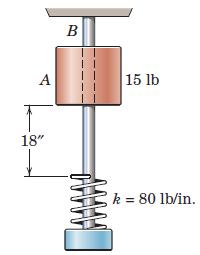
The 15-lb cylindrical collar is released from rest in the position shown and drops onto the spring. Calculate the velocity v of the cylinder when the spring has been compressed 2 in. B | | A 15 lb 18" k 80 lb/in.
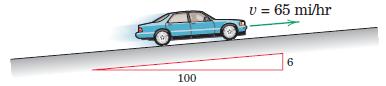
A 3600-lb car travels up the 6-percent incline shown. The car is subjected to a 60-lb aerodynamic drag force and a 50-lb force due to all other factors such as rolling resistance. Determine the power output required at a speed of 65 mi/hr if (a) The speed is constant (b) The speed is
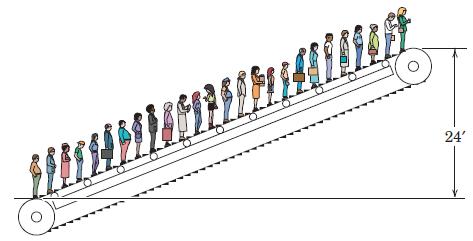
An escalator handles a steady load of 30 people per minute in elevating them from the first to the second floor through a vertical rise of 24 ft. The average person weighs 140 lb. If the motor which drives the unit delivers 4 hp, calculate the mechanical efficiency e of the system. 24'
The position vector of a particle is given by r = 8ti + 1.2t2j − 0.5(t3 − 1)k, where t is the time in seconds from the start of the motion and where r is expressed in meters. For the condition when t = 4 s, determine the power P developed by the force F = 40i − 20j − 36k N which acts on the
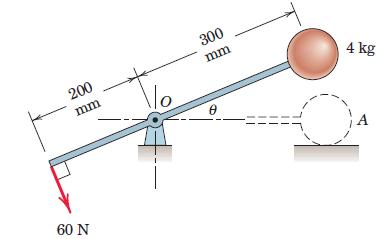
The 4-kg ball and the attached light rod rotate in the vertical plane about the fixed axis at O. If the assembly is released from rest at θ = 0 and moves under the action of the 60-N force, which is maintained normal to the rod, determine the velocity v of the ball as θ approaches 90°. Treat the
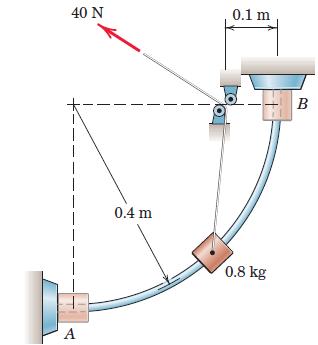
The 0.8-kg collar slides freely on the fixed circular rod. Calculate the velocity v of the collar as it hits the stop at B if it is elevated from rest at A by the action of the constant 40-N force in the cord. The cord is guided by the small fixed pulleys. 40 N 0.1 m B 0.4 m 0.8 kg A
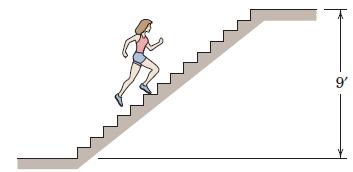
The 120-lb woman jogs up the flight of stairs in 5 seconds. Determine her average power output. Convert all given information to SI units and repeat your calculation. 9'
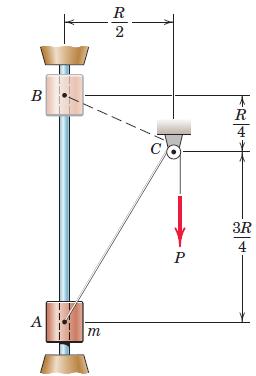
The system of the previous problem is rearranged as shown. For what constant force P will the 0.8-kg collar just reach position B with no speed after beginning from rest at position A? Friction is negligible, and R = 1.6 m. R 2 B 3R P A m 上R4
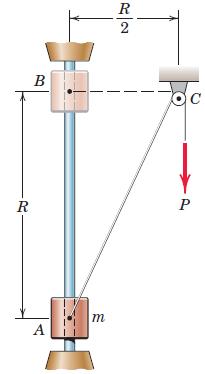
The 0.8-kg collar travels with negligible friction on the vertical rod under the action of the constant force P = 20 N. If the collar starts from rest at A, determine its speed as it passes point B. The value of R = 1.6 m. R B R m A
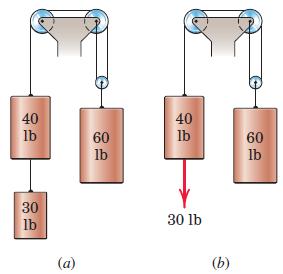
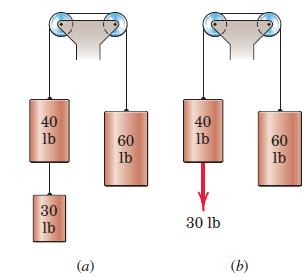
Each of the two systems is released from rest. Calculate the speed v of each 60-lb cylinder after the 40-lb cylinder has dropped 2 ft. The 30-lb cylinder of case (a) is replaced by a 30-lb force in case (b). 40 40 lb 60 lb 60 lb lb 30 lb 30 lb (a) (b)
Each of the two systems is released from rest. Calculate the speed v of each 60-lb cylinder after the 40-lb cylinder has dropped 2 ft. The 30-lb cylinder of case (a) is replaced by a 30-lb force in case (b). 40 40 lb 60 lb 60 lb lb 30 lb 30 lb (a) (b)
The 30-lb collar A is released from rest in the position shown and slides with negligible friction up the fixed rod inclined 30° from the horizontal under the action of a constant force P = 50 lb applied to the cable. Calculate the required stiffness k of the spring so that its maximum deflection
The small 0.2-kg slider is known to move from position A to position B along the vertical-plane slot. Determine (a) The work done on the body by its weight (b) The work done on the body by the spring. The distance R = 0.8 m, the spring modulus k = 180 N/m, and the unstretched length of
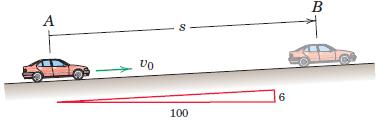
The car is moving with a speed v0 = 65 mi / hr up the 6-percent grade, and the driver applies the brakes at point A, causing all wheels to skid. The coefficient of kinetic friction for the rain-slicked road is μk = 0.60. Determine the stopping distance sAB. Repeat your calculations for the case
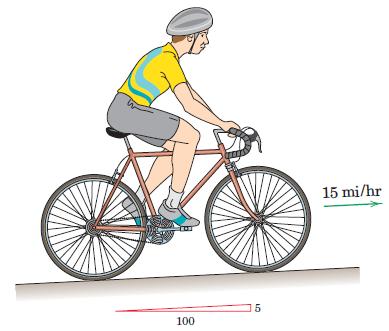
The man and his bicycle together weigh 200 lb. What power P is the man developing in riding up a 5-percent grade at a constant speed of 15 mi/hr? 15 mi/hr 5 100
The small 0.1-kg slider enters the “loop-the-loop” with a speed vA = 12 m /s as it passes point A, and it has a speed vB = 10 m /s as it exits at point B. Determine the work done by friction between points A and B. The track lies in a vertical plane. Assume that contact is maintained throughout.
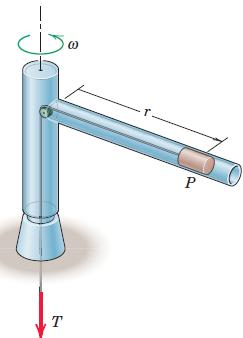
The hollow tube assembly rotates about a vertical axis with angular velocity ω = θ˙ = 4 rad /s and ω˙ = θ¨ = −2 rad /s2. A small 0.2-kg slider P moves inside the horizontal tube portion under the control of the string which passes out the bottom of the assembly. If r = 0.8 m, r˙ = −2 m
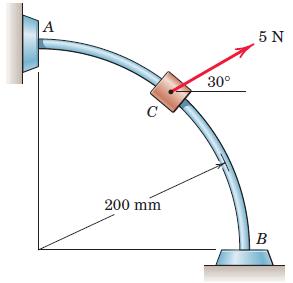
The 0.5-kg collar C starts from rest at A and slides with negligible friction on the fixed rod in the vertical plane. Determine the velocity v with which the collar strikes end B when acted upon by the 5-N force, which is constant in direction. Neglect the small dimensions of the collar. |A 5 N
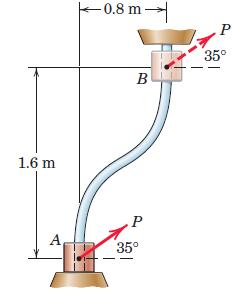
The 2-kg collar is at rest in position A when the constant force P is applied as shown. Determine the speed of the collar as it passes position B if (a) P = 25 N (b) P = 40 N. The curved rod lies in a vertical plane, and friction is negligible. -0.8 m 35° В 1.6 m .P А, 35°
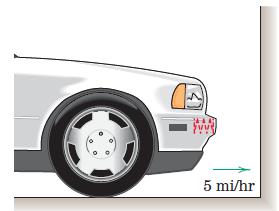
In the design of a spring bumper for a 3500-lb car, it is desired to bring the car to a stop from a speed of 5 mi/hr in a distance equal to 6 in. of spring deformation. Specify the required stiffness k for each of the two springs behind the bumper. The springs are undeformed at the start of impact.
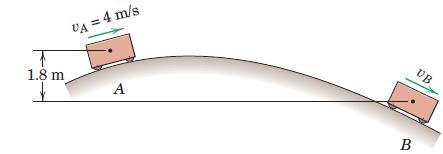
The small cart has a speed vA = 4 m /s as it passes point A. It moves without appreciable friction and passes over the top hump of the track. Determine the cart speed as it passes point B. Is knowledge of the shape of the track necessary? VA = 4 m/s UB 1.8 m A B
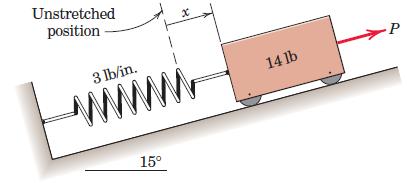
The spring is unstretched at the position x = 0. Under the action of a force P, the cart moves from the initial position x1 = −6 in. to the final position x2 = 3 in. Determine (a) The work done on the cart by the spring (b) The work done on the cart by its weight. Unstretched position 3
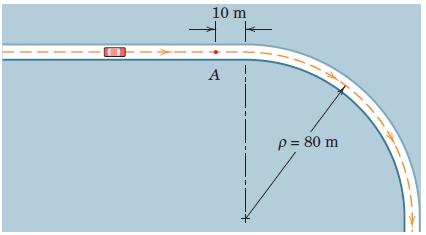
Each tire on the 1350-kg car can support a maximum friction force parallel to the road surface of 2500 N. This force limit is nearly constant over all possible rectilinear and curvilinear car motions and is attainable only if the car does not skid. Under this maximum braking, determine the total
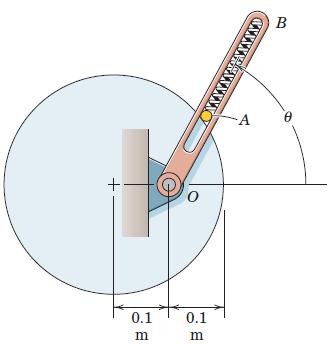
The slotted arm OB rotates in a horizontal plane about point O of the fixed circular cam with constant angular velocity θ˙ = 15 rad/s. The spring has a stiffness of 5 kN/m and is uncompressed when θ = 0. The smooth roller A has a mass of 0.5 kg. Determine the normal force N which the cam exerts
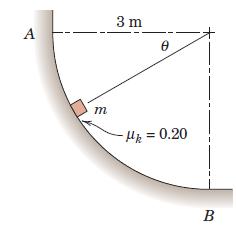
A small object is released from rest at A and slides with friction down the circular path. If the coefficient of friction is 0.20, determine the velocity of the object as it passes B. Write the equations of motion in the n- and t-directions, eliminate N, and substitute v dv = at r dθ. The
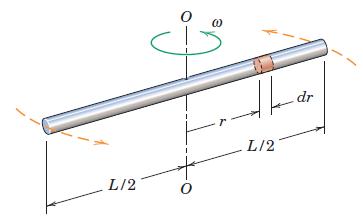
The uniform slender rod of length L, mass m, and cross-sectional area A is rotating in a horizontal plane about the vertical central axis O-O at a constant high angular velocity ω. By analyzing the horizontal forces on the accelerating differential element shown, derive an expression for the
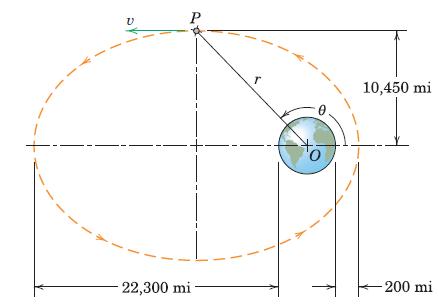
The spacecraft P is in the elliptical orbit shown. At the instant represented, its speed is v = 13,244 ft /sec. Determine the corresponding values of r˙, θ˙, r¨, and θ¨. Use g = 32.23 ft /sec2 as the acceleration of gravity on the surface of the earth and R = 3959 mi as the radius of the
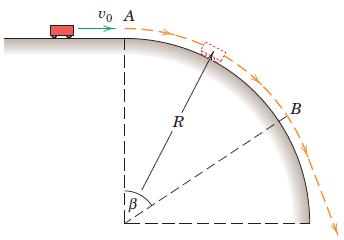
A small vehicle enters the top A of the circular path with a horizontal velocity v0 and gathers speed as it moves down the path. Determine an expression for the angle β which locates the point where the vehicle leaves the path and becomes a projectile. Evaluate your expression for v0 = 0. Neglect
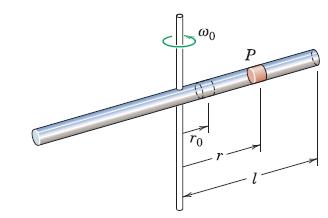
Remove the assumption of smooth surfaces as stated in Prob. 3 /88 and assume a coefficient of kinetic friction μk between the particle and rotating tube. Determine the radial position r of the particle as a function of time t if it is released with no relative velocity at r = r0 when t = 0. Assume
The particle P is released at time t = 0 from the position r = r0 inside the smooth tube with no velocity relative to the tube, which is driven at the constant angular velocity ω0 about a vertical axis. Determine the radial velocity vr, the radial position r, and the transverse velocity vθ as
Showing 2100 - 2200
of 2550
First
12
13
14
15
16
17
18
19
20
21
22
23
24
25
26
Step by Step Answers

 Get 50% OFF
Claim Now
Get 50% OFF
Claim Now