New Semester
Started
Get
50% OFF
Study Help!
--h --m --s
Claim Now
Question Answers
Textbooks
Find textbooks, questions and answers
Oops, something went wrong!
Change your search query and then try again
S
Books
FREE
Study Help
Expert Questions
Accounting
General Management
Mathematics
Finance
Organizational Behaviour
Law
Physics
Operating System
Management Leadership
Sociology
Programming
Marketing
Database
Computer Network
Economics
Textbooks Solutions
Accounting
Managerial Accounting
Management Leadership
Cost Accounting
Statistics
Business Law
Corporate Finance
Finance
Economics
Auditing
Tutors
Online Tutors
Find a Tutor
Hire a Tutor
Become a Tutor
AI Tutor
AI Study Planner
NEW
Sell Books
Search
Search
Sign In
Register
study help
engineering
engineering mechanics dynamics
Engineering Mechanics - Dynamics 11th Edition R. C. Hibbeler - Solutions
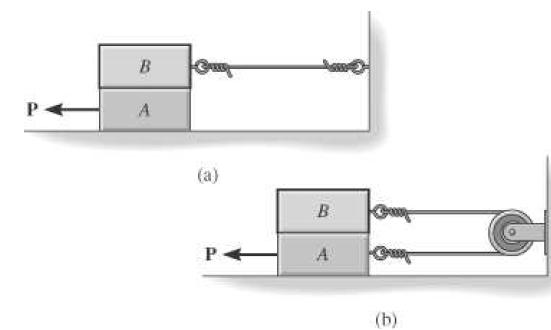
Each of the two blocks has a mass m. The coefficient of kinetic friction at all surfaces of contact is μ. If a horizontal force P moves the bottom block, determine the acceleration of the bottom block in each case. P B A @ms (a) P4 B Gra (b) G
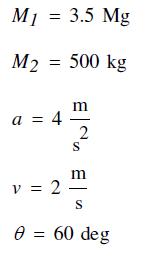
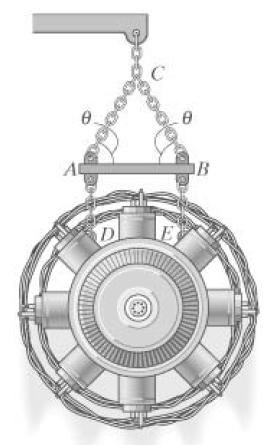
An engine of mass M1 is suspended from a spreader beam of mass M2 and hoisted by a crane which gives it an acceleration a when it has a velocity v. Determine the force in chains AC and AD during the lift. Units Used:Given: Mg = 10³ kg kN = 10³ N
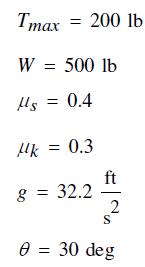
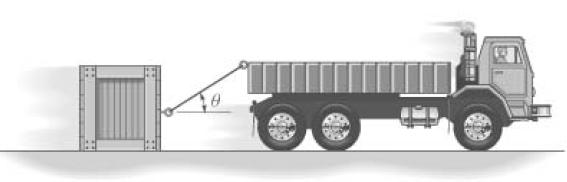
The driver attempts to tow the crate using a rope that has a tensile strength Tmax. If the crate is originally at rest and has weight W, determine the greatest acceleration it can have if the coefficient of static friction between the crate and the road is μs and the coefficient of kinetic
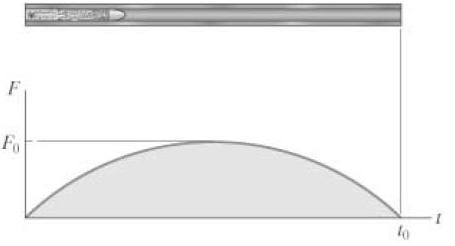
The bullet of mass m is given a velocity due to gas pressure caused by the burning of powder within the chamber of the gun. Assuming this pressure creates a force of F = F0sin(πt/t0) on the bullet, determine the velocity of the bullet at any instant it is in the barrel. What is the bullet’s
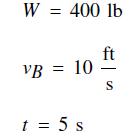
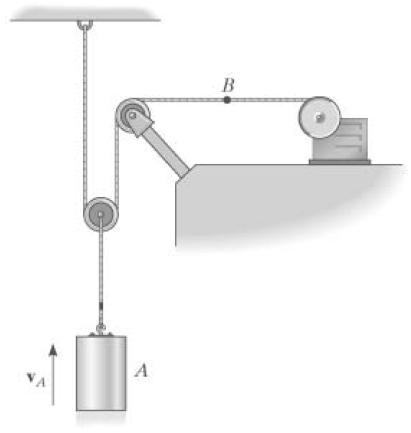
The cylinder of weight W at A is hoisted using the motor and the pulley system shown. If the speed of point B on the cable is increased at a constant rate from zero to vB in time t, determine the tension in the cable at B to cause the motion. Given: W = 400 lb VB = 10 t = 5 s ft S
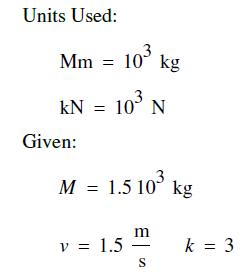
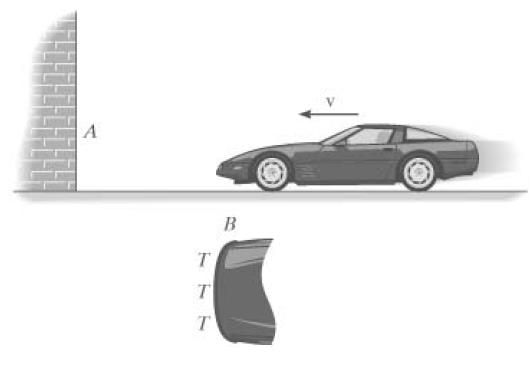
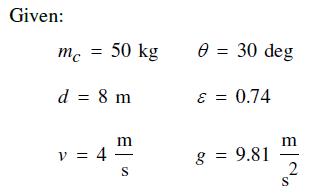
A car is equipped with a bumper B designed to absorb collisions. The bumper is mounted to the car using pieces of flexible tubing T. Upon collision with a rigid barrier at A, a constant horizontal force F is developed which causes a car deceleration kg (the highest safe deceleration for a passenger
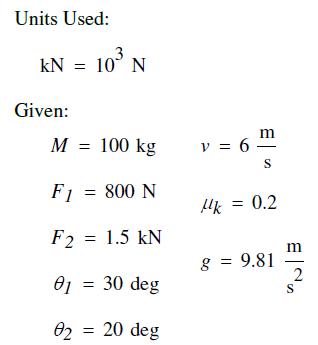
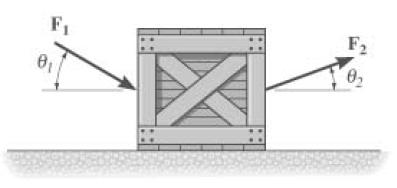
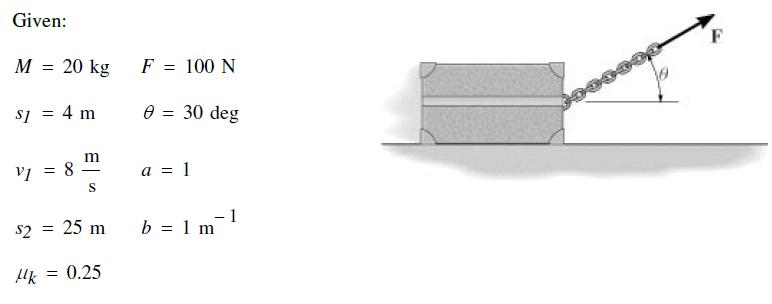
The crate of mass M is subjected to forces F1 and F2, as shown. If it is originally at rest, determine the distance it slides in order to attain a speed v. The coefficient of kinetic friction between the crate and the surface is μk. Units Used: KN = 10 N 10³ Given: M = 100 kg F1 = 800 N F2 = 1.5
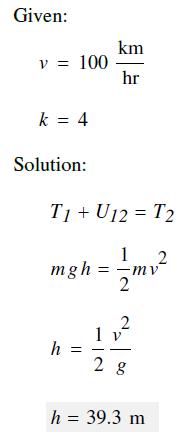
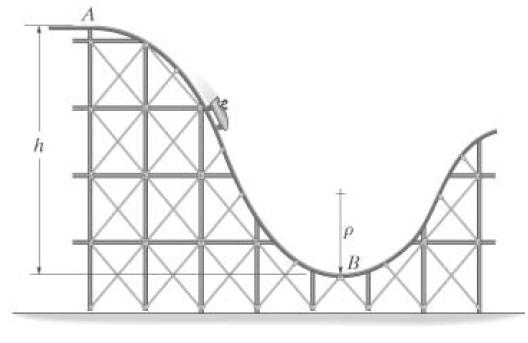
Determine the required height h of the roller coaster so that when it is essentially at rest at the crest of the hill it will reach a speed v when it comes to the bottom. Also, what should be the minimum radius of curvature ρ for the track at B so that the passengers do not experience a normal
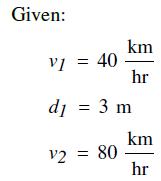
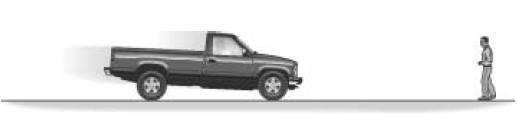
When the driver applies the brakes of a light truck traveling at speed v1 it skids a distance d1 before stopping. How far will the truck skid if it is traveling at speed v2 when the brakes are applied? Given: = VI 40- km hr d₁ = 3 m V2 = 80 km hr
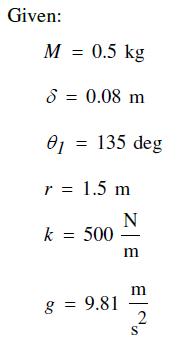
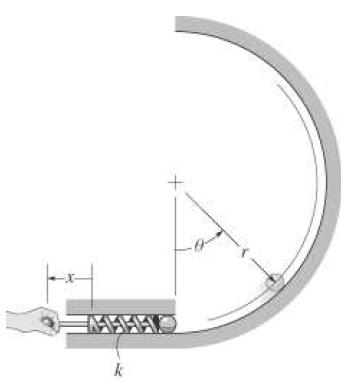
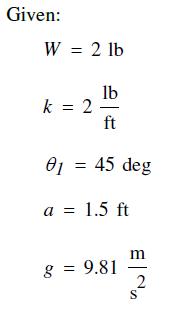
The ball of mass M of negligible size is fired up the vertical circular track using the spring plunger. The plunger keeps the spring compressed a distance δ when x = 0. Determine how far x it must be pulled back and released so that the ball will begin to leave the track when θ = θ1. Given: M =
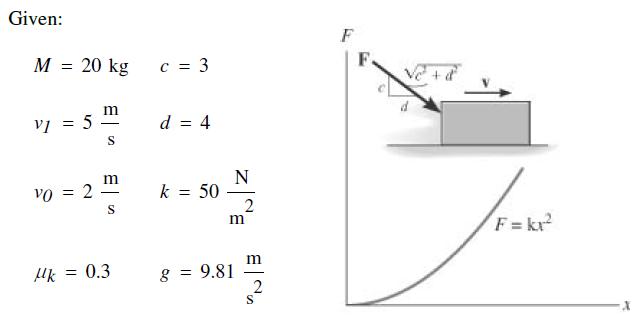
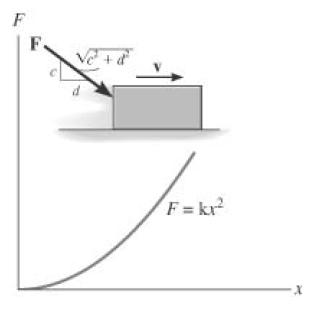
The force F, acting in a constant direction on the block of mass M, has a magnitude which varies with the position x of the block. Determine how far the block slides before its velocity becomes v1. When x = 0, the block is moving to the right at speed v0 . The coefficient of kinetic friction
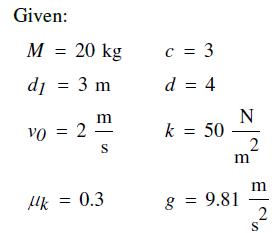
The force F, acting in a constant direction on the block of mass M, has a magnitude which varies with position x of the block. Determine the speed of the block after it slides a distance d1 . When x = 0, the block is moving to the right at v0 .The coefficient of kinetic friction between the block
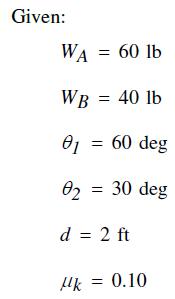
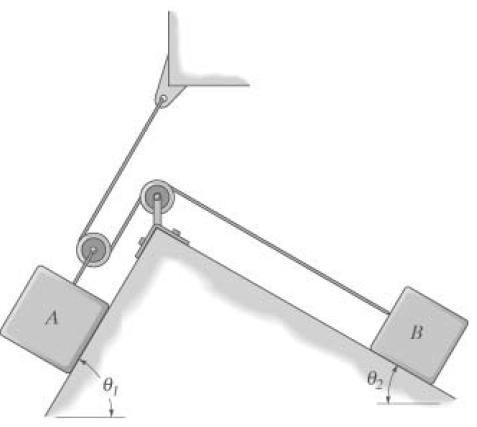
Determine the velocity of the block A of weight WA if the two blocks are released from rest and the block B of weight WB moves a distance d up the incline. The coefficient of kinetic friction between both blocks and the inclined planes is μk. Given: WA = 60 lb WB = 40 lb 01 = 60 deg 02 = 30 deg d
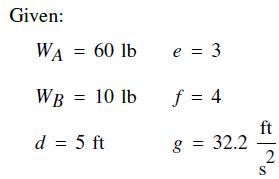
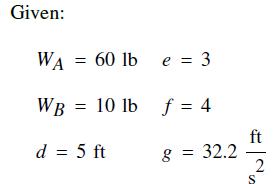
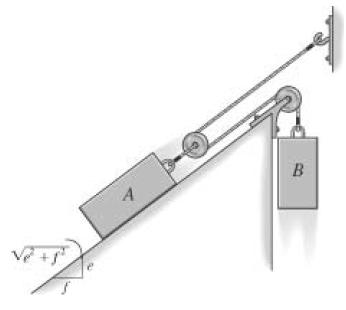
Block A has weight WA and block B has weight WB. Determine the speed of block A after it moves a distance d down the plane, starting from rest. Neglect friction and the mass of the cord and pulleys. Given: WA = 60 lb WB = 10 lb d = 5 ft e = 3 f = 4 g 8 = 32.2 ft 2 S
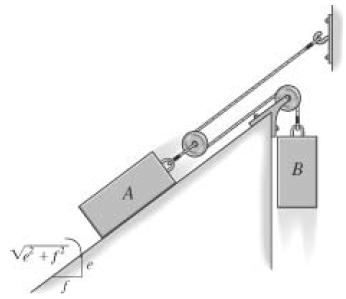
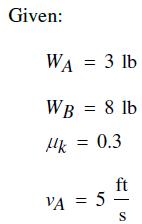
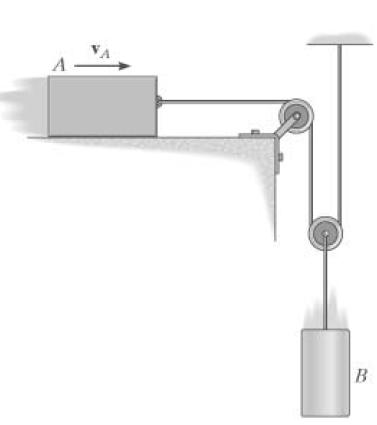
The block A of weight WA rests on a surface for which the coefficient of kinetic friction is μk. Determine the distance the cylinder B of weight WB must descend so that A has a speed vA starting from rest. Given: WA = 3 lb WB = 8 lb Mk = 0.3 VA = 5 ft S
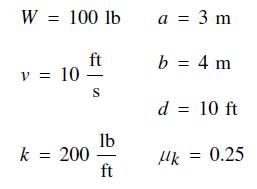
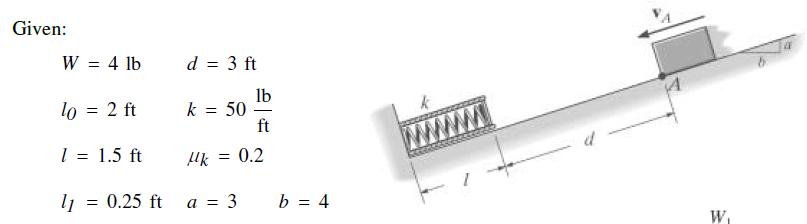
The block of weight W slides down the inclined plane for which the coefficient of kinetic friction is μk. If it is moving at speed v when it reaches point A, determine the maximum deformation of the spring needed to momentarily arrest the motion. W = 100 lb ft v = 10- k = 200 S lb ft a = 3 m b = 4
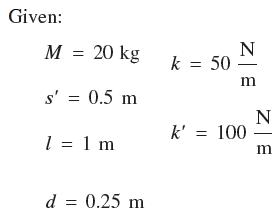
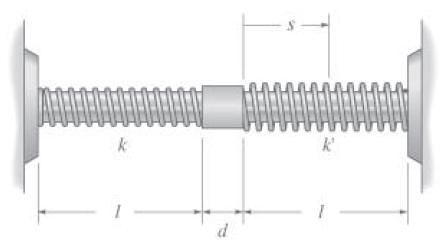
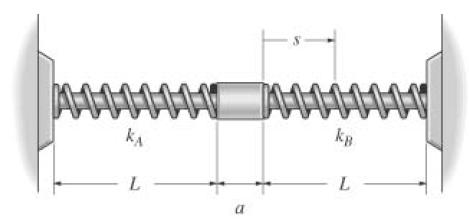
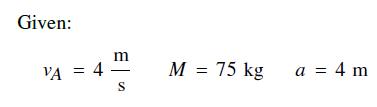
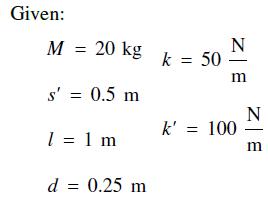
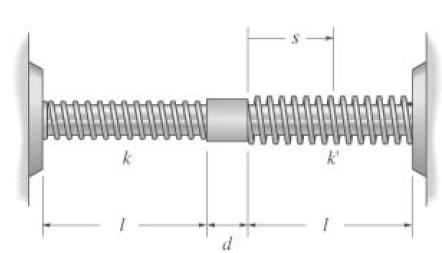
The collar has mass M and rests on the smooth rod. Two springs are attached to it and the ends of the rod as shown. Each spring has an uncompressed length l. If the collar is displaced a distance s = s' and released from rest, determine its velocity at the instant it returns to the point s = 0.
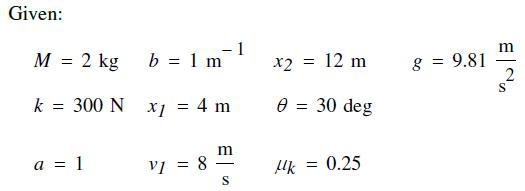
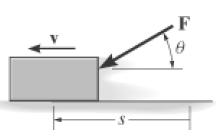
The block of mass M is subjected to a force having a constant direction and a magnitude F = k/(a+bx). When x = x1, the block is moving to the left with a speed v1. Determine its speed when x = x2. The coefficient of kinetic friction between the block and the ground is μk. Given: M = 2 kg k = 300
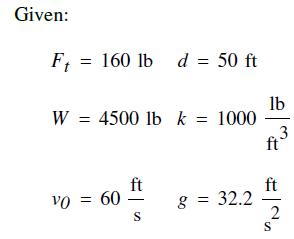
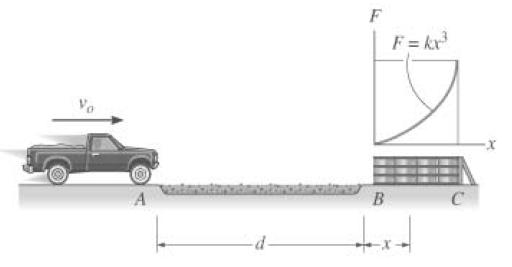
The motion of a truck is arrested using a bed of loose stones AB and a set of crash barrels BC. If experiments show that the stones provide a rolling resistance Ft per wheel and the crash barrels provide a resistance as shown in the graph, determine the distance x the truck of weight W penetrates
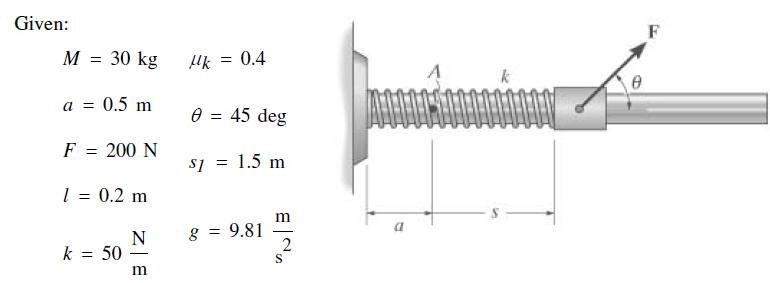
The collar has a mass M and is supported on the rod having a coefficient of kinetic friction μk. The attached spring has an unstretched length l and a stiffness k. Determine the speedof the collar after the applied force F causes it to be displaced a distance s = s1 from point A. When s = 0 the
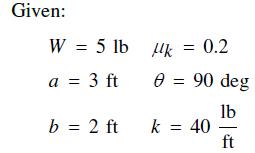
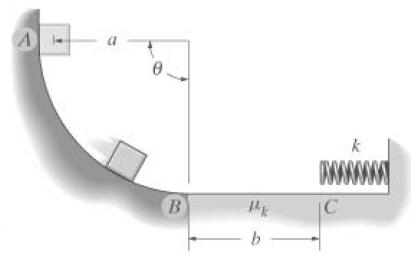
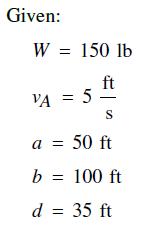
The block of weight W is released from rest at A and slides down the smooth circular surface AB. It then continues to slide along the horizontal rough surface until it strikes the spring. Determine how far it compresses the spring before stopping. Given: W = 5 lb a = 3 ft b = 2 ft k = 0.2 0 = 90
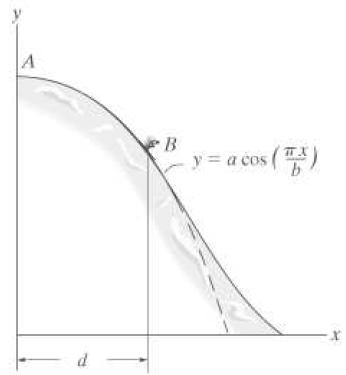
When the skier of weight W is at point A he has a speed vA. Determine his speed when he reaches point B on the smooth slope. For this distance the slope follows the cosine curve shown. Also, what is the normal force on his skis at B and his rate of increase in speed? Neglect friction and air
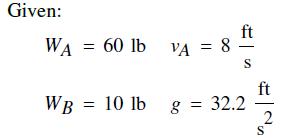
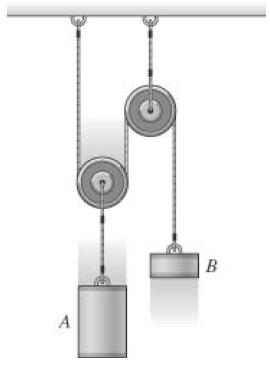
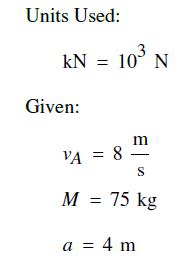
Cylinder A has weight WA and block B has weight WB. Determine the distance A must descend from rest before it obtains speed vA. Also, what is the tension in the cord supporting block A? Neglect the mass of the cord and pulleys. Given: WA = 60 lb ft VA = 8- S WB = 10 lb g = 32.2 ft 2 S
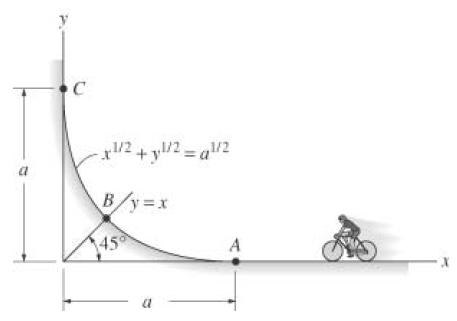
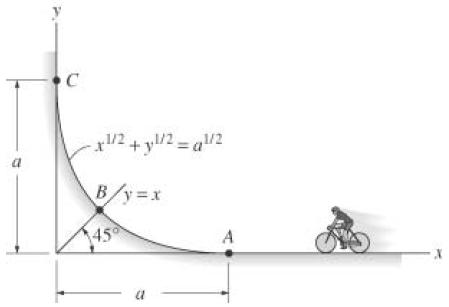
The cyclist travels to point A, pedaling until he reaches speed vA. He then coasts freely up the curved surface. Determine the normal force he exerts on the surface when he reaches point B. The total mass of the bike and man is M. Neglect friction, the mass of the wheels, and the size of the
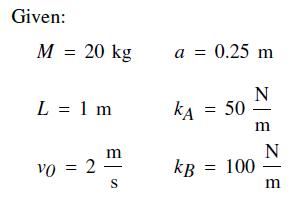
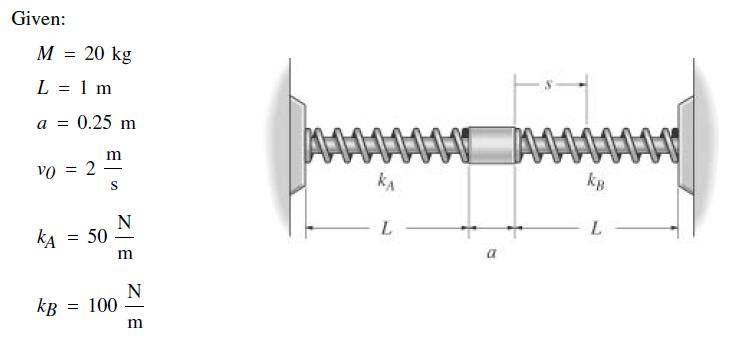
The collar has mass M and slides along the smooth rod. Two springs are attached to it and the ends of the rod as shown. If each spring has an uncompressed length L and the collar has speed v0 when s = 0, determine the maximum compression of each spring due to the back-and-forth (oscillating) motion
The catapulting mechanism is used to propel slider A of mass M to the right along the smooth track. The propelling action is obtained by drawing the pulley attached to rod BC rapidly to the left by means of a piston P. If the piston applies constant force F to rod BC such that it moves it a
The cyclist travels to point A, pedaling until he reaches speed vA. He then coasts freely up the curved surface. Determine how high he reaches up the surface before he comes to a stop. Also, what are the resultant normal force on the surface at this point and his acceleration? The total mass of the
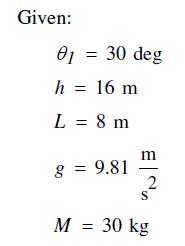
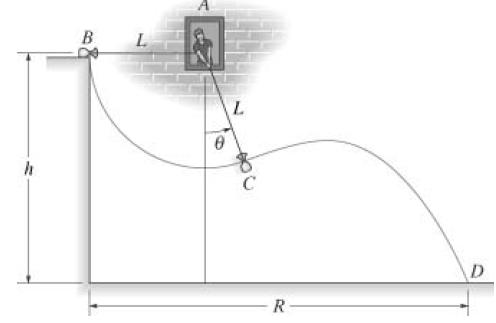
The man at the window A wishes to throw a sack of mass M onto the ground. To do this he allows it to swing from rest at B to point C, when he releases the cord at θ = θ1. Determine the speed at which it strikes the ground and the distance R. Given: 01 = 30 deg h = 16 m L = 8 m 8 = 9.81 E 2 S M =
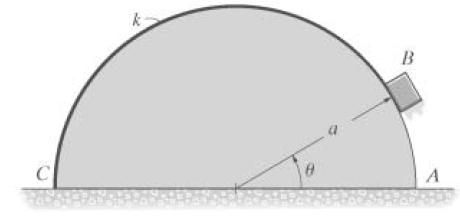
A block of weight W rests on the smooth semicylindrical surface. An elastic cord having a stiffness k is attached to the block at B and to the base of the semicylinder at point C. If the block is released from rest at A(θ = 0°), determine the unstretched length of the cord so the block begins to
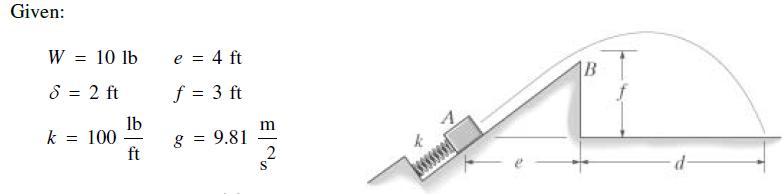
The block of weight W is pressed against the spring so as to compress it a distance δ when it is at A. If the plane is smooth, determine the distance d, measured from the wall, to where the block strikes the ground. Neglect the size of the block. Given: W = 10 lb 8 = 2 ft k = 100 lb ft e = 4 ft f
The spring has a stiffness k and an unstretched length l0. As shown, it is confined by the plate and wall using cables so that its length is l. A block of weight W is given a speed vA when it is at A, and it slides down the incline having a coefficient of kinetic friction μk. If it strikes the
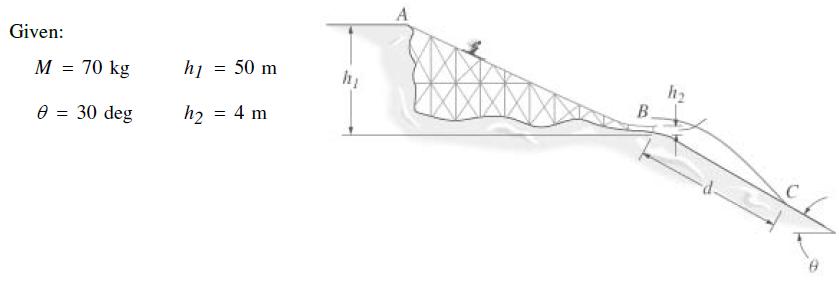
The skier starts from rest at A and travels down the ramp. If friction and air resistance can be neglected, determine his speed vB when he reaches B. Also, find the distance d to where he strikes the ground at C, if he makes the jump traveling horizontally at B. Neglect the skier’s size. He has a
A spring having a stiffness k is compressed a distance δ. The stored energy in the spring is used to drive a machine which requires power P. Determine how long the spring can supply energy at the required rate. Units Used: Given: 3 KN = 10 N kN k = 5. m 8 = 400 mm P = 90 W
Determine the power input for a motor necessary to lift a weight W at a constant rate v. The efficiency of the motor is ε. Given: W 300 lbf v = 5 = ft - S ε = 0.65
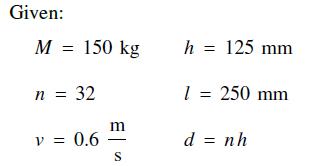
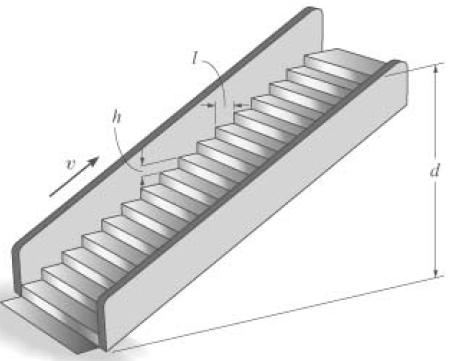
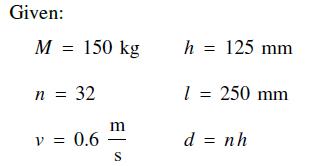
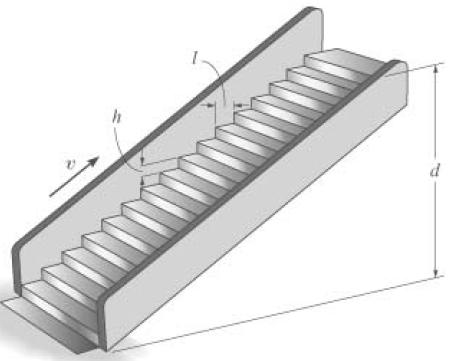
The escalator steps move with a constant speed v. If the steps are of height h and length l, determine the power of a motor needed to lift an average mass M per step. There are n steps. Given: M = 150 kg n = 32 V = 0.6 m S h = 125 mm 1 = 250 mm d = nh
An electrically powered train car draws a power P. If the car has weight W and starts from rest, determine the maximum speed it attains in time t. The mechanical efficiency is ε. Given: P = 30 kW W = 40000 lbf t = 30 s = 0.8 E =
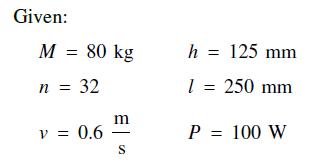
If the escalator in Prob. 14−46 is not moving, determine the constant speed at which a man having a mass M must walk up the steps to generate power P—the same amount that is needed to power a standard light bulb.Data from problem 46The escalator steps move with a constant speed v. If the steps
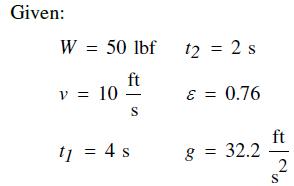
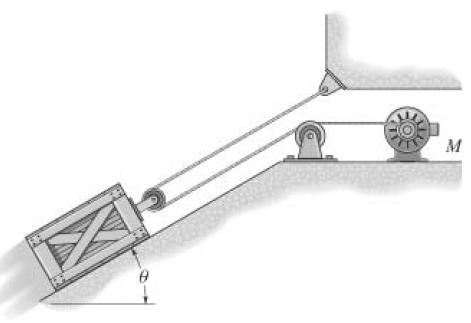
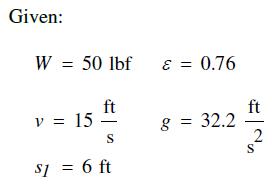
The crate of weight W is given speed v in time t1 starting from rest. If the acceleration is constant, determine the power that must be supplied to the motor when t = t2. The motor has an efficiency ε. Neglect the mass of the pulley and cable. Given: W = 50 lbf ft V = 10 S t1 = 4 s t2 = 2 s ε =
An electric streetcar has a weight W and accelerates along a horizontal straight road from rest such that the power is always P. Determine how far it must travel to reach a speed of v. Given: W = 15000 lbf v = 40 ft S P = 100 hp
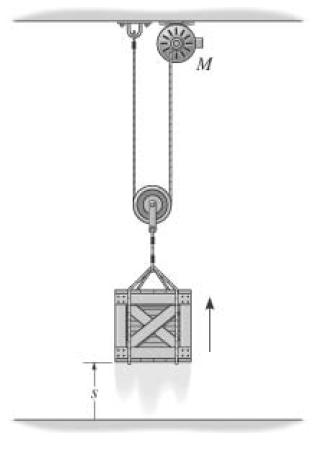
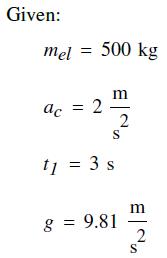
The elevator of mass mel starts from rest and travels upward with a constant acceleration ac. Determine the power output of the motor M when t = t1. Neglect the mass of the pulleys and cable. Given: mel = 500 kg ac = 2 t1 8 = m 2 S : 3 s 9.81 E 2 S
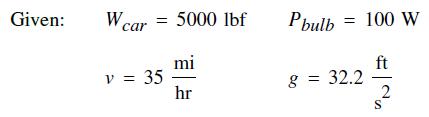
To dramatize the loss of energy in an automobile, consider a car having a weight Wcar that is traveling at velocity v. If the car is brought to a stop, determine how long a light bulb with power Pbulb must burn to expend the same amount of energy. Given: Wcar 5000 lbf = V = 35 mi hr Pbulb = 100 W 8
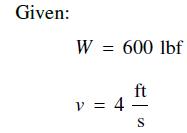
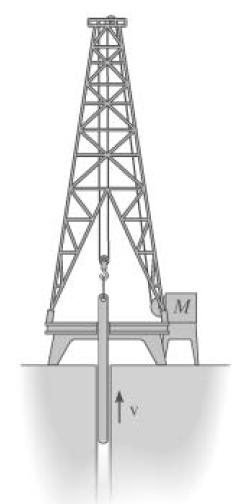
Determine the power output of the draw-works motor M necessary to lift the drill pipe of weight W upward with a constant speed v. The cable is tied to the top of the oil rig, wraps around the lower pulley, then around the top pulley, and then to the motor. Given: W = 600 lbf v = 4 ft S
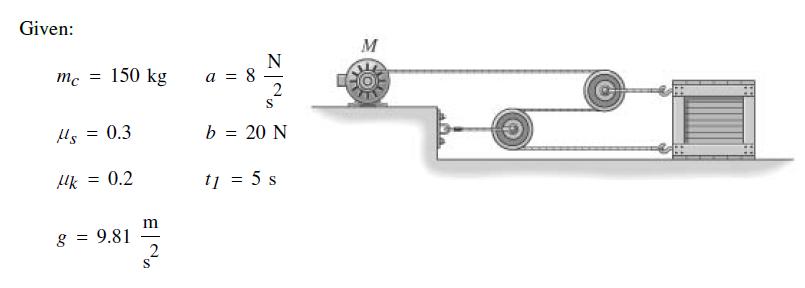
The crate has mass mc and rests on a surface for which the coefficients of static and kinetic friction are μs and μk respectively. If the motor M supplies a cable force of F = at2 + b, determine the power output developed by the motor when t = t1. Given: mc = 150 kg Hs = 0.3 Mk = 0.2 8 = 9.81 m a
The crate of mass mc is hoisted up the incline of angle θ by the pulley system and motor M. If the crate starts from rest and by constant acceleration attains speed v after traveling a distance d along the plane, determine the power that must be supplied to the motor at this instant. Neglect
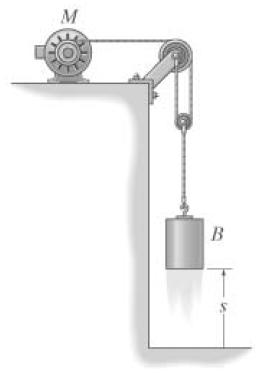
The load of weight W is hoisted by the pulley system and motor M. If the crate starts from rest and by constant acceleration attains a speed v after rising a distance s = s1, determine the power that must be supplied to the motor at this instant. The motor has an efficiency ε. Neglect the mass of
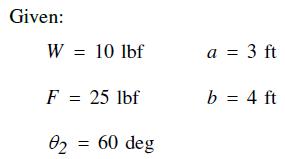
The collar of weight W starts from rest at A and is lifted by applying a constant vertical force F to the cord. If the rod is smooth, determine the power developed by the force at the instant θ = θ2. Given: W = 10 lbf F = 25 lbf 82 = 60 deg a = 3 ft b = 4 ft
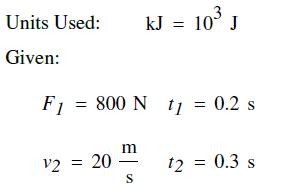
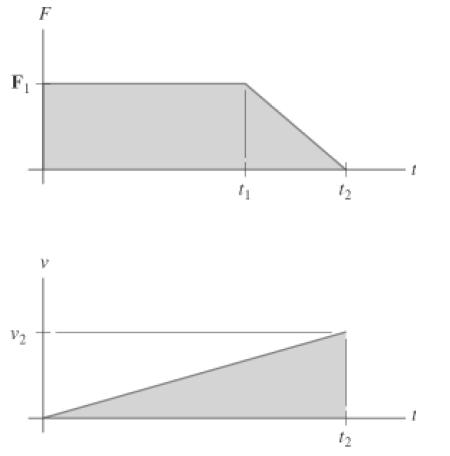
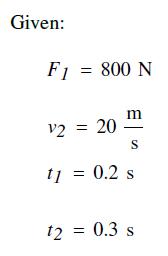
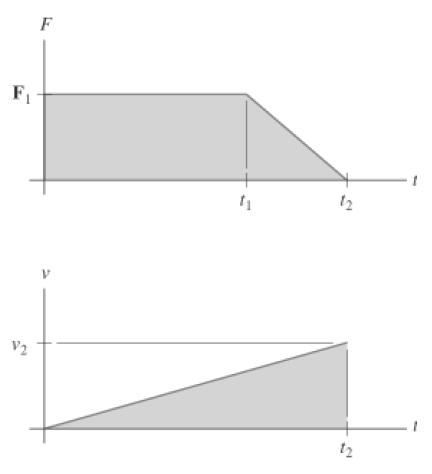
An athlete pushes against an exercise machine with a force that varies with time as shown in the first graph. Also, the velocity of the athlete’s arm acting in the same direction as the force varies with time as shown in the second graph. Determine the power applied as a function of time and the
An athlete pushes against an exercise machine with a force that varies with time as shown in the first graph. Also, the velocity of the athlete’s arm acting in the same direction as the force varies with time as shown in the second graph. Determine the maximum power developed during the time
Block A has weight WA and block B has weight WB. Determine the speed of block A after it moves a distance d down the plane, starting from rest. Neglect friction and the mass of the cord and pulleys. Given: WA = 60 lb WB = 10 lb d = 5 ft e = 3 f = 4 8 = 32.2 ft 2 S
The collar has mass M and rests on the smooth rod. Two springs are attached to it and the ends of the rod as shown. Each spring has an uncompressed length l. If the collar is displaced a distance s = s' and released from rest, determine its velocity at the instant it returns to the point s = 0.
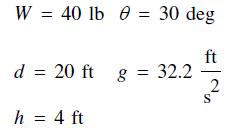
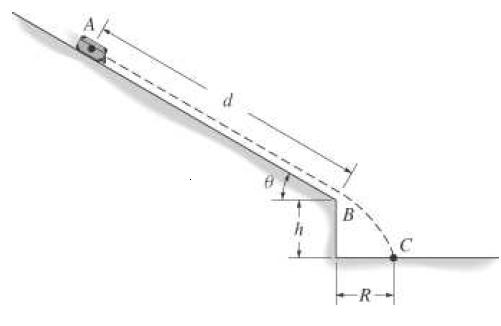
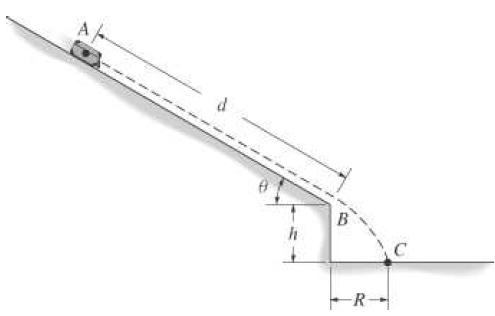
A suitcase of weight W slides from rest a distance d down the smooth ramp. Determine the point where it strikes the ground at C. How long does it take to go from A to C? Given: W = 40 lb = 30 deg d = 20 ft h = 4 ft 8 = 32.2 ft 2 S
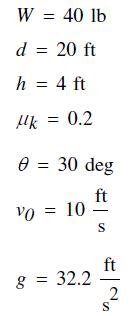
A suitcase of weight W slides from rest a distance d down the rough ramp. The coefficient of kinetic friction along ramp AB is μk. The suitcase has an initial velocity down the ramp v0. Determine the point where it strikes the ground at C. How long does it take to go from A to C? Given: W = 40
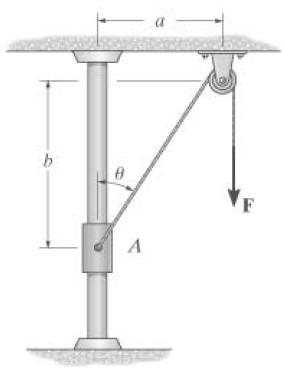
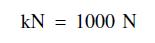
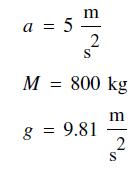
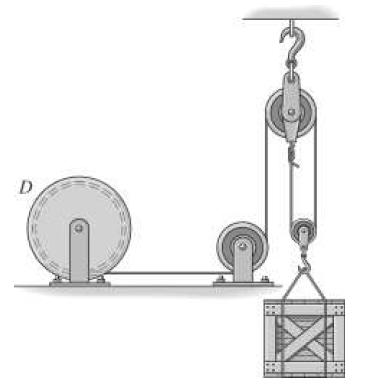
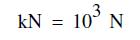
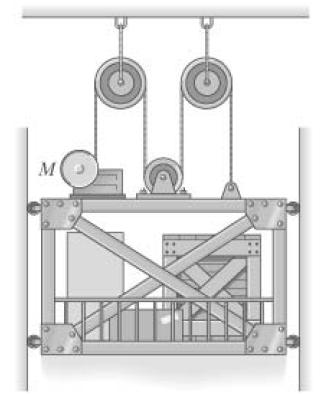
The winding drum D is drawing in the cable at an accelerated rate a. Determine the cable tension if the suspended crate has mass M. Units Used:Given: kN = 1000 N
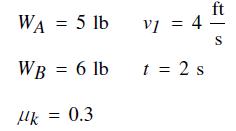
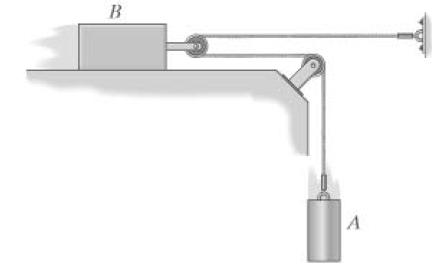
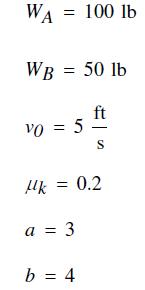
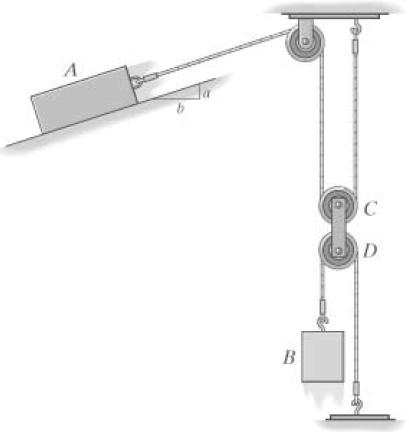
At a given instant block A of weight WA is moving downward with a speed v1. Determine its speed at the later time t. Block B has weight WB, and the coefficient of kinetic friction between it and the horizontal plane is μk. Neglect the mass of the pulleys and cord. Given: WA = 5 lb WB = 6 lb k 0.3
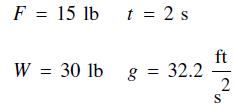
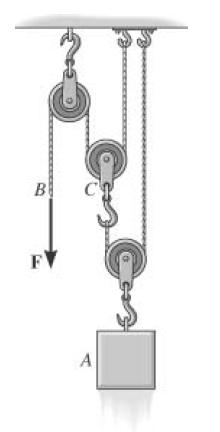
A force F is applied to the cord. Determine how high the block A of weight W rises in time t starting from rest. Neglect the weight of the pulleys and cord. Given: F = 15 lb t = 2 s W = 30 lb g 8 = 32.2 ft 2 S
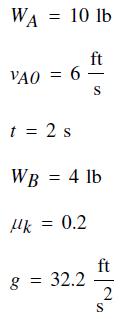
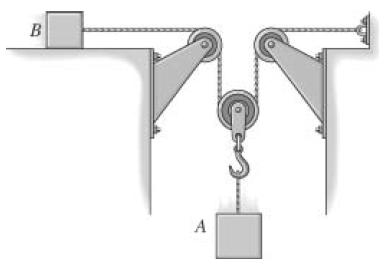
At a given instant block A of weight WA is moving downward with speed vA0. Determine its speed at a later time t. Block B has a weight WB and the coefficient of kinetic friction between it and the horizontal plane is μk. Neglect the mass of the pulleys and cord. Given: WA = 10 lb VAO = 6- S t = 2
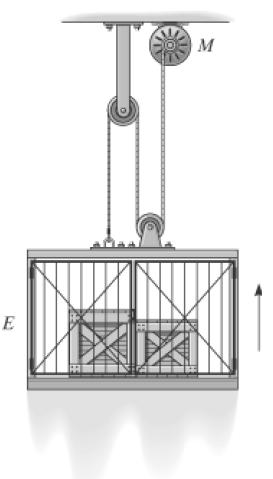
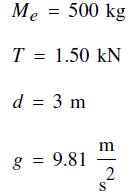
A freight elevator, including its load, has mass Me. It is prevented from rotating due to the track and wheels mounted along its sides. If the motor M develops a constant tension T in its attached cable, determine the velocity of the elevator when it has moved upward at a distance d starting from
At the instant shown the block A of weight WA is moving down the plane at v0 while being attached to the block B of weight WB. If the coefficient of kinetic friction is μk, determine the acceleration of A and the distance A slides before it stops. Neglect the mass of the pulleys and cables. Given:
A woman having a mass M stands in an elevator which has a downward acceleration a starting from rest. Determine the work done by her weight and the work of the normal force which the floor exerts on her when the elevator descends a distance s. Explain why the work of these forces is different.
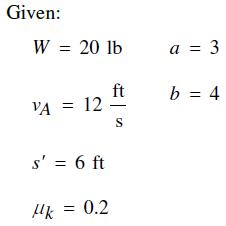
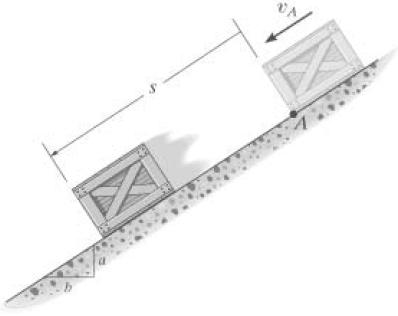
The crate of weight W has a velocity vA when it is at A. Determine its velocity after it slides down the plane to s = s'. The coefficient of kinetic friction between the crate and the plane is μk. Given: W = 20 lb VA = 12 s' = 6 ft μk = 0.2 ft S a = 3 b = 4
The crate of mass M is subjected to a force having a constant direction and a magnitude F, where s is measured in meters. When s = s1, the crate is moving to the right with a speed v1. Determine its speed when s = s2. The coefficient of kinetic friction between the crate and the ground is μk.
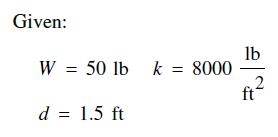
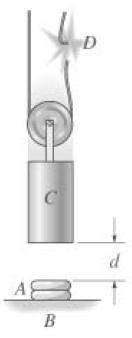
The “air spring” A is used to protect the support structure B and prevent damage to the conveyor-belt tensioning weight C in the event of a belt failure D. The force developed by the spring as a function of its deflection is shown by the graph. If the weight is W and it is suspended a height d
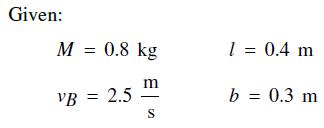
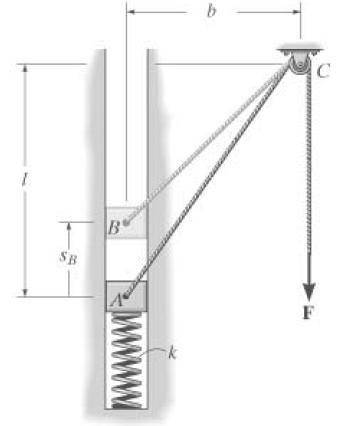
The block has a mass M and moves within the smooth vertical slot. If it starts from rest when the attached spring is in the unstretched position at A, determine the constant vertical force F which must be applied to the cord so that the block attains a speed vB when it reaches sB. Neglect the size
The collar has mass M and slides along the smooth rod. Two springs are attached to it and the ends of the rod as shown. If each spring has an uncompressed length L and the collar has speed v0 when s = 0, determine the maximum compression of each spring due to the back-and-forth (oscillating) motion
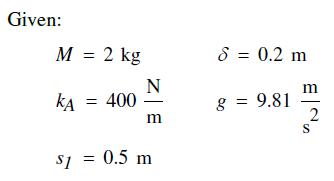
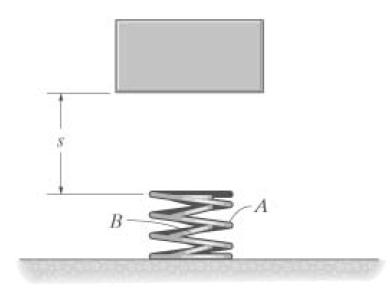
Two equal-length springs are “nested” together in order to form a shock absorber. If it is designed to arrest the motion of mass M that is dropped from a height s1 above the top of the springs from an at-rest position, and the maximum compression of the springs is to be δ, determine the
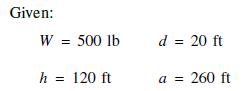
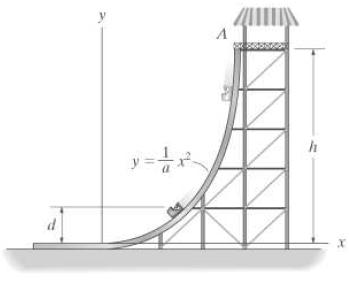
The ride at an amusement park consists of a gondola which is lifted to a height h at A. If it is released from rest and falls along the parabolic track, determine the speed at the instant y = d. Also determine the normal reaction of the tracks on the gondola at this instant. The gondola and
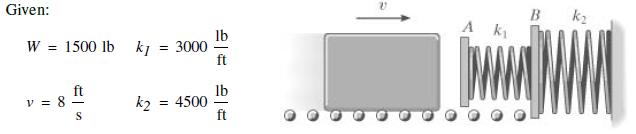
The double-spring bumper is used to stop the steel billet of weight W in the rolling mill. Determine the maximum deflection of the plate A caused by the billet if it strikes the plate with a speed v. Neglect the mass of the springs, rollers and the plates A and B. Given: W = 1500 lb kj ft S v=8- =
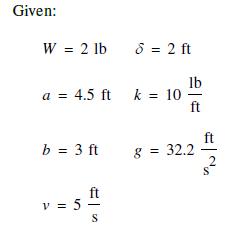
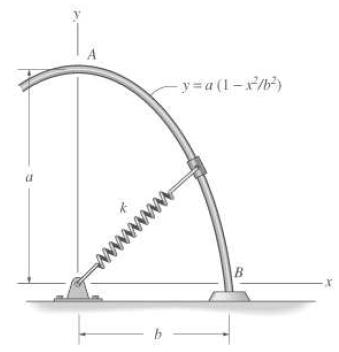
The collar of weight W has a speed v at A. The attached spring has an unstretched length δ and a stiffness k. If the collar moves over the smooth rod, determine its speed when it reaches point B, the normal force of the rod on the collar, and the rate of decrease in its speed. Given: W = 2 lb a =
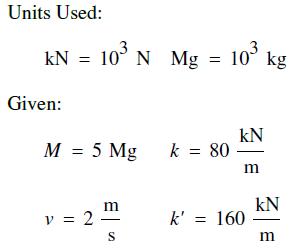
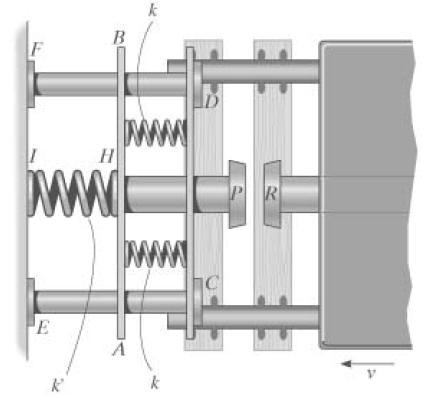
The spring mechanism is used as a shock absorber for railroad cars. Determine the maximum compression of spring HI if the fixed bumper R of a railroad car of mass M, rolling freely at speed v strikes the plate P. Bar AB slides along the guide paths CE and DF. The ends of all springs are attached to
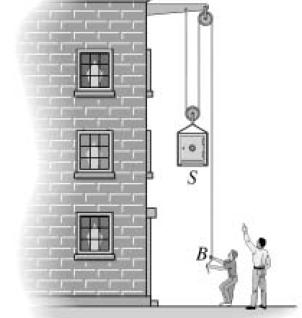
The safe S has weight Ws and is supported by the rope and pulley arrangement shown. If the end of the rope is given to a boy B of weight Wb, determine his acceleration if in the confusion he doesn’t let go of the rope. Neglect the mass of the pulleys and rope. Given: ft Ws = 200 lb Wb = 90 lb g =
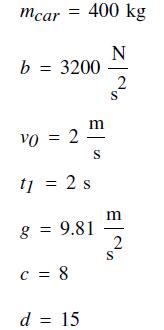
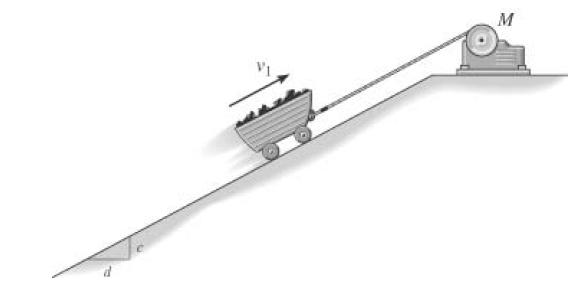
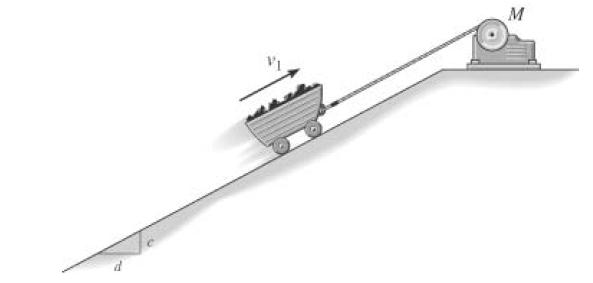
The mine car of mass mcar is hoisted up the incline using the cable and motor M. For a short time, the force in the cable is F = bt2. If the car has an initial velocity v0 when t = 0, determine its velocity when t = t1. Given: mcar = b = 3200 VO = 2 400 kg t₁ = 2 s c = 8 g 8 = 9.81 d =
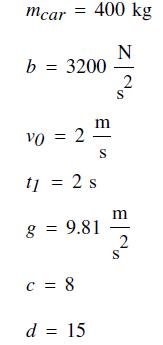
The mine car of mass mcar is hoisted up the incline using the cable and motor M. For a short time, the force in the cable is F = bt2. If the car has an initial velocity v0 when t = 0, determine the distance it moves up the plane when t = t1.Given: mcar = = 400 kg b = 3200 VO = 2 t₁ = 2 s EI c =
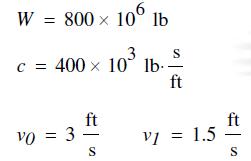
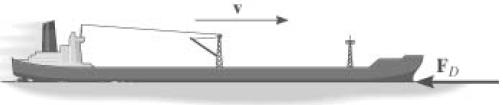
The tanker has a weight W and is traveling forward at speed v0 in still water when the engines are shut off. If the drag resistance of the water is proportional to the speed of the tanker at any instant and can be approximated by FD = cv, determine the time needed for the tanker’s speed to become
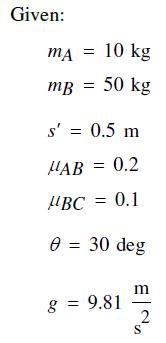
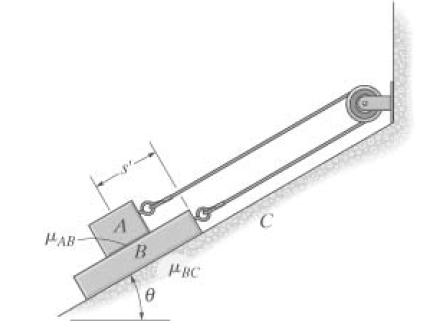
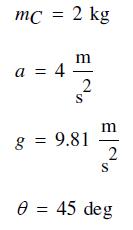
The block A of mass mA rests on the plate B of mass mB in the position shown. Neglecting the mass of the rope and pulley, and using the coefficients of kinetic friction indicated, determine the time needed for block A to slide a distance s' on the plate when the system is released from rest.
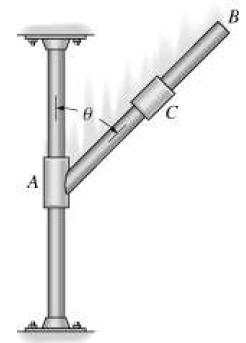
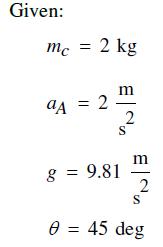
The collar C of mass mc is free to slide along the smooth shaft AB. Determine the acceleration of collar C if collar A is subjected to an upward acceleration a. The collar moves in the plane. Given: = 2 kg mc = a = 4 m 2 S g 8 = 9.81 m 2 S 0 = 45 deg
The collar C of mass mc is free to slide along the smooth shaft AB. Determine the acceleration of collar C if(a) The shaft is fixed from moving,(b) Collar A, which is fixed to shaft AB, moves downward at constant velocity along the vertical rod,(c) Collar A is subjected to downward acceleration aA.
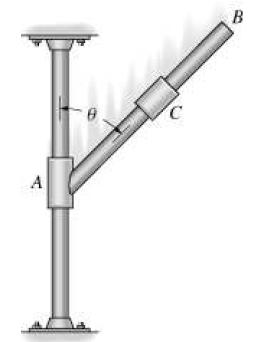
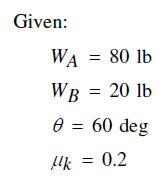
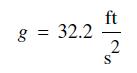
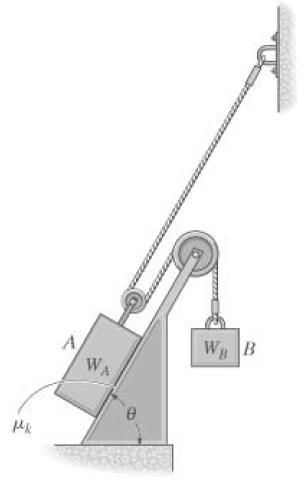
Determine the acceleration of block A when the system is released from rest. The coefficient of kinetic friction and the weight of each block are indicated. Neglect the mass of the pulleys and cord. Given: WA = 80 lb WB = 20 lb 8 = 60 deg Ꮎ Mk = 0.2 μk
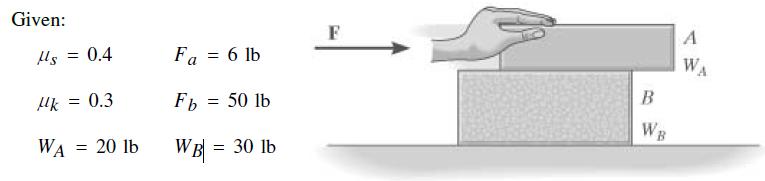
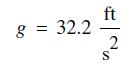
Block B rests on a smooth surface. If the coefficients of static and kinetic friction between A and B are μs and μk respectively, determine the acceleration of each block if someone pushes horizontally on block A with a force of(a) F = Fa(b) F = Fb. Given: s = 0.4 k = 0.3 WA = 20 lb Fa = 6 lb Fb
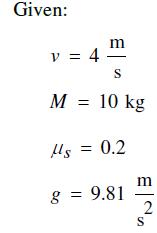
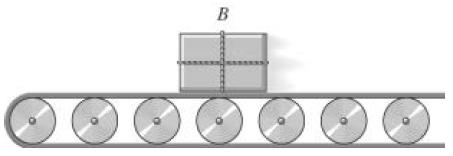
The conveyor belt is moving at speed v. If the coefficient of static friction between the conveyor and the package B of mass M is μs, determine the shortest time the belt can stop so that the package does not slide on the belt. Given: V = 4 EI S M = 10 kg μs = 0.2 g 8 = 9.81 m 2 S
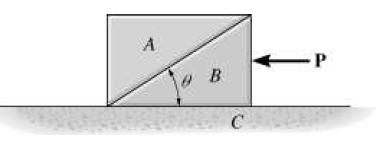
Blocks A and B each have mass m. Determine the largest horizontal force P which can be applied to B so that A will not slip up B. The coefficient of static friction between A and B is μs. Neglect any friction between B and C. A 4 B C - P
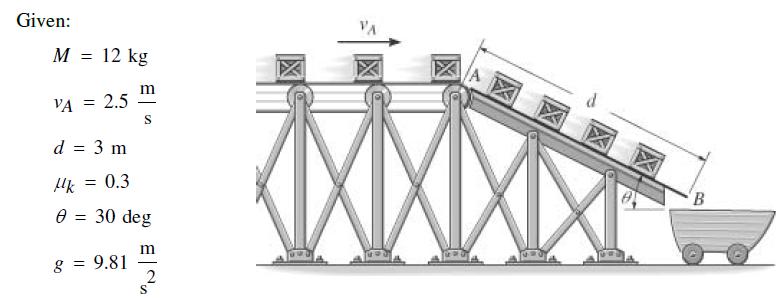
The conveyor belt delivers each crate of mass M to the ramp at A such that the crate’s speed is vA directed down along the ramp. If the coefficient of kinetic friction between each crate and the ramp is μk, determine the speed at which each crate slides off the ramp at B. Assume that no tipping
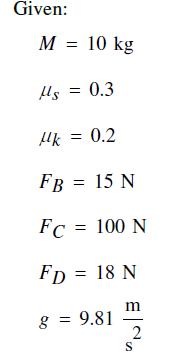
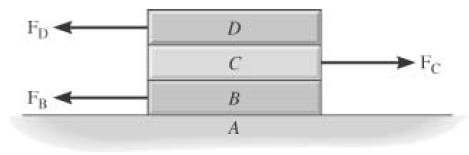
Each of the three plates has mass M. If the coefficients of static and kinetic friction at each surface of contact are μs and μk respectively, determine the acceleration of each plate when the three horizontal forces are applied. Given: M = 10 kg μs = 0.3 Mk = 0.2 FB = 15 N FC = 100 N FD = 18
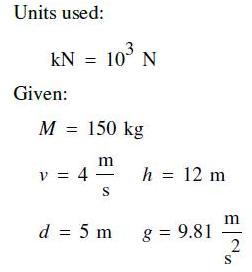
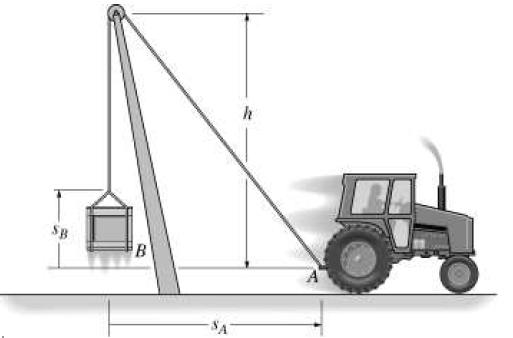
The tractor is used to lift load B of mass M with the rope of length 2h, and the boom, and pulley system. If the tractor is traveling to the right at constant speed v, determine the tension in the rope when sA = d. When sA = 0 , sB = 0 Units used: KN = 10³ N Given: M = 150 kg m v = 4- S d = 5 m h
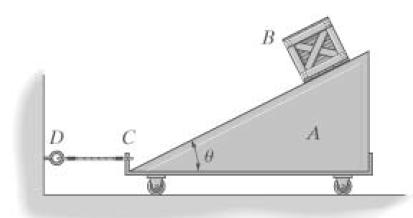
Crate B has a mass m and is released from rest when it is on top of cart A, which has a mass 3m. Determine the tension in cord CD needed to hold the cart from moving while B is sliding down A. Neglect friction. D C B
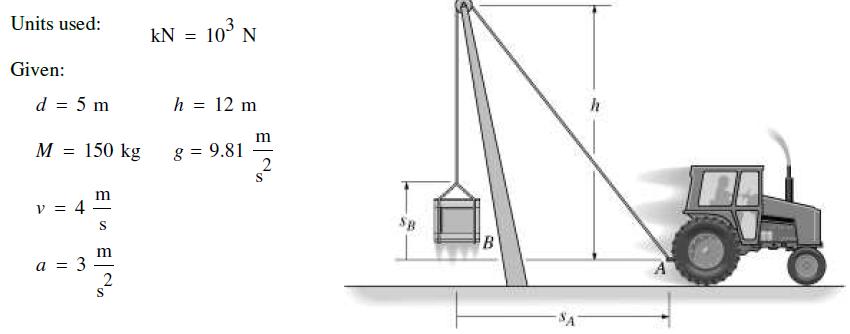
The tractor is used to lift load B of mass M with the rope of length 2h, and the boom, and pulley system. If the tractor is traveling to the right with an acceleration a and has speed v at the instant sA = d, determine the tension in the rope. When sA = 0 , sB = 0. Units used: Given: d = 5 m M =
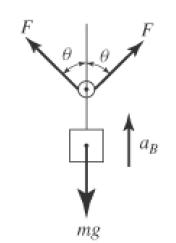
Block B has a mass m and is hoisted using the cord and pulley system shown. Determine the magnitude of force F as a function of the block’s vertical position y so that when F is applied the block rises with a constant acceleration aB. Neglect the mass of the cord and pulleys. mg
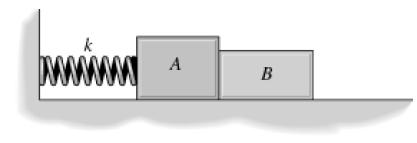
Block A has mass mA and is attached to a spring having a stiffness k and unstretched length l0. If another block B, having mass mB is pressed against A so that the spring deforms a distance d, determine the distance both blocks slide on the smooth surface before they begin to separate. What is
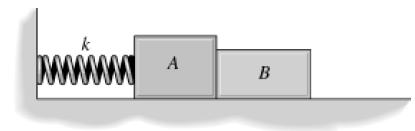
Block A has a mass mA and is attached to a spring having a stiffness k and unstretched length l0. If another block B, having a mass mB is pressed against A so that the spring deforms a distance d, show that for separation to occur it is necessary that d > 2μk g(mA+mB)/k, where μk is the
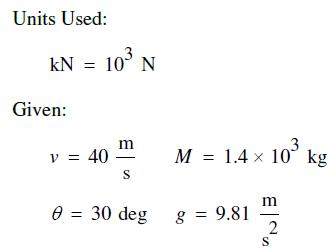
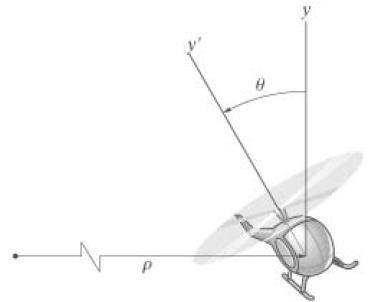
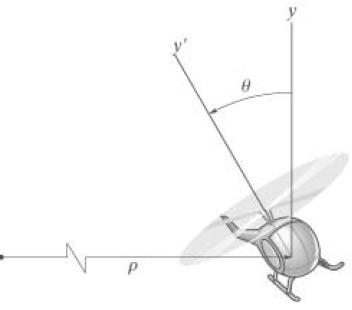
The helicopter of mass M is traveling at a constant speed v along the horizontal curved path while banking at angle θ. Determine the force acting normal to the blade, i.e., in the y' direction, and the radius of curvature of the path. Units Used: kN = 10³ N Given: V = 40 m S M = 1.4 × 10³ kg 0
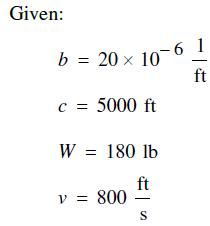
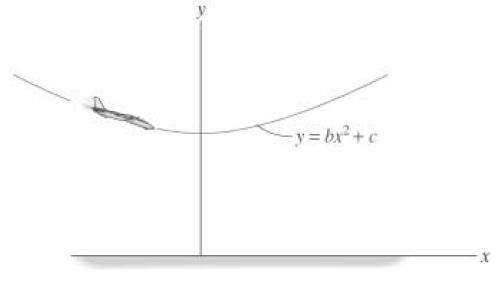
The plane is traveling at a constant speed v along the curve y = bx2 + c. If the pilot has weight W, determine the normal and tangential components of the force the seat exerts on the pilot when the plane is at its lowest point. Given: b = 20 x 10-6 c = 5000 ft W = 180 lb ft v = 800 S 1 ft
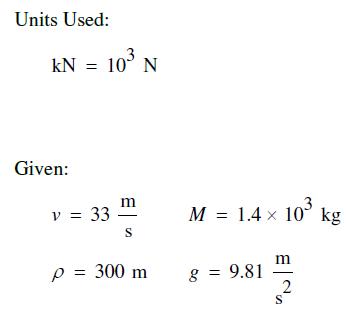
The helicopter of mass M is traveling at a constant speed v along the horizontal curved path having a radius of curvature ρ. Determine the force the blade exerts on the frame and the bank angle θ. Units Used: kN KN = 10 N Given: v = 33 m S p = 300 m M = 1.4 x 10 kg 8 = 9.81 m 2 S
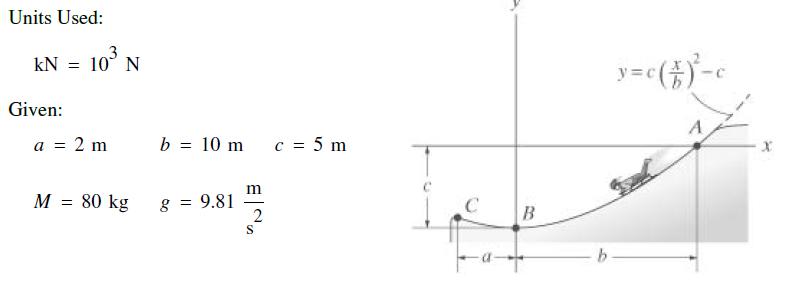
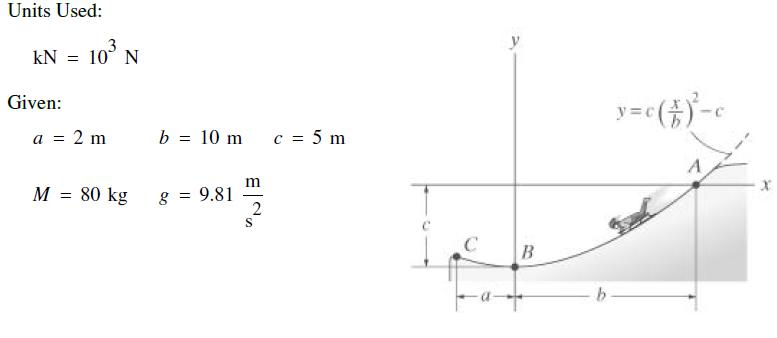
The sled and rider have a total mass M and start from rest at A(b, 0). If the sled descends the smooth slope, which may be approximated by a parabola, determine the normal force that the ground exerts on the sled at the instant it arrives at point B. Neglect the size of the sled and rider. Units
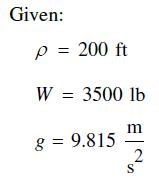
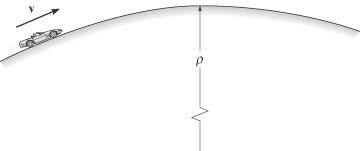
If the crest of the hill has a radius of curvature ρ, determine the maximum constant speed at which the car can travel over it without leaving the surface of the road. Neglect the size of the car in the calculation. The car has weight W. Given: P = 200 ft W = 3500 lb 8 = 9.815 m 2 S
The sled and rider have a total mass M and start from rest at A(b, 0). If the sled descends the smooth slope which may be approximated by a parabola, determine the normal force that the ground exerts on the sled at the instant it arrives at point C. Neglect the size of the sled and rider. Units
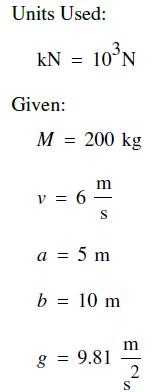
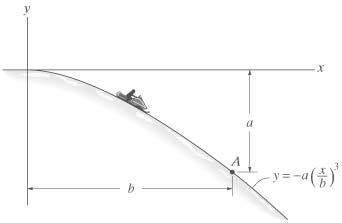
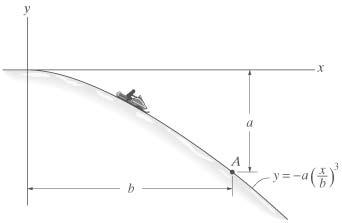
The snowmobile of mass M with passenger is traveling down the hill at a constant speed v. Determine the resultant normal force and the resultant frictional force exerted on the tracks at the instant it reaches point A. Neglect the size of the snowmobile. Units Used: kN = 10³N Given: M = 200 kg m v
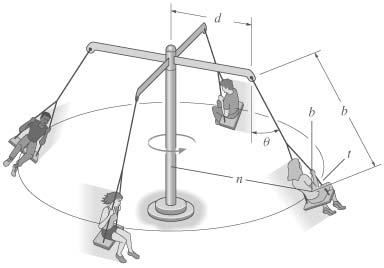
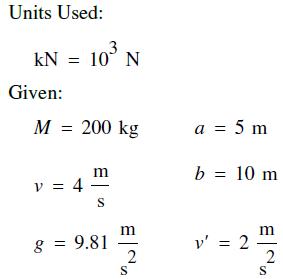
Determine the constant speed of the passengers on the amusement-park ride if it is observed that the supporting cables are directed at angle q from the vertical. Each chair including its passenger has a mass mc. Also, what are the components of force in the n, t, and b directions which the chair
The snowmobile of mass M with passenger is traveling down the hill such that when it is at point A, it is traveling at speed v and increasing its speed at v'. Determine the resultant normal force and the resultant frictional force exerted on the tracks at this instant. Neglect the size of the
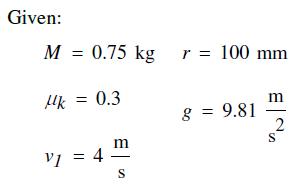
A collar having a mass M and negligible size slides over the surface of a horizontal circular rod for which the coefficient of kinetic friction is μk. If the collar is given a speed v1 and then released at θ = 0 deg, determine how far, d, it slides on the rod before coming to rest. Given: M =
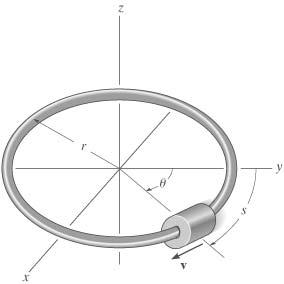
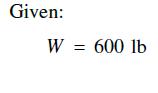
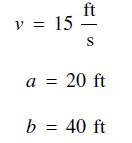
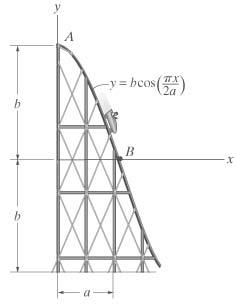
The roller coaster car and passenger have a total weight W and starting from rest at A travel down the track that has the shape shown. Determine the normal force of the tracks on the car when the car is at point B, it has a velocity of v. Neglect friction and the size of the car and passenger.
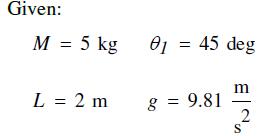
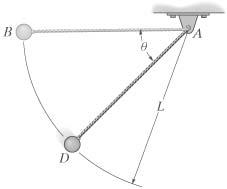
The pendulum bob B of mass M is released from rest when θ = 0°. Determine the initial tension in the cord and also at the instant the bob reaches point D, θ = θ1. Neglect the size of the bob. Given: M = 5 kg L = 2 m 01 = 45 deg 8 = 9.81 2 S
Showing 700 - 800
of 2550
1
2
3
4
5
6
7
8
9
10
11
12
13
14
15
Last
Step by Step Answers

 Get 50% OFF
Claim Now
Get 50% OFF
Claim Now