New Semester
Started
Get
50% OFF
Study Help!
--h --m --s
Claim Now
Question Answers
Textbooks
Find textbooks, questions and answers
Oops, something went wrong!
Change your search query and then try again
S
Books
FREE
Study Help
Expert Questions
Accounting
General Management
Mathematics
Finance
Organizational Behaviour
Law
Physics
Operating System
Management Leadership
Sociology
Programming
Marketing
Database
Computer Network
Economics
Textbooks Solutions
Accounting
Managerial Accounting
Management Leadership
Cost Accounting
Statistics
Business Law
Corporate Finance
Finance
Economics
Auditing
Tutors
Online Tutors
Find a Tutor
Hire a Tutor
Become a Tutor
AI Tutor
AI Study Planner
NEW
Sell Books
Search
Search
Sign In
Register
study help
engineering
engineering mechanics dynamics
Engineering Mechanics Dynamics 8th Edition James L. Meriam, L. G. Kraige, J. N. Bolton - Solutions
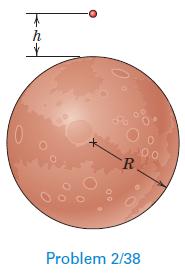
Compute the impact speed of a body released from rest at an altitude h = 650 miles above the surface of Mars. (a) First assume a constant gravitational acceleration gm0 = 12.3 ft/sec2 (equal to that at the surface) and (b) then account for the variation of g with altitude. Neglect any effects of
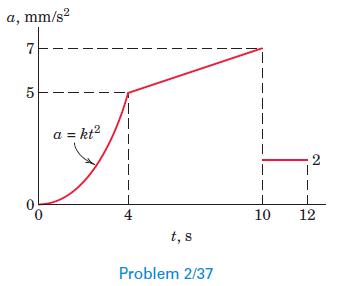
The graph shows the rectilinear acceleration of a particle as a function of time over a 12-second interval. If the particle is at rest at the position s0 = 0 at time t = 0, determine the velocity of the particle when (a) t = 4 s, (b) t = 8 s, and (c) t = 12 s. a, mm/s? 7 5 a = kt? 4 10 12 t, s
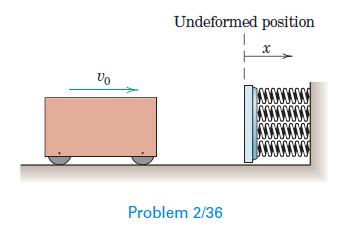
The cart impacts the safety barrier with speed v0 = 3.25 m/s and is brought to a stop by the nest of nonlinear springs which provide a deceleration a = −k1x − k2x3, where x is the amount of spring deflection from the un deformed position and k1 and k2 are positive constants. If the maximum
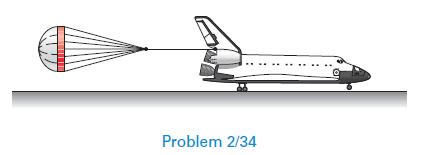
Reconsider the rollout of the space-shuttle orbiter of the previous problem. The drag chute is deployed at 200 mi/hr, the wheel brakes are applied at 100 mi/hr until wheel stop, and the drag chute is jettisoned at 35 mi/hr. If the drag chute results in a deceleration of −0.0003v2 (in feet per
The 230,000-lb space-shuttle orbiter touches down at about 220 mi/hr. At 200 mi/hr its drag parachute deploys. At 35 mi/hr, the chute is jettisoned from the orbiter. If the deceleration in feet per second squared during the time that the chute is deployed is −0.0003v2 (speed v in feet per
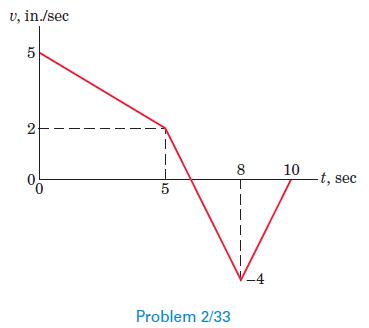
A particle moves along the x-axis with the velocity history shown. If the particle is at the position x = −4 in. at time t = 0, plot the corresponding displacement history for the time interval 0 ≤ t ≤ 10 sec. Additionally, find the net displacement and total distance traveled by the particle
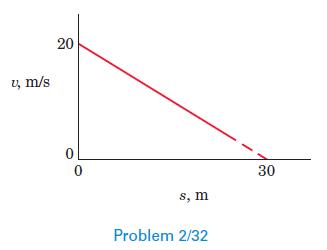
If the velocity v of a particle moving along a straight line decreases linearly with its displacement s from 20 m/s to a value approaching zero at s = 30 m, determine the acceleration a of the particle when s = 15 m and show that the particle never reaches the 30-m displacement. 20 u, m/s 30 s, m
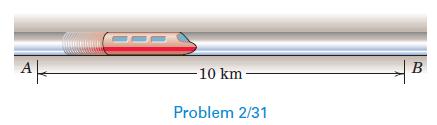
A vacuum-propelled capsule for a high-speed tube transportation system of the future is being designed for operation between two stations A and B, which are 10 km apart. If the acceleration and deceleration are to have a limiting magnitude of 0.6g and if velocities are to be limited to 400 km/h,
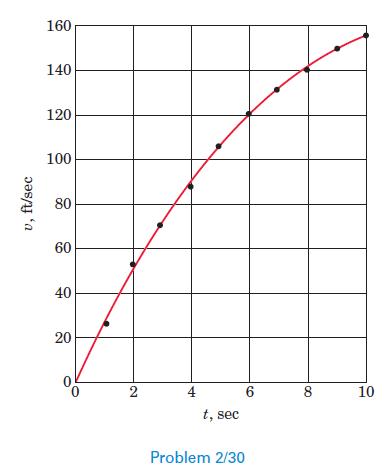
An electric car is subjected to acceleration tests along a straight and level test track. The resulting v-t data are closely modeled over the first 10 seconds by the function v = 24 t − t2 + 5√t, where t is the time in seconds and v is the velocity in feet per second. Determine the displacement
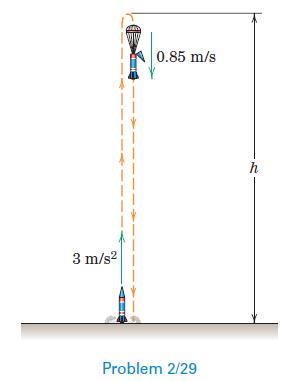
A model rocket is launched from rest with a constant upward acceleration of 3 m/s2 under the action of a small thruster. The thruster shuts off after 8 seconds, and the rocket continues upward until it reaches its apex. At apex, a small chute opens which ensures that the rocket falls at a constant
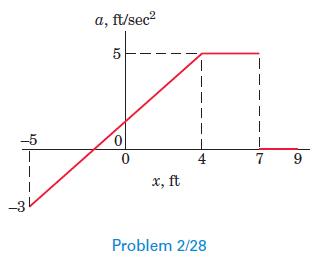
A particle moving along a straight line has an acceleration which varies according to position as shown. If the velocity of the particle at the position x = −5 ft is v = −2 ft/sec, determine the velocity when x = 9 ft. a, ft/sec2 5 -5 0. 4 7 9 x, ft -3 Problem 2/28
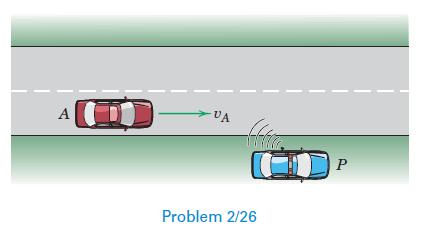
Car A is traveling at a constant speed vA = 130 km/h at a location where the speed limit is 100 km / h. The police officer in car P observes this speed via radar. At the moment when A passes P, the police car begins to accelerate at the constant rate of 6 m/s2 until a speed of 160 km/h is achieved,
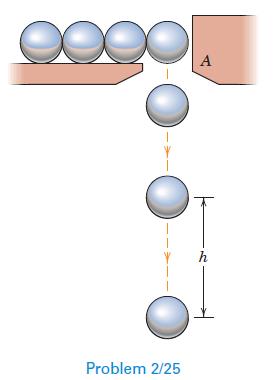
Small steel balls fall from rest through the opening at A at the steady rate of two per second. Find the vertical separation h of two consecutive balls when the lower one has dropped 3 meters. Neglect air resistance. A h Problem 2/25
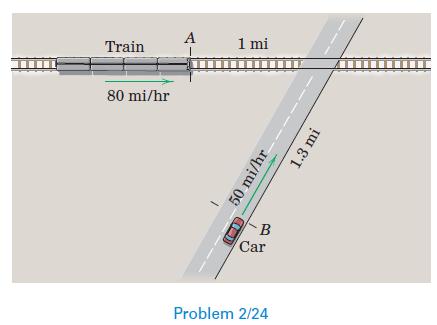
A train which is traveling at 80 mi/hr applies its brakes as it reaches point A and slows down with a constant deceleration. Its decreased velocity is observed to be 60 mi/hr as it passes a point 1/2 mi beyond A. A car moving at 50 mi/hr passes point B at the same instant that the train reaches
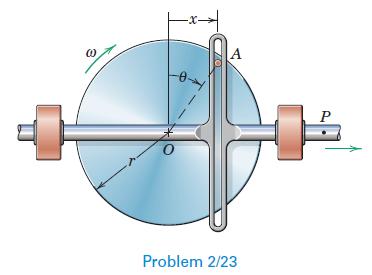
A Scotch-yoke mechanism is used to convert rotary motion into reciprocating motion. As the disk rotates at the constant angular rate ω, a pin A slides in a vertical slot causing the slotted member to displace horizontally according to x = r sin(ωt) relative to the fixed disk center O. Determine
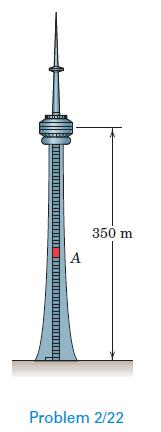
The main elevator A of the CN Tower in Toronto rises about 350 m and for most of its run has a constant speed of 22 km/h. Assume that both the acceleration and deceleration have a constant magnitude of 1/4 g and determine the time duration t of the elevator run. 350 m A Problem 2/22
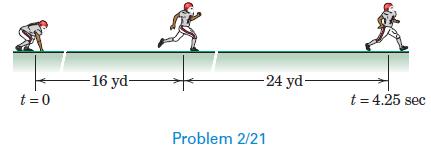
At a football tryout, a player runs a 40-yard dash in 4.25 seconds. If he reaches his maximum speed at the 16-yard mark with a constant acceleration and then maintains that speed for the remainder of the run, determine his acceleration over the first 16 yards, his maximum speed, and the time
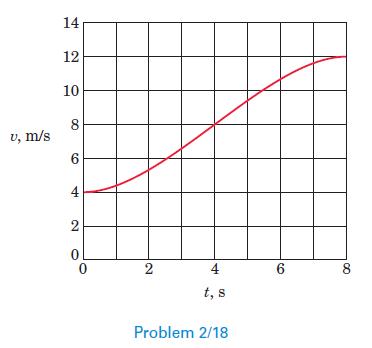
During an 8-second interval, the velocity of a particle moving in a straight line varies with time as shown. Within reasonable limits of accuracy, determine the amount Δa by which the acceleration at t = 4 s exceeds the average acceleration during the interval. What is the displacement Δs during
The pilot of a jet transport brings the engines to full takeoff power before releasing the brakes as the aircraft is standing on the runway. The jet thrust remains constant, and the aircraft has a near constant acceleration of 0.4g. If the takeoff speed is 200 km/h, calculate the distance s and
A car comes to a complete stop from an initial speed of 50 mi/hr in a distance of 100 ft. With the same constant acceleration, what would be the stopping distance s from an initial speed of 70 mi/hr?
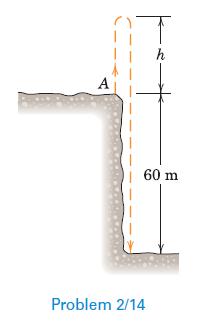
A ball is thrown vertically up with a velocity of 30 m/s at the edge of a 60-m cliff. Calculate the height h to which the ball rises and the total time t after release for the ball to reach the bottom of the cliff. Neglect air resistance and take the downward acceleration to be 9.81 m/s2. h 60 m
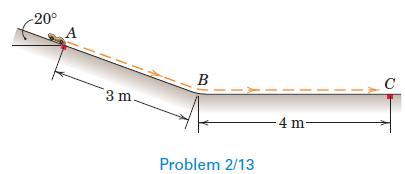
In the pinewood-derby event shown, the car is released from rest at the starting position A and then rolls down the incline and on to the finish line C. If the constant acceleration down the incline is 2.75 m /s2 and the speed from B to C is essentially constant, determine the time duration tAC for
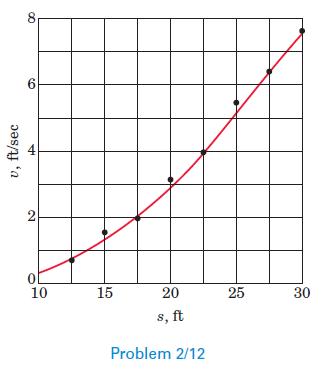
Experimental data for the motion of a particle along a straight line yield measured values of the velocity v for various position coordinates s. A smooth curve is drawn through the points as shown in the graph. Determine the acceleration of the particle when s = 20 ft. 6 2 10 15 20 25 30 s, ft
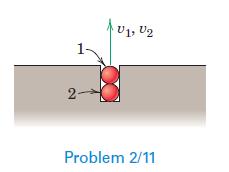
Ball 1 is launched with an initial vertical velocity v1 = 160 ft/sec. Three seconds later, ball 2 is launched with an initial vertical velocity v2. Determine v2 if the balls are to collide at an altitude of 300 ft. At the instant of collision, is ball 1 ascending or descending? 2- Problem 2/11
A particle in an experimental apparatus has a velocity given by v = k√s, where v is in millimeters per second, the position s is millimeters, and the constant k = 0.2 mm1/2s−1. If the particle has a velocity v0 = 3 mm/s at t = 0, determine the particle position, velocity, and acceleration as
Calculate the constant acceleration a in g’s which the catapult of an aircraft carrier must provide to produce a launch velocity of 180 mi/hr in a distance of 300 ft. Assume that the carrier is at anchor.
The acceleration of a particle is given by a = c1 + c2v, where a is in millimeters per second squared, the velocity v is in millimeters per second, and c1 and c2 are constants. If the particle position and velocity at t = 0 are s0 and v0, respectively, determine expressions for the position s of
The acceleration of a particle is given by a = −ks2, where a is in meters per second squared, k is a constant, and s is in meters. Determine the velocity of the particle as a function of its position s. Evaluate your expression for s = 5 m if k = 0.1 m−1s−2 and the initial conditions at time
The acceleration of a particle is given by a = −kt2, where a is in meters per second squared and the time t is in seconds. If the initial velocity of the particle at t = 0 is v0 = 12 m/s and the particle takes 6 seconds to reverse direction, determine the magnitude and units of the constant k.
The acceleration of a particle is given by a = 2t − 10, where a is in meters per second squared and t is in seconds. Determine the velocity and displacement as functions of time. The initial displacement at t = 0 is s0 = −4 m, and the initial velocity is v0 = 3 m/s. -+ s, ft or m -1 1 2 3
The displacement of a particle which moves along the s-axis is given by s = (−2 + 3t)e−0.5t, where s is in meters and t is in seconds. Plot the displacement, velocity, and acceleration versus time for the first 20 seconds of motion. Determine the time at which the acceleration is zero. -+ s, ft
The velocity of a particle which moves along the s-axis is given by v = 2 − 4t + 5t3/2, where t is in seconds and v is in meters per second. Evaluate the position s, velocity v, and acceleration a when t = 3 s. The particle is at the position s0 = 3 m when t = 0. -+ s, ft or m -1 1 2 3
The position of a particle is given by s = 0.27t3 − 0.65t2 − 2.35t + 4.4, where s is in feet and the time t is in seconds. Plot the displacement, velocity, and acceleration as functions of time for the first 5 seconds of motion. Determine the positive time when the particle changes its
The velocity of a particle is given by v = 25t2 − 80t − 200, where v is in feet per second and t is in seconds. Plot the velocity v and acceleration a versus time for the first 6 seconds of motion and evaluate the velocity when a is zero. + 1 --+ s, ft or m -1 3
The weight of one dozen apples is 5 lb. Determine the average mass of one apple in both SI and U.S. units and the average weight of one apple in SI units. In the present case, how applicable is the “rule of thumb” that an average apple weighs 1 N?
Determine the dimensions of the quantity where ρ is density and v is speed.
Determine the base units of the expression in both SI and U.S. units. The variable m represents mass, g is the acceleration due to gravity, r is distance, and t is time. E mgr dt
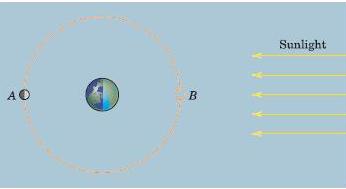
Determine the ratio RA of the force exerted by the sun on the moon to that exerted by the earth on the moon for position A of the moon. Repeat for moon position B. Sunlight AO B
Consider a woman standing on the earth with the sun directly overhead. Determine the ratio Res of the force which the earth exerts on the woman to the force which the sun exerts on her. Neglect the effects of the rotation and oblateness of the earth.
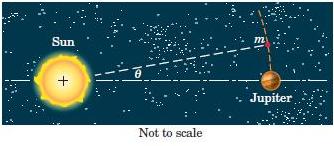
Determine the angle θ at which a particle in Jupiter’s circular orbit experiences equal attractions from the sun and from Jupiter. Use Table D /2 of Appendix D as needed. Sun my + Jupiter Not to scale
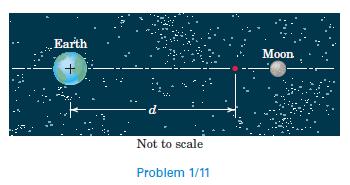
Calculate the distance d from the center of the earth at which a particle experiences equal attractions from the earth and from the moon. The particle is restricted to the line through the centers of the earth and the moon. Justify the two solutions physically. Refer to Table D/2 of Appendix D as
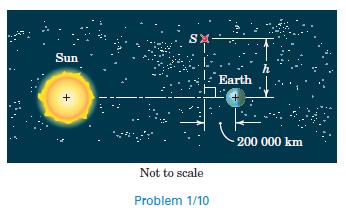
Determine the distance h for which the spacecraft S will experience equal attractions from the earth and from the sun. Use Table D/2 of Appendix D as needed. SX- Sun h Earth 200 000 km Not to scale Problem 1/10
A space shuttle is in a circular orbit at an altitude of 200 mi. Calculate the absolute value of g at this altitude and determine the corresponding weight of a shuttle passenger who weighs 180 lb when standing on the surface of the earth at a latitude of 45°. Are the terms “zero-g” and
Determine the absolute weight and the weight relative to the rotating earth of a 60-kg woman if she is standing on the surface of the earth at a latitude of 35°.
At what altitude h above the north pole is the weight of an object reduced to one-third of its earth-surface value? Assume a spherical earth of radius R and express h in terms of R.
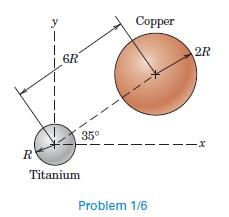
Two uniform spheres are positioned as shown. Determine the gravitational force which the titanium sphere exerts on the copper sphere. The value of R is 40 mm. y Сopper 2R 6R 35° R Titanium Problem 1/6
Consider two iron spheres, each of diameter 100 mm, which are just touching. At what distance r from the center of the earth will the force of mutual attraction between the contacting spheres be equal to the force exerted by the earth on one of the spheres?
Determine your mass in slugs. Convert your weight to newtons and calculate the corresponding mass in kilograms.
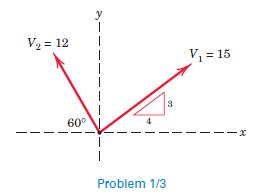
For the given vectors V1 and V2, determine V1 + V2, V1 + V2, V1 − V2, V1 × V2, V2 × V1, and V1∙V2. Consider the vectors to be non dimensional. y V2 = 12 V = 15 60° x- Problem 1/3
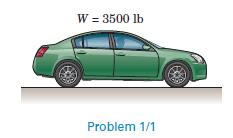
For the 3500-lb car, determine (a) its mass in slugs, (b) its weight in newtons, and (c) its mass in kilograms. W = 3500 lb Problem 1/1
Showing 2500 - 2600
of 2550
First
12
13
14
15
16
17
18
19
20
21
22
23
24
25
26
Step by Step Answers

 Get 50% OFF
Claim Now
Get 50% OFF
Claim Now