New Semester
Started
Get
50% OFF
Study Help!
--h --m --s
Claim Now
Question Answers
Textbooks
Find textbooks, questions and answers
Oops, something went wrong!
Change your search query and then try again
S
Books
FREE
Study Help
Expert Questions
Accounting
General Management
Mathematics
Finance
Organizational Behaviour
Law
Physics
Operating System
Management Leadership
Sociology
Programming
Marketing
Database
Computer Network
Economics
Textbooks Solutions
Accounting
Managerial Accounting
Management Leadership
Cost Accounting
Statistics
Business Law
Corporate Finance
Finance
Economics
Auditing
Tutors
Online Tutors
Find a Tutor
Hire a Tutor
Become a Tutor
AI Tutor
AI Study Planner
NEW
Sell Books
Search
Search
Sign In
Register
study help
engineering
engineering mechanics dynamics
Engineering Mechanics Dynamics 8th Edition James L. Meriam, L. G. Kraige, J. N. Bolton - Solutions
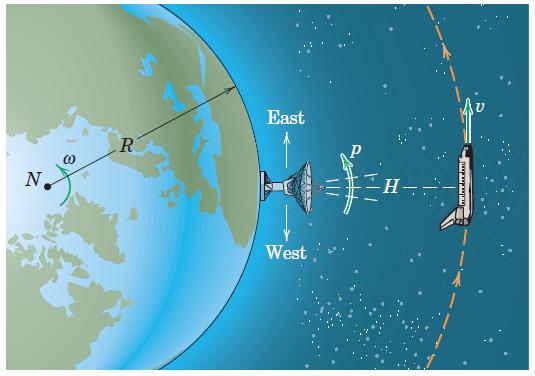
A spacecraft moving in a west-to-east equatorial orbit is observed by a tracking station located on the equator. If the spacecraft has a perigee altitude H = 150 km and velocity v when directly over the station and an apogee altitude of 1500 km, determine an expression for the angular rate p
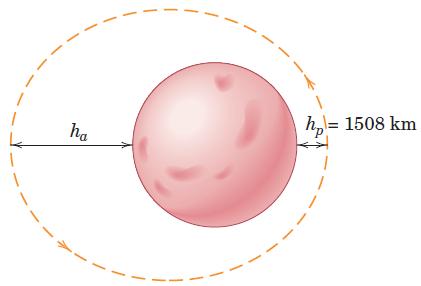
The perigee and apogee altitudes above the surface of the earth of an artificial satellite are hp and ha, respectively. Derive the expression for the radius of curvature ρp of the orbit at the perigee position. The radius of the earth is R.
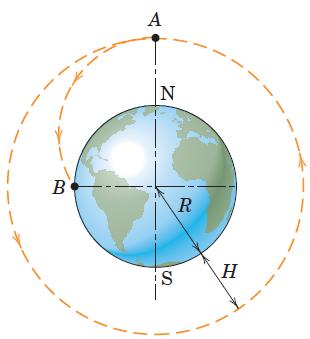
A satellite is placed in a circular polar orbit a distance H above the earth. As the satellite goes over the north pole at A, its retro-rocket is activated to produce a burst of negative thrust which reduces its velocity to a value which will ensure an equatorial landing. Derive the expression for
Determine the necessary amount Δv by which the circular-orbit velocity of satellite C should be reduced if the catch-up maneuver of Prob. 3/288 is to be accomplished with not one but two periods in a new elliptical orbit.
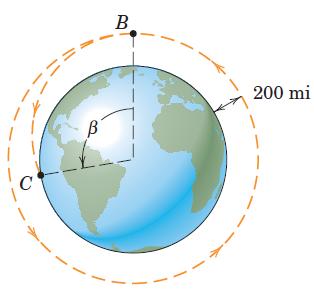
The 175,000-lb space-shuttle orbiter is in a circular orbit of altitude 200 miles. The two orbital-maneuvering-system (OMS) engines, each of which has a thrust of 6000 lb, are fi red in retrothrust for 150 seconds. Determine the angle β which locates the intersection of the shuttle trajectory with
Compare the orbital period of the moon calculated with the assumption of a fixed earth with the period calculated without this assumption.
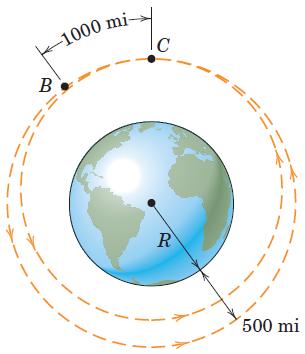
Two satellites B and C are in the same circular orbit of altitude 500 miles. Satellite B is 1000 mi ahead of satellite C as indicated. Show that C can catch up to B by “putting on the brakes.” Specifically, by what amount Δv should the circular-orbit velocity of C be reduced so that it will
Determine the unstretched spring length which would cause the 3-lb collar of the previous problem to have no speed as it arrives at position B. All other conditions of the previous problem remain the same.
All conditions of the previous problem remain the same, except now the applied couple varies with time according to M = 2t, where t is in seconds and M is in newton-meters. Determine the angular velocity of the assembly at time t = 5 s.
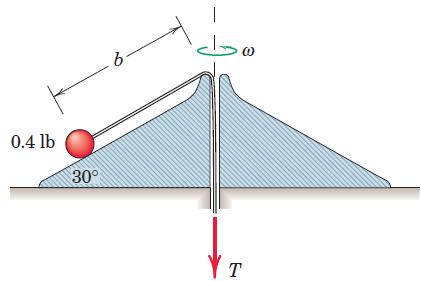
The 0.4-lb ball and its supporting cord are revolving about the vertical axis on the fixed smooth conical surface with an angular velocity of 4 rad /sec. The ball is held in the position b = 14 in. by the tension T in the cord. If the distance b is reduced to the constant value of 9 in. by
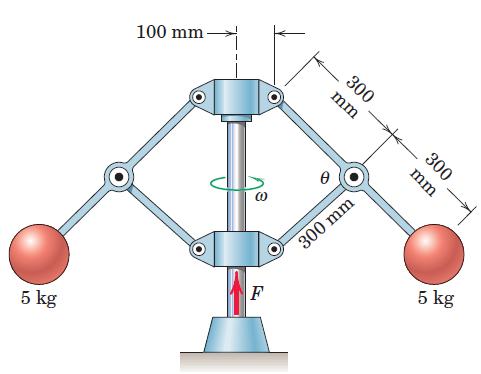
The assembly of two 5-kg spheres is rotating freely about the vertical axis at 40 rev/min with θ = 90°. If the force F which maintains the given position is increased to raise the base collar and reduce θ to 60°, determine the new angular velocity ω. Also determine the work U done by F in
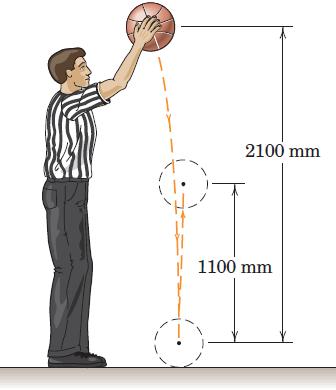
As a check of the basketball before the start of a game, the referee releases the ball from the overhead position shown, and the ball rebounds to about waist level. Determine the coefficient of restitution e and the percentage n of the original energy lost during the impact. 2100 mm 1100 mm
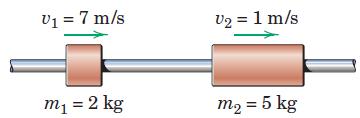
Compute the final velocities v1′ and v2′ after collision of the two cylinders which slide on the smooth horizontal shaft. The coefficient of restitution is e = 0.8. v1 = 7 m/s U2 = 1 m/s %3D m1 = 2 kg m2 = 5 kg
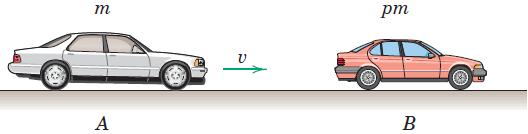
Car B is initially stationary and is struck by car A, which is moving with speed v. The mass of car B is pm, where m is the mass of car A and p is a positive constant. If the coefficient of restitution is e = 0.1, express the speeds vA′ and vB′ of the two cars at the end of the impact in terms
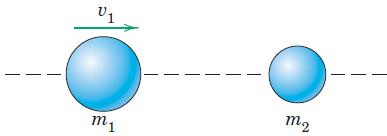
The sphere of mass m1 travels with an initial velocity v1 directed as shown and strikes the stationary sphere of mass m2. For a given coefficient of restitution e, what condition on the mass ratio m1/m2 ensures that the final velocity of m2 is greater than v1? V1 m2 m1
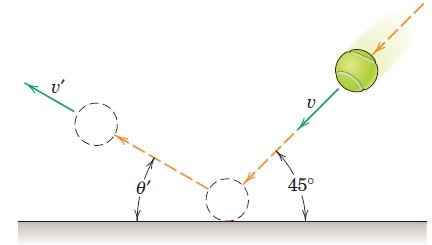
A tennis ball is projected toward a smooth surface with speed v as shown. Determine the rebound angle θ′ and the final speed v′. The coefficient of restitution is 0.6. 45°
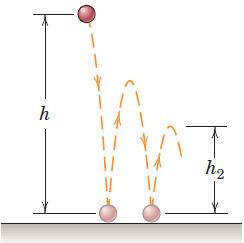
Determine the coefficient of restitution e for a steel ball dropped from rest at a height h above a heavy horizontal steel plate if the height of the second rebound is h2. h h2
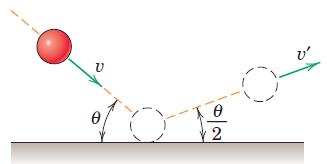
Determine the value of the coefficient of restitution e for which the outgoing angle is one-half of the incoming angle θ as shown. Evaluate your general expression for θ = 40°. v' 2
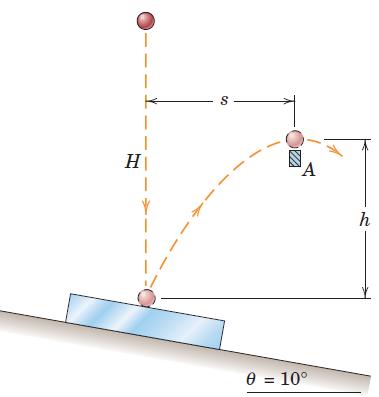
To pass inspection, steel balls designed for use in ball bearings must clear the fixed bar A at the top of their rebound when dropped from rest through the vertical distance H = 36 in. onto the heavy inclined steel plate. If balls which have a coefficient of restitution of less than 0.7 with the
The cart of mass m1 = 3 kg is moving to the right with a speed v1 = 6 m/s when it collides with the initially stationary barrier of mass m2 = 5 kg. The coefficient of restitution for this collision is e = 0.75. Determine the maximum deflection δ of the barrier, which is connected to three springs,
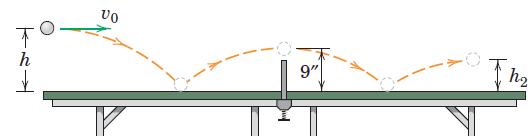
If the center of the ping-pong ball is to clear the net as shown, at what height h should the ball be horizontally served? Also determine h2. The coefficient of restitution for the impacts between ball and table is e = 0.9, and the radius of the ball is r = 0.75 in. h2 9" h
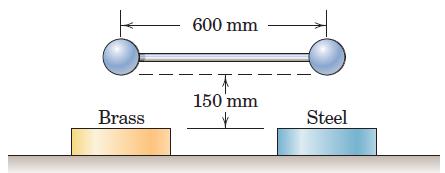
Two steel balls of the same diameter are connected by a rigid bar of negligible mass as shown and are dropped in the horizontal position from a height of 150 mm above the heavy steel and brass base plates. If the coefficient of restitution between the ball and the steel base is 0.6 and that between
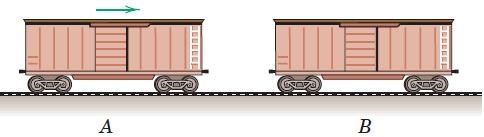
Freight car A of mass mA is rolling to the right when it collides with freight car B of mass mB initially at rest. If the two cars are coupled together at impact, show that the fractional loss of energy equals mB /(mA + mB). A B
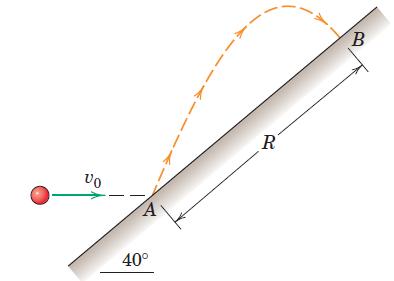
A small ball is projected horizontally toward an incline as shown. Determine the slant range R. The initial speed is v0 = 16 m /s, and the coefficient of restitution for the impact at A is e = 0.6. R' vo A 40°
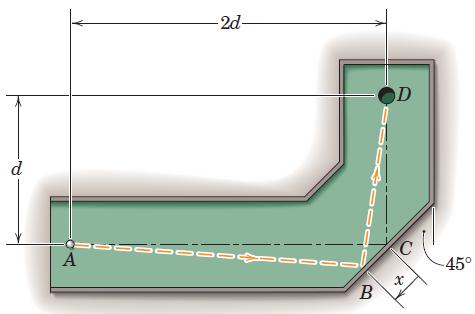
A miniature-golf shot from position A to the hole D is to be accomplished by “banking off” the 45° wall. Using the theory of this article, determine the location x for which the shot can be made. The coefficient of restitution associated with the wall collision is e = 0.8. 2d- D d A 45°
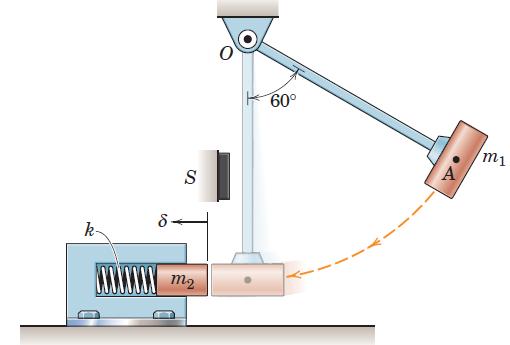
The pendulum is released from the 60° position and then strikes the initially stationary cylinder of mass m2 when OA is vertical. Determine the maximum spring compression δ. Use the values m1 = 3 kg, m2 = 2 kg, OA = 0.8 m, e = 0.7, and k = 6 kN/m. Assume that the bar of the pendulum is light so
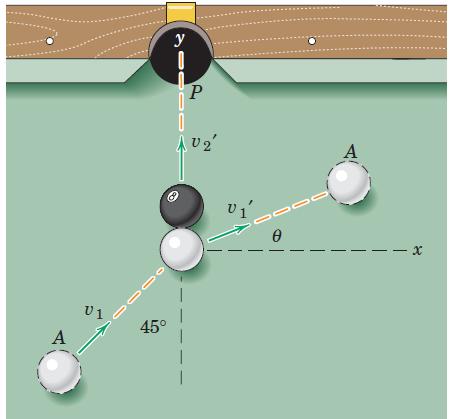
In a pool game the cue ball A must strike the eight ball in the position shown in order to send it to the pocket P with a velocity v2′. The cue ball has a velocity v1 before impact and a velocity v1′ after impact. The coefficient of restitution is 0.9. Both balls have the same mass and
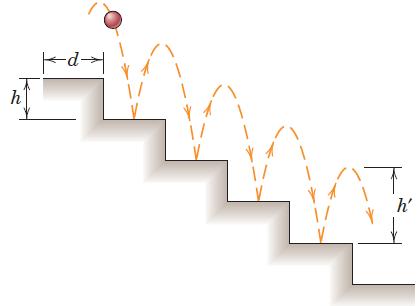
Determine the coefficient of restitution e which will allow the ball to bounce down the steps as shown. The tread and riser dimensions, d and h, respectively, are the same for every step, and the ball bounces the same distance h′ above each step. What horizontal velocity vx is required so that
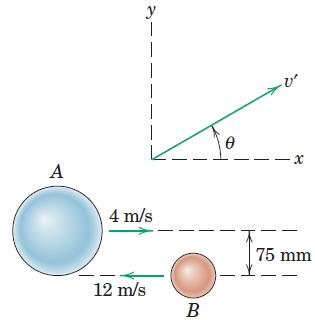
Sphere A has a mass of 23 kg and a radius of 75 mm, while sphere B has a mass of 4 kg and a radius of 50 mm. If the spheres are traveling initially along the parallel paths with the speeds shown, determine the velocities of the spheres immediately after impact. Specify the angles θA and θB with
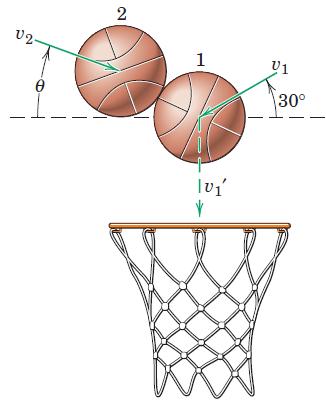
During a pregame warmup period, two basketballs collide above the hoop when in the positions shown. Just before impact, ball 1 has a velocity v1 which makes a 30° angle with the horizontal. If the velocity v2 of ball 2 just before impact has the same magnitude as v1, determine the two
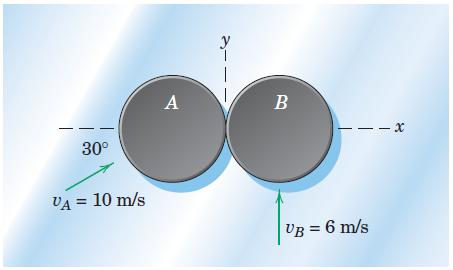
Two identical hockey pucks moving with initial velocities vA and vB collide as shown. If the coefficient of restitution is e = 0.75, determine the velocity (magnitude and direction θ with respect to the positive x-axis) of each puck just after impact. Also calculate the percentage loss n of
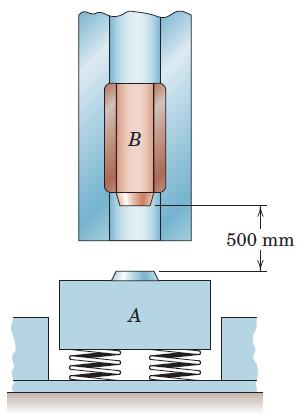
The 3000-kg anvil A of the drop forge is mounted on a nest of heavy coil springs having a combined stiffness of 2.8(106) N/m. The 600-kg hammer B falls 500 mm from rest and strikes the anvil, which suffers a maximum downward deflection of 24 mm from its equilibrium position. Determine the height h
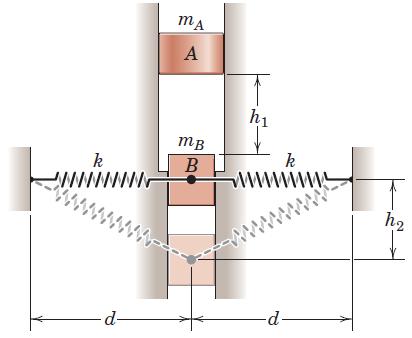
The 0.5-kg cylinder A is released from rest from the position shown and drops the distance h1 = 0.6 m. It then collides with the 0.4-kg block B; the coefficient of restitution is e = 0.8. Determine the maximum downward displacement h2 of block B. Neglect all friction and assume that block B is
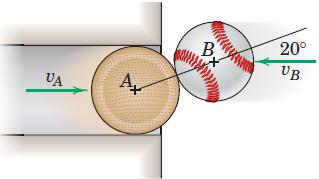
The elements of a device designed to measure the coefficient of restitution of bat–baseball collisions are shown. The 1-lb “bat” A is a short length of wood or aluminum which is projected to the right with a speed vA = 60 ft/sec within the confines of the horizontal slot. Just before and
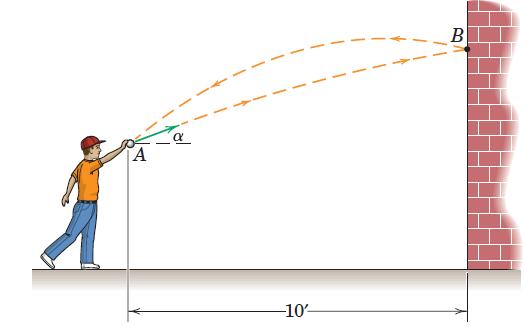
A child throws a ball from point A with a speed of 50 ft/sec. It strikes the wall at point B and then returns exactly to point A. Determine the necessary angle α if the coefficient of restitution in the wall impact is e = 0.5. В -10-
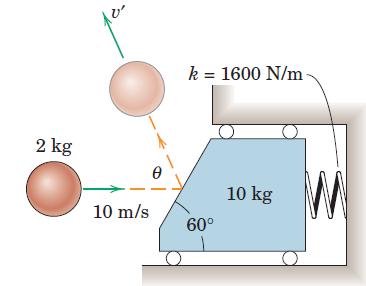
The 2-kg sphere is projected horizontally with a velocity of 10 m /s against the 10-kg carriage which is backed up by the spring with stiffness of 1600 N/m. The carriage is initially at rest with the spring uncompressed. If the coefficient of restitution is 0.6, calculate the rebound velocity v′,
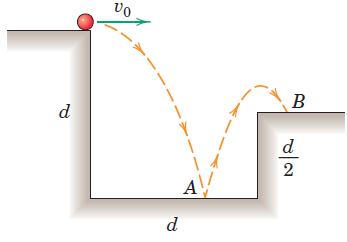
A small ball is projected horizontally as shown and bounces at point A. Determine the range of initial speed v0 for which the ball will ultimately land on the horizontal surface at B. The coefficient of restitution at A is e = 0.8 and the distance d = 4 m. vo B d d 2 A d
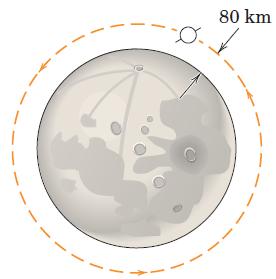
Calculate the velocity of a spacecraft which orbits the moon in a circular path of 80-km altitude. 80 km
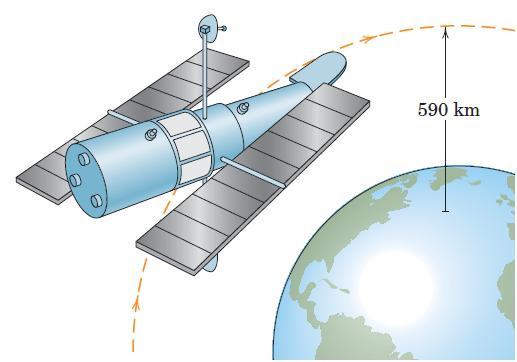
What velocity v must the space shuttle have in order to release the Hubble space telescope in a circular earth orbit 590 km above the surface of the earth? 590 km
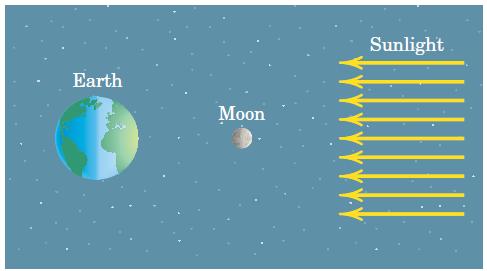
Show that the path of the moon is concave toward the sun at the position shown. Assume that the sun, earth, and moon are in the same line. Sunlight Earth Moon
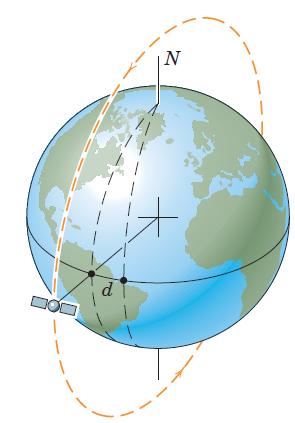
A satellite is in a circular polar orbit of altitude 300 km. Determine the separation d at the equator between the ground tracks (shown dashed) associated with two successive overhead passes of the satellite. d
Determine the apparent velocity vrel of a satellite moving in a circular equatorial orbit 200 mi above the earth as measured by an observer on the equator (a) For a west-to-east orbit (b) For an east-to-west orbit. Why is the west-to-east orbit more easily achieved?
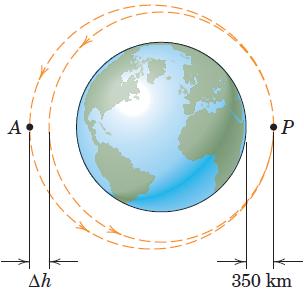
A spacecraft is in an initial circular orbit with an altitude of 350 km. As it passes point P, onboard thrusters give it a velocity boost of 25 m/s. Determine the resulting altitude gain Δh at point A. А Ah 350 km
If the perigee altitude of an earth satellite is 240 km and the apogee altitude is 400 km, compute the eccentricity e of the orbit and the period τ of one complete orbit in space.
Determine the energy difference ΔE between an 80 000-kg space-shuttle orbiter on the launch pad in Cape Canaveral (latitude 28.5°) and the same orbiter in a circular orbit of altitude h = 300 km.
The Mars orbiter for the Viking mission was designed to make one complete trip around the planet in exactly the same time that it takes Mars to revolve once about its own axis. This time is 24 h, 37 min, 23 s. In this way, it is possible for the orbiter to pass over the landing site of the lander
A “drag-free” satellite is one which carries a small mass inside a chamber as shown. If the satellite speed decreases because of drag, the mass speed will not, and so the mass moves relative to the chamber as indicated. Sensors detect this change in the position of the mass within the chamber,
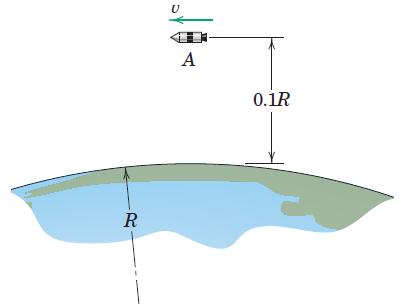
Determine the speed v required of an earth satellite at point A for (a) A circular orbit, (b) An elliptical orbit of eccentricity e = 0.1, (c) An elliptical orbit of eccentricity e = 0.9, (d) A parabolic orbit. In cases (b), (c), and (d), A is the orbit perigee. A 0.iR R
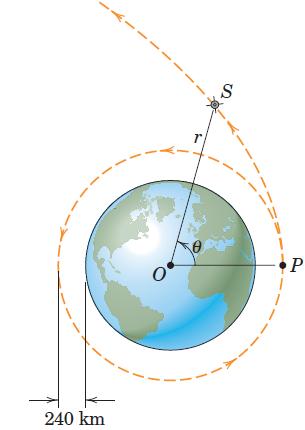
Initially in the 240-km circular orbit, the spacecraft S receives a velocity boost at P which will take it to r →∞ with no speed at that point. Determine the required velocity increment Δv at point P and also determine the speed when r = 2rP. At what value of θ does r become 2rP? S 240 km
If the earth were suddenly deprived of its orbital velocity around the sun, find the time t which it would take for the earth to “fall” to the location of the center of the sun.
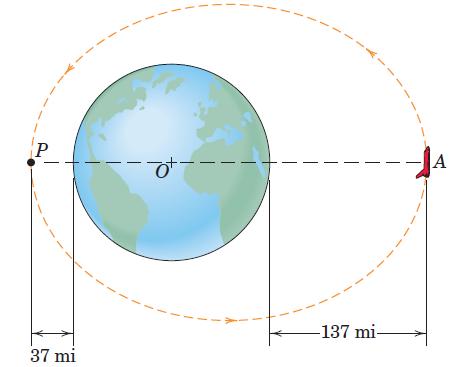
Just after launch from the earth, the space-shuttle orbiter is in the 37 × 137-mi orbit shown. The first time that the orbiter passes the apogee A, its two orbital-maneuvering-system (OMS) engines are fired to circularize the orbit. If the weight of the orbiter is 175,000 lb and the OMS engines
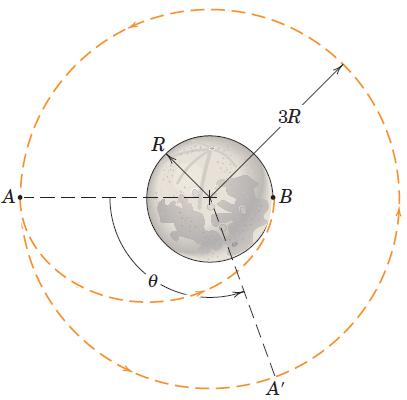
A spacecraft is in a circular orbit of radius 3R around the moon. At point A, the spacecraft ejects a probe which is designed to arrive at the surface of the moon at point B. Determine the necessary velocity vr of the probe relative to the spacecraft just after ejection. Also calculate the position
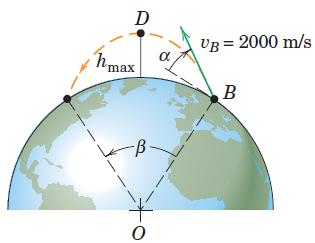
A projectile is launched from B with a speed of 2000 m/s at an angle α of 30° with the horizontal as shown. Determine the maximum altitude hmax. D UB = 2000 m/s 'max B
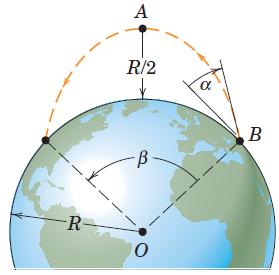
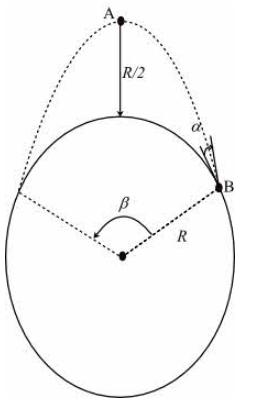
Compute the magnitude of the necessary launch velocity at B if the projectile trajectory is to intersect the earth’s surface so that the angle β equals 90°. The altitude at the highest point of the trajectory is 0.5R. A R/2 B R-
Compute the necessary launch angle α at point B for the trajectory prescribed in Prob. 3/286.Data from problem 286 R/2 B
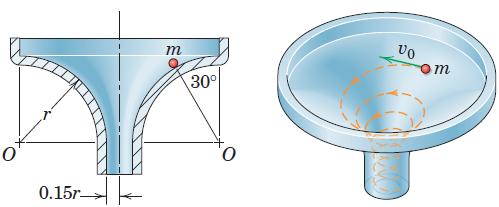
A particle is launched with a horizontal velocity v0 = 0.55 m/s from the 30° position shown and then slides without friction along the funnel-like surface. Determine the angle θ which its velocity vector makes with the horizontal as the particle passes level O-O. The value of r is 0.9 m. m 30°
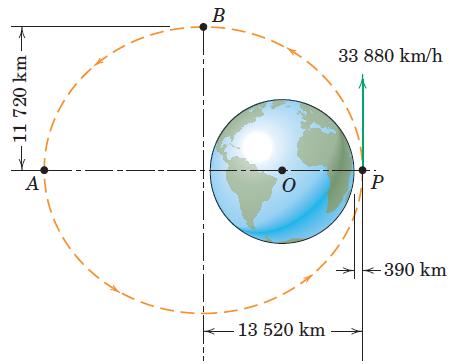
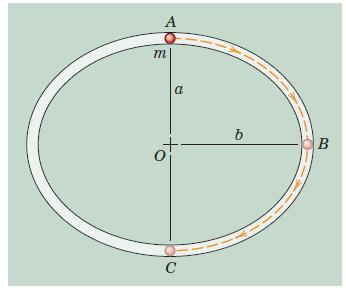
The central attractive force F on an earth satellite can have no moment about the center O of the earth. For the particular elliptical orbit with major and minor axes as shown, a satellite will have a velocity of 33 880 km/h at the perigee altitude of 390 km. Determine the velocity of the satellite
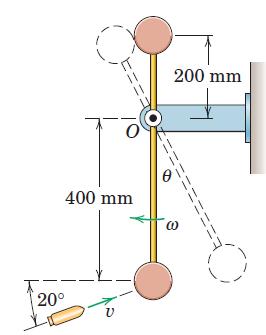
A pendulum consists of two 3.2-kg concentrated masses positioned as shown on a light but rigid bar. The pendulum is swinging through the vertical position with a clockwise angular velocity ω = 6 rad /s when a 50-g bullet traveling with velocity v = 300 m /s in the direction shown strikes the lower
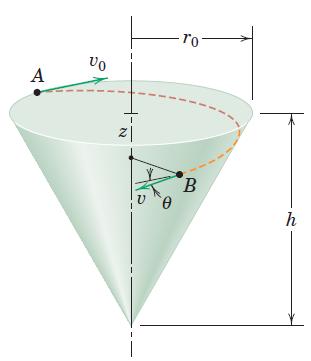
A particle moves on the inside surface of a smooth conical shell and is given an initial velocity v0 tangent to the horizontal rim of the surface at A. As the particle slides past point B, a distance z below A, its velocity v makes an angle θ with the horizontal tangent to the surface through B.
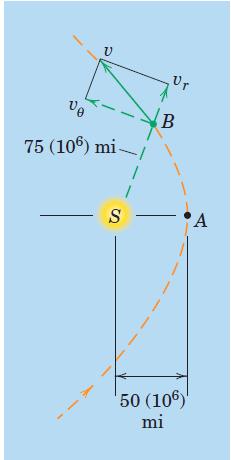
At the point A of closest approach to the sun, a comet has a velocity vA = 188,500 ft /sec. Determine the radial and transverse components of its velocity vB at point B, where the radial distance from the sun is 75(106) mi. Ur 75 (106) mi S A '50 (106)' mi
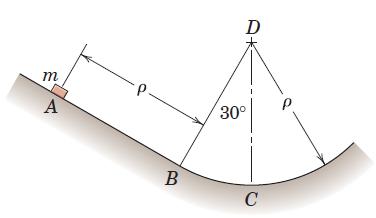
A particle of mass m is released from rest in position A and then slides down the smooth vertical-plane track. Determine its angular momentum about both points A and D (a) As it passes position B (b) As it passes position C. D m A 30° B C
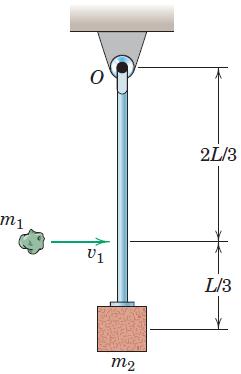
A wad of clay of mass m1 with an initial horizontal velocity v1 hits and adheres to the massless rigid bar which supports the body of mass m2, which can be assumed to be a particle. The pendulum assembly is freely pivoted at O and is initially stationary. Determine the angular velocity θ˙ of the
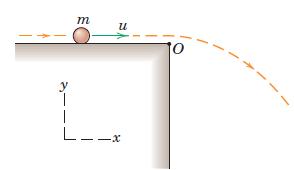
The particle of mass m is launched from point O with a horizontal velocity u at time t = 0. Determine its angular momentum HO relative to point O as a function of time. m y L--x
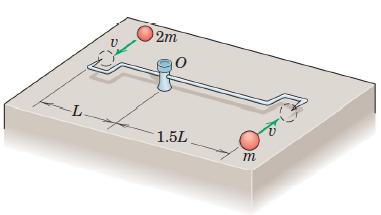
The small spheres, which have the masses and initial velocities shown in the figure, strike and become attached to the spiked ends of the rod, which is freely pivoted at O and is initially at rest. Determine the angular velocity ω of the assembly after impact. Neglect the mass of the rod. 2m 1.5L m
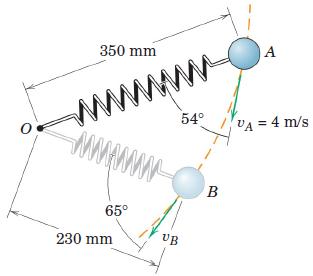
A particle of mass m moves with negligible friction on a horizontal surface and is connected to a light spring fastened at O. At position A the particle has the velocity vA = 4 m/s. Determine the velocity vB of the particle as it passes position B. 350 mm |A ww 54° VA = 4 m/s B 65° 230 mm UB
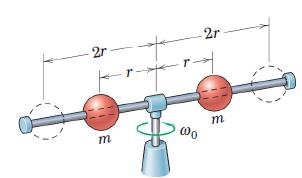
The two spheres of equal mass m are able to slide along the horizontal rotating rod. If they are initially latched in position a distance r from the rotating axis with the assembly rotating freely with an angular velocity ω0, determine the new angular velocity ω after the spheres are released and
A 0.7-lb particle is located at the position r1 = 2i + 3j + k ft and has the velocity v1 = i + j + 2k ft/sec at time t = 0. If the particle is acted upon by a single force which has the moment MO = (4 + 2t)i + (3 − t2) j + 5k lb-ft about the origin O of the coordinate system in use, determine the
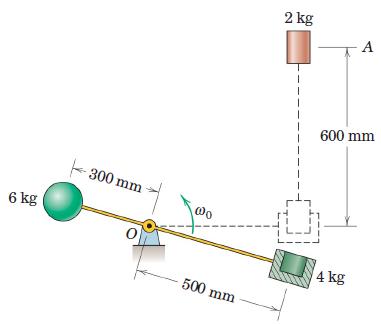
The 6-kg sphere and 4-kg block (shown in section) are secured to the arm of negligible mass which rotates in the vertical plane about a horizontal axis at O. The 2-kg plug is released from rest at A and falls into the recess in the block when the arm has reached the horizontal position. An instant
A particle with a mass of 4 kg has a position vector in meters given by r = 3t2i − 2tj − 3k, where t is the time in seconds. For t = 5 s determine the angular momentum of the particle and the moment of all forces on the particle, both about the origin O of coordinates.
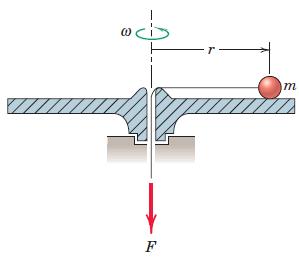
The small particle of mass m and its restraining cord are spinning with an angular velocity ω on the horizontal surface of a smooth disk, shown in section. As the force F is slightly relaxed, r increases and ω changes. Determine the rate of change of ω with respect to r and show that the work
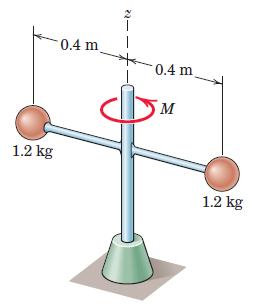
The rigid assembly which consists of light rods and two 1.2-kg spheres rotates freely about a vertical axis. The assembly is initially at rest and then a constant couple M = 2 N∙ m is applied for 5 s. Determine the final angular velocity of the assembly. Treat the small spheres as particles. 0.4
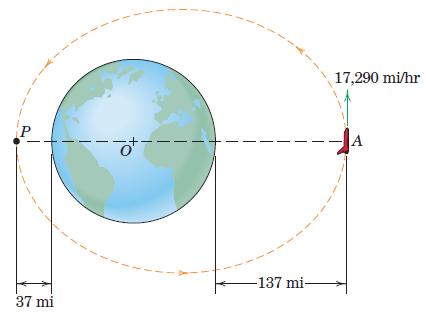
Just after launch from the earth, the space-shuttle orbiter is in the 37 × 137–mi orbit shown. At the apogee point A, its speed is 17,290 mi/hr. If nothing were done to modify the orbit, what would be its speed at the perigee P? Neglect aerodynamic drag. (Note that the normal practice is to add
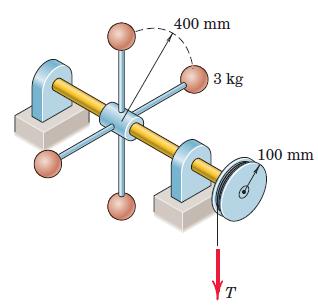
The assembly starts from rest and reaches an angular speed of 150 rev/min under the action of a 20-N force T applied to the string for t seconds. Determine t. Neglect friction and all masses except those of the four 3-kg spheres, which may be treated as particles. 400 mm 3 kg 100 mm T
The particle of mass m is gently nudged from the equilibrium position A and subsequently slides along the smooth elliptical path which lies in a vertical plane. Determine the magnitude of its angular momentum about point O as it passes (a) point B and (b) point C. In each case, determine the time
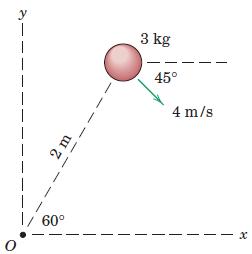
The 3-kg sphere moves in the x-y plane and has the indicated velocity at a particular instant. Determine its (a) Linear momentum, (b) Angular momentum about point O, (c) Kinetic energy. y 3 kg 45° 4 m/s 60° 2 m
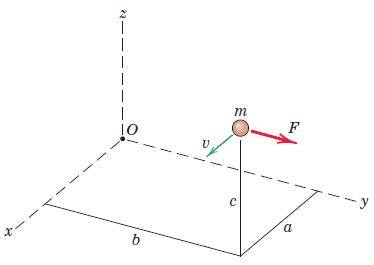
At a certain instant, the particle of mass m has the position and velocity shown in the figure, and it is acted upon by the force F. Determine its angular momentum about point O and the time rate of change of this angular momentum. m F of - у
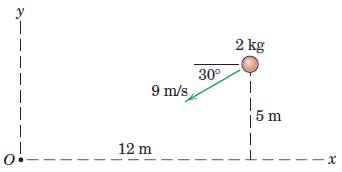
Determine the magnitude HO of the angular momentum of the 2-kg sphere about point O (a) By using the vector definition of angular momentum (b) By using an equivalent scalar approach. The center of the sphere lies in the x-y plane. y 2 kg 30° 9 m/s 5 m 12 m
Two barges, each with a displacement (mass) of 500 Mg, are loosely moored in calm water. A stunt driver starts his 1500-kg car from rest at A, drives along the deck, and leaves the end of the 15° ramp at a speed of 50 km/h relative to the barge and ramp. The driver successfully jumps the gap and
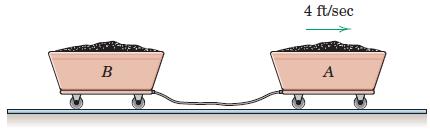
The two mine cars of equal mass are connected by a rope which is initially slack. Car A is given a shove which imparts to it a velocity of 4 ft/sec with car B initially at rest. When the slack is taken up, the rope suffers a tension impact which imparts a velocity to car B and reduces the velocity
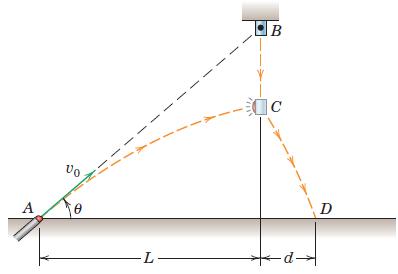
The wad of clay A is projected as shown at the same instant that cylinder B is released. The two bodies collide and stick together at C and then ultimately strike the horizontal surface at D. Determine the horizontal distance d. Use the values v0 = 12 m/s, θ = 40°, L = 6 m, mA = 0.1 kg, and mB =
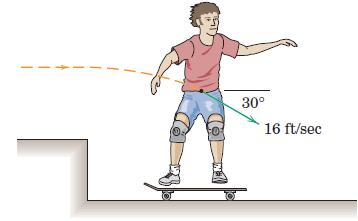
The 80-lb boy has taken a running jump from the upper surface and lands on his 10-lb skateboard with a velocity of 16 ft/sec in the plane of the figure as shown. If his impact with the skateboard has a time duration of 0.05 sec, determine the final speed v along the horizontal surface and the total
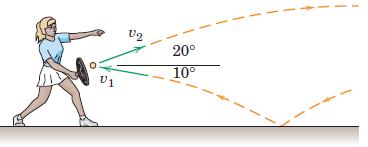
A tennis player strikes the tennis ball with her racket while the ball is still rising. The ball speed before impact with the racket is v1 = 15 m/s and after impact its speed is v2 = 22 m/s, with directions as shown in the figure. If the 60-g ball is in contact with the racket for 0.05 s, determine
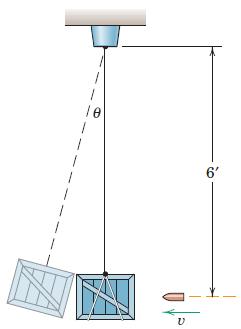
The ballistic pendulum is a simple device to measure projectile velocity v by observing the maximum angle θ to which the box of sand with embedded projectile swings. Calculate the angle θ if the 2-oz projectile is fired horizontally into the suspended 50-lb box of sand with a velocity v = 2000
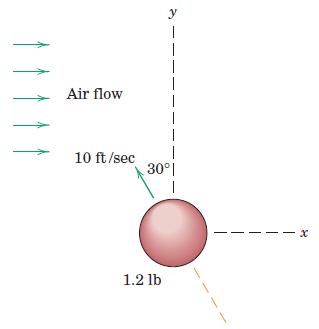
The 1.2-lb sphere is moving in the horizontal x-y plane with a velocity of 10 ft /sec in the direction shown and encounters a steady flow of air in the x-direction. If the air stream exerts an essentially constant force of 0.2 lb on the sphere in the x-direction, determine the time t required for
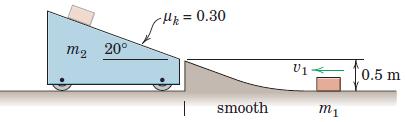
The slider of mass m1 = 0.4 kg moves along the smooth support surface with velocity v1 = 5 m/s when in the position shown. After negotiating the curved portion, it moves onto the inclined face of an initially stationary block of mass m2 = 2 kg. The coefficient of kinetic friction between the slider
A spacecraft in deep space is programmed to increase its speed by a desired amount Δv by burning its engine for a specified time duration t. Twenty-five percent of the way through the burn, the engine suddenly malfunctions and thereafter produces only half of its normal thrust. What percent n of
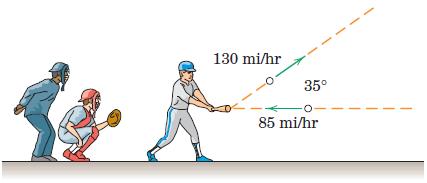
The baseball is traveling with a horizontal velocity of 85 mi/hr just before impact with the bat. Just after the impact, the velocity of the 5 1/8 -oz ball is 130 mi/hr directed at 35° to the horizontal as shown. Determine the x- and y-components of the average force R exerted by the bat on the
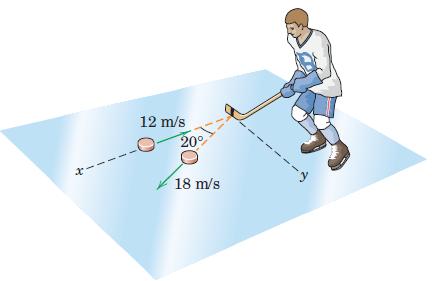
The ice-hockey puck with a mass of 0.20 kg has a velocity of 12 m/s before being struck by the hockey stick. After the impact the puck moves in the new direction shown with a velocity of 18 m/s. If the stick is in contact with the puck for 0.04 s, compute the magnitude of the average force F
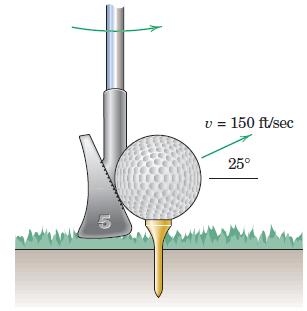
The 1.62-oz golf ball is struck by the fi ve-iron and acquires the velocity shown in a time period of 0.001 sec. Determine the magnitude R of the average force exerted by the club on the ball. What acceleration magnitude a does this force cause, and what is the distance d over which the launch
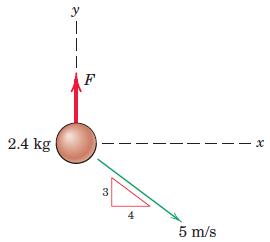
The 2.4-kg particle moves in the horizontal x-y plane and has the velocity shown at time t = 0. If the force F = 2 + 3t2/4 newtons, where t is time in seconds, is applied to the particle in the y-direction beginning at time t = 0, determine the velocity v of the particle 4 seconds after F is
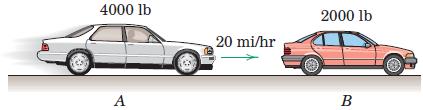
Car B is initially stationary and is struck by car A moving with initial speed v1 = 20 mi/hr. The cars become entangled and move together with speed v′ after the collision. If the time duration of the collision is 0.1 sec, determine (a) The common final speed v′.(b) The average
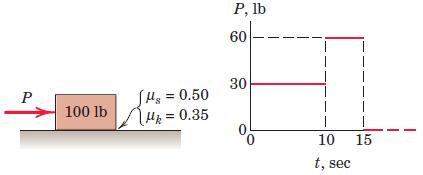
The 100-lb block is stationary at time t = 0, and then it is subjected to the force P shown. Note that the force is zero for all times beyond t = 15 sec. Determine the velocity v of the block at time t = 15 sec. Also calculate the time t at which the block again comes to rest. P, lb 60 30 SHs =
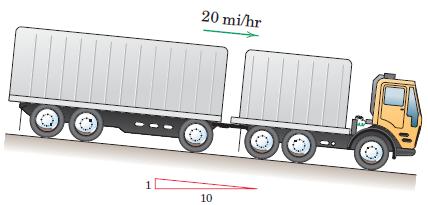
The hydraulic braking system for the truck and trailer is set to produce equal braking forces for the two units. If the brakes are applied uniformly for 5 seconds to bring the rig to a stop from a speed of 20 mi/hr down the 10-percent grade, determine the force P in the coupling between the trailer
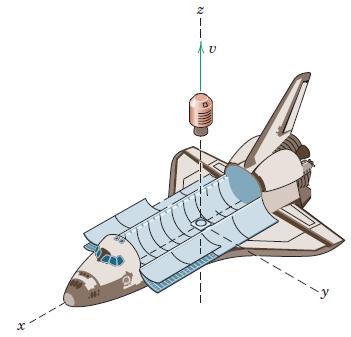
The space shuttle launches an 800-kg satellite by ejecting it from the cargo bay as shown. The ejection mechanism is activated and is in contact with the satellite for 4 s to give it a velocity of 0.3 m/s in the z-direction relative to the shuttle. The mass of the shuttle is 90 Mg. Determine the
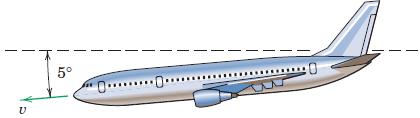
The pilot of a 90,000-lb airplane which is originally flying horizontally at a speed of 400 mi/hr cuts off all engine power and enters a 5° glide path as shown. After 120 seconds the airspeed is 360 mi/hr. Calculate the time-average drag force D (air resistance to motion along the flight path).
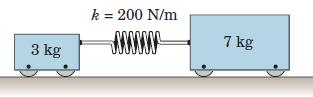
The spring of modulus k = 200 N/m is compressed a distance of 300 mm and suddenly released with the system at rest. Determine the absolute velocities of both masses when the spring is unstretched. Neglect friction. k = 200 N/m 7 kg 3 kg
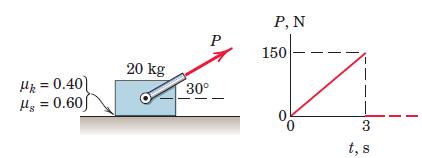
All elements of the previous problem remain unchanged, except that the force P is now held at a constant 30° angle relative to the horizontal. Determine the time ts at which the initially stationary 20-kg block comes to rest. Р, N P 150 20 kg He = 0.40) 30° Hs = 0.60f 3 t, s
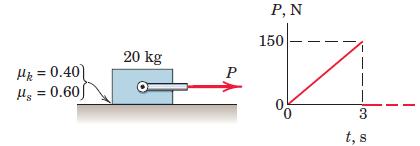
The initially stationary 20-kg block is subjected to the time-varying horizontal force whose magnitude P is shown in the plot. Note that the force is zero for all times greater than 3 s. Determine the time ts at which the block comes to rest. Р, N 150 20 kg HR = 0.40) Hg = 0.60 P 3 t, s
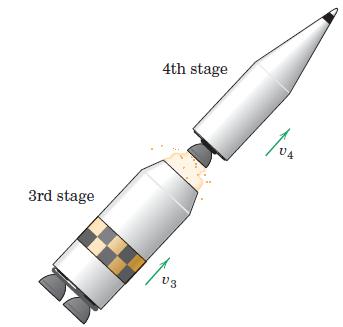
The third and fourth stages of a rocket are coasting in space with a velocity of 18 000 km/h when a small explosive charge between the stages separates them. Immediately after separation the fourth stage has increased its velocity to v4 = 18 060 km/h. What is the corresponding velocity v3 of the
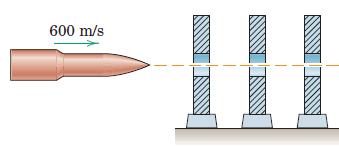
The 140-g projectile is fired with a velocity of 600 m /s and picks up three washers, each with a mass of 100 g. Find the common velocity v of the projectile and washers. Determine also the loss ΔE| of energy during the interaction. 600 m/s
Showing 2000 - 2100
of 2550
First
12
13
14
15
16
17
18
19
20
21
22
23
24
25
26
Step by Step Answers

 Get 50% OFF
Claim Now
Get 50% OFF
Claim Now