New Semester
Started
Get
50% OFF
Study Help!
--h --m --s
Claim Now
Question Answers
Textbooks
Find textbooks, questions and answers
Oops, something went wrong!
Change your search query and then try again
S
Books
FREE
Study Help
Expert Questions
Accounting
General Management
Mathematics
Finance
Organizational Behaviour
Law
Physics
Operating System
Management Leadership
Sociology
Programming
Marketing
Database
Computer Network
Economics
Textbooks Solutions
Accounting
Managerial Accounting
Management Leadership
Cost Accounting
Statistics
Business Law
Corporate Finance
Finance
Economics
Auditing
Tutors
Online Tutors
Find a Tutor
Hire a Tutor
Become a Tutor
AI Tutor
AI Study Planner
NEW
Sell Books
Search
Search
Sign In
Register
study help
engineering
engineering mechanics dynamics
Engineering Mechanics - Dynamics 11th Edition R. C. Hibbeler - Solutions
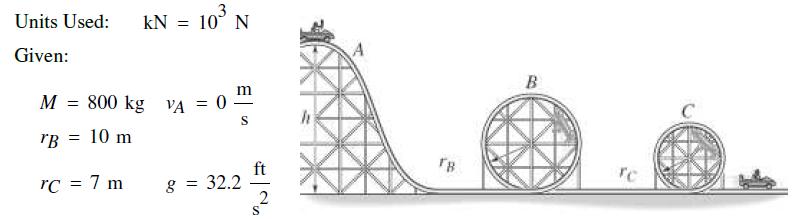
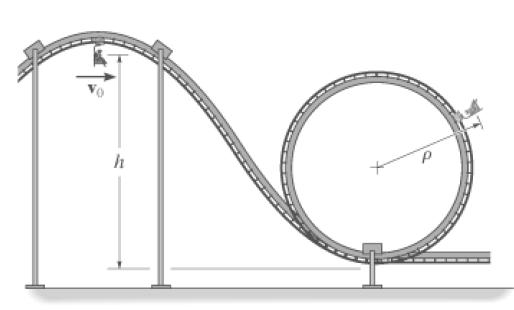
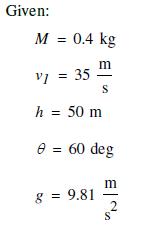
The roller-coaster car has mass M, including its passenger, and starts from the top of the hill A with a speed vA. Determine the minimum height h of the hill crest so that the car travels around both inside loops without leaving the track. Neglect friction, the mass of the wheels, and the size of
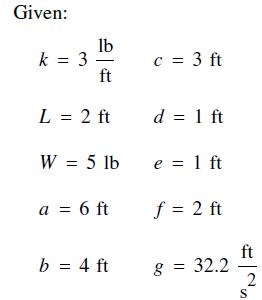
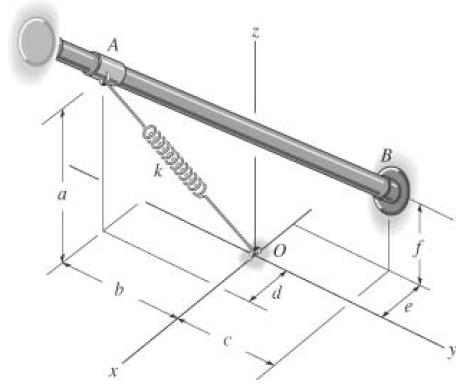
The spring has stiffness k and unstretched length L. If it is attached to the smooth collar of weight W and the collar is released from rest at A, determine the speed of the collar just before it strikes the end of the rod at B. Neglect the size of the collar. Given: k = 3 lb ft L = 2 ft W = 5 lb a
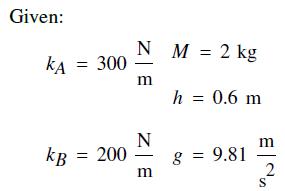
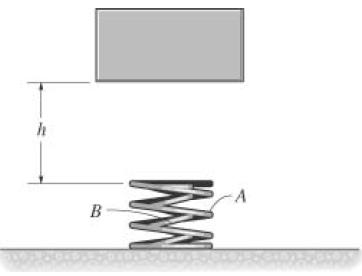
Two equal-length springs having stiffnesses kA and kB are “nested” together in order to form a shock absorber. If a block of mass M is dropped from an at-rest position a distance h above the top of the springs, determine their deformation when the block momentarily stops. Given: KA = 300 kB =
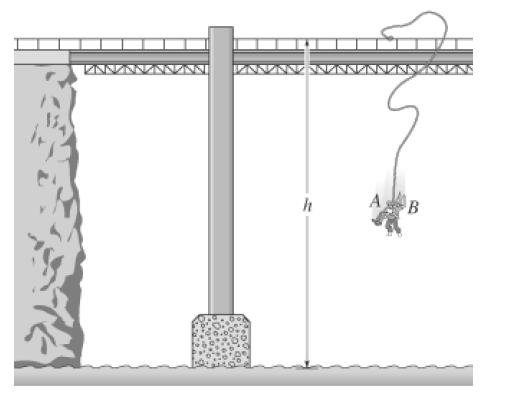
Just for fun, two engineering students each of weight W, A and B, intend to jump off the bridge from rest using an elastic cord (bungee cord) having stiffness k. They wish to just reach the surface of the river, when A, attached to the cord, lets go of B at the instant they touch the water.
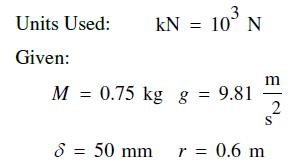
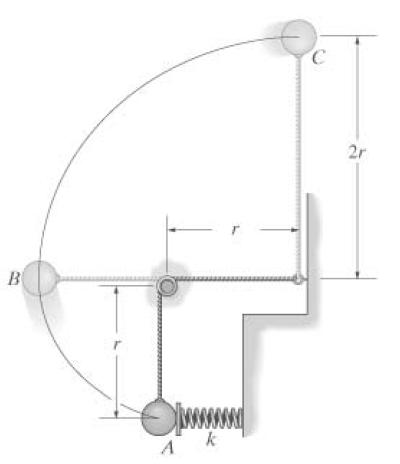
The bob of mass M of a pendulum is fired from rest at position A. If the spring is compressed to a distance δ and released, determine (a) Its stiffness k so that the speed of the bob is zero when it reaches point B, where the radius of curvature is still r, (b) The stiffness k so that when the bob
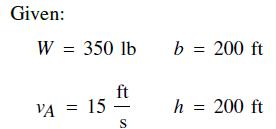
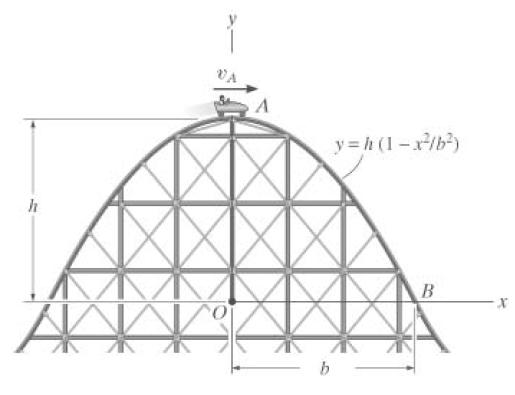
The roller-coaster car has a speed vA when it is at the crest of a vertical parabolic track. Determine the car’s velocity and the normal force it exerts on the track when it reaches point B. Neglect friction and the mass of the wheels. The total weight of the car and the passengers is W. Given: W
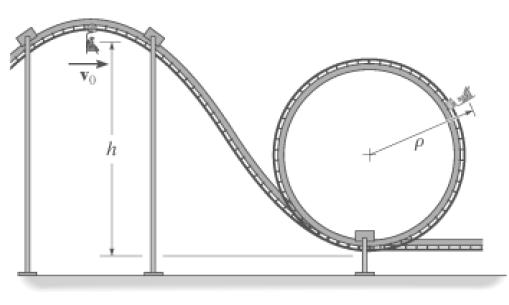
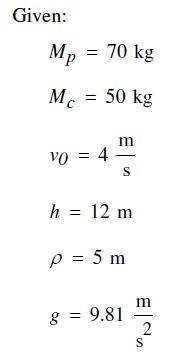
The Raptor is an outside loop roller coaster in which riders are belted into seats resembling ski-lift chairs. Determine the minimum speed v0 at which the cars should coast down from the top of the hill, so that passengers can just make the loop without leaving contact with their seats. Neglect
The Raptor is an outside loop roller coaster in which riders are belted into seats resembling ski-lift chairs. If the cars travel at v0 when they are at the top of the hill, determine their speed when they are at the top of the loop and the reaction of the passenger of mass Mp on his seat at this
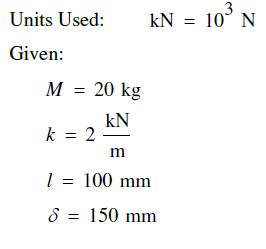
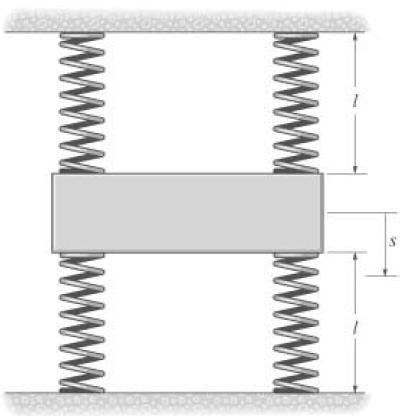
A block having a mass M is attached to four springs. If each spring has a stiffness k and an unstretched length δ, determine the maximum downward vertical displacement smax of the block if it is released from rest at s = 0. Units Used: Given: kN = 10 N 10³ N M = 20 kg kN m 1 = 100 mm 8 = 150 mm k
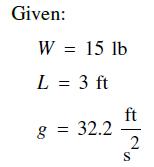
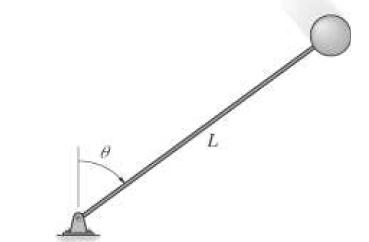
The ball has weight W and is fixed to a rod having a negligible mass. If it is released from rest when θ = 0°, determine the angle θ at which the compressive force in the rod becomes zero. Given: W = 15 lb L = 3 ft 00 g = || 32.2 ft 2 S
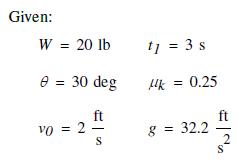
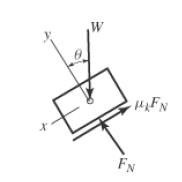
A block of weight W slides down an inclined plane of angle θ with initial velocity v0. Determine the velocity of the block at time t1 if the coefficient of kinetic friction between the block and the plane is μk. Given: W = 20 lb 9 = 30 deg VO = 2 ft S t₁ = 3 s t1 Mk = 0.25 8 = 32.2 ft 2 S
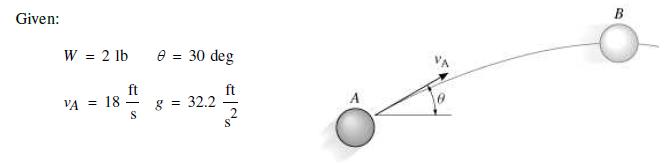
A ball of weight W is thrown in the direction shown with an initial speed vA. Determine the time needed for it to reach its highest point B and the speed at which it is traveling at B. Use the principle of impulse and momentum for the solution. Given: W = 2 lb 8 = 30 deg ft VA-183-322 ft O² B
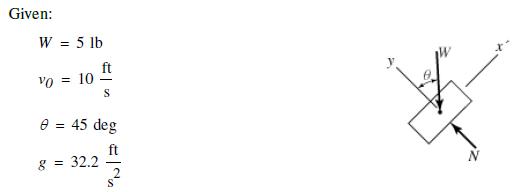
A block of weight W is given an initial velocity v0 up a smooth slope of angle θ. Determine the time it will take to travel up the slope before it stops. Given: W = 5 lb VO 10 = 8 = DO S 45 deg ft = 32.2 n
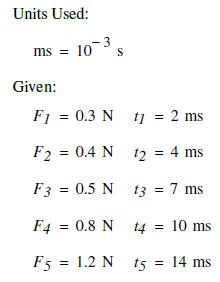
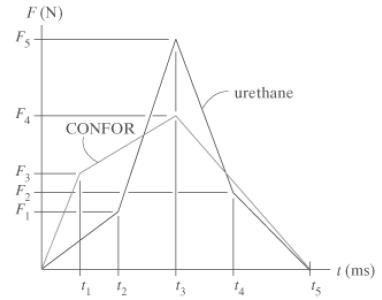
The choice of a seating material for moving vehicles depends upon its ability to resist shock and vibration. From the data shown in the graphs, determine the impulses created by a falling weight onto a sample of urethane foam and CONFOR foam. Units Used: 3 ms = 10-³ S Given: F₁ = 0.3 N F2 = 0.4
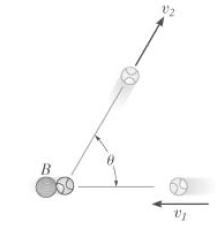
The baseball has a horizontal speed v1 when it is struck by the bat B. If it then travels away at an angle θ from the horizontal and reaches a maximum height h, measured from the height of the bat, determine the magnitude of the net impulse of the bat on the ball. The ball has a mass M. Neglect
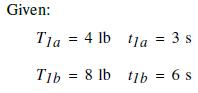
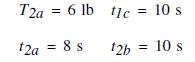
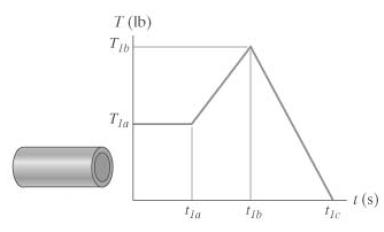
A solid-fueled rocket can be made using a fuel grain with either a hole (a), or starred cavity (b), in the cross section. From experiment the engine thrust-time curves (T vs. t) for the same amount of propellant using these geometries are shown. Determine the total impulse in both cases. Given: Tla
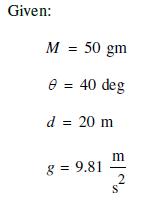
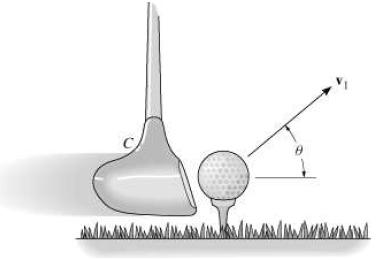
A man hits the golf ball of mass M such that it leaves the tee at angle θ with the horizontal and strikes the ground at the same elevation a distance d away. Determine the impulse of the club C on the ball. Neglect the impulse caused by the ball’s weight while the club is striking the ball.
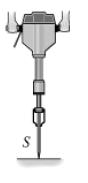
During operation the breaker hammer develops on the concrete surface a force which is indicated in the graph. To achieve this the spike S of weight W is fired from rest into the surface at speed v. Determine the speed of the spike just after rebounding. S
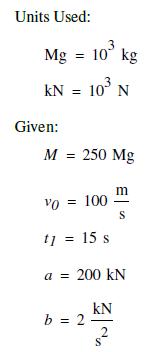
The jet plane has a mass M and a horizontal velocity v0 when t = 0. If both engines provide a horizontal thrust which varies as shown in the graph, determine the plane’s velocity at time t1. Neglect air resistance and the loss of fuel during the motion. Units Used: Mg kN = 10³ Given: 10³ M =
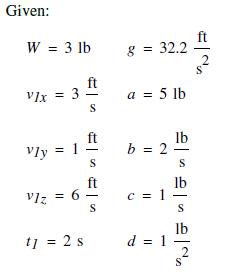
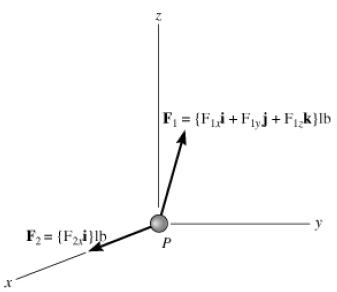
The particle P is acted upon by its weight W and forces F1 = (ai + btj + ctk) and F2 = dt2i. If the particle originally has a velocity of v1 = (v1xi+v1yj+v1zk), determine its speed after time t1. Given: W = 3 lb Vlx = 3 vly = ܙ vlz t1 = 2 s ft S ft S ft S 8 = 32.2 a = 5 lb b = 2 - S c = 1 lb d =
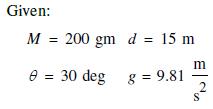
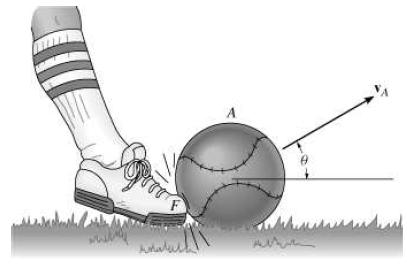
A man kicks the ball of mass M such that it leaves the ground at angle θ with the horizontal and strikes the ground at the same elevation a distance d away. Determine the impulse of his foot F on the ball. Neglect the impulse caused by the ball’s weight while it’s being kicked. Given: M = 200
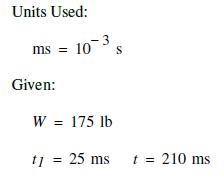
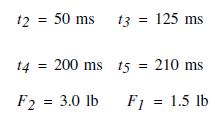
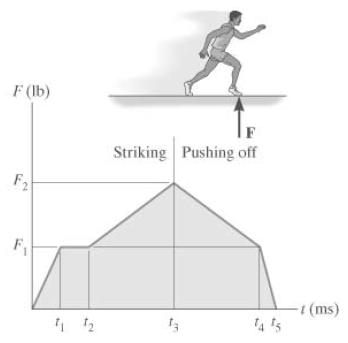
From experiments, the time variation of the vertical force on a runner’s foot as he strikes and pushes off the ground is shown in the graph. These results are reported for a 1-lb static load, i.e., in terms of unit weight. If a runner has weight W, determine the approximate vertical impulse he
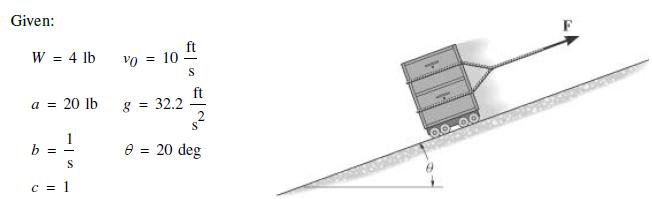
The cabinet of weight W is subjected to the force F = a(bt+c). If the cabinet is initially moving up the plane with velocity v0, determine how long it will take before the cabinet comes to a stop. F always acts parallel to the plane. Neglect the size of the rollers. Given: W = 4 lb a = 20 lb b =
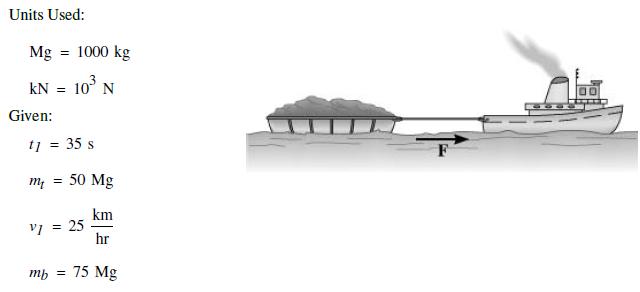
If it takes time t1 for the tugboat of mass mt to increase its speed uniformly to v1 starting from rest, determine the force of the rope on the tugboat. The propeller provides the propulsion force F which gives the tugboat forward motion, whereas the barge moves freely. Also, determine the force F
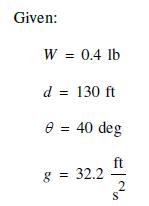
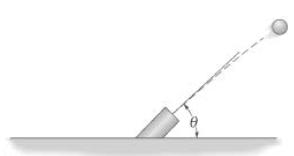
When the ball of weight W is fired, it leaves the ground at an angle θ from the horizontal and strikes the ground at the same elevation a distance d away. Determine the impulse given to the ball. Given: W = 0.4 lb d = 130 ft 0 = 40 deg ft DO = 32.2 2 S
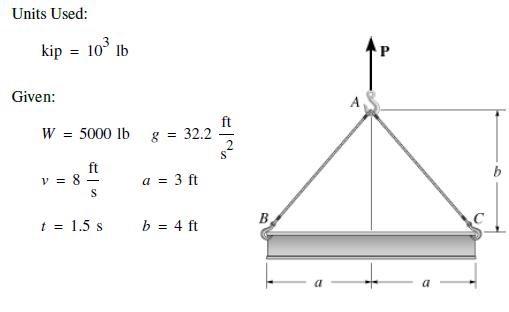
The uniform beam has weight W. Determine the average tension in each of the two cables AB and AC if the beam is given an upward speed v in time t starting from rest. Neglect the mass of the cables. Units Used: kip = 10³ lb Given: W = 5000 lb ft S v=8- t = 1.5 s ft 32.2/ 8 = 32.2 a = 3 ft b = 4
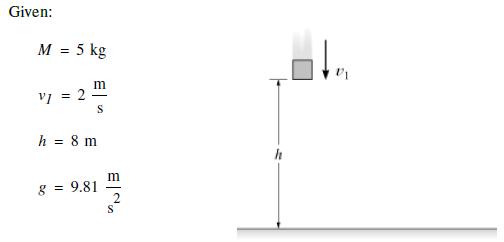
The block of mass M is moving downward at speed v1 when it is a distance h from the sandy surface. Determine the impulse of the sand on the block necessary to stop its motion. Neglect the distance the block dents into the sand and assume the block does not rebound. Neglect the weight of the block
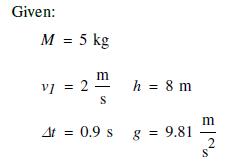
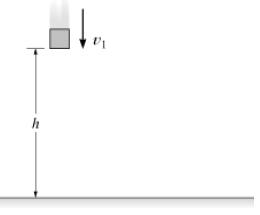
The block of mass M is falling downward at speed v1 when it is a distance h from the sandy surface. Determine the average impulsive force acting on the block by the sand if the motion of the block is stopped in time Δt once the block strikes the sand. Neglect the distance the block dents into the
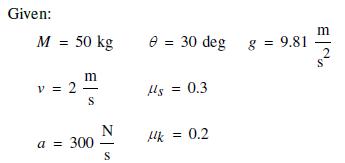
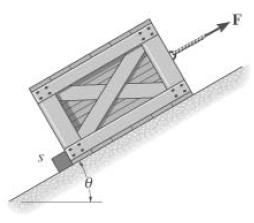
A crate of mass M rests against a stop block s, which prevents the crate from moving down the plane. If the coefficients of static and kinetic friction between the plane and the crate are μs and μk respectively, determine the time needed for the force F to give the crate a speed v up the plane.
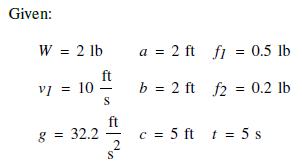
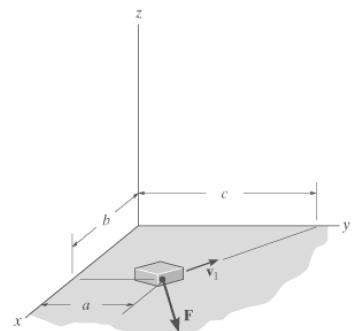
The block of weight W has an initial velocity v1 in the direction shown. If a force F = {f1i + f2j} acts on the block for time t, determine the final speed of the block. Neglect friction. Given: W = 2 lb VI = 10 8 = 32.2 S ft 2 S a = 2 ft b = 2 ft f1 = 0.5 lb f2 = 0.2 lb c = 5 ft t = 5 s
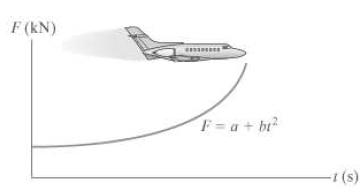
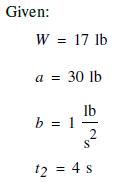
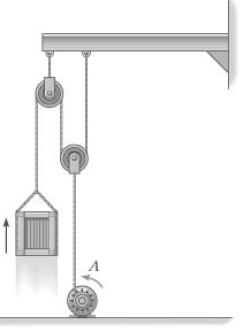
The motor pulls on the cable at A with a force F = a + bt2. If the crate of weight W is originally at rest at t = 0, determine its speed at time t = t2. Neglect the mass of the cable and pulleys. Given: W = 17 lb a = 30 lb lb b = 1 2 S 12 = 4 s
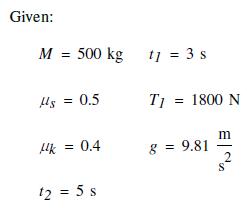
The log has mass M and rests on the ground for which the coefficients of static and kinetic friction are μs and μk respectively. The winch delivers a horizontal towing force T to its cable at A which varies as shown in the graph. Determine the speed of the log when t = t2. Originally the tension
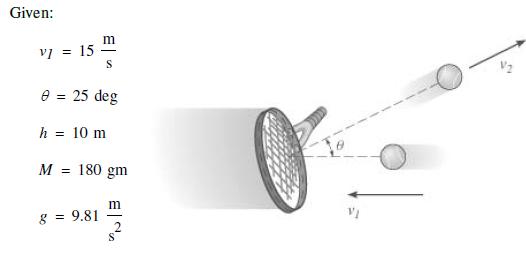
The tennis ball has a horizontal speed v1 when it is struck by the racket. If it then travels away at angle θ from the horizontal and reaches maximum altitude h, measured from the height of the racket, determine the magnitude of the net impulse of the racket on the ball. The ball has mass M.
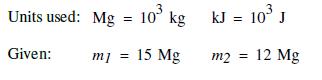
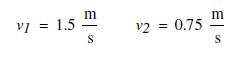
A railroad car having mass m1 is coasting with speed v1 on a horizontal track. At the same time another car having mass m2 is coasting with speed v2 in the opposite direction. If the cars meet and couple together, determine the speed of both cars just after the coupling. Find the difference between
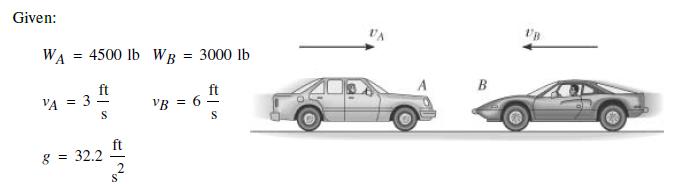
Car A has weight WA and is traveling to the right at speed vA Meanwhile car B of weight WB is traveling at speed vB to the left. If the cars crash head-on and become entangled, determine their common velocity just after the collision. Assume that the brakes are not applied during collision.
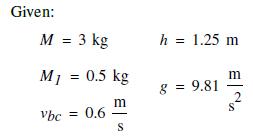
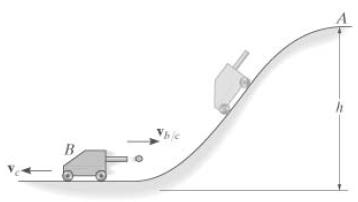
The cart has mass M and rolls freely down the slope. When it reaches the bottom, a spring loaded gun fires a ball of mass M1 out the back with a horizontal velocity vbc measured relative to the cart. Determine the final velocity of the cart. Given: M = 3 kg M₁ = 0.5 kg m S Vbc = 0.6 h = 1.25 m 8
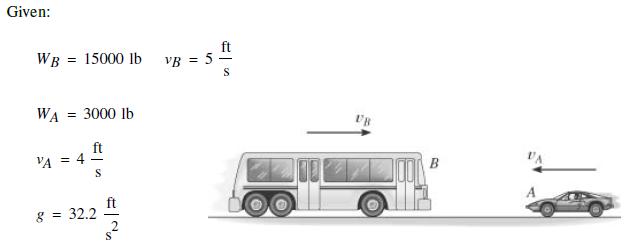
The bus B has weight WB and is traveling to the right at speed vB. Meanwhile car A of weight WA is traveling at speed vA to the left. If the vehicles crash head-on and become entangled, determine their common velocity just after the collision. Assume that the vehicles are free to roll during
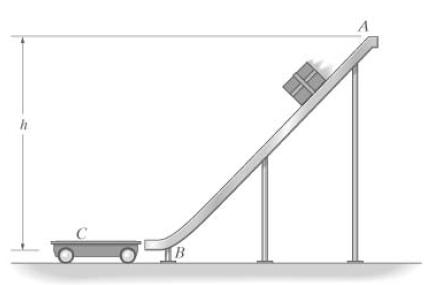
A box of weight W1 slides from rest down the smooth ramp onto the surface of a cart of weight W2. Determine the speed of the box at the instant it stops sliding on the cart. If someone ties the cart to the ramp at B, determine the horizontal impulse the box will exert at C in order to stop its
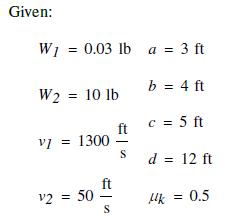
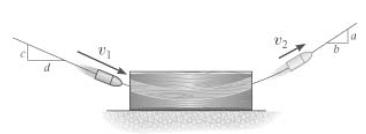
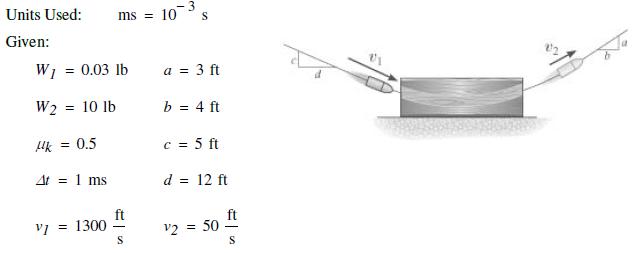
A bullet of weight W1 traveling at speed v1 strikes the wooden block of weight W2 and exits the other side at speed v2 as shown. Determine the speed of the block just after the bullet exits the block, and also determine how far the block slides before it stops. The coefficient of kinetic friction
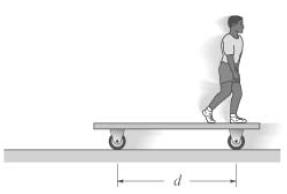
A boy of weight W1 walks forward over the surface of the cart of weight W2 with a constant speed v relative to the cart. Determine the cart’s speed and its displacement at the moment he is about to step off. Neglect the mass of the wheels and assume the cart and boy are originally at rest.
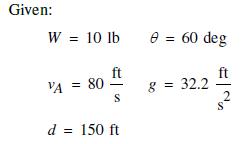
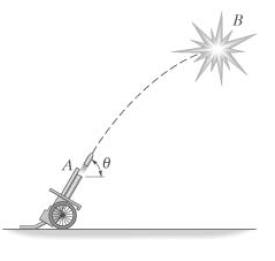
The projectile of weight W is fired from ground level with an initial velocity vA in the direction shown. When it reaches its highest point B it explodes into two fragments of weight W/2. If one fragment is seen to travel vertically upward, and after they fall they are a distance d apart, determine
A bullet of weight W1 traveling at v1 strikes the wooden block of weight W2 and exits the other side at v2 as shown. Determine the speed of the block just after the bullet exits the block. Also, determine the average normal force on the block if the bullet passes through it in time Δt , and the
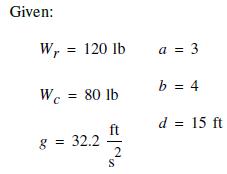
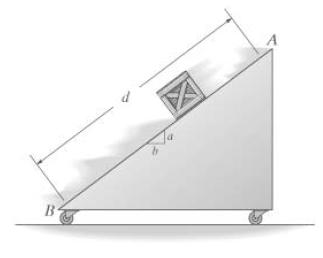
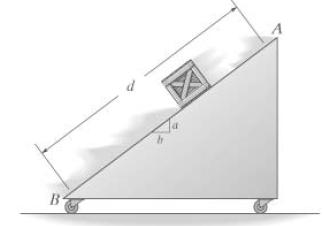
The free-rolling ramp has a weight Wr. The crate, whose weight is Wc, slides a distance d from rest at A, down the ramp to B. Determine the ramp’s speed when the crate reaches B. Assume that the ramp is smooth, and neglect the mass of the wheels. Given: W, = 120 lb We = 80 lb C 8 = 32.2 ft 2 S a
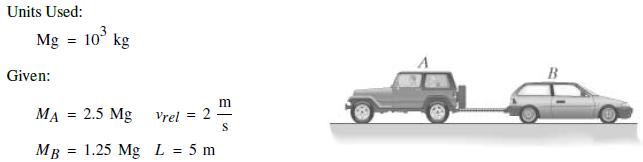
The winch on the back of the jeep A is turned on and pulls in the tow rope at speed vrel. If both the car B of mass MB and the jeep A of mass MA are free to roll, determine their velocities at the instant they meet. If the rope is of length L, how long will this take? Units Used: Mg
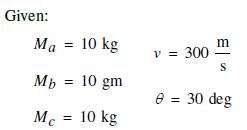
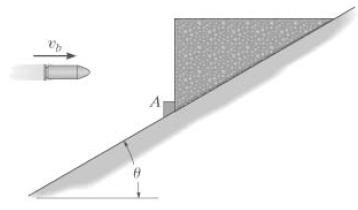
The block of mass Ma is held at rest on the smooth inclined plane by the stop block at A. If the bullet of mass Mb is traveling at speed v when it becomes embedded in the block of mass Mc, determine the distance the block will slide up along the plane before momentarily stopping. Given: Ma 10 kg Mb
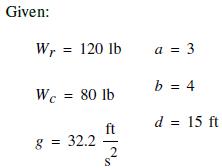
The free-rolling ramp has a weight Wr. If the crate, whose weight is Wc, is released from rest at A, determine the distance the ramp moves when the crate slides a distance d down the ramp and reaches the bottom B. Given: Wr = 120 lb Wc = 80 lb ft 2 S 8 = 32.2 a = 3 b = 4 d = 15 ft
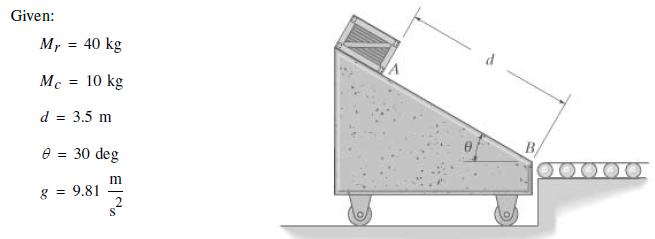
The free-rolling ramp has a mass Mr. A crate of mass Mc is released from rest at A and slides down d to point B. If the surface of the ramp is smooth, determine the ramp’s speed when the crate reaches B. Also, what is the velocity of the crate? Given: Mr = 40 kg Mc = 10 kg d = 3.5 m 8 = 30
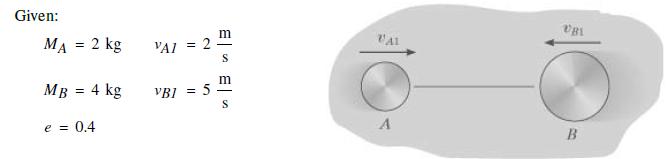
Disks A and B have masses MA and MB respectively. If they have the velocities shown, determine their velocities just after direct central impact. Given: MA = 2 kg MB = 4 kg e = 0.4 VAI = 2 VB1 = 5 EE m VBI B
Blocks A and B have masses mA and mB respectively. They are placed on a smooth surface and the spring connected between them is stretched a distance d. If they are released from rest, determine the speeds of both blocks the instant the spring becomes unstretched. MA 40 kg mB = = 60 kg d = 2
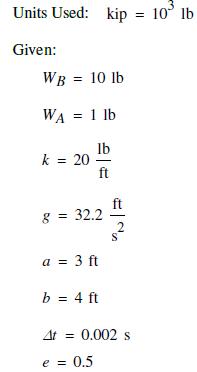
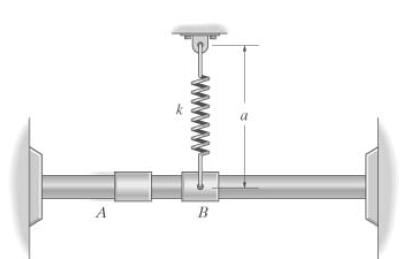
The collar B of weight WB is at rest, and when it is in the position shown the spring is unstretched. If another collar A of weight WA strikes it so that B slides a distance b on the smooth rod before momentarily stopping, determine the velocity of A just after impact, and the average force exerted
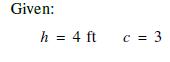
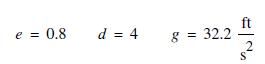
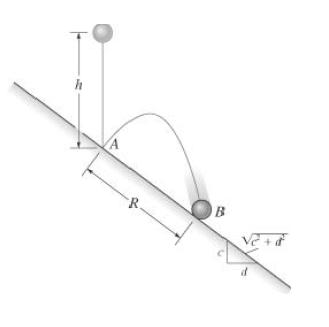
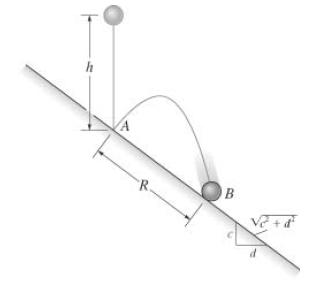
The ball is dropped from rest and falls a distance h before striking the smooth plane at A. If the coefficient of restitution is e, determine the distance R to where it again strikes the plane at B. Given: h = 4 ft c = 3
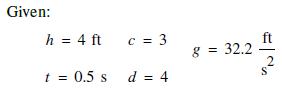
The ball is dropped from rest and falls a distance h before striking the smooth plane at A. If it rebounds and in time t again strikes the plane at B, determine the coefficient of restitution e between the ball and the plane. Also, what is the distance R? Given: h = 4 ft t c = 3 0.5 s d = 4 8 =
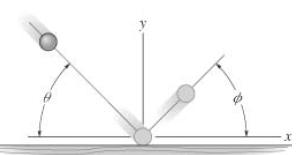
A ball is thrown onto a rough floor at an angle of θ. If it rebounds at the same angle φ, determine the coefficient of kinetic friction between the floor and the ball. The coefficient of restitution is e. Show that during impact, the average impulses in the x and y directions are related by Ix =
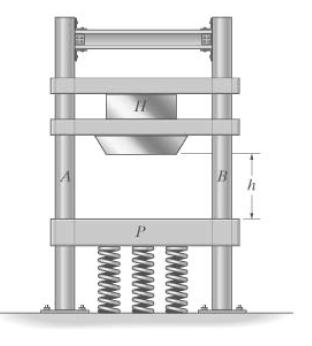
The drop hammer H has a weight WH and falls from rest h onto a forged anvil plate P that has a weight WP. The plate is mounted on a set of springs that have a combined stiffness kT. Determine(a) The velocity of P and H just after collision.(b) The maximum compression in the springs caused by the
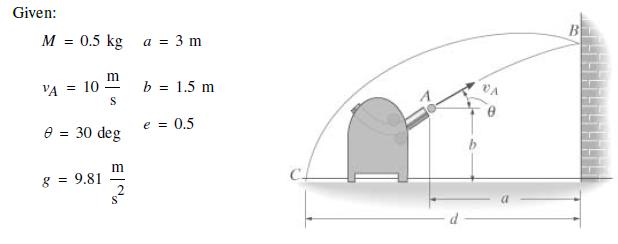
A pitching machine throws the ball of weight M towards the wall with an initial velocity vA as shown. Determine(a) The velocity at which it strikes the wall at B,(b) The velocity at which it rebounds from the wall(c) The distance d from the wall to where it strikes the ground at C. Given: M = 0.5
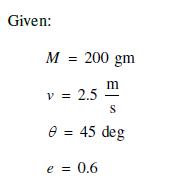
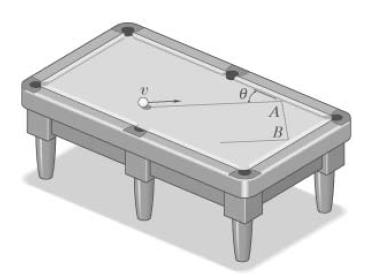
The billiard ball of mass M is moving with a speed v when it strikes the side of the pool table at A. If the coefficient of restitution between the ball and the side of the table is e, determine the speed of the ball just after striking the table twice, i.e., at A, then at B. Neglect the size of
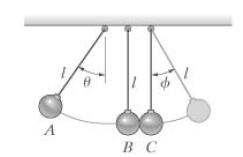
The three balls each have the same mass m. If A is released from rest at θ, determine the angle φ to which C rises after collision. The coefficient of restitution between each ball is e. A B C
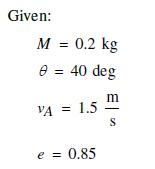
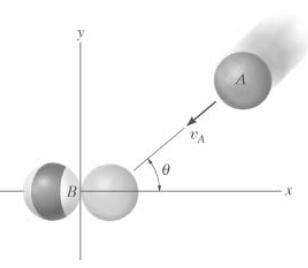
Two smooth billiard balls A and B each have mass M. If A strikes B with a velocity vA as shown, determine their final velocities just after collision. Ball B is originally at rest and the coefficient of restitution is e. Neglect the size of each ball. Given: M = 0.2 kg 0 = 40 deg VA = = 1.5 e =
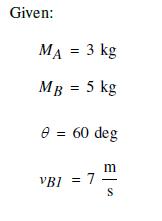
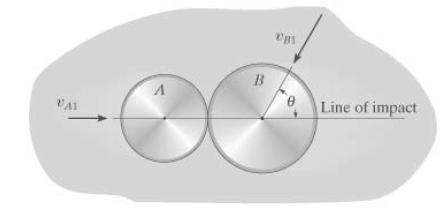
The two disks A and B have a mass MA and MB, respectively. If they collide with the initial velocities shown, determine their velocities just after impact. The coefficient of restitution is e. Given: MA = 3 kg MB = 5 kg 8 = 60 deg VB1 = 7 m S
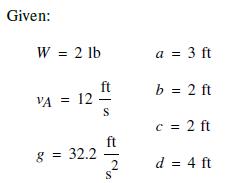
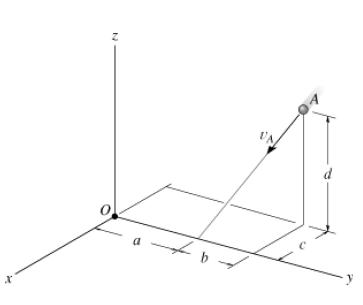
Determine the angular momentum of particle A of weight W about point O. Use a Cartesian vector solution. Given: W = 2 lb VA = 12 8 = 32.2 ft S ft 2 S a = 3 ft b = 2 ft c = 2 ft d = 4 ft
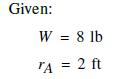
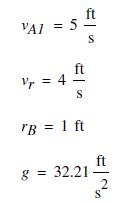
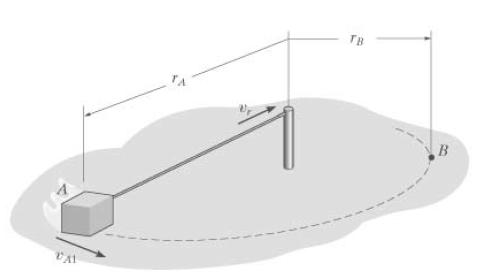
A box having a weight W is moving around in a circle of radius rA with a speed vA1 while connected to the end of a rope. If the rope is pulled inward with a constant speed vr, determine the speed of the box at the instant r = rB. How much work is done after pulling in the rope from A to B? Neglect
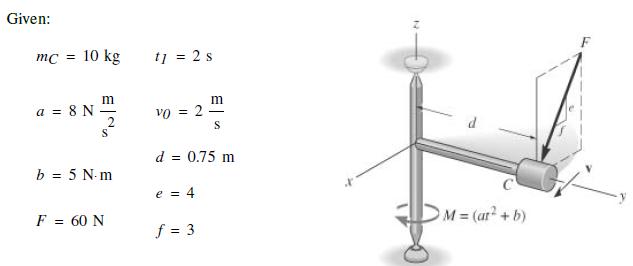
The small cylinder C has mass mC and is attached to the end of a rod whose mass may be neglected. If the frame is subjected to a couple M = at2 + b, and the cylinder is subjected to force F, which is always directed as shown, determine the speed of the cylinder when t = t1. The cylinder has a speed
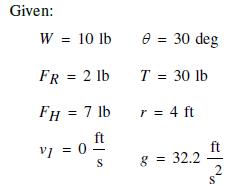
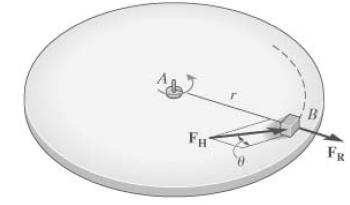
The block of weight W is originally at rest on the smooth surface. It is acted upon by a radial force FR and a horizontal force FH, always directed at θ from the tangent to the path as shown. Determine the time required to break the cord, which requires a tension T. What is the speed of the block
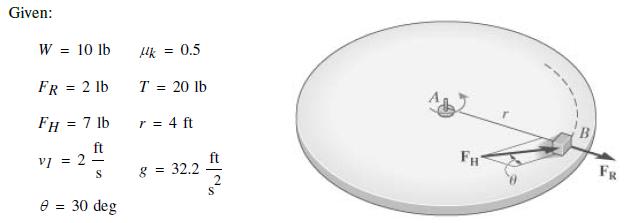
The block of weight W rests on a surface for which the kinetic coefficient of friction is μk. It is acted upon by a radial force FR and a horizontal force FH, always directed at angle θ from the tangent to the path as shown. If the block is initially moving in a circular path with a speed v1 at
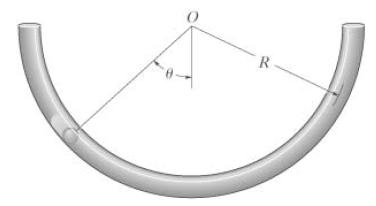
A small particle having a mass m is placed inside the semicircular tube. The particle is placed at the position shown and released. Apply the principle of angular momentum about point O (ΣM0 = H0), and show that the motion of the particle is governed by the differential equation θ'' + (g / R) sin
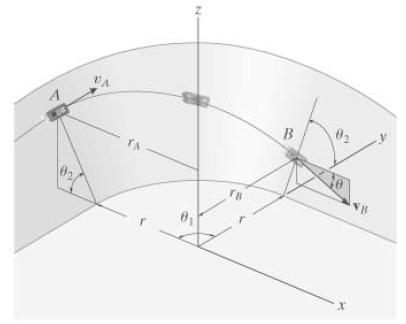
A toboggan and rider, having a total mass M, enter horizontally tangent to a circular curve (θ1) with a velocity vA. If the track is flat and banked at angle θ2, determine the speed vB and the angle θ of “descent”, measured from the horizontal in a vertical x–z plane, at which the toboggan
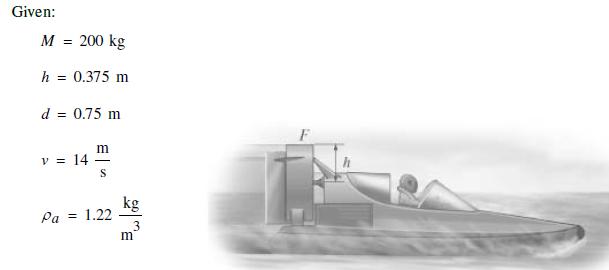
The boat of mass M is powered by a fan F which develops a slipstream having a diameter d. If the fan ejects air with a speed v, measured relative to the boat, determine the initial acceleration of the boat if it is initially at rest. Assume that air has a constant density ρa and that the entering
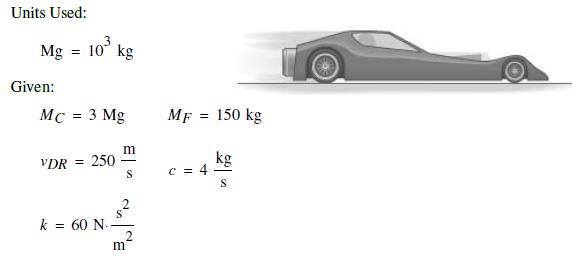
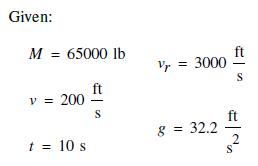
The rocket car has a mass MC (empty) and carries fuel of mass MF. If the fuel is consumed at a constant rate c and ejected from the car with a relative velocity vDR, determine the maximum speed attained by the car starting from rest. The drag resistance due to the atmosphere is FD = kv2 and the
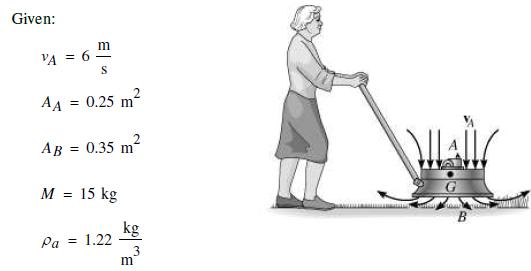
A power lawn mower hovers very close over the ground. This is done by drawing air in at speed vA through an intake unit A, which has cross-sectional area AA and then discharging it at the ground, B, where the cross-sectional area is AB. If air at A is subjected only to atmospheric pressure,
A rocket has an empty weight W1 and carries fuel of weight W2. If the fuel is burned at the rate c and ejected with a relative velocity vDR, determine the maximum speed attained by the rocket starting from rest. Neglect the effect of gravitation on the rocket. Given: W1 = 500 lb W2 = 300 lb c =
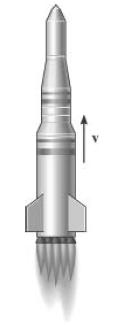
The rocket has mass M including the fuel. Determine the constant rate at which the fuel must be burned so that its thrust gives the rocket a speed v in time t starting from rest. The fuel is expelled from the rocket at relative speed vr. Neglect the effects of air resistance and assume that g is
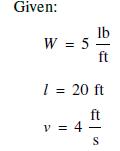
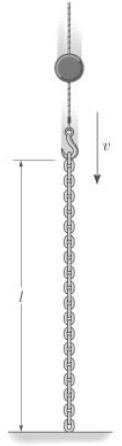
If the chain is lowered at a constant speed v, determine the normal reaction exerted on the floor as a function of time. The chain has a weight W and a total length l. Given: W = 5 ft 1 = 20 ft ft v = 4- S
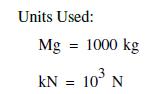
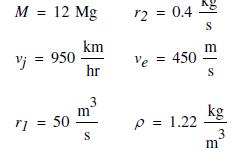
The jet airplane of mass M has constant speed vj when it is flying along a horizontal straight line. Air enters the intake scoops S at rate r1. If the engine burns fuel at the rate r2 and the gas (air and fuel) is exhausted relative to the plane with speed ve, determine the resultant drag force
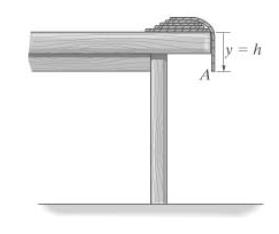
The rope has a mass m' per unit length. If the end length y = h is draped off the edge of the table, and released, determine the velocity of its end A for any position y, as the rope uncoils and begins to fall. 고
The car has a mass m0 and is used to tow the smooth chain having a total length l and a mass per unit of length m'. If the chain is originally piled up, determine the tractive force F that must be supplied by the rear wheels of the car, necessary to maintain a constant speed v while the chain is
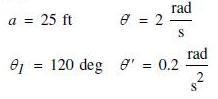
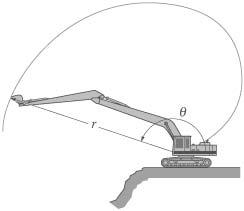
For a short time the bucket of the backhoe traces the path of the cardioid r = a(1 − cosθ). Determine the magnitudes of the velocity and acceleration of the bucket at θ = θ1 if the boom is rotating with an angular velocity θ' and an angular acceleration θ'' at the instant shown. Given: a =
Determine the time needed for the load at B to attain speed v, starting from rest, if the cable is drawn into the motor with acceleration a. Given: v = -8 V EI m S
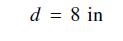
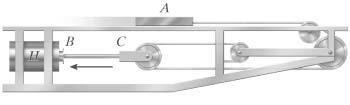
If the hydraulic cylinder at H draws rod BC in by a distance d, determine how far the slider at A moves. Given: d = 8 in
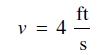
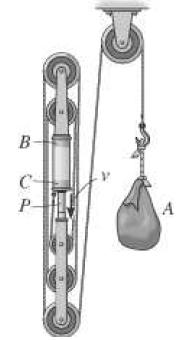
The pulley arrangement shown is designed for hoisting materials. If BC remains fixed while the plunger P is pushed downward with speed v, determine the speed of the load at A. Given: ft V v = 4- S
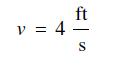
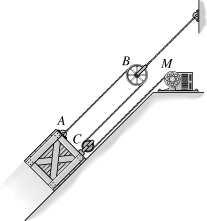
The crate is being lifted up the inclined plane using the motor M and the rope and pulley arrangement shown. Determine the speed at which the cable must be taken up by the motor in order to move the crate up the plane with constant speed v. Given: v = 4 V ft S
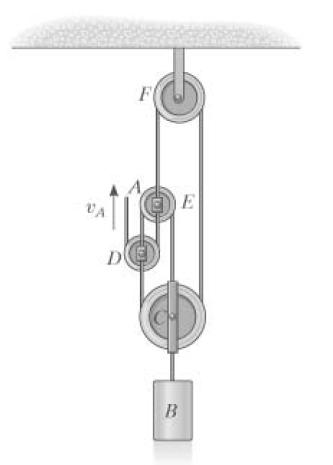
If block A is moving downward with speed vA while C is moving up at speed vC, determine the speed of block B. Given: ft VA = 4- S
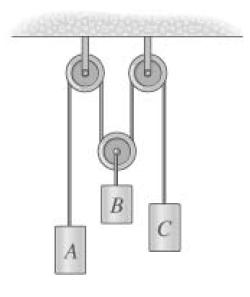
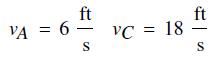
If block A is moving downward at speed vA while block C is moving down at speed vC, determine the relative velocity of block B with respect to C. Given: ft = 6- VC = 18 S VA = 6- ft S
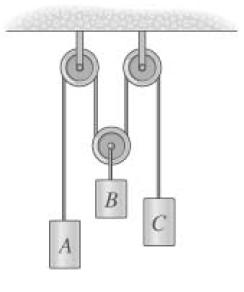
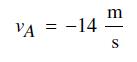
If the point A on the cable is moving upwards at vA, determine the speed of block B. Given: VA || = -14 m S
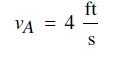
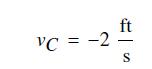
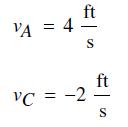
If block A of the pulley system is moving downward with speed vA while block C is moving up at vC determine the speed of block B. Given: ft VA 4- = S || VC = -2 ft | S
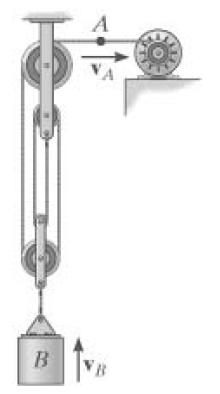
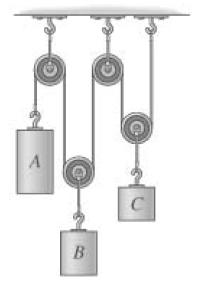
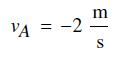
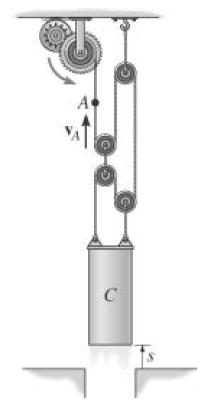
The cylinder C is being lifted using the cable and pulley system shown. If point A on the cable is being drawn toward the drum with speed of vA, determine the speed of the cylinder. Given: VA = -2 m S
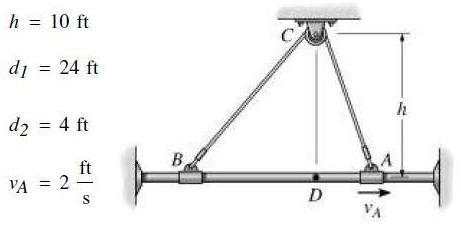
Collars A and B are connected to the cord that passes over the small pulley at C. When A is located at D, B is a distance d1 to the left of D. If A moves at a constant speed vA, to the right, determine the speed of B when A is distance d2 to the right of D. Given: h = 10 ft d₁ = 24 ft d2 d₂ = 4
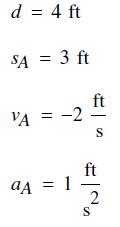
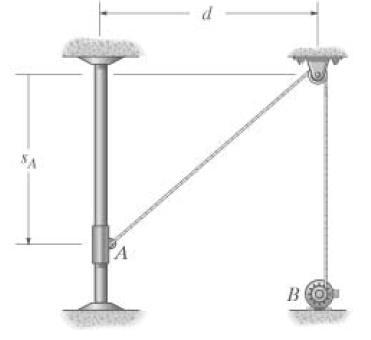
The motion of the collar at A is controlled by a motor at B such that when the collar is at sA, it is moving upwards at vA and slowing down at aA. Determine the velocity and acceleration of the cable as it is drawn into the motor B at this instant. Given: d = 4 ft SA = 3 ft VA aA || || ft -2 1 |
Vertical motion of the load is produced by movement of the piston at A on the boom. Determine the distance the piston or pulley at C must move to the left in order to lift the load a distance h. The cable is attached at B, passes over the pulley at C, then D, E, F, and again around E, and is
By using an inclined plane to retard the motion of a falling object, and thus make the observations more accurate, Galileo was able to determine experimentally that the distance through which an object moves in free fall is proportional to the square of the time for travel. Show that this is the
Determine the gravitational attraction between two spheres which are just touching each other. Each sphere has a mass M and radius r. Given: r = 200 mm M = 10 kg G = 66.73 x 10 12 m³ 3 kg.si nN = 1 × 10⁹ N -9
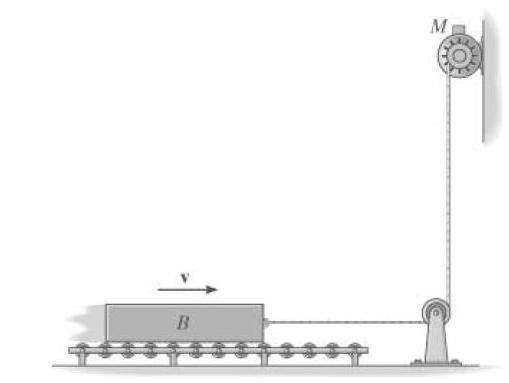
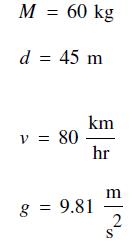
A bar B of mass M1, originally at rest, is being towed over a series of small rollers. Determine the force in the cable at time t if the motor M is drawing in the cable for a short time at a rate v = kt2. How far does the bar move in time t? Neglect the mass of the cable, pulley, and the rollers.
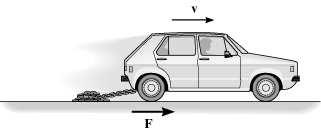
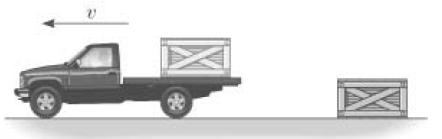
A crate having a mass M falls horizontally off the back of a truck which is traveling with speed v. Determine the coefficient of kinetic friction between the road and the crate if the crate slides a distance d on the ground with no tumbling along the road before coming to rest. Assume that the
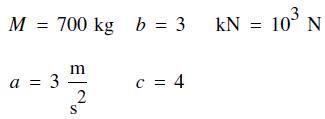
The crane lifts a bin of mass M with an initial acceleration a. Determine the force in each of the supporting cables due to this motion. Given: M = 700 kg a = 3 m 2 S b = 3 c = 4 kN = 10³ N
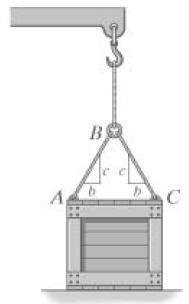
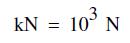
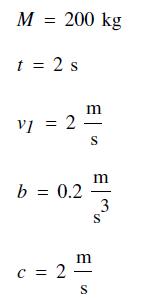
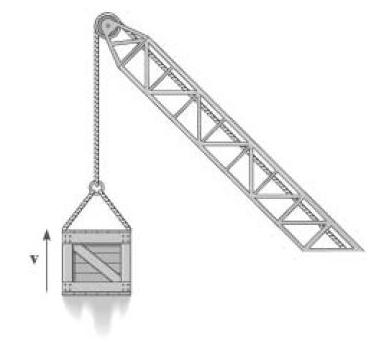
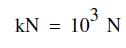
The crate of mass M is suspended from the cable of a crane. Determine the force in the cable at time t if the crate is moving upward with (a) a constant velocity v1 and (b) a speed of v = bt2 + c. Units Used:Given: KN = 10³ N
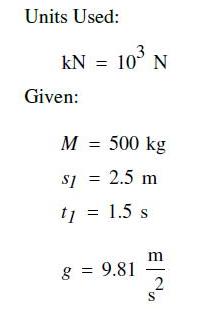
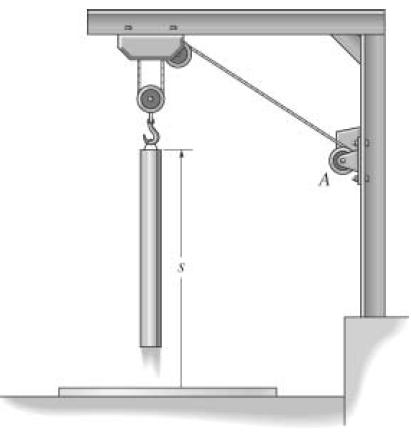
The fuel assembly of mass M for a nuclear reactor is being lifted out from the core of the nuclear reactor using the pulley system shown. It is hoisted upward with a constant acceleration such that s = 0 and v = 0 when t = 0 and s = s1 when t = t1. Determine the tension in the cable at A during the
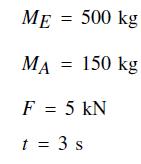
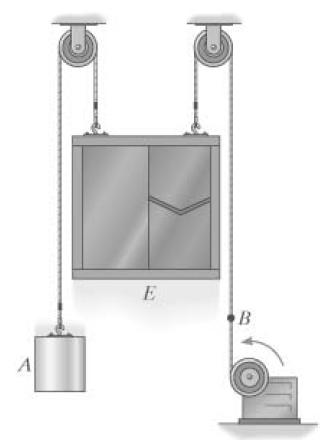
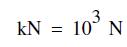
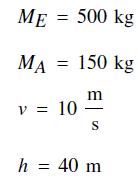
The elevator E has a mass ME, and the counterweight at A has a mass MA. If the motor supplies a constant force F on the cable at B, determine the speed of the elevator at time t starting from rest. Neglect the mass of the pulleys and cable. Units Used:Given: kN = 10 N
The elevator E has a mass ME and the counterweight at A has a mass MA. If the elevator attains a speed v after it rises a distance h, determine the constant force developed in the cable at B. Neglect the mass of the pulleys and cable. Units Used:Given: kN = 10 N
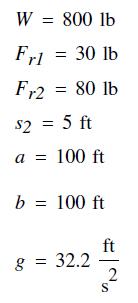
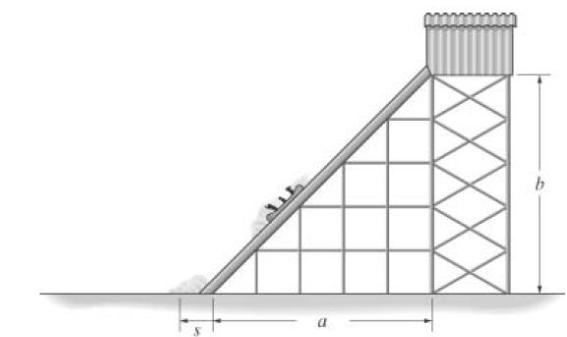
The water-park ride consists of a sled of weight W which slides from rest down the incline and then into the pool. If the frictional resistance on the incline is Fr1 and in the pool for a short distance is Fr2, determine how fast the sled is traveling when s = s2. Given: W = 800 lb Frl Fr2 = 80
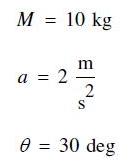
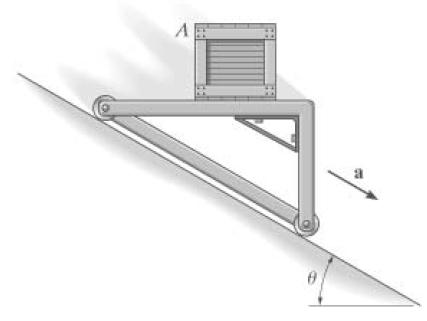
Determine the normal force the crate A of mass M exerts on the smooth cart if the cart is given an acceleration a down the plane. Also, what is the acceleration of the crate? Given: M = 10 kg a a = 2 m 2 S 8 = 30 deg
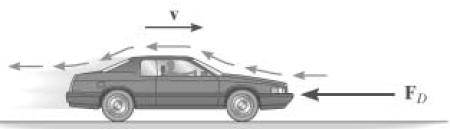
A car of mass m is traveling at a slow velocity v0. If it is subjected to the drag resistance of the wind, which is proportional to its velocity, i.e., FD = kv determine the distance and the time the car will travel before its velocity becomes 0.5 v0. Assume no other frictional forces act on the
Showing 600 - 700
of 2550
1
2
3
4
5
6
7
8
9
10
11
12
13
14
15
Last
Step by Step Answers

 Get 50% OFF
Claim Now
Get 50% OFF
Claim Now