New Semester
Started
Get
50% OFF
Study Help!
--h --m --s
Claim Now
Question Answers
Textbooks
Find textbooks, questions and answers
Oops, something went wrong!
Change your search query and then try again
S
Books
FREE
Study Help
Expert Questions
Accounting
General Management
Mathematics
Finance
Organizational Behaviour
Law
Physics
Operating System
Management Leadership
Sociology
Programming
Marketing
Database
Computer Network
Economics
Textbooks Solutions
Accounting
Managerial Accounting
Management Leadership
Cost Accounting
Statistics
Business Law
Corporate Finance
Finance
Economics
Auditing
Tutors
Online Tutors
Find a Tutor
Hire a Tutor
Become a Tutor
AI Tutor
AI Study Planner
NEW
Sell Books
Search
Search
Sign In
Register
study help
engineering
engineering mechanics dynamics
Engineering Mechanics - Dynamics 11th Edition R. C. Hibbeler - Solutions
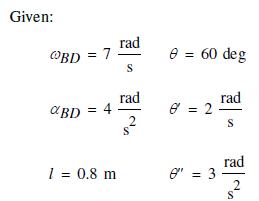
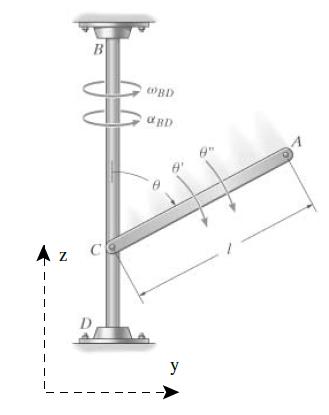
At the instant shown, rod BD is rotating about the vertical axis with an angular velocity ωBD and an angular acceleration αBD. Link AC is rotating downward. Determine the velocity and acceleration of point A on the link at this instant. Given: COBD = 7 BD = 4 1 = 0.8 m rad S rad 2 8 = 60 deg 8 =
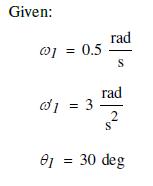
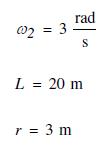
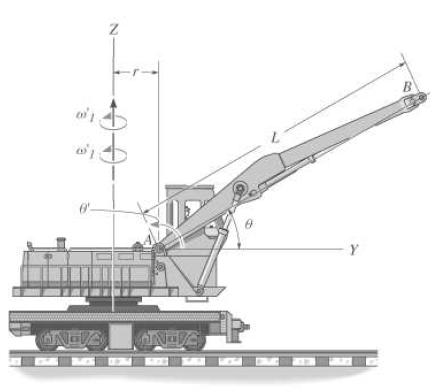
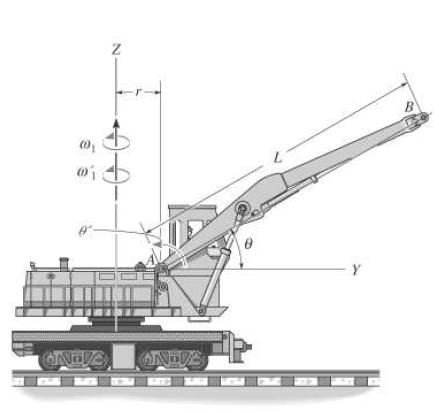
The boom AB of the locomotive crane is rotating about the Z axis with angular velocity ω1 which is increasing at ω'1. At this same instant, θ = θ1 and the boom is rotating upward at a constant rate ofθ' = ω2. Determine the velocity and acceleration of the tip B of the boom at this instant.
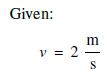
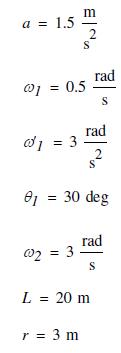
The locomotive crane is traveling to the right with speed v and acceleration a. The boom AB is rotating about the Z axis with angular velocity ω1 which is increasing at ω'1. At this same instant, θ= θ1 and the boom is rotating upward at a constant rate of θ' = ω2. Determine the velocity and
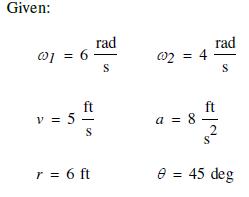
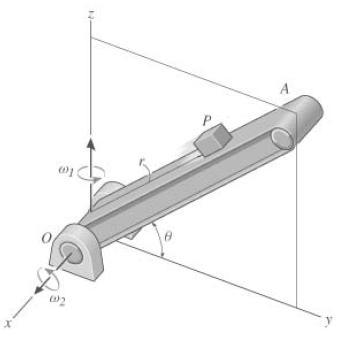
At the instant shown, the arm OA of the conveyor belt is rotating about the z axis with a constant angular velocity ω1, while at the same instant the arm is rotating upward at a constant rate ω2. If the conveyor is running at the rate r' = v which is increasing at the rate r'' = a, determine the
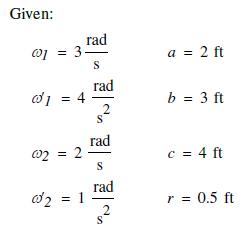
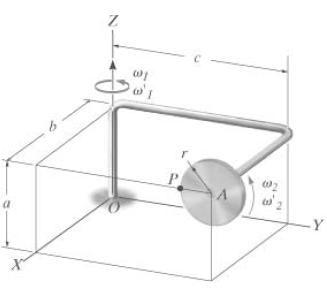
At the given instant, the rod is spinning about the z axis with an angular velocity ω and angular acceleration ω'1. At this same instant, the disk is spinning, with ω2 and ω'2 both measured relative to the rod. Determine the velocity and acceleration of point P on the disk at this instant.
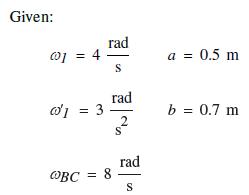
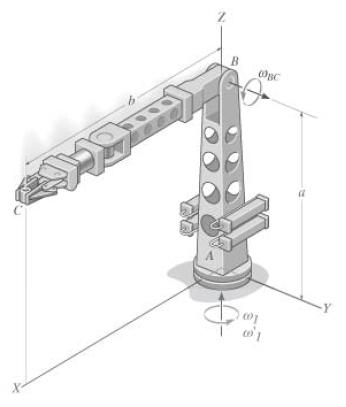
At the instant shown, the base of the robotic arm is turning about the z axis with angular velocity ω1, which is increasing at ω'1. Also, the boom segment BC is rotating at constant rate ωBC. Determine the velocity and acceleration of the part C held in its grip at this instant. Given: 00] =
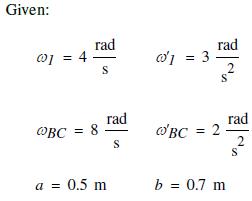
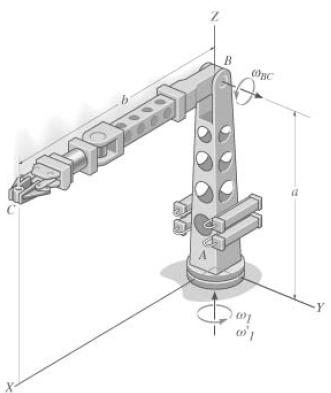
At the instant shown, the base of the robotic arm is turning about the z axis with angular velocity ω1, which is increasing at ω'1. Also, the boom segment BC is rotating with angular velociy ωBC which is incrasing at ω'BC. Determine the velocity and acceleration of the part C held in its grip
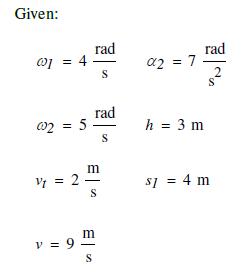
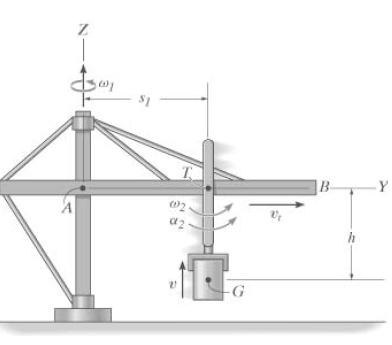
The load is being lifted upward at a constant rate v relative to the crane boom AB. At the instant shown, the boom is rotating about the vertical axis at a constant rate ω1, and the trolley T is moving outward along the boom at a constant rate vt. Furthermore, at this same instant the rectractable
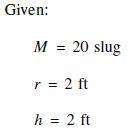
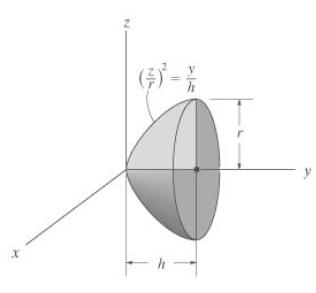
Determine the moments of inerta Ix and Iy of the paraboloid of revolution. The mass of the paraboloid is M. Given: M = 20 slug r = 2 ft h = 2 ft
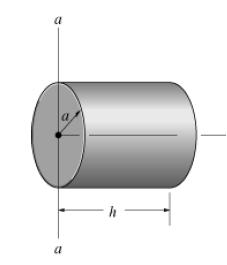
Determine the moment of inertia of the cylinder with respect to the a-a axis of the cylinder. The cylinder has a mass m. a a a h
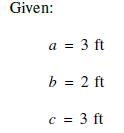
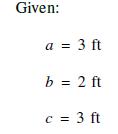
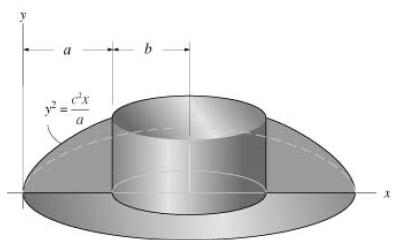
Determine the product of inertia Ixy of the body formed by revolving the shaded area about the line x = a + b. Express your answer in terms of the density ρ. Given: a = 3 ft b = 2 ft c = 3 ft
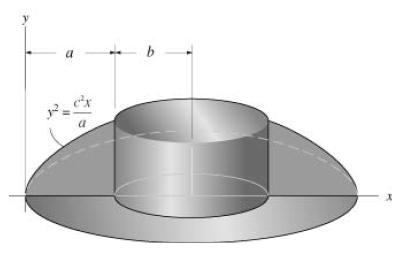
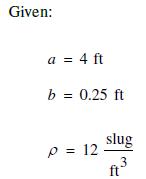
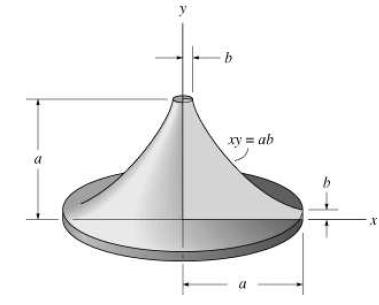
Determine the radii of gyration kx and ky for the solid formed by revolving the shaded area about the y axis. The density of the material is ρ. Given: a = 4 ft b = 0.25 ft slug 3 ft p = 12-
Determine the moment of inertia Iy of the body formed by revolving the shaded area about the line x = a + b. Express your answer in terms of the density ρ. Given: a = 3 ft b = 2 ft c = 3 ft
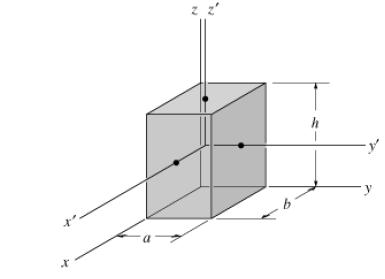
Determine the mass moment of inertia of the homogeneous block with respect to its centroidal x' axis. The mass of the block is m. h
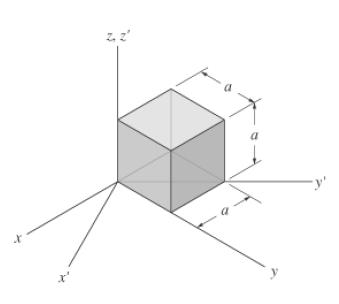
Determine the elements of the inertia tensor for the cube with respect to the x, y, z coordinate system. The mass of the cube is m. X ܕܝܐ a
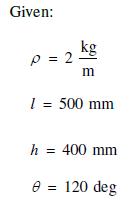
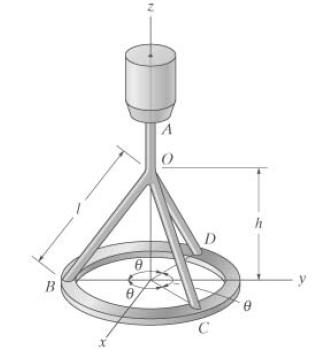
Compute the moment of inertia of the rod-and-thin-ring assembly about the z axis. The rods and ring have a mass density ρ. Given: P = 2 kg m 1 = 500 mm h = 400 mm e = 120 deg
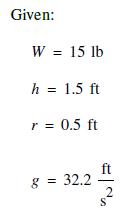
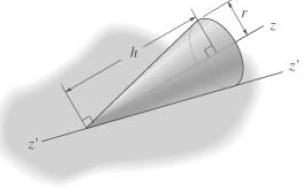
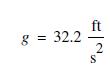
Determine the moment of inertia of the cone about the z' axis. The weight of the cone is W, the height is h, and the radius is r. Given: W = 15 lb h = 1.5 ft r = 0.5 ft 8 = 32.2 ft 2 S
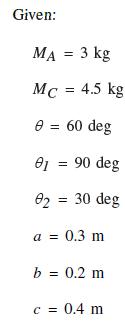
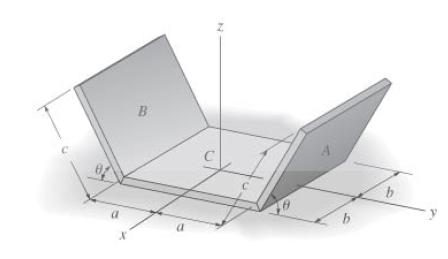
The assembly consists of two square plates A and B which have a mass MA each and a rectangular plate C which has a mass MC. Determine the moments of inertia Ix, Iy and Iz. Given: MA = 3 kg ΜΑ Mc 0 = 60 deg 4.5 kg 81 = 90 deg 02 = 30 deg a = 0.3 m b = 0.2 m c = 0.4 m
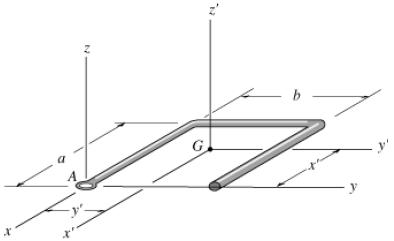
The bent rod has weight density γ. Locate the center of gravity G(x', y') and determine the principal moments of inertia Ix', Iy', and Iz' of the rod with respect to the x', y', z' axes. Given: Y = 1.5 a = 1 ft b = 1 ft lb ft g = 32.2 ft 2 S
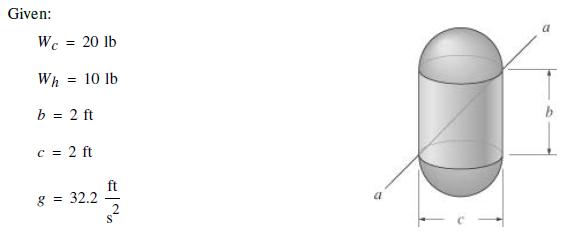
Determine the moment of inertia of the composite body about the aa axis. The cylinder has weight Wc and each hemisphere has weight Wh. Given: Wc = Wh = 10 lb b = 2 ft DO 20 lb c = 2 ft g = 322- B C
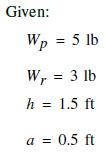
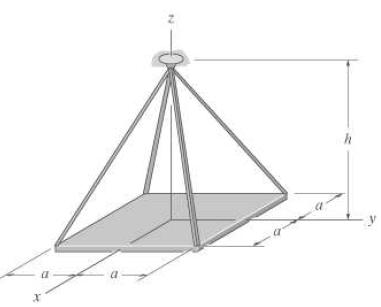
The thin plate has a weight Wp and each of the four rods has weight Wr. Determine the moment of inertia of the assembly about the z axis. Given: Wp = 5 lb W₁ = 3 lb h = 1.5 ft a = 0.5 ft
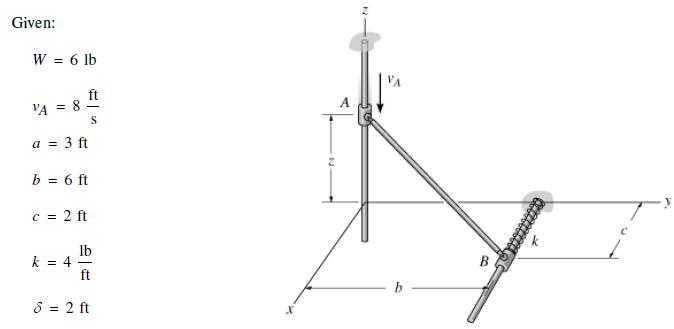
Rod AB has weight W and is attached to two smooth collars at its ends by ball-and-socket joints. If collar A is moving downward with speed vA when z = a, determine the speed of A at the instant z = 0. The spring has unstretched length c. Neglect the mass of the collars. Assume the angular velocity
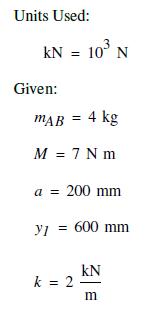
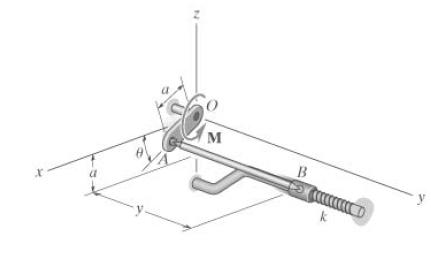
The assembly consists of a rod AB of mass mAB which is connected to link OA and the collar at B by ball-and-socket joints. When θ = 0 and y = y1, the system is at rest, the spring is unstretched, and a couple moment M, is applied to the link at O. Determine the angular velocity of the link at the
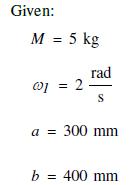
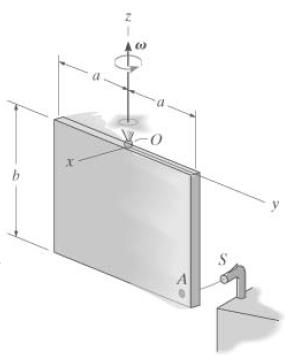
The thin plate of mass M is suspended at O using a ball-and-socket joint. It is rotating with a constant angular velocity ω = ω1k when the corner A strikes the hook at S, which provides a permanent connection. Determine the angular velocity of the plate immediately after impact. Given: M = 5
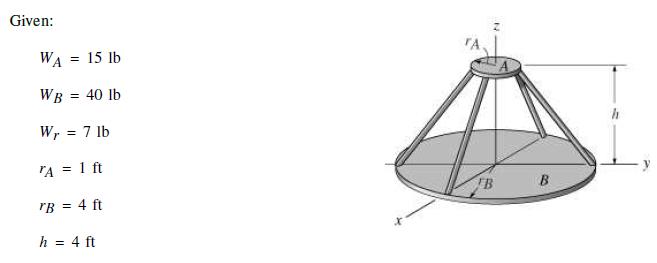
The assembly consists of a plate A of weight WA, plate B of weight WB, and four rods each of weight Wr. Determine the moments of inertia of the assembly with respect to the principal x, y, z axes. Given: WA = 15 lb WB = 40 lb Wr = 7 lb TA = 1 ft rB = 4 ft h = 4 ft B B
The assembly consists of a rod AB of mass mAB which is connected to link OA and the collar at B by ball-and-socket joints. When θ = 0 and y = y1, the system is at rest, the spring is unstretched, and a couple moment M = M0(bθ + c), is applied to the link at O. Determine the angular velocity of
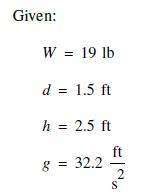
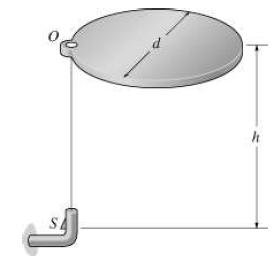
The circular plate has weight W and diameter d. If it is released from rest and falls horizontally a distance h onto the hook at S, which provides a permanent connection, determine the velocity of the mass center of the plate just after the connection with the hook is made. Given: W = 19 lb d = 1.5
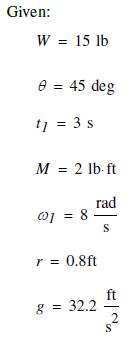
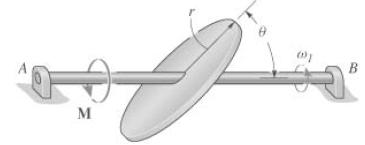
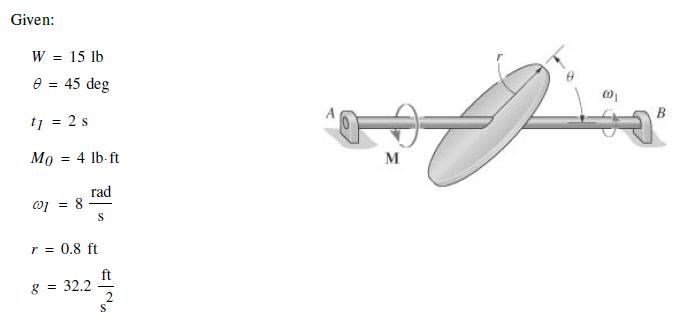
The circular disk has weight W and is mounted on the shaft AB at angle θ with the horizontal. Determine the angular velocity of the shaft when t = t1 if a constant torque M is applied to the shaft. The shaft is originally spinning with angular velocity ω1 when the torque is applied. Given: W = 15
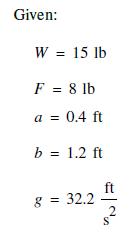
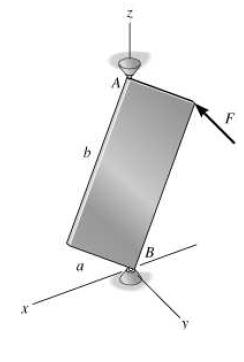
The plate of weight W is subjected to force F which is always directed perpendicular to the face of the plate. If the plate is originally at rest, determine its angular velocity after it has rotated one revolution (360°). The plate is supported by ball-and-socket joints at A and B. Given: W = 15
The circular disk has weight W and is mounted on the shaft AB at angle of θ with the horizontal. Determine the angular velocity of the shaft when t = t1 if a torque M = M0ebt applied to the shaft. The shaft is originally spinning at ω1 when the torque is applied. Given: W = 15 lb 0 = 45 deg t₁
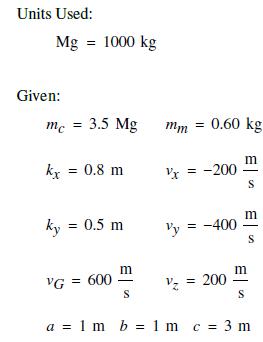
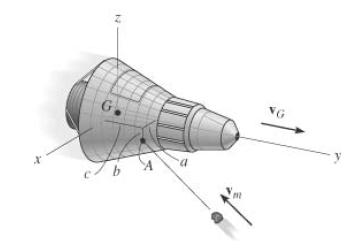
The space capsule has mass mc and the radii of gyration are kx = kz and ky. If it is traveling with a velocity vG, compute its angular velocity just after it is struck by a meteoroid having mass mm and a velocity vm = ( vxi +vyj +vzk ). Assume that the meteoroid embeds itself into the capsule at
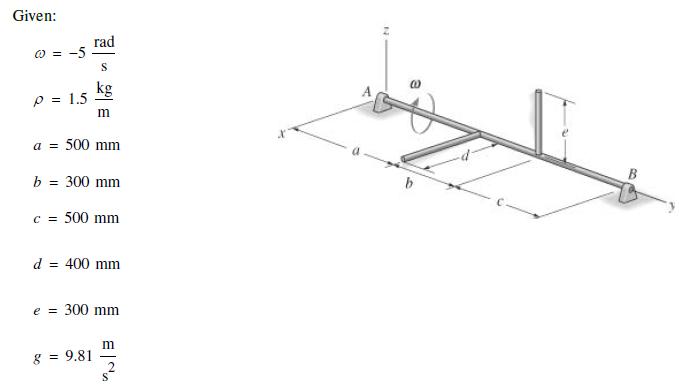
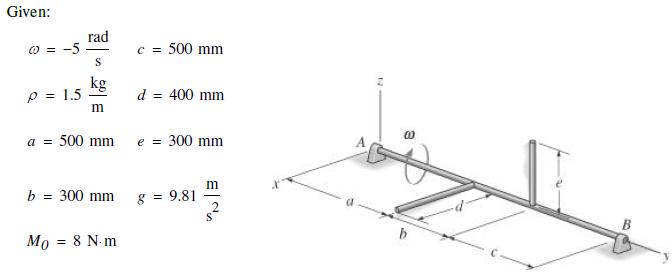
The rod assembly is supported by journal bearings at A and B, which develops only x and z force reactions on the shaft. If the shaft AB is rotating in the direction shown with angular velocity ω, determine the reactions at the bearings when the assembly is in the position shown. Also, what is the
The rod assembly is supported by journal bearings at A and B, which develops only x and z force reactions on the shaft. If the shaft AB is subjected to a couple moment M0j and at the instant shown the shaft has an angular velocity ωj, determine the reactions at the bearings when the assembly is in
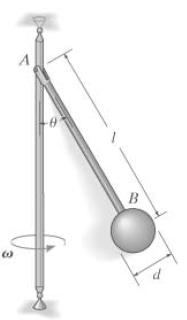
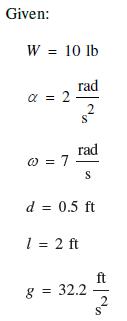
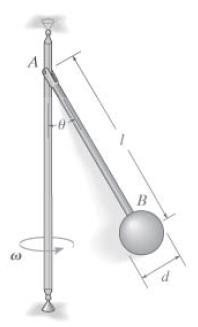
The rod AB supports the sphere of weight W. If the rod is pinned at A to the vertical shaft which is rotating at a constant rate ωk, determine the angle θ of the rod during the motion. Neglect the mass of the rod in the calculation. Given: W = 10 lb rad S d = 0.5 ft 00 = 7 1 = 2 ft = 32.2 2 S
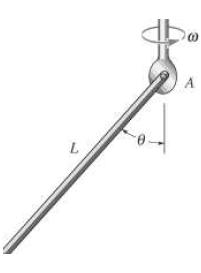
The conical pendulum consists of a bar of mass m and length L that is supported by the pin at its end A. If the pin is subjected to a rotation ω, determine the angle θ that the bar makes with the vertical as it rotates. L (0 A
The rod AB supports the sphere of weight W. If the rod is pinned at A to the vertical shaft which is rotating with angular acceleration α k, and at the instant shown the shaft has an angular velocity ωk, determine the angle θ of the rod during the motion. Neglect the mass of the rod in the
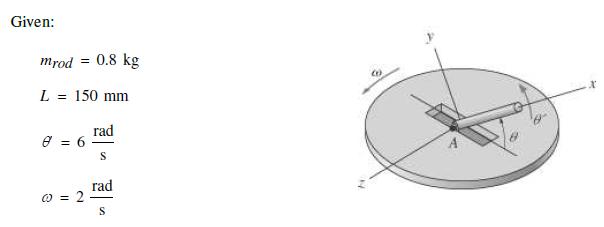
The thin rod has mass mrod and total length L. Only half of the rod is visible in the figure. It is rotating about its midpoint at a constant rate θ', while the table to which its axle A is fastened is rotating at angular velocity ω. Determine the x, y, z moment components which the axle exerts
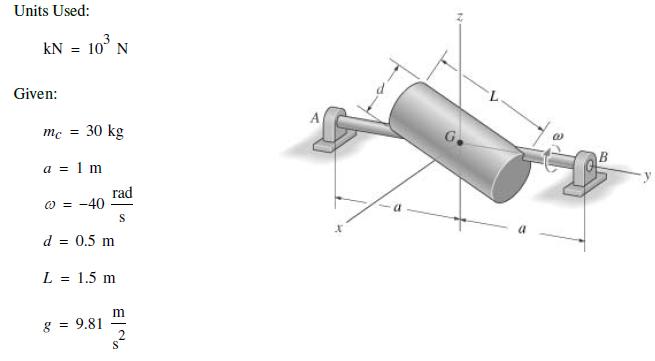
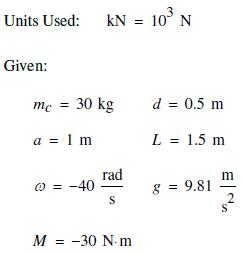
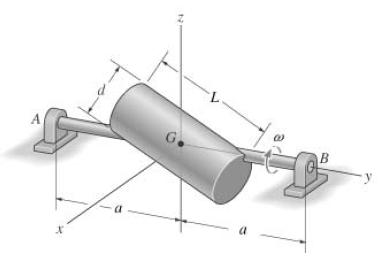
The cylinder has mass mc and is mounted on an axle that is supported by bearings at A and B. If the axle is turning at ωj, determine the vertical components of force acting at the bearings at this instant. Units Used: KN = 10³ N Given: mc = 30 kg a = 1 m @= -40 rad S d = 0.5 m L = 1.5 m 8 =
The cylinder has mass mc and is mounted on an axle that is supported by bearings at A and B. If the axle is subjected to a couple moment M j and at the instant shown has an angular velocity ωj, determine the vertical components of force acting at the bearings at this instant. Units Used: Given: mc
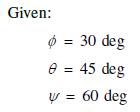
A thin rod is initially coincident with the Z axis when it is given three rotations defined by the Euler angles φ, θ, and ψ. If these rotations are given in the order stated, determine the coordinate direction angles α, β, γ of the axis of the rod with respect to the X, Y, and Z axes. Are
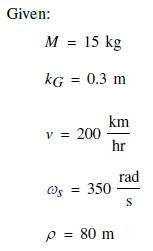
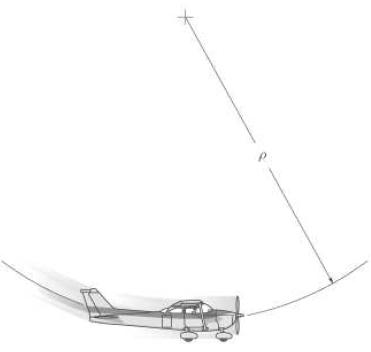
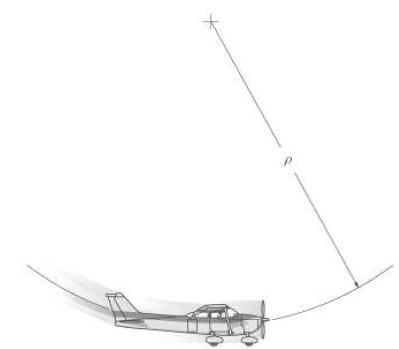
The propeller on a single-engine airplane has a mass M and a centroidal radius of gyration kG computed about the axis of spin. When viewed from the front of the airplane, the propeller is turning clockwise at ωs about the spin axis. If the airplane enters a vertical curve having a radius ρ and is
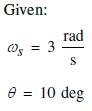
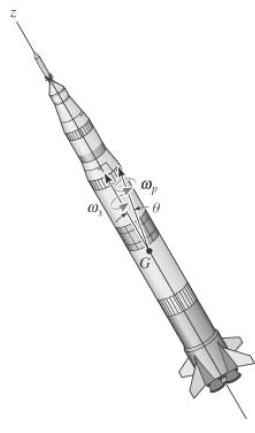
While the rocket is in free flight, it has a spin ωs and precesses about an axis measured angle θ from the axis of spin. If the ratio of the axial to transverse moments of inertia of the rocket is r, computed about axes which pass through the mass center G, determine the angle which the resultant
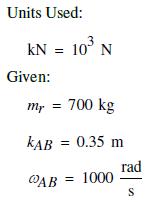
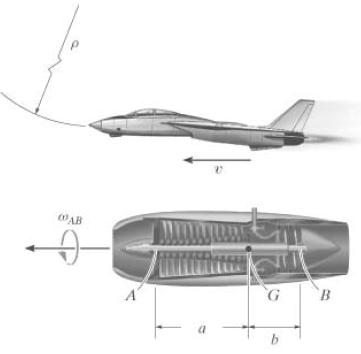
The rotor assembly on the engine of a jet airplane consists of the turbine, drive shaft, and compressor. The total mass is mr, the radius of gyration about the shaft axis is kAB, and the mass center is at G. If the rotor has an angular velocity ωAB, and the plane is pulling out of a vertical curve
An airplane descends at a steep angle and then levels off horizontally to land. If the propeller is turning clockwise when observed from the rear of the plane, determine the direction in which the plane tends to turn as caused by the gyroscopic effect as it levels off.
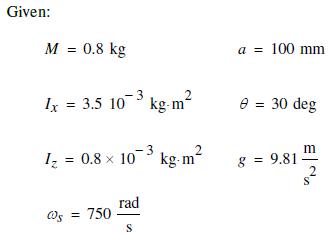
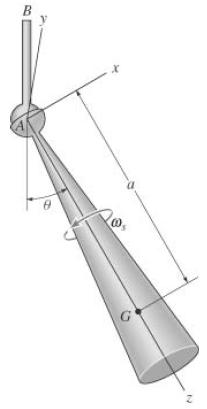
The conical top has mass M, and the moments of inertia are Ix = Iy and Iz. If it spins freely in the ball-and-socket joint at A with angular velocity ωs compute the precession of the top about the axis of the shaft AB. Given: M = 0.8 kg Ix = 3.5 10³ kg-m 1₂ = 0.8 × 10³ kg-m² x 05 =
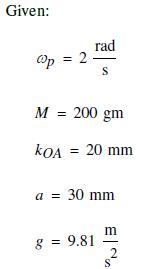
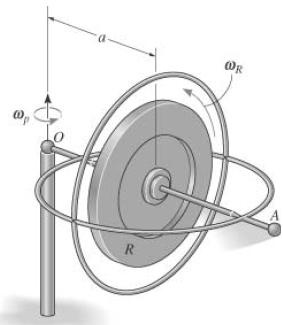
The toy gyroscope consists of a rotor R which is attached to the frame of negligible mass. If it is observed that the frame is precessing about the pivot point O at rate ωp determine the angular velocity ωR of the rotor. The stem OA moves in the horizontal plane. The rotor has mass M and a radius
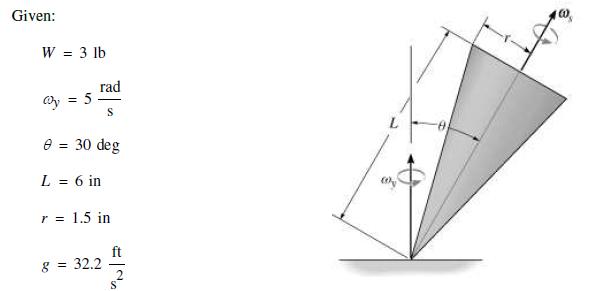
The top has weight W and can be considered as a solid cone. If it is observed to precessing about the vertical axis at a constant rate of ωy, determine its spin ωs. Given: W = 3 lb rad Oy = 5 S 8 = 30 deg L = 6 in r = 1.5 in 8 = 32.2 100,
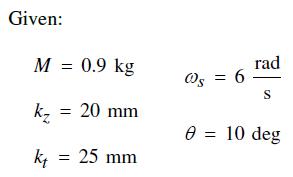
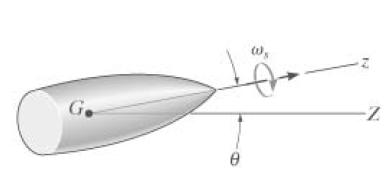
The projectile has a mass M and axial and transverse radii of gyration kz and kt, respectively. If it is spinning at ωs when it leaves the barrel of a gun, determine its angular momentum. Precession occurs about the Z axis. Given: M = 0.9 kg k₂ = 20 mm kt = 25 mm @s = 6 rad S 8 = 10 deg
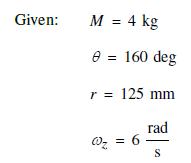
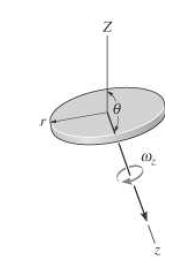
The disk of mass M is thrown with a spin ωz. The angle θ is measured as shown. Determine the precession about the Z axis. Given: M = 4 kg 8 = 160 deg r = 125 mm = 6 rad S
A spring has stiffness k. If a block of mass M is attached to the spring, pushed a distance d above its equilibrium position, and released from rest, determine the equation which describes the block’s motion. Assume that positive displacement is measured downward. Given: k = 600 ZI m M = 4 kg d =
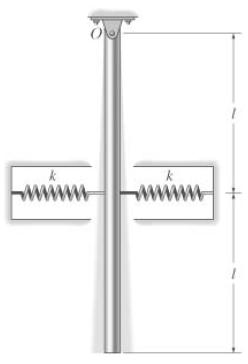
If the lower end of the slender rod of mass M is displaced a small amount and released from rest, determine the natural frequency of vibration. Each spring has a stiffness k and is unstretched when the rod is hanging vertically. Given: M = 30 kg k = 500 ZIE N m 1 = 1 m
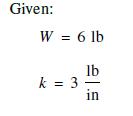
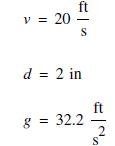
A weight W is suspended from a spring having a stiffness k. If the weight is given an upward velocity of v when it is distance d above its equilibrium position, determine the equation which describes the motion and the maximum upward displacement of the weight, measured from the equilibrium
When a block of mass m1 is suspended from a spring, the spring is stretched a distance δ. Determine the natural frequency and the period of vibration for a block of mass m2 attached to the same spring. Given: mj = 3 kg m2 = 0.2 kg 8 = 60 mm 8 = 9.81 m
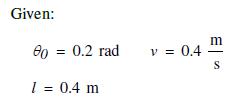
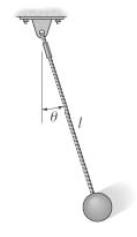
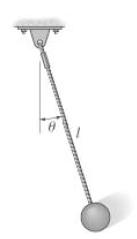
Determine to the nearest degree the maximum angular displacement of the bob if it is initially displaced θ0 from the vertical and given a tangential velocity v away from the vertical. Given: 80 = 0.2 rad 1 = 0.4 m v = 0.4 m S
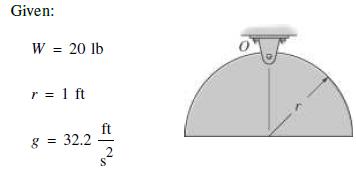
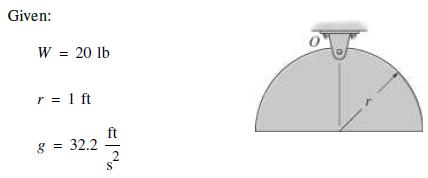
The semicircular disk has weight W. Determine the natural period of vibration if it is displaced a small amount and released. Given: W = 20 lb r = 1 ft 8 = 32.2 ft 2
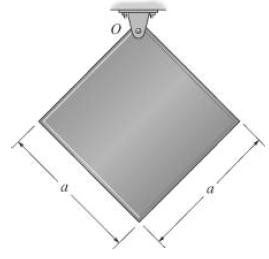
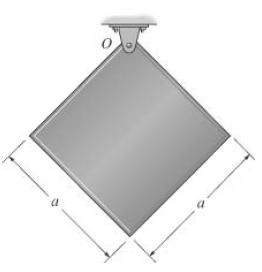
The square plate has a mass m and is suspended at its corner by the pin O. Determine the natural period of vibration if it is displaced a small amount and released.
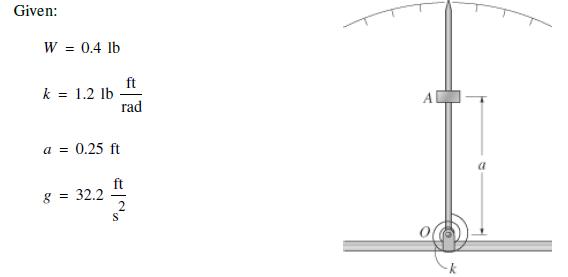
The pointer on a metronome supports slider A of weight W, which is positioned at a fixed distance a from the pivot O of the pointer. When the pointer is displaced, a torsional spring at O exerts a restoring torque on the pointer having a magnitude M = kθ where θ represents the angle of
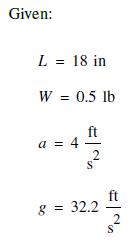
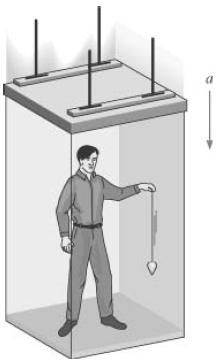
While standing in an elevator, the man holds a pendulum which consists of cord of length L and a bob of weight W. If the elevator is descending with an acceleration a, determine the natural period of vibration for small amplitudes of swing. Given: L = 18 in W = 0.5 lb a = 4 2 8 = 32.2 ft 2 S
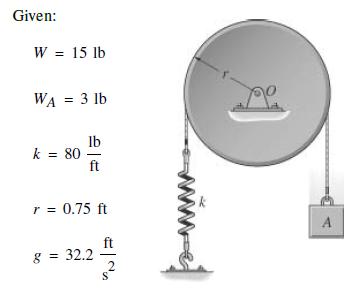
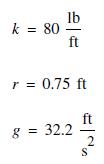
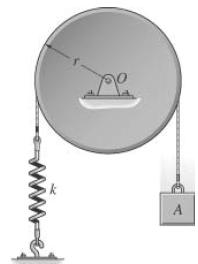
The disk, having weight W, is pinned at its center O and supports the block A that has weight WA. If the belt which passes over the disk is not allowed to slip at its contacting surface, determine the natural period of vibration of the system. Given: W = 15 lb WA = 3 lb k = 80 lb ft r = 0.75 ft 8 =
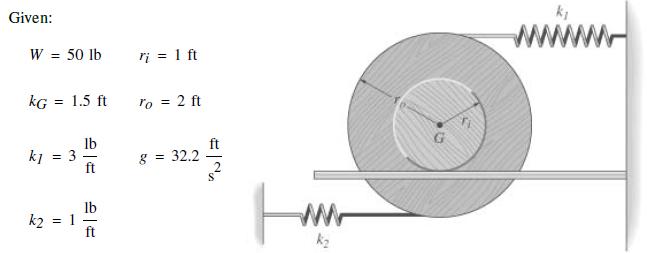
The spool of weight W is attached to two springs. If the spool is displaced a small amount and released, determine the natural period of vibration. The radius of gyration of the spool is kG. The spool rolls without slipping. Given: W = 50 lb KG = 1.5 ft kj 11 3 k2 = 1 lb ft lb ft ri = 1 ft To = 2
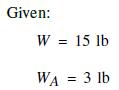
The disk, having weight W, is pinned at its center O and supports the block A that has weight WA. If the belt which passes over the disk is not allowed to slip at its contacting surface, determine the natural period of vibration of the system. Given: W = 15 lb WA = 3 lb
The semicircular disk has weight W. Determine the natural period of vibration if it is displaced a small amount and released. Solve using energy methods. Given: W = 20 lb r = 1 ft = 8-3222/22 S
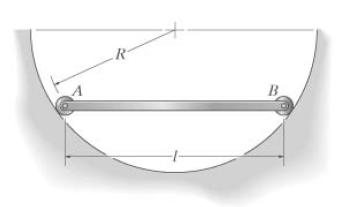
The bar has length l and mass m. It is supported at its ends by rollers of negligible mass. If it is given a small displacement and released, determine the natural frequency of vibration. R B
The square plate has a mass m and is suspended at its corner by the pin O. Determine the natural period of vibration if it is displaced a small amount and released. Solve using energy methods.
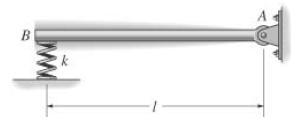
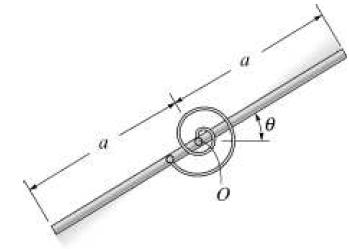
The uniform rod of mass m is supported by a pin at A and a spring at B. If the end B is given a small downward displacement and released, determine the natural period of vibration. B
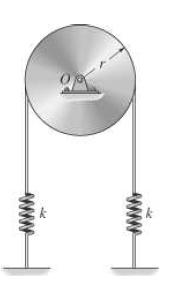
The disk of mass M is pin-connected at its midpoint. Determine the natural period of vibration of the disk if the springs have sufficient tension in them to prevent the cord from slipping on the disk as it oscillates. Assume that the initial stretch in each spring is δ0. This term will cancel out
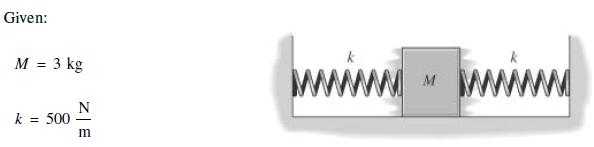
Determine the differential equation of motion of the block of mass M when it is displaced slightly and released. The surface is smooth and the springs are originally unstretched. Given: M = 3 kg k = 500 ZIE m wi…. » wi M
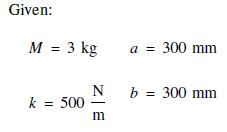
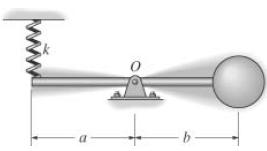
Determine the natural period of vibration of the sphere of mass M. Neglect the mass of the rod and the size of the sphere. Given: M = 3 kg k = 500 ZIE m a = 300 mm b = 300 mm
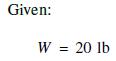
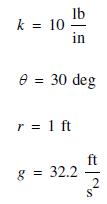
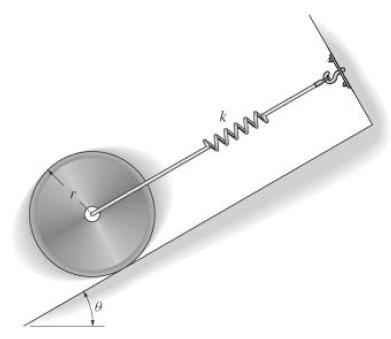
Determine the natural frequency of vibration of the disk of weight W. Assume the disk does not slip on the inclined surface. Given: W = : 20 lb
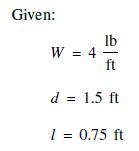
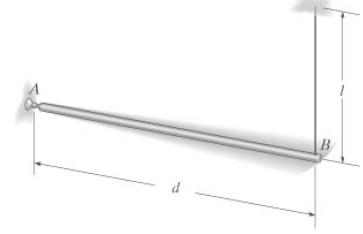
The slender rod has a weight W. If it is supported in the horizontal plane by a ball-and-socket joint at A and a cable at B, determine the natural frequency of vibration when the end B is given a small horizontal displacement and then released. Given: W = 4 lb ft d = 1.5 ft 1 = 0.75 ft
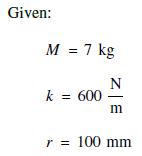
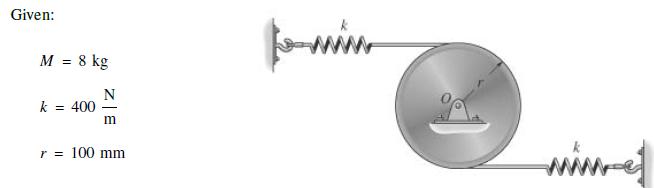
If the disk has mass M, determine the natural frequency of vibration. The springs are originally unstretched. Given: M = 8 kg N k = 400 r = 100 mm
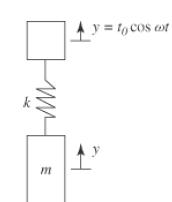
Use a block-and-spring model like that shown in Fig. 22-14a but suspended from a vertical position and subjected to a periodic support displacement of δ = δ0 cos ωt, determine the equation of motion for the system, and obtain its general solution. Define the displacement y measured from the
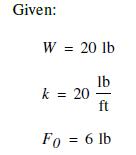
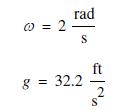
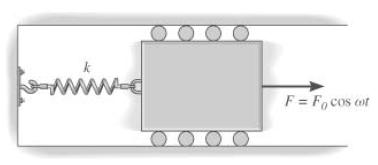
The block of weight W is attached to a spring having stiffness k. A force F = F0 cosω t is applied to the block. Determine the maximum speed of the block after frictional forces cause the free vibrations to dampen out. Given: W = 20 lb lb ft Fo= 6 lb k = 20
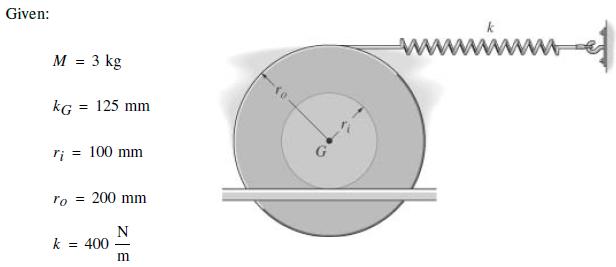
Determine the differential equation of motion of the spool of mass M. Assume that it does not slip at the surface of contact as it oscillates. The radius of gyration of the spool about its center of mass is kG. Given: M = 3 kg KG = 125 mm r¡ = 100 mm To = 200 mm k = 400 ZE m wwwwwwwwwww
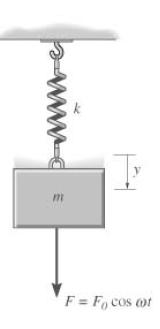
If the block is subjected to the impressed force F = F0 cos(ωt), show that the differential equation of motion is y'' + (k/m)y = (F0/m)cos(ωt), where y is measured from the equilibrium position of the block. What is the general solution of this equation? m y F = F₁ cos cot
Draw the electrical circuit that is equivalent to the mechanical system shown. What is the differential equation which describes the charge q in the circuit? wwww 4 m
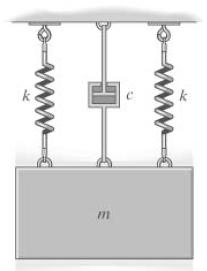
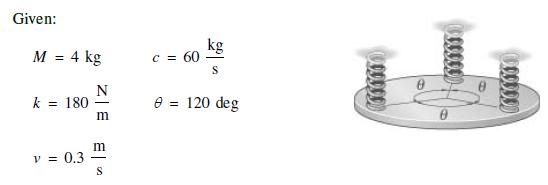
The circular disk of mass M is attached to three springs, each spring having a stiffness k. If the disk is immersed in a fluid and given a downward velocity v at the equilibrium position, determine the equation which describes the motion. Assume that positive displacement is measured downward, and
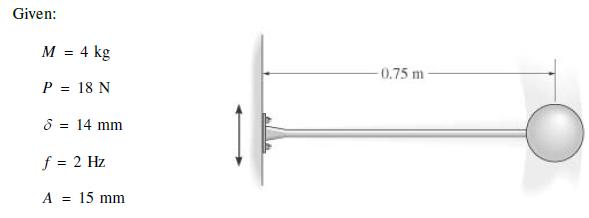
The light elastic rod supports the sphere of mass M. When a vertical force P is applied to the sphere, the rod deflects a distance d. If the wall oscillates with harmonic frequency f and has amplitude A, determine the amplitude of vibration for the sphere. Given: M = 4 kg P = 18 N 8 = 14 mm f = 2
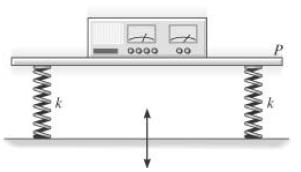
The instrument is centered uniformly on a platform P, which in turn is supported by four springs, each spring having stiffness k. If the floor is subjected to a vibration f, having a vertical displacement amplitude δ0, determine the vertical displacement amplitude of the platform and instrument.
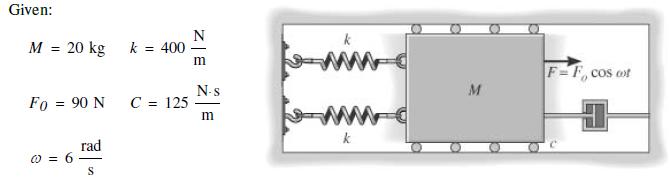
The block of mass M is subjected to the action of the harmonic force F = F0cosωt. Write the equation which describes the steady-state motion. Given: M = 20 kg Fo = 90 N @=6 rad S k = 400 C = 125 ZE m N-S m k M F=F, cos oot
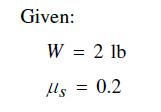
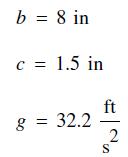
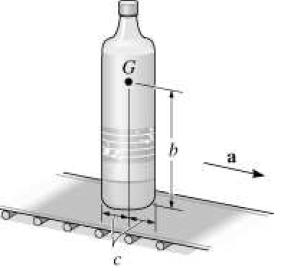
The bottle of weight W rests on the check-out conveyor at a grocery store. If the coefficient of static friction is μs, determine the largest acceleration the conveyor can have without causing the bottle to slip or tip. The center of gravity is at G. Given: W = 2 lb Hs = 0.2
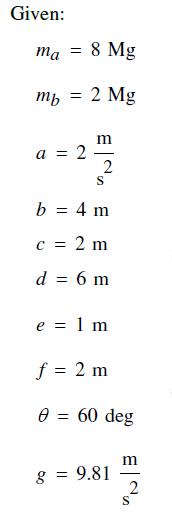
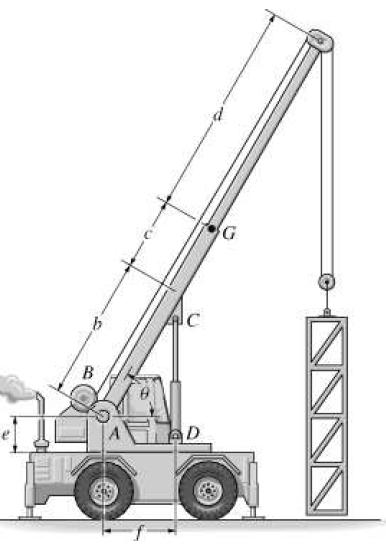
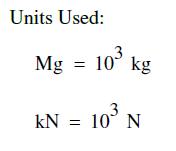
The assembly has mass ma and is hoisted using the boom and pulley system. If the winch at B draws in the cable with acceleration a, determine the compressive force in the hydraulic cylinder needed to support the boom. The boom has mass mb and mass center at G. Units Used: Mg = 10 kg kN 10 10 N
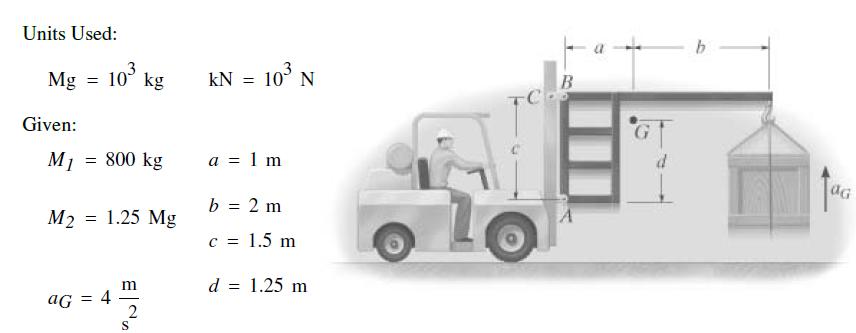
The fork lift has a boom with mass M1 and a mass center at G. If the vertical acceleration of the boom is aG, determine the horizontal and vertical reactions at the pin A and on the short link BC when the load M2 is lifted. Units Used: Mg Given: = 10³ kg M₁ = 800 kg M2 = 1.25 Mg aG = 4. m 2 S KN
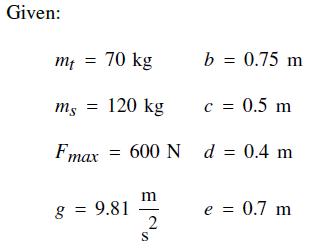
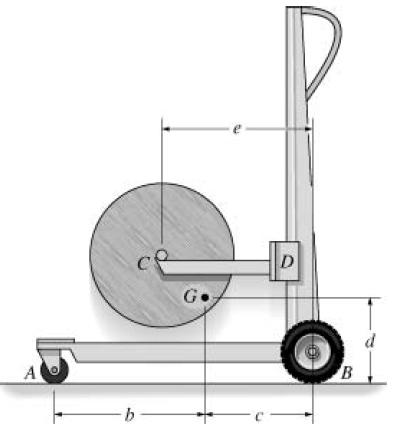
The lift truck has mass mt and mass center at G. Determine the largest upward acceleration of the spool of mass ms so that no reaction of the wheels on the ground exceeds Fmax. Given: mt = = 70 kg mg = 120 kg Fmax = 600 N d = 0.4 m 8 = 9.81 m 2 b = 0.75 m S c = 0.5 m e = 0.7 m
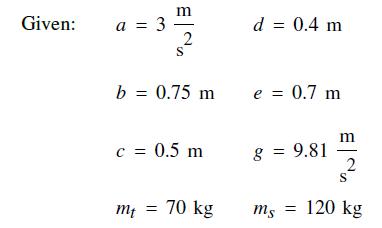
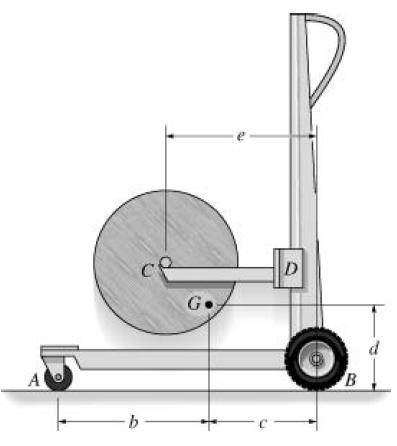
The lift truck has mass mt and mass center at G. If it lifts the spool of mass ms with acceleration a, determine the reactions of each of the four wheels on the ground. The loading is symmetric. Neglect the mass of the movable arm CD. Given: a = 3 m 2 b = 0.75 m c = 0.5 m mt = 70 kg d = 0.4 m e =
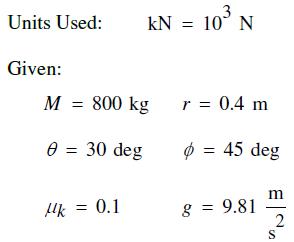
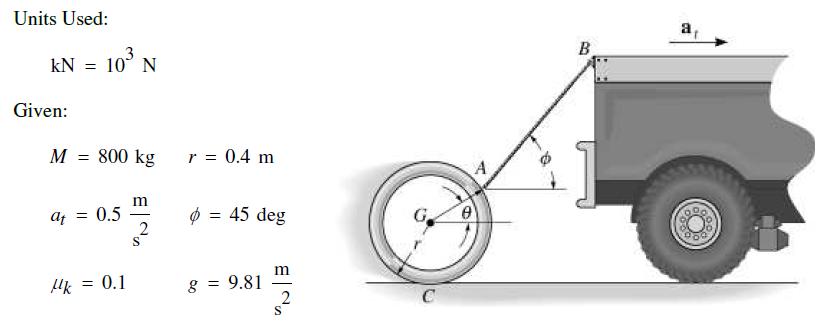
The pipe has mass M and is being towed behind a truck. Determine the acceleration of the truck and the tension in the cable. The coefficient of kinetic friction between the pipe and the ground is μk. Units Used: Given: kN = 10 N M = 800 kg 0 = 30 deg Mk = 0.1 r = 0.4 m o = 45 deg Φ 8 = 9.81 m 2 S
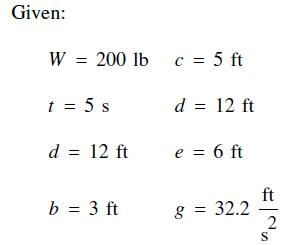
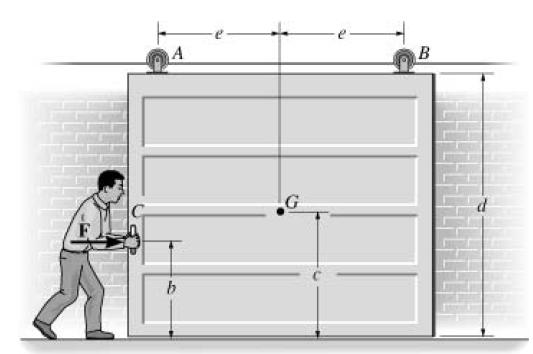
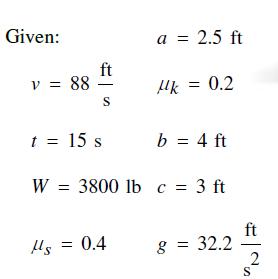
The door has weight W and center of gravity at G. Determine the constant force F that must be applied to the door to push it open a distance d to the right in time t, starting from rest. Also, find the vertical reactions at the rollers A and B. Given: W = 200 lb t = 5 s d = 12 ft b = 3 ft c = 5
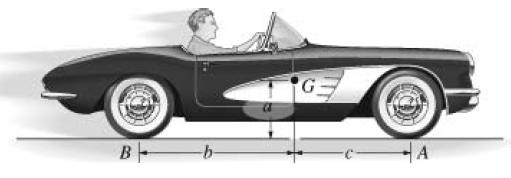
The car accelerates uniformly from rest to speed v in time t. If it has weight W and a center of gravity at G, determine the normal reaction of each wheel on the pavement during the motion. Power is developed at the front wheels, whereas the rear wheels are free to roll. Neglect the mass of the
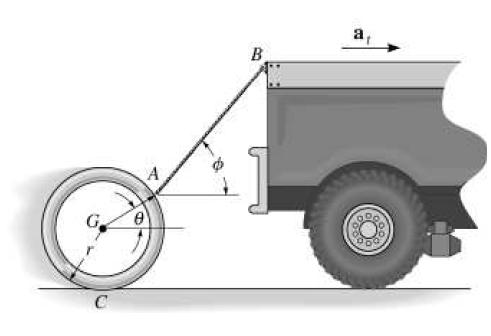
The pipe has mass M and is being towed behind the truck. If the acceleration of the truck is at, determine the angle θ and the tension in the cable. The coefficient of kinetic friction between the pipe and the ground is μk. Units Used: KN = 10 N Given: M = 800 kg at = 0.5 Mk = 0.1 m r = 0.4 m Ø
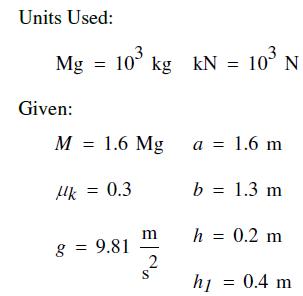
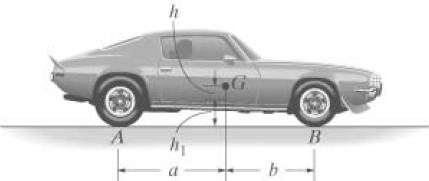
The car of mass M shown has been “raked” by increasing the height of its center of mass to h This was done by raising the springs on the rear axle. If the coefficient of kinetic friction between the rear wheels and the ground is μk, show that the car can accelerate slightly faster than its
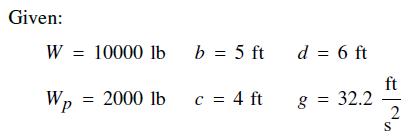
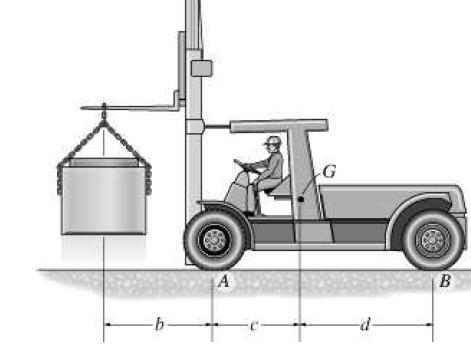
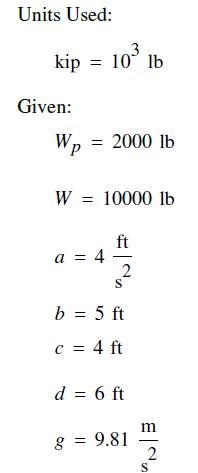
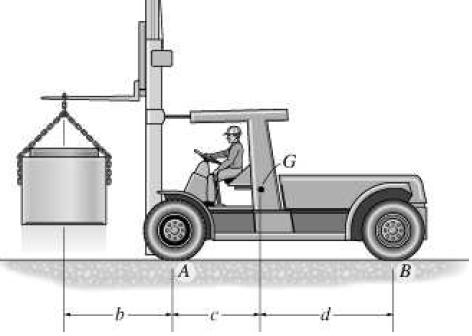
The forklift and operator have combined weight W and center of mass at G. If the forklift is used to lift the concrete pipe of weight Wp determine the maximum vertical acceleration it can give to the pipe so that it does not tip forward on its front wheels. Given: W = 10000 lb b = 5 ft Wp = 2000
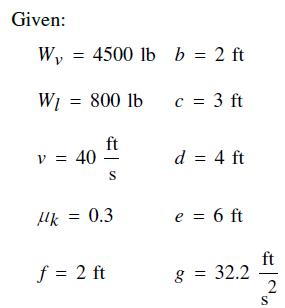
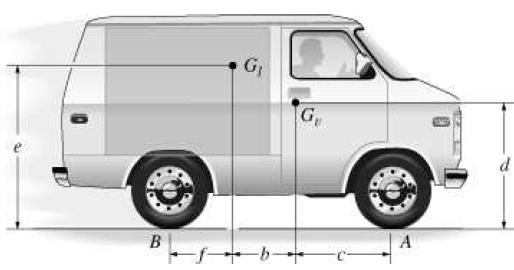
The van has weight Wv and center of gravity at Gv. It carries fixed load Wl which has center of gravity at Gl. If the van is traveling at speed v, determine the distance it skids before stopping. The brakes cause all the wheels to lock or skid. The coefficient of kinetic friction between the wheels
The forklift and operator have combined weight W and center of mass at G. If the forklift is used to lift the concrete pipe of weight Wp determine the normal reactions on each of its four wheels if the pipe is given upward acceleration a. Units Used: 3 kip = 10 lb Given: Wp = 2000 lb W 10000 lb = a
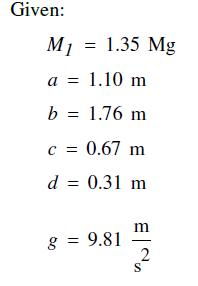
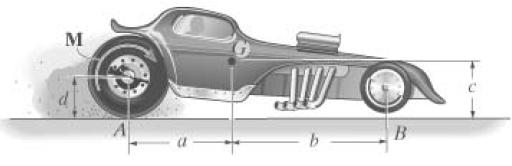
The “muscle car” is designed to do a “wheeley”, i.e., to be able to lift its front wheels off the ground in the manner shown when it accelerates. If the car of mass M1 has a center of mass at G, determine the minimum torque that must be developed at both rear wheels in order to do this.
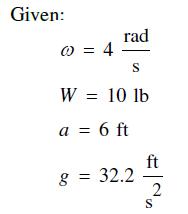
The rod of weight W is pin-connected to its support at A and has an angular velocity ω when it is in the horizontal position shown. Determine its angular acceleration and the horizontal and vertical components of reaction which the pin exerts on the rod at this instant. Given: rad @=4- S W = 10
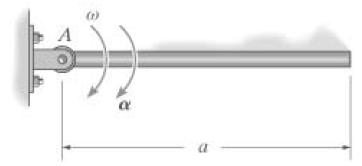
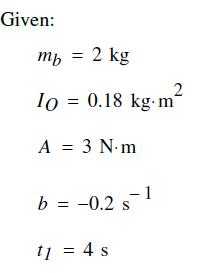
The fan blade has mass mb and a moment of inertia I0 about an axis passing through its center O. If it is subjected to moment M = A(1 − ebt) determine its angular velocity when t = t1 starting from rest. Given: m₂ = 2 kg 2 Io = 0.18 kg m A = 3 N.m b = -0.2 s t₁ = 4 s 1
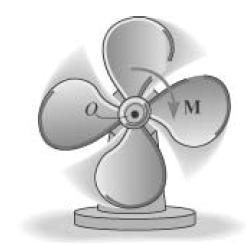
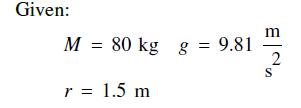
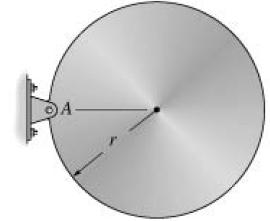
The disk of mass M is supported by a pin at A. If it is released from rest from the position shown, determine the initial horizontal and vertical components of reaction at the pin. Given: M = 80 kg g = 9.81 r = 1.5 m 2 S
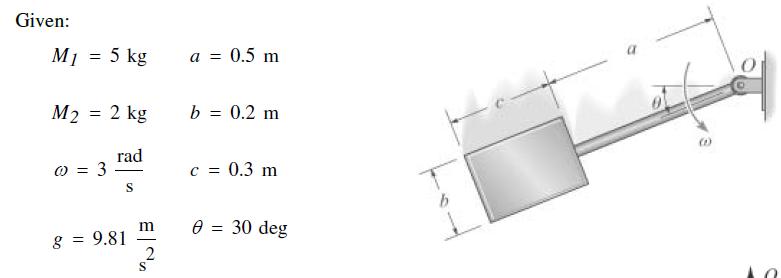
The pendulum consists of a uniform plate of mass M1 and a slender rod of mass M2. Determine the horizontal and vertical components of reaction that the pin O exerts on the rod at the instant shown at which time its angular velocity is ω. Given: M₁ = 5 kg M₂ = 2 kg M2 @=3 rad S g = 9.81 m 2 a =
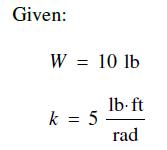
The bar of weight W is pinned at its center O and connected to a torsional spring. The spring has a stiffness k, so that the torque developed is M = kθ. If the bar is released from rest when it is vertical at θ = 90°, determine its angular velocity at the instant θ = 0°. Given: W = 10 lb k =
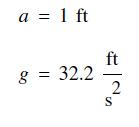
The pendulum consists of a disk of weight W1 and a slender rod of weight W2. Determine the horizontal and vertical components of reaction that the pin O exerts on the rod just as it passes the horizontal position, at which time its angular velocity is ω. Given: W₁ W2 = 15 lb = 10 lb a = 0.75 ft
Showing 300 - 400
of 2550
1
2
3
4
5
6
7
8
9
10
11
12
13
14
15
Last
Step by Step Answers

 Get 50% OFF
Claim Now
Get 50% OFF
Claim Now