New Semester
Started
Get
50% OFF
Study Help!
--h --m --s
Claim Now
Question Answers
Textbooks
Find textbooks, questions and answers
Oops, something went wrong!
Change your search query and then try again
S
Books
FREE
Study Help
Expert Questions
Accounting
General Management
Mathematics
Finance
Organizational Behaviour
Law
Physics
Operating System
Management Leadership
Sociology
Programming
Marketing
Database
Computer Network
Economics
Textbooks Solutions
Accounting
Managerial Accounting
Management Leadership
Cost Accounting
Statistics
Business Law
Corporate Finance
Finance
Economics
Auditing
Tutors
Online Tutors
Find a Tutor
Hire a Tutor
Become a Tutor
AI Tutor
AI Study Planner
NEW
Sell Books
Search
Search
Sign In
Register
study help
engineering
mechanical vibration analysis
Mechanical Vibrations 6th Edition Singiresu S Rao - Solutions
Prove that the constant \(a\) in Eqs. (8.18) and (8.19) is negative for common boundary conditions.Equation 8.18 and 8.19:- dw dx2 - W = 0 (8.18)
Find the free-vibration solution of a cord fixed at both ends when its initial conditions are given by\[w(x, 0)=0, \quad \frac{\partial w}{\partial t}(x, 0)=\frac{2 a x}{l} \quad \text { for } \quad 0 \leq x \leq \frac{l}{2}\]and\[\frac{\partial w}{\partial t}(x, 0)=2 a\left(1-\frac{x}{l}\right)
What is the main difference in the nature of the frequency equations of a discrete system and a continuous system?
Fill in the Blank.When a beam is subjected to an axial force (tension), it ____________ the natural frequency.
Pinned enda. Bending moment \(=0\); shear force equals theb. Deflection \(=0\); slope \(=0\)c. Deflection \(=0\); bending moment \(=0\)d. Bending moment \(=0\); shear force \(=0\)
True or False.For a discrete system, the boundary conditions are to be applied explicitly.
What is the effect of a tensile force on the natural frequencies of a beam?
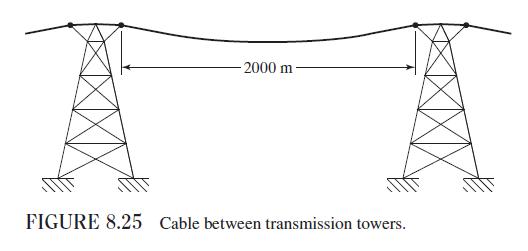
The cable between two electric transmission towers has a length of \(2000 \mathrm{~m}\). It is clamped at its ends under a tension \(P\) (Fig. 8.25). The density of the cable material is \(8890 \mathrm{~kg} / \mathrm{m}^{3}\). If the first four natural frequencies are required to lie between \(0
Fill in the Blank.The Timoshenko beam theory can be considered as __________ beam theory.
Fixed end spring forcea. Bending moment \(=0\); shear force equals theb. Deflection \(=0\); slope \(=0\)c. Deflection \(=0\); bending moment \(=0\)d. Bending moment \(=0\); shear force \(=0\)
True or False.The Euler-Bernoulli beam theory is more accurate than the Timoshenko theory.
Under what circumstances does the frequency of vibration of a beam subjected to an axial load become zero?
Fill in the Blank.A drumhead can be considered as \(\mathrm{a}(\mathrm{n})\) ____________ .
Elastically restrained enda. Bending moment \(=0\); shear force equals theb. Deflection \(=0\); slope \(=0\)c. Deflection \(=0\); bending moment \(=0\)d. Bending moment \(=0\); shear force \(=0\)
If a string of length \(l\), fixed at both ends, is given an initial transverse displacement of \(h\) at \(x=l / 3\) and then released, determine its subsequent motion. Compare the deflection shapes of the string at times \(t=0, l /(4 c), l /(3 c), l /(2 c)\), and \(l / c\) by considering the first
Why does the natural frequency of a beam become lower if the effects of shear deformation and rotary inertia are considered?
Fill in the Blank.A string has the same relationship to a beam as a membrane bears to a(n) ____________.
A cord of length \(l\) is made to vibrate in a viscous medium. Derive the equation of motion considering the viscous damping force.
a. Zero bending momentb. Zero transverse displacementc. Zero shear forced. Zero slope\(W=0\)
Give two practical examples of the vibration of membranes.
Fill in the Blank.Rayleigh's method can be used to estimate the system _____________ natural frequency of a continuous system.
a. Zero bending momentb. Zero transverse displacementc. Zero shear forced. Zero slope\(W^{\prime}=0\)
Determine the free-vibration solution of a string fixed at both ends under the initial conditions \(w(x, 0)=w_{0} \sin (\pi x / l)\) and \((\partial w / \partial t)(x, 0)=0\).
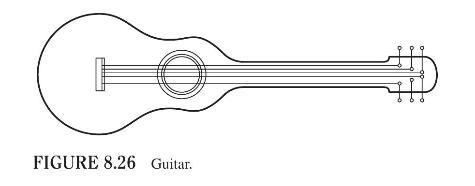
The strings of a guitar (Fig. 8.26) are made of music wire with diameter \(0.05 \mathrm{~mm}\), weight density \(76.5 \mathrm{kN} / \mathrm{m}^{3}\), and Young's modulus \(207 \mathrm{GPa}\). If the lengths of two of the strings are given by \(0.60 \mathrm{~m}\) and \(0.65 \mathrm{~m}\), determine
What is the basic principle used in Rayleigh's method?
Fill in the Blank.\(E I \frac{\partial^{2} w}{\partial x^{2}}\) denotes the _____________ in a beam.
a. Zero bending momentb. Zero transverse displacementc. Zero shear forced. Zero slope\(W^{\prime \prime}=0\)
Why is the natural frequency given by Rayleigh's method always larger than the true value of \(\omega_{1}\) ?
Fill in the Blank.For a discrete system, the governing equations are _____________differential equations.
a. Zero bending momentb. Zero transverse displacementc. Zero shear forced. Zero slope\(W^{\prime \prime \prime}=0\)
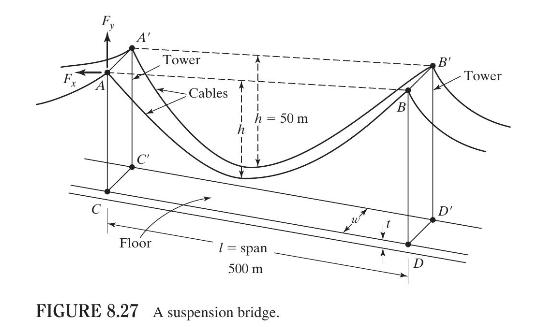
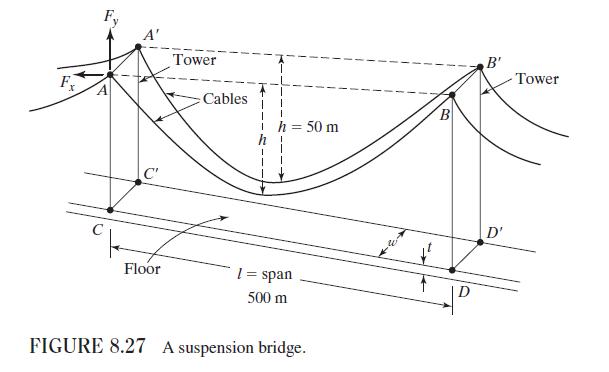
The vertical and horizontal forces (reactions) at joints \(A\) and \(B\) of a typical cable of the suspension bridge shown in Fig. 8.27 are given by \(F_{x}=2.8 \times 10^{6} \mathrm{~N}\) and \(F_{y}=1.1 \times 10^{6} \mathrm{~N}\). The cables are made of steel with a weight density of \(76.5
What is the difference between Rayleigh's method and the Rayleigh-Ritz method?
Fill in the Blank.An axial tensile load increases the bending ___________ of a beam.
a. Longitudinal vibration of a barb. Torsional vibration of a shaftc. Transverse vibration of a string\(c=\left(\frac{P}{ho}\right)^{1 / 2}\)Data:-\(c^{2} \frac{\partial^{2} w}{\partial x^{2}}=\frac{\partial^{2} w}{\partial t^{2}}\) :
Derive an equation for the principal modes of longitudinal vibration of a uniform bar having both ends free.
Fill in the Blank.The ____________ energy of a beam is denoted by \(\frac{1}{2} \int_{0}^{l} ho A\left(\frac{\partial w}{\partial t}\right)^{2} d x\).
a. Longitudinal vibration of a barb. Torsional vibration of a shaftc. Transverse vibration of a string\(c=\left(\frac{E}{ho}\right)^{1 / 2}\)Data:-\(c^{2} \frac{\partial^{2} w}{\partial x^{2}}=\frac{\partial^{2} w}{\partial t^{2}}\) :
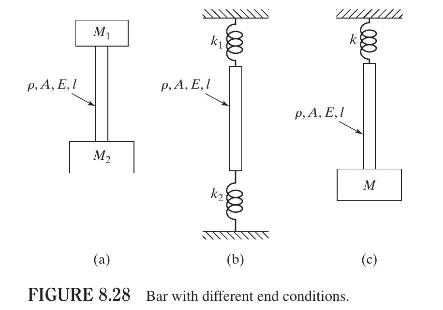
Derive the frequency equation for the longitudinal vibration of the systems shown in Fig. 8.28. M p. A, E.1 p.A. E,I M k p. A. E,I ell M k (a) (b) FIGURE 8.28 Bar with different end conditions. (c)
Fill in the Blank.The ____________ energy of a beam is denoted by \(\frac{1}{2} \int_{0}^{l} E I\left(\frac{\partial^{2} w}{\partial x^{2}}\right)^{2} d x\).
a. Longitudinal vibration of a barb. Torsional vibration of a shaftc. Transverse vibration of a string\(c=\left(\frac{G}{ho}\right)^{1 / 2}\)Data:-\(c^{2} \frac{\partial^{2} w}{\partial x^{2}}=\frac{\partial^{2} w}{\partial t^{2}}\) :
A thin bar of length \(l\) and mass \(m\) is clamped at one end and free at the other. What mass \(M\) must be attached to the free end in order to decrease the fundamental frequency of longitudinal vibration by \(50 \%\) from its fixed-free value?
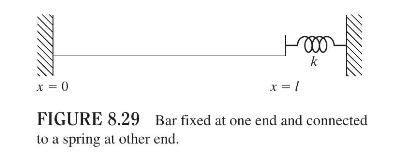
Show that the normal functions corresponding to the longitudinal vibration of the bar shown in Fig. 8.29 are orthogonal. x=0 1000 k x=/ FIGURE 8.29 Bar fixed at one end and connected to a spring at other end.
Derive the frequency equation for the longitudinal vibration of a stepped bar having two different cross-sectional areas \(A_{1}\) and \(A_{2}\) over lengths \(l_{1}\) and \(l_{2}\), respectively. Assume fixed-free end conditions.
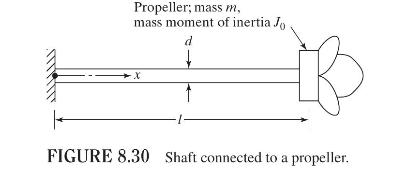
A steel shaft of diameter \(d\) and length \(l\) is fixed at one end and carries a propeller of mass \(m\) and mass moment of inertia \(J_{0}\) at the other end (Fig. 8.30). Determine the fundamental natural frequency of vibration of the shaft in (a) axial vibration, and (b) torsional vibration.
A torsional system consists of a shaft with a disc of mass moment of inertia \(I_{0}\) mounted at its center. If both ends of the shaft are fixed, find the response of the system in free torsional vibration of the shaft. Assume that the disc is given a zero initial angular displacement and an
Find the natural frequencies for torsional vibration of a fixed-fixed shaft.
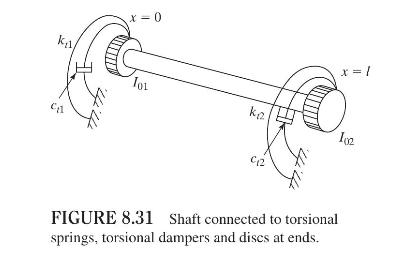
A uniform shaft of length \(l\) and torsional stiffness \(G J\) is connected at both ends by torsional springs, torsional dampers, and discs with inertias, as shown in Fig. 8.31. State the boundary conditions. x=0 x=1 101 ka 102 FIGURE 8.31 Shaft connected to torsional springs, torsional dampers
Solve Problem 8.23 if one end of the shaft is fixed and the other free.Data From Problem 8.23:-Find the natural frequencies for torsional vibration of a fixed-fixed shaft.
Derive the frequency equation for the torsional vibration of a uniform shaft carrying rotors of mass moment of inertia \(I_{01}\) and \(I_{02}\) one at each end.
An external torque \(M_{t}(t)=M_{t 0} \cos \omega t\) is applied at the free end of a fixed-free uniform shaft. Find the steady-state vibration of the shaft.
Find the fundamental frequency for torsional vibration of a shaft of length \(2 \mathrm{~m}\) and diameter \(50 \mathrm{~mm}\) when both the ends are fixed. The density of the material is \(7800 \mathrm{~kg} / \mathrm{m}^{3}\) and the modulus of rigidity is \(0.8 \times 10^{11} \mathrm{~N} /
A uniform shaft, supported at \(x=0\) and rotating at an angular velocity \(\omega\), is suddenly stopped at the end \(x=0\). If the end \(x=l\) is free, determine the subsequent angular displacement response of the shaft.
Compute the first three natural frequencies and the corresponding mode shapes of the transverse vibrations of a uniform beam of rectangular cross section \((100 \mathrm{~mm} \times 300 \mathrm{~mm})\) with \(l=2 \mathrm{~m}, E=20.5 \times 10^{10} \mathrm{~N} / \mathrm{m}^{2}\), and \(ho=7.83 \times
Derive an expression for the natural frequencies for the lateral vibration of a uniform fixedfree beam.
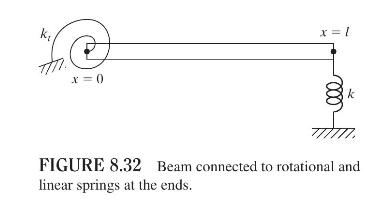
Prove that the normal functions of a uniform beam, whose ends are connected by springs as shown in Fig. 8.32, are orthogonal. x=0 FIGURE 8.32 x=1 k Beam connected to rotational and linear springs at the ends.
Derive an expression for the natural frequencies for the transverse vibration of a uniform beam with both ends simply supported.
Derive the expression for the natural frequencies for the lateral vibration of a uniform beam suspended as a pendulum, neglecting the effect of dead weight.
Find the cross-sectional area \((A)\) and the area moment of inertia (I) of a simply supported steel beam of length \(1 \mathrm{~m}\) for which the first three natural frequencies lie in the range \(1500-5000 \mathrm{~Hz}\).
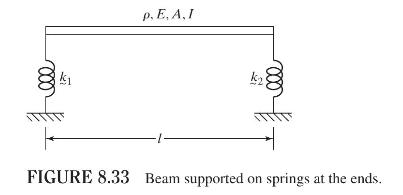
Derive the frequency equation for the transverse vibration of a uniform beam resting on springs at both ends, as shown in Fig. 8.33. The springs can deflect vertically only, and the beam is horizontal in the equilibrium position. 000 k p. E, A,I k2 FIGURE 8.33 Beam supported on springs at the ends.
A uniform beam, simply supported at both ends, is found to vibrate in its first mode with an amplitude of \(10 \mathrm{~mm}\) at its center. If \(A=120 \mathrm{~mm}^{2}, I=1000 \mathrm{~mm}^{4}, E=20.5 \times 10^{10} \mathrm{~N} / \mathrm{m}^{2}\), \(ho=7.83 \times 10^{3} \mathrm{~kg} /
A simply supported uniform beam of length \(l\) carries a mass \(M\) at the center of the beam. Assuming \(M\) to be a point mass, obtain the frequency equation of the system.
A uniform fixed-fixed beam of length \(2 l\) is simply supported at the middle point. Derive the frequency equation for the transverse vibration of the beam.
A simply supported beam carries initially a uniformly distributed load of intensity \(f_{0}\). Find the vibration response of the beam if the load is suddenly removed.
Estimate the fundamental frequency of a cantilever beam whose cross-sectional area and moment of inertia vary as\[A(x)=A_{0} \frac{x}{l} \quad \text { and } \quad I(x)=\bar{I} \frac{x}{l}\]where \(x\) is measured from the free end.
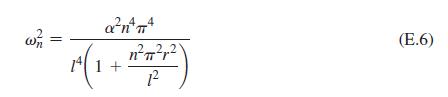
Derive Eqs. (E.5) and (E.6) of Example 8.10.Data From Example 8.10:-Equation E.5 and E.6:- Determine the effects of rotary inertia and shear deformation on the natural frequencies of a simply supported uniform beam.
(a) Derive a general expression for the response of a uniform beam subjected to an arbitrary force.(b) Use the result of part (a) to find the response of a uniform simply supported beam under the harmonic force \(F_{0} \sin \omega t\) applied at \(x=a\). Assume the initial conditions as \(w(x,
Derive Eqs. (E.7) and (E.8) of Example 8.10.Data From Example 8.10:-Equation E.7 and E.8:- Determine the effects of rotary inertia and shear deformation on the natural frequencies of a simply supported uniform beam.
Prove that the constant \(a\) in Eq. (8.82) is positive for common boundary conditions. c dW(x) W(x) dx4 = 1 dT(t) T(t) dt = a = w (8.82)
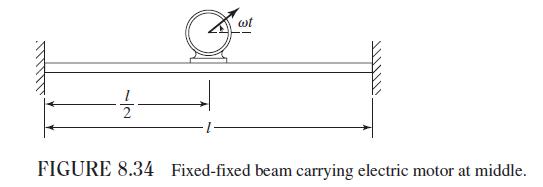
A fixed-fixed beam carries an electric motor of mass \(100 \mathrm{~kg}\) and operational speed \(3000 \mathrm{rpm}\) at its midspan, as shown in Fig. 8.34. If the motor has a rotational unbalance of \(0.5 \mathrm{~kg}-\mathrm{m}\), determine the steady-state response of the beam. Assume the length
Find the response of a simply supported beam subject to a uniformly distributed harmonically varying load.
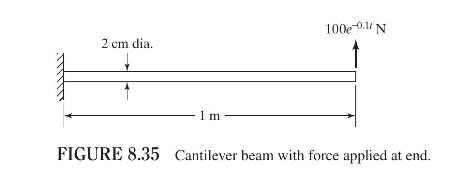
A steel cantilever beam of diameter \(2 \mathrm{~cm}\) and length \(1 \mathrm{~m}\) is subjected to an exponentially decaying force \(100 e^{-0.1 t} \mathrm{~N}\) at the free end, as shown in Fig. 8.35. Determine the steady-state response of the beam. Assume the density and Young's modulus of steel
Find the steady-state response of a cantilever beam that is subjected to a suddenly applied step bending moment of magnitude \(M_{0}\) at its free end.
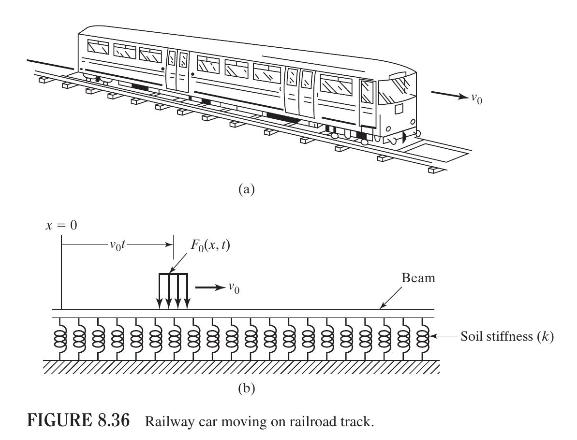
Consider a railway car moving on a railroad track as shown in Fig. 8.36(a). The track can be modeled as an infinite beam resting on an elastic foundation and the car can be idealized as a moving load \(F_{0}(x, t)\) (see Fig. 8.36(b)). If the soil stiffness per unit length is \(k\), and the
A cantilever beam of length \(l\), density \(ho\), Young's modulus \(E\), area of cross section \(A\), and area moment of inertia \(I\) carries a concentrated mass \(M\) at its free end. Derive the frequency equation for the transverse vibration of the beam.
Find the first two natural frequencies of vibration in the vertical direction of the floor of the suspension bridge shown in Fig. 8.27 under the following assumptions:1. The floor can be considered as a uniform beam with simple supports at both ends \(C\) and \(D\).2. The floor has a width \((w) 12
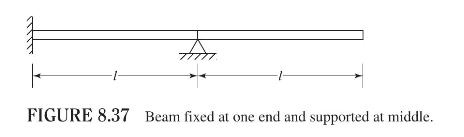
A uniform beam of length \(2 l\) is fixed at the left end, supported on a simple support at the middle, and free at the right end as shown in Fig. 8.37. Derive the frequency equation for determining the natural frequencies of vibration of the continuous beam. FIGURE 8.37 Beam fixed at one end and
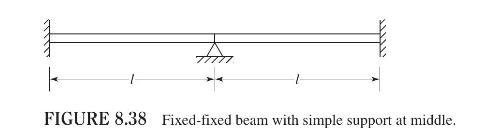
A uniform fixed-fixed beam of length \(2 l\) is supported on a pin joint at the midpoint as shown in Fig. 8.38. Derive the frequency equation for determining the natural frequencies of vibration of the continuous beam. FIGURE 8.38 Fixed-fixed beam with simple support at middle.
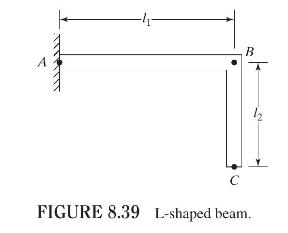
The L-shaped frame shown in Fig. 8.39 is fixed at the end \(A\) and free at end \(C\). The two segments of the frame, \(A B\) and \(B C\), are made of the same material with identical square cross sections. Indicate a procedure for finding the natural frequencies of in-plane vibration of the frame
Consider a simply supported uniform beam resting on an elastic foundation, with a foundation modulus \(k \mathrm{~N} / \mathrm{m}\).a. Derive the equation of motion of the beam when the applied distributed load is \(p\) per unit length.b. Find the natural frequencies of vibration of the beam.
Consider a fixed-fixed uniform beam resting on an elastic foundation, with a foundation modulus \(k \mathrm{~N} / \mathrm{m}\).a. Derive the equation of motion of the beam when the applied distributed load is \(p\) per unit length.b. Find the natural frequencies of vibration of the beam.
Consider a simply supported uniform beam of length \(l\) subjected to a concentrated transverse harmonic force \(F(t)=F_{0} \sin \omega t\) at \(x=x_{0}\) from the left end of the beam. Determine the steady state response of the beam. Assume the foundation modulus as \(k \mathrm{~N} / \mathrm{m}\).
Starting from fundamentals, show that the equation for the lateral vibration of a circular membrane is given by\[\frac{\partial^{2} w}{\partial r^{2}}+\frac{1}{r} \frac{\partial w}{\partial r}+\frac{1}{r^{2}} \frac{\partial^{2} w}{\partial \theta^{2}}=\frac{ho}{P} \frac{\partial^{2} w}{\partial
Consider a rectangular membrane of sides \(a\) and \(b\) supported along all the edges.(a) Derive an expression for the deflection \(w(x, y, t)\) under an arbitrary pressure \(f(x, y, t)\).(b) Find the response when a uniformly distributed pressure \(f_{0}\) is applied to a membrane that is
Find the free-vibration solution and the natural frequencies of a rectangular membrane that is clamped along all the sides. The membrane has dimensions \(a\) and \(b\) along the \(x\) and \(y\) directions, respectively.
Find the free-vibration response of a rectangular membrane of sides \(a\) and \(b\) subject to the following initial conditions:\[\begin{aligned}& w(x, y, 0)=w_{0} \sin \frac{\pi x}{a} \sin \frac{\pi y}{b}, \quad 0 \leq x \leq a, \quad 0 \leq y \leq b \\& \frac{\partial w}{\partial t}(x, y, 0)=0,
Find the free-vibration response of a rectangular membrane of sides \(a\) and \(b\) subjected to the following initial conditions:\[\left.\begin{array}{c}w(x, y, 0)=0 \\\frac{\partial w}{\partial t}(x, y, 0)=\dot{w}_{0} \sin \frac{\pi x}{a} \sin \frac{2 \pi y}{b}\end{array}\right\},
Compare the fundamental natural frequencies of transverse vibration of membranes of the following shapes:(a) square;(b) circular; and(c) rectangular with sides in the ratio of 2:1. Assume that all the membranes are clamped around their edges and have the same area, material, and tension.
Using the equation of motion given in Problem 8.59, find the natural frequencies of a circular membrane of radius \(R\) clamped around the boundary at \(r=R\).Data From Problem 8.59:-Starting from fundamentals, show that the equation for the lateral vibration of a circular membrane is given by
Find the fundamental natural frequency of a fixed-fixed beam using the static deflection curve\[W(x)=\frac{c_{0} x^{2}}{24 E I}(l-x)^{2}\]where \(c_{0}\) is a constant.
Solve Problem 8.66 using the deflection shape \(W(x)=c_{0}\left(1-\cos \frac{2 \pi x}{l}\right)\), where \(c_{0}\) is a constant.Data From Problem 8.66:-Find the fundamental natural frequency of a fixed-fixed beam using the static deflection curve \[W(x)=\frac{c_{0} x^{2}}{24 E I}(l-x)^{2}\]where
Find the fundamental natural frequency of vibration of a uniform beam of length \(l\) that is fixed at one end and simply supported at the other end. Assume the deflection shape of the beam to be same as the static deflection curve under its self weight.\[E I \frac{d^{4} W(x)}{d x^{4}}=ho g
Determine the fundamental frequency of a uniform fixed-fixed beam carrying a mass \(M\) at the middle by applying Rayleigh's method. Use the static deflection curve for \(W(x)\).
Applying Rayleigh's method, determine the fundamental frequency of a cantilever beam (fixed at \(x=l\) ) whose cross-sectional area \(A(x)\) and moment of inertia \(I(x)\) vary as \(A(x)=A_{0} x / l\) and \(I(x)=I_{0} x / l\).
Using Rayleigh's method, estimate the fundamental frequency for the lateral vibration of a uniform beam fixed at both the ends. Assume the deflection curve to be\[W(x)=c_{1}\left(1-\cos \frac{2 \pi x}{l}\right)\]
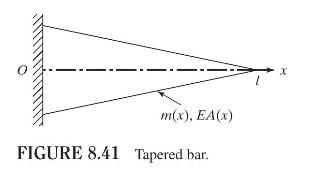
Find the fundamental frequency of longitudinal vibration of the tapered bar shown in Fig. 8.41, using Rayleigh's method with the mode shape\[U(x)=c_{1} \sin \frac{\pi x}{2 l}\]The mass per unit length is given by\[m(x)=2 m_{0}\left(1-\frac{x}{l}\right)\]and the stiffness by\[E A(x)=2 E
Approximate the fundamental frequency of a rectangular membrane supported along all the edges by using Rayleigh's method with\[W(x, y)=c_{1} x y(x-a)(y-b)\]\[V=\frac{P}{2} \iint\left[\left(\frac{\partial w}{\partial x}\right)^{2}+\left(\frac{\partial w}{\partial y}\right)^{2}\right] d x d y \quad
The root mean square value of a signal \(x(t), x_{\mathrm{rms}}\), is defined as\[x_{\mathrm{rms}}=\left\{\lim _{T \rightarrow \infty} \frac{1}{T} \int_{0}^{T} x^{2}(t) d t\right\}^{1 / 2}\]Using this definition, find the root mean square values of the displacement
What are the various methods available for vibration control?
Fill in the Blank.The presence of unbalanced mass in a rotating disc causes ____________ .
An electronic instrument, of mass \(20 \mathrm{~kg}\), is to be isolated to achieve a natural frequency of \(15 \mathrm{rad} / \mathrm{s}\) and a damping ratio of 0.95. The available dashpots can produce a damping constant(c) in the range \(10 \mathrm{~N}-\mathrm{s} / \mathrm{m}\) to \(80
Showing 1000 - 1100
of 2655
First
4
5
6
7
8
9
10
11
12
13
14
15
16
17
18
Last
Step by Step Answers

 Get 50% OFF
Claim Now
Get 50% OFF
Claim Now