New Semester
Started
Get
50% OFF
Study Help!
--h --m --s
Claim Now
Question Answers
Textbooks
Find textbooks, questions and answers
Oops, something went wrong!
Change your search query and then try again
S
Books
FREE
Study Help
Expert Questions
Accounting
General Management
Mathematics
Finance
Organizational Behaviour
Law
Physics
Operating System
Management Leadership
Sociology
Programming
Marketing
Database
Computer Network
Economics
Textbooks Solutions
Accounting
Managerial Accounting
Management Leadership
Cost Accounting
Statistics
Business Law
Corporate Finance
Finance
Economics
Auditing
Tutors
Online Tutors
Find a Tutor
Hire a Tutor
Become a Tutor
AI Tutor
AI Study Planner
NEW
Sell Books
Search
Search
Sign In
Register
study help
engineering
mechanical vibration analysis
Mechanical Vibrations 6th Edition Singiresu S Rao - Solutions
Fill in the Blank.Rayleigh's quotient has a stationary value in the neighborhood of a(n) ___________.
True or False.The matrix iteration method requires the natural frequencies to be distinct and well separated.
True or False.The matrix iteration method will never fail to converge to higher frequencies.
Fill in the Blank.Holzer's method is basically a(n) ___________ method.
Using the matrix iteration method, how do you find the intermediate natural frequencies?
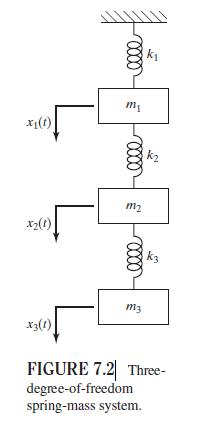
Using Rayleigh's method, determine the first natural frequency of vibration of the system shown in Fig. 7.2. Assume \(k_{1}=k, k_{2}=2 k, k_{3}=3 k\), and \(m_{1}=m, m_{2}=2 m, m_{3}=3 m\). 0000 x(1) mi x2(1) m2 0000 m3 X3(1) k FIGURE 7.2 Three- degree-of-freedom spring-mass system.
Matrix iteration methoda. Finds the natural frequencies and mode shapes of the system, one at a time, using several trial values for each frequency.b. Finds all the natural frequencies using trial vectors and matrix deflation procedure.c. Finds all the eigenvalues and eigenvectors simultaneously
What is the difference between the matrix iteration method and Jacobi's method?
Jacobi's methoda. Finds the natural frequencies and mode shapes of the system, one at a time, using several trial values for each frequency.b. Finds all the natural frequencies using trial vectors and matrix deflation procedure.c. Finds all the eigenvalues and eigenvectors simultaneously without
True or False.When Rayleigh's method is used for a shaft carrying several rotors, the static deflection curve can be used as the appropriate mode shape.
True or False.Rayleigh's method can be considered to be same as the conservation of energy for a vibrating system.
Fill in the Blank.___________ method is more extensively applied to torsional systems, although the method is equally applicable to linear systems.
What is a rotation matrix? What is its purpose in Jacobi's method?
Fill in the Blank.The computation of higher natural frequencies, based on the matrix iteration method, involves a process known as matrix ___________ .
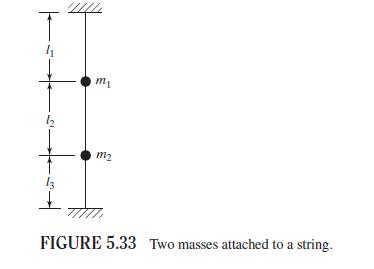
Using Rayleigh's method, solve Problem 7.6.Data From Problem 7.6:-Using Dunkerley's formula, determine the fundamental natural frequency of the stretched string system shown in Fig. 5.33 with \(m_{1}=m_{2}=m\) and \(l_{1}=l_{2}=l_{3}=l\). T m m2 FIGURE 5.33 Two masses attached to a string.
Using Rayleigh's method, determine the fundamental natural frequency of the system shown in Fig. 5.33 when \(m_{1}=m, m_{2}=5 m, l_{1}=l_{2}=l_{3}=l\). T m 12 m2 FIGURE 5.33 Two masses attached to a string.
What is the role of Choleski decomposition in deriving a standard eigenvalue problem?
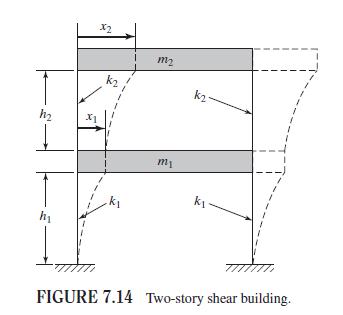
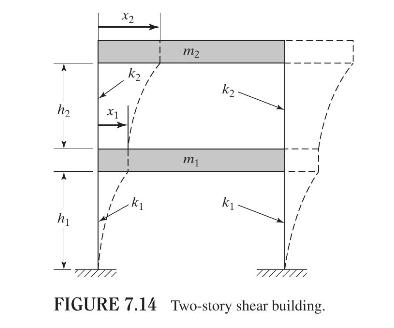
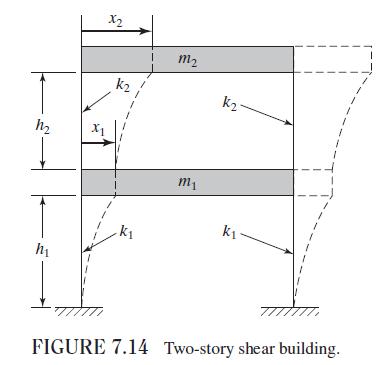
A two-story shear building is shown in Fig. 7.14 in which the floors are assumed to be rigid. Using Rayleigh's method, compute the first natural frequency of the building for \(m_{1}=2 m, m_{2}=m, h_{1}=h_{2}=h\), and \(k_{1}=k_{2}=3 E I / h^{3}\). Assume the first mode configuration to be the same
How do you find the inverse of an upper triangular matrix?
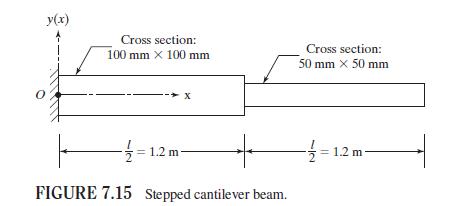
Figure 7.15 shows a steel stepped cantilever beam. The steps have square cross sections of size \(100 \mathrm{~mm} \times 100 \mathrm{~mm}\) and \(50 \mathrm{~mm} \times 50 \mathrm{~mm}\) each with a length of \(1.2 \mathrm{~m}\). Assuming the Young's modulus as E \(=200 \mathrm{GPa}\) and the
Prove that Rayleigh's quotient is never higher than the highest eigenvalue.
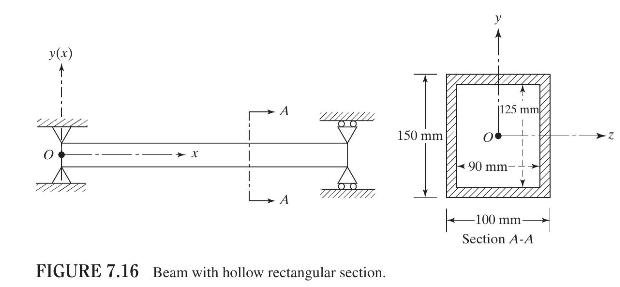
A uniform simply supported beam of length \(2.5 \mathrm{~m}\) with a hollow rectangular section is shown in Fig. 7.16. Assuming a deflection shape of\[y(x)=C \sin \frac{\pi x}{l}\]find the natural frequency of transverse vibration of the beam. The material of the beam has a Young's modulus of
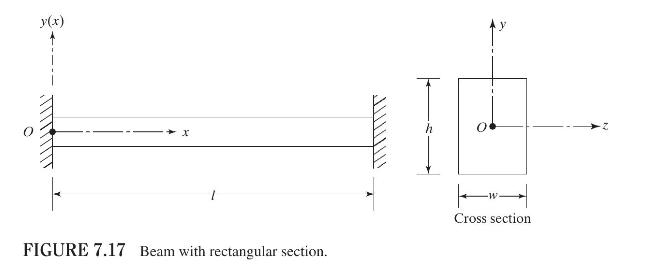
A uniform fixed-fixed beam of length \(l\) with a rectangular cross section \(w \times h\) is shown in Fig. 7.17. Assuming the Young's modulus as \(E\) and unit weight as \(\gamma\) for the material of the beam and the deflection shape as\[y(x)=C\left(1-\cos \frac{2 \pi x}{l}\right)\]Determine the
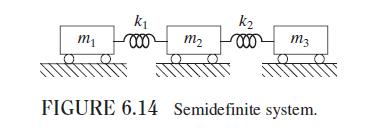
Using Holzer's method, find the natural frequencies and mode shapes of the system shown in Fig. 6.14, with \(m_{1}=100 \mathrm{~kg}, m_{2}=20 \mathrm{~kg}, m_{3}=200 \mathrm{~kg}, k_{1}=8000 \mathrm{~N} / \mathrm{m}\), and \(k_{2}=4000 \mathrm{~N} / \mathrm{m}\).Figure 6.14:- k k m 000 m2 000 m3
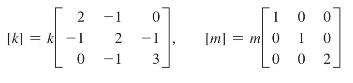
The stiffness and mass matrices of a vibrating system are given byUsing Holzer's method, determine all the principal modes and the natural frequencies. 2 -1 0 []=-1 2 -1 0 -1 3 0 [m] m0 1 = 0 0 02
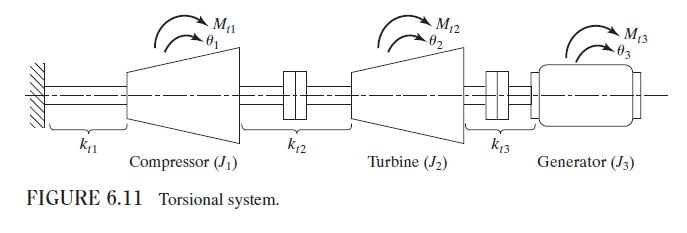
For the torsional system shown in Fig. 6.11, determine a principal mode and the corresponding frequency by Holzer's method. Assume that \(k_{t 1}=k_{t 2}=k_{t 3}=k_{t}\) and \(J_{1}=J_{2}=J_{3}=J_{0}\).Figure 6.11:- M2 02 Mn M3 -03 K3 K2 Turbine (J2) Generator (J3) Compressor (J1) FIGURE 6.11
Using Holzer's method, find the natural frequencies and mode shapes of the shear building shown in Fig. 7.14. Assume that \(m_{1}=2 m, m_{2}=m, h_{1}=h_{2}=h, k_{1}=2 k, k_{2}=k\), and \(k=3 E I / h^{3}\).Figure 7.14:- X2 m2 K- k m1 k FIGURE 7.14 Two-story shear building.
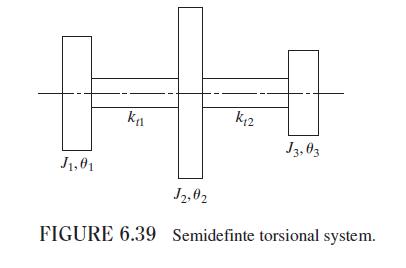
Using Holzer's method, find the natural frequencies and mode shapes of the system shown in Fig. 6.39. Assume that \(J_{1}=10 \mathrm{~kg}-\mathrm{m}^{2}, J_{2}=5 \mathrm{~kg}-\mathrm{m}^{2}, J_{3}=1 \mathrm{~kg}-\mathrm{m}^{2}\), and \(k_{t 1}=k_{t 2}=\) \(1 \times 10^{6} \mathrm{~N}-\mathrm{m} /
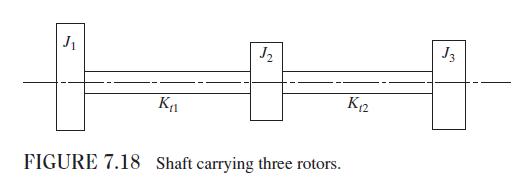
A uniform shaft carries three rotors as shown in Fig. 7.18 with mass moments of inertia \(J_{1}=J_{2}=5 \mathrm{~kg}-\mathrm{m}^{2}\) and \(J_{3}=10 \mathrm{~kg}-\mathrm{m}^{2}\). The torsional stiffnesses of the segments between the rotors are given by \(k_{t 1}=20,000 \mathrm{~N}-\mathrm{m} /
A uniform shaft carries three rotors as shown in Fig. 7.18 with mass moments of inertia \(J_{1}=5 \mathrm{~kg}-\mathrm{m}^{2}, J_{2}=15 \mathrm{~kg}-\mathrm{m}^{2}\) and \(J_{3}=25 \mathrm{~kg}-\mathrm{m}^{2}\). The torsional stiffnesses of the segments between the rotors are given by \(k_{t
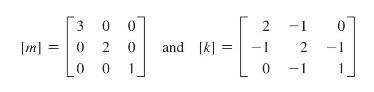
The mass and stiffness matrices of a three-degree-of-freedom spring-mass system are given byDetermine the natural frequencies and mode shapes of the system using Holzer's method. [m] = 3 0 0 2 = 0 2 0 and [k] = 1 2 -1 0 0 1 0 -1
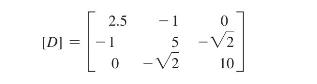
The largest eigenvalue of the matrixis given by \(\lambda_{1}=10.38068\). Using the matrix iteration method, find the other eigenvalues and all the eigenvectors of the matrix. Assume \([m]=[I]\). 2.5 -1 [D] 1 5 -Vi 0 10
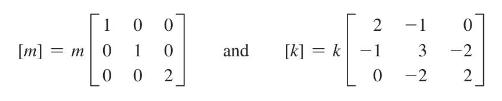
The mass and stiffness matrices of a spring-mass system are known to beUsing the matrix iteration method, find the natural frequencies and mode shapes of the system. 0 0 2 -1 0 [m] = m 0 1 0 and [k] = k-1 3 -2 0 0 2 0 -2 2
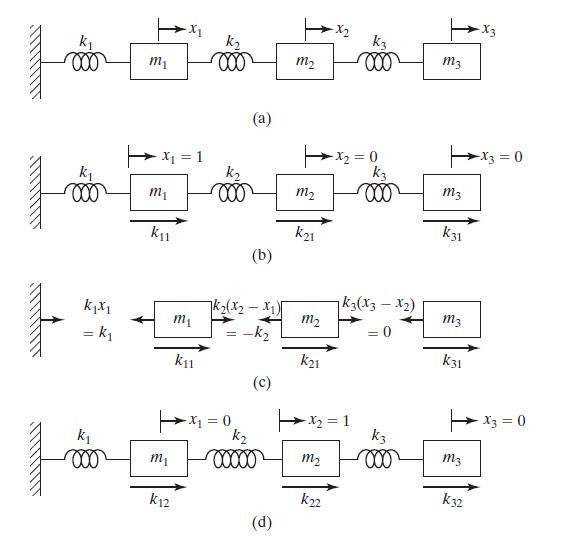
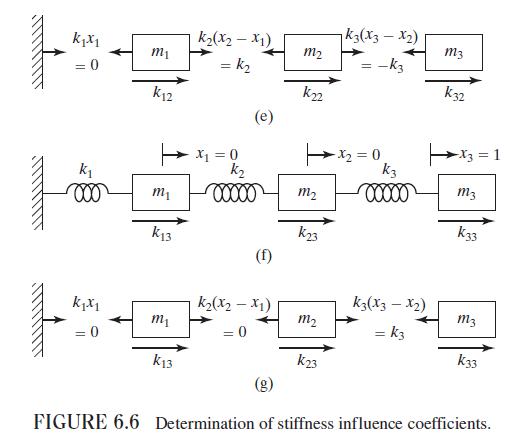
Using the matrix iteration method, find the natural frequencies and mode shapes of the system shown in Fig. 6.6 with \(k_{1}=k, k_{2}=2 k, k_{3}=3 k\), and \(m_{1}=m_{2}=m_{3}=m\).Figure 6.6:- k k3 m3 (a) k x = 1 -x2=0 X3 = 0 k3 000 m m2 000 m3 k11 K21 K31 (b) k |2(x-x1)| 1k3(x3x2) m3 m m2 =k = -k
Using the matrix iteration method, find the natural frequencies of the system shown in Fig. 6.28. Assume that \(J_{d 1}=J_{d 2}=J_{d 3}=J_{0}, l_{i}=l\), and \((G J)_{i}=G J\) for \(i=1\) to 4.
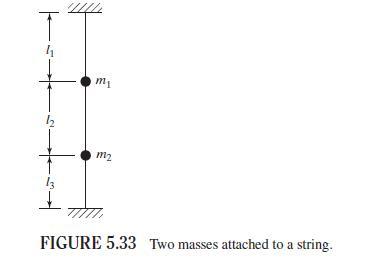
Using the matrix iteration method, solve Problem 7.6.Data From Problem 7.6:-Using Dunkerley's formula, determine the fundamental natural frequency of the stretched string system shown in Fig. 5.33 with \(m_{1}=m_{2}=m\) and \(l_{1}=l_{2}=l_{3}=l\). T m m2 FIGURE 5.33 Two masses attached to a string.
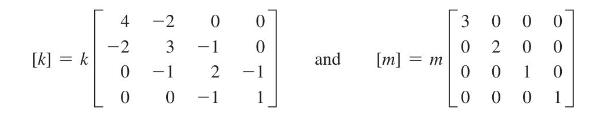
The stiffness and mass matrices of a vibrating system are given byUsing the matrix iteration method, find the fundamental frequency and the mode shape of the system. 4 -2 0 0 3 0 0 0 -2 3 -1 0 0 2 0 0 [k] = k and [m] = m 0 -1 2 -1 0 0 1 0 00 -1 0 0 01
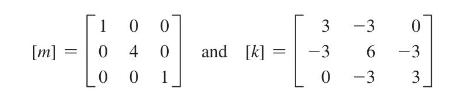
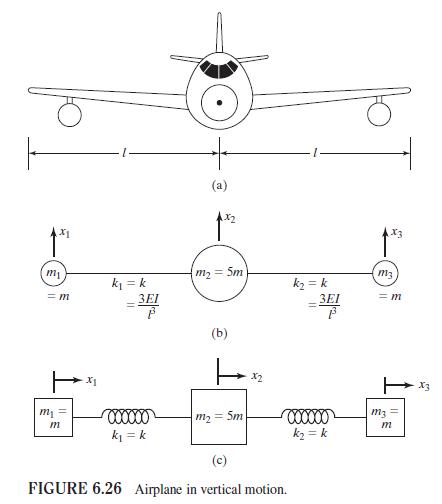
The mass and stiffness matrices of an airplane in flight, with a three-degree-of-freedom model for vertical motion (similar to Fig. 6.26) are given byDetermine the highest natural frequency of vibration of the airplane using the matrix iteration method.Figure 6.26:- 0 0 3 3 -3 [m] = 0 4 0 and [k]
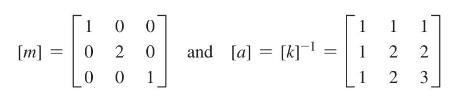
The mass and flexibility matrices of a three-degree-of-freedom system are given byFind the lowest natural frequency of vibration of the system using the matrix iteration method. 1 0 0 1 1 [m] = 0 20 and [a] [k]. = = 1 2 2 0 0 1 1 2 3
For the system considered in Problem 7.34, determine the highest natural frequency of vibration of the system using the matrix iteration method.Data From Problem 7.34:-The mass and flexibility matrices of a three-degree-of-freedom system are given byFind the lowest natural frequency of vibration of
Find the middle natural frequency of vibration of the system considered in Problems 7.34 and 7.35 using the matrix iteration method.Data From Problem 7.35:-For the system considered in Problem 7.34, determine the highest natural frequency of vibration of the system using the matrix iteration
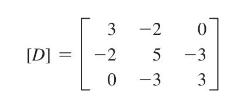
Using Jacobi's method, find the eigenvalues and eigenvectors of the matrix 3-2 0 [D]=-2 5 -3 0-3 3 3
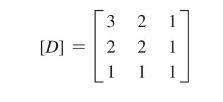
Using Jacobi's method, find the eigenvalues and eigenvectors of the matrix [D] 3 2 22 22 1 1
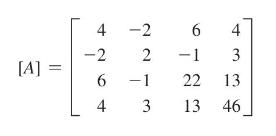
Using Jacobi's method, find the eigenvalues of the matrix \([A]\) given by 4 -2 6 4 -2 2 -1 3 [A] = 6 -1 22 13 4 3 13 46,
Using the Choleski decomposition technique, decompose the matrix given in Problem 7.39.Data From Problem 7.39:-Using Jacobi's method, find the eigenvalues of the matrix \([A]\) given by 4 -2 6 4 -2 2 -1 3 [A] = 6 -1 22 13 4 3 13 46,
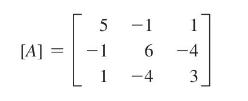
Using the decomposition \([A]=[U]^{T}[U]\), find the inverse of the following matrix: 5 -1 [A] = 6-4 -4 3
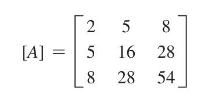
Using Choleski decomposition, find the inverse of the following matrix: [A] = 258 5 8 16 28 8 28 54
Convert Problem 7.32 to a standard eigenvalue problem with a symmetric matrix.Data From Problem 7.32:-The stiffness and mass matrices of a vibrating system are given byUsing the matrix iteration method, find the fundamental frequency and the mode shape of the system. 4 -2 0 0 3 0 0 0 -2 3 -1 0 0 2
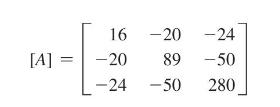
Using the Choleski decomposition technique, express the following matrix as the product of two triangular matrices: 16 -20-24 [A] = -20 89 -50 -24-50 280
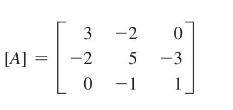
Using MATLAB, find the eigenvalues and eigenvectors of the following matrix: 3 -2 32 25 [A] = -2 0 5 -3 0-1
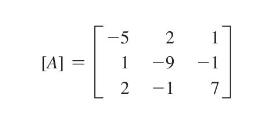
Using MATLAB, find the eigenvalues and eigenvectors of the following matrix: -5 2 [A] = 1 -9 -1 2 -1 7
Using Program9.m, find the eigenvalues and eigenvectors of the matrix \([D]\) given in Problem 7.27.Data From Problem 7.27:-The largest eigenvalue of the matrixis given by \(\lambda_{1}=10.38068\). Using the matrix iteration method, find the other eigenvalues and all the eigenvectors of the matrix.
Using Program \(10 . \mathrm{m}\), determine the eigenvalues and eigenvectors of the matrix \([D]\) given in Problem 7.38.Data From Problem 7.38:-Using Jacobi's method, find the eigenvalues and eigenvectors of the matrix [D] 3 2 22 22 1 1
Using Program \(11 . m\), find the solution of the general eigenvalue problem given in Problem 7.32 with \(k=m=1\).Data From Problem 7.32:-The stiffness and mass matrices of a vibrating system are given byUsing the matrix iteration method, find the fundamental frequency and the mode shape of the
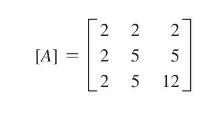
Find the eigenvalues and eigenvectors of the following matrix using MATLAB: 222 22 [A] 25 25 255 2 5 12 13
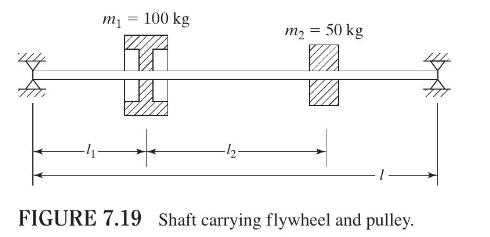
A flywheel of mass \(m_{1}=100 \mathrm{~kg}\) and a pulley of mass \(m_{2}=50 \mathrm{~kg}\) are to be mounted on a shaft of length \(l=2 \mathrm{~m}\), as shown in Fig. 7.19. Determine their locations \(l_{1}\) and \(l_{2}\) to maximize the fundamental frequency of vibration of the system. 4 m1 =
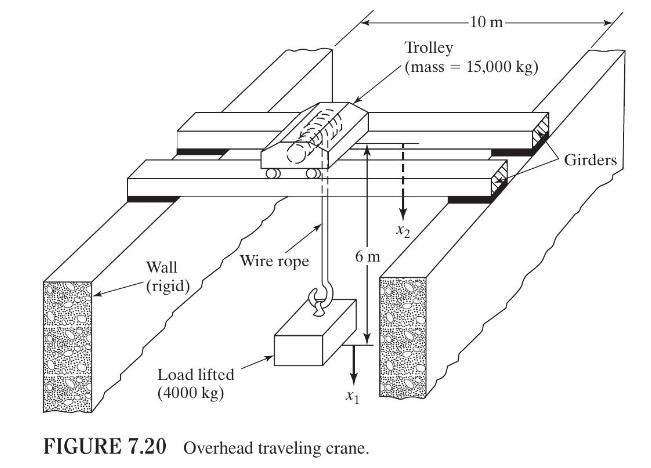
A simplified diagram of an overhead traveling crane is shown in Fig. 7.20. The girder, with square cross section, and the wire rope, with circular cross section, are made up of steel. Design the girders and the wire rope such that the natural frequencies of the system are greater than the operating
Fill in the Blank.The free-vibration equation of a string is also called \(a(n)\) _________ equation.
The frequency equation of a continuous system is aa. polynomial equationa. transcendental equationb. differential equation
True or False.Continuous systems are the same as distributed systems.
Determine the velocity of wave propagation in a cable of mass \(ho=5 \mathrm{~kg} / \mathrm{m}\) when stretched by a tension \(P=4000 \mathrm{~N}\).
How does a continuous system differ from a discrete system in the nature of its equation of motion?
Fill in the Blank.The frequency equation is also known as the _________ equation.
The number of natural frequencies of a continuous system isa. infiniteb. onec. finite
True or False.Continuous systems can be considered to have an infinite number of degrees of freedom.
A steel wire of \(2 \mathrm{~mm}\) diameter is fixed between two points located \(2 \mathrm{~m}\) apart. The tensile force in the wire is \(250 \mathrm{~N}\). Determine (a) the fundamental frequency of vibration and (b) the velocity of wave propagation in the wire.
How many natural frequencies does a continuous system have?
Fill in the Blank.The method of separation of variables is used to express the free-vibration solution of a string as a(n) _________ of function of \(x\) and function of \(t\).
When the axial force approaches the Euler buckling load, the fundamental frequency of the beam reachesa. infinityb. the frequency of a taut stringc. zero
True or False.The governing equation of a continuous system is an ordinary differential equation.
A stretched cable of length \(2 \mathrm{~m}\) has a fundamental frequency of \(3000 \mathrm{~Hz}\). Find the frequency of the third mode. How are the fundamental and third mode frequencies changed if the tension is increased by \(20 \%\) ?
Are the boundary conditions important in a discrete system? Why?
Fill in the Blank.Both boundary and _________ continuous system are to be specified to find the solution of a vibrating.
The value of the Timoshenko shear coefficient depends on the following:a. shape of the cross sectionb. size of the cross sectionc. length of the beam
True or False.The free-vibration equations corresponding to the transverse motion of a string, the longitudinal motion of a bar, and the torsional motion of a shaft have the same form.
Find the time it takes for a transverse wave to travel along a transmission line from one tower to another one \(300 \mathrm{~m}\) away. Assume the horizontal component of the cable tension as 30,000 \(\mathrm{N}\) and the mass of the cable as \(2 \mathrm{~kg} / \mathrm{m}\) of length.
What is a wave equation? What is a traveling-wave solution?
Fill in the Blank.In the wave-solution \(w(x, t)=w_{1}(x-c t)+w_{2}(x+c t)\), the first term represents the wave that propagates in the __________ directions of \(x\). conditions
A Laplacian operator is given bya. \(\frac{\partial^{2}}{\partial x \partial y}\)b. \(\frac{\partial^{2}}{\partial x^{2}}+\frac{\partial^{2}}{\partial y^{2}}+2 \frac{\partial^{2}}{\partial x \partial y}\)c. \(\frac{\partial^{2}}{\partial x^{2}}+\frac{\partial^{2}}{\partial y^{2}}\)
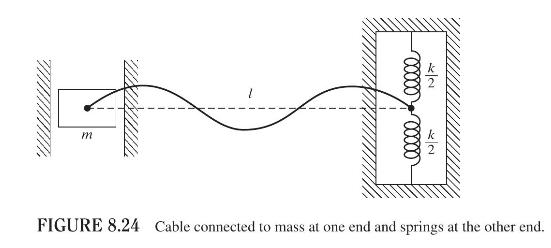
A cable of length \(l\) and mass \(ho\) per unit length is stretched under a tension \(P\). One end of the cable is connected to a mass \(m\), which can move in a frictionless slot, and the other end is fastened to a spring of stiffness \(k\), as shown in Fig. 8.24. Derive the frequency equation
True or False.The normal modes of a continuous system are orthogonal.
What is the significance of wave velocity?
Fill in the Blank.The quantities \(E I\) and \(G J\) are called the ___________ and ____________ stiffnesses, respectively.
True or False.A membrane has zero bending resistance.
The cord of a musical instrument is fixed at both ends and has a length \(2 \mathrm{~m}\), diameter \(0.5 \mathrm{~mm}\), and density \(7800 \mathrm{~kg} / \mathrm{m}^{3}\). Find the tension required in order to have a fundamental frequency of (a) \(1 \mathrm{~Hz}\) and (b) \(5 \mathrm{~Hz}\).
State the boundary conditions to be specified at the simply supported end of a beam if (a) thin-beam theory is used and (b) Timoshenko beam theory is used.
Fill in the Blank.The thin beam theory is also known as the ___________ theory.
The orthogonality of normal functions of the longitudinal vibration of a bar is given bya. \(\int_{0}^{l} U_{i}(x) U_{j}(x) d x=0\)b. \(\int_{0}^{l}\left(U_{i}^{\prime} U_{j}-U_{j}^{\prime} U_{i}\right) d x=0\)c. \(\int_{0}^{l}\left(U_{i}(x)+U_{j}(x)\right) d x=0\)
True or False.Rayleigh's method can be considered as a method of conservation of energy.
A cable of length \(l\) and mass \(ho\) per unit length is stretched under a tension \(P\). One end of the cable is fixed and the other end is connected to a pin, which can move in a frictionless slot. Find the natural frequencies of vibration of the cable.
State the possible boundary conditions at the ends of a string.
How do you determine the number of degrees of freedom of a lumped-mass system?
Define these terms: mass coupling, velocity coupling, elastic coupling.
Is the nature of the coupling dependent on the coordinates used?
How many degrees of freedom does an airplane in flight have if it is treated as (a) a rigid body, and (b) an elastic body?
What are principal coordinates? What is their use?
Why are the mass, damping, and stiffness matrices symmetrical?
What is a node?
What is meant by static and dynamic coupling? How can you eliminate coupling of the equations of motion?
Define the impedance matrix.
Showing 1400 - 1500
of 2655
First
8
9
10
11
12
13
14
15
16
17
18
19
20
21
22
Last
Step by Step Answers

 Get 50% OFF
Claim Now
Get 50% OFF
Claim Now