New Semester
Started
Get
50% OFF
Study Help!
--h --m --s
Claim Now
Question Answers
Textbooks
Find textbooks, questions and answers
Oops, something went wrong!
Change your search query and then try again
S
Books
FREE
Study Help
Expert Questions
Accounting
General Management
Mathematics
Finance
Organizational Behaviour
Law
Physics
Operating System
Management Leadership
Sociology
Programming
Marketing
Database
Computer Network
Economics
Textbooks Solutions
Accounting
Managerial Accounting
Management Leadership
Cost Accounting
Statistics
Business Law
Corporate Finance
Finance
Economics
Auditing
Tutors
Online Tutors
Find a Tutor
Hire a Tutor
Become a Tutor
AI Tutor
AI Study Planner
NEW
Sell Books
Search
Search
Sign In
Register
study help
engineering
thermodynamics concepts and applications
Thermodynamics Concepts And Applications 2nd Edition Stephen R. Turns, Laura L. Pauley - Solutions
Consider the air-standard diesel cycle described in Problem 9.95 operating with a compression ratio of 15 (= Vmax/Vmin). The air just prior to compression is at 20° C and 0.1014 MPa. The maximum cycle temperature is 2500 K. Assuming constant specific heats, determine the temperature and pressure
In a compression-ignition engine, air originally at 120 F is compressed to a temperature of 980 F. Compression obeys the relationship PV1:34 = constant. Determine (a) The compression ratio required (i.e., the ratio of the volume before compression to the volume after compression), (b) The
In a compression-ignition engine, air originally at 50° C is compressed to a temperature of 550° C. The compression obeys the relationship PV1:34 = constant. Determine (a) The compression ratio required (i.e., the ratio of the volume before compression to the volume after
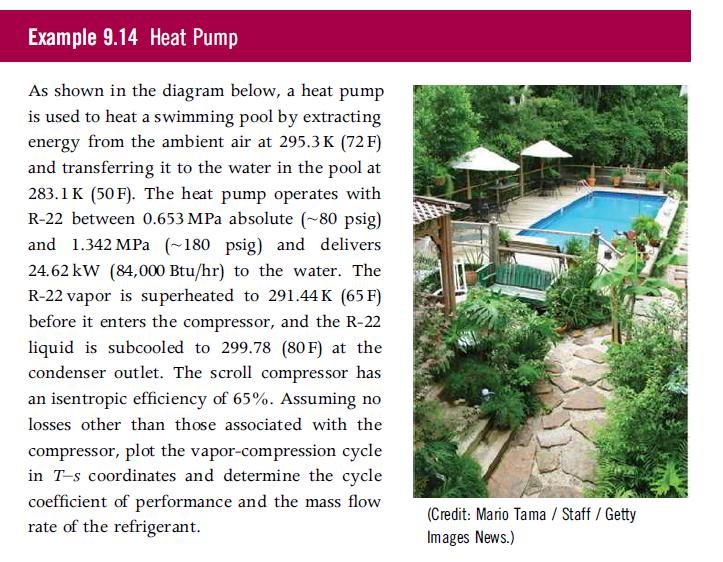
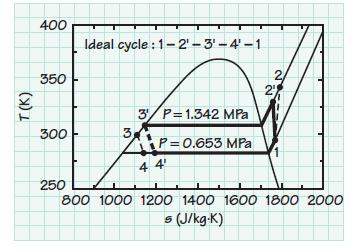
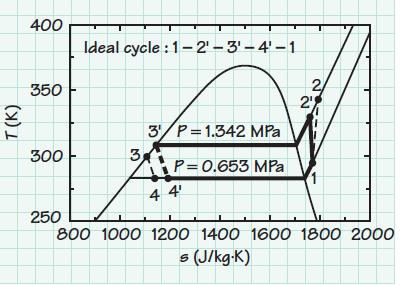
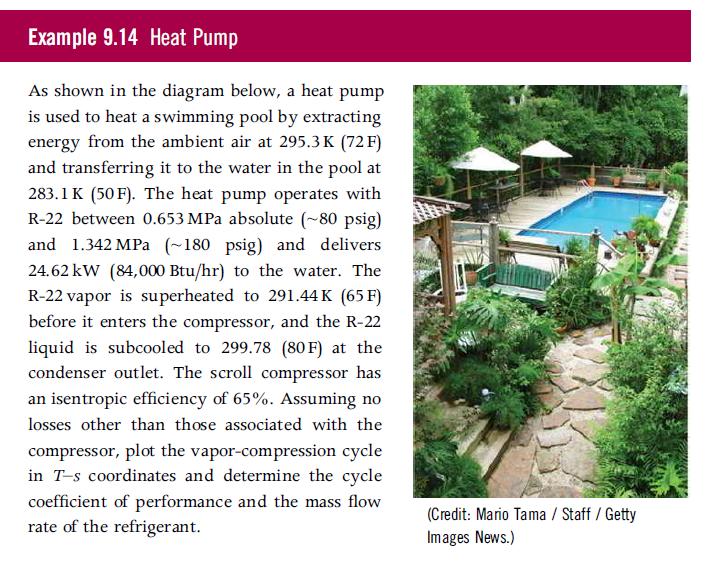
Determine the heat pump coefficient of performance for an ideal vapor compression refrigeration cycle operating between 0.653 and 1.342 MPa. The working fluid is R-22. Compare your result with that for the real cycle described in Example 9.14. Example 9.14 Heat Pump As shown in the diagram below, a
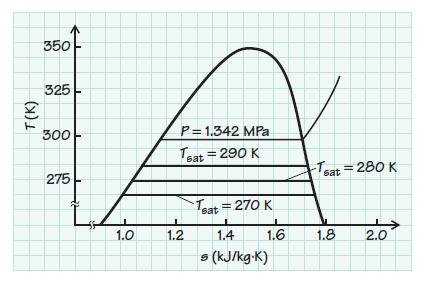
Determine the influence of the evaporator temperature on the heat pump coefficient of performance for an ideal vapor-compression cycle. The working fluid is R-22. The pressure is fixed in the condenser at 1.342MPa. Vary the evaporator temperature over a reasonable range that includes Tsat =
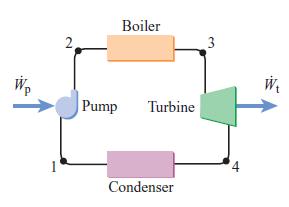
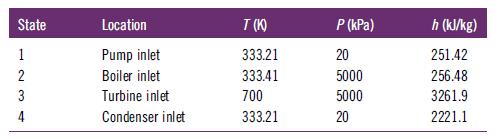
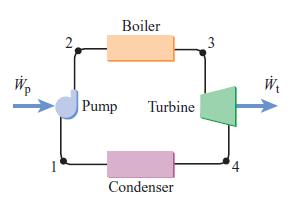
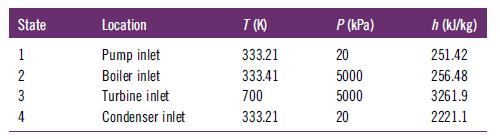
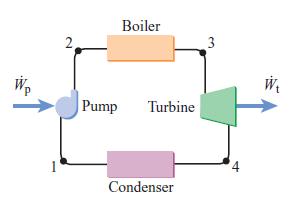
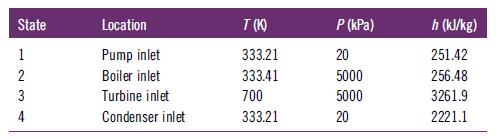
Consider a Rankine cycle steam power plant with superheat having a flow rate of 5 kg/s. The temperatures and pressures at the inlet states of the four basic components are given in the table. The turbine and the pump are both adiabatic.Determine the thermal efficiency of the cycle.a. 34.5%b.
Consider a Rankine cycle steam power plant with superheat having a flow rate of 5 kg/s. The temperatures and pressures at the inlet states of the four basic components are given in the table. The turbine and the pump are both adiabatic.Determine the rate of heat transfer in the boiler.a. 3MWb. 15
Consider a Rankine cycle steam power plant with superheat having a flow rate of 5 kg/s. The temperatures and pressures at the inlet states of the four basic components are given in the table. The turbine and the pump are both adiabatic.Determine the net power output.a. 5.20 MWb. 1.04 MWc. 5.18 MWd.
For the purpose of testing air conditioners, the following indoor and outside air temperatures and relative humidities are defined for a so-called moderate climate:Determine the specific humidity and dew point associated with these two conditions. Indoors: Outside: TA 27 °C (80.6F), = 0.48, = TA =
A Carnot refrigerator removes energy at a rate of 300 Btu/hr from a low temperature thermal reservoir at –160 F. The high-temperature reservoir for the refrigerator is the atmosphere at 40 F. A Carnot engine operating between a reservoir at 1140 F and the atmosphere (40 F) drives this Carnot
A 5-m3 tank contains 2 kmol of oxygen and 5 kmol of nitrogen at 300 K.a. Find the total pressure of the mixture.b. Find the apparent constant-volume specific heat using a mass-basis (cv,mix in kJ/kg · K) and molar-basis (cv,mix in kJ/kg · K).c. Find the heat transfer required to raise the
Sketch an evaporative cooler. Discuss its operation.
Sketch a humidifier. Discuss its operation.
Sketch an air conditioner. Discuss its operation.
On an extremely cold winter day, the air temperature and relative humidity in the living space of a home are 295.3 K (72 F) and 18%, respectively. After operating a humidifier for 8 hr, the relative humidity in the house has increased to 40%, the low end of the comfort zone. The air temperature
Combustion products (10% carbon dioxide, 20% water vapor, and 70% nitrogen by volume) flow in a chimney at 94° C and 1 atm. Determine (a) The dewpoint temperature (°C), (b) The humidity ratio, (c) The relative humidity.
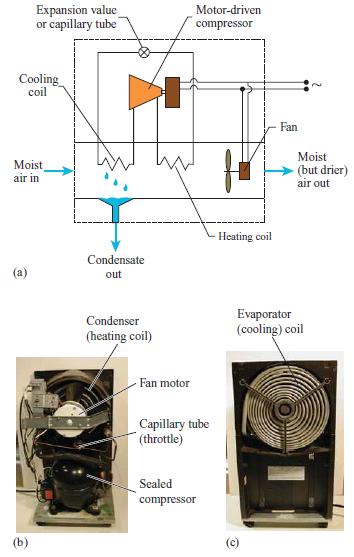
Sketch a dehumidifier. Discuss its operation.
Combustion products (10% carbon dioxide, 20% water vapor, and 70% nitrogen by volume) flow in a pipe at 94° C and 1.36 atm. Determine (a) The dew-point temperature (°C)(b) The humidity ratio(c) The relative humidity.
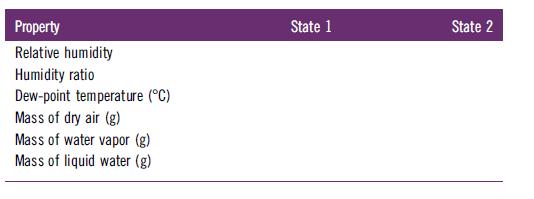
At state 1, a piston–cylinder device contains 0.004m3 of moist air initially at 20° C and 0.10135MPa with a 70% relative humidity. The volume is then decreased to 0.002m3 at state 2 as the piston is pushed inward in a reversible isothermal process.A. Complete the following table:B. Does the
Sketch a cooling tower. Discuss its operation.
A mixture [10 mol CO2, 70 mol N2, and 20 mol H2O (liquid plus vapor)] is at 40° C and 1 atm. This temperature is below the dew point and the mixture is saturated with water vapor. Determine the number of moles of water that are vapor and the number of moles of water that are liquid.
A 10-ft by 20-ft by 8-ft room contains moist air at 90 F and 14.7 psia. The partial pressure of the water vapor is 0.3 psia. Determine the following quantities:A. The dew-point temperature (F), relative humidity, and humidity ratioB. The total mass (lbm) of the water vapor in the roomC. The volume
Define the term “psychrometry.” How is psychrometry included in a weather report?
Moist air at 100 F, 20 psia, and 40% relative humidity is flowing in a pipe. Determine (a) The dew-point temperature (F) (b) The humidity ratio.
Define the humidity ratio, ω.
A 20-ft by 12-ft by 8-ft room contains an air–water vapor mixture at 80 F. The barometric pressure is 14.7 psia and the measured partial pressure of the water vapor is 0.2 psia. Calculate (a) The relative humidity(b) The humidity ratio(c) The dew-point temperature,(d) the mass (lbm) of water
Define the relative humidity, ϕ.
A 4-m by 6-m by 2.4-m room contains an air–water vapor mixture at a total pressure of 100 kPa and a temperature of 25° C. The partial pressure of the water vapor is 1.4 kPa. Determine(a) The humidity ratio(b) The dew point(c) The total mass of water vapor in the room.
Define the dew point, TDP.
Consider a room containing moist air at 24° C, 60% relative humidity, and 1 atm. Determine the following:A. The humidity ratioB. The mixture enthalpy (kJ/kg)C. The dew-point temperature (°C)D. The mixture specific volume (m3/kg)
An air–water vapor mixture at 100 F (37.8° C) temperature contains 0.02 lbm water vapor per pound mass of dry air. The barometric pressure is 28.561 in Hg (96.7 kPa). Calculate the relative humidity and dew-point temperature.
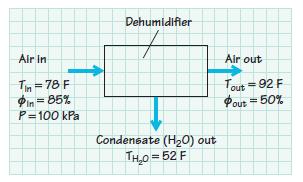
Consider a home dehumidifier, as shown in Fig. 11.5. Moist air at 78 F and relative humidity 85% enters at a volumetric flow rate of 330 ft3/min. The air exits at 92 F with a relative humidity of 50%, and the condensate exits at 52 F. Determine the electrical power supplied to the dehumidifier in
Define the adiabatic saturation temperature.
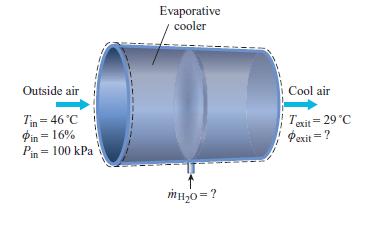
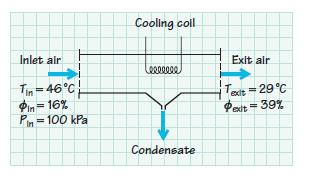
An evaporative cooler inducts outside air at 46° C (114.8 F) and 100 kPa having a relative humidity of 16%. The air is cooled to 29° C (84.2 F).Determine the following quantities:A. The mass of water added by the cooler per unit mass of dry air.B. The relative humidity of the outlet stream.C. The
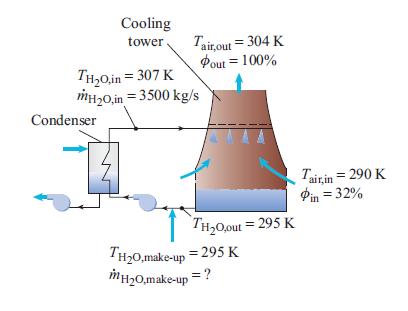
Cooling water from a power plant steam condenser enters a cooling tower at 307 K (93 F) with a flow rate of 3500 kg/s. The water exits the tower at 295 K (71.4 F). Air enters at the base of the tower at 290 K (62.4 F) with a relative humidity of 32% and exits at the top, saturated, at 304 K (87.6
A dry gas mixture (60% oxygen, 40% helium, by volume) is at 94° C and 3.4 atm. Moisture is then added. The properties at the final state are 94° C, 3.4 atm, and 20% relative humidity. Determine(a) The dew-point temperature (°C).(b) The molar composition of the moist gas.(c) The humidity ratio.
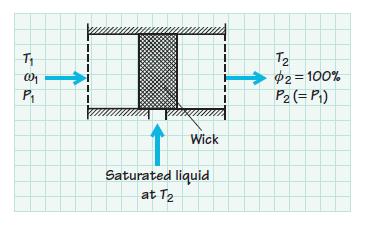
As shown in the sketch below, moist air enters an insulated tube at station 1with properties T1, P1, and ω1. Moisture is added to the air stream as it passes through a wick and exits at station 2 saturated with moisture (i.e., ϕ2 = 100%) at a temperature T2. The pressure at station 2 can be
A dry mixture of carbon dioxide and nitrogen (30% carbon dioxide and 70% nitrogen by volume) is initially at 90 F and 14.7 psia. Moisture is then added to the mixture until it becomes saturated at 90 F and 14.7 psia. Determine the following quantities:A. The molar mass of the original, dry
A1-kg mixture of air and water vapor at 20 °C, 1 atm, and 75% relative humidity is confined in a cylinder by a frictionless piston. This mixture is compressed isothermally until the pressure is 2 atm. Determine (a) The final relative humidity and humidity ratio.(b) The mass (kg) of water
An air-conditioning unit inducts outside air at 46° C (114.8 F) and 100 kPa having a relative humidity of 16%. The air is cooled and dehumidified to provide an outlet temperature of 29° C (84.2 F) and relative humidity of 39%. The coefficient of performance for the vapor-compression refrigeration
Combustion products (10% carbon dioxide, 20% water vapor, and 70% nitrogen, by volume) enter a pipe at 200 F and 14.7 psia. The mass flow rate of the products is 6 lbm/min. The products are cooled as they flow through the pipe and leave at 100 F and 14.7 psia. Determine (a) The mass flow rate
Moist natural gas enters a valve at 40° C, 0.2 MPa, and 70% relative humidity with a volumetric flow rate of 20m3/min. An analysis of the dry gases in the natural gas shows 80% methane and 20% hydrogen by volume as the gas enters. The moist natural gas leaves the valve at 0.15 MPa. Determine the
A tank contains moist air at 37.7 °C, 14.7 psia, and 27% relative humidity. Determine the following:A. The dew-point temperature (°C) of the mixture.B. The temperature (°C) at which condensation will begin if the mixture is cooled down.C. The heat transfer (kJ/m3) required to cool the contents
A 10-ft3 tank initially contains a moist gas (30% carbon dioxide, 50% nitrogen, and 20% water vapor by volume) at 300 F and 50 psia. Heat transfer to the atmosphere reduces the mixture temperature to 150 F. Determine the following:A. The final pressure (psia) in the tankB. The mass (lbm) of water
One of the many methods used for drying air is to cool it below the dew-point temperature so that condensation or freezing of the moisture takes place. To what temperature must atmospheric air be cooled to have a humidity ratio of 0.00433? To what temperature must this air be cooled if the pressure
One method of removing moisture from atmospheric air is to cool the air so that the moisture condenses or freezes out. A laboratory experiment requires a humidity ratio of 0.00620. To what temperature must the air be cooled at a pressure of 0.1 MPa to achieve this humidity?
Air enters an air compressor at 70 F (21.1°C ) and 14.7 psia (101.3 kPa) with a 50% relative humidity. The air is compressed to 50 psia (344.7 kPa) and sent to an intercooler. If condensation of water vapor from the air is to be prevented, what is the lowest temperature to which the air can be
A 4-lbm mass of air at 80 F (26.7° C) and 50% relative humidity mixes with a 1-lbm mass of air at 60 F (15.6° C) and 50% relative humidity. The pressure is 1 atm. Determine (a) The relative humidity of the mixture.(b) The dewpoint temperature of the mixture.
Air is compressed in a compressor from 30° C, 60% relative humidity, and 101 kPa to 414 kPa and then cooled in an intercooler before entering a second stage of compression. What is the minimum temperature (°C) to which the air can be cooled so that condensation does not take place?
A 0.5-m3 tank contains an air–water vapor mixture at 100 kPa and 35° C with a 70% relative humidity. The tank is cooled until the water vapor begins to condense. Determine the temperature at which condensation begins and the heat transfer for the process.
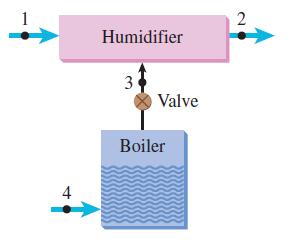
Moist air enters an adiabatic humidifier at state 1 [21.1 °C (70 F), 1 atm, 10% relative humidity] with a volumetric flow rate of 500 ft3/min. The air leaves the humidifier at state 2 [23.9 °C (75 F), 1 atm, 70% relative humidity]. The change in the condition of the moist air is brought about by
Moist air enters an air conditioner at 305.3 K, 137.9 kPa, and 80% relative humidity. The mass flow rate of dry air entering is 45.4 kg/min. The moist air leaves the air conditioner at 285.3 K, 124.1 kPa, and 100% relative humidity. The condensed moisture leaves at 285.3 K and 124.1 kPa. Determine
A moist gas (10% carbon dioxide, 70% nitrogen, 20% water vapor by volume) enters a reversible adiabatic turbine at 250° C and 0.4 MPa. The turbine exit pressure is 0.10135 MPa. The inlet volumetric flow rate is 3m3/min. Determine the following:A. The mass flow rate (kg/min) of dry gas mixtureB.
Moist air at 90 F, 14.7 psia, and 80% relative humidity is removed from the top of a large room at a rate of 500 ft3/min. The air is then cooled in an air conditioner at constant pressure to 60 F and returned to the bottom of the room. Condensed moisture leaves the air conditioner at 60 F and 14.7
Moist air at 30° C, 1 atm, and 20% relative humidity flows steadily into an adiabatic mixing chamber. Steam at 1 atm is sprayed into the chamber to humidify the air. The air leaves the chamber completely saturated at 30° C and 1 atm.A. Determine the temperature (°C) and/or quality of the added
Cold air enters an air conditioner at 4.4 °C (40 F) with 50% relative humidity at a volumetric flow rate of 1000 ft3/min. The air is then heated. Next, moisture at 21.1 °C (70 F) and 1 atm is added adiabatically to bring the air to 26.7 °C (80 F) with a 40% relative humidity. The entire process
Moist air steadily enters a room at 20° C and 1 atm with a dew-point temperature of 7°C at a rate of 15m3/min. As the moist air passes through the room it is heated at a rate of 7kW by a source at 65° C. Liquid water at 20° C is also supplied to the room at a rate of 5 kg/hr and is evaporated
A stream of moist air is obtained by mixing a 1500 ft3/min flow of air at 26.7 °C (80 F) and 80% relative humidity with a 500 ft3/min flow of air at 15.6 °C (60 F) and 50% relative humidity. The mixing is adiabatic and occurs at constant pressure (1 atm). Determine the temperature (°C), humidity
An evaporative cooler for an automobile consists of an 18-in-long by 8-indiameter cylinder that hangs on the outside of the car. At 55 mph the cooler processes 4500 lbm of dry air per hour. During desert driving, the air is at 100 F with 10% relative humidity. Inside the cooler, the air passes
Coolingwater from an internal combustion engine is to be cooled from 150 to 110 F. The pressure is 14.7 psia. Compare the following three methods with respect to the air and/or city water required (lbm/1000 gallons of engine cooling water):A. Heat transfer to city water. The city water temperature
Humid air enters a dehumidifier with an enthalpy of 21.6 Btu/lbm for the dry air and 1100 Btu/lbm for the water vapor. There is 0.02 lbm of vapor per pound of dry air at entrance and 0.009 lbm of vapor per pound of dry air at exit. The dry air at exit has an enthalpy of 13.2 Btu/lbm, and the vapor
Air is supplied to a room from outside, where the temperature is 20 F (–6.7° C) and the relative humidity is 60%. The room is to be maintained at 70 F (21.1° C) and 50% relative humidity. What mass of water must be supplied per mass of air supplied to the room?
A stoichiometric mixture of gaseous octane and oxygen reacts completely at 25° C in a nonflow, constant-volume process. The initial pressure is 1 atm. Assume all the water in the products is liquid. Determine the heat transfer in MJ per kg of octane.
For a steady-flow stoichiometric reaction of gaseous octane with oxygen, each reactant enters at 25° C and 1 atm and the products leave at 25° C and 1 atm. Determine the heat transfer (MJ per kg fuel).
Saturated air at 40 F (4.4° C) is first preheated and then saturated adiabatically. This saturated air is then heated to a final condition of 105 F (40.6° C) and 28% relative humidity. To what temperature must the air initially be heated in the preheat coil?
An air–water vapor mixture enters an air-conditioning unit at a pressure of 150 kPa, a temperature of 30° C, and a relative humidity of 80%. The mass flow rate of dry air entering is 1 kg/s. The air–vapor mixture leaves the air conditioning unit at 125 kPa, 10° C, and 100% relative humidity.
Air at 40° C and 300 kPa with a relative humidity of 35% expands in a reversible adiabatic nozzle. To how low a pressure (kPa) can the gas be expanded if no condensation is to take place? What is the exit velocity (m/s) at this condition?
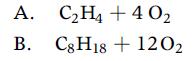
Determine whether the following mixtures are stoichiometric: A. B. C₂H₂ + 40₂ C8H18 + 120₂
In an air-conditioning unit, air enters at 80 F, 60% relative humidity, and standard atmospheric pressure. The volumetric flow rate of the entering air (dry basis) is 71,000 ft3/min. The moist air exits at 57 F and 90% humidity.Calculate the following:A. The cooling capacity of the air-conditioning
An air–water vapor mixture enters a heater–humidifier unit at 5° C, 100 kPa, and 50% relative humidity. The flow rate of dry air is 0.1 kg/s. Liquid water at 10° C is sprayed into the mixture at the rate of 0.0022 kg/s. The mixture leaves the unit at 30° C and 100 kPa. Calculate(a) The
A room is maintained at 75 F and 50% relative humidity. The outside air is available at 40 F and 50% relative humidity. The return air from the room is cooled and dehumidified by mixing it with fresh air from the outside. The air flowing into the room is 60% outdoor air and 40% return air by mass.
Balance the chemical equations and find the mass fuel oxidizer ratio for the following equations: A. B. C5H12 + a O₂ = b CO₂ + c H₂O C3H8 + a O₂ = b CO₂ + c H₂O
An air–water vapor mixture at 14.7 psia, 85 F, and 50% relative humidity is contained in a 15-ft3 tank. At what temperature will condensation begin? If the tank and mixture are cooled an additional 15 F, how much water will condense from the mixture?
Consider 1000 ft3/min (dry basis) of air at 14.7 psia, 90 F, and 60% relative humidity passing over a cooling coil with a mean surface temperature of 40 F. A water spray on the coil ensures that the exiting air is saturated at the coil temperature. What is the required cooling capacity of the coil
A flow of 2832 liters/s (6000 ft3/min, dry basis) of air at 26.7° C (80 F) dry-bulb temperature, 50% relative humidity, and standard atmospheric pressure enters an air-conditioning unit. The air exits at temperature 13.9° C (57 F) with 90% relative humidity. Determine the following:A. The cooling
A gas-turbine engine burns liquid octane with 300% “theoretical” air (i.e. the octane to air ratio is 1:3) in a steady-flow constant-pressure process. The air and octane both enter the engine at 25° C. The exhaust gases leave the engine at 725° C. The overall engine is well insulated.
Moist air at 100 F, 20 psia, and 40% relative humidity is flowing in a pipe. Determine (a) The dew-point temperature.(b) The humidity ratio.(c) The adiabatic saturation temperature.
The temperature and adiabatic saturation temperature for a room of moist air are measured to be 30° C and 20° C, respectively.A. Determine the humidity ratio and relative humidity if the pressure is 1 atm.B. Determine the humidity ratio if the pressure is 0.95 atm with the same temperature and
In a classroom the temperature is 78 F, the adiabatic saturation temperature is 64 F, and the barometric pressure is 29.175 in Hg.A. Determine the humidity ratio.B. Determine the partial pressures (in Hg) of the dry air and of the water vapor.C. Determine the relative humidity.D. Determine the
Without using the psychrometric chart, determine the humidity ratio and the relative humidity of an air–water-vapor mixture with a dry-bulb temperature of 32° C and a thermodynamics wet-bulb temperature of 25° C. The barometric pressure is 101 kPa. Check your results using the psychrometric
What quantities are conserved when a fuel and air burn to form combustion products?
What does it mean that a fuel burns with air in stoichiometric proportions?
Distinguish between the terms “rich” and “lean.”
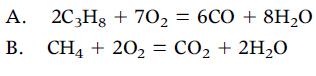
Determine whether the following reactions are stoichiometric: A. B. 2C3H8 + 70₂ = 6CO + 8H₂0 CH4 + 20₂ = CO₂ + 2H₂O
What is the physical meaning of the equivalence ratio Φ? What is implied when Φ is greater than unity? Less than unity?
A mass of particular solid fuel (70% carbon, 20%hydrogen, and 10% water by mass) reacts stoichiometrically with air. Assume that the air is 79% N2 and 21% O2 by volume. Determine the balanced chemical equation. Your final equation should be for an amount of fuel containing 1 mol of carbon.
Explain the concept of standardized properties applied to chemically reacting systems.
A certain amount of Hexane (C6H14) burns with air (21% O2, 79% N2) in stoichiometric proportions. Write the overall chemical reaction for this situation and determine the mole fractions for the C6H14, O2, and N2 in the reactant mixture. Also determine the mole fraction of each species in the
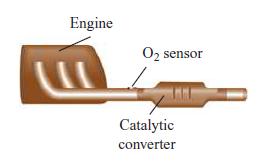
For correct operation of the catalytic converter in an automobile, the air–fuel ratio of the engine must be precisely controlled to near the stoichiometric value. This control is achieved using feedback from an O2 sensor located in the exhaust stream.A. If the equivalent composition of gasoline
Sketch an adiabatic constant-pressure combustion process in H–T coordinates. Show lines representing Hreac(T) and Hprod(T).
Set up the necessary combustion equations and determine the mass of air required to burn 1 lbm of pure carbon to equal masses of CO and CO2. Assume that the air is 79% N2 and 21% O2 by volume.
What is the sign (positive or negative) associated with the enthalpy of reaction for exothermic reactions? For endothermic reactions?
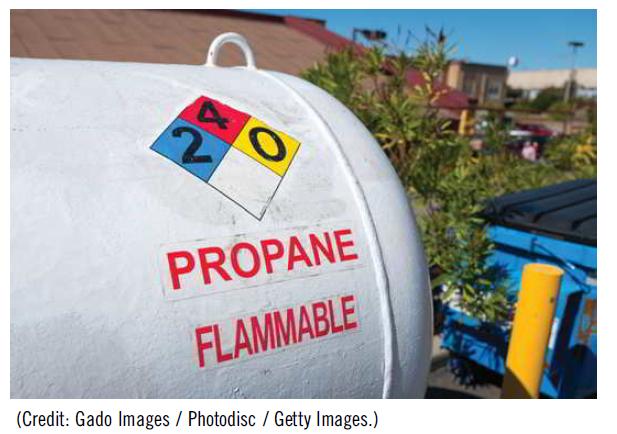
Propane (C3H8) and air (21% O2 and 79% N2) burn at an air–fuel mass ratio of 20:1. Determine (a) The equivalence ratio Φ,(b) The percent stoichiometric air(c) The percent excess air. 2 0 PROPANE FLAMMABLE (Credit: Gado Images / Photodisc / Getty Images.)
Derive an expression for the stoichiometric air–fuel ratio (by mass) of an arbitrary hydrocarbon fuel CxHy.
Write the stoichiometric combustion reaction for methanol (CH3OH) and air (21% O2, 79% N2) and determine the stoichiometric air–fuel ratio (by mass).
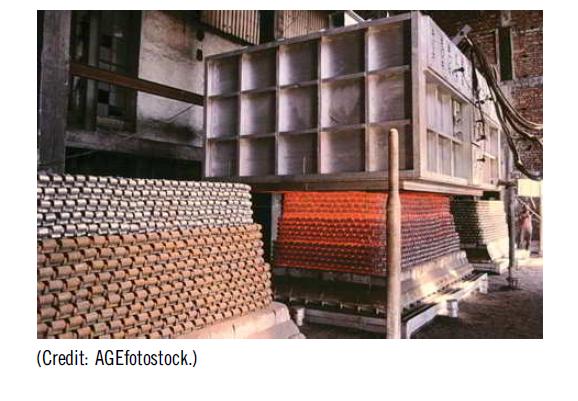
Air (21% O2, 79% N2) and natural gas (CH4) are supplied to an industrial furnace at an equivalence ratio Φ of 0.95. The air mass flow rate is 4 kg/s. Determine the mass flow rate of the CO2 exiting the furnace. (Credit: AGEfotostock.)
Sketch an adiabatic constant-volume combustion process in U–T coordinates. Show lines representing Ureac(T) and Uprod(T).
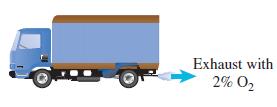
In a propane-fueled truck, 2% (by volume) oxygen is measured in the exhaust stream of the running engine. Assuming complete combustion without dissociation, determine the air–fuel ratio (mass) supplied to the engine. Also determine the percent theoretical air, the percent excess air, and the
Propane reacts completely with a stoichiometric amount of hydrogen peroxide (H2O2) to form carbon dioxide and water. Determine the mass of water formed per mass of propane.
Liquid hydrogen peroxide (H2O2) is used as the oxidizer to burn 1 kmol of propane in a stoichiometric reaction. Initially, the hydrogen peroxide and propane are each at 40° C and 2 atm. The final state of the exhaust product mixture (carbon dioxide and water) is 800 K and 10 atm. Determine the
Showing 100 - 200
of 971
1
2
3
4
5
6
7
8
9
10
Step by Step Answers

 Get 50% OFF
Claim Now
Get 50% OFF
Claim Now