New Semester
Started
Get
50% OFF
Study Help!
--h --m --s
Claim Now
Question Answers
Textbooks
Find textbooks, questions and answers
Oops, something went wrong!
Change your search query and then try again
S
Books
FREE
Study Help
Expert Questions
Accounting
General Management
Mathematics
Finance
Organizational Behaviour
Law
Physics
Operating System
Management Leadership
Sociology
Programming
Marketing
Database
Computer Network
Economics
Textbooks Solutions
Accounting
Managerial Accounting
Management Leadership
Cost Accounting
Statistics
Business Law
Corporate Finance
Finance
Economics
Auditing
Tutors
Online Tutors
Find a Tutor
Hire a Tutor
Become a Tutor
AI Tutor
AI Study Planner
NEW
Sell Books
Search
Search
Sign In
Register
study help
engineering
thermodynamics concepts and applications
Thermodynamics Concepts And Applications 2nd Edition Stephen R. Turns, Laura L. Pauley - Solutions
A rigid vessel contains 1 kg of saturated R-134a refrigerant at 15.6° C. Determine(a) The volume and mass of liquid (b) The volume and mass of vapor at the initial state that are necessary to make the R-134a pass through the critical state (or point) when heated.
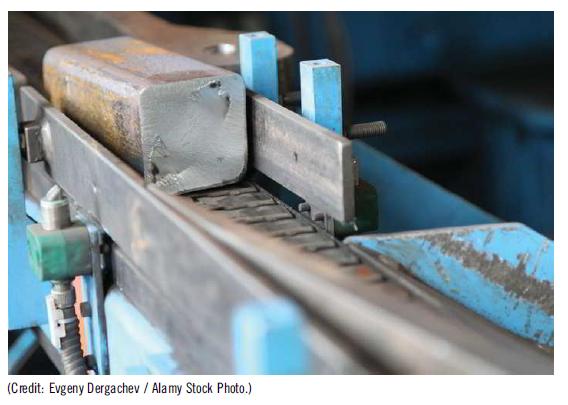
Consider a block of pure aluminum measuring 25 × 300 × 200mm3. The density and specific heat of aluminium are approximately 2702 kg/m3 and 903 J/kg · K, respectively. Estimate the change in internal energy ΔU associated with a temperature change from 600 K to 400 K. (Credit: Evgeny Dergachev /
Determine (a) The specific enthalpy of evaporation of steam (kJ/kg) (b) The ratio of the vapor to liquid specific volumes at standard atmospheric pressure.
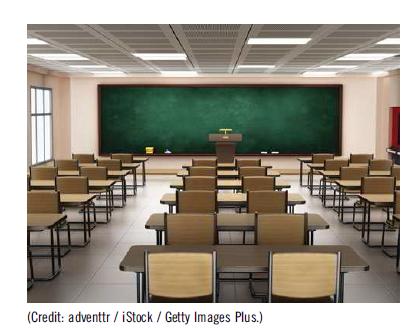
Determine the mass (lbm) of air in a classroom that is 30 ft wide, 50 ft long, and 15 ft high. The pressure is 14.7 psia and the temperature is 70 F. Convert units to SI before performing your calculation. WWONENTS (Credit: adventtr / iStock /Getty Images Plus.)
Air at 540°C and 140 KPa flows through a 2-ft-inside-diameter pipe at a mass flow rate of 1.05 kg/s. Determine the average velocity (m/s) of the air. Assume ideal-gas behavior.
Air with a density of 1.20 kg/m3 enters a steady-flow control volume through a 0.3-m-diameter duct with an average velocity of 3 m/s. The air leaves with a specific volume of 0.311 m3/kg through a 0.1-m diameter duct. Determine (a) The mass flow rate (kg/hr) (b) The average outlet
A steady-flow boiler is essentially a long, heated, variable-area duct with liquid water coming in at one end and steam coming out at the other end. Water enters at 420 K and 20 MPa and leaves at 880 K and 20 MPa. Determine the ratio of the outlet area to the inlet area if the outlet velocity is
Steam enters a 60-mm-inner-diameter tube with an average velocity of 4 m/s. The specific volume of the entering steam is 0.127m3/kg. The steam exits the tube with a density of 9.94 kg/m3. Determine the average velocity of the steam at the tube exit, assuming steady flow.
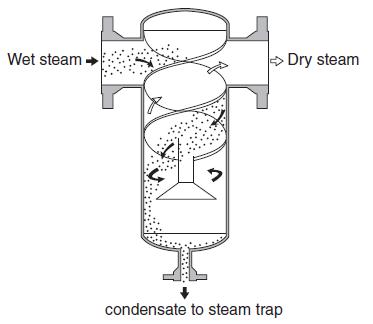
Wet steam at 0.40 MPa enters a cyclonic separator (Problem 3.25) with a quality of 0.96 at a velocity of 30 m/s. The diameter of the separator inlet is 150 mm. Determine the volumetric and mass flow rates of the wet steam.Data from in problem 3.25Moisture in a steam pipeline can result in
A gas enters a steady-flow system through a 5-cm-diameter tapering duct with an average velocity of 3.5 m/s and a density of 1.20 kg/m3. It leaves the duct with a specific volume of 0.31m3 /kg through a 1.6-cm-diameter constriction. Determine (a) The mass flow rate (kg/hr) (b) The average
A variable-diameter duct has a flow cross-sectional area of 0.006m2 at state 1 and 0.002m2 at state 2. Steam at 680 K and 6.0 MPa enters at state 1 at a velocity of 30 m/s, flows steadily through the duct, and leaves at 580 K and 3.0MPa at state 2. (a) Determine the velocity (m/s) at state
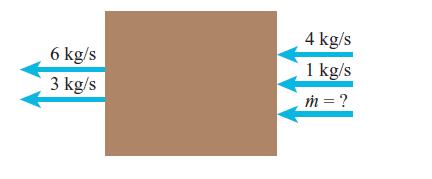
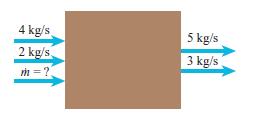
For the mixing chamber shown in the sketch, determine the unknown mass flow rate assuming there is no loss or gain of fluid in the chamber. 6 kg/s 3 kg/s 4 kg/s 1 kg/s m=?
For the mixing chamber shown in the sketch, determine the unknown mass flow rate assuming there is no loss or gain of fluid in the chamber. 4 kg/s 2 kg/s m=? 5 kg/s 3 kg/s
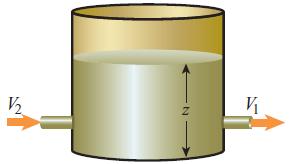
Consider the draining of a liquid from a tank. The level of the liquid above the bottom of the tank at any instant of time is z. The cross-sectional area of the tank is At. The flow area at the tank exit is Ae. The exit velocity V is given by V = Cz1/2, where C is a constant.A. Derive a
A cylindrical water tank, shown in the sketch, has a cross-sectional area of 5m2. Water flows out of the tank through a pipe of 0.2-m diameter with an average velocity V1 of 6 m/s. Water flows into the tank through a 0.1m diameter pipe with an average velocity V2 of 12 m/s. Define an open system
Water with a density of 990 kg/m3 is flowing through a 3-cm diameter pipe at a mass flow rate of 5 kg/s. What is the flow velocity in the pipe? a. 7.1 m/s,b. 1.8 m/s, c. 22.4 m/s, d. 0.21 m/s.
Name three pioneers in the thermal-fluid sciences and indicate their major contributions. Provide an approximate date for these contributions.
Show in detail that the units associated with the term V2/2 are J/kg. Be sure to show how basic unit definitions are required to obtain the final result; for example, 1 N Ξ 1kg·m/s2:
For the temperature range 1000–5000 K, the ratio of the molar constant pressure specific heat to the universal gas constant is given as follows for CO2: Cp/R₁ = 4.45362 + (3.140168 × 10³) T (1.278410 × 10⁶) 7² + (2.393996 × 10-¹0) 7³ (1.6690333 x 10-¹4) T4, where T[=] K. For 1 kg of
Consider an ideal gas contained in a piston–cylinder arrangement as a closed thermodynamic system. The gas expands from an initial volume at state 1 to a larger volume V2. The expansion process can be carried out as either a constant-pressure process or an isothermal process. It is desired to
Consider an ideal gas contained in a piston–cylinder arrangement as a closed thermodynamic system. The gas is compressed from an initial volume at state 1 to a smaller volume V2. The compression process can be carried out as either a constant-pressure process or an isothermal process. It is
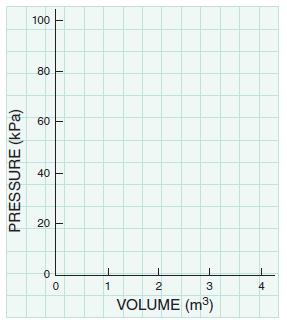
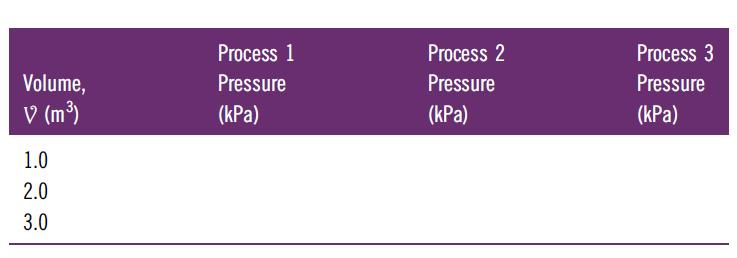
Consider air (ideal gas) within a piston–cylinder assembly as a thermodynamic system. We wish to compare three different quasi-equilibrium expansion processes for this system by plotting the pressure as a function of volume. Each process starts from the same initial condition: P = 100 kPa and V =
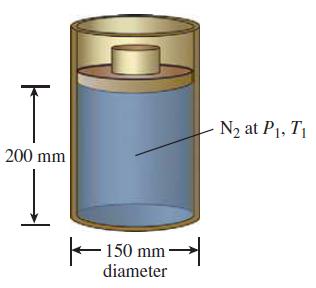
Consider nitrogen gas contained in a piston-cylinder arrangement as shown in the sketch. The piston is free to move without friction. The cylinder diameter is 150 mm. At the initial state the temperature of the N2 is 500 K, the pressure is 100 kPa, and the height of the gas column within the
For the same conditions as in Problem 4.27, determine the work done if the process is polytropic with n = 1.4 (i.e., PV1.4 = constant).Data from in Problem 4.27A gas is trapped in a cylinder–piston arrangement as shown in the sketch. The initial pressure and volume are 13,789.5 Pa and 0.02832m3,
A 0.0065-kg mass of air expands in a piston–cylinder assembly following a constant-pressure path with a work output of 1.3 kJ. The initial specific volume of the air is 0.25 m3/kg. The final volume is three times that of the initial volume.A. Sketch the process in P–V and T–V coordinates.B.
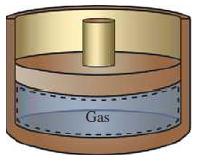
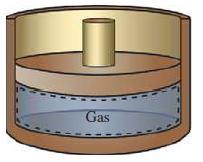
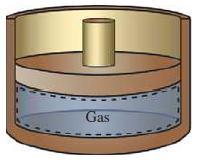
A gas is trapped in a cylinder–piston arrangement as shown in the sketch. The initial pressure and volume are 13,789.5 Pa and 0.02832m3, respectively. Determine the work (kJ) assuming that the volume is increased to 0.08496m3 in a constant-pressure process. Gas
For the same conditions as in Problem 4.27, determine the work done if the process is polytropic with n = 1 (i.e., PV = constant).Problem 4.27A gas is trapped in a cylinder–piston arrangement as shown in the sketch. The initial pressure and volume are 13,789.5 Pa and 0.02832m3, respectively.
Air is compressed in a piston–cylinder assembly by a constant-pressure process with a work input of 225 J. The initial volume is 0.001 m3, and the final volume is one-fourth of the initial volume. Determine the gas pressure during the process.
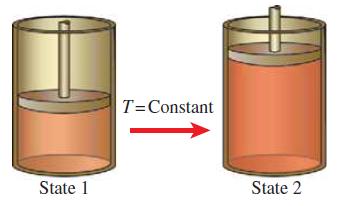
Initially, 0.05 kg of air is contained in a piston–cylinder device at 200° C and 1.6MPa. The air then expands at constant temperature to a pressure of 0.4 MPa. Assume the process occurs slowly enough that the acceleration of the piston can be neglected. The ambient pressure is 101.35 kPa.A.
Air is compressed reversibly in a piston–cylinder assembly. The 0.12 lbm of air in the cylinder is initially at 15 psia and 80 F, and the compression process takes place isothermally to 120 psia.A. Determine the work required to compress the air (Btu).B. Determine the final pressure of the air
One cubic meter of an ideal gas expands in an isothermal process from 760 to 350 kPa. Determine these work done by this gas in kJ and Btu.
Consider a power cycle in which air is the working fluid. The air is contained in a piston–cylinder assembly and undergoes the following processes:State 1–State 2: Isentropic compression from the maximum volume Vmax to the minimum volume Vmin, where Vmax = 10Vmin. The initial state pressure,
An air-standard Otto cycle is often used as a very simplified model of a spark ignition engine. The following sequence of processes applied to a fixed mass of air in a piston–cylinder assembly constitutes the Otto cycle:Process 1–2: Isentropic compression from the maximum volume Vmax to the
Consider the Otto cycle described in Problem 4.51. The initial state (state 1) temperature, pressure, and volume are 90 F, 14.7 psia, and 40 in3, respectively. The compression ratio, Vmax/ Vmin, is 8.5. The maximum temperature is 4500 F (state 3). Assume the specific heat ratio is constant with a
Air is the working fluid in a thermodynamic cycle for the production of power. The air undergoes the processes listed below in a reciprocating piston–cylinder assembly.State 1–State 2: Isothermal compression from an initial volume (0.0008 m3) to a volume one-eighth of the initial volume. The
Air is compressed reversibly and isothermally in a piston–cylinder assembly. The 0.05 kg of air in the cylinder is initially at 110 kPa and 300 K and is compressed to 830 kPa. Assuming ideal-gas behavior, determine the work required to compress the air.
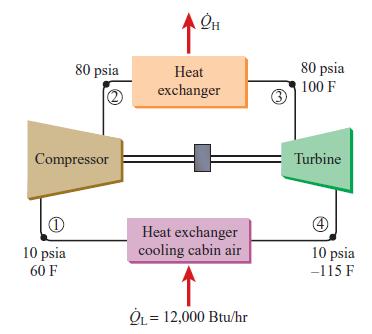
The cycle shown in the sketch is used to cool the passenger cabin of a commercial aircraft. Air is the working fluid. Assuming an ideal compression process, determine the following: A. The net work required (hp) per ton of refrigeration (1 ton = 12,000 Btu/hr)B. The heat rejected at the heat
Consider a Brayton cycle using air as the working fluid. The air enters the compressor at 102 kPa and 15° C and exits at 612 kPa. If the maximum cycle temperature is 800° C, what is the ideal cycle efficiency?
A turbojet-powered aircraft is flying at 240 m/s and 7000-m altitude, where the ambient temperature and pressure are 240 K and 41 kPa, respectively. The pressure ratio of the compressor is 6 and the turbine inlet temperature is 970 K. At these conditions, the fuel flow rate is 0.68 kg/s and the
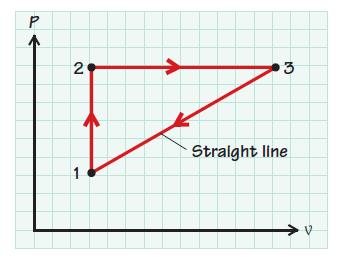
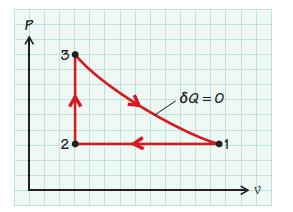
Rework Problem 9.100 for the following cycle.Problem 9.100Determine the efficiency for the air-standard cycle indicated in the sketch. Assume the pressures and temperatures are known quantities P 2 3 Straight line
Express the thermal efficiency of a Carnot-cycle heat engine in terms of the isentropic compression ratio (Vrisen Ξ Vlarge/Vsmall).
An inventor proposes a reversible nonflow cycle using air. The cycle consists of the following three processes:1–2: Constant-volume compression from 101 kPa and 15° C to 700 kPa.2–3: Constant-pressure heat addition during which the volume is tripled.3–1: A process that appears as a straight
Consider the air-standard Otto cycle described in Problem 9.94, operating with a compression ratio of 8:1. In the constant-volume heat-addition process (state 2–state 3), 1800 kJ/kg of energy is transferred to the air. If the cycle begins with air at ambient conditions of 100 kPa and 15° C
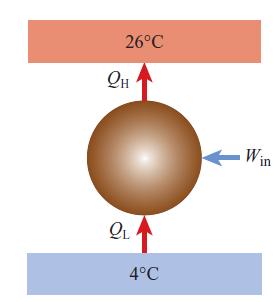
A reversible refrigerator removes energy from one thermal reservoir at 4° C and delivers energy to another thermal reservoir at 26° C. Determine the coefficient of performance for this device. Also determine the coefficient of performance for a reversible heat pump operating between the same two
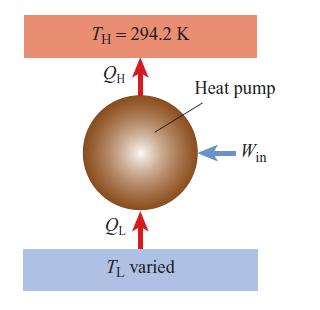
Plot the Carnot coefficient of performance for a heat pump delivering energy into a thermal reservoir at 294.2 K (70 F) as a function of the temperature of the cold reservoir. Use a range of cold reservoir temperatures from 255 K (~0 F) to 290 K (~62 F). TH=294.2 K Он QL T₁ varied Heat pump W₁
An architect wants to use an electrical work input to keep the temperature inside a building at 20° C when the outside temperature is –20° C. Determine the maximum heat-transfer rate (kW) that can be supplied to the building (per kW of electrical input) by (a) A resistance heater; (b)
A 1-ton (200 Btu/min) vapor-compression refrigerator uses R-134a as the refrigerant. Evaporation occurs at 10 F and condensation occurs at 100 F. The compressor is reversible and adiabatic. The refrigerant leaves the evaporator at 20 F and leaves the condenser at 95 F. The heating and cooling
Determine all the combinations of the following 120-volt kitchen appliances that can be operated simultaneously without tripping a 15-ampere circuit breaker: blender (300 W); clock radio (70 W); coffee maker (1200 W); food processor (200 W); microwave oven (1450 W); toaster oven (1150 W). Would you
A somewhat hard-to-start car engine requires the starter motor to crank for approximately 5 seconds. The current drain from the 12-volt battery during cranking is 116 amperes. If an equivalent amount of the energy is used to operate a 43-W CFL lightbulb, for how many minutes would the lightbulb be
An automobile drive shaft rotates at 3000 rev/min and delivers 75kW of power from the engine to the wheels. Determine the torque (N–m and ft-lbf) in the drive shaft.
The output shaft of a gas-turbine engine in a locomotive rotates steadily at 3000 rev/min. The torque in the shaft is 3500 N·m. Determine (i) the instantaneous power delivered (kW) and (ii) the amount of work transfer for one minute of operation.
The torque in the shaft of a water pump is 15 N·m. How much work is performed after 1000 revolutions of the shaft?
The shaft of an electric motor in a drone helicopter delivers 52.5 W of power to a propeller. The 3.17-mm shaft spins at 10,500 rev/min. Determine the torque in the motor shaft.
A toaster draws 9.6 amperes of current from a 120-volt wall socket when operating. Bread is toasted to a nice golden brown after 2 1/2 minutes. Determine (i) the instantaneous electrical power supplied to the toaster and (ii) the energy used to toast the bread. Discuss the fate of the electrical
Saturated steam is condensed to saturated liquid in a piston–cylinder assembly at constant pressure. The 721-kg piston has a diameter of 15 cm and moves freely without friction during the process. The work transfer to the steam during this process is 56 kJ. The atmospheric pressure is 100 kPa,
A vertical cylinder–piston arrangement contains 0.3 lbm of H2O (liquid and vapor in equilibrium) at 120 F, as shown in the sketch for the previousproblem. Initially, the piston rests on the stops, and the volume beneath the 250-lbm piston is 1.054 ft3. The piston area is 120 in2. The atmospheric
Consider 0.15 kg of H2O (liquid and vapor in equilibrium) contained in a vertical piston–cylinder arrangement at 350 K, as shown in the sketch. Initially, the piston rests on the stops, and the volume beneath the 142.8-kg piston (area of 10 cm2) is 0.001306m3. The atmospheric pressure is 100 kPa,
A 0.5-kg mass of saturated steam at 1 MPa is contained in a piston–cylinder assembly. Heat is removed from the steam during a quasi-static constant pressure process such that 65 kJ of work is done by the surroundings on the steam. Sketch the process in P–V coordinates and determine the quality
Determine the work done in ft-lbf by a 2-lbm steam system as it expands slowly in a cylinder–piston arrangement from the initial conditions of 324 psia and 12.44 ft3 to the final volume of 25.256 ft3 in accordance with the following relations: (a) P = 20V + 75:12, where V and P are expressed
Consider a fixed mass of air trapped in a piston–cylinder assembly. The air standard diesel cycle is defined by the following sequences of processes applied to this system:Process 1–2: Isentropic compression from the maximum volume Vmax to the minimum volume Vmin. Note: This process can be
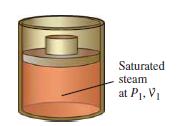
Saturated steam at 2MPa is contained in a piston–cylinder arrangement as shown in the sketch below. The initial volume is 0.25m3. Heat is removed from the steam during a quasi-static constant-pressure process such that 197.6 kJ of work is done by the surroundings on the steam. Determine the
One kilogram of wet steam at 450 K with a quality of 0.75 is contained in a piston–cylinder assembly. Heat is added to the steam during a quasi-static isothermal process until the steam becomes saturated vapor. Sketch the process in P–V coordinates and determine the work done by the steam on
Consider an ideal-gas fixed-mass system undergoing a quasi-equilibrium (reversible) process. Which of the following statements are true? Explain your answer in each case.A. On a pressure–volume plot, a constant-temperature process is represented by a hyperbola.B. On a pressure–volume plot, a
Consider an ideal gas contained in a piston–cylinder arrangement as a closed thermodynamic system. The gas expands following a polytropic process PVn = P1Vn1 from state 1 to state 2. The polytropic exponent n is a constant.A. Starting with the definition of moving-boundary work ∫
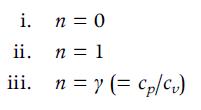
A polytropic process is one that obeys the relationship PVn = constant, where n may take on various values.A. Define the type of process associated with each of the following values of n, assuming the working fluid is an ideal gas (i.e., determine which state variable is constant):B. Starting from
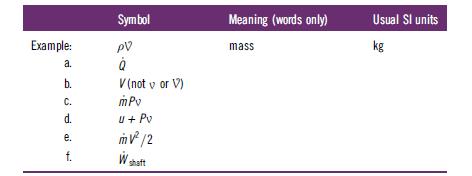
Write out in words the precise meaning of the following symbols. Be very specific, using appropriate adjectives as needed. Also provide the usual SI units associated with the quantities. For the terms that are products of symbols, give a single word or short phrase describing the grouping (see
Indicate whether each of the following statements is true or false. Justify your choice.A. The electrical power associated with a battery always moves from the battery (system) to the surroundings.B. The rate of enthalpy flow across an open-system boundary m_ his the sum of the rate of internal
Consider a 25-mm-diameter steel ball that has a density of 7870 kg/m3 and a constant-volume specific heat of the formWhat velocity would the ball have to achieve so that its bulk kinetic energy equals its internal energy at 500 K? Use an internal energy reference. state of 300 K. C₂ (J/kg.K) =
Assuming simple straight-line motion, show how the definition of work as the integral of a force with respect to distance, ∫ Fdx, is identical to the integral of pressure with respect to volume ∫ PdV for a simple compressible substance.
A 3.0-kg steel projectile is fired from a gun. At a particular point in its trajectory it has a velocity of 300 m/s, an altitude of 700 m, and a temperature of 350 K. The projectile is spinning about its longitudinal axis at an angular speed of 100 rad/s. Treating the projectile as a thermodynamic
A 100-kg man wants to lose weight by increasing his energy consumption through exercise. He proposes to do this by climbing a 6-m staircase several times a day. His current food consumption provides him with an energy input of 4000 Calories/day. A Calorie (Cal) is a unit for measuring the energy
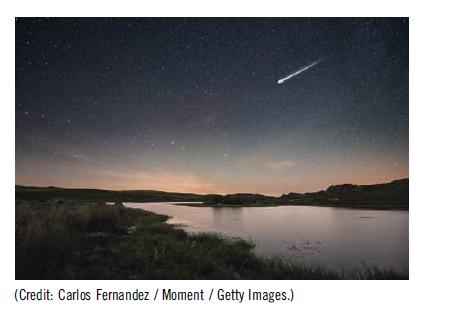
The Chelyabinsk meteor exploded over Russia in 2013 with a blast whose brightness exceeded that of the sun. The meteor entered the atmosphere with a speed of approximately 60,000 km/h and exploded at an altitude of approximately 29.7 miles. The estimated mass of the meteor was 13,000 metric tons (1
Initially, 1 lbm of water is at rest at 14.7 psia and 70 F. The water then undergoes a process where the final state is 30 psia and 700 F with a velocity of 100 ft/s and an elevation of 100 ft above the starting location. Determine the increases in internal energy, potential energy, and kinetic
A vapor-compression refrigerator using R-134a has a maximum pressure of 120 psia and a minimum pressure of 15 psia. The R-134a leaves the condenser as a saturated liquid and leaves the evaporator as a saturated vapor. The compressor is reversible and adiabatic. Determine:(a) The maximum room
Create a T–s diagram for Problem 9.125 using the NIST software plotting capability. Your sketch should show the following:A. The vapor domeB. Constant-temperature lines (isotherms) for 10, 20, 95, and 100 FC. Constant-pressure lines (isobars) for evaporation at 10 F and condensation at 100 FD.
Create a P–h diagram for Problem 9.125 using the NIST software plotting capability. Your sketch should show the following:A. The vapor domeB. Constant-temperature lines (isotherms) for 10, 20, 95, and 100 FC. Constant-pressure lines (isobars) for evaporation at 10 F and condensation at 100 FD.
A vapor-compression heat pump circulates R-134a at 300 lbm/hr. The R-134a enters the compressor at 20 F and 20 psia and leaves at 180 F and 180 psia. The refrigerant enters the expansion valve at 100° F and 160 psia and leaves the at 20° F and 20 psia. Determine:(a) The heating capacity
In a vapor-compression refrigeration cycle that circulates R-134a at a rate of 5 kg/min, the refrigerant enters the compressor at –10° C and 0.18 MPa and leaves at 70° C and 0.7 MPa. The R-134a leaves the condenser as saturated liquid at the compressor outlet pressure. Determine the
In a vapor-compression cycle using R-134a as the working fluid, the condenser pressure is 100 psia and the evaporator pressure is 20 psia. The R-134a leaves the condenser as saturated liquid and the evaporator as saturated vapor. Determine the coefficient of performance both as an air conditioner
Repeat Problem 9.131 using EES. Find the coefficient of performance and generate T–s diagrams for the original cycle conditions and your two modified cycles having an improved coefficient of performance.Problem 9.131In a vapor-compression refrigeration cycle that circulates R-134a at a rate of 5
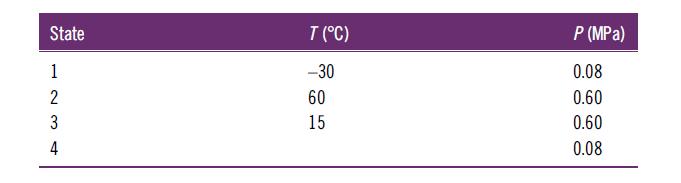
The temperatures and pressures shown in the table were measured for a vapor-compression refrigerator that uses R-134a as the refrigerant.The refrigerator operates between a cold region at TC and a hot region at TH. The positive-displacement compressor (piston-cylinder device) has a cylindervolume
A vapor-compression refrigerator using R-134a is to provide chilled water at 40 F and 14.7 psia. Originally the water is at 70 F and 14.7 psia. The pressure in the evaporator is 40 psia and that in the condenser is 100 psia. The R-134a enters the compressor at 40 F and leaves at 120 F. The power
In a vapor-compression cycle, evaporation occurs at –10° C and condensation occurs at 40° C. The compressor is reversible and adiabatic. R-134a exits the evaporator at –5° C and exits the condenser at 38° C. Determine the work into the compressor per unit mass of R-134a (kJ/kg).
You are charged with the design of the electrical circuits for a small workshop. A design criterion is that a circular saw (1200 W) and a drill press (1100 W) are able to operate simultaneously. Choices of circuit breakers are 15 amperes and 20 amperes. How many circuits do you propose and at what
You like to play very loud music on your car stereo such that your stereo system draws about 4 amperes more or less continuously. At what average rate would you have to eat donuts to consume food energy at the same rate as your stereos’ electricity consumption? A donut contains 260 food calories
A 40-ohm resistor is rated at 5 watts. Would this resistor be safe to use (i) in a computer with a 5-volt drop, (ii) in an automobile with a 12-volt drop, or (iii) in a home appliance with a 120-volt drop?
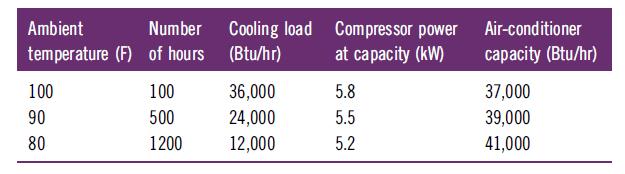
The capacity and compressor-work characteristics for a 3-ton (600-Btu/min) vapor-compression air conditioner are given in the table, along with the seasonal house-cooling needs. If electricity costs 5 cents/kW · hr, determine the seasonal operating cost and the seasonal coefficient of performance.
A computer facility in the Sahara Desert is to be maintained at 15° C by a vapor-compression refrigeration system that uses water as the refrigerant. The water leaves the evaporator as a saturated vapor at 10° C. The compressor is reversible and adiabatic. The pressure in the condenser is 0.01MPa
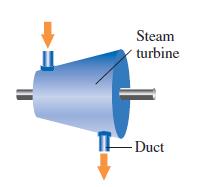
Steam exits a turbine and enters a 1.435-m-diameter duct. The steam is at 4.5 kPa and has a quality of 0.90. The mean velocity of the steam through the duct is 40 m/s. Determine the flow work rate required to push the steam into the duct. Steam turbine -Duct
An old 10-kW vapor-compression heat pump using R-12 maintains a building at 20° C. The inlet state to the compressor is saturated vapor at –30° C. The compressor exit state is at 50° C and 0.7 MPa. The inlet state to the expansion valve is saturated liquid at 25° C. Perform a complete thermal
A 3-ton (600-Btu/min) vapor-compression refrigeration cycle uses R-134a to maintain a freezing compartment at 0 F. The room air is at 70 F. The R-134a condenses at 80 F and evaporates at –10 F. It enters the compressor with 10 F of superheat. The compressor efficiency is 0.85. It leaves the
How is the apparent molecular weight used in thermodynamics calculations?
On a hot (95 F) summer day the relative humidity reaches an uncomfortable 85%. At this condition, the water vapor mole fraction is 0.056. Treating the moist air as an ideal-gas mixture of water vapor and dry air, determine the mass fraction of water vapor and the apparent molecular weight of the
For air containing 75.53% N2, 23.14% O2, 1.28% Ar, and 0.05% CO2, by mass, determine the gas constant and its molecular weight. How do these values compare for a mass based composition of 76.7% N2 and 23.3% O2?
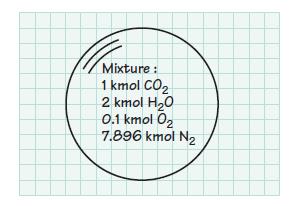
A mixture of ideal gases contains 1 kmol of CO2, 2 kmol of H2O, 0.1 kmol of O2, and 7.896 kmol of N2. Determine the mole fractions and the mass fractions of each constituent. Also determine the apparent molecular weight of the mixture. Mixture: 1 kmol CO₂ 2 kmol H₂O 0.1 kmol O₂ 7.896 kmol N₂
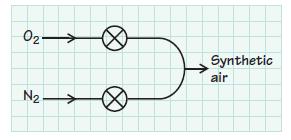
Determine the apparent molecular weight of synthetic air created by mixing 1 kmol of O2 with 3.76 kmol of N2. Also determine the mole and mass fractions of the O2 in the mixture. 0₂- N₂ D Synthetic air
Derive an expression relating the mole fraction and mass fraction of species ⅰ in a mixture.
A gas mixture of O2, N2, and CO2 contains 5.5, 3, and 1.5 kmol of each species, respectively. Determine the volume fractions of each component. Also determine the mass (kg) and molecular weight (kg/kmol) of the mixture.
Consider an ideal-gas mixture. Explain the differences and similarities among the following measures of composition: mole fraction, volume fraction, and mass fraction.
Give an example of a mixture that cannot be analyzed as a pure substance.
Showing 300 - 400
of 971
1
2
3
4
5
6
7
8
9
10
Step by Step Answers

 Get 50% OFF
Claim Now
Get 50% OFF
Claim Now