New Semester
Started
Get
50% OFF
Study Help!
--h --m --s
Claim Now
Question Answers
Textbooks
Find textbooks, questions and answers
Oops, something went wrong!
Change your search query and then try again
S
Books
FREE
Study Help
Expert Questions
Accounting
General Management
Mathematics
Finance
Organizational Behaviour
Law
Physics
Operating System
Management Leadership
Sociology
Programming
Marketing
Database
Computer Network
Economics
Textbooks Solutions
Accounting
Managerial Accounting
Management Leadership
Cost Accounting
Statistics
Business Law
Corporate Finance
Finance
Economics
Auditing
Tutors
Online Tutors
Find a Tutor
Hire a Tutor
Become a Tutor
AI Tutor
AI Study Planner
NEW
Sell Books
Search
Search
Sign In
Register
study help
engineering
thermodynamics concepts and applications
Thermodynamics Concepts And Applications 2nd Edition Stephen R. Turns, Laura L. Pauley - Solutions
Give an example of a mixture that can be analyzed as a pure substance.
Define a “pure substance”.
Natural gas (methane) is mixed with air in a molar ratio of 1:6 (1 kmol of methane with 6 kmol of air). Determine the volume fractions of each component and the apparent molecular weight (kg/kmol) of the mixture. For this mixture, determine the volume of 3 kg at 300 K and 101 kPa (atmospheric
How does the partial pressure of a constituent in an ideal-gas mixture relate to the mole fraction of that constituent?
The NIST software approximates the molar content of air as 78.12% N2, 20.96% O2 and 0.92% Ar. Find the apparent molecular weight for the mixture. For this mixture, determine the volume of 3 kg at 300 K and 101 kPa (atmospheric conditions).
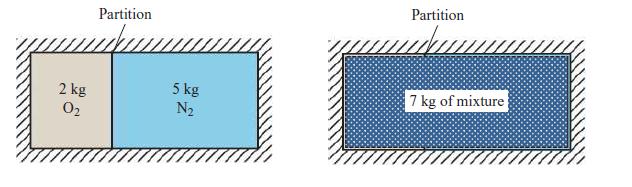
A gas mixture contains 2 kg O2 and 5 kg N2. For this mixture, determine the total volume at 300 K and 101 kPa (atmospheric conditions) in two different ways, as given in parts A and B below:A. Consider the oxygen and nitrogen as being in separate chambers.B. Find the apparent molecular weight,Mmix,
A 0.5-m3 rigid vessel contains 1 kg of carbon monoxide and 1.5 kg of air at 15° C. The composition of the air on a mass basis is 23.3% O2 and 76.7% N2. What are the partial pressures (kPa) of each component?
Compare and contrast Dalton’s and Amagat’s views of an ideal-gas mixture.
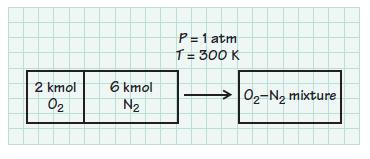
Calculate the change in entropy for mixing 2 kmol of O2 with 6 kmol of N2. Both species are initially at 1 atm and 300 K, as is the final mixture. 2 kmol 02 6 kmol N₂ P= 1 atm T = 300 K 0₂-N₂ mixture
Determine the change in specific entropy (kJ/kg · K) of CO2 for a process from 1 atm and 500 K to 3 atm and 1400K.
A partition separating a chamber into two compartments is removed. The first compartment initially contains oxygen at 600 kPa and 100° C; the second compartment initially contains nitrogen at the same pressure and temperature. The oxygen compartment volume is twice that of the compartment
Consider two compartments of the same chamber separated by a partition. Both compartments contain nitrogen at 600 kPa and 100° C; however, the volume of one compartment is twice that of the other. The partition is removed. Assuming the chamber is isolated from the surroundings, determine the
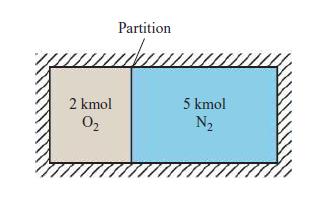
Consider 2 kmol of O2 and 5 kmol of N2 separated by a partition. The oxygen is at 400 K and 200 kPa. The nitrogen is at 300 K and 450 kPa. The partition is removed and the O2 and N2 mix. Determine the final temperature and pressure of the mixture and the entropy change associated with this mixing
Calculate the change in entropy on mixing 4 kmol of O2 with 1 kmol of CO2. Both species are initially at 2 atm and 500 K, as is the final mixture.
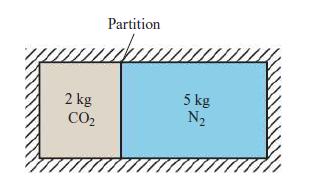
Consider 2 kg of CO2 and 5 kg of N2 separated by a partition. The carbon dioxide is at 300 K and 200 kPa. The nitrogen is at 500 K and 350 kPa. The partition is removed and the CO2 and N2 mix. Determine the final temperature and pressure of the mixture and the entropy change associated with this
A mixture of 15% CO2, 12% O2, and 73% N2, (by volume) expands to a final volume six times greater than its initial volume. The corresponding temperature change is 1000° C to 750° C. Determine the entropy change (kJ/kg·K).
Determine the change in entropy (kJ/kg·K) of a mixture of 80% N2 and 20% O2 by volume for a reversible adiabatic decrease in volume by a factor of 4. The initial temperature is 400 K.
Determine the change in entropy (kJ/kg · K) of a mixture of 60% N2 and 40% CO2 by volume for a reversible adiabatic increase in volume by a factor of 5. The initial temperature is 540° C.
A mixture of ideal gases contains 0.5 kmol of CO2, 2 kmol of O2, and 7 kmol of N2 at 700 K. Determine the following quantities:A. The mole fraction of each constituent in the mixture.B. The apparent molecular weight of the mixture.C. The volume of the mixture when the pressure is 600 kPa.D. The
Determine the change in specific entropy (kJ/kg · K) of CO for a process from 4 atm and 2500 K to 1 atm and 1400 K.
The gravimetric (mass) analysis of a gaseous mixture yields CO2 = 32%, O2 = 56.5%, and N2 = 11.5%. The mixture is at a pressure of 3 psia. Determine (a) The volumetric composition (b) The partial pressure of each component.
Explain in words how the mass-specific and molar-specific enthalpies of an ideal-gas mixture relate to the corresponding properties of the constituent species.
Determine the total apparent specific heat at constant volume (cv,mix in kJ/kg·K) for a fuel–air reactant mixture containing 1 kmol CH4, 2.5 kmol O2, and 9.4 kmol N2 at 500 K and 1 atm. What heat transfer is required to cool the mixture from 500 K to 300 K? Use specific heat values for each
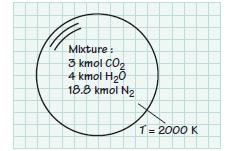
A mixture of products of combustion contains the following constituents at 2000 K: 3 kmol of CO2, 4 kmol of H2O, and 18.8 kmol of N2. Determine the following quantities:A. The mole fraction of each constituent in the mixture.B. The apparent molecular weight of the mixture.C. The apparent
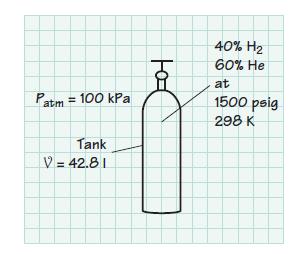
An instrument for the analysis of trace hydrocarbons in air, or in the products of combustion, uses a flame ionization detector. The flame in this device is fueled by a mixture of 40% (vol.) hydrogen and 60% (vol.) helium. The fuel mixture is contained in a 42.8-liter tank at 1500 psig and 298 K.
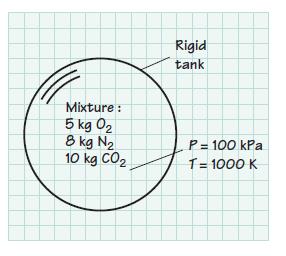
A rigid tank contains 5 kg of O2, 8 kg of N2, and 10 kg of CO2 at 100 kPa and 1000 K. Assume that the mixture behaves as an ideal gas. Determine (a) The mass fraction of each component, (b) The mole fraction of each component, (c) The partial pressure of each component, (d) The average molar
A 3-ft3 rigid vessel contains a 50–50 mixture of N2 and CO (by volume). Determine the mass of each component for T = 65 F and P = 30 psia.
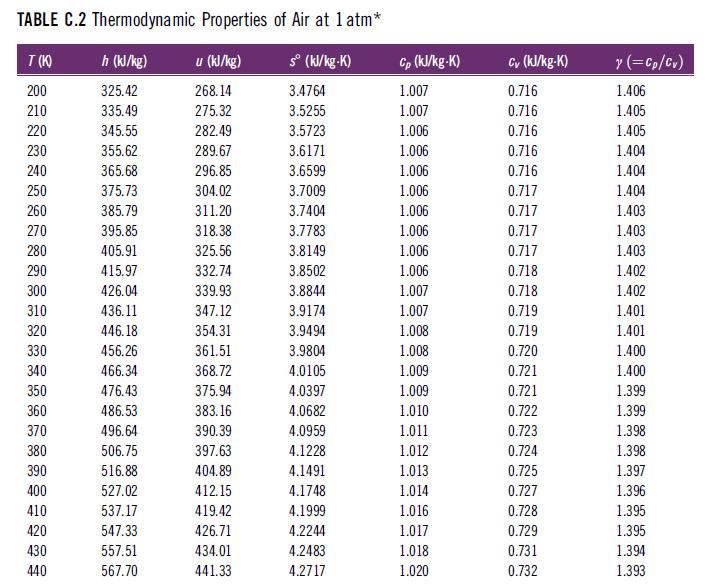
In Table C.2, at what reference temperature and pressure is the entropy zero? TABLE C.2 Thermodynamic Properties of Air at 1 atm* h (kJ/kg) u (kJ/kg) sº
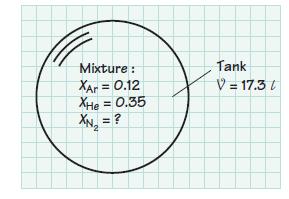
A 17.3-liter tank contains a mixture of argon, helium, and nitrogen at 298 K. The argon and helium mole fractions are 0.12 and 0.35, respectively. If the partial pressure of the nitrogen is 0.8 atm, determine (a) The total pressure in the tank, (b) The total number of moles (kmol) in the
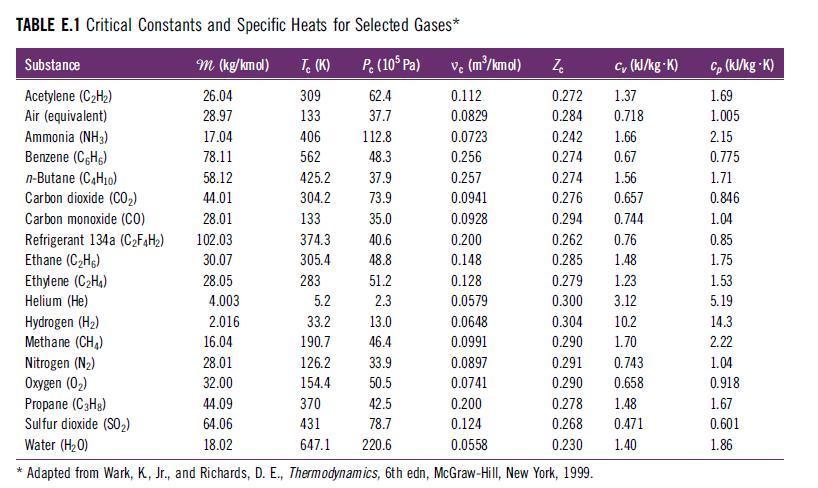
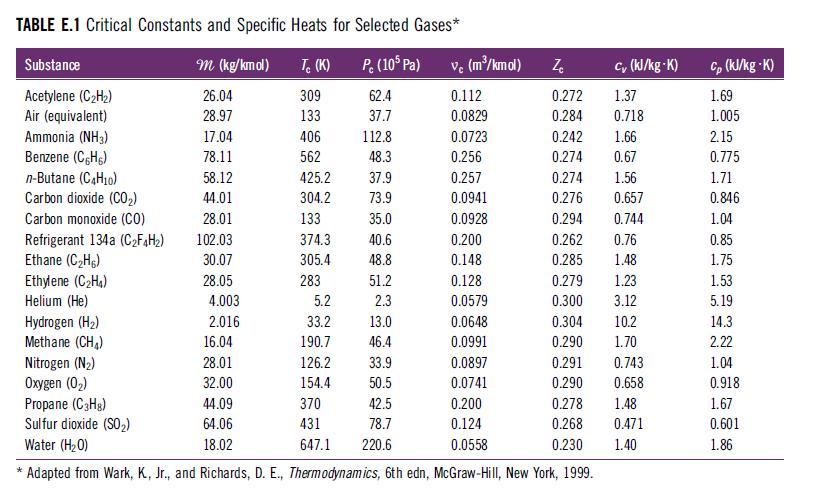
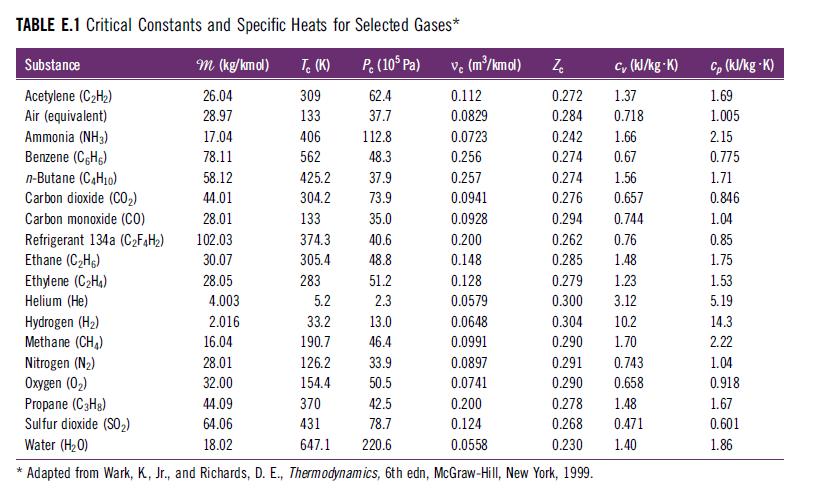
Determine the total apparent specific heat at constant pressure (cp,mix in kJ/kg · K) for a fuel–air reactant mixture containing 1 kmol CH4, 2.5 kmol O2, and 9.4 kmol N2 at 500 K and 1 atm. Use specific heat values for each species from Table E.1. TABLE E.1 Critical Constants and Specific Heats
A 1-m3 tank contains nitrogen at 30°C and 500 kPa. In an isothermal process, CO2 is forced into this tank until the pressure is 1000 kPa. What is the mass (kg) of each gas present at the end of this process?
A 0.08-m3 rigid vessel contains a 50–50 (by volume) mixture of nitrogen and carbon monoxide at 21° C and 2.75MPa. Determine the mass of each component.
A 0.12-m3 rigid vessel contains a 50–50 (by mass) mixture of nitrogen and carbon dioxide at 340 K and 1.5 MPa. Determine the number of moles and partial pressure of each component.
A 3-m3 rigid vessel contains a 50–50 mixture of N2 and O2 (by mass). Determine the number of moles of each component for T = 350 K and P = 500 kPa.
A mixture at 400 kPa and 500 K contains 2 kmol O2 and 8 kmol N2. Find the apparent molecular weight of the mixture. Determine the apparent specific heat at constant volume using a mass-basis (cv,mix in kJ/kgmol·k) and molar-basis (cv,mix in kJ/kmol·K).
A mixture at 500 kPa and 1000 K contains 2 kmol O2, 8 kmol N2, and 0.2 kmol of H2O. Find the apparent molecular weight of the mixture. Determine the apparent specific heat at constant volume using a mass-basis (cv,mix in kJ/kg·K) and molar-basis (cv,mixin kJ/kmol · K). Assume that water is
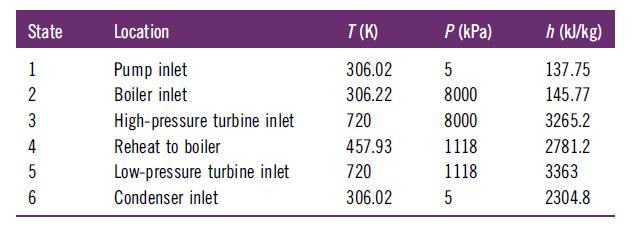
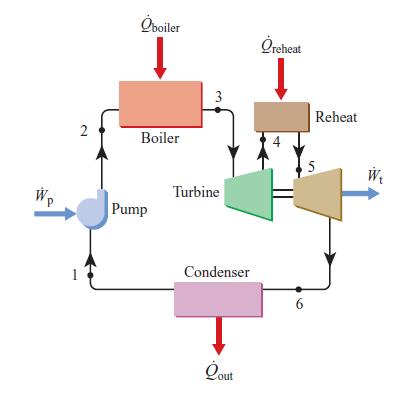
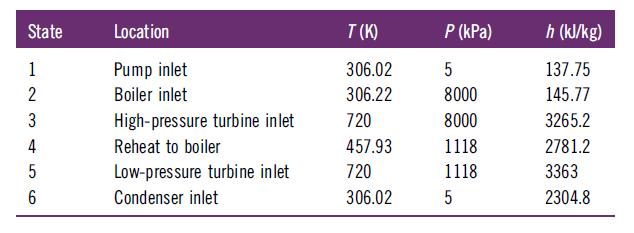
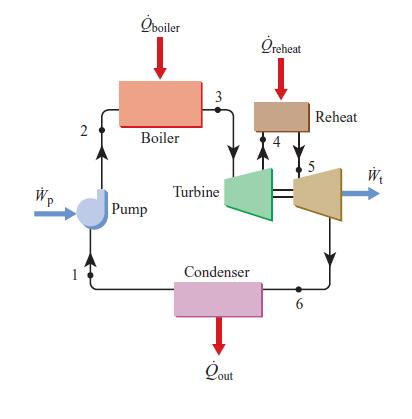
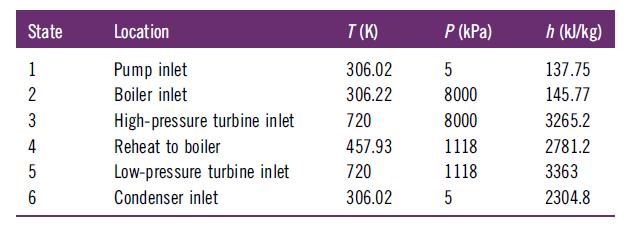
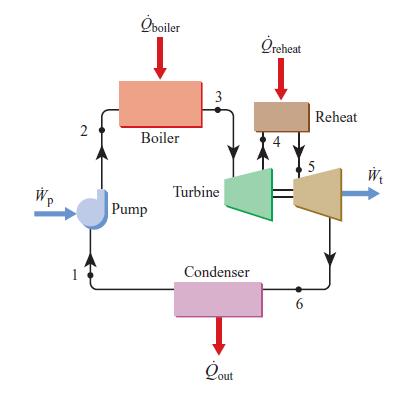
Determine the thermal efficiency of the cycle.a. 55.5%b. 54.3%c. 34.7%d. 64.5%.Consider an ideal Rankine cycle with superheat and reheat having a flow rate of 8 kg/s. The maximum temperature of the superheated and reheated steam is 720 K. maximum pressure in the cycle is 8 MPa and the minimum
Determine the net power output.a. 16.1 MW,b. 7.7 MWc. 2.01 MWd. 8.5 MW.Consider an ideal Rankine cycle with superheat and reheat having a flow rate of 8 kg/s. The maximum temperature of the superheated and reheated steam is 720 K. maximum pressure in the cycle is 8 MPa and the minimum pressure is 5
Determine the rate of heat transfer during reheat, Q̇ reheat.a. 3.12 MWb. 25.0 MWc. 582 kWd. 4.65 MW.Consider an ideal Rankine cycle with superheat and reheat having a flow rate of 8 kg/s. The maximum temperature of the superheated and reheated steam is 720 K. maximum pressure in the cycle is 8
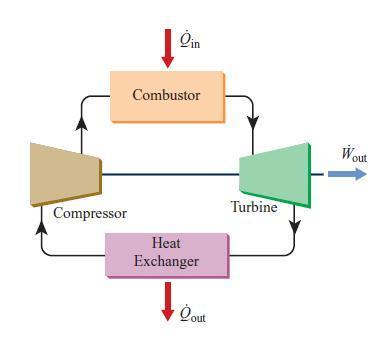
For this Brayton cycle, find the temperature of the air entering the combustor.a. 750 Kb. 529 Kc. 595 Kd. 1050 K.Brayton cycle Consider a gas-turbine engine operating with 20 kg/s of air entering at 300 K and a pressure ratio of 11. Using an ideal air-standard cycle as a model of this engine,
For the above Brayton cycle, find the net power output from the gas-turbine engine.a. 5.9 MWb. 1.5 MW, 4.9 MW, 4.5 MW.Brayton cycle Consider a gas-turbine engine operating with 20 kg/s of air entering at 300 K and a pressure ratio of 11. Using an ideal air-standard cycle as a model of this engine,
For the above Brayton cycle, determine the ideal thermal efficiency. a. 49.6%,b. 60.1%c. 42.2%d. 35.4%.Brayton cycle Consider a gas-turbine engine operating with 20 kg/s of air entering at 300 K and a pressure ratio of 11. Using an ideal air-standard cycle as a model of this engine, determine
Natural gas enters a 12-in-diameter pipeline at 300 psig and 68 F. The average velocity of the entering gas is 30 m/s. Determine the flow work rate required to push the gas into the duct. Express your result in ft ∙ lbf/s, Btu/hr, horsepower, and kW. Assume the natural gas has the properties of
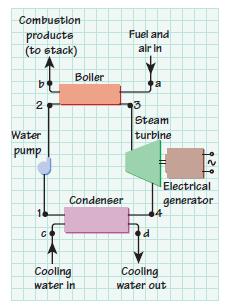
Consider the Rankine cycle power plant, as shown in the sketch below. Using a control volume that includes only the working fluid (steam/water), draw and label a sketch showing all the heat and work interactions associated with the cycle control volume. Combustion products (to
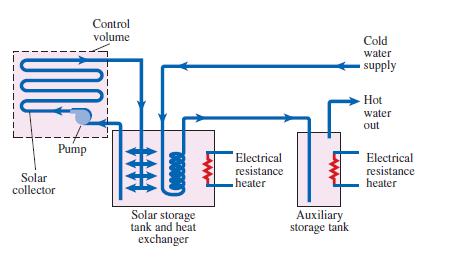
Consider the solar water heating scheme illustrated in Fig. 4.20. To analyze this scheme, choose a control surface that includes all the components shown and cuts through the cold water supply and hot-water-out lines. Assume hot water is being drawn for a shower. Sketch the control volume and show
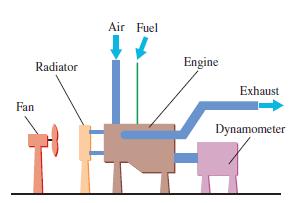
To conduct a laboratory test, a multicylinder spark-ignition engine is connected to a dynamometer (a device that measures the shaft power output), as shown in the sketch.For the following control volumes, draw a sketch indicating all heat and work interactions (i.e., all values of Q̄ and W̅):A.
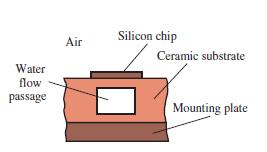
In a high-performance computer, silicon chips are actively cooled by water flowing through the ceramic substrate, as shown in the sketch. The chip assembly is inside a case through which air freely circulates.Consider the following thermodynamic systems (or control volumes), sketching each and
A 35-mm length of 1-mm-diameter nichrome (80% Ni, 20% Cr) wire is heated to 915 K by the passage of an electrical current through the wire (Joule heating). The wire is in an enclosure, the walls of which are maintained at 300 K. Warm air at 325 K flows slowly through the enclosure. The emissivity
Determine the instantaneous rate of heat transfer from a 1.5-cmdiameter ball bearing with a surface temperature of 150 °C submerged in an oil bath at 75 °C if the surface convective heat transfer coefficient is 850 W/m2 . °C.
Air at 480 F flows over a 20-in by 12-in flat surface. The surface is maintained at 75 F and the convective heat-transfer coefficient at the surface is 45 Btu/hr·ft2·F. Find the rate of heat transfer to the surface.
A convective heat flux of 20 W/m2 (with free convection) is observed between the walls of a room and the ambient air. What is the heat-transfer coefficient when the air temperature is 32° C and the wall temperature is 35° C?
A 30-cm-diameter, 5-m-long steam pipe passes through a room where the air temperature is 20° C. If the exposed surface of the pipe is a uniform 40° C, find the rate of heat loss from the pipe to the air if the surface heat-transfer coefficient is 8.5 W/m2° C.
A 10-ft-diameter spherical tank is used to store petroleum products. The products in the tank maintain the exposed surface of the tank 75 F. Air at 60 F blows over the surface, resulting in a heat-transfer coefficient of 10 Btu/hr·ft2 F. Determine the rate of heat transfer from the tank.
A surface is maintained at 100 °C and is enclosed by very large surrounding surfaces at 80 °C. What is the net radiant flux (W/m2) from this surface if its emissivity is (a) 1.0 (b) 0.8?
Find the rate of radiant energy emitted by an ideal blackbody having a surface area of 10m2 when the surface temperature is maintained at: (a) 50 °C(b) 100 °C(c) 500 °C.
A typical value of the heat-transfer coefficient for water boiling on a flat surface is 900 Btu/hr · ft2 · F. Estimate the heat flux on such surface when the surface is maintained at 222 F and the water is at 212 F.
Show in detail how the first law reduces to 1Q2 = ΔH for a system comprising a compressible substance undergoing a constant pressure process. What assumptions are required?
A frictionless 3000-N piston maintains a gas at constant pressure in a cylinder. The cross-sectional area of the piston is 52 cm2 and the atmospheric pressure acting on this area is 0.1 MPa. A process occurs in which a paddle wheel transfers 6800N·m of work to the gas,10 kJ of heat is transferred
An insulated container, filled with 10 kg of liquid water at 20° C, is fitted with a stirrer. The stirrer is made to turn by lowering a 25-kg object outside the container a distance of 10m using a frictionless pulley system. The local acceleration of gravity is 9.7 m/s2. Assume that all work done
Front-wheel-drive cars do not distribute the work involved in stopping the car equally among all wheels. The front wheel brakes dissipate about 60% of the energy transfer involved in braking, while the rear wheels take care of the remaining 40%. If you are in such a car, traveling at 55 miles/hr,
A tank contains a fluid that is stirred by a paddle wheel. The work input to the paddle wheel is 4309 kJ. The heat transferred from the tank is 1371 kJ. Considering the tank and the fluid as a closed system, determine the change in the internal energy (kJ) of the system.
A closed system rejects 25 kJ of energy in a heat interaction while experiencing a volume change of 0.1m3 (0.15 to 0.05m3). Assuming a reversible constant pressure process at 350 kPa, determine the change in internal energy.
A rigid tank contains a fixed mass of air. The air is the system of interest and undergoes a finite process from state 1 to state 2. The process results in the final (state-2) pressure of the air being much less than the initial pressure (state 1).A. Does the temperature increase or decrease?
A rigid tank contains a fixed mass of air. The air is the system of interest and undergoes a finite process from state 1 to state 2. The process results in the final (state-2) pressure of the air being much greater than the initial pressure (state 1).A. Does the temperature increase or decrease?
A piston–cylinder assembly contains a fixed mass of air. The air is the system of interest and undergoes a finite process from state 1 to state 2. The piston moves such that the final (state-2) volume of the air is several times smaller than the initial volume (state 1). The process occurs at
Without reference to the text, write symbolic expressions for the conservation of energy (the first law of thermodynamics) for a system, for the following conditions:A. A change from state 1 to state 2B. An incremental change (use δ and d as appropriate)C. At an instant
A piston–cylinder assembly contains a fixed mass of air. The air is the system of interest and undergoes a finite process from state 1 to state 2. The piston moves such that the final (state-2) volume of the air is several times larger than the initial volume (state 1). The process occurs at
What is the shaft work when a torque of 130 N·m is required to rotate a pump shaft at 300 rpm? a. 245 MWb. 16.3 MWc. 156 MWd. 2.6 MW
Air (γ = 1.4) expands at a constant pressure of 300 kPa from a volume of 0.1 m3 to 0.4 m3. What is the work done by the air? a. 9 kJ,b. 30 kJ,c. 90 kJ,d. 120 kJ.
Plot Problems 4.97 and 4.98 on the same P-V diagram. Also plot the isobaric process from the initial state to the final volume. Which process produces the greatest P-V work? Explain how you used the P-V diagram to answer this question.Problems 4.977 kg water initially at 500 kPa and 2 m3 is
7 kg water initially at 500 kPa and 2 m3 is expanded to a volume of 5 m3 in an isothermal process. Use EES or NIST and a spreadsheet to plot the process on a P-V diagram. At least ten points should be used from the initial to final state, in order to produce a smooth curve.
Air initially at 500 kPa and 2 m3 is expanded to a volume of 7 m3 in an isentropic process. (For an ideal gas, an isentropic process is a polytropic process with n = γ) Use EES or a spreadsheet to plot the process on a P-V diagram. At least ten points should be used from the initial to final
Air initially at 500 kPa and 2 m3 is expanded to a volume of 7 m3 in an isothermal process. Use EES or a spreadsheet to plot the process on a P-V diagram. At least ten points should be used from the initial to final state, in order to produce a smooth curve.
Repeat Problem 4.92 for a surface temperature of 150° C, with all other data remaining unchanged.Problem 4.92A surface is maintained at 100 °C and is enclosed by very large surrounding surfaces at 80 °C. What is the net radiant flux (W/m2) from this surface if its emissivity is (a)
A hydrogen storage tank containing 30 kg of H2 is exposed to a fire such that 128.5 MJ is transferred to the H2 in a heat interaction. The initial temperature and pressure in the tank are 300 K and 500 kPa, respectively. The maximum safe pressure for the tank is 1.5 MPa. A. Is there a danger
Consider a sealed rigid tank containing 0.12 kg of N2 at 300 K and 1 atm (state 1). The N2 is heated to a temperature of 700 K (state 2). Plot the process in P–v and T–v coordinates and determine the following quantities: 1W2, ΔU, ΔΗ, and 1Q2.
Consider a sealed rigid tank containing 0.15 kg of dry air at 300 K and 100 kPa (state 1). The air is heated to 600 K (state 2). Plot the process in P–v and T–v coordinates and determine the following quantities: 1W2, ΔU, ΔΗ, and 1Q2. Give units.
Consider a piston–cylinder assembly containing 0.12 kg of nitrogen at 300 K and 1 atm (state 1). The nitrogen is heated at constant pressure to 700 K (state 2). Plot process in P–v and T–v coordinates. Assuming a constant value of the constant-pressure specific heat of 1.067 kJ/kg · K
During the compression stroke in an automobile engine, air initially at 95 kPa and 305 K is compressed according to PV1.48 = constant. The engine compression ratio (= V1/V2) is 7.5. Determine (a) The work (b) The heat transfer, each in kJ/kg.
Consider a cylinder–piston arrangement trapping air at 630 kPa and 550°C. Assume the air expands in a polytropic process (PV1.3 = constant) to 100 kPa. What is the specific entropy change (kJ/kg · K)?
An ideal gas contained in a piston–cylinder device expands isothermally at 20°C from state 1 to state 2.A. If the expansion process is reversible and 100 kJ of heat is transferred from the surroundings to the gas, determine the increase in entropy (kJ/K) of the gas.B. If the expansion process
Air, entering at 16°C, is used to cool an electronic compartment. The maximum allowable air temperature is 38°C. If the equipment in the compartment dissipates 3600W of energy to the air, determine the necessary air flow rates at the inlet in (a) kg/hr (b) m3/min.
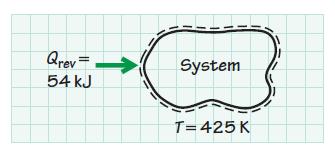
Repeat Problem 7.1 but for the case where 54 kJ of energy is removed from the system in a heat interaction. Also discuss how your result would change if the process were irreversible rather than reversible.Problem 7.1In a reversible heat interaction, 54 kJ of energy is transferred from the
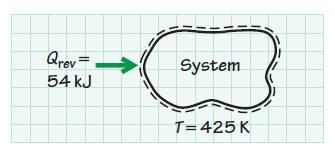
In a reversible heat interaction, 54 kJ of energy is transferred from the surroundings to a thermodynamic system. The process occurs isothermally at 425 K. Determine the entropy change of the system. How would the entropy of the system change if the process were irreversible rather than reversible?
In a reversible heat interaction, 300 Btu of energy is transferred from the surroundings to a thermodynamic system. The process occurs isothermally at 200 F. Determine the entropy change of the system. How would the entropy of the system change if the process were internally irreversible rather
Consider the same isothermal process, but now include irreversible mixing in the system that increases the entropy by 80 J/K. Determine the entropy change of the system.
During a reversible process, 15 kJ of energy is added to a system at a constant temperature of 380 K. Determine the entropy change of the system. Consider the same isothermal process but now include irreversible mixing in the system that increases the entropy by 80 J/K. Determine the entropy change
An ideal gas contained in a piston–cylinder device expands isothermally at 80° C from state 1 to state 2.A. If the expansion process is reversible and 100 kJ of heat is transferred from the surroundings to the gas, determine the increase in entropy (kJ/K) of the gas.B. What is the P–V work
An ideal gas contained in a piston–cylinder device expands isothermally at 120 F from state 1 to state 2.A. If the expansion process is reversible and 20 Btu of heat is transferred from the surroundings to the gas, determine the increase in entropy (Btu/R) of the gas.B. What is the P–v work
If a rigid system is at 350 K and the entropy of the system increases by 120 J/K in a reversible process, what is the heat transfer? Is the heat added or removed from the system?
In the cylinders of an internal combustion engine, air is compressed reversibly from 103.5 kPa and 23.9° C to 793 kPa. Calculate the work per unit mass if the process is (a) Adiabatic (b) Polytropic with n = 1.25.
If a rigid system is at 200 F and the entropy of the system decreases by 0.6 Btu/R in a reversible process, what is the heat transfer? Is the heat added or removed from the system?
Air is compressed in a reversible, steady-state, steady-flow process from 15 psia and 80 F to 120 psia. The process is polytropic with n = 1.22. Calculate the work of compression, the change in entropy, and the heat transfer, all per unit mass (lbm) of air compressed.
Air is compressed in a reversible, steady-state, steady-flow process from 15 psia and 80 F to 120 psia. The process is polytropic with n = 1.22. Calculate the work of compression, the change in entropy, and the heat transfer, all per unit mass (lbm) of air compressed.
Natural gas enters a 12-in-diameter pipeline at 300 psig and 68 F. The average velocity of the entering gas is 30 m/s. Determine the flow work rate required to push the gas into the duct. Express your result in ft ∙ lbf/s, Btu/hr, horsepower, and kW. Assume the natural gas has the properties of
Mixing of the fluid in a rigid system generates 0.05 kJ/K of entropy. What heat transfer is required to maintain the fluid temperature at 400 K during the mixing process?
Mixing of the fluid in a rigid system generates 0.03 Btu/R of entropy. What heat transfer is required to maintain the fluid temperature at 800 R?
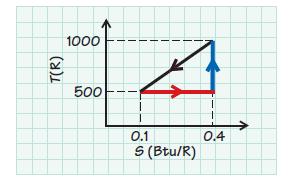
Determine the coefficient of performance of the reversible cycle shown in the sketch. T(R) 1000 500-- 1 0.1 S (Btu/R) 0.4
An ideal gas (3 lbm) in a closed system is compressed in such a way that Δs = 0 from 14.7 psia and 70 F to 60 psia. For this gas, cp = 0.238 Btu/lbm/F,cv = 0.169 Btu/ lbm · F, and R = 53.7 ft lbf/lbm · R. Compute (a) The final volume if the initial volume is 40.3 ft3 (b) The final
A piston–cylinder assembly contains oxygen initially at 0.965 MPa and 315.5°C. The oxygen then expands in such a way that the entropy s remains constant to a final pressure of 0.1379MPa. Determine the change in internal energy per kg of oxygen.
Showing 400 - 500
of 971
1
2
3
4
5
6
7
8
9
10
Step by Step Answers

 Get 50% OFF
Claim Now
Get 50% OFF
Claim Now