New Semester
Started
Get
50% OFF
Study Help!
--h --m --s
Claim Now
Question Answers
Textbooks
Find textbooks, questions and answers
Oops, something went wrong!
Change your search query and then try again
S
Books
FREE
Study Help
Expert Questions
Accounting
General Management
Mathematics
Finance
Organizational Behaviour
Law
Physics
Operating System
Management Leadership
Sociology
Programming
Marketing
Database
Computer Network
Economics
Textbooks Solutions
Accounting
Managerial Accounting
Management Leadership
Cost Accounting
Statistics
Business Law
Corporate Finance
Finance
Economics
Auditing
Tutors
Online Tutors
Find a Tutor
Hire a Tutor
Become a Tutor
AI Tutor
AI Study Planner
NEW
Sell Books
Search
Search
Sign In
Register
study help
engineering
thermodynamics concepts and applications
Thermodynamics Concepts And Applications 2nd Edition Stephen R. Turns, Laura L. Pauley - Solutions
A booster pump is used to move water from the basement equipment room to the twelfth floor of an apartment building at the rate of 363 kg/min. The elevation change is 40 m between the basement and the twelfth floor. Determine the minimum size of pump (hp) required.
The discharge of a pump is 3 m above the inlet. Water enters at a pressure of 138 kPa and leaves at a pressure of 1.38 MPa. The specific volume of the water is 0.001 m3/kg. If there is no heat transfer and no changes in kinetic or internal energies, what is the specific work (kJ/kg)?
A centrifugal pump receives liquid nitrogen at –340 F at the rate of 100 lbm/s. The nitrogen enters the pump as a liquid at 15 psia. The discharge pressure is 400 psia. Estimate the minimum size of the motor (hp) needed to drive this pump.
Water enters a pump at 10 kPa and 35° C and leaves at 5 MPa. For reversible adiabatic operation, calculate the work done per unit mass of working fluid and the exit temperature.
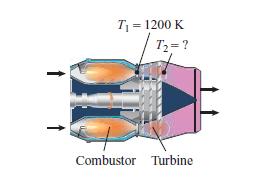
Products of combustion enter the turbine section of a jet engine at 1200 K with a flow rate of 63.5 kg/s. Determine the turbine outlet temperature if the turbine delivers 28.2 MW to drive the compressor. Assume ideal operation of the turbine and that the properties of the combustion products can be
A compressor uses air as the working fluid. The air enters at 101 kPa and 16° C and exits at 1.86 MPa and 775° C. What is the compressor isentropic efficiency?
Air is compressed from 101.3 kPa and 15° C to 700 kPa. Determine the power required to process 0.3 m3/min at the outlet if the operation is (a) Polytropic (n = 1.25) (b) Isentropic.
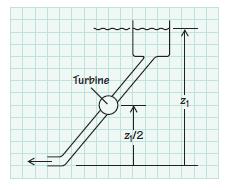
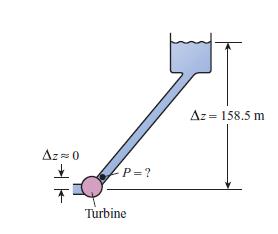
Consider the situation described in Example 8.74; however, imagine that the turbine is now located at one-half z1 and that the discharge pipe is extended down to z2 (= 0), the original discharge location. What is the ideal power produced by the turbine? Assuming the discharge pipe to be
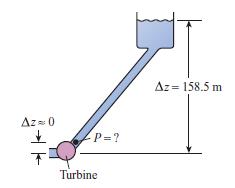
Air at 50 psia and 90 F flows at the rate of 1.6 lbm/s through an insulated ideal turbine. If the air delivers 11.5 hp to the turbine blades, at what temperature does the air leave the turbine? Δz = 0 k 1 με P=? Turbine Δ== 158.5 m
A 200-ft3/min flow of air at 14.7 psia and 60 F enters a fan with negligible inlet velocity. The fan discharge duct has a cross-sectional area of 3 ft2. The process across the fan is isentropic (reversible and adiabatic). The fan discharge pressure is 14.8 psia. Determine(a) The velocity in the
A fan is used to provide fresh air to the welding area in an industrial plant. The fan takes in outside air at 27° C and 101 kPa at a rate of 34 m3/min with negligible inlet velocity. In the 0.93-m2 duct leaving the fan, the air pressure is 6.9 kPa gage. If the process is assumed to be reversible
Water flowing at 950,000 liters/min enters a pump in a power plant at 150° C and 0.5 MPa. The pump increases the water pressure to 10 MPa (v = 0.063 m3/kg).Determine (a) The mass flow rate (kg/hr), (b) The volume flow rate at discharge (liters/min), (c) The temperature change across
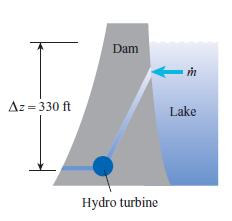
The elevation change available at the Grand Coulee Dam is 330 ft. What is the maximum possible power per unit mass flow rate that a hydro turbine can produce at this site? What mass flow rate of water is required to produce 100 MW of shaft power? Az = 330 ft Dam Hydro turbine m Lake
Air enters a multistage compressor of a jet engine at 50 kPa and 270 K with a flow rate of 40 kg/s. The compressor has an overall pressure ratio of 20:1. Determine the power required to drive the compressor and the temperature of the air at the compressor outlet. Use the following specific heat at
Solve Problem 8.59 using EES or other software.Problem 8.59Air enters a multistage compressor of a jet engine at 50 kPa and 270 K with a flow rate of 40 kg/s. The compressor has an overall pressure ratio of 20:1. Determine the power required to drive the compressor and the temperature of the air at
A turbine receives steam at a pressure of 1000 psia and 1000 F and exhausts the steam at 3 psia. The velocity of the steam at the inlet is 50 ft/s. At the outlet, which is 10 ft higher, the velocity is 1000 ft/s. Assuming that the operation is reversible and adiabatic, determine the work produced
Solve Problem 8.62 using EES or other software.Problem 8.62Determine the power required to is entropically pump 25 kg/s of water from saturated liquid at 50 kPa to 3.0 MPa. Assume incompressible flow.
Using your computer solution from Problem 8.63, vary the outflow pressure from 300 kPa to 6 MPa. Plot the power as a function of the outflow pressure. Put pressure on the abscissa (x-axis) of the plot.Problem 8.63Solve Problem 8.62 using EES or other software.Problem 8.62Determine the power
Determine the flow rate required to produce 25 MW of shaft power from a steam turbine in which the steam enters at MPa and 720 K and exits at 5 kPa for the following cases: (a) An ideal turbine (b) A turbine with an isentropic efficiency of 96%.
The steam flow rate in a power plant is 650,000 lbm/hr. The steam enters the turbine at 500 psia and 1000 F. The turbine exhaust pressure is 1.0 psia and the quality of the exiting steam is 0.925. Determine (a) The turbine power output (kW) (b) The isentropic efficiency of the turbine.
Steam expands in an ideal adiabatic turbine from 5000 kPa and 400°C to 40 kPa. Determine the turbine power output if the steam is supplied at a rate of 136 kg/s.
A small adiabatic steam turbine operating at part load produces 100 hp. The mass flow rate is 1350 lbm/hr. Steam at 450 F and 200 psia is throttled to 160 psia before entering the turbine. The turbine exit pressure is 1 psia. Determine the quality (or temperature (F), if superheated) at the turbine
A shell-and-tube heat exchanger uses 6800 kg/hr of water (cp = 4.18 kJ/kg· °C) entering at 25° C to cool 18,000 kg/h of oil (cp = 2.9 kJ/kg· °C) entering at 100° C. For a water outflow temperature of 58° C, determine the outflow temperature of the oil and the heat-transfer rate between the
A counter flow heat exchanger uses 6500 kg/hr of water (cp ≌ 4.18 kJ/kg · °C) entering at 25° C to cool 13,000 kg/hr of oil (cp = 2.09 kJ/kg · °C) entering at 100° C. If the heat-transfer rate between the streams is 75 kW, determine the outflow temperature of the two streams.
Steam flows through a turbine in a nuclear power plant at 1,230,000 lbm/hr. The turbine inlet conditions are 500 psia and 1200 F, and the turbine outlet pressure is 5 psia. Determine the maximum turbine power output.
Air at 50 psia and 90 F flows through an expander (like a turbine) at the rate of 1.6 lbm/s to an exit pressure of 14.7 psia. (a) What is the minimum temperature attainable at the expander exit if changes in kinetic energy are neglected? (b) If the inlet velocity is not to exceed 12 ft/s,
For the turbine in Problem 8.81, how does the isentropic efficiency change if the exit pressure is decreased to 35 kPa with the same outflow quality of 0.92?Problem 8.81Steam enters a turbine as a saturated vapor at 2 MPa and exits at 101 kPa with a quality of 0.92. Determine the turbine isentropic
A high-speed turbine produces 1 hp while operating on compressed air. The inlet and outlet conditions are 70 psia and 85 F and 14.7 psia and –50 F, respectively. Assume changes in kinetic and potential energies are negligible. Determine the mass flow rate.
Solve Problem 8.86 using EES or other software.Problem 8.86Steam at 600° C and 12 MPa with a flow rate of 65 kg/s enters an isentropic turbine. What is the power output from the turbine if the outflow pressure is 70 kPa?
Steam with a flow rate of 65 kg/s enters an isentropic turbine at 12 MPa and exits at 70 kPa. Using your computer solution from Problem 8.87, vary the inflow temperature from 500° C to 650° C. Plot the turbine power as a function of the inflow temperature. Put temperature on the abscissa (x-axis)
In the production of orange juice, it is desired to heat the juice from 4° C to 93° C in a tubular heat exchanger. To accomplish this task, saturated steam enters the outer tube of the heat exchanger at 150 kPa and exits as a saturated liquid at the same pressure. For an orange juice flow rate of
Water enters a heat exchanger at 180 F and 20 psia and leaves at 160 F and 19.8 psia. Air enters the heat exchanger at 70 F and 15 psia and leaves at 100 F and 14.7 psia. The mass flow rate of the water is 40 lbm/min. Determine the heat-transfer rate (Btu/min) to the air and the air mass flow rate
Water is heated by air in a heat exchanger. The water enters at 420 K and 0.3 MPa and leaves at 560 K and 0.3 MPa. The mass flow rate of the water is 1.2 kg/s. The air enters at 620 K and 0.1 MPa at a rate of 2 kg/s. Determine the heat-transfer rate between the two fluids (kW) and the exit
A steam condenser is made with 125 tube paths each having an inside diameter of 11.7 mm. Cooling water (cp = 4.18 kJ/kg · °C) enters the tubes at 42° C with an average velocity of 1.37 m/s through each tube. Saturated-vapor steam at 14 kPa condenses on the outside of the tubes. If the cooling
A one-shell-pass, two-tube-pass heat exchanger is to be used to cool ethylene glycol with water. The ethylene glycol (cp = 2.505 kJ/kg · °C) enters at 85° C flowing at 1 kg/s; the water (cp= 4.18kJ/kg · °C) enters at 15° C, flowing at 2 kg/s. If the cooling water exits the heat exchanger at
A one-shell-pass, one-tube-pass, counterflow heat exchanger is used to cool oil (cp = 1.811 kJ/kg · °C). The oil enters the shell at 120° C flowing at 15,000 kg/hr. Cooling water (cp= 4.18 kJ/kg · °C) enters the tubes at 30° C, flowing at 6500 kg/hr. If the cooling water exits the heat
Saturated steam condenses in a horizontal steam condenser at a pressure of 14 kPa. Each of the 180 parallel tubes in the condenser has an inside diameter of 12.6 mm and an average liquid water velocity of 1 m/s. If the cooling water (cp= 4.18 kJ/kg · °C) enters at 20° C and exits at 48° C, find
A 3.1-lbm mass of air is trapped in a cylinder and compressed isothermally at 85 F from 15 psia to 100 psia. During the compression, 412 Btu of energy is removed in a heat-transfer process. Determine (a) The compression ratio (= V1/V2), (b) The work required (Btu), (c) The entropy
A steam condenser is made with 115 parallel tubes each having an inner diameter of 0.584 inches. The cooling water (cp = 1.0 Btu/lbm · F) enters the tubes at 70 F with an average velocity of 5 ft/s through each tube. Saturated-vapor steam at 5 psia condenses on the outside of the tubes. If
Consider a piston–cylinder assembly containing 0.15 kg of N2 initially at 515 K and 800 kPa (state 1). The piston is such that the final pressure of the air is 175 kPa. The process occurs at a constant temperature. Determine the magnitude of the heat interaction associated with this process.
Initially, 0.5 kg of dry, saturated steam at 115° C is contained inside a spherical elastic balloon whose internal pressure is proportional its diameter. Heat is then transferred to the steam until the steam pressure reaches 0.2 MPa. Determine the final temperature (°C) and the heat
Consider the following four (A–D) closed thermodynamic systems at an instant. The systems consist of a single-phase substance.Answer the questions posed for the following scenarios:A. At a particular instant, energy enters a system as a heat interaction at a rate of 14 kJ/s. No energy leaves. Is
Pulverized coal particles at 300 K are injected into hot furnace gases at 1500 K. Estimate the initial heating rate of a 70μm-diameter particle. Express your result in kelvins per second. TXhe convective heat-transfer coefficient is approximately 1500 W/m2· K.The specific heat and density of the
Dry, saturated steam from a turbine enters a condenser at 4 kPa and exits as saturated liquid, also at 4 kPa. In the condenser, energy is removed from the steam by heat transfer to a stream of lake water. The lake water enters at 5° C and is then returned to the lake at 10° C (the maximum allowed
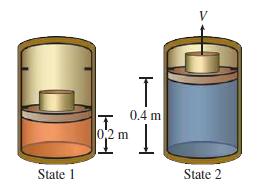
Air is contained in a piston–cylinder assembly at 2 MPa and 400 K (state 1). The 0.15-m-diameter piston is locked in place by stops at the 0.2-m position, and a 2-kg steel block sits on top of the piston, as shown in the sketch. The mass of the piston is 0.1 kg. The stops are removed and the
Consider a piston–cylinder assembly containing 0.12 kg of nitrogen initially at 700 K and 300 kPa (state 1). The piston moves such that the final volume of the nitrogen (state 2) is three times larger than the initial volume (state 1). The process occurs at constant temperature. Plot the process
Consider a piston–cylinder assembly containing 0.10 kg of air initially at 300 K and 300 kPa (state 1). The piston moves such that 35.9 kJ of work is done on the air by the surroundings. The process occurs adiabatically, i.e., there is no heat interaction. Assuming an average value of the
Consider a piston–cylinder assembly containing 0.25 kg of air initially at 750 K and 200 kPa (state 1). The piston moves such that 20 kJ of work is done on the air by the surroundings. The process occurs at constant pressure. Determine the magnitude of the heat interaction with this process.
Consider a piston–cylinder assembly containing 0.14 kg of air initially at 500 K and 250 kPa (state 1). The piston moves such that 5 kJ of work is done on the air by the surroundings. The process occurs at constant pressure. Determine the magnitude of the heat interaction associated with this
Consider a piston–cylinder assembly containing 0.08 kg of air initially at 950 K and 400 kPa (state 1). The piston moves such that 30 kJ of work is done by the air on the surroundings. The process occurs at constant pressure. Determine the magnitude of the heat interaction associated with this
Consider a piston–cylinder assembly containing 0.09 kg of air initially at 600 K and 350 kPa (state 1). The piston moves such that 18 kJ of work is done by the air on the surroundings. The process occurs at constant pressure. Determine the magnitude of the heat interaction associated with this
Consider a thermodynamic system consisting 3 kg of air. The air is compressed frictionlessly and adiabatically from 100 kPa and 300 K to 400 kPa. The process follows the path PVγ = constant (= P1V1 γ = P2V2 γ). Compute (a) The initial volume, (b) The final volume, (c) The
Consider a piston–cylinder assembly containing 0.10 kg of N2 initially at 425 K and 150 kPa (state 1). The piston moves such that the final pressure of the air is 350 kPa. The process occurs at constant temperature. Determine the magnitude of the heat interaction associated with this process.
Saturated steam is contained in a sealed rigid tank at 600 K (state 1). Energy is removed from the steam by heat transfer until a temperature of 400 K (state 2) is reached. Plot the process in P–v and T–v coordinates. Include the steam dome on your plots. Determine the following quantities for
Consider a piston–cylinder assembly containing 0.85 kg of air initially at 400 K and 620 kPa (state 1). The piston such that the final pressure of the air is 300 kPa. The process occurs constant temperature. Determine the magnitude of the heat interaction associated with this process.
While trapped in a cylinder, 2.27 kg of air is compressed isothermally (a water jacket being used around the cylinder to maintain constant temperature) from initial conditions of 101 kPa and 16°C to a final pressure of 793 kPa. For this process, determine (a) The work required (b) The
Consider a piston–cylinder assembly containing 0.09 kg of steam having a quality of 0.9 at 500 kPa (state 1). Energy added to the steam by a heat interaction at constant pressure until a temperature of 700 K is reached (state 2 Plot the process in P–v and T–v coordinates and determine
A balloon at sea level contains 2 kg of helium at 30° C and 1 atm. The balloon then rises to 1500m above sea level. At this height, the helium temperature is 6° C. Determine the change in internal energy (kJ) of the helium.
Initially, 1 kg of air at 101 kPa and 700 K is contained in a rigid tank. The tank is not insulated and cools down, as result of heat transfer to the atmosphere (Tatm = 25° C, Patm = 101 kPa), until it reaches thermal equilibrium. Determine the final pressure (kPa) and the heat transfer (kJ)
Air, initially at 205°C and 3.45 MPa, expands isothermally in a piston–cylinder device until its volume is 100 times larger than its initial volume. Determine the following:A. The increase in internal energy (kJ/kg) of the airB. The work transfer (kJ/kg) and direction into or out of the air.C.
Consider a piston–cylinder assembly containing 0.1 kg of saturated steam at 300 kPa (state 1). Energy is added the steam by a heat interaction at constant pressure until a temperature of 600 K is reached (state 2). Plot the in P–v and T–v coordinates and determine the quantities:
Superheated steam is contained in a sealed rigid tank at 600 K and 0.3 MPa (state 1). Energy is removed from the steam by heat transfer until a temperature of 350 K (state 2) is reached. Plot the process in P–v and T–v coordinates. Include the steam dome on your plots. Determine the following
Consider a piston–cylinder assembly containing 0.125 kg of wet steam with a quality of 0.45 at 300 kPa (state 1). Energy is added to the steam at constant temperature by a heat interaction until the volume of the steam is doubled (state 2). Determine the heat transfer. Give units.
Consider a piston–cylinder assembly containing 0.25 kg of wet steam with a quality of 0.85 at 400 kPa (state 1). Energy is removed from the steam at constant temperature by a heat interaction until the final volume (state 2) of the steam is one-third that of the original volume. Determine the
Saturated steam is contained in a sealed rigid tank at 500 K (state 1). Energy is removed from the steam by heat transfer until a temperature of 350 K (state 2) is reached. Determine the heat transfer.
Consider a piston–cylinder assembly containing 0.12 kg of superheated steam at 700 kPa and 800 K (state 1). Energy is removed from the steam by heat transfer until a temperature of 400 K is reached (state 2). The process is conducted at constant pressure. Determine the work and heat transfer.
Steam (13.2 kg) at 1.5 MPa with an 80% quality comprises a thermodynamic system. The steam is heated in a frictionless process until the temperature is 540 K.A. Calculate the heat transfer (kJ) if the process occurs at constant pressure.B. What is the heat transfer if the process is carried out at
Consider 1.1 kg of steam initially at 0.15 MPa and 400 K in a closed, rigid container. This steam is heated to 440 K. Determine the amount of heat added to the system in kJ.
Initially, 1 kg of water (liquid and/or vapor) at 0.1 MPa is contained in a rigid 1.5-m3 tank. The H2O is then heated and equilibrates at 300° C. Determine the final pressure (MPa) and the heat transfer (kJ). Plot the process in P–v and T–v coordinates.
Old homes are sometimes heated with so-called steam radiators. In operation, steam flows through the metal radiator causing the metal surface to become hot, which, in turn, results in heat transfer to the room air. A particular steam radiator has a volume of 0.1416m3 and initially contains dry,
An 2.27-m3 steam boiler initially contains 1.7025m3 of liquid water and 0.5675m3 of water vapor in equilibrium at 100 kPa. The boiler is fired up and the liquid and vapor in the boiler are heated. Somehow the valves on the inlet and discharge of the boiler are both left closed. The
The temperature of 150 liters of liquid water, initially at 10°C, is increased to 60°C by a 2500-W electric heater.A. Determine the total energy (MJ) required.B. Determine the length of time (hr) required.C. If electricity can be purchased for 6 cents per kW · hr, determine the cost (cents).
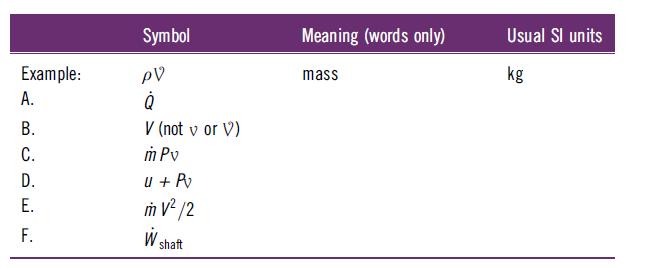
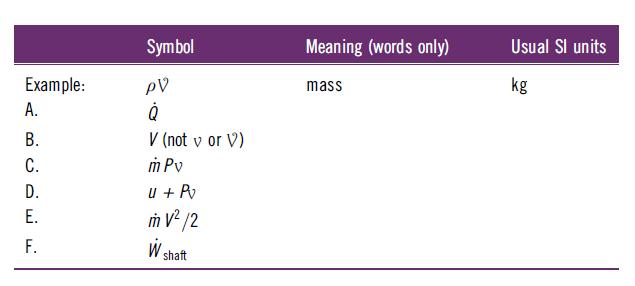
Write out in words the precise meaning of the following symbols. Be very specific, using appropriate adjectives as needed. Also provide the usual SI units associated with the quantities. If the quantity is dimensionless, write “dimensionless.” For the terms that are products of symbols, give a
A piston–cylinder assembly initially contains 0.45 kg of water at 8.0 MPa and a quality of 0.25. The water is then heated to a temperature of 760 K. The piston moves freely and maintains the cylinder contents at constant pressure. Determine the work transfer (kJ) and the heat transfer (kJ).
One kilogram of water (liquid and/or vapor) at 140 kPa is contained in a piston cylinder device. The initial volume is 0.7m3 The water is then heated until its temperature reaches 700 K. The piston is free to move up or down unless it reaches a set of stops, which piston motion. When the
A piston–cylinder device has an initial volume of 0.003m3 and contains dry, saturated water vapor at 200°C. A connecting rod attached to the piston and transfers work to (or from) the device. The piston then moves out until the volume reaches 0.015m3. The final pressure of the steam
Initially, 0.45 kg of steam at 0.7 MPa with a quality of 0.90 is held in an adiabatic cylinder fitted with a freely floating piston and paddle wheel. The paddle wheel is then turned on for 1 min. During time interval, 200 kJ of work is transferred to the steam from the paddle wheel. Use
A rigid cylinder fitted with a freely floating piston is divided into two parts (A and B) by a rigid metal partition. Initially, part contains 0.91 kg of water liquid and/or vapor) at 1.7 MPa and part B contains 0.45 kg of dry, saturated water vapor at 600 kPa. The piston and the sides of A
Compressed natural gas (CNG) is contained in a rigid tank near room temperature (300 K) and with a pressure of 6.75 MPa. CNG is cooled until it just starts to condense. Assuming the CNG can be treated as methane (CH4), answer the following:A. In what thermodynamic region does the initial
A small propane tank (V = 0.0185 m3), used to fuel a barbeque grill, is approximately half full and contains 10 pounds (4.55 kg) of propane. A fire breaks out enveloping the tank in flames. There is no pressure relief system to prevent the pressure from building up as the tank heats. If the
A 1-kg piece of iron, initially at 700° C, is quenched by dropping it into an insulated tank containing 2 kg of liquid water. The initial temperature of the water is 20° C.Determine the final temperature of the iron, assuming no water is vaporized.
A closed, rigid steel tank has an inner volume of 0.02832m3 and has a mass of 22.7 kg when empty. Initially, the tank contains 0.45 kg of water (liquid plus vapor), and the tank and the water are both at 294 K. The tank containing the water is then placed on a 45 kg slab of steel, which is at
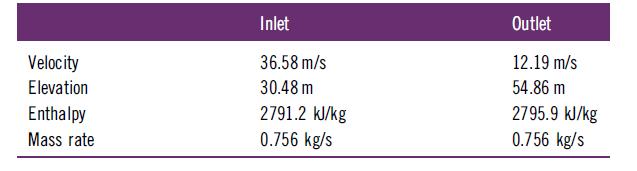
The inlet and outlet streams of an open system are described by the following information.If the net work rate out is 4.101 kW, what is the heat-transfer rate? Velocity Elevation Enthalpy Mass rate Inlet 36.58 m/s 30.48 m 2791.2 kJ/kg 0.756 kg/s Outlet 12.19 m/s 54.86 m 2795.9 kJ/kg 0.756 kg/s
A car battery is charged by applying a current of 40A at 12 V for 30 min. During the charging process, there is a heat transfer of 200 from the battery to the surroundings. Determine the increase in internal energy (Btu) of the battery.
An electric circuit consists of a 12-V storage battery, a 10-oh resistor, and an electric motor connected in parallel. If the motor produces 100mW of power, estimate the rate of energy depletion from the battery.
Which of the following are true statements? Justify your responses, true or false, with a sentence or two.cA. Enthalpy appears in the conservation of energy equation for open systems because open systems involve constant-pressure processes.B. Enthalpy appears in the conservation-of-energy equation
Consider a waterfall having a drop of 84.7 m.A. Determine the specific potential energy (J/kg) of the water at the top of the waterfall with respect to the base of the waterfall.B. Assuming no energy is exchanged with the surroundings, determine the velocity (m/s) of the water just before it
Without reference to the text, write a symbolic expression for the conservation of energy (the first law of thermodynamics) for a open system having a single inlet and a single outlet. Assume steady state. Below each term, write its meaning in words.
Repeat Problem 5.82, eliminating the assumption of a steady state.Problem 5.82Without reference to the text, write a symbolic expression for the conservation of energy (the first law of thermodynamics) for a open system having a single inlet and a single outlet. Assume steady state. Below each
Explain the origin of enthalpy in the expression of the conservation of energy for an open system.
Show in excruciating detail that the units associated with the term V2/2 are J/kg.
Mass flows through a control volume (open system) at 1 kg/s. The enthalpy, velocity, and elevation at entrance are 200 kJ/kg, 30 m/s, and 100 m, respectively. At the exit, these quantities are 198 kJ/kg, 0.3 m/s, and –3 m. Heat is transferred to the system at a rate of 5 kJ/s. How much work
Saturated steam at 0.3 MPa flows through a 5.08-cm-inside-diameter pipe at a rate of 700 kg/hr. Determine the specific kinetic energy of the steam in kJ/kg.
Steam at 580 K and 1.5 MPa enters a well-insulated steady-state device through a standard 3-inch pipeline (inside diameter = 3.068 in) at 10 ft/s. The exhaust from the device flows through a standard 10-in pipeline (inside diameter = 10.02 in) at 360 K and 35 kPa. Determine the power output of the
As a fluid flows steadily past a turbine blade with friction present, the fluid velocity drops from 400 m/s to 100 m/s while the fluid enthalpy increases by 25 kJ/kg. Assuming the process ais adiabatic, determine the specific work transfer (kJ/kg) from the fluid to the blade.
An ideal gas passes steadily through a device that increases the gas velocity from 5m/s to 300 m/s without transfer of heat or work.A. Determine the increase in specific enthalpy (kJ/kg) of the gas.B. If the specific heat of the gas is a linear function of temperature given by cp [kJ/kg · K] =
Quite some time ago, Frank Lloyd Wright designed a one-mile-high building. Suppose that, in such a building, steam for the heating system enters a pipe at ground level as dry, saturated vapor at 200 kPa. On the top floor of the building, the pressure in the pipe is 70 kPa. The heat transfer from
Water (assumed to be incompressible) is pumped at a constant rate of 22.7 kg/min through a pipeline that has an internal diameter of 50.8 mm. The pipe discharges through a nozzle that has a diameter of 25.4 mm at the exit and is at an elevation of 30 m above the inlet to the pump. At the inlet to
The manager of an amusement park at the bottom of Niagara Falls wants to install a water turbine to produce 100 kW. (assumed to be incompressible) would enter the pipeline leading to the turbine at 20°C and 0.10135MPa at the top of the falls, 51m above the turbine exit, with a velocity of 3
Water at 5 MPa and 400 K enters the steam-generating unit of a power plant and leaves the unit as steam at 5 MPa and 1000 K. The water mass flow rate is 14,000 kg/hr. Determine the capacity of the steam-generating unit in units of kJ/hr and MW.
Showing 600 - 700
of 971
1
2
3
4
5
6
7
8
9
10
Step by Step Answers

 Get 50% OFF
Claim Now
Get 50% OFF
Claim Now