New Semester
Started
Get
50% OFF
Study Help!
--h --m --s
Claim Now
Question Answers
Textbooks
Find textbooks, questions and answers
Oops, something went wrong!
Change your search query and then try again
S
Books
FREE
Study Help
Expert Questions
Accounting
General Management
Mathematics
Finance
Organizational Behaviour
Law
Physics
Operating System
Management Leadership
Sociology
Programming
Marketing
Database
Computer Network
Economics
Textbooks Solutions
Accounting
Managerial Accounting
Management Leadership
Cost Accounting
Statistics
Business Law
Corporate Finance
Finance
Economics
Auditing
Tutors
Online Tutors
Find a Tutor
Hire a Tutor
Become a Tutor
AI Tutor
AI Study Planner
NEW
Sell Books
Search
Search
Sign In
Register
study help
engineering
thermodynamics concepts and applications
Thermodynamics Concepts And Applications 2nd Edition Stephen R. Turns, Laura L. Pauley - Solutions
Air is heated from 49° C to 650° C at a constant pressure of 620 kPa. Determine the enthalpy and entropy changes for this process. Ignore any variation in specific heat and use the value at 27° C. Also determine the percentage error associated with the use of this constant value of specific heat.
During the compression stroke in an internal combustion engine, air initially at 41° C and 101 kPa is compressed is entropically to 965 kPa. Determine (a) The final temperature (°C), (b) The change in enthalpy (kJ/kg), and (c) the final volume (m3/kg).
An ideal gas expands in a polytropic process (n = 1.4) from 850 to 500 kPa. Determine the final volume if the initial volume is 100m3.
Nitrogen undergoes an isentropic process from an initial state at 425 K and 150 kPa to a final state at 600 K. Determine the density of the N2 at the final state.
The following processes constitute the air-standard Diesel cycle:1–2: isentropic compression,2–3: constant-volume energy addition (T and P increase),3–4: constant-pressure energy addition (v increases),4–5: isentropic expansion, and5–1: constant-volume energy rejection (T and P
Air is compressed in a piston–cylinder system having an initial volume of 80 in3. The initial pressure and temperature are 20 psia and 140 F. The final volume is one-eighth of the initial volume at a pressure of 175 psia. Determine the following:A. The final temperature (F)B. The mass of air
Consider a cylinder–piston arrangement trapping air at 630 kPa and 550° C. Assume the air expands in a polytropic process (PV1.3 = constant) to 100 kPa. What is the specific entropy change (kJ/kg·K)?
Air in a cylinder (V1 = 0.03m3, P1 = 400 kPa, T1 = 80° C) expands reversibly at constant temperature to a pressure of 150 kPa. Determine the entropy change, the heat transferred, and the work done. Also sketch this process on T–S and P–V diagrams.
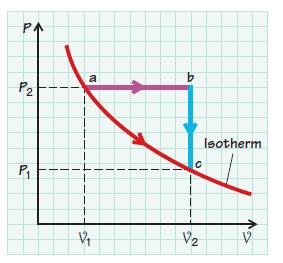
The following sketch illustrates three processes: ab, bc, and ac. Assuming constant specific heats, sketch these three processes on a T–S diagram. Assume that the working substance is an ideal gas. PA P2 P₁ a V₁ b C V₂ N Isotherm V
Air expands through an air turbine from inlet conditions of 690 kPa and 538° C to an exit pressure of 6.9 kPa in an isentropic process. Determine the inlet specific volume, the outlet specific volume, and the change in specific enthalpy.
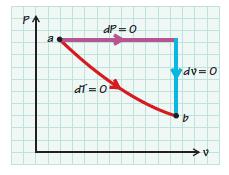
For the paths indicated in the sketch, show that the entropy change for an ideal gas by either path is the same. PA dP=0 dl=0° dv=0 b A
For a simple compressible substance with cp = a(1 + bT), where a and b are constants, determine the entropy change for an isobaric process going from T1 and T2.
Is the adiabatic compression of air from 150 kPa and 50° C to 400 kPa and 90° C possible? Assume the specific heats are constant.
A 0.5-lbm mass of air is compressed irreversibly from 15 psia and 40 F to 30 psia. During the process, 8.5 Btu of heat is removed from the air and 13 Btu of work is done on the air. Determine the entropy change of the air.
Consider a closed system (fixed mass) of air. For the following processes, indicate whether the entropy change of the system is zero, positive, negative, or indeterminate.A. Reversible cooling at constant pressureB. Irreversible cooling at constant pressureC. Reversible heating at constant
Air enters an expansion valve at 700 kPa and 200° C. If the exit pressure is 150 kPa, determine the change in the specific entropy.
A 0.5-m3 tank contains air at 300 K and 0.75MPa. A valve is suddenly opened and air rushes out until the tank pressure drops to 0.15 MPa. The air in the tank at the end of the process may be assumed to have undergone a reversible adiabatic process. Determine the final temperature (K and mass
A piston–cylinder device contains steam at 500 F and 100 psia. The piston is then slowly pushed in so that the steam undergoes a reversible, isothermal process until the pressure reaches 150 psia. Determine (a) The increase in entropy (Btu/lbm · R), (b) The heat transfer (Btu/lbm)
Is the adiabatic expansion of superheated steam from 850° C and 2.0 MPa to 650° C and 1.2 MPa possible? Explain.
Is the adiabatic compression of superheated steam from 440 K and 150 kPa to 680 K and 700 kPa possible? Explain.
Saturated vapor water (1.2 kg) in a piston–cylinder at 420 K is expanded to 100 kPa in a reversible isothermal process. Determine the work done by the water and the heat transfer during the process.
An insulated rigid tank contains two chambers, each with a volume of 0.25 m3. Air at 400 kPa and 50° C is contained in one chamber of the insulated tank. Air at 250 kPa and 200° C is contained in the other chamber of the insulated tank. The air in the two chambers is suddenly mixed when the wall
An insulated rigid tank contains two chambers, each with a volume of 0.25 m3. Air at 300 kPa and 25° C is contained in one chamber of the insulated tank. The air is suddenly expanded to twice its volume when the wall dividing the two chambers is punctured.A. Determine the final temperature and
An insulated rigid tank contains two chambers, each with a volume of 0.25 m3. Air at 400 kPa and 50° C is contained in one chamber of the insulated tank. Air at 250 kPa and 200° C is contained in the other chamber of the insulated tank. The air in the two chambers is suddenly mixed when the wall
An insulated rigid tank contains two chambers. Steam at 300 kPa and 500 K is contained in one chamber with a volume of 0.9 m3. Saturated liquid at 300 kPa is contained in the other chamber with a volume of 0.01 m3. The steam two chambers is suddenly mixed when the wall dividing the two chambers is
An insulated rigid tank with a volume of 7 m3 contains steam at 500 kPa and 480 K and a hot 5-kg steel bar. The steel bar cools until the insulated system reaches an equilibrium temperature of 520 K. For the steel bar, use ρ = 7900 kg/m3 and c = 477 J/kg · K.A. Determine the initial temperature
An insulated rigid tank with a volume of 0.2 m3 contains steam at 100 kPa and 400 K and a 4-cm3 ice cube at 0° C. Determine the equilibrium temperature of the water and the change in entropy during the process. For the ice, v = 0.00111 m³/kg, hfusion = hliq - hsolid = 333.4 kJ/kg and ASfusion =
Steam in a piston–cylinder device initially has a volume of 0.2 m3 at 300 kPa and 540 K. The steam is compressed reversibly from 300 kPa to 700 kPa at a constant temperature of 540 K. The steam temperature in the cylinder is maintained constant during this process as a result of heat transfer to
The air in a piston–cylinder device initially has a volume of 0.2 m3 at 400 kPa and 120° C. The air expands in a reversible process from 400 kPa to 150 kPa at a constant temperature of 120° C. The air temperature in the cylinder is maintained constant during this process as a result of heat
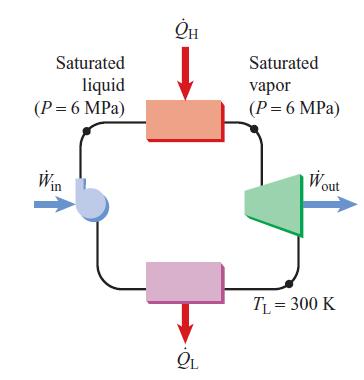
Consider a steady-flow ideal Carnot cycle, using steam as the working fluid, in which the high-temperature, constant-pressure heat-addition process starts with a saturated liquid and ends with a saturated vapor. A. Plot this cycle in T–s coordinates showing the steam dome.B. Calculate the
A closed office contains three computers each requiring 500 W to operate. The heat loss from the walls of the room to the surroundings gives a steady-state room temperature of 27° C when the computers are operating. The surrounding air is at 10° C. Determine:A. The rate change in entropy of the
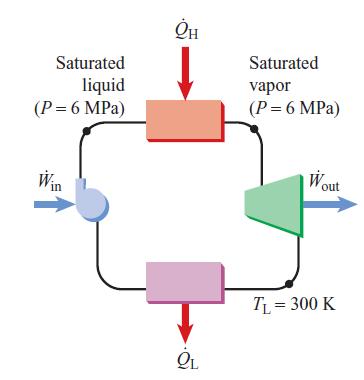
Consider the situation described in Problem 7.112. How does the thermal efficiency change if the high-temperature heat-addition process is now conducted at 15MPa instead of 6 MPa? Be quantitative. How does the net work produced per unit mass of steam (Ẇnet=ṁ) compare for the two cycles?Problem
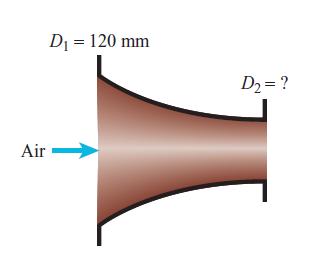
Air enters a nozzle at 1.30 atm and 25° C with a velocity of 2.5 m/s. The nozzle entrance diameter is 120 mm. The exits the nozzle at 1.24 atm with a velocity of 90 m/s. Determine the temperature of the exiting air and the nozzle exit diameter. Air D₁ = 120 mm D₂ = ?
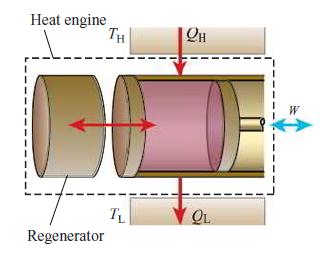
An ideal gas in a heat engine undergoes the following processes comprising a cycle in a piston–cylinder regenerator device:1–2: isothermal heating at TH from a heat source at TH,2–3: constant-volume cooling to TL by the regenerator,3–4: isothermal cooling at TL by a heat sink at TL,
Solve Problems 7.99 and 7.100 and compare your results. Why is the change in entropy of the world greater for Problem 7.100?Problem 7.100Steam in a piston–cylinder device initially has a volume of 0.2 m3 at 300 kPa and 540 K. The steam is compressed from 300 kPa to 700 kPa at a constant
An insulated 2-m3 rigid tank contains steam at 500 kPa and 580 K. A paddle mixes the steam for two minutes with a power of 50 W.A. What is the final temperature and pressure of the steam?B. What is the change in entropy of the system during this process?C. What is the change in entropy of the world
A 2-m3 rigid tank contains steam at 300 kPa and 520 K. A paddle mixes the steam for two minutes with a power of 50 W. The final temperature of the steam is 580 K. A. What is the heat transfer during the process?B. What is the change in entropy of the system during this process?C. What is the
In the cylinders of a steam engine, superheated vapor is compressed reversibly from 300 kPa and 460 K to 500 kPa. Calculate the work per unit mass if the process is (a) Adiabatic (b) Isothermal. For each case, sketch the process on P–V and T–s diagrams, showing the vapor dome. On the
Superheated steam in a cylinder (V1 = 0.03m3, P1 = 500 kPa, T1 = 520 K) is compressed reversibly at constant temperature to a pressure of 700 kPa. Determine the entropy change of the system, the heat transferred, and the work done. Also sketch this process on T–s and P–V diagrams.
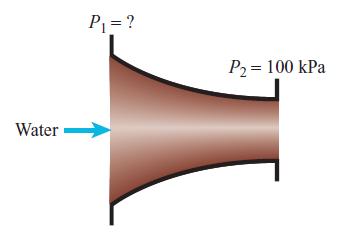
Water enters a nozzle with a velocity of 0.8 m/s and exits with a velocity of 5 m/s. The nozzle entrance diameter is 12 mm. Estimate the inlet pressure if the outlet pressure is 100 kPa and the water temperature is 300 K. Water P₁ = ? P₂ = 100 kPa
A Carnot heat engine between heat reservoirs at 550° C and 50° C delivers 420 kJ. Determine the heat transfer from the high-temperature reservoir (kJ) and the engine efficiency. Also determine the entropy change (kJ/K) associated with the high and low temperature reservoirs.
For the conditions given in part B of Problem 7.112, calculate the heat added, the heat rejected, and the net work performed (all per unit mass of steam).Problem 7.112Consider a steady-flow ideal Carnot cycle, using steam as the working fluid, in which the high-temperature, constant-pressure
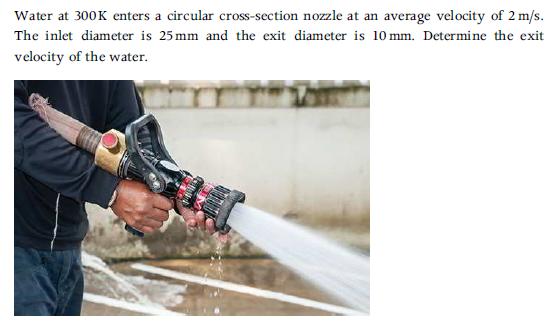
Estimate the pressure drop P1 –P2 for the nozzle and flow conditions given in Example 8.1. Assume the flow is isothermal.Example 8.1 Water at 300K enters a circular cross-section nozzle at an average velocity of 2 m/s. The inlet diameter is 25 mm and the exit diameter is 10 mm. Determine the
Air in a piston–cylinder device undergoes an internally reversible cycle. That is, the air itself undergoes a reversible set of processes, but irreversible processes (e.g., heat transfer through a finite temperature difference) are possible outside the air in the cylinder. From state 1 at 100° C
A Carnot heat engine receives 633 kJ from a reservoir at 650° C while rejecting heat at 38° C. Determine the work delivered (kJ) and the engine efficiency. Also determine the entropy change (kJ/K) associated with the high- and low temperature reservoirs.
Consider a steady-flow, ideal Carnot cycle in a closed piston–cylinder device, using steam as the working fluid, in which the high-temperature heat-addition process starts with a saturated liquid and ends with a saturated vapor. The working fluid is at 570 K during the heat-addition process and
Sketch an incompressible nozzle. How does the flow area change in th$#!#$e flow direction? How does the velocity change in the flow direction?
Steam flows through a nozzle at 105 lbm/min. The entering pressure and velocity are 250 psia and 400 ft/s, respectively; the exiting values are 1 psia and 4000 ft/s, respectively. Assuming the process is adiabatic, determine the enthalpy change of the steam (Btu/lbm).
Repeat Question 8.4 for an incompressible diffuser.Question 8.4Sketch an incompressible nozzle. How does the flow area change in the flow direction? How does the velocity change in the flow direction?
Steam at 100 lbf/in2 and 400 F enters a rigid, insulated nozzle with a velocity of 200 ft/s. The steam leaves at a pressure of 20 lbf/in2 and a velocity of 2000 ft/s. Assuming that the enthalpy at the entrance (hi) is 1227.6 Btu/lbm, determine the value of the enthalpy at the exit (he).
Sketch an isentropic and an actual nozzle process on a T–s diagram. Include the pressure contours that pass through the initial and final states.
A diffuser is an integral part of a water pump. The diameter at the entrance to the diffuser section is 30 mm and the diameter at the exit is 45 mm. Water at 300 K flows through the pump at 2.2 kg/s. Determine the pressure rise in kPa and psi associated with the diffuser.Assume that the water is
Air enters a converging nozzle at 50 m/s, 3 atm, and 300 K. Assuming an adiabatic reversible process, find the outflow velocity and temperature when the nozzle exit pressure is 1 atm.
List several devices that can act as throttles.
Steam flows through a nozzle from inlet conditions at 200 psia and 800 F to an exit pressure of 30 psia. The flow is reversible and adiabatic. For a flow rate of 10 lbm/s, determine the exit area if the inlet velocity is negligible.
Air enters a converging nozzle at 10 m/s, 250 kPa, and 300 K. Assuming an adiabatic reversible process, find the outflow velocity and temperature when the nozzle exit pressure is 150 kPa. If the inflow nozzle area is 0.1 m2, what is the area at the outflow of the nozzle?
Explain the operation and use of a throttling calorimeter.
Sketch a throttling process of an ideal gas on a T–s diagram. Include the pressure contours that pass through the initial and final states.
Steam at 2 MPa and 290° C expands to 1.400 MPa and 24x7° C through a nozzle. If the entering velocity is 100 m/s, determine (a) The exit velocity (b) The nozzle isentropic efficiency.
Distinguish between a positive-displacement pump and a dynamic (centrifugal) pump.
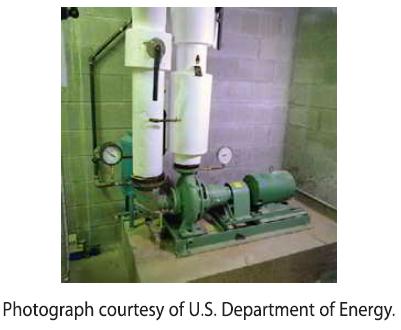
A 1-hp electric motor drives a water pump. Water enters the pump at 90 kPa and 300 K. The volumetric flow rate is 2 × 10⁻³ m3/s. Estimate the maximum possible outlet pressure of the pump when the water is considered incompressible. Photograph courtesy of U.S. Department of Energy.
Steam enters a diffuser at 700 m/s, 200 kPa, and 200° C. It leaves the diffuser at 70 m/s. Assuming reversible adiabatic operation, determine the final pressure and temperature.
Create a sketch to illustrate the difference in the geometries of a centrifugal compressor and an axial-flow compressor.
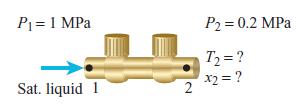
Saturated liquid water at 1 MPa enters a throttling device and exits at 0.2 MPa. Determine the temperature and quality of the exiting liquid–vapor mixture. P₁ = 1 MPa Sat. liquid 1 2 P₂ = 0.2 MPa T₂ = ? = ? x2
Define the isentropic efficiency of a pump/compressor.
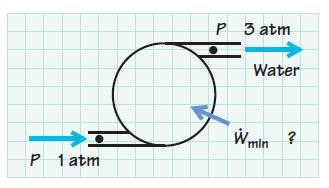
It is desired to pump water at 50 gal/min from 1 to 3 atm. The water temperature is 25° C. Determine the minimum power input required, assuming ideal frictionless operation and incompressible flow. P 1 atm P 3 atm J Water W min ?
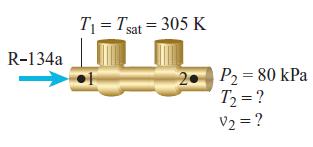
In a refrigerator, saturated liquid R-134a (a refrigerant) is throttled from an initial temperature of 305 K to a final pressure of 80 kPa. Determine the final temperature and specific volume of the R-134a. R-134a T₁=Tsat = 305 K 2. P₂=80 kPa T₂=? V₂ = ?
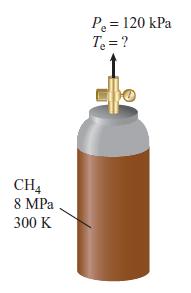
Methane stored in a tank at 8 MPa and 300 K is used as a fuel for a laboratory-scale gas-turbine combustor. The methane is throttled as it passes through a pressure regulator. The regulated pressure is 120 kPa. Determine the temperature of the methane at the exit of the pressure regulator. Assume
Sketch an isentropic and actual pumping process on a T–s diagram for a compressed liquid. Include the vapor dome and the pressure contours that pass through the initial and final states.
Sketch an isentropic and actual pumping process on a T–s diagram when the inlet flow is a saturated vapor. Include the vapor dome and the pressure contours that pass through the initial and final states.
Sketch an isentropic and actual pumping process on a T–s diagram for an ideal gas. Include the pressure contours that pass through the initial and final states.
Saturated vapor at 2 MPa is adiabatically throttled to a pressure of 150 kPa. What is the temperature after throttling? What is the change in specific entropy across the throttle? Sketch the process on a T–s diagram. Include the vapor dome and the pressure contours at the initial and final
Solve Problem 8.16 using EES or other software.Problem 8.16Air enters a converging nozzle at 10 m/s, 250 kPa, and 300 K. Assuming an adiabatic reversible process, find the outflow velocity and temperature when the nozzle exit pressure is 150 kPa. If the inflow nozzle area is 0.1 m2, what is the
List several applications of turbines. What type of turbine is typically used with the applications you list?
Using your computer solution from Problem 8.17, vary the outflow pressure from 150 kPa to 250 kPa (no nozzle). Plot T (ordinate vs. –A (abscissa). Also plot P (ordinate) vs. –A (abscissa) and V (ordinate) vs. –A (abscissa). For both of these plots, using the negative of the cross-sectional
Define the isentropic efficiency of a turbine.
Air is throttled (in a constant-enthalpy process) across a valve from 5.0 MPa and 300° C to 120 kPa. Determine the temperature and specific volume of the air downstream of the valve. Also determine the air specific entropy change across the valve (kJ/kg·K).
Sketch an isentropic and an actual turbine process on a T–s diagram when the inlet flow is a superheated vapor and the outflow is a saturated mixture. Include the vapor dome and the pressure contours that pass through the initial and final states.
Sketch an isentropic and an actual turbine process on a T–s diagram for an ideal gas. Include the pressure contours that pass through the initial and final states.
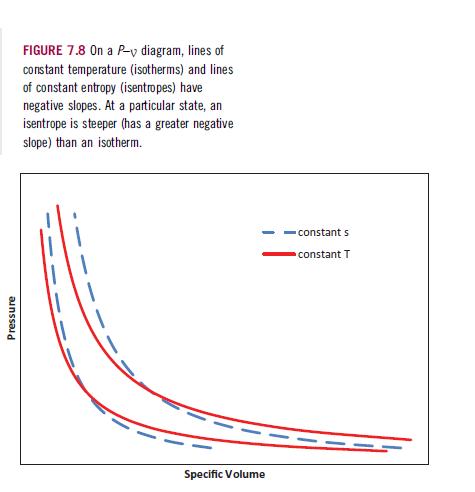
Using your computer solution from Problem 8.29, vary the outflow pressure from 100 kPa to 5.0 MPa (no throttle). Plot a P–v diagram for this range of pressures. Compare your results to Figure 7.8.Solve Problem 8.28 using EES or other software.Problem 8.28Air is throttled (in a constant-enthalpy
Distinguish among parallel-flow heat exchangers, counter flow heat exchangers, and cross-flow heat exchangers.
Determine the minimum pump power required to pump water from one reservoir to another at an elevation of 110 m above the first. The desired flow rate is 0.2 kg/s. Assume the water is at room temperature (25° C) and atmospheric pressure in each reservoir. Approximate the water as incompressible.
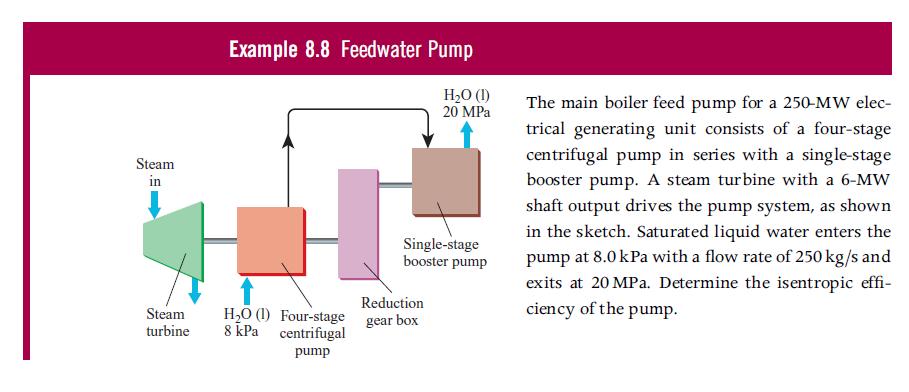
Consider a combination-boiler feed pump and booster pump similar to the arrangement shown in Example 8.8. The flow rate is 2,484,000 lbm/hr, and the specific enthalpy increase from inlet to outlet is 16.79 Btu/lbm. Saturated liquid water enters at a pressure of 1.55 in -Hg absolute. Estimate (a)
Define the heat-capacity rate.
Water at 140 °C and 10 MPa is adiabatically throttled to a pressure of 0.2 MPa. Determine the quality after throttling. What is the change in specific entropy across the throttle? Sketch this process on a T–s diagram. Include the vapor dome and the pressure contours at the initial and final
Water is throttled (in a constant-enthalpy process) across a valve from 20.0 MPa and 260° C to 0.143 MPa. Determine the temperature of the H2O downstream of the valve. What is the physical state of the H2O (i.e., superheated vapor, subcooled liquid, etc.)? Sketch the process on a T–s diagram.
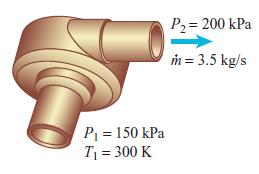
Water enters a pump at 300 K and 150 kPa and exits at 200 kPa with a flow rate of 3.5 kg/s. Estimate the shaft power required to pump the water at these conditions. Neglect all friction and heat-transfer effects. Assume the temperature of the water at the exit is approximately 300 K and regard the
Air is throttled (in a constant-enthalpy process) across a valve from 20.0 MPa and 260° C to 0.143 MPa. Determine the temperature and specific volume of the air downstream of the valve. Also determine the air specific entropy change across the valve (kJ/kg · K).
Solve Problem 8.28 using EES or other software.Problem 8.28Air is throttled (in a constant-enthalpy process) across a valve from 5.0 MPa and 300° C to 120 kPa. Determine the temperature and specific volume of the air downstream of the valve. Also determine the air specific entropy change across
Consider the situation described in Problem 8.35. If the pump exit diameter is 50 mm, determine the ratio of the pump power to the kinetic energy rate of the exiting water.Problem 8.35Water enters a pump at 300 K and 150 kPa and exits at 200 kPa with a flow rate of 3.5 kg/s. Estimate the shaft
Air enters a multistage compressor of a jet engine at 0.65 atm and 275 K with a flow rate of 63.5 kg/s. The compressor has an overall pressure ratio of 24:1 and an isentropic efficiency of 94%. Determine the power required to drive the compressor and the temperature of the air at the compressor
Steam at 10 psia with a quality of 0.90 enters an adiabatic steady-flow compressor at a rate of 50 lbm/s. The steam leaves at 400 F and 100 psia. Determine the horsepower required to drive the compressor.
Determine the power required to is entropically pump 25 kg/s of water from saturated liquid at 50 kPa to 3.0 MPa. Assume incompressible flow.
Air is compressed in a steady-flow reversible process from 15 psia and 80 F to 120 psia. Determine the work and the heat transfer per pound of air compressed for each of the following types of process: (a) Adiabatic, (b) Isothermal, (c) Polytropic (n = 1.25).
The compressor at the inlet section of a jet engine has a diameter of 4 ft and receives air at 730 ft/s and 20 F. The air is compressed reversibly and adiabatically from 4 to 36 psia. The discharge velocity is negligible. Determine the horsepower required to operate the compressor.
Air is compressed through a pressure ratio of 4:1. Assume that the process is steady-flow and adiabatic and that the temperature increases by a factor of 1.65. Calculate the entropy change.
Determine the isentropic efficiency of a water pump when water enters as a saturated liquid at 96.5 kPa and exits at 5 MPa and 106° C.
A pump delivers 160 lbm/hr of water at a pressure of 1000 psia when the inlet conditions are 15 psia and 100 F. Ignoring changes in kinetic and potential energies, find the minimum size of motor (hp) required to drive the pump.
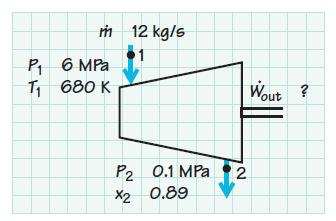
Steam enters a turbine superheated at 6 MPa and 680 K and exits the turbine at 0.1 MPa with a quality of 0.89. The steam flow rate is 12 kg/s. Determine the power delivered by the turbine. P₁ T₁ m 12 kg/s 6 MPa 680 K P2 X2 0.1 MPa 0.89 2 Wout ?
The water table of a housing development is 400 ft below the surface. You have to install a well pump that will deliver 15 gal/min of water (8.33 lbm/gal and 0.016 ft3/lbm) at a pressure of 30 psig at the surface. What horsepower motor should you use?
Showing 500 - 600
of 971
1
2
3
4
5
6
7
8
9
10
Step by Step Answers

 Get 50% OFF
Claim Now
Get 50% OFF
Claim Now