New Semester
Started
Get
50% OFF
Study Help!
--h --m --s
Claim Now
Question Answers
Textbooks
Find textbooks, questions and answers
Oops, something went wrong!
Change your search query and then try again
S
Books
FREE
Study Help
Expert Questions
Accounting
General Management
Mathematics
Finance
Organizational Behaviour
Law
Physics
Operating System
Management Leadership
Sociology
Programming
Marketing
Database
Computer Network
Economics
Textbooks Solutions
Accounting
Managerial Accounting
Management Leadership
Cost Accounting
Statistics
Business Law
Corporate Finance
Finance
Economics
Auditing
Tutors
Online Tutors
Find a Tutor
Hire a Tutor
Become a Tutor
AI Tutor
AI Study Planner
NEW
Sell Books
Search
Search
Sign In
Register
study help
engineering
thermodynamics concepts and applications
Thermodynamics Concepts And Applications 2nd Edition Stephen R. Turns, Laura L. Pauley - Solutions
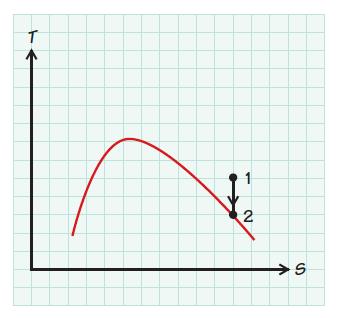
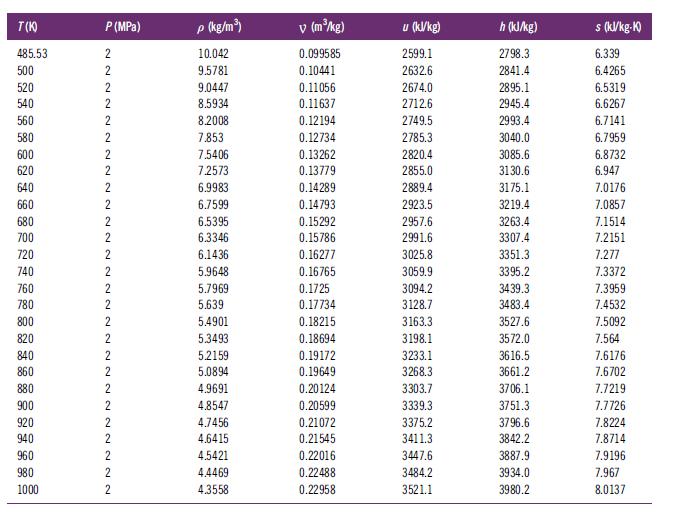
Steam expands is entropically (i.e., at constant entropy s) from 2MPa and 500 K to a final state in which the steam has become saturated vapor. What is the temperature of the steam at the final state? T 2 SE
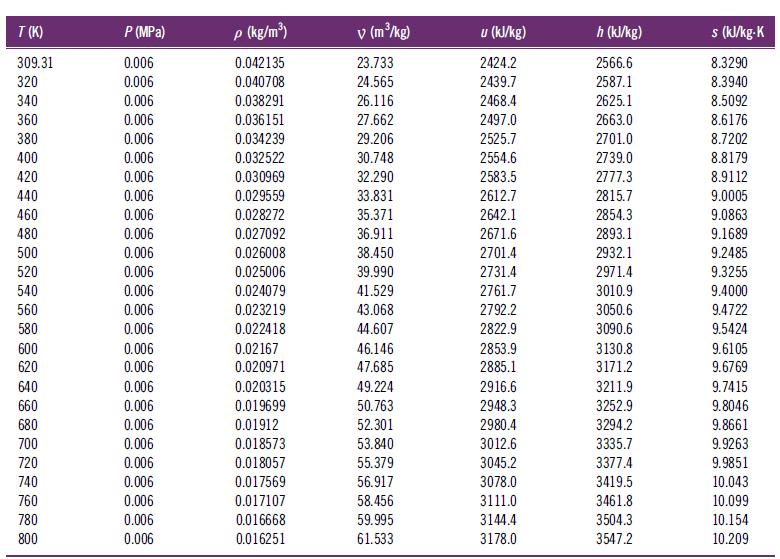
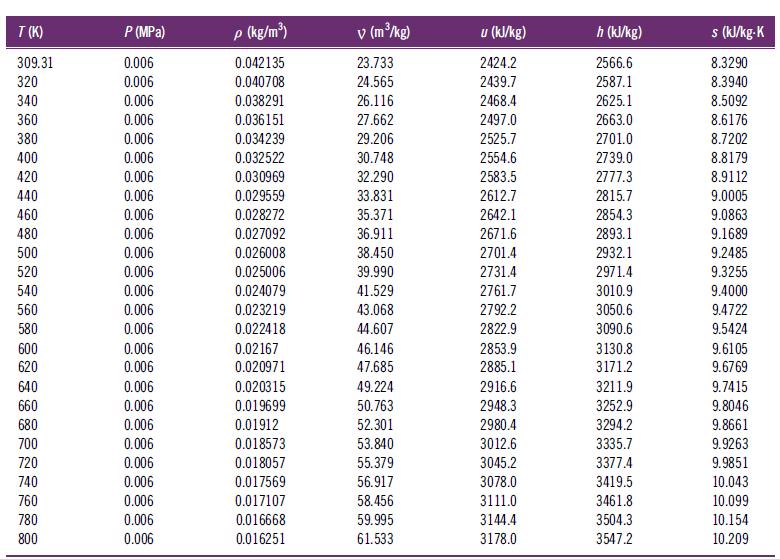
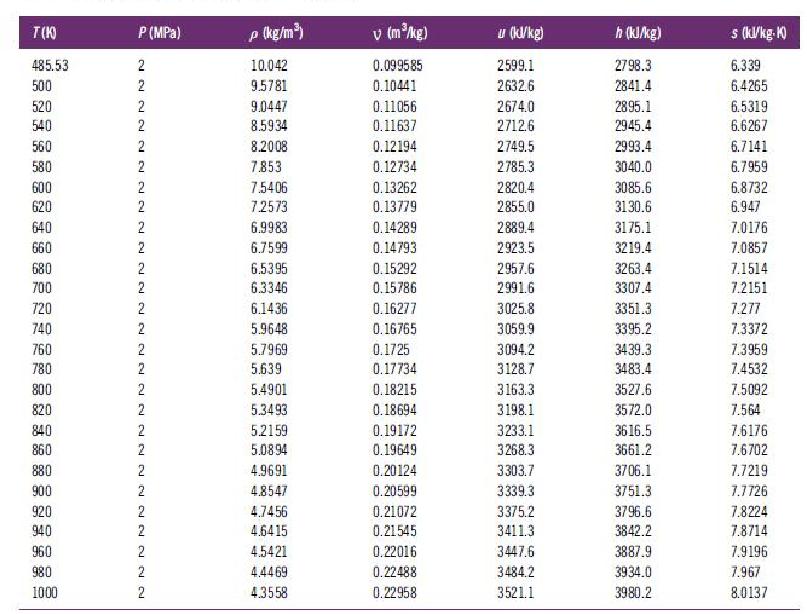
Apply interpolation to the property data in Table B.3 to determine the following properties of superheated steam:A. The specific volume at 727 K and 1.5 MPaB. The mass-specific enthalpy at 823 K and 10.0 MPaC. The mass-specific internal energy at 815 K and 0.15 MPaTable B.3 T
Water at 3.4 MPa is pumped through pipes embedded in the concrete of a large dam. The water, in picking up the heat of hydration of the concrete curing, increases in temperature from 10 °C to 40 °C. Determine(a) The change in enthalpy (kJ/kg) (b) The change in entropy of the water (kJ/kg ·
Apply interpolation to the property data in Table B.3 to determine the following properties of superheated steam:A. The specific volume at 523 K and 1.0 MPaB. The mass-specific enthalpy at 815 K and 0.3 MPaC. The mass-specific internal energy at 620 K and 4.5 MPaTable B.3 T
Steam enters the condenser of a modern power plant with temperature 32 °C and quality 0.98. The condensate (water) leaves at 7 kPa and 27 °C. Determine the change in specific volume between the inlet and outlet of the condenser in m3/kg. Use the NIST software or online database.
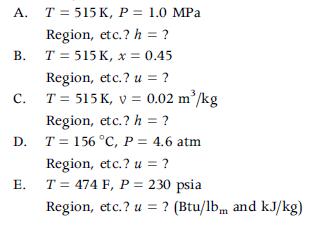
How to Use the NIST Software. Given the following property data for H2O, designate the region, line, or point in T–v or P–v space (i.e., compressed liquid, liquid–vapor mixture, superheated vapor, etc.) and find the value of the requested property. Use the NIST software mini REFPROP that you
Consider H2O at 1 MPa. Plot the following properties as a function of the quality x: T (K), h (kJ/kg), s (kJ/kg·K), and v (m3/kg). Discuss.
Consider identically sized blocks (30 × 250 × 200mm3) of pure aluminium, pure copper, and pure iron. Equal amounts of energy are added to each block such that the internal energy increases by 600 kJ in the process. Estimate the final temperature of each block if the initial temperature is 300 K.
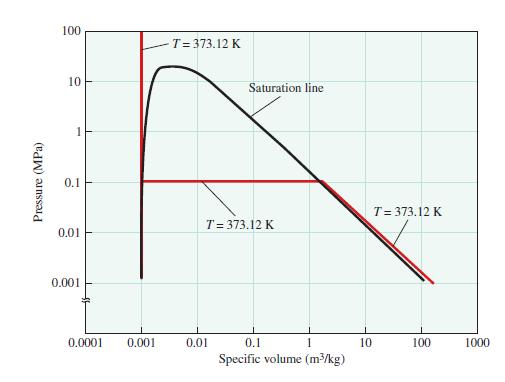
Use EES or NIST to generate a P–v diagram for water that includes:A. Constant temperature curves at 300 K, 373 K, and 450 K that extend from compressed liquid to superheated vapor;B. The vapor dome showing the saturated liquid and vapor conditions;C. A linear scale for the pressure and specific
A 7.57-m3 rigid tank contains 0.546 kg of H2O at 37.8° C. The H2O is then heated to 204.4° C. Determine (a) the initial and final pressures of the H2O in the tank (MPa) and (b) the change in internal energy (kJ).
A 2.7-kg mass of H2O is in a 0.566-m3 container (liquid and vapor in equilibrium) at 700 kPa. Calculate (a) the volume and mass of liquid and (b) the volume and mass of vapor in the container.
Determine the mass-specific enthalpy (Btu/lbm) of superheated ammonia vapor at 1.3 MPa and 65 °C. Use the NIST WebBook.
Given the following property data for H2O, designate the region (or line or point) in T–v or P–v space (i.e., compressed liquid, liquid–vapor mixture, superheated vapor, saturated liquid, etc.) and find the value of the requested property. Use the tables in Appendix B and then verify your
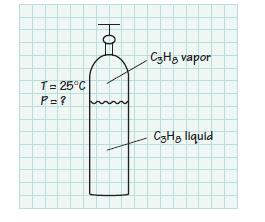
How to Use the NIST Software.A. At room temperature (25 °C), what pressure (in both kPa and psi) is required to liquefy propane (C3H8)?B. Determine values of the specific volume of the saturated vapor and saturated liquid. Also determine their ratios.C. Determine the enthalpy of vaporization hfg
Steam expands is entropically (i.e., at constant entropy s) from 6 MPa and 1000 K to 1 MPa. Determine the temperature at the final state. Also determine the specific enthalpy change for the process, (i.e., h2 – h1).
Plot the 1-atm isobar for H2O in T–v coordinates. Start in the compressed liquid region, continue across the liquid–vapor dome, and end well into the superheated-vapor region. Given the following property data for H2O, designate the region (or line or point) in T–v or P–v space (i.e.,
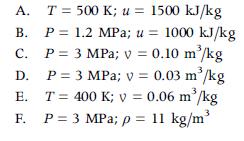
Determine the temperature and or quality of H2O for the following states. Use the Appendix B tables, not the NIST software. Some single interpolation may be required (but no double interpolation). Indicate the tables used. A. B. C. D. E. F. T = 500 K; u = 1500 kJ/kg P = 1.2 MPa; u = 1000 kJ/kg P =
A piston–cylinder assembly contains steam initially at 0.965 MPa and 315.6 °C. The steam then expands in an isentropic process (i.e., at constant entropy s) to a final pressure of 0.138 MPa. Determine the change in mass-specific internal energy. Use the NIST software or online database for
liquid–vapor mixture of H2O at 2 MPa is heated in a constant-volume process. The final state is the critical point. Determine the initial quality of the liquid–vapor mixture.
Use EES or NIST to plot the following states as a cycle on a P–v diagram and a T–s diagram. Include the vapor dome on each plot.1. Saturated liquid water at 3 MPa.2. Saturated vapor water at 3 MPa.3. Saturated mixture at 30 kPa and the same entropy as state 2 (s3 = s2).4. Saturated liquid water
Use EES or NIST to plot the following states as a cycle on a P–v diagram and a T–s diagram. Include the vapor dome on each plot.1. Saturated liquid water at 3 MPa.2. Saturated vapor water at 3 MPa.3. Superheated water at 3 MPa and 640 K.4. Saturated mixture at 30 kPa and the same entropy as
How to Use the NIST Software, paying particular attention to how to use the various units. Water flows through a hot water heater at 2.0 gal/min, entering at 50 F and 40 psig. The water leaves the heater at 160 F and 39 psig. The barometric pressure is one standard atmosphere. Determine the change
Water at 200 kPa-gage is heated from 17 °C to 46 °C. The atmospheric pressure is 100 kPa. Determine the change in mass specific enthalpy for this process.
A piston–cylinder arrangement contains 0.05 m3 of liquid water and 2.0 m3 of water vapor in equilibrium at 1.5 MPa. Heat crosses the boundary from the surroundings to the H2O at constant pressure until the temperature reaches 700 K. Use tables, not the NIST software, to solve this problem.A.
Draw from memory (or familiarity) a pressure–specific volume (P–v) diagram for H2O. Show an isotherm that begins in the compressed-liquid region and ends in the superheated-vapor region. Label all lines and regions and indicate the critical point.
Draw from memory (or familiarity) a temperature specific-volume (T–v) diagram for H2O. Show an isobar that begins in the compressed-liquid region and ends in the superheated-vapor region. Label all lines and regions and indicate the critical point.
Is steam at 10 MPa and 500 °C close to behaving as an ideal gas? Discuss.
Create the requested plots for air, assuming ideal-gas behavior.A. Sketch isotherms on a pressure–specific-volume (P–v) plot for temperatures of 610 and 830 K with specific volumes ranging from 0.2 to 1.0 m3/kg. Label the isotherms.B. Sketch two isobars on a temperature–specific-volume
Determine the density of methane (CH4) at 300 K and 40 atm. Compare the results obtained by assuming ideal-gas behavior, by using the generalized compressibility chart, and by using the NIST software or online database. Discuss.
Consider steam. Plot the 500-K isotherm in P–v space using the NIST online database as your data source. Also plot on the same graph the 500-K isotherm assuming ideal-gas behavior. Start (actually, end) the isotherm at the saturated vapor line. Use a sufficiently large range of pressures that the
Determine the density of oxygen (O2) at 250 K and 50 atm. Compare the results obtained by assuming ideal-gas behavior, by using the generalized compressibility chart, and by using the NIST software or online database. Discuss.
Carbon dioxide (CO2) is heated in a constant-pressure process from 15° C and 101.3 kPa to 86° C. Determine, per unit mass, the changes in:(a) Enthalpy(b) Internal energy(c) VolumeAll in SI units. Use the NIST software or online database to find these quantities.
Use the van der Waals equation of state to determine the density of propane (C3H8) at 400 K and 12.75 MPa. How does this value compare with that obtained from the NIST software or online database?
Use the van der Waals equation of state to determine the density of propane (C3H8) at 300 K and 800 kPa. How does this value compare with that obtained from the NIST software or online database?
Use the van der Waals equation of state to determine the density of methane (CH4) at 300 K and 5 MPa. How does this value compare with that obtained from the NIST software or online database?
Create the requested plots for air, assuming ideal-gas behavior.A. Sketch isotherms on a pressure–specific-volume (P–v) plot for temperatures of 360 and 520 K with specific volumes ranging from 0.2 to 1.0 m3/kg. Label the isotherms.B. Sketch two isobars on a temperature–specific-volume
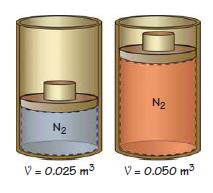
Nitrogen in a cylinder slowly expands from an initial volume of 0.025m3 to 0.05m3 at a constant pressure of 400 kPa. Determine the final temperature if the initial temperature is 500 K. Plot the process in P–v and T–v coordinates using spreadsheet software. N₂ V = 0.025 m³ N₂ V = 0.050 m³
Nitrogen in a cylinder is slowly compressed from an initial volume of 0.06m3 to 0.03m3 at a constant temperature of 400 K. Determine the final pressure if the initial pressure is 500 kPa. Plot the process in P–v and T–v coordinates using spreadsheet software.
Nitrogen in a cylinder slowly expands from an initial volume of 0.025m3 to 0.05m3 at a constant temperature of 500 K. Determine the final pressure if the initial pressure is 600 kPa. Plot the process in P–v and T–v coordinates using spreadsheet software.
Create the requested plots for air, assuming ideal-gas behavior.A. Sketch isotherms on a pressure–specific-volume (P–v) plot for temperatures of 360 and 520 K with specific volumes ranging from 0.2 to 1.0 m3/kg. Label the isotherms.B. Sketch two isobars on a temperature–specific-volume
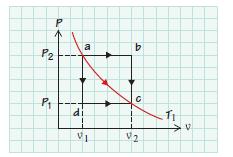
Consider the five processes α–b, b–c, c–d, d–a, and a–c shown below, as sketched in P–v coordinates. Show the same processes in P–T and T–v coordinates assuming ideal-gas behavior. PE P2 P₁ a di 1 VI b C V2 1₁ V
Using P –v coordinates, sketch a process in which the product of the pressure and specific volume is constant from state 1 to state 2. Assume an ideal gas. Also assume P1 > P2. Show this same process on P–T and T– v diagrams.
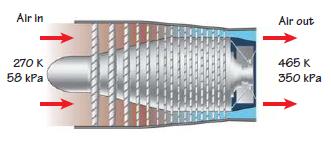
Air is compressed in the compressor of a turbojet engine. The air enters the compressor at 270 K and 58 kPa and exits the compressor at 465 K and 350 kPa. Determine the mass specific volume, enthalpy, and internal energy changes associated with the compression process. Air In 270 K 58 kPa Air
Calculate the mass-specific volume and enthalpy changes for air undergoing a change of state from 400 K and 2 atm to 800 K and 7.2 atm.
Air is compressed in a piston–cylinder system having an initial volume of 80 in3. The initial pressure and temperature are 20 psia and 140 F. The final volume is one eighth of the initial volume at a pressure of 175 psia. Determine the following:A. The final temperature (F)B. The mass of air
A. Determine the density of air at Coors Stadium in Denver, Colorado, on a warm summer evening when the temperature is 78 F. The barometric pressure is 85.1 kPa.B. Assume to a first approximation that the drag force exerted on a well-hit baseball arcing to the outfield, or beyond, is proportional
In a fixed-mass system, 1.8 kg of air is heated at constant pressure (200 kPa) from 278 K to 333 K. Determine the change in internal energy (kJ) for this process assuming an average constant-volume molar specific heat Cv,avg of 20.76 kJ/kmol·K. The specific heat ratio γ is 1.4.
Perform the temperature conversions as requested.A. For safety, cans of whipped cream (with propellant) should not be stored above 120 F. What is this temperature expressed on the Rankine, Celsius, and Kelvin temperature scales?B. Albuterol inhalers, used for the control of asthma, are to be stored
Consider the following gases for conditions under which ideal-gas behavior occurs: argon, helium, hydrogen, nitrogen, and oxygen.A. Rank the gases from that with the greatest density to that with the least density for fixed temperature and pressure.B. Rank the pressures associated with the five
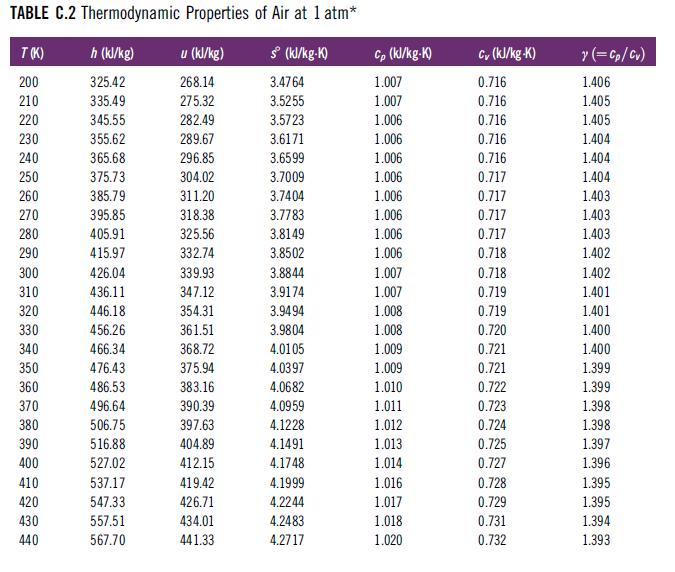
Use Table C.2 to calculate the mass-specific enthalpy change for air undergoing a change of state from 300 K to 1000 K. How does this value compare with that estimated using the constant-pressure specific heat at the average temperature, Tavg = (300 + 1000)/2? TABLE C.2 Thermodynamic Properties of
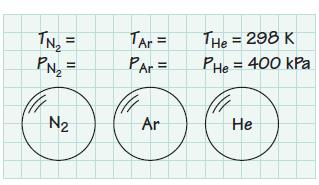
Consider three 0.03-m3 tanks filled, respectively, with N2, Ar, and He. Each tank is filled to a pressure of 400 kPa at room temperature, 298 K. Determine the mass of gas contained in each tank. Also determine the number of moles of gas (kmol) in each tank. = PN₂ = 3 N₂ TAr = PAr = Ar THE = 298
A piston–cylinder arrangement in an air separation plant contains nitrogen at 21 °C and 1.379 MPa. The piston moves and compresses the nitrogen from 98 to 82 cm3. The final (equilibrium) temperature is 27 °C. Determine the final pressure (in kPa).
Pure carbon dioxide flows through a pipe in a vacuum process at 49 °C and 0.8 kPa. Determine the specific volume (m3/kg) of the CO2. How does this value compare to that for air at the same temperature and pressure?
Air cools an electronics compartment by entering at 300 K and leaving at 340 K. The pressure is essentially constant at 101.3 kPa. Determine (a) the change in the mass-specific internal energy of the air as it flows through the compartment and (b) its change in specific volume.
As air flows across the cooling coil of an air conditioner at a rate of 3856 kg/hr, the temperature of the air drops from 26 °C to 12 °C. Determine the average. internal energy rate of change in kJ/hr. Sketch the process in mass-specific enthalpy–temperature (h–T) coordinates.
Hydrogen is compressed in a cylinder from 101 kPa and 15 °C to 5.5 MPa and 121 °C. Determine the changes in specific volume (Δv), mass-specific internal energy (Δu), and mass-specific enthalpy (Δh).
Determine the mass-specific internal energy for O2 at 900 K for a reference-state temperature of 298.15 K. Also determine the constant-volume mass-specific heat.
Compare the specific enthalpy change calculated in Problem 2.69 with the change determined directly from the ideal-gas tables. Also compare these values with that obtained from the NIST software or online database at 1 atm.Problem 2.69Compute the mass-specific enthalpy change associated with N2
Compute the mass-specific enthalpy change associated with N2 that is undergoing a change in state from 400 K to 800 K. Assume the constant-pressure specific heat is constant for your calculation. Use the arithmetic average of the values at 400 K and 800 K.
The constant-pressure specific heat of a gas is 0.24 Btu/lbm.R at room temperature Determine the specific heat in units of kJ/kg·K.
Determine the mass of air in a room that is 15m by 15m by 2.5m if the temperature and pressure are 25 °C and 1 atm, respectively. How does this mass compare with your body mass?
Hot air is contained in a piston–cylinder arrangement as shown in the sketch for Problem 2.54. The specific volume of the air is 0.25 m3/kg. The piston has a diameter of 6 cm and a mass of 95 kg. The gas forces on each side of the piston, assuming there are no frictional forces at the
Nitrogen (3.2 kg) at 348 °C is contained in a vessel having a volume of 0.015m3. Use the ideal-gas equation of state to determine the pressure of the N2. If the N2 is replaced by the same mass of hydrogen at the same temperature, does the pressure increase, decrease, or remain the same. Explain.
Hot air is contained in a piston–cylinder arrangement as shown in the sketch for Problem 2.54. The density of the air is 3.6 kg/m3. The piston has a diameter of 5 cm and a mass of 110 kg. The gas forces on each side of the piston, assuming there are no frictional forces at the
The temperature of an ideal gas remains constant while the pressure changes from 101 kPa to 827 kPa. If the initial volume is 0.08m3, what is the final volume?
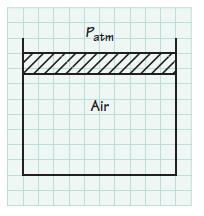
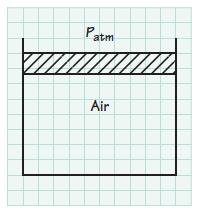
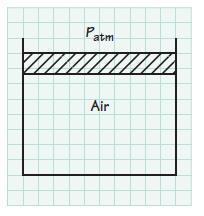
Consider the piston–cylinder arrangement shown in the sketch below. The gas forces on each side of the piston, assuming there are no frictional forces at the piston–cylinder interface, balance the weight of the piston. Determine the absolute pressure of the air (in psia) and the mass of air in
A piston–cylinder assembly (see the above sketch) contains 0.006m3 air at 20 °C. The gas forces on each side of the piston, assuming there are no frictional forces at the piston–cylinder interface, balance the weight of the piston. The piston has a cross-sectional area of 100 cm2 and a mass of
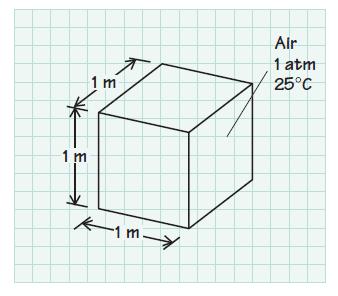
What is the mass of a cubic meter of air at 25 °C and 1 atm? How many times greater is the mass of a cubic meter of liquid water? Assume the density of water is approximately 1000 kg/m3. * 1m 1 m K -1 m Air 1 atm 25°C
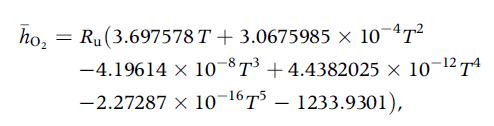
For temperatures between 300 and 1000 K and at 1 atm, the molar specific enthalpy of O2 is expressed by the following polynomial:where h̅ is expressed in kJ/kmol and T in kelvins.Determine the constant-pressure molar-specific heat c̅p at 500 K and at 1000 K. Compare the magnitudes of the values
A piston–cylinder assembly (see sketch) contains 0.005m3 air at 29.4 °C. The gas forces on each side of the piston, assuming there are no frictional forces at the piston-cylinder interface, balance the weight of the piston. The piston has a cross-sectional area of 20.2 in2 and a mass of 160.6
Hot air (at 50 °C) is contained in a piston–cylinder arrangement as shown in the sketch for Problem 2.54. The volume of the air is 250 cm3. The piston has a diameter of 4 cm and a mass of 49 kg. The gas forces on each side of the piston, assuming there are no frictional forces at the
Determine the number of kmols of carbon monoxide contained in a 0.027-m3 compressed-gas cylinder at 200 psia and 72 F. Assume ideal-gas behavior. Also, determine the weight of the gas, assuming standard gravitational acceleration. What common items (bananas, apples, etc.) have about the same
A compressor pumps air into a tank until a pressure gage reads 120 psi. The temperature of the air is 85 F, and the tank is a 0.3-m-diameter cylinder 0.6m long. Determine the mass of the air contained in the tank in grams. What common items (pencils, apples, etc.) have about the same mass?
At 600 K and 0.10 MPa, the mass-specific internal energy of some water vapor is 2852.4 kJ/kg and the specific volume is 2.7635m3/kg. Determine the density and mass-specific enthalpy of the water vapor. Also, determine the molar specific internal energy and enthalpy.
At 0.3 MPa, the mass-specific internal energy and enthalpy of a substance are 3313.6 J/kg and 3719.2 J/kg, respectively. Determine the density of the substance at these conditions.
Which of the following statements are true? Justify your choices by writing a sentence or two.A. For a simple compressible substance, the only forces that can act are pressure and gravitational body forces.B. The thermodynamic state of a simple compressible substance is defined by two extensive
A tank having a volume of 2m3 contains 6.621 kg of water vapor at 1 MPa. The internal energy of the water vapor is 19,878 J. Determine the density, the mass-specific internal energy, and the mass-specific enthalpy of the water vapor, using the given information.
Write out the state principle for a simple compressible substance and illustrate this principle with a specific example.
A cylinder containing a gas is fitted with a piston as illustrated above. Assume that there is no frictional force at the piston–cylinder-wall interface. The mass of the piston is 200 kg. The atmospheric pressure is 99 kPa, and the local acceleration due to gravity is 9.81 m/s2. The absolute
Demonstrate your knowledge of the following thermodynamics concepts by writing brief paragraphs as directed:A. Discuss the relationships among properties, states, and processes.B. Describe the continuum limit. Indicate why it is important to your study of thermodynamics.C. Explain the difference
Create a table with the following symbols as the first column: Ru, γ, U, h, and cv. In the second column, write out in words the precise meaning of these symbols. Be very specific, using appropriate adjectives as needed. In the third column, indicate whether the symbol represents an extensive or
A cylinder containing a gas is fitted with a piston having a diameter of 0.12 m. Assume that there is no frictional force at the piston–cylinder wall interface. The atmospheric pressure is 100 kPa and the local acceleration due to gravity is 9.81 m/s2. To produce an absolute pressure in the gas
Convert the following Celsius temperatures to Fahrenheit: (a) –30°C(b) –10°C(c) 0°C(d) 200°C(e) 1050°C.
A. What is the microscopic interpretation of internal energy for a monatomic gas?B. What is the microscopic interpretation of internal energy for a gas comprising diatomic molecules?
The constant-volume molar-specific heat of nitrogen (N2) at 1000K is 24.386 kJ/kmol·K and the specific-heat ratio γ is 1.3411. Determine the constant-pressure molar-specific heat and the constant-pressure mass-specific heat of the N2.
A cylinder containing a gas is fitted with a piston (see the above sketch). The cross-sectional area of the piston is 0.029m2. Assume that there is no frictional force at the piston–cylinder wall interface. The atmospheric pressure is 0.1035 MPa and the acceleration due to gravity is 30.1 ft/s2.
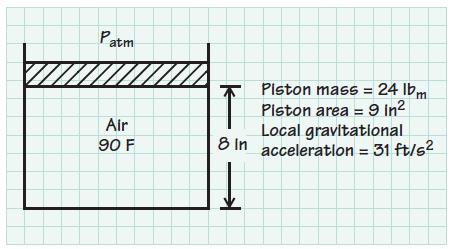
A vertical cylinder containing air is fitted with a freely moving (frictionless) piston of 68 lbm and cross-sectional area 35 in2. The ambient pressure outside the cylinder is 14.6 psia, and the local acceleration due to gravity is 31.1 ft/s2. Determine both the absolute and gage pressures (psi) of
How fast, on average, do nitrogen molecules travel at room temperature (25° C)? How does this speed compare to the average speed of a modern jet aircraft that travels 2500 miles in 5 hours?
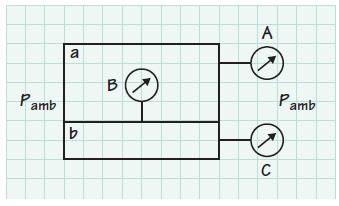
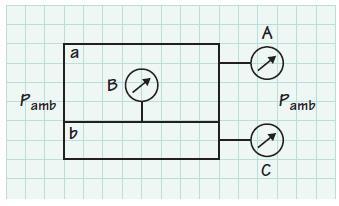
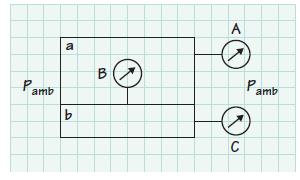
The sketch for Problem 2.22 shows a compartment divided into two sections a and b. The ambient barometric pressure reading is 28.0 inches of mercury (absolute). Gage A reads 5 kPa and gage B reads 150 kPa. Determine the reading of gage C and convert this reading to an absolute value. Problem
The sketch for Problem 2.22 shows a compartment divided into two sections a and b. The ambient barometric pressure reading is 29.0 inches of mercury (absolute). Gage A reads 435 kPa and gage B reads 150 kPa. Determine the reading of gage C and convert this reading to an absolute value. Problem
The sketch for Problem 2.22 shows a compartment divided into two sections a and b. The ambient barometric pressure reading is 30.0 inches of mercury (absolute). Gage C reads 615 kPa and gage B reads 312 kPa. Determine the reading of gage A and convert this reading to an absolute value. Problem
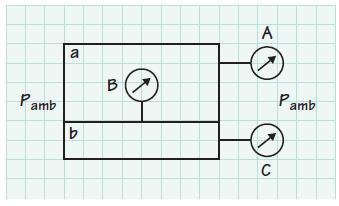
The accompanying sketch shows a compartment divided into two sections a and b. The ambient barometric pressure reading is 30.0 inches of mercury (absolute). Gage C reads 620,528 Pa and gage B reads 275,790 Pa. Determine the reading of gage A and convert this reading to an absolute value.
The pressure in a partially evacuated enclosure is 26.8 inches of mercury when the local barometer reads 29.5 inches of mercury. Determine the absolute pressure in units of inches of mercury, psia, and atm.
An instrument used to measure the concentration of the pollutant nitric oxide uses a vacuum pump to create a vacuum of 28.0 inches of mercury in a reaction chamber. What is the absolute pressure in the chamber if the barometric pressure is 1.05 atm? Express your result in psia, millimeters of
A pressure gage connected to a water line reads 60 psig. The local barometric pressure reading is 27.8 inches of mercury. Calculate the absolute pressure in units of psia, psfa (pounds-force per square foot absolute), kPa, and atm.
An unknown liquid is contained in a cylindrical tank. The tank has diameter 0.35 m, and the liquid depth is 0.6 m. The liquid weighs 1920 N. Determine the specific volume of the liquid. Assume standard earth gravity and a barometric pressure of 98 kPa.
A pressure gage connected to a natural gas pipeline reads 150 kPa. The local barometric pressure reading is 29.5 inches of mercury. Calculate the absolute pressure in units of psia, psfa (pounds-force per square foot absolute), and atm.
An instrument used to measure the concentration of the pollutant nitric oxide uses a vacuum pump to create a vacuum of 28.3 inches of Mercury in a reaction chamber. What is the absolute pressure in the chamber if the barometric pressure is 1 standard atmosphere? Express your result in psia,
A. An air compressor fills a tank to a gage pressure of 100 psi. The barometric pressure is 751 millimeters of mercury. What is the absolute pressure in the tank in kPa?B. The air in the tank is bled out through a valve, the valve is closed, and the tank and its contents sit out overnight. The
A pressure gage connected to a compressed air tank reads 325 kPa. The local barometric pressure reading is 28.3 inches of mercury. Calculate the absolute pressure in units of psia, psfa (pounds-force per square foot absolute), and atm.
Showing 800 - 900
of 971
1
2
3
4
5
6
7
8
9
10
Step by Step Answers

 Get 50% OFF
Claim Now
Get 50% OFF
Claim Now