New Semester
Started
Get
50% OFF
Study Help!
--h --m --s
Claim Now
Question Answers
Textbooks
Find textbooks, questions and answers
Oops, something went wrong!
Change your search query and then try again
S
Books
FREE
Study Help
Expert Questions
Accounting
General Management
Mathematics
Finance
Organizational Behaviour
Law
Physics
Operating System
Management Leadership
Sociology
Programming
Marketing
Database
Computer Network
Economics
Textbooks Solutions
Accounting
Managerial Accounting
Management Leadership
Cost Accounting
Statistics
Business Law
Corporate Finance
Finance
Economics
Auditing
Tutors
Online Tutors
Find a Tutor
Hire a Tutor
Become a Tutor
AI Tutor
AI Study Planner
NEW
Sell Books
Search
Search
Sign In
Register
study help
engineering
thermodynamics concepts and applications
Thermodynamics Concepts And Applications 2nd Edition Stephen R. Turns, Laura L. Pauley - Solutions
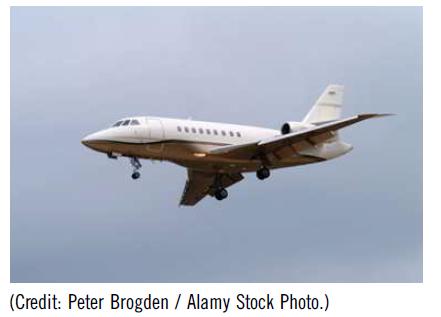
The Dassault Falcon aircraft is powered by two TF37 turbofan jet engines. At a cruise condition, each engine consumes fuel at a rate of 0.232 kg/s with a concomitant air consumption of 16.4 kg/s. The fuel blend can be approximated as C12H22, and the air composition can be assumed to be 21% O2 and
Carbon is burned with exactly the right amount of air (79% N2 and 21% O2 by volume) to form carbon dioxide.A. Determine the air–fuel ratio (by mass).B. Determine the mass of carbon dioxide per mass of fuel.C. Determine the mass of carbon dioxide formed per mass of air.
Calculate and compare the stoichiometric air–fuel mass ratios for the following common fuels. Assume that air is a simple mixture of O2 and N2 in molar proportions of 1:3.76.A. Natural gas (assume it is essentially all methane, CH4)B. Liquified petroleum gas (assume it is essentially all propane,
An automobile is traveling at 55 mph on a highway. The car’s engine is operating at 2000 revolutions per minute. The engine fills its cylinders with air each time two revolutions are completed, i.e., it operates on a four-stroke cycle. The volume of air ingested during each cycle is 95% of the
The car in Problem 12.16 operates on liquefied petroleum gas (LPG). Assume the LPG can be approximated as C3H8. Assume the air composition is that of “simple air,” i.e, 1 kmol of O2 for every 3.76 kmol of N2. The engine operates at stoichiometric conditions, i.e., the mass air-to-fuel ratio is
A hydrocarbon fuel is burned with air. Assume the air to be a simple mixture of 21% O2 and 79% N2. On a dry basis (all the water vapor has been removed from the products), a volumetric analysis of the products of combustion yields the following:CO2: 7.8%,CO: 1.1%,O2: 8.3%,N2: 82.8%.Determine
Derive that (x + y/4)/Φ is the oxidizer coefficient a in the combustion reactionwhere Φ is the air–fuel equivalence ratio. Start by considering the case where Φ = 1; i.e., by doing C, H, O, and N balances you get a = x + y/4 when the mixture is in stoichiometric proportions. Then show how Φ
Natural gas is burned to produce hot water to heat a clothing store. Assuming that the natural gas can be approximated as methane (CH4) and that the air is a simple mixture of O2 and N2 in molar proportions of 1:3.76, determine the following:A. The molar air–fuel ratio for stoichiometric
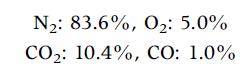
One mole of a hydrocarbon fuel (CHx) is burned with excess air. The volumetric analysis of the dry products (with H2O removed) yields:A. Determine the approximate composition of the fuel on a mass basis.B. Determine the percent theoretical air.C. Determine the equivalence ratio. N₂: 83.6%, O₂:
Ethane burns with 150% stoichiometric air. Assume the air is 79% N2 and 21%O2 by volume. Combustion goes to completion. Determine (a) The air–fuel ratio by mass (b) The mole fraction (percentage) of each product.
Rework Problem 12.24 but use propane as the fuel.Problem 12.24Ethane burns with 150% stoichiometric air. Assume the air is 79% N2 and 21%O2 by volume. Combustion goes to completion. Determine (a) The air–fuel ratio by mass (b) The mole fraction (percentage) of each product.
Ethanol (C2H5OH) is burned in a space heater at atmospheric pressure. Assume the air is 79% N2 and 21% O2 by volume.A. For combustion with 20% excess air, determine the mass air–fuel ratio and the mass of water formed per mass of fuel.B. For combustion with 180% stoichiometric air, determine the
Methane (CH4) is burned with air (79% N2 and 21% O2 by volume) at atmospheric pressure. The molar analysis of the flue gas yields CO2 = 10.00%, O2 = 2.41%, CO = 0.52%, and N2 = 87.07%. Balance the combustion equation and determine the mass air–fuel ratio, the percentage of stoichiometric air, and
Determine the air–fuel ratio by mass when a liquid fuel with a composition of 16% hydrogen and 84% carbon by mass is burned with 15% excess air.
Compute the composition of the flue gases (percentage by volume on a dry basis) resulting from the combustion of C8H18 with 114% stoichiometric air.
A liquid petroleum fuel having a hydrogen/carbon ratio by weight of 0.169 is burned in a heater with an air–fuel ratio of 17 by mass. Determine the volumetric analysis of the exhaust gas on both wet and dry bases.
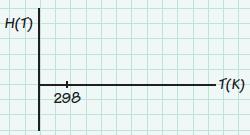
Consider the combustion of a fuel at constant pressure. Reproduce the coordinate system in the sketch and indicate and appropriately label the following items:A. HreacB. HprodC. The adiabatic flame temperature (Tad) for the reactants at 298 K H(T) 298 -T(K)
A gas mixture (60% methane, 30% ethane, and 10% nitrogen by volume) undergoes a complete reaction with 120% theoretical air (79% N2 and 21% O2 by volume). Determine the composition (in mole fractions) of the dry products.
Determine the equivalence ratio of a mixture of 1 mol of methane and 7 mol of air. Is the mixture lean or rich?
Compare the mass of CO2 produced per mass of fuel burned, i.e., the emission index of CO2 (kgCO2/kgfuel), for the following fuels for operation at stoichiometric (Φ = 1.0) and lean (Φ = 0.7) conditions. Assume that all the fuel carbon appears in the products as CO2. Treat the air as a simple
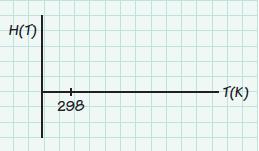
Consider the combustion of a fuel at constant pressure. Reproduce the coordinate system in the sketch and indicate and appropriately label the following items:A. HreacB. HprodC. Heating value (HV) H(T) 298 — - T(K)
Determine the standardized enthalpies of the following pure species at 4 atm and 2500 K: H2, H2O, and OH.
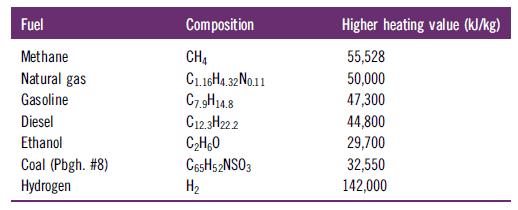
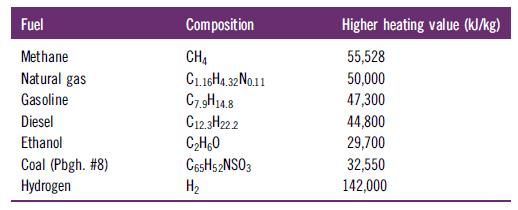
Determine the mass of CO2 produced (kg) per unit of energy released (kJ), i.e., the CO2 emission, for the complete combustion of the following fuels. The higher heating value (HHV) expresses the energy released per mass of fuel burned. Fuel Methane Natural gas Gasoline Diesel Ethanol Coal (Pbgh.
Determine the total standardized enthalpy H (kJ) for a fuel–air reactant mixture containing 1 kmol CH4, 2.5 kmol O2, and 9.4 kmol N2 at 500 K and 1 atm. Also determine the mass-specific standardized enthalpy h (kJ/kg) for this mixture.
Determine the heat transfer in the constant-volume combustion of 1 kg of carbon indicated in the following reaction:The reactants are at 298 K and the products are at 500 K. C + 1.5 0₂ CO2 + 0.5 0₂.
A mixture of products of combustion contains the following constituents at 2000 K: 3 kmol of CO2, 4 kmol of H2O, and 18.8 kmol of N2. Determine the following quantities:A. The mole fraction of each constituent in the mixtureB. The total standardized enthalpy H of the mixtureC. The mass-specific
In Problem 12.54, you calculated the CO2 emission factor for several hydrocarbon fuels. Derive an expression for the CO2 emission factor for an arbitrary hydrocarbon CxHy in which the hydrogen-to-carbon ratio y/x appears explicitly. Assume that all the fuel carbon appears in the products as CO2 and
A piston–cylinder arrangement initially contains 0.002 kmol of H2 and 0.01 kmol of O2 at 298 K and 1 atm. The mixture is ignited and burns adiabatically at constant pressure. Determine the final temperature assuming the products contain only H2O and the excess reactant. Also determine the work
Hydrogen burns with 200% stoichiometric air in a piston–cylinder arrangement. The process is carried out adiabatically and at constant pressure. The initial temperature and pressure are 298 K and 1 atm, respectively. Determine the final temperature and the work performed per mass of mixture.
A mixture of 5 g of ethane and a stoichiometric amount of oxygen is contained in a piston–cylinder device at 25° C and 1 atm. The piston moves freely without friction. A spark ignites the mixture and a complete reaction occurs at a pressure of 1 atm. The products are cooled to 25° C by the end
A rigid spherical pressure vessel initially contains 0.002 kmol of H2 and 0.01 kmol of O2 at 298 K and 1 atm. The mixture is ignited and burns adiabatically. Determine the final temperature and pressure assuming the products contain only H2O and the excess reactant. Sketch the process in U–T and
Determine the adiabatic constant-volume flame temperature for a stoichiometric mixture of propane (C3H8) and air. The reactants are at 1 atm and 298 K. Assume the air to be a simple mixture of 21% O2 and 79% N2. Furthermore, assume complete combustion with no dissociation. Sketch the process in
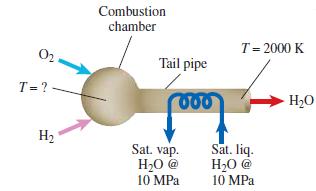
Anticipating the coming of the “hydrogen economy,” an enthusiastic mechanical engineer invents a steam generator. Pure hydrogen, H2, enters the wellinsulated combustion chamber at 298 K with a flow rate of 0.3 kg/s. The oxidizer is pure oxygen, O2, and enters in stoichiometric proportions
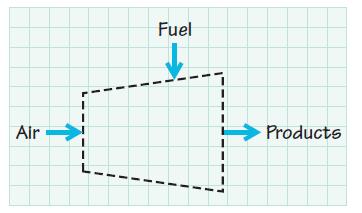
Show that Eq. 12.25 can be expressed equivalently on (a) A per unit mass of mixture basis (b) A per unit mass of fuel basis.Eq. 12.25 hreactants (T3) Specific enthalpy of reactant mixture at T3 per unit mass of air hproducts (T4). Specific enthalpy of product mixture at T4 per unit mass of air
Consider a stoichiometric reaction involving liquid octane and oxygen in a steady low reactor. The reactants enter at 25° C and 1 atm, and the products exit at the same conditions. Assuming liquid water in the products, determine the heat transfer a from the reactor in MJ per kg of fuel.
Ethane flows into a combustion chamber at 1.5 kg/min along with zero percent excess air. The fuel, oxidizer, and products are all at 25° C. The reaction is complete and the water is liquid. Determine the heat-transfer rate from the combustion chamber (MW).
Consider the turbojet combustor described in Example 12.8. Determine the temperature of the combustion products exiting the combustor if the air–fuel ratio is reduced to 50:1.Example 12.8Consider a turbo-jet-powered aircraft flying at 200 m/s at 6000-m altitude. At these conditions, air enters
The maximum temperature that the turbine blades can withstand limits the performance of a turbojet engine. This temperature, in turn, is controlled by the temperature of the combustion products exiting the combustor. Determine the minimum air–fuel ratio that can be supplied to a turbojet engine
A 50–50 blend (by volume) of methane and propane is burned with 100% excess air in a steady-flow combustion chamber. The fuel mixture and the air each enter the combustion chamber at 298 K and 1 atm. Assuming the reaction is complete and exhaust products leave the combustion chamber at 1000 K and
Propane is completely burned in a steady-flow process with 100% excess air. The propane and the air each enter the control volume at 25° C and 1 atm, and the combustion products leave at 600 K and 1 atm. Determine the heat transfer (MJ=kgC3H8 ) to the surroundings.
A stoichiometric mixture of carbon monoxide and air, initially at 25°C and 1 atm, reacts completely in an adiabatic, constant-pressure, steady-flow process. Determine the exit temperature (K) of the products.
A cutting torch burns a steady flow of acetylene gas at 25° C and 1 atm with stoichiometric air at 25° C and 1 atm. The products are at 1 atm. Assume reaction is complete (no dissociation) and adiabatic. Determine the exit temperature.
Hydrogen gas and 100% excess air each enter a steady-flow combustion chamber at 25° C and 1 atm. A complete reaction occurs with a heat loss of 40 MJ/kmol of fuel. Determine the temperature (K) of the product gas.
Consider the theoretical combustion of methane in a steady-flow process at 1 atm. Determine the heat transfer per kmol and per kg of fuel from the combustion chamber for the following cases:A. The products and the reactants are at the same temperature of 15.6° C.B. The air and the methane enter at
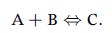
Consider a system at fixed temperature and pressure in which the following equilibrium is maintainedThe reaction is exothermic as written. Draw a sketch showing the system entropy and temperature as functions of the mole fraction of species C. A + B C.
Determine the mass air–fuel ratio if gaseous propane (C3H8) is burned with air at 1 atm in a steady-flow reactor for the following conditions. The propane and air enter the reactor at 25° C, and the combustion products must exit at less than 1425° C.
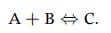
Consider a system at fixed temperature and pressure in which the following equilibrium is maintained:The reaction is exothermic as written. Draw a sketch showing the system Gibbs free energy (Gibbs function) as a function of the mole fraction of species C. A + B C.
Air enters a turbojet engine with a velocity of 150m/s (at station 1) and a mass flow rate of 23.6 kg/s. Fuel is supplied to the engine at 0.3165 kg/s. The mass specific standardized enthalpy of the air and fuel are 1.872 kJ/kgA and –3210.4 kJ/kgF, respectively, and the standardized enthalpy of
Consider the following equilibrium reaction at 1 atm and 2500 K:A. Which is the exothermic direction for this reaction? To the left or to the right?B. If the temperature is increased to 4000 K, but the pressure is unchanged, will the equilibrium shift to the left or to the right?C. If the pressure
Create a spreadsheet model of a turbojet combustor in which the air temperature, fuel temperature, and air–fuel ratio are input quantities, and the combustion product temperature is an output quantity. Use iso-octane (C8H18) and simple air as the reactants.
Ethane burns with 150% stoichiometric air. Assume complete combustion with no dissociation. Determine(a) The mole percentage of each product species.(b) The dew-point temperature of the products at 1 atm.
Rework Problem 12.76 but use propane as the fuel.Problem 12.76 Ethane burns with 150% stoichiometric air. Assume complete combustion with no dissociation. Determine(a) The mole percentage of each product species.(b) The dew-point temperature of the products at 1 atm.
Consider the combustion of benzene, C6H6, with air. Determine the dew-point temperature of the combustion products if the mass air–fuel ratio is 20:1. The pressure is 1 atm.
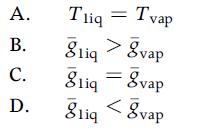
Consider a thermodynamic system consisting of liquid H2Oand H2O vapor. Which of the following conditions is/are necessary for thermodynamic equilibrium to prevail in the system? Note that there may be more than one correct answer. A. B. C. D. Tliq = Tvap > gvap = 8vap < 8vap 81iq 81iq 81iq
Consider one kmol of O2 at 1 atm and 2600 K. Calculate the Gibbs function of the O2 using the Gibbs function definition (G = H –TS).
Consider an arbitrary chemical equilibrium. What is the physical significance of Kp << 1 and Kp >> 1?
Consider one kmol of O atoms at 1 atm and 2600 K. Calculate the Gibbs function of the O atoms using the Gibbs function definition (G = H –TS).
Consider one kmol of CO2 at 1 atm and 2500 K. Calculate the Gibbs function of the CO2 using the Gibbs function definition (G = H –TS).
Explain how the second law of thermodynamics governs the equilibrium between the phases of a simple substance.
Consider one kmol of CO at 1 atm and 2500 K. Calculate the Gibbs function of the CO using the Gibbs function definition (G = H –TS).
Consider one kmol of H2O at 1500 K. Calculate the Gibbs function of the H2O for pressures of 1.0 and 100 atm.
Consider one kmol of O2 at 2400 K. Calculate and plot the Gibbs function of the O2 for pressures of 0.1, 1.0, 10, and 100 atm.
In a steam reforming process, natural gas (or other hydrocarbon or coal) is used to produce hydrogen. In this process, the water–gas shift equilibrium reaction H2O + CO ⇔ CO2 + H2 is important. Calculate the standard-state Gibbs function change for this reaction for temperatures of 1000 K, 1500
Consider the reaction O2 ⇔ 2 O. Determine a numerical value for the equilibrium constant Kp for the reaction as written for temperatures of 500 K and 5000 K.
Consider the reaction N2 ⇔ 2 N. Determine a numerical value for the equilibrium constant Kp for the reaction as written for temperatures of 500 K and 5000 K. Compare your results with Problem 13.19 and discuss.Problem 13.19In a steam reforming process, natural gas (or other hydrocarbon or coal)
Consider the reaction H2O + CO ⇔ CO2 + H2. Determine a numerical value for the equilibrium constant Kp for the reaction as written for a temperature of 1200 K.
Consider the reaction N2 + O2 , 2 NO. Determine a numerical value for the equilibrium constant Kp for the reaction as written for temperatures of 1000 K and 3500 K. Discuss
Consider the reaction 2 H2 + O2 ⇔ 2 H2O. Express the equilibrium constant Kp for the reaction using appropriate partial pressures. Also write an expression for the equilibrium constant when the reaction is written from right to left.
Express the equilibrium constant Kp for the following reactions using appropriate partial pressures: 2 H2 + O2 ⇔ 2 H2O and H2 + 1/2O2, H2O. How do the two Kps relate?
Consider a mixture of molecular nitrogen (N2) and atomic nitrogen (N) in equilibrium at 3 atm at an unknown temperature. Determine the value of the equilibrium constant Kp for the reaction N2 ⇔ 2N if the partial pressure of the N2 is 2.995 atm. Does Kp have units or is it dimensionless?
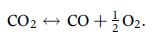
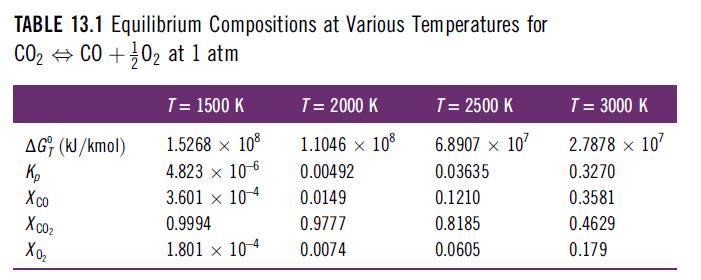
Consider the equilibrium dissociation of carbon dioxide CO2 ⇔ CO + 1/2 O2. At 2500 K, the equilibrium constant is 0.03635. Calculate the enthalpy of reaction for this reaction at 2500 K and use this to estimate the equilibrium constant for a temperature of 3000 K. Compare your estimated value
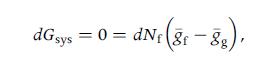
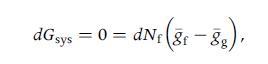
Ammonia is used as a refrigerant in large-scale refrigeration systems. Using data for ammonia (NH3) from the NIST resources, verify that the condition for phase equilibrium (Eqs.13.35) is met. Use temperatures of 300 and 400 K. [Nf (8£ - 88), dGsys=0= dNf8f
Calculate the enthalpy of reaction for CO + 1/2 O2 ↔ CO2 at 2000 K. Use your value of ΔH at 2000 K, along with the Kp value at 2000 K of 20.325, to estimate the equilibrium constant for a temperature of 2500 K.
Molecular nitrogen has a strong triple bond and, thus, high temperatures are required to achieve any significant dissociation, as compared with less strongly bonded diatomic molecules. Explore the temperature dependence of the equilibrium reaction N2 ⇔ N + N by calculating the equilibrium mole
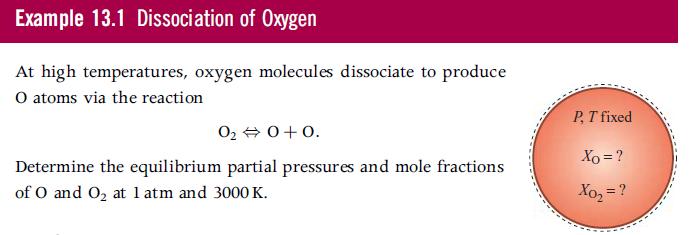
Consider the dissociation of oxygen molecules O2 ⇔ O + O at 3800 K and 2 atm. Determine the equilibrium partial pressures and mole fractions of the O atoms and molecular oxygen.
Consider an initial equimolar mixture of molecular oxygen and carbon monoxide. For the equilibrium reaction CO + 1/2 O2 ⇔ CO2 determine the equilibrium partial pressures and the mole fractions of each species at 2200 K for a total pressure of 1 atm.
Consider an initially equimolar mixture of water vapor and carbon monoxide. For the equilibrium reaction H2O + CO ⇔ CO2 + H2 determine the equilibrium partial pressures and the mole fractions of each species at 1500 K for a total pressure of 1.4 atm.
Carbon monoxide and oxygen (O2) exist in equilibrium with carbon dioxide. Determine the equilibrium composition (mole fractions) at 3200 K and 1 atm of an initial mixture of 2 kmol of carbon monoxide and 2 kmol of oxygen.
Carbon monoxide and water react to form carbon dioxide and hydrogen (H2), the so-called water-gas shift reaction. Determine the equilibrium composition (mole fractions) of a mixture at 1100 K and 1 atm initially containing 1 kmol of carbon monoxide and 1 kmol of water.
Carbon monoxide and water react to form carbon dioxide and hydrogen (H2), the so-called water–gas shift reaction. Determine the equilibrium composition (mole fractions) of a mixture at 1100 K and 1 atm initially containing 1 kmol of carbon monoxide and 2 kmol of water.
Hydrogen and oxygen react to form water. Determine the equilibrium composition (mole fractions) at 4000 K and 1 atm of an initial mixture of 1 kmol of hydrogen (H2) and 1 kmol of oxygen (O2).
Nitric oxide (NO) is a major pollutant formed in high-temperature combustion processes, but typically in less than equilibrium amounts. Equilibrium values thus can be considered to be upper limits. For the equilibrium reaction N2 + O2 ⇔ 2 NO determine the equilibrium partial pressures and the
The conversion of nitric oxide (NO) to nitrogen dioxide (NO2) is important in atmospheric chemistry. National Ambient Air Quality Standards are set for NO2, a major component of photochemical smog. Nitric oxide and oxygen are contained in an experimental reactor and allowed to react until the
Methanol has been proposed for use in fuel cells for automotive applications. The vapor pressure for methanol (CH3OH) was measured to be 4.02 and 352 kPa at 273 K and 373 K, repectively. Use these data to estimate the enthalpy of vaporization (kJ/kg) of methanol. Compare your result with the actual
Heptane is often used as a single-component fuel to model the behavior of gasoline. Volatility is important to the cold-start performance of gasoline in an automobile. Use the Clausius–Clapeyron to determine saturation pressures (kPa and psia) from 275 K (35.3 F) to 290 K (62.3 F) and the
Derive the Clausius–Clapeyron equation from the Clapeyron equation, assuming that the gas-phase specific volume is much, much greater than that of the liquid phase, and that the pressure is sufficiently low that the vapor behaves as an ideal gas.
Determine the number of degrees of freedom associated with the following systems. Also, use the NIST resources, and any other resources you can find, to determine numerical values associated with the pressure and temperature boundaries (lines, regions, point) associated with each system.A. Liquid
Determine the number of degrees of freedom associated with the following systems. Also, use the NIST resources, and any other resources you can find, to determine numerical values associated with the pressure and temperature boundaries (lines, regions, point) associated with each system.A. Liquid
Consider the liquid–vapor equilibrium of H2O at 20° C in which N2 is added to the gas phase to obtain a total pressure of 1 atm. Assuming that the N2 is both inert and insoluble in the liquid H2O, how does the N2 affect the equilibrium pressure (or partial pressure) of the H2O vapor? To answer
Heptane is frequently used as a single-component surrogate fuel to represent gasoline. Using data for heptane from the NIST resources, verify that the condition for phase equilibrium (Eqs. 13.35) is met. Use temperatures of 350 and 450 K.Eqs. 13.35 IN₁ (81-88), dGsys=0= dNf8f
Carbon monoxide and oxygen (O2) react to form carbon dioxide. Determine the equilibrium composition (mole fractions) of a mixture at 298 K and 1 atm initially containing 2 kmol of carbon monoxide and 1 kmol of oxygen. Repeat for a temperature of 2000 K and discuss.
Derive a conversion factor relating pressure in pascals (N/m2) and in psi (lbf/in2). Compare your result with the conversion factor at the front of this book.
A thermometer reads 72 F. Specify the temperature in °C, K, and R.
At what temperature are temperatures expressed in Fahrenheit and Celsius numerically equal? Solve using algebra.
In a closed (fixed-mass) system, an ideal gas undergoes a process from an initial state with pressure 517 kPa and volume of 0.1416m3 to a final state with pressure 172.3 kPa and volume of 0.2741m3. For this process, the enthalpy change ΔH is –65.4 kJ and the average constant-volume specific
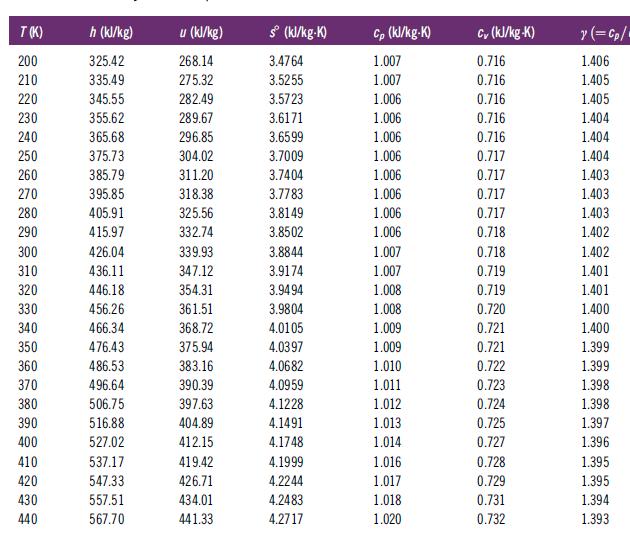
Determine the enthalpy change for air undergoing a process that causes a change of state from 300 K and 1 atm to 1000 K and 5 atms. Do this in two ways: (1) Assume ideal gas behavior and use Table C.2, and (2) use the NIST software, which incorporates real gas behavior. How do the two results
Consider an ideal gas. Indicate whether the following thermodynamic properties depend on pressure when the temperature is fixed: density, specific volume, molar-specific internal energy, mass-specific enthalpy, constant-volume specific heat, and constant-pressure specific heat. Explain your
Water at 10.0 MPa (absolute) is heated from 350 K to 380 K. Determine the change in mass-specific enthalpy for this process in three ways.(1) Use the tables in Appendix B, interpolating as required.(2) Use the NIST software or online database.(3) Use the liquid property approximation, Eqn. 2.41c.
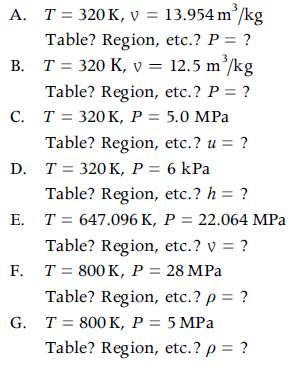
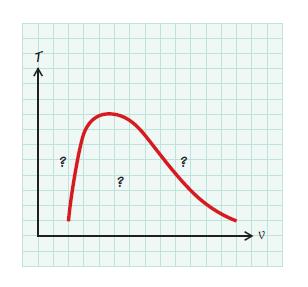
How to Define a Thermodynamic State. Given the following property data for H2O, designate the region, line, or point in T–v or P– v space (i.e., compressed liquid, liquid–vapor mixture, superheated vapor, etc.) and find the value of the requested property. If the state is a saturated mixture,
Wet steam at 375 K has a specific enthalpy of 2600 kJ/kg. Determine the quality of the mixture and the specific internal energy u.
Showing 200 - 300
of 971
1
2
3
4
5
6
7
8
9
10
Step by Step Answers

 Get 50% OFF
Claim Now
Get 50% OFF
Claim Now