New Semester
Started
Get
50% OFF
Study Help!
--h --m --s
Claim Now
Question Answers
Textbooks
Find textbooks, questions and answers
Oops, something went wrong!
Change your search query and then try again
S
Books
FREE
Study Help
Expert Questions
Accounting
General Management
Mathematics
Finance
Organizational Behaviour
Law
Physics
Operating System
Management Leadership
Sociology
Programming
Marketing
Database
Computer Network
Economics
Textbooks Solutions
Accounting
Managerial Accounting
Management Leadership
Cost Accounting
Statistics
Business Law
Corporate Finance
Finance
Economics
Auditing
Tutors
Online Tutors
Find a Tutor
Hire a Tutor
Become a Tutor
AI Tutor
AI Study Planner
NEW
Sell Books
Search
Search
Sign In
Register
study help
life sciences
principles of genetics
Principles of Genetics 7th edition D. Peter Snustad, Michael J. Simmons - Solutions
Many cancers seem to involve environmental factors. Why, then, is cancer called a genetic disease?
Both embryonic cells and cancer cells divide quickly. How can these two types of cells be distinguished from each other?
Most cancer cells are aneuploid. Suggest how aneuploidy might contribute to deregulation of the cell cycle.
Would you ever expect to find a tumor-inducing retrovirus that carried a processed cellular tumor suppressor gene in its genome?
When cellular oncogenes are isolated from different animals and compared, the amino acid sequences of the polypeptides they encode are found to be very similar. What does this suggest about the functions of these polypeptides?
The majority of the c-rasoncogenes obtained from can-cerous tissues have mutations in codon 12, 59, or 61 in the coding sequence. Suggest an explanation.
When a mutant c-H-rasoncogene with a valine for glycine substitution in codon 12 is transfected into cultured NIH 3T3 cells, it transforms those cells into cancer cells. When the same mutant oncogene is transfected into cultured embryonic cells, it does not transform them. Why?
A mutation in the rascellular oncogene can cause cancer when it is in heterozygous condition, but a mutation in the RBtumor suppressor gene can cause cancer only when it is in homozygous condition. What does this difference between dominant and recessive mutations imply about the roles that the
Explain why individuals who develop nonhereditary reti-noblastoma usually have tumors in only one eye, whereas individuals with hereditary retinoblastoma usually develop tumors in both eyes.
Approximately 5 percent of the individuals who inherit an inactivated RBgene do not develop retinoblastoma. Use this statistic to estimate the number of cell divisions that form the retinal tissues of the eye. Assume that the rate at which somatic mutations inactivate the RBgene is one mutation per
Inherited cancers like retinoblastoma show a dominant pattern of inheritance. However, the underlying genetic defect is a recessive loss-of-function mutation—often the result of a deletion. How can the dominant pattern of inheritance be reconciled with the recessive nature of the mutation?
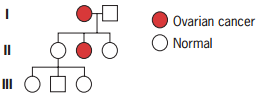
The following pedigree shows the inheritance of familial ovarian cancer caused by a mutation in the BRCA1gene. Should II-1 be tested for the presence of the predispos-ing mutation? Discuss the advantages and disadvantages of testing. Ovarian cancer O Normal
In what sense is pRB a negative regulator of E2F tran-scription factors?
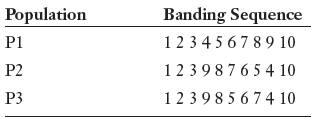
Analysis of the polytene chromosomes of three populations of Drosophila has revealed three different banding sequences in a region of the second chromosome:Explain the evolutionary relationships among these populations. Banding Sequence 123 4 5 67 89 10 123987654 10 123985 674 10 Population P1 P2 P3
A Drosophila geneticist crossed females homozygous for three X-linked mutations (y, yellow body; B, bar eye shape; v, vermilion eye color) to wild-type males. The F1females, which had gray bodies and bar eyes with dark red pigment, were then crossed to y B+v males, yielding the following
In maize, the genes Pl for purple leaves (dominant over Pl for green leaves), sm for salmon silk (recessive to Sm for yellow silk), and py for pig my plant (recessive to Py for normal-size plant) are on chromosome 6, with map positions as shown:pl......... sm........ py45........ 55.........
In Drosophila, the genes st (scarlet eyes), ss (spineless bristles), and e (ebony body) are located on chromosome 3, with map positions as indicated:st....... ss........ e44.......58.......70Each of these mutations is recessive to its wild-type allele (st+, dark red eyes; ss+, smooth bristles; e+,
Genes on different chromosomes recombine with a frequency of 50 percent. Is it possible for two genes on the same chromosome to recombine with this frequency?
Cytological examination of the sex chromosomes in a man has revealed that he carries an insertional translocation. A small segment has been deleted from the Y chromosome and inserted into the short arm of the X chromosome; this segment contains the gene responsible for male differentiation (SRY).
In Drosophila, vestigial wing (vg), hairy body (h), and eyeless (ey) are recessive mutations on chromosomes 2, 3, and 4, respectively. Wild-type males that had been irradiated with X rays were crossed to triply homozygous recessive females. The F1 males (all phenotypically wildtype) were then
In Drosophila, the autosomal genes cinnabar (cn) and brown (bw) control the production of brown and red eye pigments, respectively. Flies homozygous for cinnabar mutations have bright red eyes, flies homozygous for brown mutations have brown eyes, and flies homozygous for mutations in both of these
A male mouse that is heterozygous for a reciprocal translocation between the X chromosome and an autosome is crossed to a female mouse with a normal karyotype. The autosome involved in the translocation carries a gene responsible for coloration of the fur. The allele on the male’s translocated
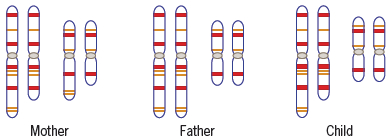
The following diagram shows two pairs of chromosomes in the karyotypes of a man, a woman, and their child. The man and the woman are phenotypically normal, but the child (a boy) suffers from a syndrome of abnormalities, including poor motor control and severe mental impairment. What is the genetic
A man has attached chromosomes 21. If his wife is cytologically normal, what is the chance their first child will have Down syndrome?
A yellow-bodied Drosophila female with attached-X chromosomes was crossed to a white-eyed male. Both of the parental phenotypes are caused by X-linked recessive mutations. Predict the phenotypes of the progeny.
Distinguish between a compound chromosome and a Robertsonian translocation.
A phenotypically normal boy has 45 chromosomes, but his sister, who has Down syndrome, has 46. Suggest an explanation for this paradox.
In Drosophila, the genes bw and st are located on chromosomes 2 and 3, respectively. Flies homozygous for bw mutations have brown eyes, flies homozygous for st mutations have scarlet eyes, and flies homozygous for bw and st mutations have white eyes. Doubly heterozygous males were mated
One chromosome in a plant has the sequence A B C D E F, and another has the sequence M N O P Q R. A reciprocal translocation between these chromosomes produced the following arrangement: A B C P Q R on one chromosome and M N O D E F on the other. Illustrate how these translocated chromosomes would
In plants translocation heterozygotes display about 50 percent pollen abortion. Why?
Other chromosomes have sequences as follows: (a) 1 2 5 6 7 8; (b) 1 2 3 4 4 5 6 7 8; (c) 1 2 3 4 5 8 7 6. What kind of chromosome change is present in each? Illustrate how these chromosomes would pair with a chromosome whose sequence is 1 2 3 4 5 6 7 8.
In a Drosophila salivary chromosome, the bands have a sequence of 1 2 3 4 5 6 7 8. The homologue with which this chromosome is synapsed has a sequence of 1 2 3 6 5 4 7 8. What kind of chromosome change has occurred?Draw the synapsed chromosomes.
Although XYY men are phenotypically normal, would they be expected to produce more children with sex chromosome abnormalities than XY men? Explain.
In humans, Hunter syndrome is known to be an X-linked trait with complete penetrance. In family A, two phenotypically normal parents have produced a normal son, a daughter with Hunter and Turner syndromes, and a son with Hunter syndrome. In family B, two phenotypically normal parents have produced
A woman with X-linked color blindness and Turner syndrome had a color-blind father and a normal mother. In which of her parents did nondisjunction of the sex chromosomes occur?
The Drosophila fourth chromosome is so small that flies monosomic or trisomic for it survive and are fertile. Several genes, including eyeless (ey), have been located on this chromosome. If a cytologically normal fly homozygous for a recessive eyeless mutation is crossed to a fly monosomic for a
If nondisjunction of chromosome 21 occurs in the division of a secondary oocyte in a human female, what is the chance that a mature egg derived from this division will receive two number 21 chromosomes?
Identify the sexual phenotypes of the following genotypes in human beings: XX, XY, XO, XXX, XXY, XYY.
A plant species X with n = 5 was crossed with a related species Y with n = 7. The F1 hybrid produced only a few pollen grains, which were used to fertilize the ovules of species Y. A few plants were produced from this cross, and all had 19 chromosomes. Following self-fertilization, the F1 hybrids
A plant species A, which has seven chromosomes in its gametes, was crossed with a related species B, which has nine. The hybrids were sterile, and microscopic observation of their pollen mother cells showed no chromosome pairing. A section from one of the hybrids that grew vigorously was propagated
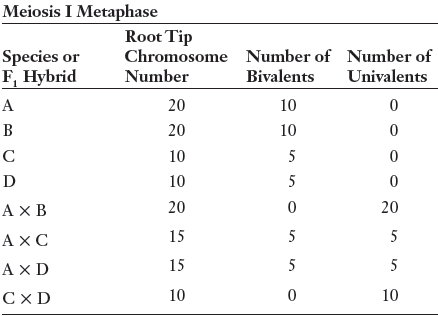
The following table presents chromosome data on four species of plants and their F1hybrids:(a) Deduce the chromosomal origin of species A.(b) How many bivalents and univalents would you expect to observe at meiotic metaphase I in a hybrid between species C and species B?(c) How many bivalents and
During meiosis, why do some tetraploids behave more regularly than triploids?
In humans, a cytologically abnormal chromosome 22, called the “Philadelphia” chromosome because of the city in which it was discovered, is associated with chronic leukemia. This chromosome is missing part of its long arm. How would you denote the karyotype of an individual who had 46
In the human karyotype, the X chromosome is approximately the same size as seven of the autosomes (the so-called C group of chromosomes). What procedure could be used to distinguish the X chromosome from the other members of this group?
In 1908, F. M. Durham and D. C. E. Marryat reported the results of breeding experiments with canaries. Cinnamon canaries have pink eyes when they first hatch, whereas green canaries have black eyes. Durham and Marryat crossed cinnamon females with green males and observed that all the F1 progeny
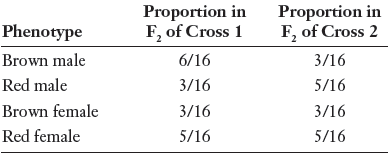
A breeder of sun conures (a type of bird) has obtained two true-breeding strains, A and B, which have red eyes instead of the normal brown found in natural populations. In Cross 1, a male from strain A was mated to a female from strain B, and the male and female offspring all had brown eyes. In
Males in a certain species of deer have two nonhomologous X chromosomes, denoted X1 and X2, and a Y chromosome. Each X chromosome is about half as large as the Y chromosome, and its centromere is located near one of the ends; the centromere of the Y chromosome is located in the middle. Females in
What is the maximum number of Barr bodies in the nuclei of human cells with the following chromosome compositions:(a) XY;(b) XX;(c) XXY;(d) XXX;(e) XXXX;(f) XYY?
A Drosophila male carrying a recessive X-linked mutation for yellow body is mated to a homozygous wild-type female with gray body. The daughters of this mating all have uniformly gray bodies. Why are not their bodies a mosaic of yellow and gray patches?
In chickens, the absence of barred feathers is due to a recessive allele. A barred rooster was mated with a nonbarred hen, and all the offspring were barred. These F1chickens were intercrossed to produce F2 progeny, among which all the males were barred; half the females were barred and half were
Predict the sex of Drosophila with the following chromosome compositions (A = haploid set of autosomes):(a) 4X 4A;(b) 3X 4A;(c) 2X 3A;(d) 1X 3A;(e) 2X 2A;(f) 1X 2A.
In Drosophila, the gene for bobbed bristles (recessive allele bb, bobbed bristles; wild-type allele+, normal bristles) is located on the X chromosome and on a homologous segment of the Y chromosome. Give the genotypes and phenotypes of the offspring from the following crosses:(a) Xbb Xbb × Xbb
Would a human with two X chromosomes and a Y chromosome be male or female?
Suppose that a mutation occurred in the SRY gene on the human Y chromosome, knocking out its ability to produce the testis-determining factor. Predict the phenotype of an individual who carried this mutation and a normal X chromosome.
In Drosophila, a recessive mutation called chocolate (c) causes the eyes to be darkly pigmented. The mutant phenotype is indistinguishable from that of an autosomal recessive mutation called brown (bw). A cross of chocolate- eyed females to homozygous brown males yielded wild-type F1 females and
A Drosophila female heterozygous for the recessive X-linked mutation w (for white eyes) and its wild-type allele w 1 is mated to a wild-type male with red eyes. Among the sons, half have white eyes and half have red eyes. Among the daughters, nearly all have red eyes; however, a few have white
From information in the chapter about the ABO blood types, what phenotypes and ratios are expected from the following matings: (a) IA IA × IB IB; (b) IA IB × ii; (c) IA i × IB i; and (d) IA i × ii;
In Drosophila, vermilion eye color is due to a recessive allele (v) located on the X chromosome. Curved wingsare due to a recessive allele (cu) located on one auto some, and ebony body is due to a recessive allele (e) located on another auto some. A vermilion male is mated to a curved, ebony
In the mosquito Anopheles culicifacies, golden body (go) is a recessive X-linked mutation, and brown eyes (bw) is a recessive autosomal mutation. A homozygous XX female with golden body is mated to a homozygous XY male with brown eyes. Predict the phenotypes of their F1 offspring. If the F1 progeny
The Boston barberry is an imaginary plant with a diploid chromosome number of 4, and Boston barberry cells are easily grown in suspended cell cultures. 3H-thymidine was added to the culture medium in which a G1-stage cell of this plant was growing. After one cell ONLINE_generation of growth in
What is the macromolecular composition of a bacterial virus or bacteriophage such as phage T2?
How could it be demonstrated that the mixing of heatkilled Type III pneumococcus with live Type II resulted in a transfer of genetic material from Type III to Type II rather than a restoration of viability to Type III by Type II?
The relationship between the melting Tm and GC content can be expressed, in its much simplified form, by the formula Tm = 69 + 0.41 (% GC).(a) Calculate the melting temperature of E. coli DNA that has about 50% GC.(b) Estimate the %GC of DNA from a human kidney cell where Tm = 85°C.
A diploid nucleus of Drosophila melanogaster contains about 3.4 × 10⁸ nucleotide pairs. Assume (1) that all nuclear DNA is packaged in nucleosomes and (2) that an average internucleosome linker size is 60 nucleotide pairs. How many nucleosomes would be present in a diploid nucleus of D.
The available evidence indicates that each eukaryotic chromosome (excluding polytene chromosomes) contains a single giant molecule of DNA. What different levels of organization of this DNA molecule are apparent in chromosomes of eukaryotes at various times during the cell cycle?
A diploid rye plant, Secale cereale, has 2n = 14 chromosomes and approximately 1.6 × 10¹⁰ bp of DNA. How much DNA is in a nucleus of a rye cell at (a) Mitotic metaphase, (b) Meiotic metaphase I, (c) Mitotic telophase, and (d) Meiotic telophase II?
The temperature at which one-half of a double-stranded DNA molecule has been denatured is called the melting temperature, Tm. Why does Tm depend directly on the GC content of the DNA?
Compare and contrast the structures of the A, B, and Z forms of DNA.
The nucleic acids from various viruses were extracted and examined to determine their base composition. Given the following results, what can you hypothesize about the physical nature of the nucleic acids from these viruses?(a) 35% A, 35% T, 15% G, and 15% C. (b) 35% A, 15% T, 25% G, and 25%
Indicate whether each of the following statements about the structure of DNA is true or false. (Each letter is used to refer to the concentration of that base in DNA.)(a) A + T = G + C(b) A = G; C = T(c) A/T = C/G(d) T/A = C/G(e) A + G = C + T(f) G/C = 1(g) A = T within each single strand.(h)
If one strand of DNA in the Watson–Crick double helixhas a base sequence of 5-GTCATGAC-3, what is the base sequence of the complementary strand?
DNA was extracted from cells of Staphylococcus afermentans and analyzed for base composition. It was found that 37 percent of the bases are cytosine. With this information, is it possible to predict what percentage of the bases are adenine? If so, what percentage? If not, why not?
RNA was extracted from TMV (tobacco mosaic virus) particles and found to contain 20 percent cytosine (20 percent of the bases were cytosine). With this information, is it possible to predict what percentage of the bases in TMV are adenine? If so, what percentage? If not, why not?
What are the differences between DNA and RNA?
(a) If a virus particle contained double-stranded DNA with 200,000 base pairs, how many nucleotides would be present? (b) How many complete spirals would occur on each strand? (c) How many atoms of phosphorus would be present? (d) What would be the length of the DNA configuration in
(a) Why did Watson and Crick choose a double helix for their model of DNA structure? (b) Why were hydrogen bonds placed in the model to connect the bases?
(a) What background material did Watson and Crick have available for developing a model of DNA? (b) What was their contribution to building the model?
How did the reconstitution experiment of Fraenkel–Conrat and colleagues show that the genetic information of tobacco mosaic virus (TMV) is stored in its RNA rather than its protein?
(a) What was the objective of the experiment carried out by Hershey and Chase? (b) How was the objective accomplished? (c) What is the significance of this experiment?
A cell-free extract is prepared from Type IIIS pneumococcal cells. What effect will treatment of this extract with (a) Protease, (b) RNase, and (c) DNase have on its subsequent capacity to transform recipient Type IIR cells to Type IIIS? Why?
(a) How did the transformation experiments of Griffith differ from those of Avery and his associates? (b) What was the significant contribution of each? (c) Why was Griffith’s work not evidence for DNA as the genetic material, whereas the experiments of Avery and coworkers provided
In what ways do the life cycles of bacteriophages T4 and λ differ? In what aspects are they the same?
How do bacteriophages differ from other viruses?
By what criteria are viruses living? nonliving?
Experimental evidence indicates that most highly repetitive DNA sequences in the chromosomes of eukaryotes do not produce any RNA or protein products. What does this indicate about the function of highly repetitive DNA?
The satellite DNAs of Drosophila virilis can be isolated, essentially free of main-fraction DNA, by density-gradient centrifugation. If these satellite DNAs are sheared into approximately 40-nucleotide-pair-long fragments and are analyzed in denaturation–renaturation experiments, how would you
(a) What functions do (1) centromeres and (2) telomeres provide? (b) Do telomeres have any unique structural features? (c) When chromosomes are broken by exposure to high-energy radiation such as X rays, the resulting broken ends exhibit a pronounced tendency to stick to each other and
Are eukaryotic chromosomes metabolically most active during prophase, metaphase, anaphase, telophase, or interphase?
Are the scaffolds of eukaryotic chromosomes composed of histone or nonhistone chromosomal proteins? How has this been determined experimentally?
(a) Which class of chromosomal proteins, histones or nonhistones, is the more highly conserved in different eukaryotic species? Why might this difference be expected?(b) If one compares the histone and nonhistone chromosomal proteins of chromatin isolated from different tissues or cell types of a
(a) If the haploid human genome contains 3 × 10⁹ nucleotide pairs and the average molecular weight of a nucleotide pair is 660, how many copies of the human genome are present, on average, in 1 mg of human DNA? (b) What is the weight of one copy of the human genome?(c) If the haploid genome
DNA polymerase I of E. coli is a single polypeptide of molecular weight 103,000.(a) What enzymatic activities other than polymerase activity does this polypeptide possess? (b) What are the in vivo functions of these activities? (c) Are these activities of major importance to an E. coli
Escherichia coli cells are grown for many generations in a medium in which the only available nitrogen is the heavy isotope 15N. They are then transferred to a medium containing 15N as the only source of nitrogen.(a) What distribution of 15N and 14N would be expected in the DNA molecules of cells
Why do DNA molecules containing 15N band at a different position than DNA molecules containing 14N when centrifuged to equilibrium in 6M CsCl?
A DNA template plus primer with the structure(where P = a phosphate group) is placed in an in vitro DNA synthesis system (Mg2+, an excess of the four deoxyribonucleoside triphosphates, etc.) containing a mutant form of E. coli DNA polymerase I that lacks exonuclease activity. The polymerase and
How might continuous and discontinuous modes of DNA replication be distinguished experimentally?
E. coli cells contain five different DNA polymerases—I, II, III, IV, and V. Which of these enzymes catalyzes the semiconservative replication of the bacterial chromosome during cell division?What are the functions of the other four DNA polymerases in E. coli?
Suppose that the experiment described in Problem 10.7 was carried out again, except this time replacing the 3H-thymidine with nonradioactive thymidine at the same time that the colchicine was added (after one cell generation of growth in 3H-thymidine-containing medium). The cells were then
Suppose that the DNA of cells (growing in a cell culture) in a eukaryotic species was labeled for a short period of time by the addition of 3H-thymidine to the medium. Next assume that the label was removed and the cells were resuspended in nonradioactive medium. After a short period of growth in
Arrange the following enzymes in the order of their action during DNA replication in E. coli: (1) DNA polymerase I, (2) DNA polymerase III, (3) DNA primase, (4) DNA gyrase, and (5) DNA helicase.
Showing 300 - 400
of 617
1
2
3
4
5
6
7
Step by Step Answers

 Get 50% OFF
Claim Now
Get 50% OFF
Claim Now


![Phenotype Number Yellow, bar, vermilion] wild-type 546 Yellow 244 bar, vermilion Yellow, vermilion] bar 160 Yellow, barl](https://dsd5zvtm8ll6.cloudfront.net/si.question.images/images/question_images/1538/4/0/5/7705bb2358aa60891538388125627.jpg)