New Semester
Started
Get
50% OFF
Study Help!
--h --m --s
Claim Now
Question Answers
Textbooks
Find textbooks, questions and answers
Oops, something went wrong!
Change your search query and then try again
S
Books
FREE
Study Help
Expert Questions
Accounting
General Management
Mathematics
Finance
Organizational Behaviour
Law
Physics
Operating System
Management Leadership
Sociology
Programming
Marketing
Database
Computer Network
Economics
Textbooks Solutions
Accounting
Managerial Accounting
Management Leadership
Cost Accounting
Statistics
Business Law
Corporate Finance
Finance
Economics
Auditing
Tutors
Online Tutors
Find a Tutor
Hire a Tutor
Become a Tutor
AI Tutor
AI Study Planner
NEW
Sell Books
Search
Search
Sign In
Register
study help
life sciences
principles of genetics
Principles of Genetics 7th edition D. Peter Snustad, Michael J. Simmons - Solutions
Fifteen distinct DNA polymerases—α, β, γ, δ, ε, κ, ζ, η, θ, κ, λ, μ, σ, ϕ, and Rev1—have been characterized in mammals. What are the intracellular locations and functions of these polymerases?
The E. coli chromosome contains approximately 4 × 10⁶ nucleotide pairs and replicates as a single bidirectional replicon in approximately 40 minutes under a wide variety of growth conditions. The largest chromosome of D. melanogaster contains about 6 × 10⁷ nucleotide pairs.(a) If this chromosome
E. coli cells that have been growing in 14N for many generations are transferred to medium containing only 15N and allowed to grow in this medium for four generations. Their DNA is then extracted and analyzed by equilibrium CsCl density-gradient centrifugation. What proportion of this DNA will band
The bacteriophage lambda chromosome has several A:T-rich segments that denature when exposed to pH 11.05 for 10 minutes. After such partial denaturation, the linear packaged form of the lambda DNA molecule has the structure shown in Figure 10.9a. Following its injection into an E. coli cell, the
What enzyme activity catalyzes each of the following steps in the semiconservative replication of DNA in prokaryotes?(a) The formation of negative supercoils in progeny DNA molecules. (b) The synthesis of RNA primers.(c) The removal of RNA primers. (d) The covalent extension of DNA chains
One species of tree has a very large genome consisting of 2.0 × 10¹⁰ base pairs of DNA.(a) If this DNA was organized into a single linear molecule, how long (meters) would this molecule be? (b) If the DNA is evenly distributed among 10 chromosomes and each chromosome has one origin of DNA
Why must each of the giant DNA molecules in eukaryotic chromosomes contain multiple origins of replication?
In E. coli, viable polA mutants have been isolated that produce a defective gene product with little or no 5′→3′ polymerase activity, but normal 5′→3′ exonuclease activity. However, no polA mutant has been identified that is completely deficient in the 5′→3′ exonuclease activity,
Other polA mutants of E. coli lack the 3′ → 5′ exonuclease activity of DNA polymerase I. Will the rate of DNA synthesis be altered in these mutants? What effect(s) will these polA mutations have on the phenotype of the organism?
Many of the origins of replication that have been characterized contain AT-rich core sequences. Are these AT-rich cores of any functional significance? If so, what?
(a) Why isn’t DNA primase activity required to initiate rolling-circle replication?(b) DNA primase is required for the discontinuous synthesis of the lagging strand, which occurs on the single-stranded tail of the rolling circle. Why?
DNA polymerase I is needed to remove RNA primers during chromosome replication in E. coli. However, DNA polymerase III is the true replicase in E. coli. Why does not DNA polymerase III remove the RNA primers?
In E. coli, three different proteins are required to unwind the parental double helix and keep the unwound strands in an extended template form. What are these proteins, and what are their respective functions?
How similar are the structures of DNA polymerase I and DNA polymerase III in E. coli? What is the structure of the DNA polymerase III holoenzyme? What is the function of the dnaN gene product in E. coli?
The dnaA gene product of E. coli is required for the initiation of DNA synthesis at oriC. What is its function?How do we know that the DnaA protein is essential to the initiation process?
What is a primosome, and what are its functions? What essential enzymes are present in the primosome? What are the major components of the E. coli replisome? How can geneticists determine whether these components are required for DNA replication?
The chromosomal DNA of eukaryotes is packaged into nucleosomes during the S phase of the cell cycle. What obstacles do the size and complexity of both the replisome and the nucleosome present during the semiconservative replication of eukaryotic DNA? How might these obstacles be overcome?
In what ways does chromosomal DNA replication in eukaryotes differ from DNA replication in prokaryotes?(1) DNA replication usually occurs continuously in rapidly growing prokaryotic cells but is restricted to the S phase of the cell cycle in eukaryotes. (2) Most eukaryotic chromosomes contain
(a) The chromosome of the bacterium Salmonella typhimurium contains about 4 × 10⁶ nucleotide pairs. Approximately how many Okazaki fragments are produced during one complete replication of the S. typhimurium chromosome? (b) The largest chromosome of D. melanogaster contains approximately 6 ×
In the yeast S. cerevisiae, haploid cells carrying a mutation called est1 (for ever-shorter telomeres) lose distal telomere sequences during each cell division. Predict the ultimate phenotypic effect of this mutation on the progeny of these cells.
Assume that the sequence of a double-stranded DNA shown below is present at one end of a large DNA molecule in a eukaryotic chromosome.5′-(centromere sequence)-gattccccgggaagcttggggggcccatcttcgtacgtctttgca-3′3′-(centromere sequence)-ctaaggggcccttcgaaccccccgggtagaagcatgagaaacgt-5′You have
Distinguish between DNA and RNA (a) Chemically, (b) Functionally, (c) By location in the cell.
On the basis of what evidence was the messenger RNA hypothesis established?
At what locations in a eukaryotic cell does protein synthesis occur?
List three ways in which the mRNAs of eukaryotes differ from the mRNAs of prokaryotes.
What different types of RNA molecules are present in prokaryotic cells? in eukaryotic cells? What roles do these different classes of RNA molecules play in the cell?
Many eukaryotic genes contain non-coding introns that separate the coding sequences or exons of these genes. At what stage during the expression of these split genes are the noncoding intron sequences removed?
For several decades, the dogma in biology has been that molecular reactions in living cells are catalyzed by enzymes composed of polypeptides. We now know that the introns of some precursor RNA molecules such as the rRNA precursors in Tetrahymena are removed autocatalytically (self-spliced) with no
What role(s) do spliceosomes play in pathways of gene expression? What is their macromolecular structure?
What components of the introns of nuclear genes that encode proteins in higher eukaryotes are conserved and required for the correct excision of intron sequences from primary transcripts by spliceosomes?
In human beings, the gene for b-globin is located on chromosome 11, and the gene for a-globin, which is another component of the hemoglobin protein, is located on chromosome 16. Would these two chromosomes be expected to pair with each other during meiosis? Explain your answer.
Perform a chi-square test to determine if an observed ratio of 30 tall to 20 dwarf pea plants is consistent with an expected ratio of 1:1 from the cross Dd × dd.
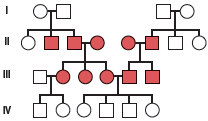
In pedigree (b) of Problem 3.24, what is the chance that the couple III-1 and III-2 will have an affected child?What is the chance that the couple IV-2 and IV-3 will have an affected child?
What blood types could be observed in children born to a woman who has blood type M and a man who has blood type MN?
In rabbits, coloration of the fur depends on alleles of the gene c. From information given in the chapter, what phenotypes and proportions would be expected from the following crosses: (a) c+c+ × cc; (b) c+c × c+c; (c) c+c b × c+c cb; (d) cc cb × cc; (e) c+c b ×
In mice, a series of five alleles determines fur color. In order of dominance, these alleles are as follows: AY, yellow fur but homozygous lethal; AL, agouti with light belly; A+, agouti (wild-type); at, black and tan; and a, black. For each of the following crosses, give the coat color of the
In several plants, such as tobacco, primrose, and red clover, combinations of alleles in eggs and pollen have been found to influence the reproductive compatibility of the plants. Homozygous combinations, such as S1 S1, do not develop because S1 pollen is not effective on S1 stigmas. However, S1
A woman with type O blood gave birth to a baby, also with type O blood. The woman stated that a man with type AB blood was the father of the baby. Is there any merit to her statement?
A woman with type AB blood gave birth to a baby with type B blood. Two different men claim to be the father. One has type A blood, the other has type B blood. Can the genetic evidence decide in favor of either?No. The woman is IAIB. One man could be either IAIA or IAi; the other could be either
The flower colors of plants in a particular population may be blue, purple, turquoise, light blue, or white. A series of crosses between different members of the population produced the following results:Cross ................................................ Parents
A woman who has blood type O and blood type M marries a man who has blood type AB and blood type MN. If we assume that the genes for the A-B-O and M-N bloodtyping systems assort independently, what blood types might the children of this couple have, and in what proportions?
A Japanese strain of mice has a peculiar, uncoordinated gait called waltzing, which is due to a recessive allele, v. The dominant allele V causes mice to move in a coordinated manner. A mouse geneticist has recently isolated another recessive mutation that causes uncoordinated movement. This
Congenital deafness in human beings is inherited as a recessive condition. In the following pedigree, two deaf individuals, each presumably homozygous for a recessive mutation, have married and produced four children with normal hearing. Propose an explanation. IV 오모모오오모
In the fruit fly, recessive mutations in either of two independently assorting genes, brown and purple, prevent the synthesis of red pigment in the eyes. Thus, homozygotes for either of these mutations have brownish-purple eyes.However, heterozygotes for both of these mutations have dark red, that
The dominant mutation Plum in the fruit fly also causes brownish-purple eyes. Is it possible to determine by genetic experiments whether Plum is an allele of the brown or purple genes?
From information given in the chapter, explain why mice with yellow coat color are not true-breeding.
A couple has four children. Neither the father nor the mother is bald; one of the two sons is bald, but neither of the daughters is bald. (a) If one of the daughters marries a nonbald man and they have a son, what is the chance that the son will become bald as an adult?(b) If the couple has a
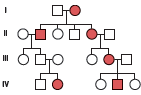
The following pedigree shows the inheritance of ataxia, a rare neurological disorder characterized by uncoordinated movements. Is ataxia caused by a dominant or a recessive allele? Explain. 모e모오모。 IV
Chickens that carry both the alleles for rose comb (R) and pea comb (P) have walnut combs, whereas chickens that lack both of these alleles (i.e., they are genotypically rr pp) have single combs. From the information about interactions between these two genes given in the chapter, determine the
Rose-comb chickens mated with walnut-comb chickens produced 15 walnut-, 14 rose-, 5 pea-, and 6 single-comb chicks. Determine the genotypes of the parents.
Summer squash plants with the dominant allele C bear white fruit, whereas plants homozygous for the recessive allele c bear colored fruit. When the fruit is colored, the dominant allele G causes it to be yellow; in the absence of this allele (i.e., with genotype gg), the fruit color is green. What
The white Leghorn breed of chickens is homozygous for the dominant allele C, which produces colored feathers. However, this breed is also homozygous for the dominant allele I of an independently assorting gene that inhibits coloration of the feathers. Consequently, Leghorn chickens have white
Fruit flies homozygous for the recessive mutation scarlet have bright red eyes because they cannot synthesize brown pigment. Fruit flies homozygous for the recessive mutation brown have brownish-purple eyes because they cannot synthesize red pigment. Fruit flies homozygous for both of these
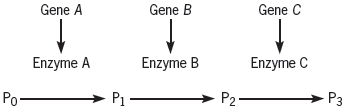
Consider the following hypothetical scheme of determination of coat color in a mammal. Gene A controls the conversion of a white pigment P0 into a gray pigment P1; the dominant allele A produces the enzyme necessary for this conversion, and the recessive allele a produces an enzyme without
What F2 phenotypic segregation ratio would be expected for the cross described in the preceding problem if the dominant allele, C, of the third gene produced a product that completely inhibited the activity of the enzyme produced by gene B—that is, prevented the reaction P1→P2, rather than
The Micronesian Kingfisher, Halcyon cinnamomina, has a cinnamon-colored face. In some birds, the color continues onto the chest, producing one of three patterns: a circle, a shield, or a triangle; in other birds, there is no color on the chest. A male with a colored triangle was crossed with a
In a species of tree, seed color is determined by four independently assorting genes: A, B, C, and D. The recessive alleles of each of these genes (a, b, c, and d) produce abnormal enzymes that cannot catalyze a reaction in the biosynthetic pathway for seed pigment. This pathway is diagrammed as
Multiple crosses were made between true-breeding lines of black and yellow Labrador retrievers. All the F1 progeny were black. When these progeny were inter crossed, they produced an F2 consisting of 91 black, 39 yellow, and 30 chocolate. (a) Propose an explanation for the inheritance of coat
Two plants with white flowers, each from true-breeding strains, were crossed. All the F1 plants had red flowers. When these F1 plants were intercrossed, they produced an F2 consisting of 177 plants with red flowers and 142 with white flowers. (a) Propose an explanation for the inheritance of
Consider the following genetically controlled bio synthetic pathway for pigments in the flowers of a hypothetical plant:Assume that gene A controls the conversion of a white pigment, P0, into another white pigment, P1; the dominant allele A specifies an enzyme necessary for this conversion, and the
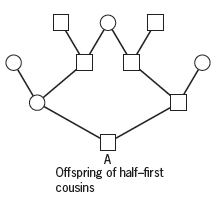
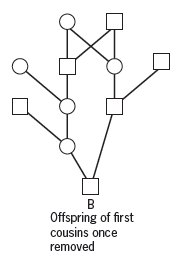
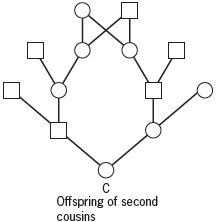
In the following pedigrees, what are the inbreeding coefficients of A, B, and C? A Offspring of half-first cousins Offspring of first cousins once removed
A, B, and C are inbred strains of mice, assumed to be completely homozygous. A is mated to B and B to C. Then the A × B hybrids are mated to C, and the offspring of this mating are mated to the B × C hybrids. What is the inbreeding coefficient of the offspring of this last mating?
Mabel and Frank are half siblings, as are Tina and Tim. However, these two pairs of half siblings do not have any common ancestors. If Mabel marries Tim and Frank marries Tina and each couple has a child, what fraction of their genes will these children share by virtue of common ancestry? Will the
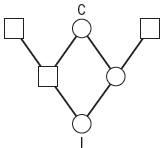
Suppose that the inbreeding coefficient of I in the following pedigree is 0.25. What is the inbreeding coefficient of I€™s common ancestor, C? C
A randomly pollinated strain of maize produces ears that are 24 cm long, on average. After one generation of self fertilization, the ear length is reduced to 20 cm. Predict the ear length if self-fertilization is continued for one more generation.
What are the genetic differences between male- and female-determining sperm in animals with heterogametic males?
A male with singed bristles appeared in a culture of Drosophila. How would you determine if this unusual phenotype was due to an X-linked mutation?
In grasshoppers, rosy body color is caused by a recessive mutation; the wild-type body color is green. If the gene for body color is on the X chromosome, what kind of progeny would be obtained from a mating between a homozygous rosy female and a hemizygous wild-type male? (In grasshoppers, females
What are the sexual phenotypes of the following genotypes in Drosophila: XX, XY, XXY, XXX, XO?
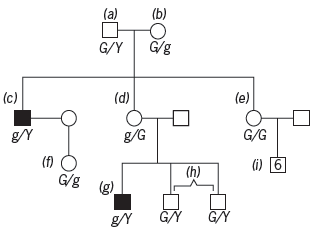
In human beings, a recessive X-linked mutation, g, causes green-defective color vision; the wild-type allele, G,causes normal color vision. A man (a) And a woman (b), Both with normal vision, have three children, all arried to people with normal vision: a color-defective
If both father and son have defective color vision, is it likely that the son inherited the trait from his father?
A normal woman, whose father had hemophilia, marries a normal man. What is the chance that their first child will have hemophilia?
A man with X-linked color blindness marries a woman with no history of color blindness in her family. Thedaughter of this couple marries a normal man, and their daughter also marries a normal man. What is the chance that this last couple will have a child with color blindness? If this couple
A man who has color blindness and type O blood has children with a woman who has normal color vision and type AB blood. The woman’s father had color blindness. Color blindness is determined by an X-linked gene, and blood type is determined by an auto somal gene.(a) What are the genotypes of the
A Drosophila female homozygous for a recessive X-linked mutation that causes vermilion eyes is mated to a wildtype male with red eyes. Among their progeny, all the sons have vermilion eyes, and nearly all the daughters have red eyes; however, a few daughters have vermilion eyes. Explain the origin
Suppose that the LCR of the β-globin gene cluster was deleted from one of the two chromosomes 11 in a man. What disease might this deletion cause?
In Drosophila larvae, the single X chromosome in males appears diffuse and bloated in the polytene cells of the salivary gland. Is this observation compatible with the idea that X-linked genes are hyperactivated in Drosophila males?
Suppose that you used site-specific mutagenesis to modify the trpL sequence such that the two UGG Trp codons at positions 54–56 and 57–60 (Figure 17.14) in the mRNA leader sequence were changed to GGG Gly codons. Will attenuation of the trp operon still be regulated by the presence or absence
By what mechanism does the presence of tryptophan in the medium in which E. coli cells are growing result in premature termination or attenuation of transcription of the trp operon?
Constitutive mutations produce elevated enzyme levels at all times; they may be of two types: Oc or I−. Assume that all other DNA present is wild-type. Outline how the two constitutive mutants can be distinguished with respect to (a) Map position, (b) Regulation of enzyme levels in
As a genetics historian, you are repeating some of the classic experiments conducted by Jacob and Monod with the lactose operon in E. coli. You use an F plasmid to construct several E. coli strains that are partially diploid for the lac operon. You construct strains with the following
Write the partial diploid genotype for a strain that will(a) Produce β-galactosidase constitutively and permease inducibly and (b) Produce β-galactosidase constitutively but not permease either constitutively or inducibly, even though a Y+ gene is known to be present.
Groups of alleles associated with the lactose operon are as follows (in order of dominance for each allelic series): repressor, Is (superrepressor), I+ (inducible), and I- (constitutive); operator, Oc (constitutive, cis- dominant) and O+ (inducible, cis-dominant); structural, Z+ and Y+. (a)
In the lactose operon of E. coli, what is the function of each of the following genes or sites:(a) Regulator, (b) Operator, (c) Promoter, (d) Structural gene Z, and (e) Structural gene Y?
The Streptococcus pyogenes Cas9 endonuclease can be targeted to a specific genomic DNA sequence by an sgRNA that at its 5′ end has 20 nucleotides complementary to the target sequence. If this target sequence is immediately upstream of the protospacer adjacent motif (PAM) 5′NGG-3′, Cas9 will
How can inducible and repressible enzymes of microorganisms be distinguished?
Distinguish between (a) Repression and (b) Feedback inhibition caused by the end-product of a biosynthetic pathway. How do these two regulatory phenomena complement each other to provide for the efficient regulation of metabolism?
What would be the result of inactivation by mutation of the following genes or sites in the E. coli lactose operon:(a) Regulator, (b) Operator, (c) Promoter, (d) Structural gene Z, and (e) Structural gene Y?
Assume that you have discovered a new strain of E. coli that has a mutation in the lac operator region that causes the wild-type repressor protein to bind irreversibly to the operator. You have named this operator mutant Osb for “superbinding” operator. (a) What phenotype would a partial
Why is the Oc mutation in the E. coli lac operon epistatic to the Is mutation?
For each of the following partial diploids indicate whether enzyme synthesis is constitutive or inducible (see Problem 17.5 for dominance relationships):(a) I+O+Z+Y+/I+O+Z+Y+, (b) I+O+Z+Y+/I+OcZ+Y+,(c) I+OcZ+Y+/I+OcZ+Y+, (d) I+O+Z+Y+/I−O+Z+Y+,(e) I-O+Z+Y+/I−O+Z+Y+.Why?
How could the tryptophan operon in E. coli have developed and been maintained by evolution?
Of what biological significance is the phenomenon of catabolite repression?
How might the concentration of glucose in the medium in which an E. coli cell is growing regulate the intracellular level of cyclic AMP?
Is the CAP–cAMP effect on the transcription of the lac operon an example of positive or negative regulation? Why?
Would it be possible to isolate E. coli mutants in which the transcription of the lac operon is not sensitive to catabolite repression? If so, in what genes might the mutations be located?
Using examples, distinguish between negative regulatory mechanisms and positive regulatory mechanisms.
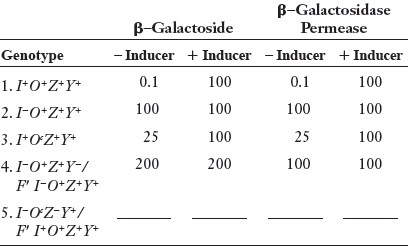
The following table gives the relative activities of the enzymes β-galactosidase and β-galactoside permease in cells with different genotypes at the lac locus in E. coli. The level of activity of each enzyme in wild-type E. coli not carrying F€™s was arbitrarily
The rate of transcription of the trp operon in E. coli is controlled by both (1) repression/derepression and (2) attenuation. By what mechanisms do these two regulatory processes modulate trp operon transcript levels?
What effect will deletion of the trpL region of the trp operon have on the rates of synthesis of the enzymes encoded by the five genes in the trp operon in E. coli cells growing in the presence of tryptophan?
Showing 400 - 500
of 617
1
2
3
4
5
6
7
Step by Step Answers

 Get 50% OFF
Claim Now
Get 50% OFF
Claim Now