New Semester
Started
Get
50% OFF
Study Help!
--h --m --s
Claim Now
Question Answers
Textbooks
Find textbooks, questions and answers
Oops, something went wrong!
Change your search query and then try again
S
Books
FREE
Study Help
Expert Questions
Accounting
General Management
Mathematics
Finance
Organizational Behaviour
Law
Physics
Operating System
Management Leadership
Sociology
Programming
Marketing
Database
Computer Network
Economics
Textbooks Solutions
Accounting
Managerial Accounting
Management Leadership
Cost Accounting
Statistics
Business Law
Corporate Finance
Finance
Economics
Auditing
Tutors
Online Tutors
Find a Tutor
Hire a Tutor
Become a Tutor
AI Tutor
AI Study Planner
NEW
Sell Books
Search
Search
Sign In
Register
study help
mathematics
calculus 10th edition
Calculus 10th Edition Ron Larson, Bruce H. Edwards - Solutions
A particle moves along the x-axis at a velocity of v(t) = 1/√t, t > 0. At time t = 1, its position is x = 4. Find the acceleration and position functions for the particle.
A particle, initially at rest, moves along the x-axis such that its acceleration at time t > 0 is given by a(t) = cos t. At the time t = 0, its position is x = 3.(a) Find the velocity and position functions for the particle(b) Find the values of t for which the particle is at rest
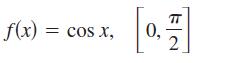
In Exercises use the Midpoint Rule with n = 4 to approximate the area of the region bounded by the graph of the function and the x-axis over the given interval. f(x) = cos x, 0, 2
In Exercises determine which value best approximates the area of the region between the x-axis and the graph of the function over the given interval. (Make your selection on the basis of a sketch of the region, not by performing calculations.)(a) -2(b) 6(c) 10(d) 3(e) 8 f(x) = 4x², [0, 2]
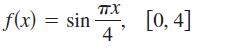
In Exercises determine which value best approximates the area of the region between the x-axis and the graph of the function over the given interval. (Make your selection on the basis of a sketch of the region, not by performing calculations.) (a) 3(b) 1(c) - 2(d) 8(e) 6 π.Χ f(x) = sin
The maker of an automobile advertises that it takes 13 seconds to accelerate from 25 kilometers per hour to 80 kilometers per hour. Assume the acceleration is constant.(a) Find the acceleration in meters per second per second.(b) Find the distance the car travels during the 13 seconds.
A car traveling at 45 miles per hour is brought to a stop, at constant deceleration, 132 feet from where the brakes are applied.(a) How far has the car moved when its speed has been reduced to 30 miles per hour?(b) How far has the car moved when its speed has been reduced to 15 miles per hour?(c)
Give the definition of the area of a region in the plane.
Assume that a fully loaded plane starting from rest has a constant acceleration while moving down a runway. The plane requires 0.7 mile of runway and a speed of 160 miles per hour in order to lift off. What is the plane’s acceleration?
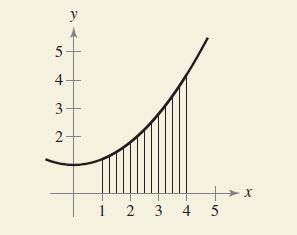
The function shown in the graph below is increasing on the interval [1,4]. The interval will be divided into 12 subintervals.(a) What are the left endpoints of the first and last subintervals?(b) What are the right endpoints of the first two subintervals?(c) When using the right endpoints, do the
In Exercises determine whether the statement is true or false. If it is false, explain why or give an example that shows it is false.The antiderivative of ƒ(x) is unique.
In Exercises determine whether the statement is true or false. If it is false, explain why or give an example that shows it is false.Each antiderivative of an nth-degree polynomial function is an (n + 1) th-degree polynomial function.
Use the figure to write a short paragraph explaining why the formula 1 + 2 + ·· + n = 1/2n(n + 1) is valid for all positive integers n. **** * ★★★★★ ***** ★★ ★★★ ★★★ ★ ★ ★ ★ ★ ★ ★
In Exercises determine whether the statement is true or false. If it is false, explain why or give an example that shows it is false.The sum of the first n positive integers is n(n+1)/2.
In Exercises determine whether the statement is true or false. If it is false, explain why or give an example that shows it is false.If p(x) is a polynomial function, then p has exactly one antiderivative whose graph contains the origin.
In Exercises determine whether the statement is true or false. If it is false, explain why or give an example that shows it is false.If ƒ is continuous and nonnegative on [a, b], then the limits asn → ∞ of its lower sum s(n) and upper sum S(n) both exist andare equal.
In Exercises determine whether the statement is true or false. If it is false, explain why or give an example that shows it is false.If F(x) and G(x) are antiderivatives of ƒ(x), then F(x) = G(x) + C.
In Exercises determine whether the statement is true or false. If it is false, explain why or give an example that shows it is false.If ƒ'(x) = g(x), then ∫g(x) dx = ƒ(x) + C.
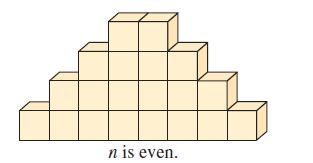
A child places cubic building blocks in a row to form the base of a triangular design (see figure). Each successive row contains two fewer blocks than the preceding row. Find a formula for the number of blocks used in the design. n is even.
In Exercises determine whether the statement is true or false. If it is false, explain why or give an example that shows it is false.∫ƒ(x)g(x) dx = ∫ƒ(x) dx ∫g(x) dx
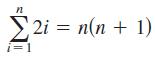
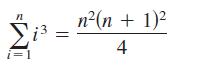
Prove each formula by mathematical induction. (You may need to review the method of proof by induction from a precalculus text.)(a)(b) n i= 2i = n(n + 1)
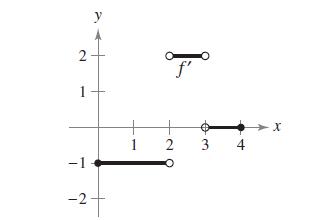
The graph of ƒ' is shown. Find and sketch the graph of ƒ given that ƒ is continuous and ƒ(0) = 1. 2 1 -1 -2 y 1 'f' + 2 3 4 X
Suppose ƒ and g are non-constant, differentiable, real-valuedfunctions defined on (-∞, ∞). Furthermore, suppose thatfor each pair of real numbers x and y, f(x + y) = f(x)f(y) - g(x)g(y) and g(x + y) = f(x)g(y) + g(x)f(y).
A dart, thrown at random, hits a square target. Assuming that any two parts of the target of equal area are equally likely to be hit, find the probability that the point hit is nearer to the center than to any edge. Write your answer in the form (a √b + c)/d, where a, b, c, and d are integers.
Let s(x) and c(x) be two functions satisfying s'(x) = c(x) and c'(x) = -s(x) for all x. If s(0) = 0 and c(0) = 1, prove that [s(x)]2+ [c(x)]² = 1.
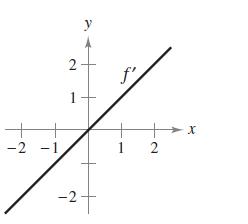
In Exercises the graph of the derivative of a function is given. Sketch the graphs of two functions that have the given derivative. -2 -1 2 1 -2 y f' 1 2 X
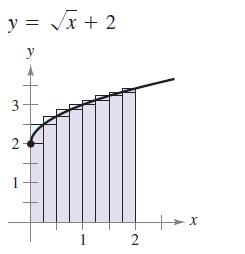
In Exercises use upper and lower sums to approximate the area of the region using the given number of subintervals (of equal width). y = √√√x + 2 y 3 2 1 2 X
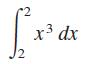
In Exercises, evaluate the integral using the following values. [x³dx = 60, [*xdx = 6₁ [dx = 2 6,
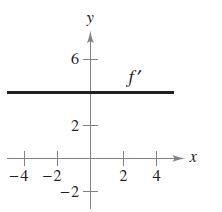
In Exercises the graph of the derivative of a function is given. Sketch the graphs of two functions that have the given derivative. -4 -2 6 2 -2 y f' + 2 4 X
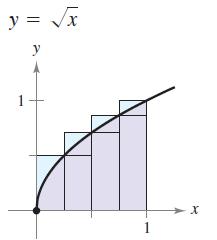
In Exercises use upper and lower sums to approximate the area of the region using the given number of subintervals (of equal width). y = √√√x y 1 X
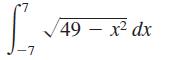
In Exercises sketch the region whose area is given by the definite integral. Then use a geometric formula to evaluate the integral (a > 0, r > 0). *7 [₁ -7 49 - x² dx
In Exercises, evaluate the integral using the following values. [x³dx = 60, [*xdx = 6₁ [dx = 2 6,
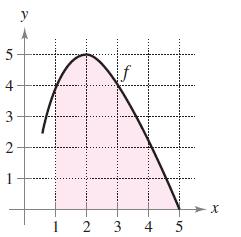
In Exercises bound the area of the shaded region by approximating the upper and lower sums. Use rectangles of width 1. 5 4 3 2 1 # 2 3 4 5 X
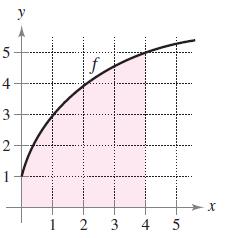
In Exercises bound the area of the shaded region by approximating the upper and lower sums. Use rectangles of width 1. 5 4 3 2 1 y f 12 3 4 5 X
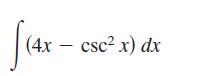
In Exercises find the indefinite integral and check the result by differentiation. (4x csc² x) dx
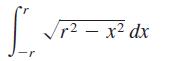
In Exercises sketch the region whose area is given by the definite integral. Then use a geometric formula to evaluate the integral (a > 0, r > 0). S. √r² - x² dx
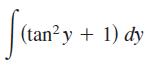
In Exercises find the indefinite integral and check the result by differentiation. [(tan² y (tan²y + 1) dy
In Exercises use left and right endpoints and the given number of rectangles to find two approximations of the area of the region between the graph of the function and the x-axis over the given interval. g(x) = sin x, [0, π], 6 rectangles
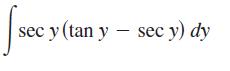
In Exercises find the indefinite integral and check the result by differentiation. sec y (tan y sec y) dy
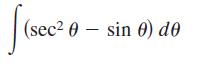
In Exercises find the indefinite integral and check the result by differentiation. [(sc (sec²0 sin 0) de -
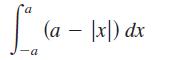
In Exercises sketch the region whose area is given by the definite integral. Then use a geometric formula to evaluate the integral (a > 0, r > 0). a 1. -a (a − x) dx
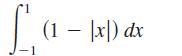
In Exercises sketch the region whose area is given by the definite integral. Then use a geometric formula to evaluate the integral (a > 0, r > 0). L₁ (1 - x) dx -1
In Exercises use left and right endpoints and the given number of rectangles to find two approximations of the area of the region between the graph of the function and the x-axis over the given interval. f(x) = cos x, 0, 4 rectangles
In Exercises use left and right endpoints and the given number of rectangles to find two approximations of the area of the region between the graph of the function and the x-axis over the given interval. g(x)=x² + 1, [1, 3], 8 rectangles
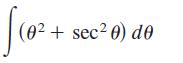
In Exercises find the indefinite integral and check the result by differentiation. SC0². (0² + sec²0) de
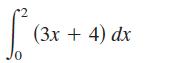
In Exercises sketch the region whose area is given by the definite integral. Then use a geometric formula to evaluate the integral (a > 0, r > 0). 2 fo (3x + 4) dx
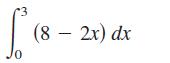
In Exercises sketch the region whose area is given by the definite integral. Then use a geometric formula to evaluate the integral (a > 0, r > 0). 3 fo (8 - 2x) dx
In Exercises use left and right endpoints and the given number of rectangles to find two approximations of the area of the region between the graph of the function and the x-axis over the given interval. g(x) = 2x² x 1, [2, 5], 6 rectangles - -
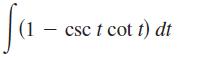
In Exercises find the indefinite integral and check the result by differentiation. (1 csc t cot t) dt
In Exercises use left and right endpoints and the given number of rectangles to find two approximations of the area of the region between the graph of the function and the x-axis over the given interval. f(x) = 9x, [2, 4], 6 rectangles
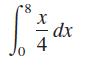
In Exercises sketch the region whose area is given by the definite integral. Then use a geometric formula to evaluate the integral (a > 0, r > 0). 8 X $.$= dx
In Exercises use left and right endpoints and the given number of rectangles to find two approximations of the area of the region between the graph of the function and the x-axis over the given interval. f(x) = 2x + 5, [0, 2], 4 rectangles
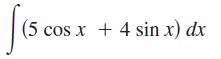
In Exercises find the indefinite integral and check the result by differentiation. fo (5 cos x + 4 sin x) dx
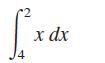
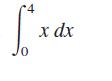
In Exercises sketch the region whose area is given by the definite integral. Then use a geometric formula to evaluate the integral (a > 0, r > 0). xp x Х J 4
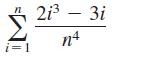
In Exercises use the summation formulas to rewrite the expression without the summation notation. Use the result to find the sums for n = 10, 100, 1000, and 10,000. i=1 2i3 - 3i nt
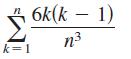
In Exercises use the summation formulas to rewrite the expression without the summation notation. Use the result to find the sums for n = 10, 100, 1000, and 10,000. n k=1 6k(k − 1) n³
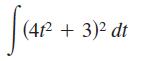
In Exercises find the indefinite integral and check the result by differentiation. [(41 (41²2 + 3)² dt
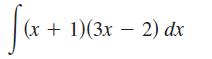
In Exercises find the indefinite integral and check the result by differentiation. fax. (x + 1)(3x - 2) dx
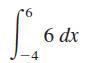
In Exercises sketch the region whose area is given by the definite integral. Then use a geometric formula to evaluate the integral (a > 0, r > 0). -4 6 dx
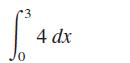
In Exercises sketch the region whose area is given by the definite integral. Then use a geometric formula to evaluate the integral (a > 0, r > 0). 3 0 4 dx
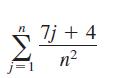
In Exercises use the summation formulas to rewrite the expression without the summation notation. Use the result to find the sums for n = 10, 100, 1000, and 10,000. j=1 7j + 4 n2
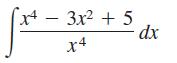
In Exercises find the indefinite integral and check the result by differentiation. 3x² + 5 x4 dx
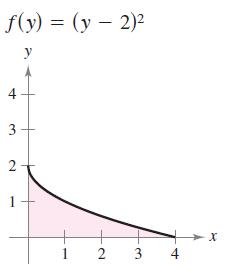
In Exercises, set up a definite integral that yields the area of the region. (Do not evaluate the integral.) f(y) = (y - 2)² y 4 3 2 1 1 2 3 4 X
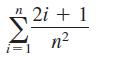
In Exercises use the summation formulas to rewrite the expression without the summation notation. Use the result to find the sums for n = 10, 100, 1000, and 10,000. i=1 2i + 1 n²
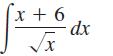
In Exercises find the indefinite integral and check the result by differentiation. x+6 X dx
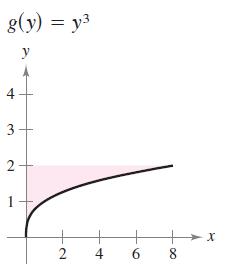
In Exercises, set up a definite integral that yields the area of the region. (Do not evaluate the integral.) g(y) = y³ y 4 3 نرا 2 2 4 6 8
In Exercises find the indefinite integral and check the result by differentiation. 3 X dx
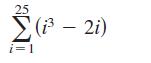
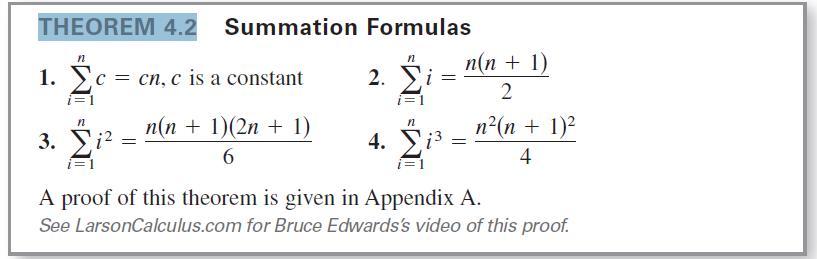
In Exercises use the properties of summation and Theorem 4.2 to evaluate the sum. Use the summation capabilities of a graphing utility to verify your result.Data from in Theorem 4.2 25 Σ(3 – 2i) i=1
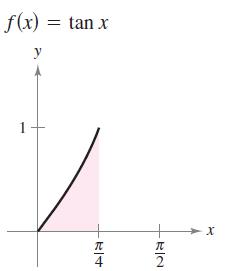
In Exercises, set up a definite integral that yields the area of the region. (Do not evaluate the integral.) f(x) = tan x y 1 元4 |2
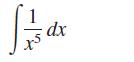
In Exercises find the indefinite integral and check the result by differentiation. 1/3 dx
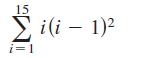
In Exercises use the properties of summation and Theorem 4.2 to evaluate the sum. Use the summation capabilities of a graphing utility to verify your result.Data from in Theorem 4.2 15 Σ - i(i – 1)2 i=1
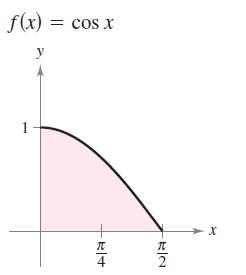
In Exercises, set up a definite integral that yields the area of the region. (Do not evaluate the integral.) f(x) = cos x 1 y R|4 2 X
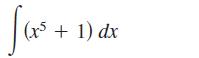
In Exercises find the indefinite integral and check the result by differentiation. fars (x³ + 1) dx
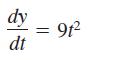
In Exercises find the general solution of the differential equation and check the result by differentiation. dy * dt = 91²
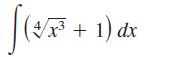
In Exercises find the indefinite integral and check the result by differentiation. f(3x³ √/x³ + 1) dx
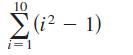
In Exercises use the properties of summation and Theorem 4.2 to evaluate the sum. Use the summation capabilities of a graphing utility to verify your result.Data from in Theorem 4.2 10 Σ(2 – 1) [ =!
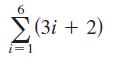
In Exercises find the sum. Use the summation capabilities of a graphing utility to verify your result. i=1 (3i + 2)
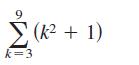
In Exercises find the sum. Use the summation capabilities of a graphing utility to verify your result. Σ (2 + 1) k=3
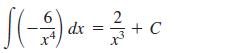
In Exercises verify the statement by showing that the derivative of the right side equals the integrand of the left side. 2 (3) (Π+ dx = X
In Exercises verify the statement by showing that the derivative of the right side equals the integrand of the left side. [(8x² + 21/12) dx = 2x¹ - 12/12 + C 2x², 2x
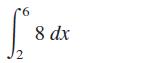
In Exercises evaluate the definite integral by the limit definition. 6 18 2 8 dx
In Exercises find the sum. Use the summation capabilities of a graphing utility to verify your result. j=4 3
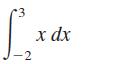
In Exercises evaluate the definite integral by the limit definition. -2 x dx
In Exercises find the sum. Use the summation capabilities of a graphing utility to verify your result. 4 Σε k=1
In Exercises find the general solution of the differential equation and check the result by differentiation. dy dt = 5
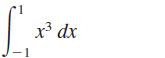
In Exercises evaluate the definite integral by the limit definition. [₁ -1 x³ dx
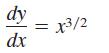
In Exercises find the general solution of the differential equation and check the result by differentiation. dy dx T/EX: =
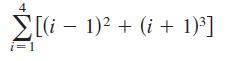
In Exercises find the sum. Use the summation capabilities of a graphing utility to verify your result. Σ[ – 1)2 + (i + 13] - = 1
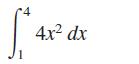
In Exercises evaluate the definite integral by the limit definition. Si 4x² dx
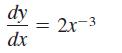
In Exercises find the general solution of the differential equation and check the result by differentiation. dy dx || 2r-3
In Exercises complete the table to find the indefinite integral. Original Integral S² 3/x dx Rewrite Integrate Simplify
In Exercises use sigma notation to write the sum. 1 + 5(1) 1 5(2) + 1 5(3) + + 1 5(11)
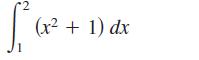
In Exercises evaluate the definite integral by the limit definition. 2. (x² + 1) dx
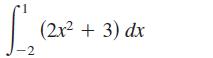
In Exercises evaluate the definite integral by the limit definition. J-2 (2x² + 3) dx
In Exercises use sigma notation to write the sum. 9 1+1 + 9 1+ 2 + 9 1+ 3 + . + 9 1 + 14
In Exercises use sigma notation to write the sum. [ ¹(!) + 5] + [ ² (?) + ³] + · · · + [79) + s 5 5 6
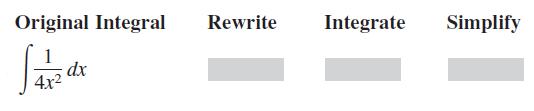
In Exercises complete the table to find the indefinite integral. Original Integral 4x² dx Rewrite Integrate Simplify
In Exercises use sigma notation to write the sum. 22 [¹ − (²] + [ ¹ - ()] + ··· + [¹-()] 1- 1 . . +1 1- 4 4
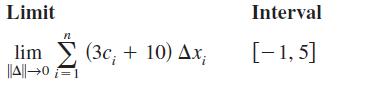
In Exercises write the limit as a definite integral on the interval [a, b], where ci is any point in the ith subinterval. Limit lim Allo n (3c; + 10) Ax; Interval [-1,5]
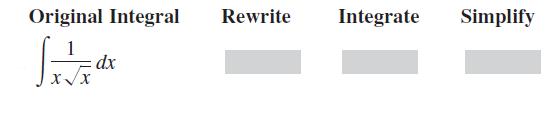
In Exercises complete the table to find the indefinite integral. Original Integral dx Rewrite Integrate Simplify
Showing 8000 - 8100
of 9867
First
74
75
76
77
78
79
80
81
82
83
84
85
86
87
88
Last
Step by Step Answers

 Get 50% OFF
Claim Now
Get 50% OFF
Claim Now