New Semester
Started
Get
50% OFF
Study Help!
--h --m --s
Claim Now
Question Answers
Textbooks
Find textbooks, questions and answers
Oops, something went wrong!
Change your search query and then try again
S
Books
FREE
Study Help
Expert Questions
Accounting
General Management
Mathematics
Finance
Organizational Behaviour
Law
Physics
Operating System
Management Leadership
Sociology
Programming
Marketing
Database
Computer Network
Economics
Textbooks Solutions
Accounting
Managerial Accounting
Management Leadership
Cost Accounting
Statistics
Business Law
Corporate Finance
Finance
Economics
Auditing
Tutors
Online Tutors
Find a Tutor
Hire a Tutor
Become a Tutor
AI Tutor
AI Study Planner
NEW
Sell Books
Search
Search
Sign In
Register
study help
mathematics
calculus 4th
Calculus 4th Edition Jon Rogawski, Colin Adams, Robert Franzosa - Solutions
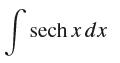
Evaluate using the substitution of Exercise 43.Data From Exercise 43Show that if u = tanh(x/2), thenFor the first relation, use the identities Ss sech x dx
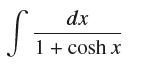
Evaluate using the substitution of Exercise 43.Data From Exercise 43Show that if u = tanh(x/2), thenFor the first relation, use the identities dx 1 + cosh x S
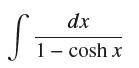
Evaluate using the substitution of Exercise 43.Data From Exercise 43Show that if u = tanh(x/2), thenFor the first relation, use the identities S dx 1 - cosh x
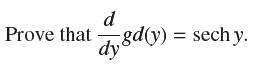
Refer to the function gd(y) = tan−1(sinh y), called the Gudermannian. In a map of the earth constructed by Mercator projection, points located y radial units from the equator correspond to points on the globe of latitude gd(y). Prove that d dy8d(y) = sech y.
Refer to the function gd(y) = tan−1(sinh y), called the Gudermannian. In a map of the earth constructed by Mercator projection, points located y radial units from the equator correspond to points on the globe of latitude gd(y).Let ƒ(y) = 2 tan−1(ey) − π/2. Prove that gd(y) = ƒ(y). Show
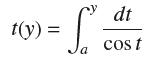
Refer to the function gd(y) = tan−1(sinh y), called the Gudermannian. In a map of the earth constructed by Mercator projection, points located y radial units from the equator correspond to points on the globe of latitude gd(y).Let t(y) = sinh−1(tan y). Show that t(y) is the inverse of gd(y) for
Refer to the function gd(y) = tan−1(sinh y), called the Gudermannian. In a map of the earth constructed by Mercator projection, points located y radial units from the equator correspond to points on the globe of latitude gd(y).Verify that t(y) in Exercise 49 satisfies t(y) = sec y, and find a
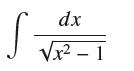
Calculate the integral in terms of the inverse hyperbolic functions. dx √x²1 s
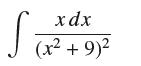
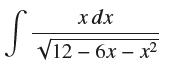
Evaluate the integral using the appropriate method or combination of methods covered thus far in the text. You may use the integral tables at the end of the text, but do not use a computer algebra system. x dx (x² + 9)² S
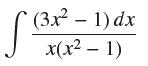
Evaluate the integral using the appropriate method or combination of methods covered thus far in the text. You may use the integral tables at the end of the text, but do not use a computer algebra system. (3x² - 1) dx x(x² - 1) for
Indicate a good method for evaluating the integral (but do not evaluate). Your choices are substitution (specify u and du), Integration by Parts (specify u and dv), a trigonometric method, or trigonometric substitution (specify). If it appears that these techniques are not sufficient, state this.
Indicate a good method for evaluating the integral (but do not evaluate). Your choices are substitution (specify u and du), Integration by Parts (specify u and dv), a trigonometric method, or trigonometric substitution (specify). If it appears that these techniques are not sufficient, state this.
Indicate a good method for evaluating the integral (but do not evaluate). Your choices are substitution (specify u and du), Integration by Parts (specify u and dv), a trigonometric method, or trigonometric substitution (specify). If it appears that these techniques are not sufficient, state this.
Indicate a good method for evaluating the integral (but do not evaluate). Your choices are substitution (specify u and du), Integration by Parts (specify u and dv), a trigonometric method, or trigonometric substitution (specify). If it appears that these techniques are not sufficient, state this.
Indicate a good method for evaluating the integral (but do not evaluate). Your choices are substitution (specify u and du), Integration by Parts (specify u and dv), a trigonometric method, or trigonometric substitution (specify). If it appears that these techniques are not sufficient, state this.
Indicate a good method for evaluating the integral (but do not evaluate). Your choices are substitution (specify u and du), Integration by Parts (specify u and dv), a trigonometric method, or trigonometric substitution (specify). If it appears that these techniques are not sufficient, state this.
Indicate a good method for evaluating the integral (but do not evaluate). Your choices are substitution (specify u and du), Integration by Parts (specify u and dv), a trigonometric method, or trigonometric substitution (specify). If it appears that these techniques are not sufficient, state this. f
Indicate a good method for evaluating the integral (but do not evaluate). Your choices are substitution (specify u and du), Integration by Parts (specify u and dv), a trigonometric method, or trigonometric substitution (specify). If it appears that these techniques are not sufficient, state this.
Indicate a good method for evaluating the integral (but do not evaluate). Your choices are substitution (specify u and du), Integration by Parts (specify u and dv), a trigonometric method, or trigonometric substitution (specify). If it appears that these techniques are not sufficient, state this.
Indicate a good method for evaluating the integral (but do not evaluate). Your choices are substitution (specify u and du), Integration by Parts (specify u and dv), a trigonometric method, or trigonometric substitution (specify). If it appears that these techniques are not sufficient, state this.
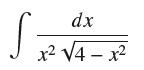
Evaluate the integral using the appropriate method or combination of methods covered thus far in the text. You may use the integral tables at the end of the text, but do not use a computer algebra system. dx x² √4x² S
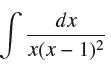
Evaluate the integral using the appropriate method or combination of methods covered thus far in the text. You may use the integral tables at the end of the text, but do not use a computer algebra system. dx x(x - 1)² L
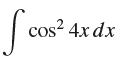
Evaluate the integral using the appropriate method or combination of methods covered thus far in the text. You may use the integral tables at the end of the text, but do not use a computer algebra system. ၂၆၀၀ cos² 4x dx
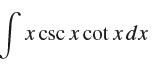
Evaluate the integral using the appropriate method or combination of methods covered thus far in the text. You may use the integral tables at the end of the text, but do not use a computer algebra system. Sx x CSC x cot xdx
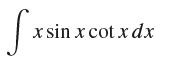
Evaluate the integral using the appropriate method or combination of methods covered thus far in the text. You may use the integral tables at the end of the text, but do not use a computer algebra system. Sr x sin x cotx dx
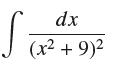
Evaluate the integral using the appropriate method or combination of methods covered thus far in the text. You may use the integral tables at the end of the text, but do not use a computer algebra system. dx (x² + 9)² Si
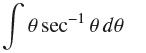
Evaluate the integral using the appropriate method or combination of methods covered thus far in the text. You may use the integral tables at the end of the text, but do not use a computer algebra system. Sosi 0 sec¹0 de Ꮎ
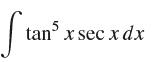
Evaluate the integral using the appropriate method or combination of methods covered thus far in the text. You may use the integral tables at the end of the text, but do not use a computer algebra system. S₁ tan³ x sec x dx
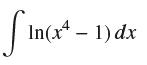
Evaluate the integral using the appropriate method or combination of methods covered thus far in the text. You may use the integral tables at the end of the text, but do not use a computer algebra system. Sin(x4- In(x² - 1) dx
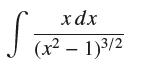
Evaluate the integral using the appropriate method or combination of methods covered thus far in the text. You may use the integral tables at the end of the text, but do not use a computer algebra system. xdx (x² - 1)³/2
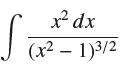
Evaluate the integral using the appropriate method or combination of methods covered thus far in the text. You may use the integral tables at the end of the text, but do not use a computer algebra system. x2dx (x² - 1)3/2
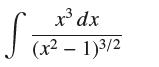
Evaluate the integral using the appropriate method or combination of methods covered thus far in the text. You may use the integral tables at the end of the text, but do not use a computer algebra system. x³ dx (x² - 1)³/2
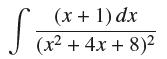
Evaluate the integral using the appropriate method or combination of methods covered thus far in the text. You may use the integral tables at the end of the text, but do not use a computer algebra system. (x + 1) dx (x² + 4x + 8)² S
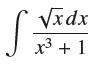
Evaluate the integral using the appropriate method or combination of methods covered thus far in the text. You may use the integral tables at the end of the text, but do not use a computer algebra system. I + EX √xdx S
Evaluate the integral using the appropriate method or combination of methods covered thus far in the text. You may use the integral tables at the end of the text, but do not use a computer algebra system. I + 8/1x XP /х S
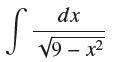
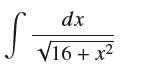
Evaluate the integral using the appropriate method or combination of methods covered thus far in the text. You may use the integral tables at the end of the text, but do not use a computer algebra system. S dx √16 + x²
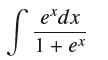
Evaluate the integral using the appropriate method or combination of methods covered thus far in the text. You may use the integral tables at the end of the text, but do not use a computer algebra system. ex dx 1 + ex Si
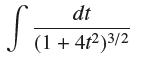
Evaluate the integral using the appropriate method or combination of methods covered thus far in the text. You may use the integral tables at the end of the text, but do not use a computer algebra system. dt (1 + 4t²)3/2 Si
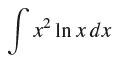
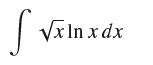
Evaluate the integral using the appropriate method or combination of methods covered thus far in the text. You may use the integral tables at the end of the text, but do not use a computer algebra system. S xInxdx
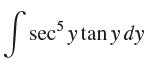
Evaluate the integral using the appropriate method or combination of methods covered thus far in the text. You may use the integral tables at the end of the text, but do not use a computer algebra system. sees, secs y tan y dy
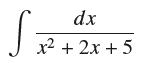
Evaluate the integral using the appropriate method or combination of methods covered thus far in the text. You may use the integral tables at the end of the text, but do not use a computer algebra system. dx x² + 2x + 5
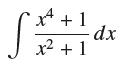
Evaluate the integral using the appropriate method or combination of methods covered thus far in the text. You may use the integral tables at the end of the text, but do not use a computer algebra system. +1 x² + 1 S dx
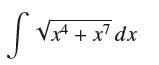
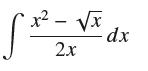
Evaluate the integral using the appropriate method or combination of methods covered thus far in the text. You may use the integral tables at the end of the text, but do not use a computer algebra system. √x + x² dx S
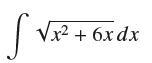
Evaluate the integral using the appropriate method or combination of methods covered thus far in the text. You may use the integral tables at the end of the text, but do not use a computer algebra system. s √x² + 6x dx
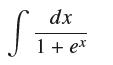
Evaluate the integral using the appropriate method or combination of methods covered thus far in the text. You may use the integral tables at the end of the text, but do not use a computer algebra system. dx 1 + ex Si
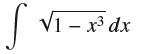
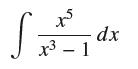
Evaluate the integral using the appropriate method or combination of methods covered thus far in the text. You may use the integral tables at the end of the text, but do not use a computer algebra system. 25 x³ - 1 S dx
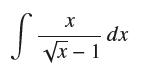
Evaluate the integral using the appropriate method or combination of methods covered thus far in the text. You may use the integral tables at the end of the text, but do not use a computer algebra system. X √x-1 dx
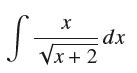
Evaluate the integral using the appropriate method or combination of methods covered thus far in the text. You may use the integral tables at the end of the text, but do not use a computer algebra system. S Vx+ 2 dx
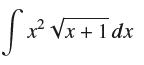
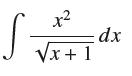
Evaluate the integral using the appropriate method or combination of methods covered thus far in the text. You may use the integral tables at the end of the text, but do not use a computer algebra system. x² √x+1 S= dx
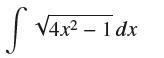
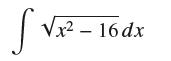
Evaluate the integral using the appropriate method or combination of methods covered thus far in the text. You may use the integral tables at the end of the text, but do not use a computer algebra system. S √x²-16 dx
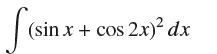
Evaluate the integral using the appropriate method or combination of methods covered thus far in the text. You may use the integral tables at the end of the text, but do not use a computer algebra system. (sin x + cos 2x)² dx
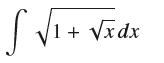
Evaluate the integral using the appropriate method or combination of methods covered thus far in the text. You may use the integral tables at the end of the text, but do not use a computer algebra system. S 1 + √xdx
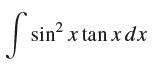
Evaluate the integral using the appropriate method or combination of methods covered thus far in the text. You may use the integral tables at the end of the text, but do not use a computer algebra system. fsi sin² x tan x dx
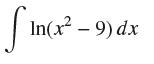
Evaluate the integral using the appropriate method or combination of methods covered thus far in the text. You may use the integral tables at the end of the text, but do not use a computer algebra system. S₁ In(x² - 9) dx
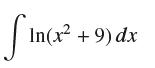
Evaluate the integral using the appropriate method or combination of methods covered thus far in the text. You may use the integral tables at the end of the text, but do not use a computer algebra system. Sin(x² + 9) dx
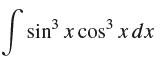
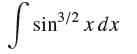
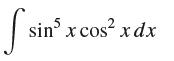
Evaluate the integral using the appropriate method or combination of methods covered thus far in the text. You may use the integral tables at the end of the text, but do not use a computer algebra system. Ss sin5 x cos² x dx
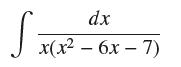
Evaluate the integral using the appropriate method or combination of methods covered thus far in the text. You may use the integral tables at the end of the text, but do not use a computer algebra system. dx x(x² - 6x-7) S -
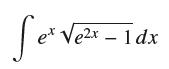
Evaluate the integral using the appropriate method or combination of methods covered thus far in the text. You may use the integral tables at the end of the text, but do not use a computer algebra system. Serv ex √e²x – 1dx
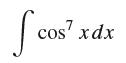
Evaluate the integral using the appropriate method or combination of methods covered thus far in the text. You may use the integral tables at the end of the text, but do not use a computer algebra system. S cos? cos² xdx
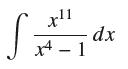
Evaluate the integral using the appropriate method or combination of methods covered thus far in the text. You may use the integral tables at the end of the text, but do not use a computer algebra system. x11 x4-1 dx
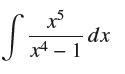
Evaluate the integral using the appropriate method or combination of methods covered thus far in the text. You may use the integral tables at the end of the text, but do not use a computer algebra system. S x5 4-1 dx
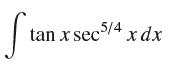
Evaluate the integral using the appropriate method or combination of methods covered thus far in the text. You may use the integral tables at the end of the text, but do not use a computer algebra system. S tan x sec 5/4 x dx
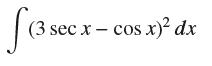
Evaluate the integral using the appropriate method or combination of methods covered thus far in the text. You may use the integral tables at the end of the text, but do not use a computer algebra system. f(3 (3 sec x- cos x)² dx
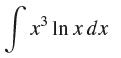
Evaluate the integral using the appropriate method or combination of methods covered thus far in the text. You may use the integral tables at the end of the text, but do not use a computer algebra system. S x³ In x dx
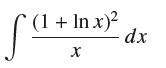
Evaluate the integral using the appropriate method or combination of methods covered thus far in the text. You may use the integral tables at the end of the text, but do not use a computer algebra system. St (1 + In x)² X - dx
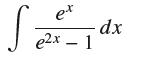
Evaluate the integral using the appropriate method or combination of methods covered thus far in the text. You may use the integral tables at the end of the text, but do not use a computer algebra system. Si et - dx e2x 1
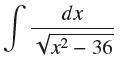
Evaluate the integral using the appropriate method or combination of methods covered thus far in the text. You may use the integral tables at the end of the text, but do not use a computer algebra system. dx √x² - 36 S
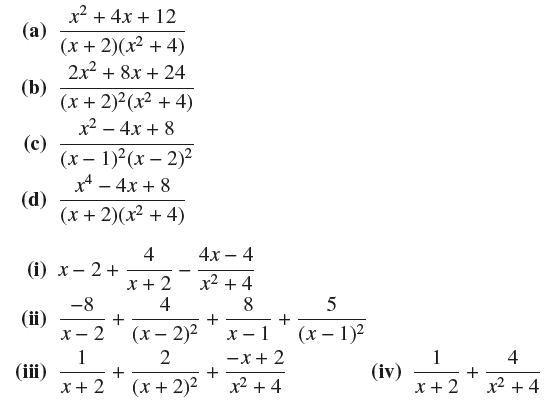
Match the rational functions (a)–(d) with the corresponding partial fraction decompositions (i)–(iv). (a) (b) (c) (d) (ii) x² + 4x + 12 (x + 2)(x² + 4) 2x² + 8x + 24 (iii) (x + 2)²(x² + 4) x² - 4x +8 (i) x-2+ -8 (x - 1)²(x - 2)² 4-4x+8 (x + 2)(x² + 4) 2 1 x + 2 4 x + 2 4 + + - 4x -
Evaluate the integral using the appropriate method or combination of methods covered thus far in the text. You may use the integral tables at the end of the text, but do not use a computer algebra system.Use Integration by Parts to compute ∫x2 ln x dx, setting u = x2 and dv = ln x dx.
Clear the denominators in the following partial fraction decomposition and determine the constant B (substitute a value of x or use the method of undetermined coefficients). 3x² + 11x + 12 (x + 1)(x + 3)² 1 B x + 1 x + 3 3 (x + 3)²
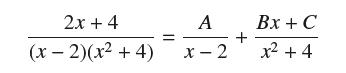
Find the constants in the partial fraction decomposition 2x + 4 (x - 2)(x2 + 4) A x-2 + Bx + C x² + 4
Evaluate using long division first to write ƒ(x) as the sum of a polynomial and a proper rational function. x dx 3x-4 S
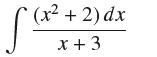
Evaluate using long division first to write ƒ(x) as the sum of a polynomial and a proper rational function. *(x² + 2) dx x + 3 Se
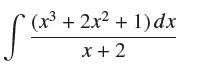
Evaluate using long division first to write ƒ(x) as the sum of a polynomial and a proper rational function. (x³ + 2x² + 1) dx x + 2
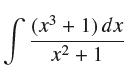
Evaluate using long division first to write ƒ(x) as the sum of a polynomial and a proper rational function. (x³ + 1) dx x² + 1
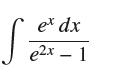
Evaluate by using first substitution and then partial fractions if necessary. S ex dx e2x - 1
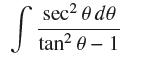
Evaluate by using first substitution and then partial fractions if necessary. sec2 Ꮎ dᎾ tan²01 S
Evaluate ∫ √x dx/x − 1. Use the substitution u = √x (sometimes called a rationalizing substitution).
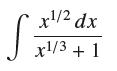
Evaluate ∫ dx/x1/2 − x1/3 .Use the substitution u = x1/6.
Evaluate ∫ dx/x5/4 − 4x3/4 .
Evaluate ∫ dx/x4/3 + x − 2x2/3.
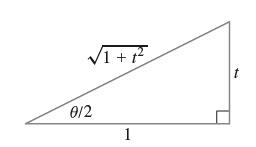
Show that the substitution θ = 2 tan−1 t (Figure 2) yields the formulasThis substitution transforms the integral of any rational function of cos θ and sin θ into an integral of a rational function of t (which can then be evaluated using partial fractions). Use it to evaluate Cos 0 = 1-1² 1 +
Evaluate ∫ dx/x2 − 1 in two ways: using partial fractions and using trigonometric substitution. Verify that the two answers agree.
Graph the equation (x − 40)y2 = 10x(x − 30) and find the volume of the solid obtained by revolving a the region between the graph and the x-axis for 0 ≤ x ≤ 30 around the x-axis.
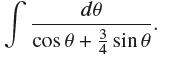
Use the substitution of Exercise 57 to evaluate ∫dθ/cos θ + sin θ.Data From Exercise 57Show that the substitution θ = 2 tan−1 t (Figure 2) yields the formulasThis substitution transforms the integral of any rational function of cos θ and sin θ into an integral of a rational function of t
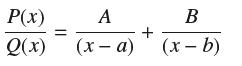
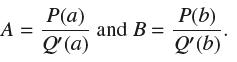
Suppose that Q(x) = (x − a)(x − b), where a ≠ b, and let P/Q be a proper rational function so that(a) Show that (b) Use this result to find the partial fraction decomposition for P(x) = 3x − 2 and Q(x) = x2 − 4x − 12. P(x) Q(x) A (x-a) + B (x-b)
Prove the general formulawhere a, b are constants such that a ≠ b. dx (x-a)(x - b) S 1 In a-b x-al + C x-b|
Find the volume of the solid of revolution that results when the region under the graph of ƒ(x) = x √sin x for 0 ≤ x ≤ π is revolved around the x-axis.
Find the volume of the solid of revolution that results when the region under the graph of ƒ(x) = ln x for 1 ≤ x ≤ e is revolved around the x-axis.
Find the volume of the solid of revolution that results when the region under the graph of ƒ(x) = 3 sin x for 0 ≤ x ≤ π is revolved around the y-axis.
Indicate a good method for evaluating the integral (but do not evaluate). Your choices are algebraic manipulation, substitution (specify u and du), and Integration by Parts (specify u and dv). If it appears that the techniques you have learned thus far are not sufficient, state this. S Vxlnxdx
Find the volume of the solid of revolution that results when the region under the graph of ƒ(x) = e−x for 0 ≤ x ≤ 1 is revolved around:(a) The y-axis.(b) The line x = 1.
Indicate a good method for evaluating the integral (but do not evaluate). Your choices are algebraic manipulation, substitution (specify u and du), and Integration by Parts (specify u and dv). If it appears that the techniques you have learned thus far are not sufficient, state this. x² -
Indicate a good method for evaluating the integral (but do not evaluate). Your choices are algebraic manipulation, substitution (specify u and du), and Integration by Parts (specify u and dv). If it appears that the techniques you have learned thus far are not sufficient, state this. x³
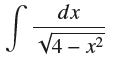
Indicate a good method for evaluating the integral (but do not evaluate). Your choices are algebraic manipulation, substitution (specify u and du), and Integration by Parts (specify u and dv). If it appears that the techniques you have learned thus far are not sufficient, state this. dx √4x²
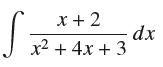
Indicate a good method for evaluating the integral (but do not evaluate). Your choices are algebraic manipulation, substitution (specify u and du), and Integration by Parts (specify u and dv). If it appears that the techniques you have learned thus far are not sufficient, state this. x + 2 x² + 4x
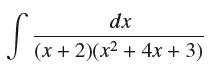
Indicate a good method for evaluating the integral (but do not evaluate). Your choices are algebraic manipulation, substitution (specify u and du), and Integration by Parts (specify u and dv). If it appears that the techniques you have learned thus far are not sufficient, state this. dx (x + 2)(x²
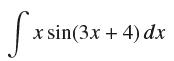
Indicate a good method for evaluating the integral (but do not evaluate). Your choices are algebraic manipulation, substitution (specify u and du), and Integration by Parts (specify u and dv). If it appears that the techniques you have learned thus far are not sufficient, state this. fxsi x sin(3x
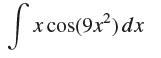
Indicate a good method for evaluating the integral (but do not evaluate). Your choices are algebraic manipulation, substitution (specify u and du), and Integration by Parts (specify u and dv). If it appears that the techniques you have learned thus far are not sufficient, state this. Sx x cos(9x²)
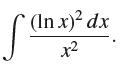
Evaluate Use substitution first and then Integration by Parts. (In x)² dx x² f
Showing 4700 - 4800
of 8339
First
41
42
43
44
45
46
47
48
49
50
51
52
53
54
55
Last
Step by Step Answers

 Get 50% OFF
Claim Now
Get 50% OFF
Claim Now