New Semester
Started
Get
50% OFF
Study Help!
--h --m --s
Claim Now
Question Answers
Textbooks
Find textbooks, questions and answers
Oops, something went wrong!
Change your search query and then try again
S
Books
FREE
Study Help
Expert Questions
Accounting
General Management
Mathematics
Finance
Organizational Behaviour
Law
Physics
Operating System
Management Leadership
Sociology
Programming
Marketing
Database
Computer Network
Economics
Textbooks Solutions
Accounting
Managerial Accounting
Management Leadership
Cost Accounting
Statistics
Business Law
Corporate Finance
Finance
Economics
Auditing
Tutors
Online Tutors
Find a Tutor
Hire a Tutor
Become a Tutor
AI Tutor
AI Study Planner
NEW
Sell Books
Search
Search
Sign In
Register
study help
mathematics
calculus 4th
Calculus 4th Edition Jon Rogawski, Colin Adams, Robert Franzosa - Solutions
Derive the reduction formula I cos cos" x dx : = 1 - n n-1 +"=¹ fcos- n cos"- x sin x + cos"-2 x dx
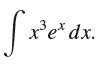
Use the reduction formula from Exercise 64 to find Data From Exercise 64Derive the reduction formula x³ ex dx.
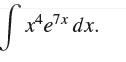
Use substitution and the reduction formula from Exercise 64 to evaluateData From Exercise 64Derive the reduction formula Sx Ae¹x dx.
Evaluate ∫ xn ln x dx for n ≠ −1. Which method should be used to evaluate ∫ x−1 ln x dx?
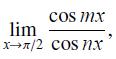
Evaluate where m, n ≠ 0 are integers. cos mx lim X→π/2 COS NX
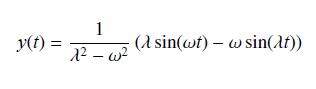
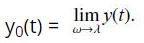
When a spring with natural frequency λ/2π is driven with a sinusoidal force sin(ωt) with ω ≠ λ, it oscillates according toLet (a) Use L’Hôpital’s Rule to determine y0(t).(b) Show that y0(t) ceases to be periodic and that its amplitude |y0(t)| tends to ∞ as t → ∞(the system is
Find the volume of revolution about the x-axis for the given function and interval. f(x) = 1 x2 [1,4]
Find the area of the region enclosed by the graphs of the functions.y = 4 − x2, y = 3x, y = 4
Let ƒ(x) = 20 + x − x2 and g(x) = x2 − 5x.Sketch the region enclosed by the graphs of f and g, and compute its area.
Use the Shell Method to compute the volume obtained by rotating the region enclosed by the graphs as indicated, about the y-axis.y = 3x − 2, y = 6 − x, x = 0
Find the volume of revolution about the x-axis for the given function and interval. f(x)= x5/3, [1,8]
Let B be the solid whose base is the unit circle x2 + y2 = 1 and whose vertical cross sections perpendicular to the xaxis are equilateral triangles. Show that the vertical cross sections have area A(x) = √3(1 − x2) and compute the volume of B.
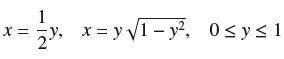
Find the area of the region enclosed by the graphs of the functions. X = 1 2y₁ x=y√1-y², 0≤y≤1
Let ƒ(x) = 20 + x − x2 and g(x) = x2 − 5x.Sketch the region between the graphs of ƒ and g over [4, 8], and compute its area as a sum of two integrals
Use the Shell Method to compute the volume obtained by rotating the region enclosed by the graphs as indicated, about the y-axis.y = √x, y = x2
Find the volume of revolution about the x-axis for the given function and interval.ƒ(x) = 4 − x2, [0, 2]
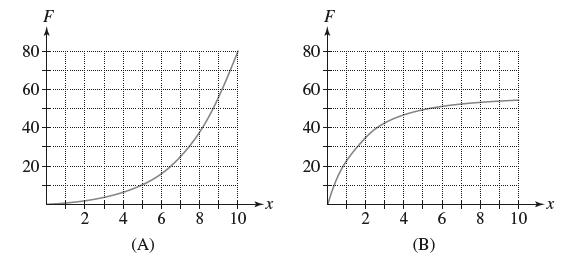
We investigate nonlinear springs. A spring is linear if it obeys Hooke’s Law, which indicates that the applied force to stretch the spring is F(x) = kx. For a linear spring, F' is constant. If, instead, F' is not constant, then the spring is called nonlinear. Furthermore, if F' (x) increases as x
Let F(x) = 20 √3x be the applied force function for a spring (with F(x) in N and x in cm). Indicate whether the spring is progressive or degressive. Compute the work required to stretch the spring from 6 to 12 cm.
Find the volume of the solid with the given base and cross sections.The base is the unit circle x2 + y2 = 1, and the cross sections perpendicular to the x-axis are triangles whose height and base are equal.
Find the area of the region enclosed by the graphs of the functions. y sin x, y = cos x, 0≤x≤ 5π 4
Find the points of intersection of the graph of y = x(x2 − 1) and the graph of y = 1 − x2. Sketch the region enclosed by these curves over [−1, 1] and compute its area.
Use the Shell Method to compute the volume obtained by rotating the region enclosed by the graphs as indicated, about the y-axis.y = x2, y = 8 − x2, x = 0, for x ≥ 0
Find the volume of revolution about the x-axis for the given function and interval. f(x) = 2 x + 1' [1,3]
Let F(x) = 0.8x + 2.4x5/3 be the applied force function for a spring (with F(x) in N and x in cm). Indicate whether the spring is progressive or degressive. Compute the work required to stretch the spring from 6 to 12 cm.
Find the area of the region enclosed by the graphs of the functions. f(x) = sinx, g(x) = sin 2x, π 3 EXSA
Find the volume of the solid with the given base and cross sections.The base is the triangle enclosed by x + y = 1, the x-axis, and the y-axis. The cross sections perpendicular to thy-axis are semicircles.
Find the points of intersection of the graph of y = x(4 − x) and the graph of y = x2(4 − x). Sketch the region enclosed by these curves over [0, 4] and compute its area.
Use the Shell Method to compute the volume obtained by rotating the region enclosed by the graphs as indicated, about the y-axis.y = 8 − x3, y = 8 − 4x, for x ≥ 0
Find the volume of revolution about the x-axis for the given function and interval.ƒ(x) = √x4 + 1, [1, 3]
Find the volume of revolution about the x-axis for the given function and interval.ƒ(x) = √3 cos x, [0, π/4]
Find the volume of the solid with the given base and cross sections.The base is the semicircle y = √9 − x2, where −3 ≤ x ≤ 3. The cross sections perpendicular to the x-axis are squares.
Find the area of the region enclosed by the graphs of the functions. y = sec² π.χ (7) ² (TX), 8 y = sec² 0≤x≤ 1
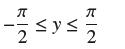
Sketch the region bounded by the line y = 2 and the graph of y = sec2 x for −π/2 < x < π/2 and find its area.
Use the Shell Method to compute the volume obtained by rotating the region enclosed by the graphs as indicated, about the y-axis.y = (x2 + 1)−2, y = 2 − (x2 + 1)−2, x = 2
Use the method of Examples 2 and 3 to calculate the work against gravity required to build the structure out of a lightweight material of density 600 kg/m3.Example 2Example 3Cylindrical column of height 4 m and radius 0.8 m EXAMPLE 2 Building a Concrete Column Compute the work (against gravity)
Find the volume of revolution about the x-axis for the given function and interval.ƒ(x) = √cos x sin x, [0, π/2]
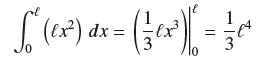
Find the volume of the solid with the given base and cross sections.The base is a square, one of whose sides is the interval [0, ℓ] along the x-axis. The cross sections perpendicular to the x-axis are rectangles of height ƒ(x) = x2. √ ² (0x²) dx = ( 1² (x ³) (6 = 1 1 0 ²
Find the area of the region enclosed by the graphs of the functions. y = X √x² + 1 y = x √√x² +4° -1 ≤x≤1
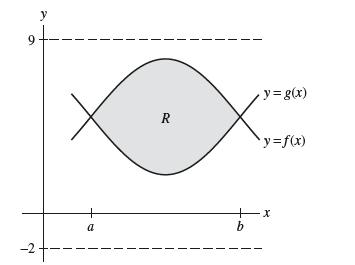
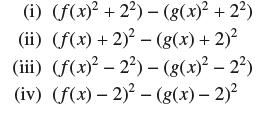
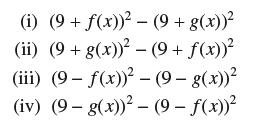
R is the shaded region in Figure 11.Which of the integrands (i)–(iv) is used to compute the volume obtained by rotating region R about y = −2? -2 y a R y = g(x) `y=f(x) + ·x b X
Use the Shell Method to compute the volume obtained by rotating the region enclosed by the graphs as indicated, about the y-axis.y = 1 − |x − 1|, y = 0
Use the method of Examples 2 and 3 to calculate the work against gravity required to build the structure out of a lightweight material of density 600 kg/m3.Example 2Example 3Right circular cone of height 4 m and base of radius 1.2 m EXAMPLE 2 Building a Concrete Column Compute the work (against
Find the volume of the solid with the given base and cross sections.The base is the region enclosed by y = x2 and y = 3. The cross sections perpendicular to the y-axis are squares.
Determine whether or not the region bounded by the curves is vertically simple and/or horizontally simple.x = y2, x = 2 − y2
Use the Shell Method to compute the volume obtained by rotating the region enclosed by the graphs as indicated, about the y-axis.y = 2 − x4, y = x2, x ≥ 0
R is the shaded region in Figure 11.Which of the integrands (i)–(iv) is used to compute the volume obtained by rotating R about y = 9 in Figure 11? -2 y a R y = g(x) `y=f(x) + ·x b X
Use a graphing utility to locate the points of intersection of y = x2 and y = cos x, and find the area between the two curves (approximately).
Find the volume of the solid with the given base and cross sections.The base is the region enclosed by y = x2 and y = 3. The cross sections perpendicular to the y-axis are rectangles of height y3.
Determine whether or not the region bounded by the curves is vertically simple and/or horizontally simple.y = x2, x = y2
Use the method of Examples 2 and 3 to calculate the work against gravity required to build the structure out of a lightweight material of density 600 kg/m3.Example 2Example 3Hemisphere of radius 0.8 m EXAMPLE 2 Building a Concrete Column Compute the work (against gravity) re- quired to build a
Use the Shell Method to compute the volume obtained by rotating the region enclosed by the graphs as indicated, about the y-axis.y =√x2 + 9, y = 0, x = 0, x = 4
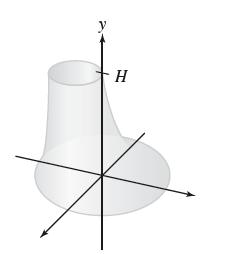
Figure 2 shows a solid whose horizontal cross section at height y is a circle of radius (1 + y)−2 for 0 ≤ y ≤ H. Find the volume of the solid. H-
(a) Sketch the region enclosed by the curves, (b) Describe the cross section perpendicular to the x-axis located at x, and (c) Find the volume of the solid obtained by rotating the region about the x-axis.y = x2 + 2, y = 10 − x2
Find the volume of the solid whose base is the region |x| + |y| ≤ 1 and whose vertical cross sections perpendicular to the y-axis are semicircles (with diameter along the base).
Determine whether or not the region bounded by the curves is vertically simple and/or horizontally simple.y = x, y = 2x, y = 1/x
Use a graphing utility to find the points of intersection of the curves numerically and then compute the volume of rotation of the enclosed region about the y-axis. y = x², y = sin(x²), x ≥ 0
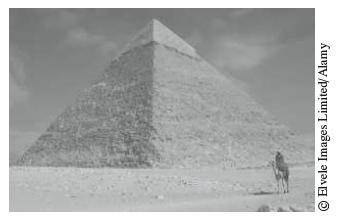
Built around 2600 bce, the Great Pyramid of Giza in Egypt (Figure 7) is 146 m high and has a square base of side 230 m. Find the work (against gravity) required to build the pyramid if the density of the stone is estimated at 2000 kg/m3. O Elvele Images Limited/Alamy
The base of a solid is the unit circle x2 + y2 = 1, and its cross sections perpendicular to the x-axis are rectangles of height 4. Find its volume.
(a) Sketch the region enclosed by the curves, (b) Describe the cross section perpendicular to the x-axis located at x, and (c) Find the volume of the solid obtained by rotating the region about the x-axis.y = x2, y = 2x + 3
Show that a pyramid of height h whose base is an equilateral triangle of side s has volume √3/12 hs2.
Determine whether or not the region bounded by the curves is vertically simple and/or horizontally simple.In the first quadrant, y = x, y = sin (π/2 x)
Use a graphing utility to find the points of intersection of the curves numerically and then compute the volume of rotation of the enclosed region about the y-axis.y = cos(x2), y = x, x = 0
Calculate the work (against gravity) required to build a box of height 3 m and square base of side 2 m out of material of variable density, assuming that the density at height y is ƒ(y) = 1000 − 100y kg/m3.
The base of a solid is the triangle bounded by the axes and the line 2x + 3y = 12, and its cross sections perpendicular to the y-axis have area A(y) = (y + 2). Find its volume.
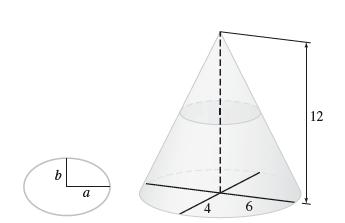
The area of an ellipse is πab, where a and b are the lengths of the semimajor and semiminor axes (Figure 20). Compute the volume of a cone of height 12 whose base is an ellipse with semimajor axis a = 6 and semiminor axis b = 4. b a 4 6 12
(a) Sketch the region enclosed by the curves, (b) Describe the cross section perpendicular to the x-axis located at x, and (c) Find the volume of the solid obtained by rotating the region about the x-axis.y = 16 − x, y = 3x + 12, x = −1
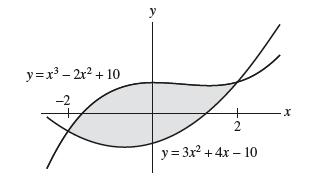
Find the area of the shaded region in Figures 16–19. y=x³ - 2x² +10 -2 y 2 y=3x² + 4x - 10 X
Sketch the solid obtained by rotating the region underneath the graph of ƒ over the interval about the given axis, and calculate its volume using the Shell Method.ƒ(x) = x3, [0, 1], about x = 2
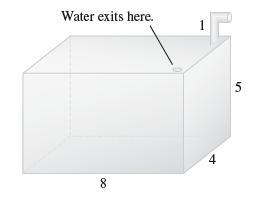
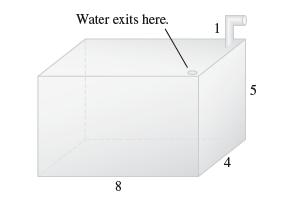
Calculate the work (in joules) required to pump all of the water out of a full tank. Distances are in meters, and the density of water is 1000 kg/m3.Rectangular tank in Figure 8; water exits from a small hole at the top Water exits here. 8 4 5
Find the total mass of a rod of length 1.2 m with linear density ρ(x) = (1 + 2x + 2/9 x3) kg/m.
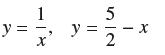
(a) Sketch the region enclosed by the curves, (b) Describe the cross section perpendicular to the x-axis located at x, and (c) Find the volume of the solid obtained by rotating the region about the x-axis. y = 1 X y= 5 2
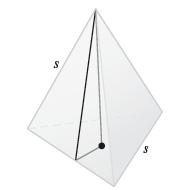
Find the volume V of a regular tetrahedron (Figure 21) whose face is an equilateral triangle of side s. The tetrahedron has height h = √2/3s. S S
Sketch the solid obtained by rotating the region underneath the graph of ƒ over the interval about the given axis, and calculate its volume using the Shell Method.ƒ(x) = x3, [0, 1], about x = −2
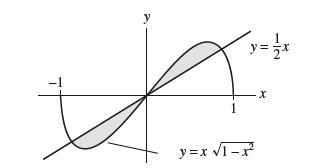
Find the area of the shaded region in Figures 16–19. y y= ½ x y=x√1-x² -X
Calculate the work (in joules) required to pump all of the water out of a full tank. Distances are in meters, and the density of water is 1000 kg/m3.Rectangular tank in Figure 8; water exits through the spout Water exits here. 8 4 5
Find the flow rate (in the correct units) through a pipe of diameter 6 cm if the velocity of fluid particles at a distance r from the center of the pipe is v(r) = (3 − r) cm/s.
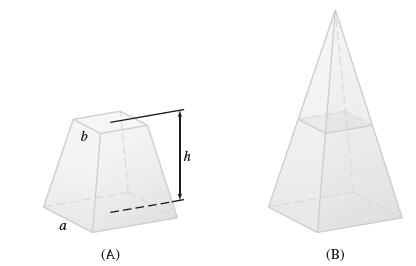
A frustum of a pyramid is a pyramid with its top cut off [Figure 22(A)]. Let V be the volume of a frustum of height h whose base is a square of side a and whose top is a square of side b with a > b ≥ 0.(a) Show that if the frustum were continued to a full pyramid, it would have height ha/(a
Sketch the solid obtained by rotating the region underneath the graph of ƒ over the interval about the given axis, and calculate its volume using the Shell Method.ƒ(x) = x−4, [−3, −1], about x = 4
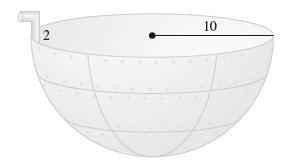
Calculate the work (in joules) required to pump all of the water out of a full tank. Distances are in meters, and the density of water is 1000 kg/m3.Hemisphere in Figure 9; water exits through the spout 2 10
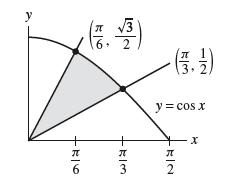
Find the area of the shaded region in Figures 16–19. y 6 √√3 2 ग 3 (3.1) y = cos x ار 2 - x
Find the average value of the function over the interval.ƒ(x) = x3 − 2x + 2, [−1, 2]
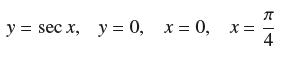
(a) Sketch the region enclosed by the curves, (b) Describe the cross section perpendicular to the x-axis located at x, and (c) Find the volume of the solid obtained by rotating the region about the x-axis. y = sec x, y = 0, x = π 4 x = π
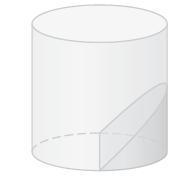
A plane inclined at an angle of 45◦ passes through a diameter of the base of a cylinder of radius r. Find the volume of the region within the cylinder and below the plane (Figure 23).
Sketch the solid obtained by rotating the region underneath the graph of ƒ over the interval about the given axis, and calculate its volume using the Shell Method. f(x) = 1 √x² + 1 [0, 2], about x = 0
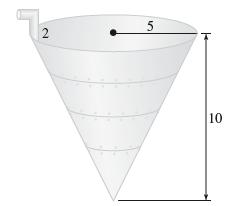
Calculate the work (in joules) required to pump all of the water out of a full tank. Distances are in meters, and the density of water is 1000 kg/m3.Conical tank in Figure 10; water exits through the spout 2 5 10
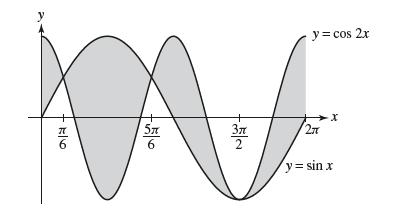
Find the area of the shaded region in Figures 16–19. как 5л Зл 6 2 y=sin x y 6 y=cos 2x 2п
Find the average value of the function over the interval.ƒ(x) = |x|, [−4, 4]
(a) Sketch the region enclosed by the curves, (b) Describe the cross section perpendicular to the x-axis located at x, and (c) Find the volume of the solid obtained by rotating the region about the x-axis. y = sec x, y = 0, x = 0, x= π 4
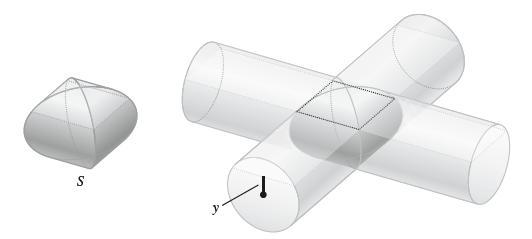
The solid S in Figure 24 is the intersection of two cylinders of radius r whose axes are perpendicular.(a) The horizontal cross section of each cylinder at distance y from the central axis is a rectangular strip. Find the strip’s width.(b) Find the area of the horizontal cross section of S at
Sketch the solid obtained by rotating the region underneath the graph of ƒ over the interval about the given axis, and calculate its volume using the Shell Method.ƒ(x) = a − x with a > 0, [0, a], about x = −1
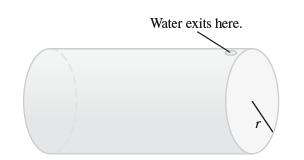
Calculate the work (in joules) required to pump all of the water out of a full tank. Distances are in meters, and the density of water is 1000 kg/m3.Horizontal cylinder in Figure 11; water exits from a small hole at the top. Hint: Evaluate the integral by interpreting part of it as the area of a
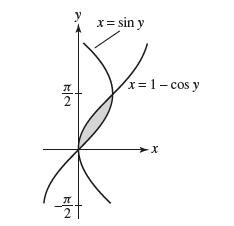
Find the area between the graphs of x = sin y and x = 1 − cos y over the given interval (Figure20). 2 21 x = sin y x=1-cosy X
Find the average value of the function over the interval.ƒ(x) = (x + 1)(x2 + 2x + 1)4/5, [0, 4]
Find the volume of the solid obtained by rotating the region enclosed by the graphs about the y-axis over the given interval.x = √y, x = 0; 1 ≤ y ≤ 4
Sketch the solid obtained by rotating the region underneath the graph of ƒ over the interval about the given axis, and calculate its volume using the Shell Method.ƒ(x) = 1 − x2, [−1, 1], x = c with c > 1
Let S be the intersection of two cylinders of radius r whose axes intersect at an angle θ. Find the volume of S as a function of r and θ.
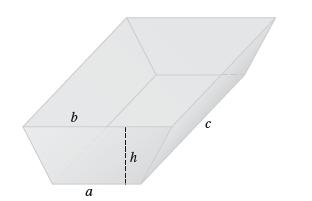
Calculate the work (in joules) required to pump all of the water out of a full tank. Distances are in meters, and the density of water is 1000 kg/m3.Trough in Figure 12; water exits by pouring over the sides b a с
Find the area between the graphs of x = sin y and x = 1 − cos y over the given interval (Figure20). 2 21 x = sin y x=1-cosy X
Find the average value of the function over the interval.ƒ(x) = |x2 − 1|, [0, 4]
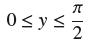
Find the volume of the solid obtained by rotating the region enclosed by the graphs about the y-axis over the given interval.x = √sin y, x = 0; 0 ≤ y ≤ π
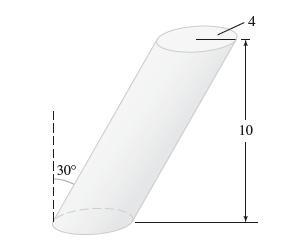
Calculate the volume of a cylinder inclined at an angle θ = 30° with height 10 and base of radius 4 (Figure 25). 30° 4 10
Showing 4900 - 5000
of 8339
First
43
44
45
46
47
48
49
50
51
52
53
54
55
56
57
Last
Step by Step Answers

 Get 50% OFF
Claim Now
Get 50% OFF
Claim Now



![f(x) = 1 x2 [1,4]](https://dsd5zvtm8ll6.cloudfront.net/images/question_images/1700/7/4/0/205655f3c6dcdfa31700740206492.jpg)
![f(x)= x5/3, [1,8]](https://dsd5zvtm8ll6.cloudfront.net/images/question_images/1700/7/4/0/227655f3c83088461700740227201.jpg)

![f(x) = 2 x + 1' [1,3]](https://dsd5zvtm8ll6.cloudfront.net/images/question_images/1700/7/4/0/309655f3cd59699d1700740310422.jpg)







![f(x) = 1 x + 1 [0, 2], about x = 0](https://dsd5zvtm8ll6.cloudfront.net/images/question_images/1700/8/1/3/81365605bf59151b1700813812987.jpg)