New Semester
Started
Get
50% OFF
Study Help!
--h --m --s
Claim Now
Question Answers
Textbooks
Find textbooks, questions and answers
Oops, something went wrong!
Change your search query and then try again
S
Books
FREE
Study Help
Expert Questions
Accounting
General Management
Mathematics
Finance
Organizational Behaviour
Law
Physics
Operating System
Management Leadership
Sociology
Programming
Marketing
Database
Computer Network
Economics
Textbooks Solutions
Accounting
Managerial Accounting
Management Leadership
Cost Accounting
Statistics
Business Law
Corporate Finance
Finance
Economics
Auditing
Tutors
Online Tutors
Find a Tutor
Hire a Tutor
Become a Tutor
AI Tutor
AI Study Planner
NEW
Sell Books
Search
Search
Sign In
Register
study help
mathematics
calculus 4th
Calculus 4th Edition Jon Rogawski, Colin Adams, Robert Franzosa - Solutions
Find the equation of the tangent line at the point indicated.y = 4ex, x0 = 0
Which relation between x and u yields √16 + x2 = 4 √1 + u2?
Calculate without using a calculator.log2(25/3)
In one year, you will be paid $1. Will the PV increase or decrease if the interest rate goes up at the start of the year?
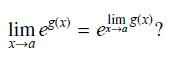
What property of the function ƒ(x) = ex allows us to say lim es(x) x→a lim g(x) q = ex-a
Show that g(x) = x/x − 1 is equal to its inverse on the domain {x : x ≠ −1}.
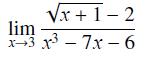
Evaluate the limit, using L’Hôpital’s Rule where it applies. √x + 1-2 lim x3 x³-7x-6
A quantity P obeys the exponential growth law P(t) = Cekt (t in years). Find the formula for P(t), assuming that P(0) = 100 and that it takes 5 years for P to double.
What is the slope of the line obtained by reflecting the line y = x/2 through the line y = x?
Find the equation of the tangent line at the point indicated.y = e4x, x0 = 0
Does ƒ(x) = x−1 have an antiderivative for x < 0? If so, describe one.
Calculate without using a calculator.log2(85/3)
For y = log10 x, if y increases by 2, then (choose the correct answer):(a) x increases by 20(b) x decreases by 20(c) x increases by a factor of 2(d) x increases by a factor of 100
Describe the graphical interpretation of the relation g'(x) = 1/ ƒ'(g(x)), where ƒ and g are inverses of each other.
A 10-kg quantity of a radioactive isotope decays to 3 kg after 17 years. Find the decay constant of the isotope.
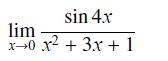
Evaluate the limit, using L’Hôpital’s Rule where it applies. lim x0x² sin 4x + 3x + 1
Prove the addition formula for cosh x.
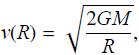
The escape velocity from a planet of radius R is where G is the universal gravitational constant and M is the mass. Find the inverse of v expressing R in terms of v. v(R): = 2GM R
Suppose that P = (2, 4) lies on the graph of ƒ and that the slope of the tangent line through P is m = 3. Assuming that ƒ−1 exists, what is the slope of the tangent line to the graph of ƒ−1 at the point Q = (4, 2)?
Find the equation of the tangent line at the point indicated.y = ex+2, x0 = −1
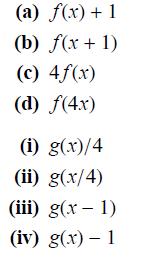
Suppose that g is the inverse of ƒ. Match the functions (a)–(d) with their inverses (i)–(iv). (a) f(x) + 1 (b) f(x + 1) (c) 4f(x) (d) f(4x) (i) g(x)/4 (ii) g(x/4) (iii) g(x - 1) (iv) g(x) - 1
What is the slope of the tangent line to y = 4x at x = 0?
Calculate without using a calculator.log64 4
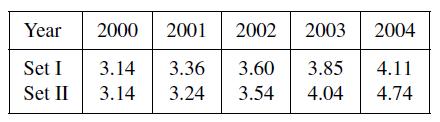
Assuming that population growth is approximately exponential, which of the following two sets of data is most likely to represent the population (in millions) of a city over a 5-year period? Year 2000 2001 2002 Set I 3.14 3.36 3.60 Set II 3.14 3.24 3.54 2003 2004 3.85 4.11 4.04 4.74
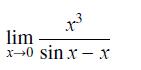
Evaluate the limit, using L’Hôpital’s Rule where it applies. lim x-0 sin x - x
Use the addition formulas to prove sinh(2x) = 2 cosh x sinh x cosh(2x) = cosh2 x + sinh2 x
Show that the power law relationship P(Q) = kQr, for Q ≥ 0 and r ≠ 0, has an inverse that is also a power law, Q(P) = mPs, where m = k−1/r and s = 1/r.
Find the equation of the tangent line at the point indicated.y = ex2 , x0 = 1
What is the rate of change of y = ln x at x = 10?
Calculate without using a calculator.log7(492)
Sam was 28 inches tall on her first birthday, 50 inches tall on her eighth, and 62 inches tall on her 14th.(a) Let t represent Sam’s age in years, and let h represent her height in inches. Determine M, A, and k for a logistic model, h(t) = M/1 + Ae−kt , that fits the given height data.(b) What
Find g'(8) where g is the inverse of a differentiable function ƒ such that ƒ(−1) = 8 and ƒ(−1) = 12.
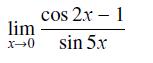
Evaluate the limit, using L’Hôpital’s Rule where it applies. lim x→0 cos 2x 1 sin 5x
The volume V of a cone that has height equal to its radius r is given by V(r) = 1/3 πr3. Find the inverse of V(r), expressing r as a function of V.
Calculate without using a calculator.log8 2 + log4 2
Suppose that ƒ(g(x)) = ex2, where g'(1) = 2 and g'(1) = 4. Find ƒ'(2).
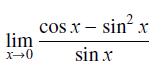
Evaluate the limit, using L’Hôpital’s Rule where it applies. lim X-0 cos.x - sin² x sin x
Suppose $500 is deposited into an account paying interest at a rate of 7%, continuously compounded. Find a formula for the value of the account at time t. What is the value of the account after 3 years?
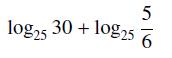
Calculate without using a calculator. 5 log25 30 +10g25 6
The surface area S of a sphere of radius r is given by S (r) = 4πr2. Explain why, in the given context, S (r) has an inverse function. Find the inverse of S (r), expressing r as a function of S.
Show that if ƒ is a function satisfying ƒ'(x) = ƒ(x)2, then its inverse g satisfies g'(x) = x−2.
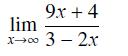
Use L’Hôpital’s Rule to evaluate the limit. 9x + 4 2x lim x-00 3 -
How long will it take for $4000 to double in value if it is deposited in an account bearing 7% interest, continuously compounded?
Find a domain on which ƒ is one-to-one and a formula for the inverse of ƒ restricted to this domain. Sketch the graphs of ƒ and ƒ−1.ƒ(x) = 4 − x
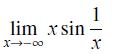
Use L’Hôpital’s Rule to evaluate the limit. lim xsin - X→-00
Calculate without using a calculator.log4 48 − log412
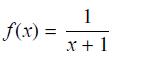
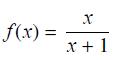
Find a domain on which ƒ is one-to-one and a formula for the inverse of ƒ restricted to this domain. Sketch the graphs of ƒ and ƒ−1. f(x) = 1 x + 1
How much must one invest today in order to receive $20,000 after 5 years if interest is compounded continuously at the rate r = 9%?
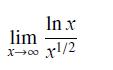
Use L’Hôpital’s Rule to evaluate the limit. In x lim X→∞0x1/2
Calculate without using a calculator.ln(√e · e7/5)
An investment increases in value at a continuously compounded rate of 9%. How large must the initial investment be in order to build up a value of $50,000 over a 7-year period?
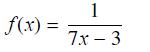
Find a domain on which ƒ is one-to-one and a formula for the inverse of ƒ restricted to this domain. Sketch the graphs of ƒ and ƒ−1. f(x) = 1 7x - 3
Calculate without using a calculator.ln(e3) + ln(e4)
Compute the PV of $5000 received in 3 years if the interest rate is (a) 6% (b) 11%. What is the PV in these two cases if the sum is instead received in 5 years?
Find a domain on which ƒ is one-to-one and a formula for the inverse of ƒ restricted to this domain. Sketch the graphs of ƒ and ƒ−1.ƒ(z) = z3
Use L’Hôpital’s Rule to evaluate the limit. 1² lim X→∞0 ex x-
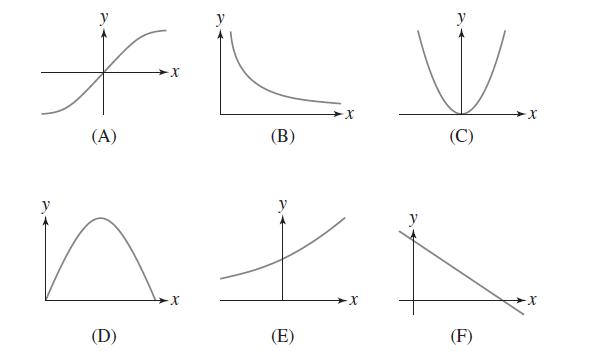
For each function shown in Figure 15, sketch the graph of the inverse (restrict the function’s domain if necessary). 7 (A) -X (D) (B) -X (C) htt (E) (F) -X -X
The decibel level for the intensity of a sound is a logarithmic scale defined by D = 10 log10 I + 120, where I is the intensity of the sound in watts per square meter.(a) Express I as a function of D.(b) Show that when D increases by 20, the intensity increases by a factor of 100.(c) Compute dI/dD.
Simplify by referring to the appropriate triangle or trigonometric identity.tan(cos−1 x)
Write as the natural log of a single expression:(a) 2 ln5 + 3 ln4 (b) 5 ln(x1/2) + ln(9x)
Find the PV of an income stream that pays out continuously at a rate R(t) = $5000e0.1t/year for 7 years, assuming r = 0.05.
Calculate without using a calculator.83log8(2)
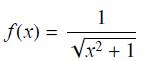
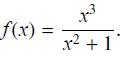
Find a domain on which ƒ is one-to-one and a formula for the inverse of ƒ restricted to this domain. Sketch the graphs of ƒ and ƒ−1. f(x) = 1 V.x² + 1
Find the PV of an investment that pays out continuously at a rate of $800/year for 5 years, assuming r = 0.08.
Calculate without using a calculator.7log7(29)
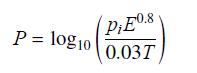
The Palermo Technical Impact Hazard Scale P is used to quantify the risk associated with the impact of an asteroid colliding with the earth:where pi is the probability of impact, T is the number of years until impact, and E is the energy of impact (in megatons of TNT). The risk is greater than a
Show that ƒ(x) = (x2 + 1)−1 is one-to-one on (−∞, 0], and find a formula for ƒ−1 for this domain of ƒ.
Refer to the appropriate triangle or trigonometric identity to compute the given value.tan (sin−1 0.8)
Let ƒ(x) = x2 − 2x. Determine a domain on which ƒ−1 exists, and find a formula for ƒ−1 for this domain of ƒ.
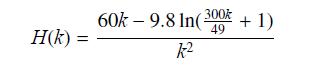
A ball is launched straight up in the air and is acted on by air resistance and gravity as in Example 8. The function H gives the maximum height that the ball attains as a function of the air-resistance parameter k. In each case, estimate the maximum height without air resistance by investigating
Refer to the appropriate triangle or trigonometric identity to compute the given value.cos (cot−1 1)
Show that the inverse of ƒ(x) = e−x exists (without finding it explicitly). What is the domain of ƒ−1?
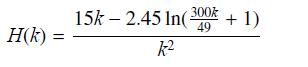
A ball with a mass of 500 g is launched upward with an initial velocity of 30 m/s, and H(K) 15k - 2.45 In(300k 49 k² + 1)
Refer to the appropriate triangle or trigonometric identity to compute the given value.cot(csc−1 2)
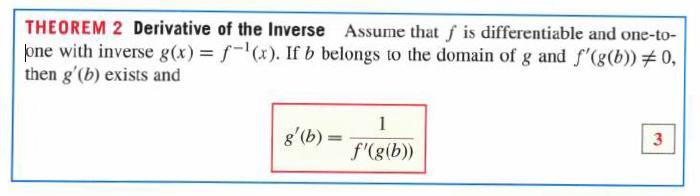
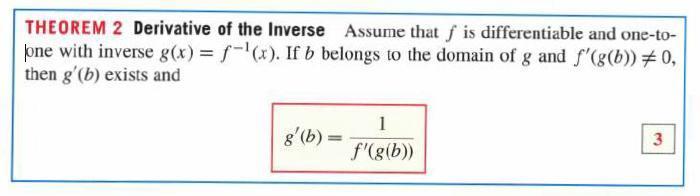
Find the inverse g of ƒ(x) = √x2 + 9 with domain x ≥ 0 and calculate g'(x) in two ways: using Theorem 2 and by direct calculation. THEOREM 2 Derivative of the Inverse Assume that f is differentiable and one-to- one with inverse g(x) = f(x). If b belongs to the domain of g and f'(g(b)) #0, then
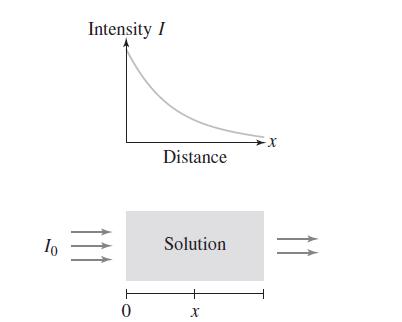
The Beer–Lambert Law is used in spectroscopy to determine the molar absorptivity α > 0 or the concentration c > 0 of a compound dissolved in a solution at low concentrations (Figure 1). The law states that the intensity I of light as it passes through the solution satisfies ln(I0/I) =
Show, by producing a counterexample, that ln(ab) is not equal to (ln a)(ln b).
Refer to the appropriate triangle or trigonometric identity to compute the given value.tan (sec−1(−2))
Let g be the inverse of ƒ(x) = x3 + 1. Find a formula for g(x) and calculate g'(x) in two ways: using Theorem 2 and then by direct calculation THEOREM 2 Derivative of the Inverse Assume that f is differentiable and one-to- one with inverse g(x) = f(x). If b belongs to the domain of g and f'(g(b))
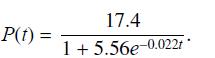
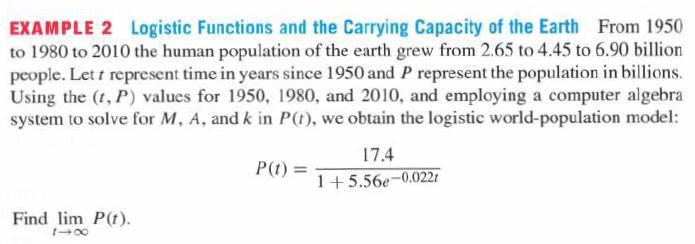
Consider the logistic world population model from Example 2: (a) Determine the time t when the population is half of the expected long-term limit of 17.4 billion.(b) There is a single point of inflection for P. Determine it. P(t) = 17.4 1+5.56e-0.022t
What is b if (logb'x)= 1/3x?
Use Theorem 2 to calculate g'(x), where g is the inverse of ƒ.ƒ(x) = 7x + 6 THEOREM 2 Derivative of the Inverse Assume that f is differentiable and one-to- one with inverse g(x) = f(x). If b belongs to the domain of g and f'(g(b)) #0, then g'(b) exists and g' (b) = 1 f'(g(b)) 3
Refer to the appropriate triangle or trigonometric identity to compute the given value.cot (tan−1 20)
Consider the general logistic function P(t) = M/1 + Ae−kt , with A, M, and k all positive. Show that Make-kt MAK-et (Ae-kt - 1) and P' (t) = (1 + Ae-kt)2 (1 + Ae-kt)3 (b) lim P(t) = 0 and lim P(t) = M, and therefore P = 0 and P = M are horizontal asymptotes of P. 1-→-00 1-00 (c) P is
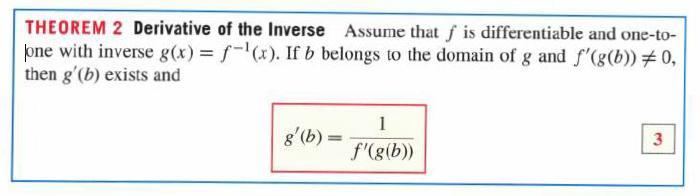
Use Theorem 2 to calculate g'(x), where g is the inverse of ƒ.ƒ(x) = √3 − x THEOREM 2 Derivative of the Inverse Assume that f is differentiable and one-to- one with inverse g(x) = f(x). If b belongs to the domain of g and f'(g(b)) #0, then g'(b) exists and g' (b) = 1 f'(g(b)) 3
Refer to the appropriate triangle or trigonometric identity to compute the given value.sin (csc−1 20)
Use Theorem 2 to calculate g'(x), where g is the inverse of ƒ.ƒ(x) = x−5 THEOREM 2 Derivative of the Inverse Assume that f is differentiable and one-to- one with inverse g(x) = f(x). If b belongs to the domain of g and f'(g(b)) #0, then g'(b) exists and g' (b) = 1 f'(g(b)) 3
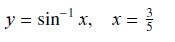
Compute the derivative at the point indicated without using a calculator. y = sin ¹x, x =
Use Theorem 2 to calculate g'(x), where g is the inverse of ƒ.ƒ(x) = 4x3 − 1 THEOREM 2 Derivative of the Inverse Assume that f is differentiable and one-to- one with inverse g(x) = f(x). If b belongs to the domain of g and f'(g(b)) #0, then g'(b) exists and g' (b) = 1 f'(g(b)) 3
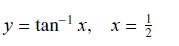
Compute the derivative at the point indicated without using a calculator. y = tan ¹x, x = 1/2
A company can earn additional profits of $500,000/year for 5 years by investing $2 million to upgrade its factory. Is the investment worthwhile if the interest rate is 6%? (Assume the savings are received as a lump sum at the end of each year.)
Compute the derivative at the point indicated without using a calculator.y = sec−1 x, x = 4
Use Theorem 2 to calculate g'(x), where g is the inverse of ƒ. THEOREM 2 Derivative of the Inverse Assume that f is differentiable and one-to- one with inverse g(x) = f(x). If b belongs to the domain of g and f'(g(b)) #0, then g'(b) exists and g' (b) = 1 f'(g(b)) 3
A new computer system costing $25,000 will reduce labor costs by $7000/year for 5 years.(a) Is it a good investment if r = 8%?(b) How much money will the company actually save?
Compute the derivative at the point indicated without using a calculator.y = arccos(4x), x = 1/5
Use Theorem 2 to calculate g'(x), where g is the inverse of ƒ.ƒ(x) = 2 + x−1 THEOREM 2 Derivative of the Inverse Assume that f is differentiable and one-to- one with inverse g(x) = f(x). If b belongs to the domain of g and f'(g(b)) #0, then g'(b) exists and g' (b) = 1 f'(g(b)) 3
Find g'(−1/2), where g is the inverse of f(x) = p³ 2+1 1-²
Let g be the inverse of ƒ(x) = x3 + 2x + 4. Calculate g(7) [without finding a formula for g(x)], and then calculate g'(7).
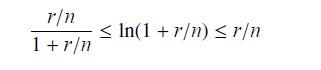
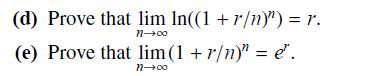
We will show that continuously compounded interest is a limiting case, as n → ∞, of periodically compounded interest. We first establish an important limit.(a) Show that ln(1 + r) is the area under the graph of y = 1/x from 1 to 1 + r.(b) Using rectangles with base length r, prove that(c) Prove
Suppose that $1000 is invested in an account that pays annual interest of 2.4%. How much is in the account after 1 year if the interest is compounded monthly? Continuously?
Showing 5200 - 5300
of 8339
First
46
47
48
49
50
51
52
53
54
55
56
57
58
59
60
Last
Step by Step Answers

 Get 50% OFF
Claim Now
Get 50% OFF
Claim Now