New Semester
Started
Get
50% OFF
Study Help!
--h --m --s
Claim Now
Question Answers
Textbooks
Find textbooks, questions and answers
Oops, something went wrong!
Change your search query and then try again
S
Books
FREE
Study Help
Expert Questions
Accounting
General Management
Mathematics
Finance
Organizational Behaviour
Law
Physics
Operating System
Management Leadership
Sociology
Programming
Marketing
Database
Computer Network
Economics
Textbooks Solutions
Accounting
Managerial Accounting
Management Leadership
Cost Accounting
Statistics
Business Law
Corporate Finance
Finance
Economics
Auditing
Tutors
Online Tutors
Find a Tutor
Hire a Tutor
Become a Tutor
AI Tutor
AI Study Planner
NEW
Sell Books
Search
Search
Sign In
Register
study help
mathematics
calculus 4th
Calculus 4th Edition Jon Rogawski, Colin Adams, Robert Franzosa - Solutions
Sketch the enclosed region and use the Shell Method to calculate the volume of rotation about the x-axis.x = y, y = 0, x = 1
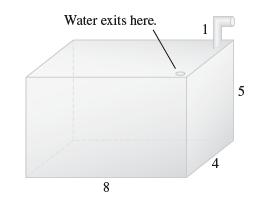
Find the work W required to empty the tank in Figure 8 through the hole at the top if the tank is half full of water. Water exits here. 8 4 5
Find the average value of the function over the interval.ƒ(x) =0 √9 − x2, [0, 3] Use geometry to evaluate the integral.
Find the area of the region lying to the right of x = y2 + 4y − 22 and to the left of x = 3y + 8.
Sketch the enclosed region and use the Shell Method to calculate the volume of rotation about the x-axis. x =y+1, x= 3-y, y=0
Find the volume of the solid obtained by rotating the region enclosed by the graphs about the y-axis over the given interval.x = y2, x = √y
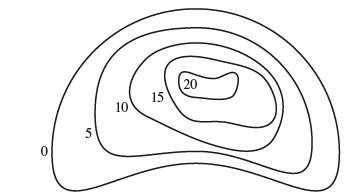
The areas of cross sections of Lake Nogebow at 5-m intervals are given in the table below. Figure 26 shows a contour map of the lake. Estimate the volume V of the lake by taking the average of the right- and left-endpoint approximations to the integral of cross-sectional area. Depth (m) Area
Find the area of the region lying to the right of x = y2 − 5 and to the left of x = 3 − y2.
Find the average value of the function over the interval.ƒ(x) = x[x] , [0, 3], where [x] is the greatest integer function
Find the volume of the solid obtained by rotating the region enclosed by the graphs about the y-axis over the given interval.x = 4 − y, x = 16 − y2
Sketch the enclosed region and use the Shell Method to calculate the volume of rotation about the x-axis.y(4 − y), x = 0
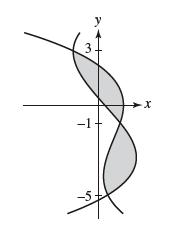
Figure 21 shows the region enclosed by x = y3 − 26y + 10 and x = 40 − 6y2 − y3. Match the equations with the curves and compute the area of the region. 3 -1 y ·X
Find the total mass of a 1-m rod whose linear density function is ρ(x) = 10(x + 1)−2 kg/m for 0 ≤ x ≤ 1.
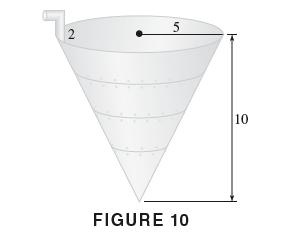
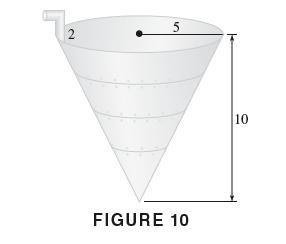
Assume the tank in Figure 10 is full. Find the work required to pump out half of the water. Hint: First, determine the level H at which the water remaining in the tank is equal to one-half the total capacity of the tank. 2 5 FIGURE 10 10
Find the average value of the function over the interval.Find ∫52 g(t) dt if the average value of g on [2, 5] is 9.
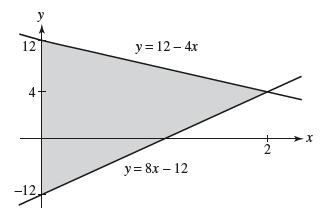
Rotation of the region in Figure 12 about the y-axis produces a solid with two types of different cross sections. Compute the volume as a sum of two integrals, one for −12 ≤ y ≤ 4 and one for 4 ≤ y ≤ 12. y 12 4 -12, y = 12 - 4x y=8x - 12 + 2 -X
Assume that the tank in Figure 10 is full.(a) Calculate the work F(y) required to pump out water until the water level has reached level y.(b) Plot F.(c) What is the significance of F'(y) as a rate of change?(d) If your goal is to pump out all of the water, at which water level y0 will half of the
Sketch the enclosed region and use the Shell Method to calculate the volume of rotation about the x-axis.x = y(4 − y), x = (y − 2)2
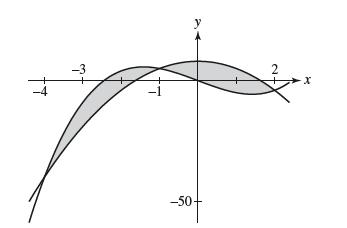
Figure 22 shows the region enclosed by y = x3 − 6x and y = 8 − 3x2.Match the equations with the curves and compute the area of the region. -3 y -50- 2 X
Find the total mass of a 3-m rod whose linear density function is ρ(x) = 3 + cos(πx) kg/m for 0 ≤ x ≤ 3.
The average value of R over [0, x] is equal to x for all x. Use the FTC to determine R(x).
Let R be the region enclosed by y = x2 + 2, y = (x − 2)2 and the axes x = 0 and y = 0. Compute the volume V obtained by rotating R about the x-axis. Express V as a sum of two integrals.
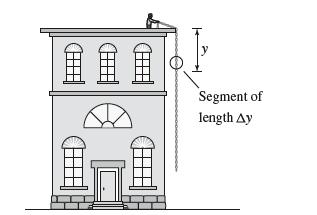
Calculate the work required to lift a 10-m chain over the side of a building (Figure 13). Assume that the chain has a density of 8 kg/m. Break up the chain into N segments, estimate the work performed on a segment, and compute the limit as N →∞as an integral. D Segment of length Ay
Sketch the enclosed region and use the Shell Method to calculate the volume of rotation about the x-axis.y = 4 − x2, x = 0, y = 0
A mineral deposit along a strip of length 6 cm has density s(x) = 0.01x(6 − x) g/cm for 0 ≤ x ≤ 6. Calculate the total mass of the deposit.
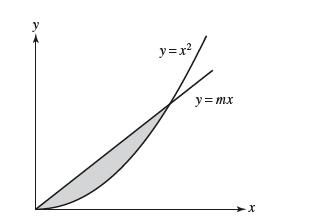
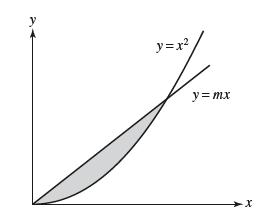
Use the Washer Method to find the volume obtained by rotating the region in Figure 3 about the x-axis. y y=x² y=mx x+
Find the area enclosed by the graphs in two ways: by integrating along the x-axis and by integrating along the y-axis.x = 9 − y2, x = 5
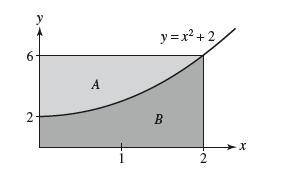
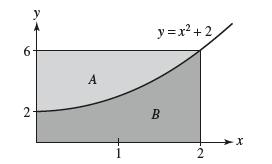
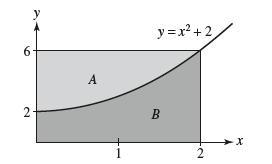
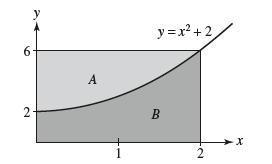
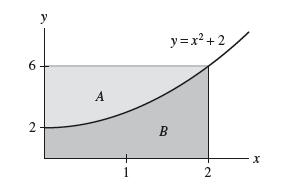
Find the volume of the solid obtained by rotating region A in Figure 13 about the given axis.x-axis 6 2- A 1 y=x2+2 B 2 X
Find the volume of the solid obtained by rotating region A in Figure 13 about the given axis.y = −2 6 2- A 1 y=x2+2 B 2 X
How much work is done lifting a 3-m chain over the side of a building if the chain has mass density 4 kg/m?
Sketch the enclosed region and use the Shell Method to calculate the volume of rotation about the x-axis.y = x1/3 − 2, y = 0, x = 27
Charge is distributed along a glass tube of length 10 cm with linear charge density ρ(x) = x(x2 + 1)−2 × 10⁻⁴ coulombs per centimeter (C/cm) for 0 ≤ x ≤ 10. Calculate the total charge.
Use the Shell Method to find the volume obtained by rotating the region in Figure 3 about the x-axis. y y=x² y=mx -X
The semicubical parabola y2 = x3 and the line x = 1
Find the volume of the solid obtained by rotating region A in Figure 13 about the given axis.y = 2 6 2- A 1 y=x2+2 B 2 X
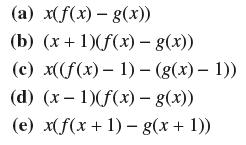
Determine which of the following is the appropriate integrand needed to determine the volume of the solid obtained by rotating around the vertical axis given by x = −1 the area that is between the curves y = ƒ(x) and y = g(x) over the interval [a, b], where a ≥ 0 and ƒ(x) ≥ g(x) over that
A 6-m chain has mass 18 kg. Find the work required to lift the chain over the side of a building.
Calculate the population within a 10-mile radius of the city center if the radial population density is ρ(r) = 4(1 + r2)1/3 (in thousands per square mile).
Find the area of the region using the method (integration along either the x- or the y-axis) that requires you to evaluate just one integral.Region between y2 = x + 5 and y2 = 3 − x
Use any method to find the volume of the solid obtained by rotating the region enclosed by the curves about the given axis.y = x2 + 2, y = x + 4, x-axis
Find the volume of the solid obtained by rotating region A in Figure 13 about the given axis.y-axis 6 2- A 1 y=x2+2 B 2 X
A 10-m chain with mass density 4 kg/m is initially coiled on the ground. How much work is performed in lifting the chain so that it is fully extended (and one end touches the ground)?
Let y = ƒ(x) be a decreasing function on [0, b], such that ƒ(b) = 0. Explain why where h denotes the inverse of ƒ. 2π f xf(x) dx = π fƒ© (h(x))² dx,
Odzala National Park in the Republic of the Congo has a high density of gorillas. Suppose that the population density is given by the radial density function ρ(r) = 52(1 + r2)−2 gorillas/km2, where r is the distance from a grassy clearing with a source of water. Calculate the number of gorillas
Find the area of the region using the method (integration along either the x- or the y-axis) that requires you to evaluate just one integral.Region between y = x and x + y = 8 over [2, 3]
Find the volume of the solid obtained by rotating region A in Figure 13 about the given axis.x = −3 6 2- A 1 y=x2+2 B 2 X
Use any method to find the volume of the solid obtained by rotating the region enclosed by the curves about the given axis.y = x2 + 6, y = 8x − 1, y-axis
How much work is done lifting a 12-m chain that has mass density 3 kg/m (initially coiled on the ground) so that its top end is 10 m above the ground?
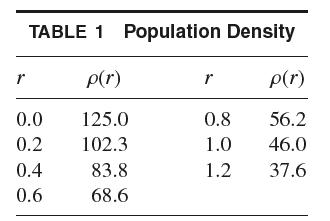
Table 1 lists the population density (in people per square kilometer) as a function of distance r (in kilometers) from the center of a rural town. Estimate the total population within a 1.2-km radius of the center by taking the average of the left- and right-endpoint approximations. r TABLE 1
Use both the Shell and Disk Methods to calculate the volume obtained by rotating the region under the graph of ƒ(x) = 8 − x3 for 0 ≤ x ≤ 2 about(a) The x-axis (b) The y-axis
Sketch the region enclosed by the curves and compute its area as an integral along the x- or y-axis.y = 25 − x2, y = x2 − 25
Use any method to find the volume of the solid obtained by rotating the region enclosed by the curves about the given axis.x = y2 − 3, x = 2y, axisy = 4
Find the volume of the solid obtained by rotating region A in Figure 13 about the given axis.x = 2 6 2- A 1 y=x2+2 B 2 X
Use any method to find the volume of the solid obtained by rotating the region enclosed by the curves about the given axis.y = 2x, y = 0, x = 8, axis x = −3
A 500-kg wrecking ball hangs from a 12-m cable of density 15 kg/m attached to a crane. Calculate the work done if the crane lifts the ball from ground level to 12 m in the air by drawing in the cable.
Sketch the solid of rotation about the y-axis for the region under the graph of the constant function ƒ(x) = c (where c > 0) for 0 ≤ x ≤ r.(a) Find the volume without using integration.(b) Use the Shell Method to compute the volume.
Find the total mass of a circular plate of radius 20 cm whose mass density is the radial function ρ(r) = 0.03 + 0.01 cos(πr2) g/cm2.
Sketch the region enclosed by the curves and compute its area as an integral along the x- or y-axis.y = x2 − 6, y = 6 − x3, x = 0
Find the volume of the solid obtained by rotating region B in Figure 13 about the given axis.x-axis 6 2 У A y=x2+2 B 2 - Х
Use any method to find the volume of the solid obtained by rotating the region enclosed by the curves about the given axis.y = x2 − 1, y = 2x − 1, axis x = −2
Calculate the work required to lift a 3-m chain over the side of a building if the chain has a variable density of ρ(x) = x2 − 3x + 10 kg/m for 0 ≤ x ≤ 3.
The density of deer in a forest is the radial function ρ(r) = 150(r2 + 2)−2 deer per square kilometer, where r is the distance (in kilometers) to a small meadow. Calculate the number of deer in the region 2 ≤ r ≤ 5 km.
Sketch the region enclosed by the curves and compute its area as an integral along the x- or y-axis.x + y = 4, x − y = 0, y + 3x = 4
Find the volume of the solid obtained by rotating region B in Figure 13 about the given axis.y = −2 6 2 A y=x² + 2 B 2 X
Use any method to find the volume of the solid obtained by rotating the region enclosed by the curves about the given axis.y = x2 − 1, y = 2x − 1, axis y = 4
A 3-m chain with linear mass density ρ(x) = 2x(4 − x) kg/m lies on the ground. Calculate the work required to lift the chain from its front end so that its bottom is 2 m above ground.
Sketch the region enclosed by the curves and compute its area as an integral along the x- or y-axis.y = 8 − 3x, y = 6 − x, y = 2
Show that a circular plate of radius 2 cm with radial mass density ρ(r) = 4 r g/cm2 has finite total mass, even though the density becomes infinite at the origin.
Let W be the volume of the solid obtained by rotating the region under the graph in Figure 11(B) about the y-axis.(a) Describe the figures generated by rotating segments A'B' and A'C' about the y-axis.(b) Set up an integral that computes W by the Shell Method.(c) Explain the difficulty in computing
Find the volume of the solid obtained by rotating region B in Figure 13 about the given axis.y = 6 6 2 A y=x² + 2 B 2 X
Use any method to find the volume of the solid obtained by rotating the region enclosed by the curves about the given axis.y = −x2 + 4x − 3, y = 0, axis y = −1
The gravitational force between two objects of mass m and M, separated by a distance r, has magnitude GMm/r2, where G = 6.67 × 10⁻¹¹ m3kg−1s−1.Show that if two objects of mass M and m are separated by a distance r1, then the work required to increase the aseparation to a distance r2 is equal
Sketch the region enclosed by the curves and compute its area as an integral along the x- or y-axis.y = 15 −√x, y = 2 √ x, x = 0
Find the flow rate through a tube of radius 4 cm, assuming that the velocity of fluid particles at a distance r centimeters from the center is v(r) = (16 − r2) cm/s.
Let R be the region under the graph of y = 9 − x2 for 0 ≤ x ≤ 2. Use the Shell Method to compute the volume of rotation of R about the x-axis as a sum of two integrals along the y-axis. The shells generated depend on whether y ∈ [0, 5] or y ∈ [5, 9].
Find the volume of the solid obtained by rotating region B in Figure 13 about the given axis.y-axis 6 2 A y=x² + 2 B 2 X
Use any method to find the volume of the solid obtained by rotating the region enclosed by the curves about the given axis.y = −x2 + 4x − 3, y = 0, axis x = 4
Use the result of Exercise 35 to calculate the work required to place a 2000-kg satellite in an orbit 1200 km above the surface of the earth. Assume that the earth is a sphere of radius Re = 6.37 × 10⁶ m and mass Me = 5.98 × 1024 kg. Treat the satellite as a point mass.Data From Exercise 35The
Sketch the region enclosed by the curves and compute its area as an integral along the x- or y-axis.y = |x2 − 4|, y = 5
The velocity of fluid particles flowing through a tube of radius 5 cm is v(r) = (10 − 0.3r − 0.34r2) cm/s, where r centimeters is the distance from the center. What quantity per second of fluid flows through the portion of the tube where 0 ≤ r ≤ 2?
Let R be the region under the graph of y = 4x−1 for 1 ≤ y ≤ 4. Use the Shell Method to compute the volume of rotation of R about the y-axis as a sum of two integrals along the x-axis.
Find the volume of the solid obtained by rotating region B in Figure 13 about the given axis.x = 2 6 2 A y=x² + 2 B 2 X
Let v(r) be the velocity of blood in an arterial capillary of radius R = 4 × 10⁻⁵ m. Use Poiseuille’s Law (Example 6) with k = 106 (m-s)−1 to determine the velocity at the center of the capillary and the flow rate (use correct units). EXAMPLE 6 Laminar Flow According to Poiseuille's Law,
Use any method to find the volume of the solid obtained by rotating the region enclosed by the curves about the given axis.x = 4y − y3, x = 0, y ≥ 0, x-axis
Use the result of Exercise 35 to compute the work required to move a 1500-kg satellite from an orbit 1000 to an orbit 1500 km above the surface of the earth.Data From Exercise 35The gravitational force between two objects of mass m and M, separated by a distance r, has magnitude GMm/r2, where G =
Sketch the region enclosed by the curves and compute its area as an integral along the x- or y-axis.x = |y|, x = 1 − |y|
A solid rod of radius 1 cm is placed in a pipe of radius 3 cm so that their axes are aligned. Water flows through the pipe and around the rod. Find the flow rate if the velocity of the water is given by the radial function v(r) = 0.5(r − 1)(3 − r) cm/s.
Use the Shell Method to find the volume obtained by rotating region A in Figure 12 about the given axis.y-axis 6 2 У A 1 B y=x2+2 2 X
Find the volume of the solid obtained by rotating region B in Figure 13 about the given axis.x = −3 6 2 A y=x² + 2 B 2 X
Use any method to find the volume of the solid obtained by rotating the region enclosed by the curves about the given axis.y2 = x−1, x = 1, x = 3, axis y = −3
Use the Shell Method to find the volume obtained by rotating region A in Figure 12 about the given axis.x = −3 6 2 У A 1 B y=x2+2 2 X
Sketch the region enclosed by the curves and compute its area as an integral along the x- or y-axis.y = |x|, y = x2 + 3
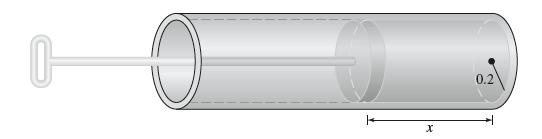
The pressure P and volume V of the gas in a cylinder of length 0.8 m and radius 0.2 m, with a movable piston, are related by PV1.4 = k, where k is a constant (Figure 14). When the piston is fully extended, the gas pressure is 2000 kilopascals (kPa; 1 kilopascal is 103 newtons per square meter).(a)
Use any method to find the volume of the solid obtained by rotating the region enclosed by the curves about the given axis.y = cos(x2), y = 0, 0 ≤ x ≤ √π/2, y-axis
Use the Shell Method to find the volume obtained by rotating region A in Figure 12 about the given axis.x = 2 6 2 У A 1 B y=x2+2 2 X
Find the volume of the solid obtained by rotating the region enclosed by the graphs about the given axis.y = x2, y = 12 − x, x = 0, about y = −2 x ≥ 0
Sketch the region enclosed by the curves and compute its area as an integral along the x-or y-axis.x = y3 − 18y, y + 2x = 0
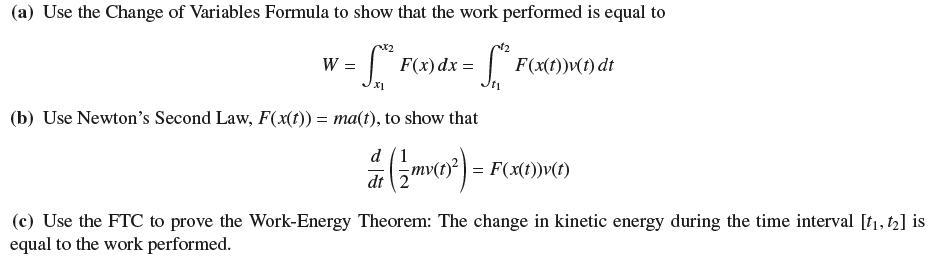
An object of mass m moves from x1 to x2 during the time interval [t1, t2] due to a force F(x) acting in the direction of motion. Let x(t), v(t), and a(t) be the position, velocity, and acceleration at time t. The object’s kinetic energy is KE = 1/2 mv2. (a) Use the Change of Variables Formula to
Calculate the average over the given interval.ƒ(x) = x3, [0, 4]
Use any method to find the volume of the solid obtained by rotating the region enclosed by the curves about the given axis.y = sec x, y = csc x, y = 0, x = 0, x = π/2, x-axis
Showing 5000 - 5100
of 8339
First
44
45
46
47
48
49
50
51
52
53
54
55
56
57
58
Last
Step by Step Answers

 Get 50% OFF
Claim Now
Get 50% OFF
Claim Now