New Semester
Started
Get
50% OFF
Study Help!
--h --m --s
Claim Now
Question Answers
Textbooks
Find textbooks, questions and answers
Oops, something went wrong!
Change your search query and then try again
S
Books
FREE
Study Help
Expert Questions
Accounting
General Management
Mathematics
Finance
Organizational Behaviour
Law
Physics
Operating System
Management Leadership
Sociology
Programming
Marketing
Database
Computer Network
Economics
Textbooks Solutions
Accounting
Managerial Accounting
Management Leadership
Cost Accounting
Statistics
Business Law
Corporate Finance
Finance
Economics
Auditing
Tutors
Online Tutors
Find a Tutor
Hire a Tutor
Become a Tutor
AI Tutor
AI Study Planner
NEW
Sell Books
Search
Search
Sign In
Register
study help
mathematics
calculus early transcendentals 9th
Calculus Early Transcendentals 9th Edition James Stewart, Daniel K. Clegg, Saleem Watson, Lothar Redlin - Solutions
Solve the inequality in terms of intervals and illustrate the solution set on the real number line.x2 + x > 1
Solve the inequality in terms of intervals and illustrate the solution set on the real number line.x2 + x + 1 > 0
Solve the inequality in terms of intervals and illustrate the solution set on the real number line.2x − 3 < x + 4 < 3x − 2
Solve the inequality in terms of intervals and illustrate the solution set on the real number line.4x < 2x + 1 ≤ 3x + 2
Solve the inequality in terms of intervals and illustrate the solution set on the real number line.−5 ≤ 3 − 2x ≤ 9
Solve the inequality in terms of intervals and illustrate the solution set on the real number line.0 ≤ 1 − x < 1
Solve the inequality in terms of intervals and illustrate the solution set on the real number line.1 < 3x + 4 ≤ 16
Solve the inequality in terms of intervals and illustrate the solution set on the real number line.−1 < 2x − 5 < 7
Solve the inequality in terms of intervals and illustrate the solution set on the real number line.1 + 5x > 5 − 3x
Solve the inequality in terms of intervals and illustrate the solution set on the real number line.2x + 1 < 5x − 8
Solve the inequality in terms of intervals and illustrate the solution set on the real number line.4 − 3x ≥ 6
Solve the inequality in terms of intervals and illustrate the solution set on the real number line.1 − x ≤ 2
Rewrite the expression without using the absolute-value symbol.|1 − 2x2|
Rewrite the expression without using the absolute-value symbol.|x2 + 1|
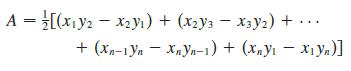
(a) If C is the line segment connecting the point (x1, y1) to the point (x2, y2), show that∫C x dy − y dx = x1y2 − x2y1(b) If the vertices of a polygon, in counterclockwise order, are (x1, y1), (x2, y2), . . . , (xn , yn), show that the area of the polygon is(c) Find the area of the pentagon
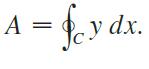
Determine whether the statement is true or false. If it is true, explain why. If it is false, explain why or give an example that disproves the statement.The area of the region bounded by the positively oriented, piecewise smooth, simple closed curve C is A = f. y dx.
Evaluate the surface integral. ls y dS, S is the surface z (*2 + y/2), 0
Sketch the solid described by the given inequalities.1 ≤ ρ ≤ 3, 0 ≤ Φ ≤ π/2, π ≤ θ ≤ 3π/2
Find ∫20 f(x, y) dx and ∫30 f(x, y) dyf(x, y) = x + 3x2y2
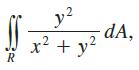
Evaluate the given integral by changing to polar coordinates.where R is the region that lies between the circles x2 + y2 = a2 and x2 + y2 = b2 with 0 < a < b. y? dA, x² + y? R
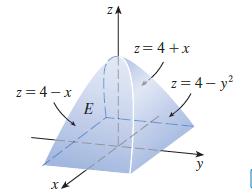
(a) Express the triple integral ∫∫∫E f(x, y, z) dV as an iterated integral for the given function f and solid region E.(b) Evaluate the iterated integral.f(x, y, z) = 2 ZA z= 4+x z = 4- y? z= 4-x E
Find the area of the surface.The part of the sphere x2 + y2 + z2 = 4 that lies above the plane z = 1.
Evaluate the double integral. (2x + y) dA, D= {(x, y) | 1 < y< 2, y – 1
Sketch the solid described by the given inequalities.1 ≤ ρ ≤ 2, π/2 ≤ Φ ≤ π
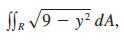
The integralwhere R = [0, 4] × [0, 2], represents the volume of a solid. Sketch the solid. le V9 - y? dA,
Sketch the solid described by the given inequalities.r2 ≤ z ≤ 8 – r2
If f is continuous, show that Jo Jo
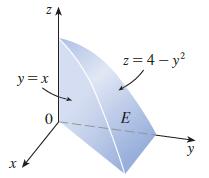
(a) Express the triple integral ∫∫∫E f(x, y, z) dV as an iterated integral for the given function f and solid region E.(b) Evaluate the iterated integral.f(x, y, z) = xy ZA z = 4 - y? y=x E y
Find the area of the surface.The surface z = 2/3 (x3/2 + y3/2), 0 ≤ x ≤ 1, 0 ≤ y ≤ 1.
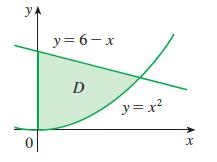
(a) Express the double integral ∫∫D f(x, y) dA as an iterated integral for the given function f and region D.(b) Evaluate the iterated integral.f(x, y) = x yA y= 6- x D y=x?
Evaluate the double integral by first identifying it as the volume of a solid. l (2x + 1) dA, R= {(x, y) | 0< x< 2,0 < y< 4}
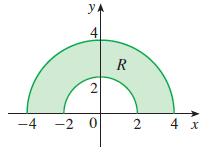
Write ∫∫ R f(x, y) dA as an iterated integral, where R is the region shown and f is an arbitrary continuous function on R. yA 4 R 2 -4 -2 0 2 4 x
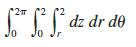
Determine whether the statement is true or false. If it is true, explain why. If it is false, explain why or give an example that disproves the statement.The integralrepresents the volume enclosed by the cone z = √x2 + y2 and the plane z = 2. 2 (2 I I dz dr de
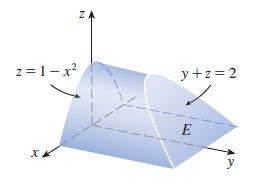
(a) Express the triple integral ∫∫∫E f(x, y, z) dV as an iterated integral for the given function f and solid region E.(b) Evaluate the iterated integral.f(x, y, z) = x ZA z =1-x? y +z= 2 X. y
Find the area of the surface.The part of the hyperbolic paraboloid z = y2 – x2 that lies between the cylinders x2 + y2 = 1 and x2 + y2 = 4.
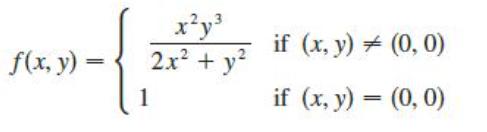
Determine the set of points at which the function is continuous. if (x, y) + (0, 0) f(x, y) = 2x? + y? 1 if (x, y) = (0, 0) 2.
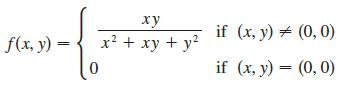
Determine the set of points at which the function is continuous. ху if (x, y) = (0, 0) f(x, y) = . x? + xy + y² if (x, y) = (0, 0)
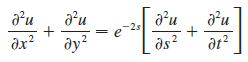
If u = f(x, y), where x = es cos t and y = es sin t, show that + dx? ds? at?
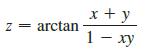
Find all the second partial derivatives. x + y 1- xy z = arctan
Draw a contour map of the function showing several level curves.f(x, y) = y/(x2 + y2)
If z = f(x, y), where x = r2 + s2 and y = 2rs, find ∂2z/∂r ∂s.
If z = f(x, y), where x = r cos θ and y = r sin θ, show that(a) ∂z/∂r(b) ∂z/∂θ(c) ∂2z/∂r ∂θ .
A grain silo is to be built by attaching a hemispherical roof and a flat floor onto a circular cylinder. Use Lagrange multipliers to show that for a total surface area S, the volume of the silo is maximized when the radius and height of the cylinder are equal.
If z = f(x, y), where x = r cos θ and y = r sin θ, show that 1 az 1 az dx? dy? ar? + .2 r a0? r år
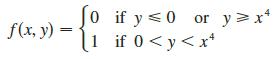
Let(a) Show that f (x, y) → 0 as (x, y) → (0, 0) along any path through (0, 0) of the form y = mxa with 0 < a < 4.(b) Despite part (a), show that f is discontinuous at s0, 0d.(c) Show that f is discontinuous on two entire curves. Jo if y x* |1 if 0
The Shannon index (sometimes called the Shannon-Wiener index or Shannon-Weaver index) is a measure of diversity in an ecosystem. For the case of three species, it is defined asH = −p1 ln p1 − p2 ln p2 − p3 ln p3where pi is the proportion of species i in the ecosystem.(a) Express H as a
The plane 4x − 3y + 8z = 5 intersects the cone z2 = x2 + y2 in an ellipse.(a) Graph the cone and the plane, and observe the elliptical intersection(b) Use Lagrange multipliers to find the highest and lowest points on the ellipse.
If c ∈ Vn, show that the function f given by f(x) = c · x is continuous on Rn.
Graph the function using various domains and viewpoints. If your software also produces level curves, then plot some contour lines of the same function and compare with the graph.f(x, y) = e−(x2 + y2)/3(sin(x2) + cos(y2)
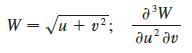
Find the indicated partial derivative(s). W = Ju + v?; au? dv ,2
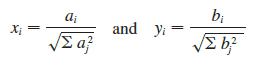
(a) Maximize subject to the constraints(b) Putto show thatfor any numbers a1, . . . , an, b1, . . . , bn. This inequality is known as the Cauchy-Schwarz Inequality. in i=1 XiYi
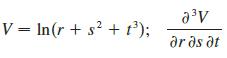
Find the indicated partial derivative(s). V = In(r + s? + t); + t'); ar ds dt
(a) Find the maximum value of given that x1, x2, . . . , xn are positive numbers and x1 + x2 + ∙ ∙ ∙ + xn = c, where c is a constant.(b) Deduce from part (a) that if x1, x2, . . . , xn are positive numbers, thenThis inequality says that the geometric mean of n numbers is no larger than
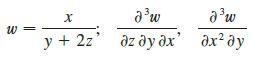
Find the indicated partial derivative(s). aw a'w ax² əy y + 2z' az dy ax'
In this problem we identify a point (a, b) on the line 16x + 15y = 100 such that the sum of the distances from (−3, 0) to sa, bd and from (a, b) to (3, 0) is a minimum.(a) Write a function f that gives the sum of the distances from (−3, 0) to a point (x, y) and from (x, y) to (3, 0). Let g(x,
Use Definition 4 to find fx(x, y) and fy(x, y).f(x, y) = xy2 − x3y
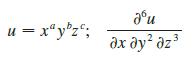
Find the indicated partial derivative(s). u = x"y"z"; ax ây? az .3
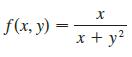
Use Definition 4 to find fx(x, y) and fy(x, y). f(x, y) = x + y?
Show that the sum of the x-, y-, and z-intercepts of any tangent plane to the surface √x + √y + √z = √c is a constant.
Describe the level surfaces of the function.f(x, y, z) = 2y − z + 1
Describe the level surfaces of the function.g(x, y, z) = x + y2 − z2
Describe the level surfaces of the function.f(x, y, z) = x2 + 2y2 + 3z2
Determine the signs of the partial derivatives for the function f whose graph.(a) fxx(−1, 2)(b) fyy(−1, 2)(c) fxy(1, 2)(d) fxy(−1, 2)
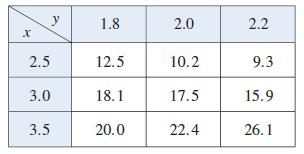
Use the table of values of f(x, y) to estimate the values of fx(3, 2), fx(3, 2.2), and fxy(3, 2). y 1.8 2.0 2.2 2.5 12.5 10.2 9.3 3.0 18.1 17.5 15.9 3.5 20.0 22.4 26.1
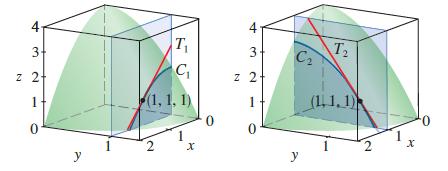
(a) We found that fx(1, 1) = −2 for the function f(x, y) = 4 − x2 − 2y2. We interpreted this result geometrically as the slope of the tangent line to the curve C1 at the point P(1, 1, 1), where C1 is the trace of the graph of f in the plane y = 1 . (See the figure.) Verify this interpretation
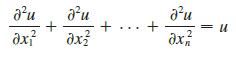
Ifwhereshow that u = e°i*1+a2 *2+ .+a, xg
Show that the function u = u(x, t) is a solution of the wave equation utt = a2uxx.(a) u = sin(kx) sin(akt)(b) u = t/(a2t2 − x2)(c) u = (x − at)6 + (x + at)6(d) u = sin(x − at) + ln(x + at)
Determine whether each of the following functions is a solution of Laplace’s equation uxx + uyy = 0.(a) u = x2 + y2(b) u = x2 − y2(c) u = x3 + 3xy2(d) u = ln√x2 + y2(e) u = sin x cosh y + cos x sinh y(f) u = e−x cos y − e−y cos x
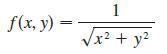
Verify that the function u = 1/√x2 + y2 + z2 is a solution of the three dimensional Laplace equation uxx + uyy + uzz = 0.
The Heat Equation Verify that the function u = e−α2k2t sin kx is a solution of the heat conduction equation ut = α2uxx.
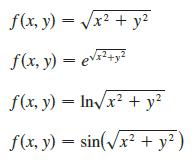
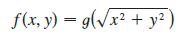
Graph the functionsandIn general, if t is a function of one variable, how is the graph ofobtained from the graph of t? f(x, y) = /x? + y² f(x, y) = ev+y f(x, y) = In/x? + y? f(x, y) = sin(/ x² + y² 2
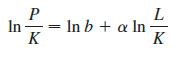
(a) Show that, by taking logarithms, the general Cobb-Douglas function P = bLαK1−α can be expressed as(b) If we let x − ln(L/K) and y = ln(P/K), the equation in part (a) becomes the linear equation y = αx + ln b. Use Table 2 (in Example 4) to make a table of values of ln(L/K) and ln(P/K) for
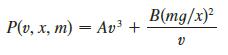
We expressed the power needed by a bird during its flapping mode aswhere A and B are constants specific to a species of bird, v is the velocity of the bird, m is the mass of the bird, and x is the fraction of the flying time spent in flapping mode. Calculate ∂P/∂v, ∂P/∂x, and
In a study of frost penetration it was found that the temperature T at time t (measured in days) at a depth x (measured in feet) can be modeled by the functionT(x, t) = T0 + T1e2−λx sin(ωt − λx)where ω = 2π/365 and λ is a positive constant.(a) Find ∂T/∂x. What is its physical
The ellipsoid 4x2 + 2y2 + z2 = 16 intersects the plane y = 2 in an ellipse. Find parametric equations for the tangent line to this ellipse at the point (1, 2, 2).
The paraboloid z = 6 − x − x2 − 2y2 intersects the plane x = 1 in a parabola. Find parametric equations for the tangent line to this parabola at the point (1, 2, −4). Use a computer to graph the paraboloid, the parabola, and the tangent line on the same screen.
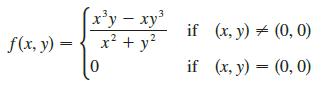
Let(a) Graph f.(b) Find fx(x, y) and fy(x, y) when (x, y) ≠ (0, 0).(c) Find fx(0, 0) and fy(0, 0) using Equations 2 and 3.(d) Show that fxy(0, 0) = −1 and fyx(0, 0) = 1.(e) Does the result of part (d) contradict Clairaut’s Theorem? Use graphs of fxy and fyx to illustrate your answer. (x'y–
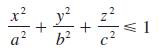
The planecuts the solid ellipsoidinto two pieces. Find the volume of the smaller piece. *++2-1 = 1 a > 0, b> 0, c>0 a
Evaluate the double integral. e *dA, D- {(x, y) |0
Find the area of the surface.The part of the sphere x2 + y2 + z2 = a2 that lies within the cylinder x2 + y2 = ax and above the xy-plane.
Evaluate the triple integral. Sle y dV, where E = {(x, y, z) | 0
Evaluate the given integral by changing to polar coordinates.∫∫D e−x2−y2 dA, where D is the region bounded by the semicircle x = √4 − y2 and the y-axis.
Sketch the solid described by the given inequalities.ρ ≤ 2, ρ ≤ csc Φ
Evaluate the double integral. | v/x2 - y2 dA, D= {(x, y) | 0
Find the area of the surface.The part of the sphere x2 + y2 + z2 = 4z that lies inside the paraboloid z = x2 + y2.
Evaluate the triple integral. SSSE e dV, where E = {(x, y, z) | 0 < y< 1, y
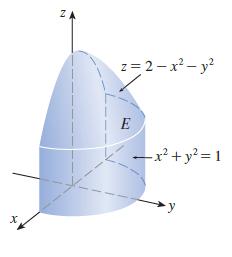
(a) Express the triple integral ∫∫∫E f(x, y, z) dV as an iterated integral in cylindrical coordinates for the given function f and solid region E.(b) Evaluate the iterated integral.f(x, y, z) = x2 + y2 ZA z= 2-x - y? E -x² + y? = 1
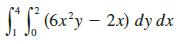
Calculate the iterated integral. (6x*y – 2x) dy dx
A solid lies inside the sphere x2 + y2 + z2 = 4z and outside the cone z = √x2 + y2 . Write a description of the solid in terms of inequalities involving spherical coordinates.
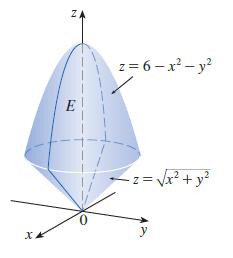
(a) Express the triple integral ∫∫∫E f(x, y, z) dV as an iterated integral in cylindrical coordinates for the given function f and solid region E.(b) Evaluate the iterated integral.f(x, y, z) = xy ZA z = 6 - x² - y? E z = Vx² + y?
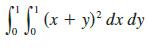
Calculate the iterated integral. (x + y)? dx dy
Evaluate the given integral by changing to polar coordinates.∫∫D x dA, where D is the region in the first quadrant that lies between the circles x2 + y2 = 4 and x2 + y2 = 2x
Sketch the solid consisting of all points with spherical coordinates (ρ, θ, Φ) such that 0 ≤ θ ≤ π/2, 0 ≤ Φ ≤ π/6, and 0 ≤ ρ ≤ 2 cos Φ.
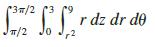
Sketch the solid whose volume is given by the integral and evaluate the integral. (37/2 (3 3m/2 r dz dr de T/2
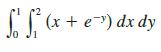
Calculate the iterated integral. (x + e-") dx dy 11
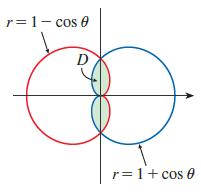
Use a double integral to find the area of the region D. r=1- cos e r=1+ cos 0
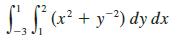
Calculate the iterated integral. y) dy dx 3 J1
Sketch the solid whose volume is given by the integral and evaluate the integral. w/4 (27 (soc o "sec p² sin o dp de do Jo Jo Jo
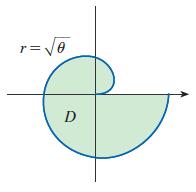
Use a double integral to find the area of the region D. D
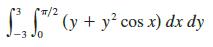
Calculate the iterated integral. (/2 L +y° cos x) dx dy -3 Jo
Showing 1800 - 1900
of 4932
First
12
13
14
15
16
17
18
19
20
21
22
23
24
25
26
Last
Step by Step Answers

 Get 50% OFF
Claim Now
Get 50% OFF
Claim Now