New Semester
Started
Get
50% OFF
Study Help!
--h --m --s
Claim Now
Question Answers
Textbooks
Find textbooks, questions and answers
Oops, something went wrong!
Change your search query and then try again
S
Books
FREE
Study Help
Expert Questions
Accounting
General Management
Mathematics
Finance
Organizational Behaviour
Law
Physics
Operating System
Management Leadership
Sociology
Programming
Marketing
Database
Computer Network
Economics
Textbooks Solutions
Accounting
Managerial Accounting
Management Leadership
Cost Accounting
Statistics
Business Law
Corporate Finance
Finance
Economics
Auditing
Tutors
Online Tutors
Find a Tutor
Hire a Tutor
Become a Tutor
AI Tutor
AI Study Planner
NEW
Sell Books
Search
Search
Sign In
Register
study help
mathematics
calculus early transcendentals 9th
Calculus Early Transcendentals 9th Edition James Stewart, Daniel K. Clegg, Saleem Watson, Lothar Redlin - Solutions
(a) Use software that plots implicitly defined curves to estimate the minimum and maximum values of f(x, y) = x3 + y3 + 3xy subject to the constraint (x − 3)2 + (y − 3)2 = 9 by graphical methods.(b) Solve the problem in part (a) with the aid of Lagrange multipliers. You will need to solve the
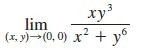
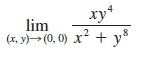
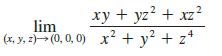
Use a graph of the function to explain why the limit does not exist. 3 lim xy (x. y)(0, 0) x + y°
Find the differential of the function.w = xze−y2−z2
Find the first partial derivatives of the function.u = sin(x1 + 2x2 + ∙ ∙ ∙ + nxn)
If v = x2 sin y + yexy, where x = s + 2t and y = st, use the Chain Rule to find ∂v/∂s and ∂v/∂t when s = 0 and t = 1.
Find the absolute maximum and minimum values of f on the set D.f(x, y) = x2 + xy + y2 − 6y, D = {(x, y) | −3 ≤ x ≤ 3, 0 ≤ y ≤ 5}
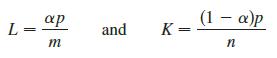
The total production P of a certain product depends on the amount L of labor used and the amount K of capital investment. Cobb-Douglas model P = bLαK1−α follows from certain economic assumptions, where b and α are positive constants and α < 1. If the cost of a unit of labor is m and the
Find h(x, y) = g(f(x, y)) and the set of points at which h is continuous.g(t) = t2 + √t, f(x, y) = 2x + 3y – 6
Suppose z = f(x, y), where x = g(s, t), y = h(s, t), g(1, 2) = 3, gs(1, 2) = −1, gt(1, 2) = 4, h(1, 2) = 6, hs(1, 2) = −5, ht(1, 2) = 10, fx(3, 6) = 7, and fy(3, 6) = 8. Find ∂z/∂s and ∂z/∂t when s = 1 and t = 2.
Find the absolute maximum and minimum values of f on the set D.f(x, y) = x2 + 2y2 − 2x − 4y + 1, D = {(x, y) | 0 ≤ x ≤ 2, 0 ≤ y ≤ 3}
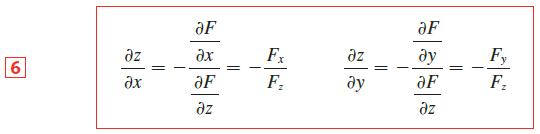
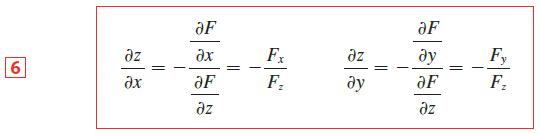
Use Equations 6 to find ∂z/∂x and ∂z/∂y.ez = xyz ƏF az ax Fx az ду Fy ax ƏF F. ду F: az az
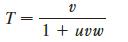
Find the differential of the function. T= 1 + uvw
Use Lagrange multipliers to give an alternate solution to the indicated exercise in Section 14.7.Exercise 50Find the dimensions of the box with volume 1000 cm3 that has minimal surface area.
Use Lagrange multipliers to give an alternate solution to the indicated exercise in Section 14.7.Exercise 51Find the volume of the largest rectangular box in the first octant with three faces in the coordinate planes and one vertex in the plane x + 2y + 3z = 6.
Draw a contour map of the function showing several level curves.f(x, y) = yex
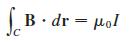
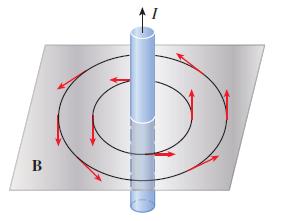
Experiments show that a steady current I in a long wire produces a magnetic field B that is tangent to any circle that lies in the plane perpendicular to the wire and whose center is the axis of the wire (as in the figure). Ampère’s Law relates the electric current to its magnetic effects and
Find the remaining trigonometric ratios.cos(x) = − 1/3, π < x < 3π/2
Find an antiderivative of the function.(a) h(q) = cos q(b) f(x) = ex
Find the first partial derivatives.G(x, y, z) = exz sin(y/z)
Find and sketch the domain of the function.f(x, y, z) = ln(16 − 4x2 − 4y2 − z2)
Find the local maximum and minimum values and saddle point(s) of the function. You are encouraged to use a calculator or computer to graph the function with a domain and viewpoint that reveals all the important aspects of the function.f(x, y) = x2 + y4 + 2xy
Use the Chain Rule to find ∂z/∂s and ∂z/∂t.z = tan(u/v), u = 2s + 3t, v = 3s − 2t
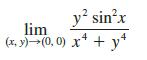
Show that the limit does not exist. y? sin?x lim (x, y)(0, 0) x* + y*
Find the first partial derivatives of the function.g(x, y) = y(x + x2y)5
Find the local maximum and minimum values and saddle point(s) of the function. You are encouraged to use a calculator or computer to graph the function with a domain and viewpoint that reveals all the important aspects of the function.f(x, y) = xy − x2y − xy2
Suppose f is a differentiable function of x and y, and p(t) = (g(t), h(t)), g(2) = 4, g'(2) = −3, h(2) = 5, h'(2) = 6, fx(4, 5) = 2, fy(4, 5) = 8. Find p'(2).
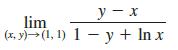
Show that the limit does not exist. y - x lim (x, y)(1, 1) 1 - y + In x
(a) What is a closed set in R2? What is a bounded set?(b) State the Extreme Value Theorem for functions of two variables.(c) How do you find the values that the Extreme Value Theorem guarantees?
Let R(s, t) = G(u(s, t), v(s, t)), where G, u, and v are differentiable, u(1, 2) = 5, us(1, 2) = 4, ut(1, 2) = −3, v(1, 2) = 7, vs(1, 2) = 2, vt(1, 2) = 6, Gu(5, 7) = 9, Gv(5, 7) = −2. Find Rs(1, 2) and Rt(1, 2).
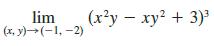
Find the limit, if it exists, or show that the limit does not exist. lim (x, y)(-1,-2) (x'y – xy? + 3)
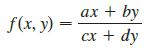
Find the first partial derivatives of the function. ах + by f(x, y) = сх + dy
Find the local maximum and minimum values and saddle point(s) of the function. You are encouraged to use a calculator or computer to graph the function with a domain and viewpoint that reveals all the important aspects of the function.f(x, y) = ex cos y
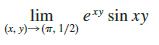
Find the limit, if it exists, or show that the limit does not exist. lim ey sin xy (x, y)-(7, 1/2)
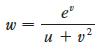
Find the first partial derivatives of the function. et w u + v? 2
Find the local maximum and minimum values and saddle point(s) of the function. You are encouraged to use a calculator or computer to graph the function with a domain and viewpoint that reveals all the important aspects of the function.f(x, y) = (x2 + y2)e−x
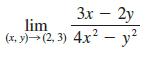
Find the limit, if it exists, or show that the limit does not exist. 3x Зх — 2у lim (x. y)(2, 3) 4x? - y?
Find the directional derivative of the function at the point P in the direction of the point Q.f(x, y) = x2y2 − y3, P(1, 2), Q(−3, 5)
Find the first partial derivatives of the function.g(u, v) = (u2v − v3)5
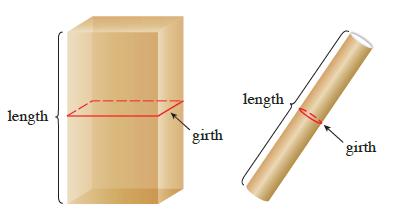
Use Lagrange multipliers to give an alternate solution to the indicated exercise in Section 4.7.Exercise 24A package to be mailed using the US postal service may not measure more than 108 inches in length plus girth. (Length is the longest dimension and girth is the largest distance around the
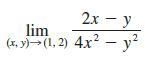
Find the limit, if it exists, or show that the limit does not exist. 2х — у y lim (x, y)(1, 2) 4x - y?
Find the directional derivative of the function at the point P in the direction of the point Q. f(x, y) – P(3, -1), Q(-2, 11)
Find the first partial derivatives of the function.u(r, θ) = sin(r cos θ)
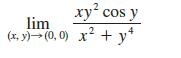
Find the limit, if it exists, or show that the limit does not exist. xy cos y lim (x, y)(0, 0) x + y* .2
Find the directional derivative of the function at the point P in the direction of the point Q.f(x, y) = √xy, P(2, 8), Q(5, 4)
Sketch the graph of the function.f(x, y) = y
Show that f(x, y) = x2 + 4y2 − 4xy + 2 has an infinite number of critical points and that D = 0 at each one. Then show that f has a local (and absolute) minimum at each critical point.
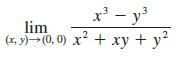
Find the limit, if it exists, or show that the limit does not exist. x' - y' lim (x, (0, 0) x? + xy + y?
Find the directional derivative of the function at the point P in the direction of the point Q.f(x, y, z) = xy2z3, P(2, 1, 1), Q(0, −3, 5)
Sketch the graph of the function.f(x, y) = x2
Show that f(x, y) = x2ye−x2−y2 has maximum values at (±1, 1/√2) and minimum values at (±1, −1/√2). Show also that f has infinitely many other critical points and D = 0 at each of them. Which of them give rise to maximum values? Minimum values? Saddle points?
Use Lagrange multipliers to find the maximum value of f subject to the given constraint. Then show that f has no minimum value with that constraint.f(x, y) = exy, x3 + y3 = 16
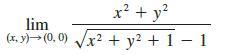
Find the limit, if it exists, or show that the limit does not exist. x² + y? lim (x. y)(0,0) x2 + y² + 1 - 1
Find the directional derivative of the function at the point P in the direction of the point Q.f(x, y, z) = xy − xy2z2, P(2, −1, 1), Q(5, 1, 7)
Find the first partial derivatives of the function.F(x, y) = ∫xy cos(et) dt
Find equations of(a) The tangent plane(b) The normal line to the given surface at the specified point.z = 3x2 − y2 + 2x, (1, −2, 1)
Sketch the graph of the function.f(x, y) = 10 − 4x − 5y
Use the Chain Rule to find the indicated partial derivatives.z = x4 + x2y, x = s + 2t − u, y = stu2; ze ze when s 4, t= 2, u = 1 dz as' at' du
Use Lagrange multipliers to find the maximum value of f subject to the given constraint. Then show that f has no minimum value with that constraint.f(x, y, z) = 4x + 2y + z, x2 + y + z2 = 1
Find the limit, if it exists, or show that the limit does not exist. lim xy (x, y) (0, 0) x + y*
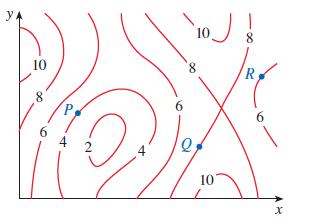
The contour map of a function f is shown. At points P, Q, and R, draw an arrow to indicate the direction of the gradient vector. y 10 8 10 P, 6. 6. 4 10
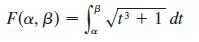
Find the first partial derivatives of the function. F(a, B) = " V3 + I dt
Find equations of(a) The tangent plane(b) The normal line to the given surface at the specified point.z = ex cos y, (0, 0, 1)
Sketch the graph of the function.f(x, y) = cos y
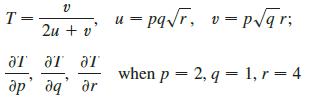
Use the Chain Rule to find the indicated partial derivatives. T= 2u + v' u = pq/r, v= Pvar; when p = 2, q = 1, r = 4 ap' aq' ar
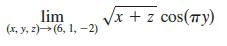
Find the limit, if it exists, or show that the limit does not exist. lim (x, y, z) (6, 1, -2) Vx +z cos(ry)
Find the linear approximation of the function f(x, y, z) = √x2 + y2 + z2 at (3, 2, 6) and use it to approximate the number (3.02)2 + (1.97)² + (5.99)².
Find the first partial derivatives of the function.f(x, y, z) = x3yz2 + 2yz
Find equations of(a) The tangent plane(b) The normal line to the given surface at the specified point.x2 + 2y2 − 3z2 = 3, (2, −1, 1)
Use the Chain Rule to find the indicated partial derivatives.w = xy + yz + zx, x = r cos θ, y = r sin θ, z = rθ; dw dw when r = 2, 0 = T/2 %3| %3| ar' ae
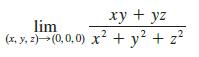
Find the limit, if it exists, or show that the limit does not exist. lim (x. y. )(0,0,0) x+ y? + z? ху + уz ² + z?
Find the first partial derivatives of the function.f(x, y, z) = xy2e−xz
Find equations of(a) The tangent plane(b) The normal line to the given surface at the specified point.xy + yz + zx = 3, (1, 1, 1)
Sketch the graph of the function.f(x, y) = 2 − x2 − y2
Find the limit, if it exists, or show that the limit does not exist. xy + yz? + xz2 XZ lim (x, y, 2)(0, 0, 0) x? + y? + z*
Find equations of(a) The tangent plane(b) The normal line to the given surface at the specified point.sin(xyz) = x + 2y + 3z, (2, −1, 0)
Sketch the graph of the function.f(x, y) = x2 + 4y2 + 1
Find the differential of the function.z = x ln(y2 + 1)
Find the first partial derivatives of the function.u = xy/z
Find du if u = ln(1 + se2t).
Use Equations 6 to find ∂z/∂x and ∂z/∂y.yz + x ln y = z2 ƏF az ax Fx az ду Fy ax ƏF F. ду F: az az
Use Lagrange multipliers to prove that the rectangle with maximum area that has a given perimeter p is a square.
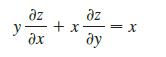
If z = y + f(x2 − y2), where f is differentiable, show that az az y + x = x ax ду
Find the indicated partial derivative. 1- Jx? + y? + z² 1 + Vx? + y? + z? f(x, y, z) = In- ; f(1, 2, 2)
Let f be a function of two variables that has continuous partial derivatives and consider the points A(1, 3), B(3, 3), C(1, 7), and D(6, 15). The directional derivative of f at A in the direction of the vector AB(vector) is 3, and the directional derivative at A in the direction of AC(vector) is
Use implicit differentiation to find ∂z/∂x and ∂z/∂y.x2 + 2y2 + 3z2 = 1
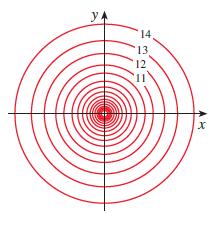
A contour map of a function is shown. Use it to make a rough sketch of the graph of f . yA 14 13 12
Use implicit differentiation to find ∂z/∂x and ∂z/∂y.x2 − y2 + z2 − 2z = 4
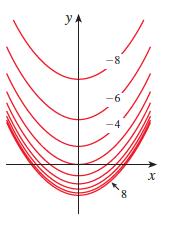
A contour map of a function is shown. Use it to make a rough sketch of the graph of f . -8 -6 -9- -4
Use implicit differentiation to find ∂z/∂x and ∂z/∂y.ez = xyz
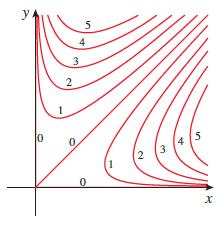
A contour map of a function is shown. Use it to make a rough sketch of the graph of f . y. 5 4 3 2 3. 2
Sketch the region in the xy-plane.{(x, y) | xy < 0}
The base and height of a triangle are measured as 28 inches and 16 inches, respectively. Suppose that each measurement has a possible error of at most ε inches.(a) Use differentials to estimate the maximum error in the calculated area of the triangle.(b) What is the estimated maximum error in the
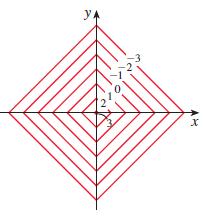
A contour map of a function is shown. Use it to make a rough sketch of the graph of f . yA
Use implicit differentiation to find ∂z/∂x and ∂z/∂y.yz + x ln y = z2
Find the point on the plane x − 2y + 3z = 6 that is closest to the point (0, 1, 1).
Find the points on the cone z2 = x2 + y2 that are closest to the point (4, 2, 0).
The radius of a right circular cylinder is measured as 2.5 ft, and the height is measured as 12 ft. Suppose that each measurement has a possible error of at most ε feet.(a) Use differentials to estimate the maximum error in the calculated volume of the cylinder.(b) If the computed volume must be
Find the directional derivative of f at the given point in the indicated direction.f(x, y) = x2e−y, (−2, 0), in the direction toward the point (2, −3)
Find ∂z/∂x and ∂z/∂y.(a) z = f(x) + g(y)(b) z = f(x + y)
Find the points on the surface y2 = 9 + xz that are closest to the origin.
Showing 1600 - 1700
of 4932
First
10
11
12
13
14
15
16
17
18
19
20
21
22
23
24
Last
Step by Step Answers

 Get 50% OFF
Claim Now
Get 50% OFF
Claim Now