New Semester
Started
Get
50% OFF
Study Help!
--h --m --s
Claim Now
Question Answers
Textbooks
Find textbooks, questions and answers
Oops, something went wrong!
Change your search query and then try again
S
Books
FREE
Study Help
Expert Questions
Accounting
General Management
Mathematics
Finance
Organizational Behaviour
Law
Physics
Operating System
Management Leadership
Sociology
Programming
Marketing
Database
Computer Network
Economics
Textbooks Solutions
Accounting
Managerial Accounting
Management Leadership
Cost Accounting
Statistics
Business Law
Corporate Finance
Finance
Economics
Auditing
Tutors
Online Tutors
Find a Tutor
Hire a Tutor
Become a Tutor
AI Tutor
AI Study Planner
NEW
Sell Books
Search
Search
Sign In
Register
study help
mathematics
calculus early transcendentals 9th
Physics For Scientists And Engineers A Strategic Approach With Modern Physics 3rd Edition Randall D. Knight - Solutions
The carbon isotope 14C is used for carbon dating of archeological artifacts. 14C (mass 2.34 × 10⁻²⁶ kg) decays by the process known as beta decay in which the nucleus emits an electron (the beta particle) and a subatomic particle called a neutrino. In one such decay, the electron and the neutrino
A 75 kg shell is fired with an initial speed of 125 m/s at an angle 55° above horizontal. Air resistance is negligible. At its highest point, the shell explodes into two fragments, one four times more massive than the other. The heavier fragment lands directly below the point of the explosion. If
The skiing duo of Brian (80 kg) and Ashley (50 kg) is always a crowd pleaser. In one routine, Brian, wearing wood skis, starts at the top of a 200-m-long, 20° slope. Ashley waits for him halfway down. As he skis past, she leaps into his arms and he carries her the rest of the way down. What is
A clay blob of mass m1, initially at rest, is pushed across a frictionless surface with constant force F for a distance d. It then hits and sticks to a second clay blob of mass m2 that is at rest. Find an expression for their speed after the collision.
A small rocket to gather weather data is launched straight up. Several seconds into the flight, its velocity is 120 m/s and it is accelerating at 18 m/s2. At this instant, the rocket’s mass is 48 kg and it is losing mass at the rate of 0.50 kg/s as it burns fuel. What is the net force on the
One week in lab, you’re given a spring-loaded bar that can be used to strike a metal ball. Your assignment is to measure what size impulse the bar delivers to the ball. You and your lab partner decide to place several balls of different mass on the edge of the lab table, use the striker to launch
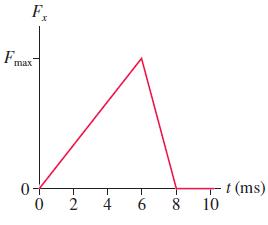
In Figure EX 9.5, what value of Fmax gives an impulse of 6.0 N s? F, Fmax 0 2 4 t (ms) 8 10 6
Explain the concept of isolated system in nonmathematical language that would make sense to an educated person who had never heard of it.
Explain the concept of impulse in nonmathematical language. That is, don’t simply put the equation in words to say that “impulse is the time integral of force.” Explain it in terms that would make sense to an educated person who had never heard of it.
You are flying to New York. You’ve been reading the in-flight magazine, which has an article about the physics of flying. You learned that the airflow over the wings creates a lift force that is always perpendicular to the wings. In level flight, the upward lift force exactly balances the
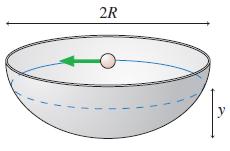
A small ball rolls around a horizontal circle at height y inside a frictionless hemispherical bowl of radius R, as shown in Figure CP8.64.a. Find an expression for the ball’s angular velocity in terms of R, y, and g.b. What is the minimum value of ω for which the ball can move in a circle?c.
You have a new job designing rides for an amusement park. In one ride, the rider’s chair is attached by a 9.0-m-long chain to the top of a tall rotating tower. The tower spins the chair and rider around at the rate of 1.0 rev every 4.0 s. In your design, you’ve assumed that the maximum possible
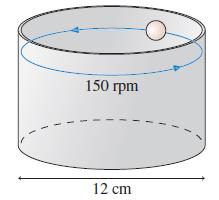
A 10 g steel marble is spun so that it rolls at 150 rpm around the inside of a vertically oriented steel tube. The tube, shown in Figure P8.39, is 12 cm in diameter. Assume that the rolling resistance is small enough for the marble to maintain 150 rpm for several seconds. During this time, will the
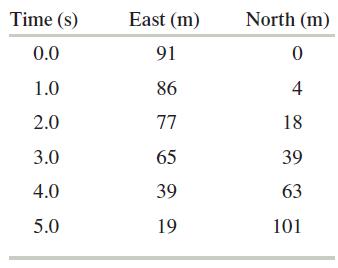
An experimental aircraft begins its takeoff at t = 0 s. Every second, an onboard GPS measures and records the plane’s distances east and north of a reference marker. The following data are downloaded to your computer:Analyze these data to determine the magnitude of the aircraft’s takeoff
A popular pastime is to see who can push an object closest to the edge of a table without its going off. You push the 100 g object and release it 2.0 m from the table edge. Unfortunately, you push a little too hard. The object slides across, sails off the edge, falls 1.0 m to the floor, and lands
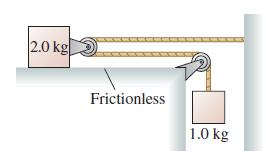
What is the acceleration of the 2.0 kg block in Figure CP7.55 across the frictionless table? 2.0 kg Frictionless 1.0 kg
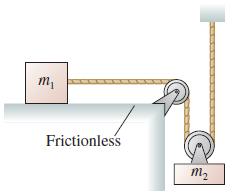
In Figure CP7.54, find an expression for the acceleration of m1. The pulleys are massless and frictionless. m, Frictionless m2
A 100 g ball of clay is thrown horizontally with a speed of 10 m/s toward a 900 g block resting on a frictionless surface. It hits the block and sticks. The clay exerts a constant force on the block during the 10 ms it takes the clay to come to rest relative to the block. After 10 ms, the block and
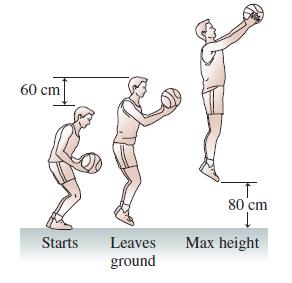
A 100 kg basketball player can leap straight up in the air to a height of 80 cm, as shown in Figure P7.50. You can understand how by analyzing the situation as follows:a. The player bends his legs until the upper part of his body has dropped by 60 cm, then he begins his jump. Draw separate
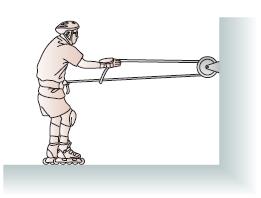
Jorge, with mass m, is wearing roller skates whose coefficient of friction with the floor is μr. He ties a massless rope around his waist, passes it around a frictionless pulley, and grabs hold of the other end, as shown in Figure P7.47. Jorge then pulls hand over hand on the rope with a constant
A rope attached to a 20 kg wood sled pulls the sled up a 20° snow-covered hill. A 10 kg wood box rides on top of the sled. If the tension in the rope steadily increases, at what value of the tension does the box slip?
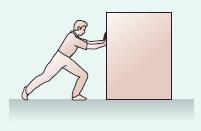
You see the boy next door trying to push a crate down the sidewalk. He can barely keep it moving, and his feet occasionally slip. You start to wonder how heavy the crate is. You call to ask the boy his mass, and he replies “50 kg.” From your recent physics class you estimate that the static and
Two-thirds of the weight of a 1500 kg car rests on the drive wheels. What is the maximum acceleration of this car on a concrete surface?
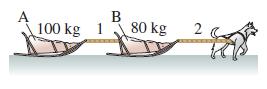
The sled dog in Figure P7.23 drags sleds A and B across the snow. The coefficient of friction between the sleds and the snow is 0.10. If the tension in rope 1 is 150 N, what is the tension in rope 2? 100 kg 1 B 80 kg 2
A massive steel cable drags a 20 kg block across a horizontal, frictionless surface. A 100 N force applied to the cable causes the block to reach a speed of 4.0 m/s in 2.0 s. What is the difference in tension between the two ends of the cable?
An 80 kg spacewalking astronaut pushes off a 640 kg satellite, exerting a 100 N force for the 0.50 s it takes him to straighten his arms. How far apart are the astronaut and the satellite after 1.0 min?
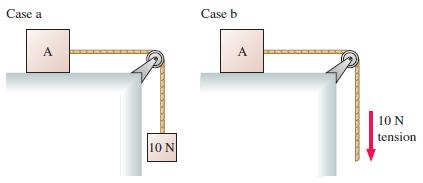
In case a in Figure Q7.15, block A is accelerated across a frictionless table by a hanging 10 N weight (1.02 kg). In case b, block A is accelerated across a frictionless table by a steady 10 N tension in the string. The string is massless, and the pulley is massless and frictionless. Is A’s
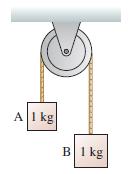
Blocks A and B in Figure Q7.14 are connected by a massless string over a massless, frictionless pulley. The blocks have just been released from rest. Will the pulley rotate clockwise, counterclockwise, or not at all? Explain. AI kg B1 kg
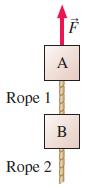
Figure EX 7.13 shows two 1.0 kg blocks connected by a rope. A second rope hangs beneath the lower block. Both ropes have a mass of 250 g. The entire assembly is accelerated upward at 3.0 m/s2 by force F(vector).a. What is F?b. What is the tension at the top end of rope 1?c. What is the tension at
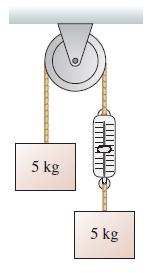
Figure Q7.12 shows two masses at rest. The string is massless and the pulley is frictionless. The spring scale reads in kg. What is the reading of the scale? 5 kg 5 kg
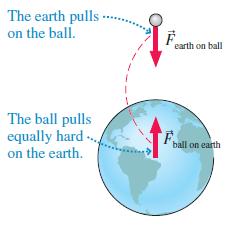
A massive steel cable drags a 20 kg block across a horizontal, frictionless surface. A 100 N force applied to the cable causes the block to reach a speed of 4.0 m/s in a distance of 2.0 m. What is the mass of the cable What is the tension in the rope of Figure EX 7.12? The earth pulls on the ball.
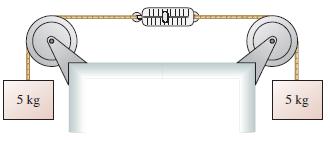
Figure Q7.11 shows two masses at rest. The string is massless and the pulley is frictionless. The spring scale reads in kg. What is the reading of the scale? 5 kg 5 kg
Blocks with masses of 1 kg, 2 kg, and 3 kg are lined up in a row on a frictionless table. All three are pushed forward by a 12 N force applied to the 1 kg block.a. How much force does the 2 kg block exert on the 3 kg block?b. How much force does the 2 kg block exert on the 1 kg block?
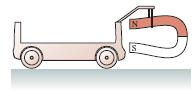
Will hanging a magnet in front of the iron cart in Figure Q7.10 make it go? Explain. IS
Teams red and blue are having a tug-of-war. According to Newton’s third law, the force with which the red team pulls on the blue team exactly equals the force with which the blue team pulls on the red team. How can one team ever win? Explain.
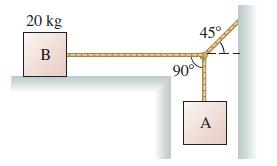
Block B in Figure EX 7.8 rests on a surface for which the static and kinetic coefficients of friction are 0.60 and 0.40, respectively. The ropes are massless. What is the maximum mass of block A for which the system is in equilibrium? 20 kg 45° 90 A
a. How much force does an 80 kg astronaut exert on his chair while sitting at rest on the launch pad?b. How much force does the astronaut exert on his chair while accelerating straight up at 10 m/s2?
A small car is pushing a large truck. They are speeding up. Is the force of the truck on the car larger than, smaller than, or equal to the force of the car on the truck?
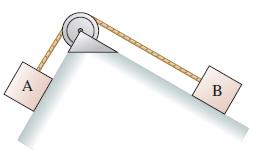
Block A in Figure EX7.6 is sliding down the incline. The rope is massless, and the massless pulley turns on frictionless bearings, but the surface is not frictionless. The rope and the pulley are among the interacting objects, but you’ll have to decide if they’re part of the system.a. Draw an
A mosquito collides head-on with a car traveling 60 mph. Is the magnitude of the mosquito’s acceleration larger than, smaller than, or equal to the magnitude of the car’s acceleration? Explain.
A mosquito collides head-on with a car traveling 60 mph. Is the force of the mosquito on the car larger than, smaller than, or equal to the force of the car on the mosquito? Explain.
A battery-powered toy car pushes a stuffed rabbit across the floor. Block A in Figure EX7.5 is heavier than block B and is sliding down the incline. All surfaces have friction. The rope is massless, and the massless pulley turns on frictionless bearings. The rope and the pulley are among the
How do basketball players jump straight up into the air? Your explanation should include pictures showing forces on the player and forces on the ground.
A mountain climber is using a rope to pull a bag of supplies up a 45° slope. The rope is not massless.a. Draw an interaction diagram, following the steps of Tactics Box.b. Identify the “system” on your interaction diagram.c. Draw a free-body diagram for each object in the system. Use dashed
How does a rocket take off? What is the upward force on it? Your explanation should include diagrams showing forces on the rocket and forces on the parcel of hot gas that was just expelled from the rocket’s exhaust.
A soccer ball and a bowling ball have a head-on collision at this instant. Rolling friction is negligible.a. Draw an interaction diagram, following the steps of Tactics Box.b. Identify the “system” on your interaction diagram.c. Draw a free-body diagram for each object in the system. Use dashed
How do you paddle a canoe in the forward direction? Explain. Your explanation should include diagrams showing forces on the water and forces on the paddle.
A weightlifter stands up at constant speed from a squatting position while holding a heavy barbell across his shoulders.a. Draw an interaction diagram, following the steps of Tactics Box.b. Identify the “system” on your interaction diagram.c. Draw a free-body diagram for each object in the
You find yourself in the middle of a frozen lake with a surface so slippery (μs = μk = 0) you cannot walk. However, you happen to have several rocks in your pocket. The ice is extremely hard. It cannot be chipped, and the rocks slip on it just as much as your feet do. Can you think of a way to
A particle of mass m moving along the x-axis experiences the net force Fx = ct, where c is a constant. The particle has velocity v0x at t = 0. Find an algebraic expression for the particle’s velocity vx at a later time t.
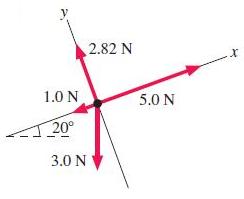
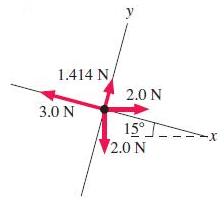
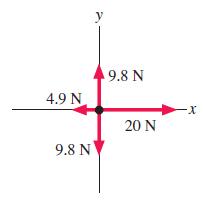
In each of the two free-body diagrams in Figure EX 6.7, the forces are acting on a 2.0 kg object. For each diagram, find the values of ax and ay, the x- and y-components of the acceleration.(a)(b) 2.82 N よ 1.0 N 5.0 N ゴ20 3.0 N
Seat belts and air bags save lives by reducing the forces exerted on the driver and passengers in an automobile collision. Cars are designed with a “crumple zone” in the front of the car. In the event of an impact, the passenger compartment decelerates over a distance of about 1 m as the front
The position of a 2.0 kg mass is given by x = (2t3 – 3t2) m, where t is in seconds. What is the net horizontal force on the mass at(a) t = 0 s(b) t = 1 s?
The piston of a machine exerts a constant force on a ball as it moves horizontally through a distance of 15 cm. You use a motion detector to measure the speed of five different balls as they come off the piston; the data are shown below. Use theory to find two quantities that, when graphed, should
Compressed air is used to fire a 50 g ball vertically upward from a 1.0-m-tall tube. The air exerts an upward force of 2.0 N on the ball as long as it is in the tube. How high does the ball go above the top of the tube?
a. A rocket of mass m is launched straight up with thrust F(vector)thrust. Find an expression for the rocket’s speed at height h if air resistance is neglected.b. The motor of a 350 g model rocket generates 9.5 N thrust. If air resistance can be neglected, what will be the rocket’s speed as it
A rifle with a barrel length of 60 cm fires a 10 g bullet with a horizontal speed of 400 m/s. The bullet strikes a block of wood and penetrates to a depth of 12 cm.a. What resistive force (assumed to be constant) does the wood exert on the bullet?b. How long does it take the bullet to come to
A 20,000 kg rocket has a rocket motor that generates 3.0 × 10⁵ N of thrust.a. What is the rocket’s initial upward acceleration?b. At an altitude of 5000 m the rocket’s acceleration has increased to 6.0 m/s2. What mass of fuel has it burned?
a. An object of mass m is at rest at the top of a smooth slope of height h and length L. The coefficient of kinetic friction between the object and the surface, μk , is small enough that the object will slide down the slope if given a very small push to get it started. Find an expression for the
Sam, whose mass is 75 kg, takes off across level snow on his jet-powered skis. The skis have a thrust of 200 N and a coefficient of kinetic friction on snow of 0.10. Unfortunately, the skis run out of fuel after only 10 s.a. What is Sam’s top speed?b. How far has Sam traveled when he finally
Sam, whose mass is 75 kg, takes off down a 50-m-high, 10° slope on his jet-powered skis. The skis have a thrust of 200 N. Sam’s speed at the bottom is 40 m/s. What is the coefficient of kinetic friction of his skis on snow?
A baggage handler drops your 10 kg suitcase onto a conveyor belt running at 2.0 m/s. The materials are such that μs = 0.50 and μk = 0.30. How far is your suitcase dragged before it is riding smoothly on the belt?
You and your friend Peter are putting new shingles on a roof pitched at 25°. You’re sitting on the very top of the roof when Peter, who is at the edge of the roof directly below you, 5.0 m away, asks you for the box of nails. Rather than carry the 2.5 kg box of nails down to Peter, you decide to
It’s moving day, and you need to push a 100 kg box up a 20° ramp into the truck. The coefficients of friction for the box on the ramp are μs = 0.90 and μk = 0.60. Your largest pushing force is 1000 N. Can you get the box into the truck without assistance if you get a running start at the ramp?
An Airbus A320 jetliner has a takeoff mass of 75,000 kg. It reaches its takeoff speed of 82 m/s (180 mph) in 35 s. What is the thrust of the engines? You can neglect air resistance but not rolling friction.
A 2.0 kg wood block is launched up a wooden ramp that is inclined at a 30° angle. The block’s initial speed is 10 m/s.a. What vertical height does the block reach above its starting point?b. What speed does it have when it slides back down to its starting point?
It’s a snowy day and you’re pulling a friend along a level road on a sled. You’ve both been taking physics, so she asks what you think the coefficient of friction between the sled and the snow is. You’ve been walking at a steady 1.5 m/s, and the rope pulls up on the sled at a 30° angle.
a. A large box of mass M is pulled across a horizontal, frictionless surface by a horizontal rope with tension T. A small box of mass m sits on top of the large box. The coefficients of static and kinetic friction between the two boxes are μs and μk, respectively. Find an expression for the
a. A large box of mass M is moving on a horizontal surface at speed v0. A small box of mass m sits on top of the large box. The coefficients of static and kinetic friction between the two boxes are μs and μk, respectively. Find an expression for the shortest distance dmin in which the large box
Your assignment in lab is to measure the coefficient of kinetic friction between a 350 g block and a smooth metal table. To do so, you decide to launch the block at various speeds and measure how far it slides; your data are listed in the table. Use a graph to determine the value of μk.Speed (m/s)
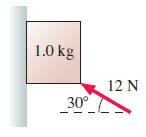
A 1.0 kg wood block is pressed against a vertical wood wall by the 12 N force shown in Figure P6.55. If the block is initially at rest, will it move upward, move downward, or stay at rest? 1.0 kg 12 N 30°
A person with compromised pinch strength in his fingers can exert a force of only 6.0 N to either side of a pinch-held object, such as the book shown in Figure P6.56.What is the heaviest book he can hold vertically before it slips out of his fingers? The coefficient of static friction between his
What is the terminal speed for an 80 kg skier going down a 40° snow covered slope on wooden skis? Assume that the skier is 1.8 m tall and 0.40 m wide.
A ball is shot from a compressed-air gun at twice its terminal speed.a. What is the ball’s initial acceleration, as a multiple of g, if it is shot straight up?b. What is the ball’s initial acceleration, as a multiple of g, if it is shot straight down?
An artist friend of yours needs help hanging a 500lb sculpture from the ceiling. For artistic reasons, she wants to use just two ropes. One will be 30° from vertical, the other 60°. She needs you to determine the smallest diameter rope that can safely support this expensive piece of art. On a
You’ve entered a “slow ski race” where the winner is the skier who takes the longest time to go down a 15° slope without ever stopping. You need to choose the best wax to apply to your skis. Red wax has a coefficient of kinetic friction 0.25, yellow is 0.20, green is 0.15, and blue is 0.10.
Astronauts in space “weigh” themselves by oscillating on a spring.Suppose the position of an oscillating 75 kg astronaut is given by x = (0.30 m) sin((π rad/s) · t), where t is in s. What force does the spring exert on the astronaut at(a) t = 1.0 s(b) 1.5 s?
At t = 0, an object of mass m is at rest at x = 0 on a horizontal, frictionless surface. A horizontal force Fx = F0(1 - t/T), which decreases from F0 at t = 0 to zero at t = T, is exerted on the object. Find an expression for the object’s(a) Velocity(b) Position at time T.
At t = 0, an object of mass m is at rest at x = 0 on a horizontal, frictionless surface. Starting at t = 0, a horizontal force Fx = F0e-t/T is exerted on the object.a. Find and graph an expression for the object’s velocity at an arbitrary lateer time t.b. What is the object’s velocity after a
Large objects have inertia and tend to keep moving—Newton’s first law. Life is very different for small microorganisms that swim through water. For them, drag forces are so large that they instantly stop, without coasting, if they cease their swimming motion. To swim at constant speed, they
Very small objects, such as dust particles, experience a linear drag force, D(vector) = (bv, direction opposite the motion), where b is a constant. That is, the quadratic model of drag of Equation 6.16 fails for very small particles. For a sphere of radius R, the drag constant can be shown to be b
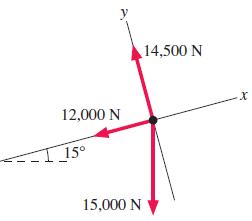
a. Write a realistic dynamics problem for which this is the correct free body diagram. Your problem should ask a question that can be answered with a value of position or velocity (such as “How far?” or “How fast?”), and should give sufficient information to allow a solution.b. Solve your
a. Write a realistic dynamics problem for which this is the correct free body diagram. Your problem should ask a question that can be answered with a value of position or velocity (such as “How far?” or “How fast?”), and should give sufficient information to allow a solution.b. Solve your
a. Write a realistic problem for which these are the correct equations.b. Draw the free-body diagram and the pictorial representation for your problem.c. Finish the solution of the problem.– 0.80n = (1500 kg)ax n – (1500 kg)(9.80 m/s2) = 0
a. Write a realistic problem for which these are the correct equations.b. Draw the free-body diagram and the pictorial representation for your problem.c. Finish the solution of the problem.T – 0.20n – (20 kg)(9.80 m/s2) sin 20° = (20 kg)(2.0 m/s2)n – (20 kg)(9.80 m/s2) cos20° = 0
a. Write a realistic problem for which these are the correct equations.b. Draw the free-body diagram and the pictorial representation for your problem.c. Finish the solution of the problem.(100 N)cos30° – fk = (20 kg)axn + (100N) sin 30° – (20 kg)(9.80 m/s2) = 0fk = 0.20n
A block of mass m is at rest at the origin at t = 0. It is pushed with constant force F0 from x = 0 to x = L across a horizontal surface whose coefficient of kinetic friction is μk = μ0(1 – x/L). That is, the coefficient of friction decreases from μ0 at x = 0 to zero at x = L.a. Use what
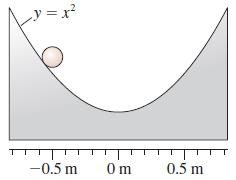
Figure CP6.74 shows an accelerometer, a device for measuring the horizontal acceleration of cars and airplanes. A ball is free to roll on a parabolic track described by the equation y = x2, where both x and y are in meters. A scale along the bottom is used to measure the ball’s horizontal
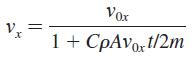
An object with cross section A is shot horizontally across frictionless ice. Its initial velocity is v0x at t0 = 0 s. Air resistance is not negligible.a. Show that the velocity at time t is given by the expressionb. A 1.6-m-wide, 1.4-m-high, 1500 kg car with a drag coefficient of 0.35 hits a very
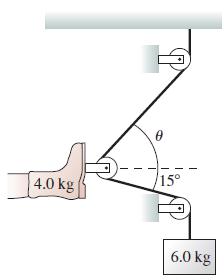
An accident victim with a broken leg is being placed in traction. The patient wears a special boot with a pulley attached to the sole. The foot and boot together have a mass of 4.0 kg, and the doctor has decided to hang a 6.0 kg mass from the rope. The boot is held suspended by the ropes, as shown
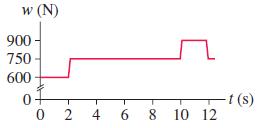
Henry gets into an elevator on the 50th floor of a building and it begins moving at t = 0 s. Figure P6.31 shows his weight over the next 12 s.a. Is the elevator’s initial direction up or down? Explain how you can tell.b. What is Henry’s mass?c. How far has Henry traveled at t = 12 s? w (N) 900
A 500 kg piano is being lowered into position by a crane while two people steady it with ropes pulling to the sides. Bob’s rope pulls to the left, 15° below horizontal, with 500 N of tension. Ellen’s rope pulls toward the right, 25° below horizontal.a. What tension must Ellen maintain in her
In an electricity experiment, a 1.0 g plastic ball is suspended on a 60 cm long string and given an electric charge. A charged rod brought near the ball exerts a horizontal electrical force F(vector)elec on it, causing the ball to swing out to a 20° angle and remain there.a. What is the magnitude
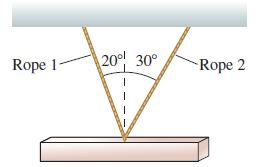
The 1000 kg steel beam in Figure P6.28 is supported by two ropes. What is the tension in each? Rope 1 20 30° Rope 2
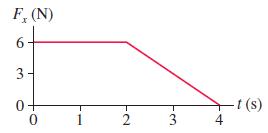
A 2.0 kg object initially at rest at the origin is subjected to the time-varying force shown in Figure P6.27. What is the object’s velocity at t = 4 s? F, (N) 6+ 3- t (s) 4 0+ 1 3. 2-
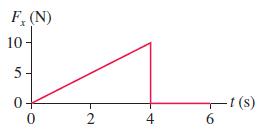
A 5.0 kg object initially at rest at the origin is subjected to the time-varying force shown in Figure P6.26. What is the object’s velocity at t = 6 s? F, (N) 10- 5 - 0- (s) 6. 4. 2.
A 6.5-cm-diameter tennis ball has a terminal speed of 26 m/s. What is the ball’s mass?
A 75 kg skydiver can be modeled as a rectangular “box” with dimensions 20 cm × 40 cm × 180 cm. What is his terminal speed if he falls feet first? Use 0.8 for the drag coefficient.
A 50,000 kg locomotive is traveling at 10 m/s when its engine and brakes both fail. How far will the locomotive roll before it comes to a stop? Assume the track is level.
A 4000 kg truck is parked on a 15° slope. How big is the friction force on the truck? The coefficient of static friction between the tires and the road is 0.90.
Showing 4600 - 4700
of 4932
First
36
37
38
39
40
41
42
43
44
45
46
47
48
49
50
Step by Step Answers

 Get 50% OFF
Claim Now
Get 50% OFF
Claim Now