New Semester
Started
Get
50% OFF
Study Help!
--h --m --s
Claim Now
Question Answers
Textbooks
Find textbooks, questions and answers
Oops, something went wrong!
Change your search query and then try again
S
Books
FREE
Study Help
Expert Questions
Accounting
General Management
Mathematics
Finance
Organizational Behaviour
Law
Physics
Operating System
Management Leadership
Sociology
Programming
Marketing
Database
Computer Network
Economics
Textbooks Solutions
Accounting
Managerial Accounting
Management Leadership
Cost Accounting
Statistics
Business Law
Corporate Finance
Finance
Economics
Auditing
Tutors
Online Tutors
Find a Tutor
Hire a Tutor
Become a Tutor
AI Tutor
AI Study Planner
NEW
Sell Books
Search
Search
Sign In
Register
study help
mathematics
calculus early transcendentals 9th
Physics For Scientists And Engineers A Strategic Approach With Modern Physics 3rd Edition Randall D. Knight - Solutions
Bob is pulling a 30 kg filing cabinet with a force of 200 N, but the filing cabinet refuses to move. The coefficient of static friction between the filing cabinet and the floor is 0.80. What is the magnitude of the friction force on the filing cabinet?
A 10 kg crate is placed on a horizontal conveyor belt. The materials are such that μs = 0.5 and μk = 0.3.a. Draw a free-body diagram showing all the forces on the crate if the conveyer belt runs at constant speed.b. Draw a free-body diagram showing all the forces on the crate if the conveyer belt
A stubborn, 120 kg mule sits down and refuses to move. To drag the mule to the barn, the exasperated farmer ties a rope around the mule and pulls with his maximum force of 800 N. The coefficients of friction between the mule and the ground are μs = 0.8 and μk = 0.5. Is the farmer able to move the
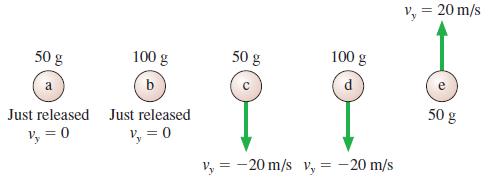
Five balls move through the air as shown in Figure Q6.18. All five have the same size and shape. Air resistance is not negligible. Rank in order, from largest to smallest, the magnitudes of the accelerations aa to ae. Some may be equal. Give your answer in the form a > b = c > d > e and
Bonnie and Clyde are sliding a 300 kg bank safe across the floor to their getaway car. The safe slides with a constant speed if Clyde pushes from behind with 385 N of force while Bonnie pulls forward on a rope with 350 N of force. What is the safe’s coefficient of kinetic friction on the bank
A crate of fragile dishes is in the back of a pickup truck. The truck accelerates north from a stop sign, and the crate moves without slipping. Does the friction force on the crate point north or south? Or is the friction force zero? Explain.
What thrust does a 200 g model rocket need in order to have a vertical acceleration of 10 m/s2a. On earth?b. On the moon, where g = 1.62 m/s2?
Can the friction force on an object ever point in the direction of the object’s motion? If yes, give an example. If no, why not?
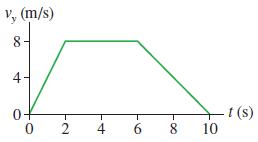
Figure EX 6.15 shows the velocity graph of a 75 kg passenger in an elevator. What is the passenger’s weight at t = 1 s? At 5 s? At 9 s? , (m/s) 8 4 (s) 10 0+ 4 6. 8
A block pushed along the floor with velocity v0x slides a distance d after the pushing force is removed.a. If the mass of the block is doubled but its initial velocity is not changed, what distance does the block slide before stopping?b. If the initial velocity is doubled to 2v0x but the mass is
It takes the elevator in a skyscraper 4.0 s to reach its cruising speed of 10 m/s. A 60 kg passenger gets aboard on the ground floor. What is the passenger’s weighta. Before the elevator starts moving?b. While the elevator is speeding up?c. After the elevator reaches its cruising speed?
Suppose you push a hockey puck of mass m across frictionless ice for a time Δt, starting from rest, giving the puck speed v after traveling distance d. If you repeat the experiment with a puck of mass 2m,a. How long will you have to push for the puck to reach the same speed v?b. How long will you
A woman has a mass of 55 kg.a. What is her weight while standing on earth?b. What are her mass and her weight on Mars, where g = 3.76 m/s2?
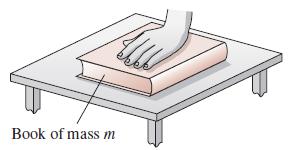
A hand presses down on the book in Figure Q6.13. Is the normal force of the table on the book larger than, smaller than, or equal to mg? Book of mass m
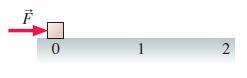
a. The block in Figure EX 6.12 floats on a cushion of air. It is pushed to the right with a force that remains constant as the block moves from 0 to 1. The blockA. Speeds up from 0 to 1.B. Speeds up at first, then has constant speed.C. Moves with constant speed from 0 to 1.b. From 1 to 2, the size
An astronaut orbiting the earth is handed two balls that have identical outward appearances. However, one is hollow while the other is filled with lead. How can the astronaut determine which is which? Cutting or altering the balls is not allowed.
A 50 kg box hangs from a rope. What is the tension in the rope if:a. The box is at rest?b. The box moves up at a steady 5.0 m/s?c. The box has vy = 5.0 m/s and is speeding up at 5.0 m/s2?d. The box has vy = 5.0 m/s and is slowing down at 5.0 m/s2?
A box with a passenger inside is launched straight up into the air by a giant rubber band. Before launch, the passenger stood on a scale and weighed 750 N. Once the box has left the rubber band but is still moving upward, is the passenger’s weight more than 750 N, 750 N, less than 750 N but not
A horizontal rope is tied to a 50 kg box on frictionless ice. What is the tension in the rope if:a. The box is at rest?b. The box moves at a steady 5.0 m/s?c. The box has vx = 5.0 m/s and ax = 5.0 m/s2?
Suppose you attempt to pour out 100 g of salt, using a pan balance for measurements, while in a rocket accelerating upward. Will the quantity of salt be too much, too little, or the correct amount? Explain.
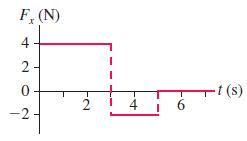
Figure EX 6.9 shows the force acting on a 2.0 kg object as it moves along the x-axis. The object is at rest at the origin at t = 0 s. What are its acceleration and velocity at t = 6 s? F, (N) 4 2 -t (s) 2 -2 4.
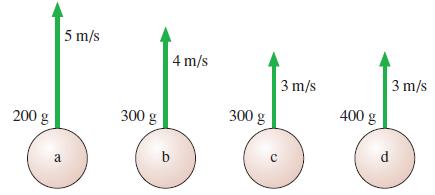
The four balls in Figure Q# 6.9 have been thrown straight up. They have the same size, but different masses. Air resistance is negligible. Rank in order, from largest to smallest, the magnitude of the net force acting on each ball. Some may be equal. Give your answer in the form a > b = c > d
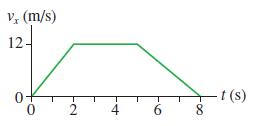
Figure EX 6.8 shows the velocity graph of a 2.0 kg object as it moves along the x-axis. What is the net force acting on this object at t = 1 s? At 4 s? At 7 s? v, (m/s) 12- -(s) 8 0- 2 6. 4.
Are the following statements true or false? Explain.a. The mass of an object depends on its location.b. The weight of an object depends on its location.c. Mass and weight describe the same thing in different units.
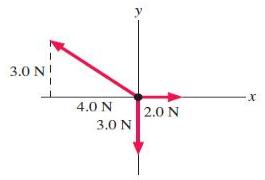
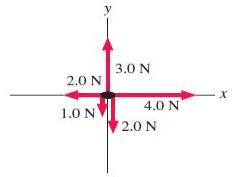
In each of the two free-body diagrams in Figure EX6.6, the forces are acting on a 2.0 kg object. For each diagram, find the values of ax and ay, the x- and y-components of the acceleration.(a)(b) 3.0 N! 4.0 N 2.0 N 3.0 N
An elevator, hanging from a single cable, moves downward and is slowing. Friction and air resistance are negligible. Is the tension in the cable greater than, less than, or equal to the gravitational force on the elevator? Explain. Include a free-body diagram as part of your explanation.
A construction worker with a weight of 850 N stands on a roof that is sloped at 20°. What is the magnitude of the normal force of the roof on the worker?
An elevator, hanging from a single cable, moves upward at constant speed. Friction and air resistance are negligible. Is the tension in the cable greater than, less than, or equal to the gravitational force on the elevator? Explain. Include a free-body diagram as part of your explanation.
If you know all of the forces acting on a moving object, can you tell the direction the object is moving? If yes, explain how. If no, give an example.
A football coach sits on a sled while two of his players build their strength by dragging the sled across the field with ropes. The friction force on the sled is 1000 N and the angle between the two ropes is 20°. How hard must each player pull to drag the coach at a steady 2.0 m/s?
Kat, Matt, and Nat are arguing about why a physics book on a table doesn’t fall. According to Kat, “Gravity pulls down on it, but the table is in the way so it can’t fall.” “Nonsense,” says Matt. “There are all kinds of forces acting on the book, but the upward forces overcome the
A 20 kg loudspeaker is suspended 2.0 m below the ceiling by two 3.0-m-long cables that angle outward at equal angles. What is the tension in the cables?
A ball tossed straight up has v = 0 at its highest point. Is it in equilibrium? Explain.
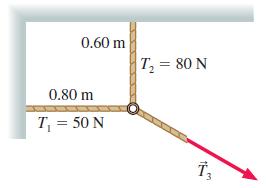
The three ropes in Figure EX 6.2 are tied to a small, very light ring. Two of these ropes are anchored to walls at right angles with the tensions shown in the figure. What are the magnitude and direction of the tension T(vector)3 in the third rope? 0.60 m T = 80 N 0.80 m T = 50 N
Are the objects described here in static equilibrium, dynamic equilibrium, or not in equilibrium at all? Explain.a. A 200 pound barbell is held over your head.b. A girder is lifted at constant speed by a crane.c. A girder is being lowered into place. It is slowing down.d. A jet plane has reached
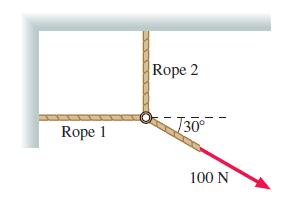
The three ropes in Figure EX6.1 are tied to a small, very light ring. Two of the ropes are anchored to walls at right angles, and the third rope pulls as shown. What are T1 and T2, the magnitudes of the tension forces in the first two ropes? Rope 2 Rope 1 T30° 100 N
An elevator, suspended by a single cable, has just left the tenth floor and is speeding up as it descends toward the ground floor.
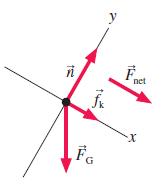
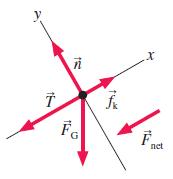
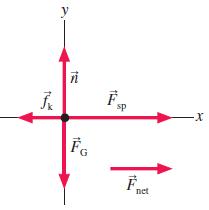
For each:a. Redraw the diagram.b. Identify the direction of the acceleration vector a(vector) and show it as a vector next to your diagram. Or, if appropriate, write a(vector) = 0(vector).c. If possible, identify the direction of the velocity vector v u and show it as a labeled vector.d. Write a
If a car stops suddenly, you feel “thrown forward.” We’d like to understand what happens to the passengers as a car stops. Imagine yourself sitting on a very slippery bench inside a car. This bench has no friction, no seat back, and there’s nothing for you to hold onto.a. Draw a picture and
A rubber ball bounces. We’d like to understand how the ball bounces.a. A rubber ball has been dropped and is bouncing off the floor. Draw a motion diagram of the ball during the brief time interval that it is in contact with the floor. Show 4 or 5 frames as the ball compresses, then another 4 or
A bag of groceries is on the seat of your car as you stop for a stop light. The bag does not slide. Draw a motion diagram, a force identification diagram, and a free-body diagram for the bag.
A heavy box is in the back of a truck. The truck is accelerating to the right. Draw a motion diagram, a force-identification diagram, and a free-body diagram for the box.
The leaf hopper, champion jumper of the insect world, can jump straight up at 4 m/s2. The jump itself lasts a mere 1 ms before the insect is clear of the ground.a. Draw a free-body diagram of this mighty leaper while the jump is taking place.b. While the jump is taking place, is the force of the
A gymnast has just landed on a trampoline. She’s still moving downward as the trampoline stretches.
A person on a bridge throws a rock straight down toward the water. The rock has just been released.
A spring-loaded gun shoots a plastic ball. The trigger has just been pulled and the ball is starting to move down the barrel. The barrel is horizontal.
A Styrofoam ball has just been shot straight up. Air resistance is not negligible.
You’ve just kicked a rock on the sidewalk and it is now sliding along the concrete.
A skier is going down a 20° slope. A horizontal headwind is blowing in the skier’s face. Friction is small, but not zero.
Based on the information in Table 5.1, estimatea. The weight of a laptop computer.b. The propulsion force of a bicycle.Force Approximate magnitude
Based on the information in Table 5.1, estimatea. The weight of a pencil.b. The propulsion force of a sprinter.Force Approximate magnitude (newtons)Weight of a
You’ve slammed on the brakes and your car is skidding to a stop while going down a 20° hill.
A jet plane is speeding down the runway during takeoff. Air resistance is not negligible.
A rocket is being launched straight up. Air resistance is not negligible.
In lab, you propel a cart with four known forces while using an ultrasonic motion detector to measure the cart’s acceleration. Your data are as follows: Force (N)
For each:a. Redraw the diagram.b. Identify the direction of the acceleration vector a(vector) and show it as a vector next to your diagram. Or, if appropriate, write a(vector) = 0(vector).c. If possible, identify the direction of the velocity vector v u and show it as a labeled vector.d. Write a
For each:a. Redraw the diagram.b. Identify the direction of the acceleration vector a(vector) and show it as a vector next to your diagram. Or, if appropriate, write a(vector) = 0(vector).c. If possible, identify the direction of the velocity vector v u and show it as a labeled vector.d. Write a
For each:a. Redraw the diagram.b. Identify the direction of the acceleration vector a(vector) and show it as a vector next to your diagram. Or, if appropriate, write a(vector) = 0(vector).c. If possible, identify the direction of the velocity vector v u and show it as a labeled vector.d. Write a
Is it possible for the friction force on an object to be in the direction of motion? If so, give an example. If not, why not?
You toss a ball straight up in the air. Immediately after you let go of it, what forces are acting on the ball? For each force you name,(a) State whether it is a contact force or a long-range force(b) Identify the agent of the force.
A baseball player is sliding into second base. Identify the forces on the baseball player.
A chandelier hangs from a chain in the middle of a dining room. Identify the forces on the chandelier.
An elevator suspended by a cable is descending at constant velocity. How many force vectors would be shown on a free-body diagram? Name them.
A car is parked on a steep hill. Identify the forces on the car.
A compressed spring is pushing a block across a rough horizontal table. How many force vectors would be shown on a free body diagram? Name them.
A brick is falling from the roof of a three-story building. How many force vectors would be shown on a free-body diagram? Name them.
A jet plane is speeding down the runway during takeoff. Air resistance is not negligible. Identify the forces on the jet.
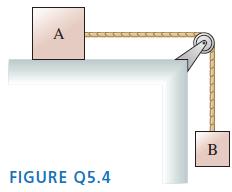
In Figure Q5.4, block B is falling and dragging block A across a table. How many force vectors would be shown on a free-body diagram of block A? Name them. A B FIGURE Q5.4
A bullet has just been shot from a gun and is now traveling horizontally. Air resistance is not negligible. Identify the forces on the bullet.
A constant force applied to A causes A to accelerate at 5 m/s2. The same force applied to B causes an acceleration of 3 m/s2. Applied to C, it causes an acceleration of 8 m/s2.a. Which object has the largest mass? Explain.b. Which object has the smallest mass?c. What is the ratio mA/mB of the mass
Two rubber bands cause an object to accelerate with acceleration a. How many rubber bands are needed to cause an object with half the mass to accelerate three times as quickly?
An object experiencing a constant force accelerates at 10 m/s2. What will the acceleration of this object be ifa. The force is doubled? Explain.b. The mass is doubled?c. The force is doubled and the mass is doubled?
Two rubber bands pulling on an object cause it to accelerate at 1.2 m/s2.a. What will be the object’s acceleration if it is pulled by four rubber bands?b. What will be the acceleration of two of these objects glued together if they are pulled by two rubber bands?
An object experiencing a constant force accelerates at 8 m/s2. What will the acceleration of this object be ifa. The force is halved? Explain.b. The mass is halved?c. The force is halved and the mass is halved?
If an object is at rest, can you conclude that there are no forces acting on it? Explain.
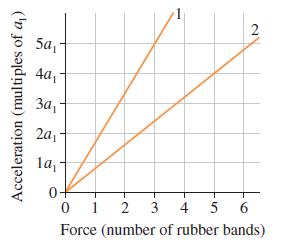
Figure shows acceleration-versus-force graphs for two objects pulled by rubber bands. What is the mass ratio m1/m2? 5a 4a, За, 2a1 la, 0 1 2 3 4 5 6 Force (number of rubber bands) Acceleration (multiples of a,)
If a force is exerted on an object, is it possible for that object to be moving with constant velocity? Explain.
For an object starting from rest and accelerating with constant acceleration, distance traveled is proportional to the square of the time. If an object travels 2.0 furlongs in the first 2.0 s, how far will it travel in the first 4.0 s?
Is the statement “An object always moves in the direction of the net force acting on it” true or false? Explain.
The period of a pendulum is proportional to the square root of its length. A 2.0-m-long pendulum has a period of 3.0 s. What is the period of a 3.0-m-long pendulum?
Newton’s second law says F(vector)net = ma(vector). So is ma(vector) a force? Explain.
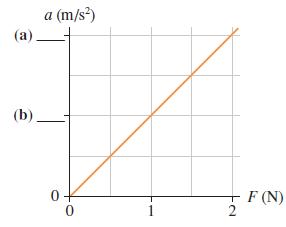
Figure shows an acceleration-versus-force graph for a 500 g object. What acceleration values go in the blanks on the vertical scale? a (m/s?) (b) F (N) 1 2.
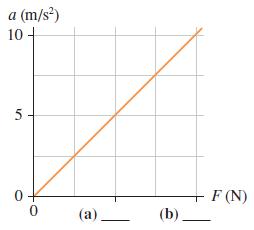
Figure shows an acceleration-versus-force graph for a 200 g object. What force values go in the blanks on the horizontal scale? (m/s) 10 + a 0 - F (N) (a) (b)
Suppose you press your physics book against a wall hard enough to keep it from moving. Does the friction force on the book point(a) Into the wall(b) Out of the wall(c) Up(d) Down(e) Is there no friction force? Explain.
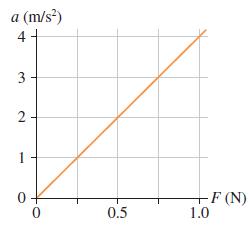
Figure shows an object’s acceleration-versus-force graph. What is the object’s mass? a (m/s?) 4 2- 1 F (N) 1.0 0.5 3.
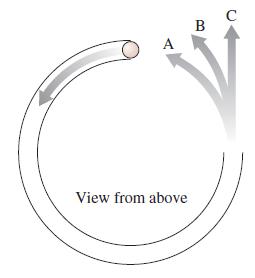
Figure Q5.15 shows a hollow tube forming three-quarters of a circle. It is lying flat on a table. A ball is shot through the tube at high speed. As the ball emerges from the other end, does it follow path A, path B, or path C? Explain. C B A View from above
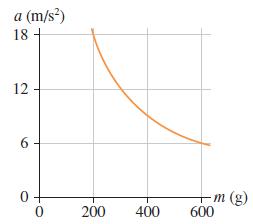
Figure shows the acceleration of objects of different mass that experience the same force. What is the magnitude of the force? a (m/s?) 18 + 12 - 6 m (g) 600 200 400
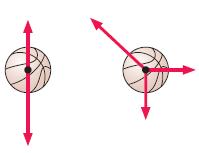
Which, if either, of the basketballs in Figure Q5.16 are in equilibrium? Explain.
Which of the following are inertial reference frames? Explain.a. A car driving at steady speed on a straight and level road.b. A car driving at steady speed up a 10° incline.c. A car speeding up after leaving a stop sign.d. A car driving at steady speed around a curve.
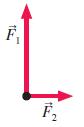
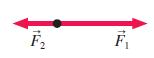
Redraw the diagram, showing all three forces. Label the third force F(vector)3. F2
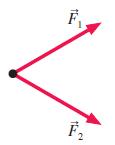
Redraw the diagram, showing all three forces. Label the third force F(vector)3.
Redraw the diagram, showing all three forces. Label the third force F(vector)3.
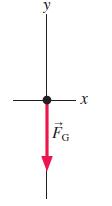
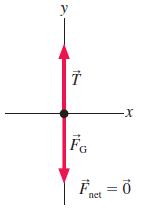
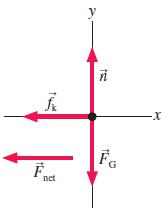
For each:a. Redraw the free-body diagram.b. Write a short description of a real object for which this is the correct free-body diagram. Use Examples 5.4, 5.5, and 5.6 as models of what a description should be like. FG F = 0 net
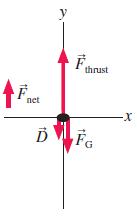
For each:a. Redraw the free-body diagram.b. Write a short description of a real object for which this is the correct free-body diagram. Use Examples 5.4, 5.5, and 5.6 as models of what a description should be like. thrust net FG
For each:a. Redraw the free-body diagram.b. Write a short description of a real object for which this is the correct free-body diagram. Use Examples 5.4, 5.5, and 5.6 as models of what a description should be like. y ri G net
Identify all forces acting on the object and draw a free-body diagram of the object. A cat is sitting on a window sill.
Identify all forces acting on the object and draw a free-body diagram of the object. An ice hockey puck glides across frictionless ice.
Identify all forces acting on the object and draw a free-body diagram of the object. Your physics textbook is sliding across the table.
Identify all forces acting on the object and draw a free-body diagram of the object. A steel beam is being lowered at steady speed by a crane.
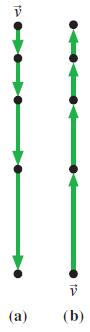
Redraw the two motion diagrams shown in Figure P5.28, then draw a vector beside each one to show the direction of the net force acting on the object. Explain your reasoning. (a) (b)
Showing 4700 - 4800
of 4932
First
36
37
38
39
40
41
42
43
44
45
46
47
48
49
50
Step by Step Answers

 Get 50% OFF
Claim Now
Get 50% OFF
Claim Now