New Semester
Started
Get
50% OFF
Study Help!
--h --m --s
Claim Now
Question Answers
Textbooks
Find textbooks, questions and answers
Oops, something went wrong!
Change your search query and then try again
S
Books
FREE
Study Help
Expert Questions
Accounting
General Management
Mathematics
Finance
Organizational Behaviour
Law
Physics
Operating System
Management Leadership
Sociology
Programming
Marketing
Database
Computer Network
Economics
Textbooks Solutions
Accounting
Managerial Accounting
Management Leadership
Cost Accounting
Statistics
Business Law
Corporate Finance
Finance
Economics
Auditing
Tutors
Online Tutors
Find a Tutor
Hire a Tutor
Become a Tutor
AI Tutor
AI Study Planner
NEW
Sell Books
Search
Search
Sign In
Register
study help
mathematics
calculus early transcendentals 9th
Physics For Scientists And Engineers A Strategic Approach With Modern Physics 3rd Edition Randall D. Knight - Solutions
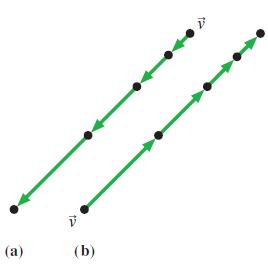
Redraw the two motion diagrams shown in Figure P5.29, then draw a vector beside each one to show the direction of the net force acting on the object. Explain your reasoning. (а) (b)
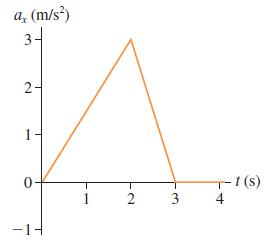
A single force with x-component Fx acts on a 2.0 kg object as it moves along the x-axis. The object’s acceleration graph (ax versus t) is shown in Figure P5.30. Draw a graph of Fx versus t. a, (m/s) 3- 1- (s) 4 2 3 -14 2.
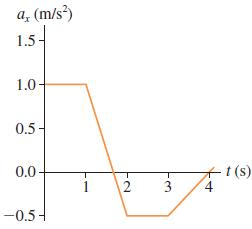
A single force with x-component Fx acts on a 500 g object as it moves along the x-axis. The object’s acceleration graph (ax versus t) is shown in Figure P5.31. Draw a graph of Fx versus t. a, (m/s) 1.5- 1.0 0.5 - 0.0- *t(s) 3 1 -0.5- 4,
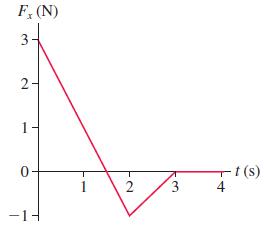
A single force with x-component Fx acts on a 2.0 kg object as it moves along the x-axis. A graph of Fx versus t is shown in Figure P 5.32. Draw an acceleration graph (ax versus t) for this object. F, (N) 2 1 T -t (s) 4 -1 3. 2. 3.
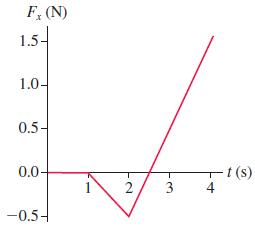
A single force with x-component Fx acts on a 500 g object as it moves along the x-axis. A graph of Fx versus t is shown in Figure P 5.33. Draw an acceleration graph (ax versus t) for this object. F, (N) 1.5- 1.0- 0.5- 0.0- 1 (s) -0.5- 4, 3.
A constant force is applied to an object, causing the object to accelerate at 8.0 m/s2. What will the acceleration be ifa. The force is doubled?b. The object’s mass is doubled?c. The force and the object’s mass are both doubled?d. The force is doubled and the object’s mass is halved?
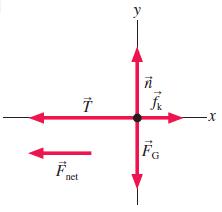
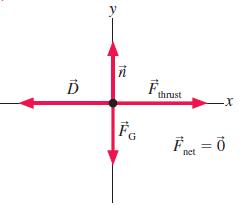
For each:a. Redraw the diagram.b. Identify the direction of the acceleration vector a(vector) and show it as a vector next to your diagram. Or, if appropriate, write a(vector) = 0(vector).c. If possible, identify the direction of the velocity vector v u and show it as a labeled vector.d. Write a
For each:a. Redraw the diagram.b. Identify the direction of the acceleration vector a(vector) and show it as a vector next to your diagram. Or, if appropriate, write a(vector) = 0(vector).c. If possible, identify the direction of the velocity vector v u and show it as a labeled vector.d. Write a
A constant force is applied to an object, causing the object to accelerate at 10 m/s2. What will the acceleration be ifa. The force is halved?b. The object’s mass is halved?c. The force and the object’s mass are both halved?d. The force is halved and the object’s mass is doubled?
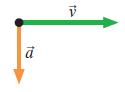
a. At this instant, is the particle (in Figure 4.1 below) speeding up, slowing down, or traveling at constant speed?b. Is this particle curving to the right, curving to the left, or traveling straight?
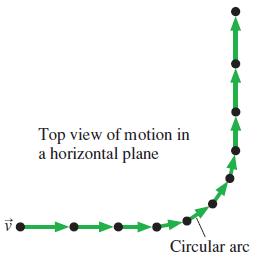
For eacha. Complete the motion diagram by adding acceleration vectors.b. Write a physics problem for which this is the correct motion diagram. Be imaginative! Don’t forget to include enough information to make the problem complete and to state clearly what is to be found. Top view of motion in a
a. At this instant, is the particle (in Figure 4.2 below) speeding up, slowing down, or traveling at constant speed?b. Is this particle curving upward, curving downward, or traveling straight?
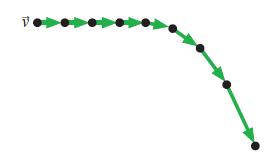
For each:a. Complete the motion diagram by adding acceleration vectors.b. Write a physics problem for which this is the correct motion diagram. Be imaginative! Don’t forget to include enough information to make the problem complete and to state clearly what is to be found.
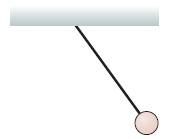
Tarzan swings through the jungle by hanging from a vine.a. Immediately after stepping off a branch to swing over to another tree, is Tarzan’s acceleration a(vector) zero or not zero? If not zero, which way does it point? Explain.b. Answer the same question at the lowest point in Tarzan’s swing.
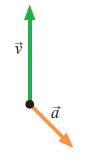
At this instant, the particle is slowing and curving upward. What is the direction of its acceleration? 12
A projectile is launched at an angle of 30°.a. Is there any point on the trajectory where v(vector) and a(vector) are parallel to each other? If so, where?b. Is there any point where v(vector) and a(vector) are perpendicular to each other? If so, where?
At this instant, the particle has steady speed and is curving to the right. What is the direction of its acceleration?
At this instant, the particle is speeding up and curving downward. What is the direction of its acceleration?
A sailboat is traveling east at 5.0m/s. A sudden gust of wind gives the boat an acceleration a(vector) = (0.80m/s2, 40° north of east). What are the boat’s speed and direction 6.0s later when the gust subsides?
A model rocket is launched from rest with an upward acceleration of 6.00 m/s2 and, due to a strong wind, a horizontal acceleration of 1.50 m/s2. How far is the rocket from the launch pad 6.00 s later when the rocket engine runs out of fuel?
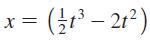
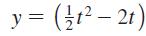
A particle’s trajectory is described byandwhere t is in s.a. What are the particle’s position and speed at t = 0 s and t = 4s?b. What is the particle’s direction of motion, measured as an angle from the x-axis, at t = 0s and t = 4s? x = (}r' – 21?)
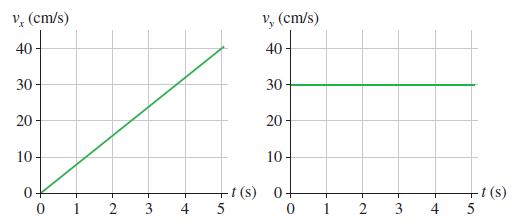
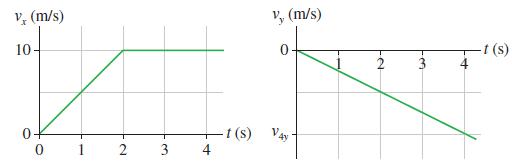
A rocket-powered hockey puck moves on a horizontal frictionless table. Figure EX4.9 shows graphs of vx and vy, the x- and y-components of the puck’s velocity. The puck starts at the origin.a. In which direction is the puck moving at t = 2s? Give your answer as an angle from the x-axis.b. How far
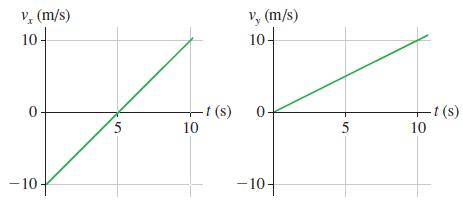
A rocket-powered hockey puck moves on a horizontal frictionless table. Figure EX4.10 shows graphs of vx and vy, the x- and y-components of the puck’s velocity. The puck starts at the origin. What is the magnitude of the puck’s acceleration at t = 5s? v, (m/s) 10- V, (m/s) 10- (s) (s) 10 10 -10+
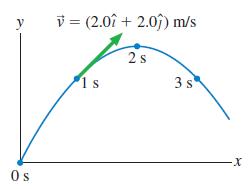
A physics student on Planet Exidor throws a ball, and it follows the parabolic trajectory shown in Figure EX 4.11. The ball’s position is shown at 1s intervals until t = 3 s. At t = 1 s, the ball’s velocity is v(vector) = (2.0î + 2.0ĵ) m/s.a. Determine the ball’s velocity at t = 0 s, 2 s,
Figure Q4.14 shows four rotating wheels. For each, determine the signs (+ or -) of ω and α.a.b.c.d. Speeding up
Figure Q4.15 shows a pendulum at one end point of its arc.a. At this point, is v positive, negative, or zero? Explain.b. At this point, is a positive, negative, or zero? Explain.
A 3.0-cm-diameter crankshaft that is rotating at 2500 rpm comes to a halt in 1.5s.a. What is the tangential acceleration of a point on the surface?b. How many revolutions does the crankshaft make as it stops?
A spaceship maneuvering near Planet Zeta is located at r(vector) = (600î – 400ĵ + 200k̂) × 103km, relative to the planet, and traveling at v(vector) = 9500î m/s. It turns on its thruster engine and accelerates with a(vector) = (40î - 20k̂)m/s2 for 35min. Where is the spaceship
A projectile is fired with an initial speed of 30 m/s at an angle of 60° above the horizontal. The object hits the ground 7.5 s later.a. How much higher or lower is the launch point relative to the point where the projectile hits the ground?b. To what maximum height above the launch point does the
You are playing right field for the baseball team. Your team is up by one run in the bottom of the last inning of the game when a ground ball slips through the infield and comes straight toward you. As you pick up the ball 65m from home plate, you see a runner rounding third base and heading for
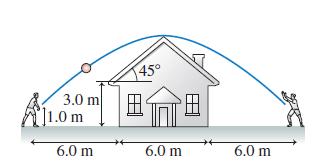
You’re 6.0 m from one wall of the house seen in figure P4.48. You want to toss a ball to your friend who is 6.0m from the opposite wall. The throw and catch each occur 1.0m above the ground.a. What minimum speed will allow the ball to clear the roof?b. At what angle should you toss the ball? 45°
Ships A and B leave port together. For the next two hours, ship A travels at 20 mph in a direction 30° west of north while the ship B travels 20° east of north at 25 mph.a. What is the distance between the two ships two hours after they depart?b. What is the speed of ship A as seen by ship B?
Mike throws a ball upward and toward the east at a 63° angle with a speed of 22 m/s. Nancy drives east past Mike at 30 m/s at the instant he releases the ball.a. What is the ball’s initial angle in Nancy’s reference frame?b. Find and graph the ball’s trajectory as seen by Nancy.
While driving north at 25 m/s during a rainstorm you notice that the rain makes an angle of 38° with the vertical. While driving back home moments later at the same speed but in the opposite direction, you see that the rain is falling straight down. From these observations, determine the speed and
You’ve been assigned the task of using a shaft encoder—a device that measures the angle of a shaft or axle and provides a signal to a computer—to analyze the rotation of an engine crankshaft under certain conditions. The table lists the crankshaft’s angles over a 0.6 s interval.
A typical laboratory centrifuge rotates at 4000 rpm. Test tubes have to be placed into a centrifuge very carefully because of the very large accelerations.a. What is the acceleration at the end of a test tube that is 10 cm from the axis of rotation?b. For comparison, what is the magnitude of the
Astronauts use a centrifuge to simulate the acceleration of a rocket launch. The centrifuge takes 30s to speed up from rest to its top speed of 1 rotation every 1.3 s. The astronaut is strapped into a seat 6.0 m from the axis.a. What is the astronaut’s tangential acceleration during the first
A computer hard disk 8.0 cm in diameter is initially at rest. A small dot is painted on the edge of the disk. The disk accelerates at 600 rad/s2 for 1/2s, then coasts at a steady angular velocity for another 1/2s.a. What is the speed of the dot at t = 1.0s?b. Through how many revolutions has the
a. A turbine spinning with angular velocity ω0 rad/s comes to a halt in T seconds. Find an expression for the angle Δθ through which the turbine turns while stopping.b. A turbine is spinning at 3800 rpm. Friction in the bearings is so low that it takes 10 min to coast to a stop. How many
A high-speed drill rotating ccw at 2400 rpm comes to a halt in 2.5s.a. What is the drill’s angular acceleration?b. How many revolutions does it make as it stops?
Your car tire is rotating at 3.5 rev/s when suddenly you press down hard on the accelerator. After traveling 200 m, the tire’s rotation has increased to 6.0 rev/s. What was the tire’s angular acceleration? Give your answer in rad/s2.
A Ferris wheel of radius R speeds up with angular acceleration a starting from rest. Find an expression for the(a) Velocity(b) Centripetal acceleration of a rider after the Ferris wheel has rotated through angle Δθ.
A 6.0-cm-diameter gear rotates with angular velocity v = (2.0 + 1/2 t2) rad/s, where t is in seconds. At t = 4.0 s, what are:a. The gear’s angular acceleration?b. The tangential acceleration of a tooth on the gear?
On a lonely highway, with no other cars in sight, you decide to measure the angular acceleration of your engine’s crankshaft while braking gently. Having excellent memory, you are able to read the tachometer every 1.0 s and remember seven values long enough to later write them down. The table
A car starts from rest on a curve with a radius of 120 m and accelerates at 1.0 m/s2. Through what angle will the car have traveled when the magnitude of its total acceleration is 2.0 m/s2?
A long string is wrapped around a 6.0-cm-diameter cylinder, initially at rest, that is free to rotate on an axle. The string is then pulled with a constant acceleration of 1.5 m/s2 until 1.0 m of string has been unwound. If the string unwinds without slipping, what is the cylinder’s angular
You are given the equations that are used to solve a problem. For each of these, you are toa. Write a realistic problem for which these are the correct equations. Be sure that the answer your problem requests is consistent with the equations given.b. Finish the solution of the problem, including a
You are given the equations that are used to solve a problem. For each of these, you are toa. Write a realistic problem for which these are the correct equations. Be sure that the answer your problem requests is consistent with the equations given.b. Finish the solution of the problem, including a
You are given the equations that are used to solve a problem. For each of these, you are toa. Write a realistic problem for which these are the correct equations. Be sure that the answer your problem requests is consistent with the equations given.b. Finish the solution of the problem, including a
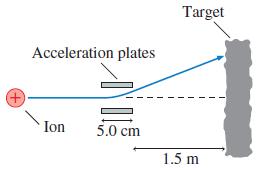
You are asked to consult for the city’s research hospital, where a group of doctors is investigating the bombardment of cancer tumors with high-energy ions. The ions are fired directly toward the center of the tumor at speeds of 5.0 × 10⁶m/s. To cover the entire tumor area, the ions are
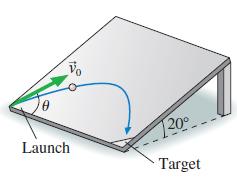
In one contest at the county fair, seen in Figure CP4.78, a spring loaded plunger launches a ball at a speed of 3.0 m/s from one corner of a smooth, flat board that is tilted up at a 20° angle. To win, you must make the ball hit a small target at the adjacent corner, 2.50 m away. At what angle θ
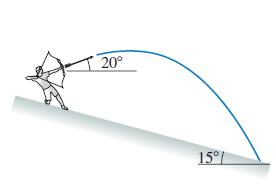
An archer standing on a 15° slope shoots an arrow 20° above the horizontal, as shown in Figure CP4.80. How far down the slope does the arrow hit if it is shot with a speed of 50 m/s from 1.75 m above the ground? 20° 15°
A motorcycle daredevil wants to set a record for jumping over burning school buses. He has hired you to help with the design. He intends to ride off a horizontal platform at 40 m/s, cross the burning buses in a pit below him, then land on a ramp sloping down at 20°. It’s very important that he
A cannon on a train car fires a projectile to the right with speed v0, relative to the train, from a barrel elevated at angle θ. The cannon fires just as the train, which had been cruising to the right along a level track with speed vtrain, begins to accelerate with acceleration a. Find an
A child in danger of drowning in a river is being carried downstream by a current that flows uniformly with a speed of 2.0 m/s. The child is 200 m from the shore and 1500 m upstream of the boat dock from which the rescue team sets out. If their boat speed is 8.0 m/s with respect to the water, at
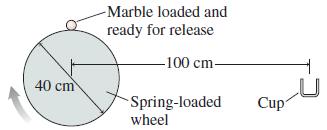
An amusement park game, shown in Figure CP4.86, launches a marble toward a small cup. The marble is placed directly on top of a spring-loaded wheel and held with a clamp. When released, the wheel spins around clockwise at constant angular acceleration, opening the clamp and releasing the marble
A particle starts from rest at r(vector)0 = 9.0 ĵ m and moves in the xy-plane with the velocity shown in Figure P4.36. The particle passes through a wire hoop located at r(vector)1 = 20î m, then continues onward.a. At what time does the particle pass through the hoop?b. What is the value of
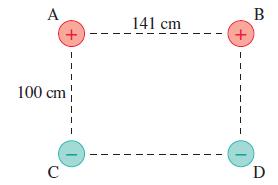
Shows four electric charges located at the corners of a rectangle. Like charges, you will recall, repel each other while opposite charges attract. Charge B exerts a repulsive force (directly away from B) on charge A of 3.0 N. Charge C exerts an attractive force (directly toward C) on charge A of
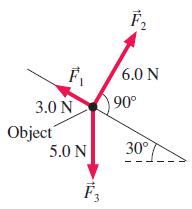
Three forces are exerted on an object placed on a tilted floor in Figure P3.43. The forces are measured in newtons (N). Assuming that forces are vectors,a. What is the component of the net force F(vector)net = F(vector)1 + F(vector)2 + F(vector)3 parallel to the floor?b. What is the component of
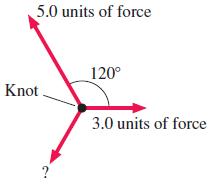
Shows three ropes tied together in a knot. One of your friends pulls on a rope with 3.0 units of force and another pulls on a second rope with 5.0 units of force. How hard and in what direction must you pull on the third rope to keep the knot from moving? 5.0 units of force 120° Knot. 3.0 units of
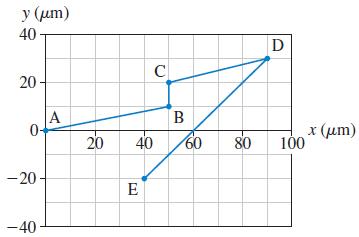
The bacterium E. coli is a single-cell organism that lives in the gut of healthy animals, including humans. When grown in a uniform medium in the laboratory, these bacteria swim along zigzag paths at a constant speed of 20 μm/s. Figure P3.40 shows the trajectory of an E. coli as it moves from
A jet plane is flying horizontally with a speed of 500 m/s over a hill that slopes upward with a 3% grade (i.e., the “rise” is 3% of the “run”). What is the component of the plane’s velocity perpendicular to the ground?
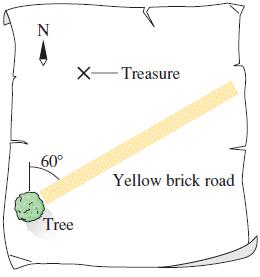
The treasure map in Figure P3.38 gives the following directions to the buried treasure: “Start at the old oak tree, walk due north for 500 paces, then due east for 100 paces. Dig.” But when you arrive, you find an angry dragon just north of the tree. To avoid the dragon, you set off along the
A field mouse trying to escape a hawk runs east for 5.0 m, darts southeast for 3.0 m, then drops 1.0 m straight down a hole into its burrow. What is the magnitude of its net displacement?
Jim’s dog Sparky runs 50 m northeast to a tree, then 70 m west to a second tree, and finally 20 m south to a third tree.a. Draw a picture and establish a coordinate system.b. Calculate Sparky’s net displacement in component form.c. Calculate Sparky’s net displacement as a magnitude and an
Bob walks 200 m south, then jogs 400 m southwest, then walks 200 m in a direction 30° east of north.a. Draw an accurate graphical representation of Bob’s motion. Use a ruler and a protractor!b. Use either trigonometry or components to find the displacement that will return Bob to his starting
While vacationing in the mountains you do some hiking. In the morning, your displacement is S(vector)morning = (2000 m, east) + (3000 m, north) + (200 m, vertical). After lunch, your displacement is S(vector)afternoon = (1500 m, west) + (2000 m, north) – (300 m, vertical).a. At the end of the
Carlos runs with velocity v(vector) = (5.0 m/s, 25° north of east) for 10 minutes. How far to the north of his starting position does Carlos end up?
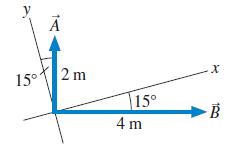
Shows vectors A(vector) and B(vector). Find D(vector) = 2A(vector) + B(vector). Write your answer in component form. 15° o2 m 15° 4 m
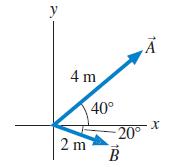
Shows vectors A(vector) and B(vector). Find vector C(vector) such that A(vector) + B(vector) + C(vector) = 0(vector) . Write your answer in component form. y 4 m 40° 20 2 m B
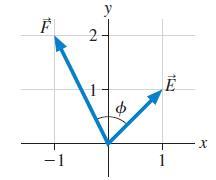
a. What is the angle Φ between vectors E(vector) and F(vector) in Figure P3.24?b. Use geometry and trigonometry to determine the magnitude and direction of G(vector) = E(vector) + F(vector).c. Use components to determine the magnitude and direction of G(vector) = E(vector) + F(vector). -1 1
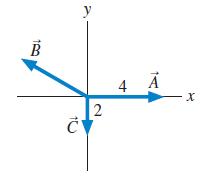
For the three vectors shown in Figure P3.23, A(vector) + B(vector) + C(vector) = 1ĵ. What is vector B(vector)?a. Write B(vector) in component form.b. Write B(vector) as a magnitude and a direction. y 4 A 2
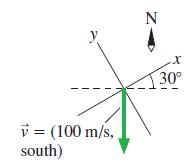
What are the x- and y-components of the velocity vector shown in N 30° v = (100 m/s, south)
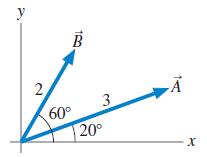
Shows vectors A(vector) and B(vector). Let C(vector) = A(vector) + B(vector).a. Reproduce the figure on your page as accurately as possible, using a ruler and protractor. Draw vector C(vector) on your figure, using the graphical addition of A(vector) and B(vector). Then determine the magnitude and
The position of a particle as a function of time is given by r(vector) = (5.0î + 4.0ĵ)t2 m, where t is in seconds.a. What is the particle’s distance from the origin at t = 0, 2, and 5 s?b. Find an expression for the particle’s velocity v(vector) as a function of time.c. What is the
Let E(vector) = 2î + 3ĵ and F(vector) = 2î - 2ĵ. Find the magnitude ofa. E(vector) and F(vector)b. E(vector) + F(vector)c. -E(vector) - 2F(vector)
Let A(vector) = (3.0 m, 20° south of east), B(vector) = (2.0 m, north), and C(vector) = (5.0 m, 70° south of west).a. Draw and label A(vector), B(vector), and C(vector) with their tails at the origin. Use a coordinate system with the x-axis to the east.b. Write A(vector), B(vector), and C(vector)
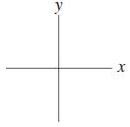
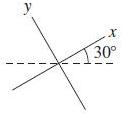
Let B(vector) = (5.0 m, 60° counter clockwise from vertical). Find the x- and y-components of B(vector) in each of the two coordinate systems shown in(a)(b) y
Let A(vector) = 4î – 2ĵ, B(vector) = –3î + 5ĵ, and E(vector) = A(vector) + 4B(vector).a. Write vector F(vector) in component form.b. Draw a coordinate system and on it show vectors A(vector), B(vector), and F(vector).c. What are the magnitude and direction of vector F(vector)?
Let A(vector) = 4î – 2ĵ, B(vector) = –3î + 5ĵ, and E(vector) = 4A(vector) + 2B(vector).a. Write vector E(vector) in component form.b. Draw a coordinate system and on it show vectors A(vector), B(vector), and E(vector).c. What are the magnitude and direction of vector E(vector)?
Let A(vector) = 4î – 2ĵ, B(vector) = –3î + 5ĵ, and D(vector) = A(vector) – B(vector).a. Write vector D(vector) in component form.b. Draw a coordinate system and on it show vectors A(vector), B(vector), and D(vector).c. What are the magnitude and direction of vector D(vector)?
Let A(vector) = 4î - 2ĵ, B(vector) = -3in + 5ĵ, and C(vector) = A(vector) + B(vector).a. Write vector C(vector) in component form.b. Draw a coordinate system and on it show vectors A(vector), B(vector), and C(vector).c. What are the magnitude and direction of vector C(vector)?
Let A(vector) = 2î + 3ĵ and Bu = 4î - 2ĵ.a. Draw a coordinate system and on it show vectors A(vector) and B(vector).b. Use graphical vector subtraction to find C(vector) = A(vector) - B(vector).
Draw each of the following vectors, label an angle that specifies the vector’s direction, then find the vector’s magnitude and direction.a. A(vector) = 4î - 6ĵb. r(vector) = (50î + 80ĵ) mc. v(vector) = (-20î + 40ĵ) m/sd. a(vector) = (2.0î - 6.0ĵ) m/s2
Draw each of the following vectors, label an angle that specifies the vector’s direction, then find its magnitude and direction.a. B(vector) = -4î + 4ĵb. r(vector) = (-2.0î - 1.0ĵ) cmc. v(vector) = (-10î - 100ĵ) m/sd. a(vector) = (20î + 10ĵ) m/s2
The magnetic field inside an instrument is B(vector) = (2.0î – 1.0ĵ) T where B(vector) represents the magnetic field vector and T stands for tesla, the unit of the magnetic field. What are the magnitude and direction of the magnetic field?
Let C(vector) = (3.15 m, 15° above the negative x-axis) and D(vector) = (25.6 m, 30° to the right of the negative y-axis). Find the magnitude, the x component, and the y-component of each vector.
Draw each of the following vectors, then find its x- and y-components.a. v(vector) = (10 m/s, negative y-direction)b. a(vector) = (20 m/s2, 30° below positive x-axis)c. F(vector) = (100 N, 36.9° counterclockwise from positive y-axis)
Draw each of the following vectors, then find its x- and y-components.a. r(vector) = (100 m, 45° below positive x-axis)b. v(vector) = (300 m/s, 20° above positive x-axis)c. a(vector) = (5.0 m/s2, negative y-direction)
A position vector in the first quadrant has an x-component of 8 m and a magnitude of 10 m. What is the value of its y component?
How would you define the zero vector 0(vector)?
A velocity vector 40º below the positive x-axis has a y-component of -10 m/s. What is the value of its x-component?
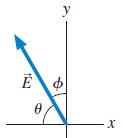
a. What are the x- and y-components of vector E(vector) shown in Figure EX3.3 in terms of the angle u and the magnitude E?b. For the same vector, what are the x- and y-components in terms of the angle f and the magnitude E? y
If C(vector) = A(vector) + B(vector), can C = 0? Can C < 0? For each, show how or explain why not.
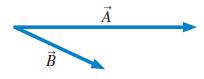
Trace the vectors in Figure EX3.2 onto your paper. Then find(a) A(vector) + B(vector)(b) A(vector) – B(vector)
If C(vector) = A(vector) + B(vector), can C = A + B? Can C > A + B? For each, show how or explain why not.
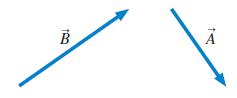
Trace the vectors in Figure EX3.1 onto your paper. Then find(a) A(vector) + B(vector)(b) A(vector) – B(vector)
Your school science club has devised a special event for homecoming. You’ve attached a rocket to the rear of a small car that has been decorated in the blue-and-gold school colors. The rocket provides a constant acceleration for 9.0 s. As the rocket shuts off, a parachute opens and slows the car
Your engineering firm has been asked to determine the deceleration of a car during hard braking. To do so, you decide to measure the lengths of the skid marks when stopping from various initial speeds. Your data are as follows:Speed (m/s)
Jill has just gotten out of her car in the grocery store parking lot. The parking lot is on a hill and is tilted 3°. Twenty meters downhill from Jill, a little old lady lets go of a fully loaded shopping cart. The cart, with frictionless wheels, starts to roll straight downhill. Jill immediately
Showing 4800 - 4900
of 4932
First
36
37
38
39
40
41
42
43
44
45
46
47
48
49
50
Step by Step Answers

 Get 50% OFF
Claim Now
Get 50% OFF
Claim Now