New Semester
Started
Get
50% OFF
Study Help!
--h --m --s
Claim Now
Question Answers
Textbooks
Find textbooks, questions and answers
Oops, something went wrong!
Change your search query and then try again
S
Books
FREE
Study Help
Expert Questions
Accounting
General Management
Mathematics
Finance
Organizational Behaviour
Law
Physics
Operating System
Management Leadership
Sociology
Programming
Marketing
Database
Computer Network
Economics
Textbooks Solutions
Accounting
Managerial Accounting
Management Leadership
Cost Accounting
Statistics
Business Law
Corporate Finance
Finance
Economics
Auditing
Tutors
Online Tutors
Find a Tutor
Hire a Tutor
Become a Tutor
AI Tutor
AI Study Planner
NEW
Sell Books
Search
Search
Sign In
Register
study help
mathematics
calculus early transcendentals 9th
Physics For Scientists And Engineers A Strategic Approach With Modern Physics 3rd Edition Randall D. Knight - Solutions
An electron orbits in a 5.0 mT field with angular momentum 8.0 × 10⁻²⁶ kg m2/s. What is the diameter of the orbit?
In the semiclassical Bohr model of the hydrogen atom, the electron moves in a circular orbit of radius 5.3 × 10⁻¹¹ m with speed 2.2 × 10⁶ m/s. According to this model, what is the magnetic field at the center of a hydrogen atom?
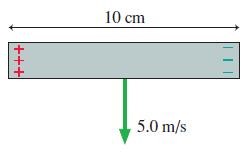
A potential difference of 0.050 V is developed across the 10-cm-long wire of Figure EX 33.2 as it moves through a magnetic field perpendicular to the page. What are the strength and direction (in or out) of the magnetic field? 10 cm 5.0 m/s +++
A 50-turn, 4.0-cm-diameter coil with R = 0.50 Ω surrounds a 2.0-cm-diameter solenoid. The solenoid is 20 cm long and has 200 turns. The 60 Hz current through the solenoid is Isol = (0.50 A)sin(2πft). Find an expression for Icoil, the induced current in the coil as a function of time.
A loop antenna, such as is used on older televisions to pick up UHF broadcasts, is 25 cm in diameter. The plane of the loop is perpendicular to the oscillating magnetic field of a 150 MHz electromagnetic wave. The magnetic field through the loop is B = (20 nT)sin ωt.a. What is the maximum emf
A 4.0-cm-long slide wire moves outward with a speed of 100 m/s in a 1.0 T magnetic field. (See Figure 33.26.) At the instant the circuit forms a 4.0 cm × 4.0 cm square, with R = 0.010 Ω on each side, what area. The induced emf?b. The induced current?c. The potential difference between the two
One way to determine a magnetic field strength is to measure the emf induced in a rotating coil. To calibrate a large magnet in your laboratory, you attach a 2.0-cm-diameter, 100-turn coil to the end of a motor-driven shaft, place the coil between the pole tips of the magnet, and rotate it at
A slide wire of length l, mass m, and resistance R slides down a U-shaped metal track that is tilted upward at angle θ. The track has zero resistance and no friction. A vertical magnetic field B fills the loop formed by the track and the slide wire.a. Find an expression for the induced current I
a. What is the magnetic energy density at the center of a 4.0-cm-diameter loop carrying a current of 1.0 A?b. What current in a straight wire gives the magnetic energy density you found in part a at a point 2.0 cm from the wire?
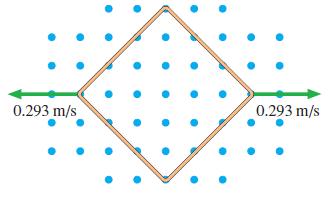
A closed, square loop is formed with 40 cm of wire having R = 0.10 Ω, as shown in Figure CP 33.81. A 0.50 T magnetic field is perpendicular to the loop. At t = 0 s, two diagonally opposite corners of the loop begin to move apart at 0.293 m/s.a. How long does it take the loop to collapse to a
Show that the quantity ε0(dΦe/dt) has units of current.
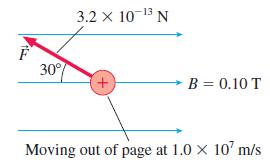
What are the electric field strength and direction at the position of the proton in Figure P 34.29? 3.2 x 10⁻¹³ N 30 B = 0.10 T Moving out of page at 1.0 x 10' m/s
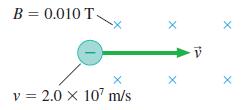
What electric field strength and direction will allow the electron in Figure P 34.30 to pass through this region of space without being deflected? B = 0.010 T. v = 2.0 X 10⁷ m/s
A very long, 1.0-mm-diameter wire carries a 2.5 A current from left to right. Thin plastic insulation on the wire is positively charged with linear charge density 2.5 nC/cm. A mosquito 1.0 cm from the center of the wire would like to move in such a way as to experience an electric field but no
A laser beam passes through a converging lens with a focal length f. At what distance past the lens has the laser beam’s(a) Intensity(b) Electric field strength increased by a factor of 4?
An electron travels with v(vector) = 5.0 × 10⁶ in m/s through a point in space where B(vector) = 0.10 ĵ T. The force on the electron at this point is F(vector) = (9.6 × 10⁻¹⁴ î – 9.6 × 10⁻¹⁴ k̂) N. What is the electric field?
A 4.0-cm-diameter parallel-plate capacitor with a 1.0 mm spacing is charged to 1000 V. A switch closes at t = 0 s, and the capacitor is discharged through a wire with 0.20 Ω resistance.a. Find an expression for the magnetic field strength inside the capacitor at r = 1.0 cm as a function of time.b.
A capacitor is connected to a 15 kHz oscillator. The peak current is 65 mA when the rms voltage is 6.0 V. What is the value of the capacitance C?
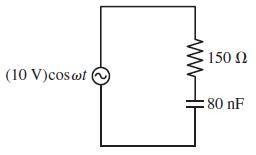
What are VR and VC if the emf frequency in Figure EX 35.15 is 10 kHz? 150 N (10 V)coswt :80 nF
A high-pass filter consists of a 1.59 μ F capacitor in series with a 100 Ω resistor. The circuit is driven by an AC source with a peak voltage of 5.00 V.a. What is the crossover frequency fc?b. What is VR when f = 1/2 fc, fc, and 2fc?
A 500 μH inductor is connected across an AC generator that produces a peak voltage of 5.0 V.a. At what frequency f is the peak current 50 mA?b. What is the instantaneous value of the emf at the instant when iL = IL?
What inductor in series with a 100 Ω resistor and a 2.5 μF capacitor will give a resonance frequency of 1000 Hz?
When two capacitors are connected in parallel across a 10.0 V rms, 1.00 kHz oscillator, the oscillator supplies a total rms current of 545 mA. When the same two capacitors are connected to the oscillator in series, the oscillator supplies an rms current of 126 mA. What are the values of the two
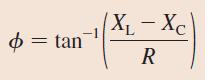
Show that Equation 35.27 for the phase angle f of a series RLC circuit gives the correct result for a capacitor-only circuit. X- Xc $ = tan R
A series RLC circuit consists of a 100 Ω resistor, a 0.15 H inductor, and a 30 μF capacitor. It is attached to a 120 V/60 Hz power line. What are(a) The emf εrms(b) The phase angle Φ(c) The average power loss?
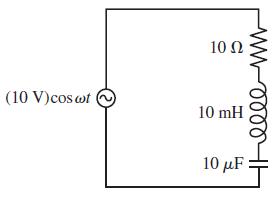
For the circuit of Figure P 35.50,a. What is the resonance frequency, in both rad/s and Hz?b. Find VR and VL at resonance.c. How can VL be larger than ε0? Explain. 10 Ω (10 V)cos ot 10 mH 10 μF
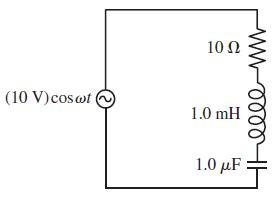
For the circuit of Figure P 35.51a. What is the resonance frequency, in both rad/s and Hz?b. Find VR and VC at resonance.c. How can VC be larger than ε0? Explain. 10 Ω (10 V)cosot 1.0 mH 1.0 μF
A series RLC circuit consists of a 100 Ω resistor, a 10 mH inductor, and a 1.0 nF capacitor. It is connected to an oscillator with an rms voltage of 10 V. What is the power supplied to the circuit if(a) ω = 1/2 ω0?(b) ω = ω0?(c) ω = 2ω0?
A sprinter crosses the finish line of a race. The roar of the crowd in front approaches her at a speed of 360 m/s. The roar from the crowd behind her approaches at 330 m/s. What are the speed of sound and the speed of the sprinter?
A positron moving in the positive x-direction at 2.0 × 10⁸ m/s collides with an electron at rest. The positron and electron annihilate, producing two gamma-ray photons. Photon 1 travels in the positive x-direction and photon 2 travels in the negative x-direction. What is the speed of each photon?
Jose is looking to the east. Lightning bolt 1 strikes a tree 300 m from him. Lightning bolt 2 strikes a barn 900 m from him in the same direction. Jose sees the tree strike 1.0 μs before he sees the barn strike. According to Jose, were the lightning strikes simultaneous? If not, which occurred
a. How fast must a rocket travel on a journey to and from a distant star so that the astronauts age 10 years while the Mission Control workers on earth age 120 years?b. As measured by Mission Control, how far away is the distant star?
Jill claims that her new rocket is 100 m long. As she flies past your house, you measure the rocket’s length and find that it is only 80 m. Should Jill be cited for exceeding the 0.5c speed limit?
At what speed is a particle’s momentum twice its Newtonian value?
What is the speed of a particle whose momentum is mc?
What are the kinetic energy, the rest energy, and the total energy of a 1.0 g particle with a speed of 0.8c?
How fast must an electron move so that its total energy is 10% more than its rest mass energy?
At what speed is a particle’s kinetic energy twice its rest energy?
At what speed is a particle’s total energy twice its rest energy?
A 50 g ball moving to the right at 4.0 m/s overtakes and collides with a 100 g ball moving to the right at 2.0 m/s. The collision is perfectly elastic. Use reference frames and the Chapter 10 result for perfectly elastic collisions to find the speed and direction of each ball after the collision.
A billiard ball has a perfectly elastic collision with a second billiard ball of equal mass. Afterward, the first ball moves to the left at 2.0 m/s and the second to the right at 4.0 m/s. Use reference frames and the Chapter 10 result for perfectly elastic collisions to find the speed and direction
In Section 36.6 we saw that muons can reach the ground because of time dilation. But how do things appear in the muon’s reference frame, where the muon’s half-life is only 1.5 μs? How can a muon travel the 60 km to reach the earth’s surface before decaying? Resolve this apparent paradox. Be
What is the speed of a proton after being accelerated from rest through a 50 × 106 V potential difference?
A solar flare blowing out from the sun at 0.9c is overtaking a rocket as it flies away from the sun at 0.8c. According to the crew on board, with what speed is the flare gaining on the rocket?
What is the momentum of a particle whose total energy is four times its rest energy? Give your answer as a multiple of mc.
At what speed is the kinetic energy of a particle twice its Newtonian value?
The sun radiates energy at the rate 3.8 × 1026 W. The source of this energy is fusion, a nuclear reaction in which mass is transformed into energy. The mass of the sun is 2.0 × 1030 kg.a. How much mass does the sun lose each year?b. What percent is this of the sun’s total mass?c. Estimate the
An oil droplet with 15 excess electrons is observed between two parallel electrodes spaced 12 mm apart. The droplet hangs motionless if the upper electrode is 25 V more positive than the lower electrode. The density of the oil is 860 kg/m3. What is the radius of the droplet?
Determine:a. The speed of a 300 eV electron.b. The speed of a 3.5 MeV H+ ion.c. The specific type of particle that has 2.09 MeV of kinetic energy when moving with a speed of 1.0 × 10⁷ m/s.
Determine:a. The speed of a 7.0 MeV neutron.b. The speed of a 15 MeV helium atom.c. The specific type of particle that has 1.14 keV of kinetic energy when moving with a speed of 2.0 × 10⁷ m/s.
How many electrons, protons, and neutrons are contained in the following atoms or ions:(a) 6Li(b) 16O+(c) 13N++?
Write the symbol for an atom or ion with:a. One electron, one proton, and two neutrons.b. Seven electrons, eight protons, and ten neutrons.
An electron in a cathode-ray beam passes between 2.5-cm long parallel-plate electrodes that are 5.0 mm apart. A 1.0 mT, 2.5-cm-wide magnetic field is perpendicular to the electric field between the plates. If the potential difference between the plates is 150 V, the electron passes through the
The charge-to-mass ratio of a nucleus, in units of e/u, is q/m = Z/A. For example, a hydrogen nucleus has q/m = 1/1 = 1.a. Make a graph of charge-to-mass ratio versus proton number Z for nuclei with Z = 5, 10, 15, 20, . . ., 90. For A, use the average atomic mass shown on the periodic table of
If the nucleus is a few fm in diameter, the distance between the centers of two protons must be ≈ 2 fm.a. Calculate the repulsive electric force between two protons that are 2.0 fm apart.b. Calculate the attractive gravitational force between two protons that are 2.0 fm apart. Could gravity be
A proton is shot straight outward from the surface of a 1.0-mm-diameter glass bead that has been charged to 0.20 nC. If the proton is launched with 520 eV of kinetic energy, what is its kinetic energy, in eV, when it is 2.0 mm from the surface?
Which metals in Table 38.1 exhibit the photoelectric effect for (a) Light with λ = 400 nm(b) Light with λ = 250 nm?Element...........................E0
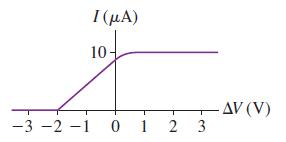
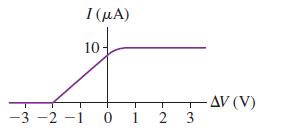
Figure Q 38.5 is the current-versus-potential-difference graph for a photoelectric-effect experiment with an unknown metal. If classical physics provided the correct description of the photoelectric effect, how would the graph look if:a. The light was replaced by an equally intense light with a
You need to design a photodetector that can respond to the entire range of visible light. What is the maximum possible work function of the cathode?
An electron and a proton are each accelerated from rest through a potential difference of 100 V. Afterward, which particle has the larger de Broglie wavelength? Explain.
Imagine that the horizontal box of Figure 38.15 is instead oriented vertically. Also imagine the box to be on a neutron star where the gravitational field is so strong that the particle in the box slows significantly, nearly stopping, before it hits the top of the box. Make a qualitative sketch of
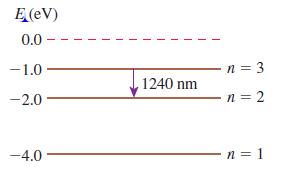
Figure Q 38.12 shows the energy-level diagram of Element X.Figure Q 38.12a. What is the ionization energy of Element X?b. An atom in the ground state absorbs a photon, then emits a photon with a wavelength of 1240 nm. What conclusion can you draw about the energy of the photon that was absorbed?c.
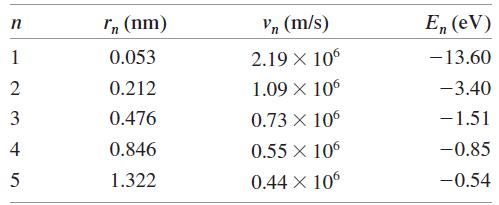
a. Calculate the de Broglie wavelength of the electron in the n = 1, 2, and 3 states of the hydrogen atom. Use the information in Table 38.2.b. Show numerically that the circumference of the orbit for each of these stationary states is exactly equal to n de Broglie wavelengths.c. Sketch the de
Show, by calculation, that the first three states of the hydrogen atom have angular momenta h, 2h, and 3h, respectively.
Is a spectral line with wavelength 656.5 nm seen in the absorption spectrum of hydrogen atoms? Why or why not?
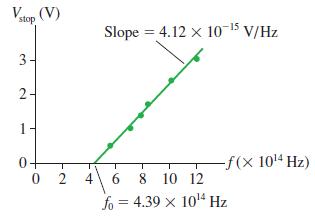
In a photoelectric-effect experiment, the stopping potential at a wavelength of 400 nm is 25.7% of the stopping potential at a wavelength of 300 nm. Of what metal is the cathode made?
A metal cathode whose work function is 3.3 eV is illuminated with 15 μW of light having a wavelength of 300 nm. The efficiency of converting photons to photoelectrons is 12%. What current is measured in the experiment?
The relationship between momentum and energy from Einstein’s theory of relativity is E2 - (pc)2 = E02, where, in this context, E0 = mc2 is the rest energy rather than the work function.a. A photon is a massless particle. What is a photon’s momentum p in terms of its energy E?b. Einstein also
A red blood cell is a 7.0–μm–diameter, 2.0–μm–thick disk with a density of 1100 kg/m3. What is the de Broglie wavelength of a red blood cell moving through a capillary at 4.0 mm/s? Do we need to be concerned with the wave nature of blood cells when describing the flow of blood?
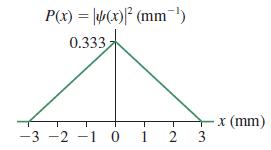
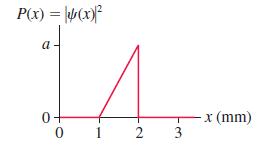
Figure EX 39.11 shows the probability density for an electron that has passed through an experimental apparatus. If 1.0 × 10⁶ electrons are used, what is the expected number that will land in a 0.010-mm-wide strip at(a) x = 0.000 mm(b) 2.000 mm? P(x) = \4(x)|* (mm¯) 0.333 x(mm) -3 -2 -1 0 i 2 3
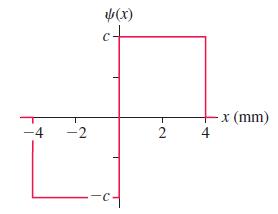
Figure EX 39.17 shows the wave function of a neutron.a. What is the value of c?b. Draw a graph of |ψ(x)|2.c. What is the probability that the neutron is located between x = – 1.0 mm and x = 1.0 mm? (x) c+ x (mm) 4 -4 -2 2.
A radar antenna broadcasts electromagnetic waves with a period of 0.100 ns. What range of frequencies would need to be superimposed to create a 1.0-ns-long radar pulse?
Consider a single-slit diffraction experiment using electrons. (Single-slit diffraction was described in Section 22.4.) Using Figure 39.5 as a model, drawa. A dot picture showing the arrival positions of the first 40 or 50 electrons.b. A graph of |ψ(x)|2 for the electrons on the detection
In an experiment with 10,000 electrons, which land symmetrically on both sides of x = 0 cm, 5000 are detected in the range -1.0 cm ≤ x ≤ +1.0 cm, 7500 are detected in the range -2.0 cm ≤ x ≤ +2.0 cm, and all 10,000 are detected in the range -3.0 cm ≤ x ≤ +3.0 cm. Draw a graph of a
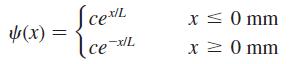
A particle is described by the wave functionwhere L = 2.0 mm.a. Sketch graphs of both the wave function and the probability density as functions of x.b. Determine the normalization constant c.c. Calculate the probability of finding the particle within 1.0 mm of the origin.d. Interpret your answer
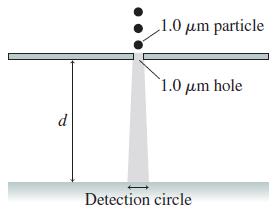
Figure CP 39.47 shows 1.0-μm-diameter dust particles (m = 1.0 × 10⁻¹⁵ kg) in a vacuum chamber. The dust particles are released from rest above a 1.0-mm-diameter hole, fall through the hole (there’s just barely room for the particles to go through), and land on a detector at distance d below.a.
a. Sketch graphs of the probability density |ψ(x)|2 for the four states in the finite potential well of Figure 40.14a. Stack them vertically, similar to the Figure 40.14a graphs of ψ(x).b. What is the probability that a particle in the n = 2 state of the finite potential well will be found at the
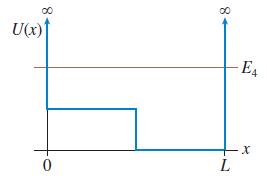
Sketch the n = 4 wave function for the potential energy shown in Figure EX 40.11. U(x) E4 L 8.
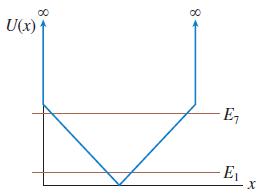
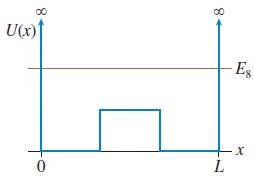
Sketch the n = 8 wave function for the potential energy shown in Figure EX 40.12. U(x) Es
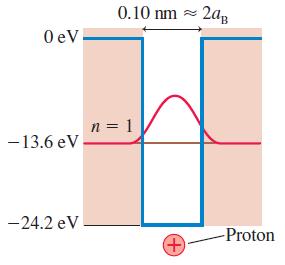
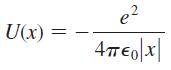
Figure 40.27a modeled a hydrogen atom as a finite potential well with rectangular edges. A more realistic model of a hydrogen atom, although still a one-dimensional model, would be the electron + proton electrostatic potential energy in one dimension:a. Draw a graph of U(x) versus x. Center your
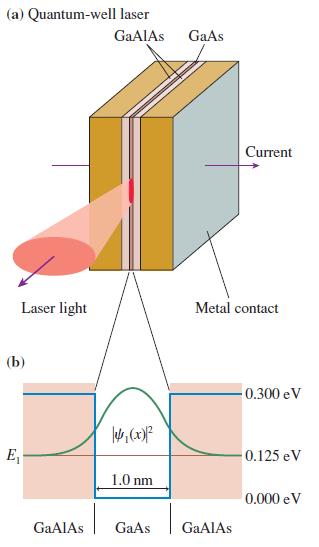
For the quantum-well laser of Figure 40.16, estimate the probability that an electron will be found within one of the GaAIAs layers rather than in the GaAs layer. Explain your reasoning. (a) Quantum-well laser GAAIAS GaAs Current Laser light Metal contact (b) 0.300 eV E, 0.125 eV 1.0 nm 0.000 eV
Consider the two hydrogen-atom states 5d and 4f. Which has the higher energy? Explain.
What is the angular momentum of a hydrogen atom in(a) A 6s state(b) A 4f state? Give your answers as a multiple of h.
What is the difference between the probability density and the radial probability density?
List the quantum numbers, excluding spin, of(a) All possible 3p states(b) All possible 3d states.
What is the difference between l and L?
A hydrogen atom has orbital angular momentum 3.65 × 10⁻³⁴ J s.a. What letter (s, p, d, or f) describes the electron?b. What is the atom’s minimum possible energy? Explain.
What is the difference between s and S?
What is the maximum possible angular momentum L (as a multiple of h) of a hydrogen atom with energy -0.544 eV?
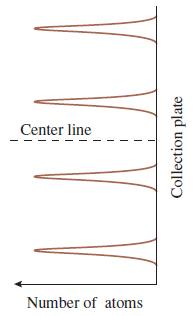
Figure Q41.5 shows the outcome of a Stern-Gerlach experiment with atoms of element X.a. Do the peaks represent different values of the atom’s total angular momentum or different values of the z-component of its angular momentum? Explain.b. What angular momentum quantum numbers characterize these
What are E and L (as a multiple of h) of a hydrogen atom in the 6f state?
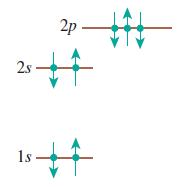
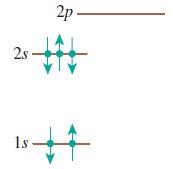
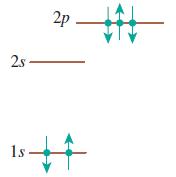
Does each of the configurations in Figure Q 41.6 represent a possible electron configuration of an element? If so, (i) identify the element and (ii) determine whether this is the ground state or an excited state. If not, why not?(a)(b)(c) 2p - %23 2s- %2. 1s
When all quantum numbers are considered, how many different quantum states are there for a hydrogen atom with n = 1? With n = 2 With n = 3? List the quantum numbers of each state.
What is an atom’s ionization energy? In other words, if you know the ionization energy of an atom, what is it that you know about the atom?
How many lines of atoms would you expect to see on the collector plate of a Stern-Gerlach apparatus if the experiment is done with(a) Lithium(b) Beryllium? Explain.
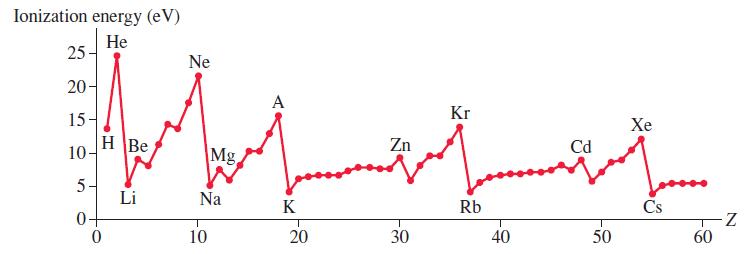
Figure 41.23 shows that the ionization energy of cadmium (Z = 48) is larger than that of its neighbors. Why is this? Ionization energy (eV) Не 25 Ne 20- A Kr Хе 15 Zn Cd HBe 10- Mg Li Na Rb Cs K z- 60 20 40 50 10 30
Predict the ground-state electron configurations of Mg, Sr, and Ba.
A neon discharge tube emits a bright reddish-orange spectrum, but a glass tube filled with neon is completely transparent. Why doesn’t the neon in the tube absorb orange and red wavelengths?
Predict the ground-state electron configurations of Al, Ga, and In.
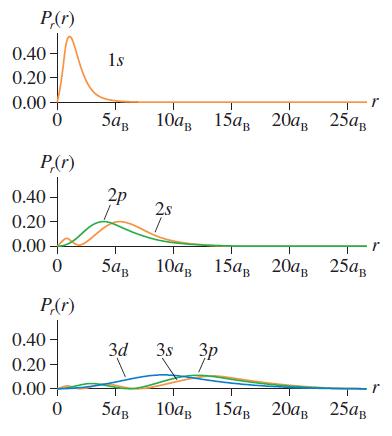
The hydrogen atom 1s wave function is a maximum at r = 0. But the 1s radial probability density, shown in Figure 41.8, peaks at r = aB and is zero at r = 0. Explain this paradox. P(r) 0.40- 0.20- 1s 0.00 10а, 15а, 20, 25а, P,(r) 2p 0.40 0.20 2s 0.00 5ag 10ав 15а, 20а, 25ар P(r) 0.40 3d 3s
Showing 4200 - 4300
of 4932
First
36
37
38
39
40
41
42
43
44
45
46
47
48
49
50
Step by Step Answers

 Get 50% OFF
Claim Now
Get 50% OFF
Claim Now