New Semester
Started
Get
50% OFF
Study Help!
--h --m --s
Claim Now
Question Answers
Textbooks
Find textbooks, questions and answers
Oops, something went wrong!
Change your search query and then try again
S
Books
FREE
Study Help
Expert Questions
Accounting
General Management
Mathematics
Finance
Organizational Behaviour
Law
Physics
Operating System
Management Leadership
Sociology
Programming
Marketing
Database
Computer Network
Economics
Textbooks Solutions
Accounting
Managerial Accounting
Management Leadership
Cost Accounting
Statistics
Business Law
Corporate Finance
Finance
Economics
Auditing
Tutors
Online Tutors
Find a Tutor
Hire a Tutor
Become a Tutor
AI Tutor
AI Study Planner
NEW
Sell Books
Search
Search
Sign In
Register
study help
mathematics
calculus early transcendentals 9th
Calculus Early Transcendentals 9th Edition James Stewart, Daniel K. Clegg, Saleem Watson, Lothar Redlin - Solutions
Write the composite function in the form f (g(ϰ). [Identify the inner function u = g(ϰ) and the outer function y = f(u).] Then find the derivative dy/dϰ.y = √ϰ3 + 2
(a) Find y' by implicit differentiation.(b) Solve the equation explicitly for y and differentiate to get y' in terms of ϰ.(c) Check that your solutions to parts (a) and (b) are consistent by substituting the expression for y into your solution for part (a).6ϰ4 + y5 = 2ϰ
A particle moves according to a law of motion s = f (t), t ≥ 0, where t is measured in seconds and s in feet.(a) Find the velocity at time t.(b) What is the velocity after 1 second?(c) When is the particle at rest?(d) When is the particle moving in the positive direction?(e) Find the total
Differentiate the function.g(t) = ln(3 + t2)
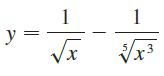
Calculate y'. 1 y .3 V
Differentiate.f (x) = tan ϰ – 4 sin ϰ
Determine whether the statement is true or false. If it is true, explain why. If it is false, explain why or give an example that disproves the statement.If f and g are differentiable, then d [f(x)g(x)] = f'(x)g(x) dx
State the derivative of each function.(a) y = xn(b) y = ex(c) y = bx(d) y = ln x(e) y = logb x(f ) y = sin x(g) y = cos x(h) y = tan x(i) y = csc x(j) y = sec x(k) y = cot x(l) y = sin-1x(m) y = cos-1x(n) y = tan-1x(o) y = sinh x(p) y = cosh x(q) y = tanh x(r) y = sinh-1x(s) y = cosh-1x(t) y =
(a) If A is the area of a circle with radius r and the circle expands as time passes, find dA/dt in terms of dr/dt.(b) Suppose oil spills from a ruptured tanker and spreads in a circular pattern. If the radius of the oil spill increases at a constant rate of 2 m/s, how fast is the area of the spill
Find the linearization L(ϰ) of the function at a.f (ϰ) = e3ϰ, a = 0
Write the composite function in the form f (g(ϰ). [Identify the inner function u = g(ϰ) and the outer function y = f(u).] Then find the derivative dy/dϰ.y = (5 – ϰ4)3
(a) Find y' by implicit differentiation.(b) Solve the equation explicitly for y and differentiate to get y' in terms of ϰ.(c) Check that your solutions to parts (a) and (b) are consistent by substituting the expression for y into your solution for part (a).5ϰ2 – y3 = 7
A particle moves according to a law of motion s = f (t), t ≥ 0, where t is measured in seconds and s in feet.(a) Find the velocity at time t.(b) What is the velocity after 1 second?(c) When is the particle at rest?(d) When is the particle moving in the positive direction?(e) Find the total
A population of the yeast cell Saccharomyces cerevisiae (a yeast used for fermentation) develops with a constant relative growth rate of 0.4159 per hour. The initial population consists of 3.8 million cells. Find the population size after 2 hours.
Calculate y'.y = (x2 + x3)4
Differentiate.f (x) = 3 sin ϰ 2 – cos ϰ
(a) If V is the volume of a cube with edge length x and the cube expands as time passes, find dV/dt in terms of dx/dt.(b) If the length of the edge of a cube is increasing at a rate of 4 cm/s, how fast is the volume of the cube increasing when the edge length is 15 cm?
Find the derivative of f (ϰ) = (1 + 2ϰ2)(ϰ – ϰ2) in two ways: by using the Product Rule and by performing the multiplication first. Do your answers agree?
Determine whether the statement is true or false. If it is true, explain why. If it is false, explain why or give an example that disproves the statement.If f and g are differentiable, then d [f(x) + g(x)] =f'(x) + g'(x) dx
Classify each function as a power function, root function, polynomial (state its degree), rational function, algebraic function, trigonometric function, exponential function, or logarithmic function.(a) f (x) = x3 + x2(b) g(t) = cos2t sin t(c) r (t) = t√3(d) v(t) = 8t(e) y = √x/x2 +
Classify each function as a power function, root function, polynomial (state its degree), rational function, algebraic function, trigonometric function, exponential function, or logarithmic function.(a) f (t) = 3t2 + 2/t(b) h(r) = 2.3r(c) s(t) = √t + 4(d) y = ϰ4 + 5(e) g(ϰ) = 3√ϰ(f ) y
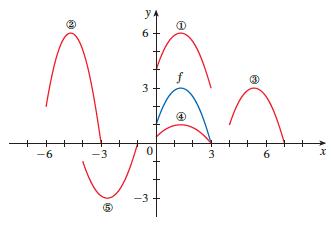
The graph of y = f(x) is given. Match each equation with its graph and give reasons for your choices.(a) y − f (x - 4)(b) y − f (x) + 3(c) y − 1/3 f(x)(d) y − 2f(x + 4)(e) y − 2f (x + 6) y. 6. -6 -3 6 -3 3. 3.
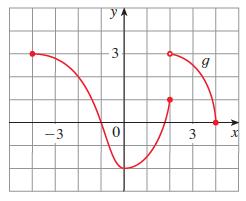
The graph of a function t is given.(a) State the values of g(-2), g(0), g(2), and g(3).(b) For what value(s) of ϰ is g(ϰ) = 3 ?(c) For what value(s) of ϰ is g(ϰ) ≤ 3?(d) State the domain and range of g.(e) On what interval(s) is t increasing? yA -3 3. 3.
Solve the equation |4x -|x + 1 || = 3.
The graph of f is given. Draw the graphs of the following functions.(a) y − f(x) - 3(b) y − f(x + 1)(c) y − 1/2 f(x)(d) y − 2f(x)
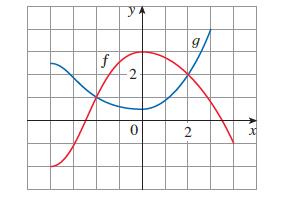
The graphs of f and t are given.(a) State the values of f (-4) and g(3).(b) Which is larger, f(-3) or g(-3) ?(c) For what values of ϰ is f (ϰ) = g(ϰ)?(d) On what interval(s) is f(ϰ) ≤ g(ϰ)?(e) State the solution of the equation f(ϰ)= −1.(f) On what interval(s) is t decreasing?(g) State
Solve the inequality |x - 1 - 2 |x - 3 | ≥ 5.
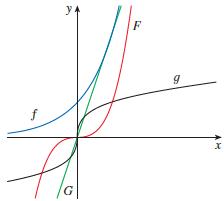
Match each equation with its graph. Explain your choices. (Don’t use a computer or graphing calculator.)(a) y =- 3ϰ(b) y = 3ϰ(c) y = x3(d) y = 3√x f G.
Find the domain of the function.f (ϰ) =cos ϰ/1 - sin ϰ
Find the domain of the function.g(ϰ) =1/1– tan ϰ
Find the domain and range of the function. Write your answer in interval notation.g(x) = √16 - x4
Graph the given functions on a common screen. How are these graphs related?y = 3x, y = 10x, y = (1/3)x, y = ( 1/10 )x
Graph the given functions on a common screen. How are these graphs related?y = 0.9x, y = 0.6x, y = 0.3x, y = 0.1x
Determine whether the equation or table defines y as a function of ϰ.3ϰ2 − 5y = 7
Find the domain and range of the function. Write your answer in interval notation.F(t) = 3 + cos 2t
Determine whether the equation or table defines y as a function of ϰ.ϰ2 + (y - 3)2 = 5
Make a rough sketch by hand of the graph of the function. Use the graphs given in Figures 3 and 15 and, if necessary, the transformations of Section 1.3.g(ϰ) = 3ϰ + 1
What do all members of the family of linear functions f (ϰ) = c – ϰ have in common? Sketch several members of the family.
Determine whether the equation or table defines y as a function of ϰ.2ϰy + 5y2 = 4
A function is given by a table of values, a graph, a formula, or a verbal description. Determine whether it is one-to-one.f(ϰ) = ϰ4 – 16
Sketch several members of the family of polynomials P(ϰ) = ϰ3 2 cϰ2. How does the graph change when c changes?
Determine whether the equation or table defines y as a function of ϰ.(y + 3)3 + 1 = 2ϰ
Make a rough sketch by hand of the graph of the function. Use the graphs given in Figures 3 and 15 and, if necessary, the transformations of Section 1.3.y = –e–ϰ
A function is given by a table of values, a graph, a formula, or a verbal description. Determine whether it is one-to-one.r(t) = t3 + 4
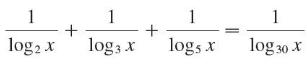
Show that if x > 0 and x ≠ 1, then 1 1 1 1 log2 x log3 x logs x log 30 X
Determine whether the equation or table defines y as a function of x.2ϰ - |y | = 0
Make a rough sketch by hand of the graph of the function. Use the graphs given in Figures 3 and 15 and, if necessary, the transformations of Section 1.3.y = 4ϰ+2
A function is given by a table of values, a graph, a formula, or a verbal description. Determine whether it is one-to-one.g(ϰ) = 3√ϰ
A function is given by a table of values, a graph, a formula, or a verbal description. Determine whether it is one-to-one.f (ϰ) = ϰ4 – 1, 0 ≤ x ≤ 10
Starting with the graph of y = eϰ, write the equation of the graph that results from(a) Shifting 2 units downward.(b) Shifting 2 units to the right.(c) Reflecting about the ϰ-axis.(d) Reflecting about the y-axis.(e) Reflecting about the ϰ-axis and then about the y-axis.
Graph the function by hand, not by plotting points, but by starting with the graph of one of the standard functions given in Table 1.2.3, and then applying the appropriate transformations.y = 1 + 1/x2
Starting with the graph of y = eϰ, find the equation of the graph that results from(a) Reflecting about the line y = 4.(b) Reflecting about the line x = 2.
Graph the function by hand, not by plotting points, but by starting with the graph of one of the standard functions given in Table 1.2.3, and then applying the appropriate transformations.y = 2 + √x + 1
Assume that f is a one-to-one function.(a) If f (6) = 17, what is f -1(17)?(b) If f -1(3) = 2, what is f (2)?
Graph the function by hand, not by plotting points, but by starting with the graph of one of the standard functions given in Table 1.2.3, and then applying the appropriate transformations.y – 2(x – 1)2 + 3
If f (ϰ) = ϰ5 + ϰ3 + ϰ, find f–1(3) and f (f–1(2)).
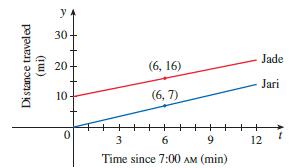
Jade and her roommate Jari commute to work each morning, traveling west on I-10. One morning Jade left for work at 6:50 am, but Jari left 10 minutes later. Both drove at a constant speed. The graphs show the distance (in miles) each of them has traveled on I-10, t minutes after 7:00 am.(a) Use the
Graph the function by hand, not by plotting points, but by starting with the graph of one of the standard functions given in Table 1.2.3, and then applying the appropriate transformations.y − x2 - 2x + 5
Graph the function by hand, not by plotting points, but by starting with the graph of one of the standard functions given in Table 1.2.3, and then applying the appropriate transformations.y = (x + 1)3 + 2
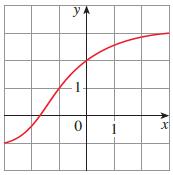
The graph of f is given.(a) Why is f one-to-one?(b) What are the domain and range of f–1?(c) What is the value of f–1(2)?(d) Estimate the value of f–1(0). y. 1
The formula C = 5/9 (F – 32), where F ≥ –459.67, expresses the Celsius temperature C as function of the Fahrenheit temperature F. Find a formula for the inverse function and interpret it. What is the domain of the inverse function?
The resistance R of a wire of fixed length is related to its diameter x by an inverse square law, that is, by a function of the form R(ϰ) − kϰ-2.(a) A wire of fixed length and 0.005 meters in diameter has a resistance of 140 ohms. Find the value of k.(b) Find the resistance of a wire made of
Find a formula for the inverse of the function.f (ϰ) = 1 – ϰ2, ϰ ≥ 0
The illumination of an object by a light source is related to the distance from the source by an inverse square law. Suppose that after dark you are sitting in a room with just one lamp, trying to read a book. The light is too dim, so you move your chair halfway to the lamp. How much brighter is
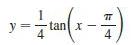
Graph the function by hand, not by plotting points, but by starting with the graph of one of the standard functions given in Table 1.2.3, and then applying the appropriate transformations. y=ィtan x -) 4 4
Find a formula for the inverse of the function.g(x) = ϰ2 – 2ϰ, ϰ ≥ 1
The pressure P of a sample of oxygen gas that is compressed at a constant temperature is related to the volume V of gas by a reciprocal function of the form P − k/V.(a) A sample of oxygen gas that occupies 0.671 m3 exerts a pressure of 39 kPa at a temperature of 293 K (absolute temperature
If f(x) = 2x + 4x, find f-1(6).
Graph the function by hand, not by plotting points, but by starting with the graph of one of the standard functions given in Table 1.2.3, and then applying the appropriate transformations.y = |cos πx|
Find a formula for the inverse of the function.g(ϰ) = 2 + √ϰ + 1
The power output of a wind turbine depends on many factors. It can be shown using physical principles that the power P generated by a wind turbine is modeled byP − kAv3where v is the wind speed, A is the area swept out by the blades, and k is a constant that depends on air density, efficiency of
Find a formula for the inverse of the function.h(x) = 6 – 3ϰ/5ϰ + 7
Astronomers infer the radiant exitance (radiant flux emitted per unit area) of stars using the Stefan BoltzmannLaw:E(T) − (5.67 × 10⁻⁸)T4where E is the energy radiated per unit of surface area measured in watts (W) and T is the absolute temperature measured in kelvins (K).(a) Graph the
Use the laws of logarithms to expand each expression.a. in x √x + 1b. log2 √x2 + 1/x-1
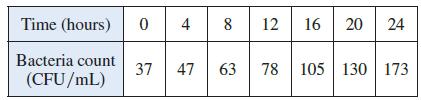
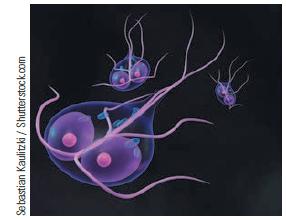
A researcher is trying to determine the doubling time for a population of the bacterium Giardia lamblia. He starts a culture in a nutrient solution and estimates the bacteria count every four hours. His data are shown in the table.(a) Make a scatter plot of the data.(b) Use a calculator or computer
Find a formula for the inverse of the function.y = e1–ϰ
Find a formula for the inverse of the function.y = 3 ln(ϰ – 2)
Find a formula for the inverse of the function.y = (2 + 3√ϰ )5
A gray squirrel population was introduced in a certain region 18 years ago. Biologists observe that the population doubles every six years, and now the population is 600.(a) What was the initial squirrel population?(b) What is the expected squirrel population t years after introduction?(c) Estimate
Solve the equation for x. Give both an exact value and a decimal approximation, correct to three decimal places.e2x = 3
In Example 4, the patient’s viral load V was 76.0 RNA copies per mL after one day of treatment. Use the graph of V in Figure 11 to estimate the additional time required for the viral load to decrease to half that amount.
Solve the equation for x. Give both an exact value and a decimal approximation, correct to three decimal places.ln x2 = 5
After alcohol is fully absorbed into the body, it is metabolized. Suppose that after consuming several alcoholic drinks earlier in the evening, your blood alcohol concentration (BAC) at midnight is 0.14 g/dL. After 1.5 hours your BAC is half this amount.(a) Find an exponential model for your BAC t
Solve the equation for x. Give both an exact value and a decimal approximation, correct to three decimal places.eex = 10
If g(ϰ) = x/√x+1, find g (0), g(3), 5g(a), 1/2 g (4a), g(a2), [g(a)]2, g(a + h), and g(x-a).
Solve the equation for x. Give both an exact value and a decimal approximation, correct to three decimal places.cos-1x = 2
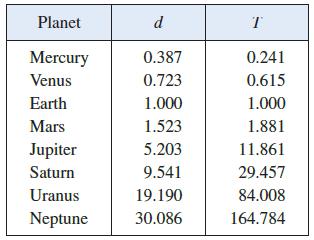
The table shows the mean (average) distances d of the planets from the sun (taking the unit of measurement to be the distance from the earth to the sun) and their periods T (time of revolution in years).(a) Fit a power model to the data.(b) Kepler’s Third Law of Planetary Motion states that
Solve the equation for x. Give both an exact value and a decimal approximation, correct to three decimal places.tan-1(3x2) d = π/4
Let f (ϰ) = √1 - ϰ2, 0 < ϰ < 1.(a) Find f -1. How is it related to f ?(b) Identify the graph of f and explain your answer to part (a).
Solve the equation for x. Give both an exact value and a decimal approximation, correct to three decimal places.ln x - 1 = ln(5 + x) - 4
Let g(ϰ) − 3√1 – ϰ3 .(a) Find g–1. How is it related to g ?(b) Graph g. How do you explain your answer to part (a)?
The viral load for an HIV patient is 52.0 RNA copies/mL before treatment begins. Eight days later the viral load is half of the initial amount.(a) Find the viral load after 24 days.(b) Find the viral load V(t) that remains after t days.(c) Find a formula for the inverse of the function V and
Suppose that a force or energy originates from a point source and spreads its influence equally in all directions, such as the light from a lightbulb or the gravitational force of a planet. So at a distance r from the source, the intensity I of the force or energy is equal to the source strength S
Express the function in the form f ° t.S(t) = sin2 (cos t)
Use Formula 11 to graph the given functions on a common screen. How are these graphs related?y = log1.5 ϰ, y = ln ϰ, y = log10 ϰ, y = log50 ϰ
Express the function in the form f ° t.H(x) = √(1 + √x)
Use Formula 11 to graph the given functions on a common screen. How are these graphs related?y = ln ϰ, y = log8 ϰ, y = eϰ, y = 8ϰ
Suppose that the graph of y = log2 ϰ is drawn on a coordinate grid where the unit of measurement is an inch. How many miles to the right of the origin do we have to move before the height of the curve reaches 3 ft?
Express the function in the form f ° t ° h.H(x) = 8√2 + |x|
Compare the functions f (ϰ) = ϰ0.1 and g(ϰ) = ln ϰ by graphing both functions in several viewing rectangles. When does the graph of f finally surpass the graph of t?
Showing 4000 - 4100
of 4932
First
34
35
36
37
38
39
40
41
42
43
44
45
46
47
48
Last
Step by Step Answers

 Get 50% OFF
Claim Now
Get 50% OFF
Claim Now


![d [f(x)g(x)] = f'(x)g(x) dx](https://dsd5zvtm8ll6.cloudfront.net/si.question.images/images/question_images/1609/2/1/9/5215feabdc144e331609219520457.jpg)
![d [f(x) + g(x)] =f'(x) + g'(x) dx](https://dsd5zvtm8ll6.cloudfront.net/si.question.images/images/question_images/1609/3/9/1/1085fed5c04ba0261609391124275.jpg)