New Semester
Started
Get
50% OFF
Study Help!
--h --m --s
Claim Now
Question Answers
Textbooks
Find textbooks, questions and answers
Oops, something went wrong!
Change your search query and then try again
S
Books
FREE
Study Help
Expert Questions
Accounting
General Management
Mathematics
Finance
Organizational Behaviour
Law
Physics
Operating System
Management Leadership
Sociology
Programming
Marketing
Database
Computer Network
Economics
Textbooks Solutions
Accounting
Managerial Accounting
Management Leadership
Cost Accounting
Statistics
Business Law
Corporate Finance
Finance
Economics
Auditing
Tutors
Online Tutors
Find a Tutor
Hire a Tutor
Become a Tutor
AI Tutor
AI Study Planner
NEW
Sell Books
Search
Search
Sign In
Register
study help
mathematics
calculus early transcendentals
Calculus Early Transcendentals 2nd edition William L. Briggs, Lyle Cochran, Bernard Gillett - Solutions
Let R be the region bounded by the following curves. Let S be the solid generated when R is revolved about the given axis. If possible, find the volume of S by both the disk/washer and shell methods. Check that your results agree and state which method is easier to apply.y = x2, y = 2 - x, and x =
Let R be the region bounded by the following curves. Let S be the solid generated when R is revolved about the given axis. If possible, find the volume of S by both the disk/washer and shell methods. Check that your results agree and state which method is easier to apply.y = x, y = x1/3 in the
Use either the washer or shell method to find the volume of the solid that is generated when the region in the first quadrant bounded by y = x2, y = 1, and x = 0 is revolved about the following lines.x = 2
Use either the washer or shell method to find the volume of the solid that is generated when the region in the first quadrant bounded by y = x2, y = 1, and x = 0 is revolved about the following lines.y = 6
Use either the washer or shell method to find the volume of the solid that is generated when the region in the first quadrant bounded by y = x2, y = 1, and x = 0 is revolved about the following lines.x = -1
Use either the washer or shell method to find the volume of the solid that is generated when the region in the first quadrant bounded by y = x2, y = 1, and x = 0 is revolved about the following lines.y = -2
Let R be the region bounded by y = x2, x = 1, and y = 0. Use the shell method to find the volume of the solid generated when R is revolved about the following lines.y = 2
Let R be the region bounded by y = x2, x = 1, and y = 0. Use the shell method to find the volume of the solid generated when R is revolved about the following lines.y = -2
Let R be the region bounded by y = x2, x = 1, and y = 0. Use the shell method to find the volume of the solid generated when R is revolved about the following lines.x = 1
Let R be the region bounded by y = x2, x = 1, and y = 0. Use the shell method to find the volume of the solid generated when R is revolved about the following lines.x = -2
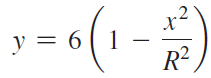
Use the shell method to find the volume of the following solids.A hole of radius r ≤ R is drilled symmetrically along the axis of a bullet. The bullet is formed by revolving the parabola about the y-axis, where 0 ≤ x ≤ R. х* y = 6( 1 R2,
Use the shell method to find the volume of the following solids.The ellipsoid formed when that part of the ellipse x2 + 2y2 = 4 with x ≥ 0 is revolved about the y-axis
Use the shell method to find the volume of the following solids.The solid formed when a hole of radius 3 is drilled symmetrically through the center of a sphere of radius 6
Use the shell method to find the volume of the following solids.The solid formed when a hole of radius 3 is drilled symmetrically along the axis of a right circular cone of radius 6 and height 9
Use the shell method to find the volume of the following solids.The solid formed when a hole of radius 2 is drilled symmetrically along the axis of a right circular cylinder of height 6 and radius 4
Use the shell method to find the volume of the following solids.A right circular cone of radius 3 and height 8
Let R be the region bounded by the following curves. Use the shell method to find the volume of the solid generated when R is revolved about the x-axis.y = √50 - 2x2, in the first quadrant
Let R be the region bounded by the following curves. Use the shell method to find the volume of the solid generated when R is revolved about the x-axis.y = √cos-1 x, in the first quadrant
Let R be the region bounded by the following curves. Use the shell method to find the volume of the solid generated when R is revolved about the x-axis.y = √sin-1 x, y = √π/2, and x = 0
Let R be the region bounded by the following curves. Use the shell method to find the volume of the solid generated when R is revolved about the x-axis.y = 2x-3/2, y = 2, y = 16, and x = 0
Let R be the region bounded by the following curves. Use the shell method to find the volume of the solid generated when R is revolved about the x-axis.y = x3, y = 1, and x = 0
Let R be the region bounded by the following curves. Use the shell method to find the volume of the solid generated when R is revolved about the x-axis.x = y2, x = 0, and y = 3
Let R be the region bounded by the following curves. Use the shell method to find the volume of the solid generated when R is revolved about the x-axis.x = y2, x = 4, and y = 0
Let R be the region bounded by the following curves. Use the shell method to find the volume of the solid generated when R is revolved about the x-axis.y = x, y = 2 - x, and y = 0
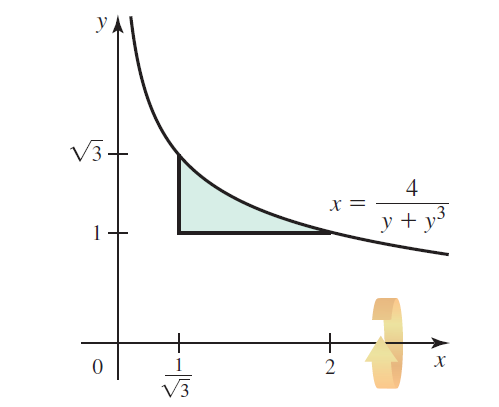
Let R be the region bounded by the following curves. Use the shell method to find the volume of the solid generated when R is revolved about the x-axis. 4 ,3> X = and y = V3 х- y + y3' V3+ 4 y + y3 х V3
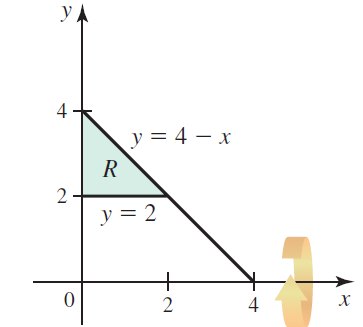
Let R be the region bounded by the following curves. Use the shell method to find the volume of the solid generated when R is revolved about the x-axis.y = 4 - x, y = 2, and x = 0 УА 4 y = 4 – x y = 2 4
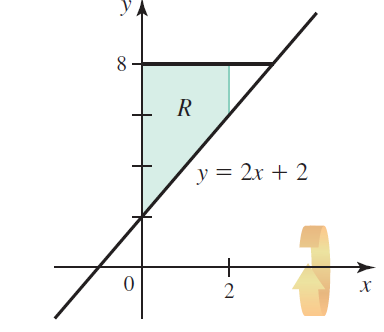
Let R be the region bounded by the following curves. Use the shell method to find the volume of the solid generated when R is revolved about the x-axis.y = 8, y = 2x + 2, x = 0, and x = 2 8 y = 2x + 2 + х 2
Let R be the region bounded by the following curves. Use the shell method to find the volume of the solid generated when R is revolved about the y-axis.y = √4 - 2x2, y = 0, and x = 0, in the first quadrant
Let R be the region bounded by the following curves. Use the shell method to find the volume of the solid generated when R is revolved about the y-axis.y = cos x2, y = 0, for 0 ≤ x ≤ √π/2
Let R be the region bounded by the following curves. Use the shell method to find the volume of the solid generated when R is revolved about the y-axis.y = √x, y = 0, and x = 1
Let R be the region bounded by the following curves. Use the shell method to find the volume of the solid generated when R is revolved about the y-axis.y = x3 - x8 + 1, y = 1
Let R be the region bounded by the following curves. Use the shell method to find the volume of the solid generated when R is revolved about the y-axis.y = 1 - x2, x = 0, and y = 0, in the first quadrant
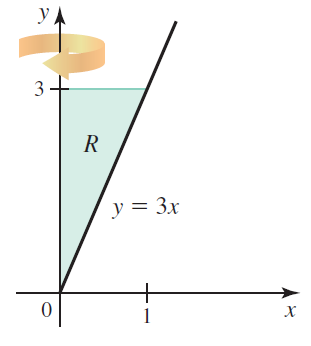
Let R be the region bounded by the following curves. Use the shell method to find the volume of the solid generated when R is revolved about the y-axis.y = 3x, y = 3, and x = 0 (Use integration and check your answer using the volume formula for a cone.) УА 3 у %3D Зх х 1
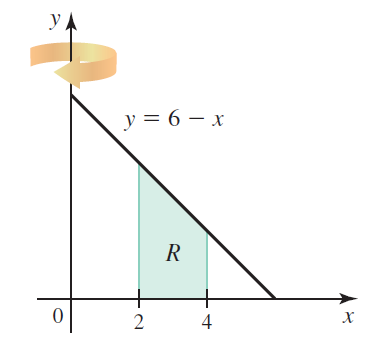
Let R be the region bounded by the following curves. Use the shell method to find the volume of the solid generated when R is revolved about the y-axis.y = 6 - x, y = 0, x = 2, and x = 4 УА y = 6 – x R х 2
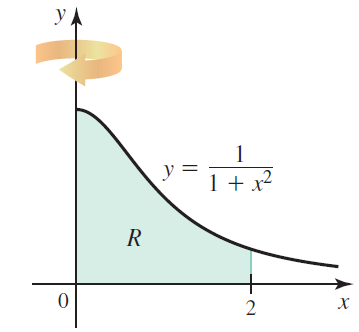
Let R be the region bounded by the following curves. Use the shell method to find the volume of the solid generated when R is revolved about the y-axis.y = (1 + x2)-1, y = 0, x = 0, and x = 2 УА y = 1 + x? R 2
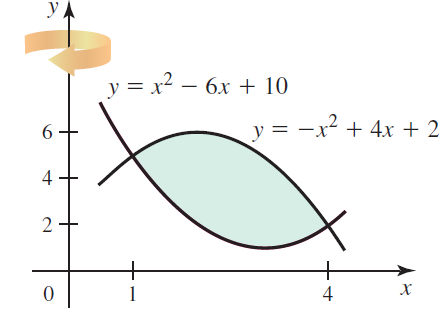
Let R be the region bounded by the following curves. Use the shell method to find the volume of the solid generated when R is revolved about the y-axis.y = -x2 + 4x + 2, y = x2 - 6x + 10 УА y = x2 – 6x + 10 y = -x² + 4x + 2 У 3 6. 4 х 1 4 2.
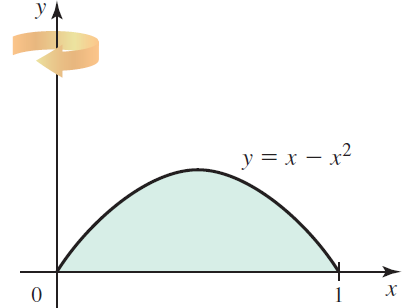
Let R be the region bounded by the following curves. Use the shell method to find the volume of the solid generated when R is revolved about the y-axis.y = x - x2, y = 0 у 3х — х2 1 х
Are shell method integrals easier to evaluate than washer method integrals? Explain.
Fill in the blanks: A region R is revolved about the x-axis. The volume of the resulting solid could (in principle) be found using the disk/washer method and integrating with respect to ________ or using the shell method and integrating with respect to ________.
Fill in the blanks: A region R is revolved about the y-axis. The volume of the resulting solid could (in principle) be found using the disk/washer method and integrating with respect to ________ or using the shell method and integrating with respect to ________.
Assume f and g are continuous with f(x) ≥ g(x) on [a, b]. The region bounded by the graphs of f and g and the lines x = a and x = b is revolved about the y-axis. Write the integral given by the shell method that equals the volume of the resulting solid.
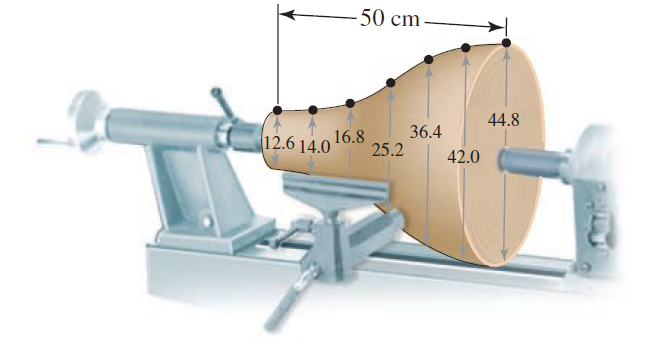
A solid wooden object turned on a lathe has a length of 50 cm and diameters (measured in cm) shown in the figure. (A lathe is a tool that spins and cuts a block of wood so that it has circular cross sections.) Use left Riemann sums with uniformly spaced grid points to estimate the volume of the
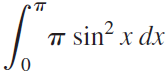
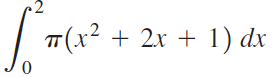
Sketch a solid of revolution whose volume by the disk method is given by the following integrals. Indicate the function that generates the solid. Solutions are not unique.a.b. TT T sin? x dx 7 (x? + 2х + 1) dx TT
Let R be the region bounded by the curve y = √x + a (with a > 0), the y-axis, and the x-axis. Let S be the solid generated by rotating R about the y-axis. Let T be the inscribed cone that has the same circular base as S and height √a. Show that volume(S)/volume(T) = 8/5.
Find the volume of the solid of revolution. Sketch the region in question.The region bounded by y = e-x, y = 0, x = 0, and x = p > 0 revolved about the x-axis (Is the volume bounded as p→∞)
Find the volume of the solid of revolution. Sketch the region in question.The region bounded by y = ln x, y = ln x2, and y = ln 8 revolved about the y-axis
Find the volume of the solid of revolution. Sketch the region in question.The region bounded by y = e-x, y = ex, x = 0, and x = ln 4 revolved about the x-axis
Find the volume of the solid of revolution. Sketch the region in question.The region bounded by y = ex, y = 0, x = 0, and x = 2 revolved about the x-axis
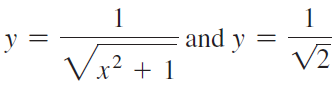
Find the volume of the solid of revolution. Sketch the region in question.The region bounded by revolved about the x-axis and y x² + 1 /2 Vx?
Find the volume of the solid of revolution. Sketch the region in question.The region bounded by y = 1/√x, y = 0, x = 2, and x = 6 revolved about the x-axis
Find the volume of the solid of revolution. Sketch the region in question.The region bounded by y = (ln x)/√x, y = 0, and x = 2 revolved about the x-axis
Determine whether the following statements are true and give an explanation or counterexample.a. A pyramid is a solid of revolution.b. The volume of a hemisphere can be computed using the disk method.c. Let R1 be the region bounded by y = cos x and the x-axis on [-π/2, π/2]. Let R2 be the region
Find the volume of the solid generated in the following situations.The region R is bounded by the graph of f(x) = 2x(2 - x) and the x-axis. Which is greater, the volume of the solid generated when R is revolved about the line y = 2 or the volume of the solid generated when R is revolved about the
Find the volume of the solid generated in the following situations.The region R in the first quadrant bounded by the graphs of y = 2 - x and y = 2 - 2x is revolved about the line x = 3.
Find the volume of the solid generated in the following situations.The region R in the first quadrant bounded by the graphs of y = x and y = 1 + x/2 is revolved about the line y = 3.
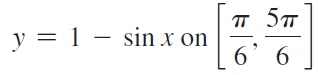
Find the volume of the solid generated in the following situations.The region R bounded by the graphs of y = sin x andis revolved about the line y = -1. TT 5T y = 1 – sin x on 6’ 6
Find the volume of the solid generated in the following situations.The region R bounded by the graph of y = ln x and the y-axis on the interval 0 ≤ y ≤ 1 is revolved about the line x = -1.
Find the volume of the solid generated in the following situations.The region R bounded by the graph of y = 2 sin x and the x-axis on [0, π] is revolved about the line y = -2.
Find the volume of the solid generated in the following situations.The region R bounded by the graphs of x = 0, y = √x, and y = 2 is revolved around the line x = 4.
Find the volume of the solid generated in the following situations.The region R bounded by the graphs of x = 0, y = √x, and y = 1 is revolved around the line y = 1.
For the following regions R, determine which is greater—the volume of the solid generated when R is revolved about the x-axis or about the y-axis.R is bounded by y = x2 and y = √8x.
For the following regions R, determine which is greater—the volume of the solid generated when R is revolved about the x-axis or about the y-axis.R is bounded by y = 1 - x3, the x-axis, and the y-axis.
For the following regions R, determine which is greater—the volume of the solid generated when R is revolved about the x-axis or about the y-axis.R is bounded by y = 4 - 2x, the x-axis, and the y-axis.
For the following regions R, determine which is greater—the volume of the solid generated when R is revolved about the x-axis or about the y-axis.R is bounded by y = 2x, the x-axis, and x = 5.
Let R be the region bounded by the following curves. Use the disk or washer method to find the volume of the solid generated when R is revolved about the y-axis.y = sin-1 x, x = 0, y = π/4
Let R be the region bounded by the following curves. Use the disk or washer method to find the volume of the solid generated when R is revolved about the y-axis.x = √4 - y2, x = 0
Let R be the region bounded by the following curves. Use the disk or washer method to find the volume of the solid generated when R is revolved about the y-axis.y = √x, y = 0, x = 4
Let R be the region bounded by the following curves. Use the disk or washer method to find the volume of the solid generated when R is revolved about the y-axis.y = x3, y = 0, x = 2
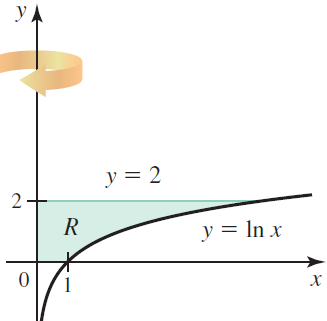
Let R be the region bounded by the following curves. Use the disk or washer method to find the volume of the solid generated when R is revolved about the y-axis.y = 0, y = ln x, y = 2, x = 0 y = 2 2 - y = In x 1 х
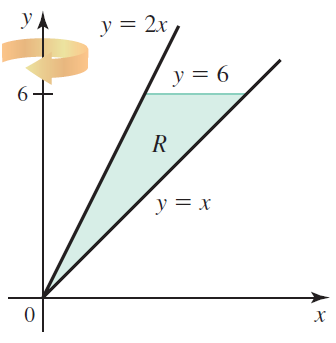
Let R be the region bounded by the following curves. Use the disk or washer method to find the volume of the solid generated when R is revolved about the y-axis.y = x, y = 2x, y = 6 УА 2x y = 6 у 3 х х
Let R be the region bounded by the following curves. Use the washer method to find the volume of the solid generated when R is revolved about the x-axis.y = |x|, y = 2 - x2
Let R be the region bounded by the following curves. Use the washer method to find the volume of the solid generated when R is revolved about the x-axis.y = sin x, y = √sin x, for 0 ≤ x ≤ π/2
Let R be the region bounded by the following curves. Use the washer method to find the volume of the solid generated when R is revolved about the x-axis.y = √sin x, y = 1, x = 0
Let R be the region bounded by the following curves. Use the washer method to find the volume of the solid generated when R is revolved about the x-axis.y = x + 3, y = x2 + 1
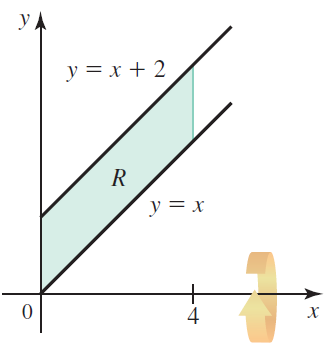
Let R be the region bounded by the following curves. Use the washer method to find the volume of the solid generated when R is revolved about the x-axis.y = x, y = x + 2, x = 0, x = 4 y, у %3Dх+ 2 у 3 х х 4.
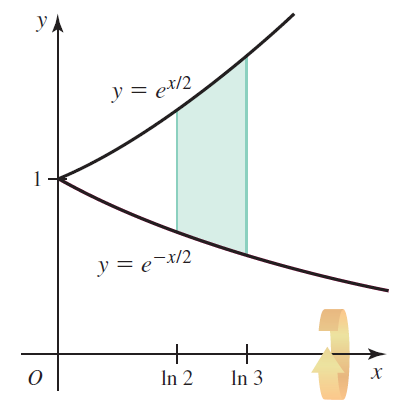
Let R be the region bounded by the following curves. Use the washer method to find the volume of the solid generated when R is revolved about the x-axis.y = ex/2, y = e-x/2, x = ln 2, x = ln 3 УА y = ex/2 y = e¯x/2 In 2 In 3
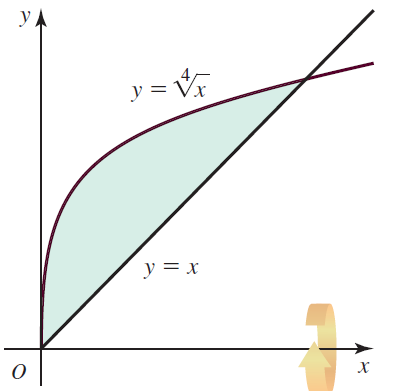
Let R be the region bounded by the following curves. Use the washer method to find the volume of the solid generated when R is revolved about the x-axis.y = x, y = 4√x У y = у %3 х х
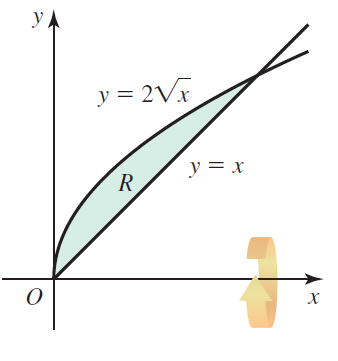
Let R be the region bounded by the following curves. Use the washer method to find the volume of the solid generated when R is revolved about the x-axis.y = x, y = 2√x УА y = 2Vx у — х R х
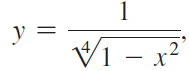
Let R be the region bounded by the following curves. Use the disk method to find the volume of the solid generated when R is revolved about the x-axis.y = 0, x = -1/2, and x = 1/2 y = VI – x² .2
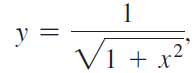
Let R be the region bounded by the following curves. Use the disk method to find the volume of the solid generated when R is revolved about the x-axis. y = 0, x = -1, and x = 1 уз V1 + x2 .2
Let R be the region bounded by the following curves. Use the disk method to find the volume of the solid generated when R is revolved about the x-axis.y = sec x, y = 0, x = 0, and x = π/4
Let R be the region bounded by the following curves. Use the disk method to find the volume of the solid generated when R is revolved about the x-axis.y = 0, x = 0, and x = 1/2 y = 0, x = 0, and x y : VI %3D
Let R be the region bounded by the following curves. Use the disk method to find the volume of the solid generated when R is revolved about the x-axis.y = √25 - x2, y = 0 (Verify that your answer agrees with the volume formula for a sphere.)
Let R be the region bounded by the following curves. Use the disk method to find the volume of the solid generated when R is revolved about the x-axis.y = sin x on [0, π], y = 0 (Recall that sin2 x = 1/2 (1 - cos 2x).)
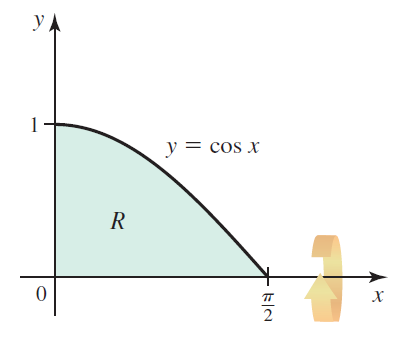
Let R be the region bounded by the following curves. Use the disk method to find the volume of the solid generated when R is revolved about the x-axis.y = cos x on [0, π/2], y = 0, x = 0 (Recall that cos2 x = 1/2 (1 + cos 2x).) УА 1 y = cos x R х
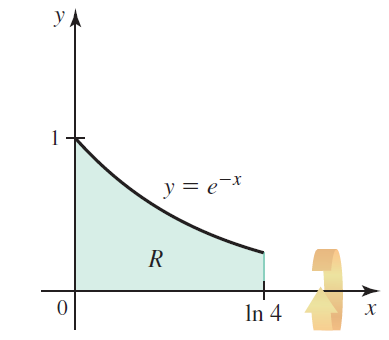
Let R be the region bounded by the following curves. Use the disk method to find the volume of the solid generated when R is revolved about the x-axis.y = e-x, y = 0, x = 0, x = ln 4 y = e=x R In 4 х
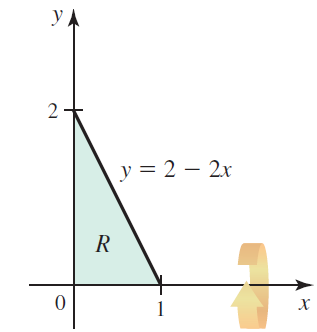
Let R be the region bounded by the following curves. Use the disk method to find the volume of the solid generated when R is revolved about the x-axis.y = 2 - 2x, y = 0, x = 0 (Verify that your answer agrees with the volume formula for a cone.) y = 2 – 2x
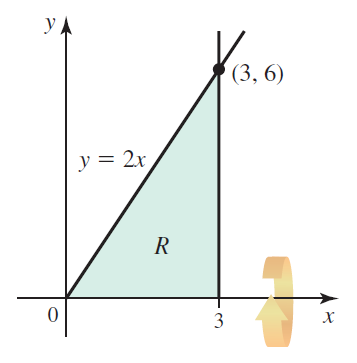
Let R be the region bounded by the following curves. Use the disk method to find the volume of the solid generated when R is revolved about the x-axis.y = 2x, y = 0, x = 3 (Verify that your answer agrees with the volume formula for a cone.) (3, 6) у %3D 2х R х 3
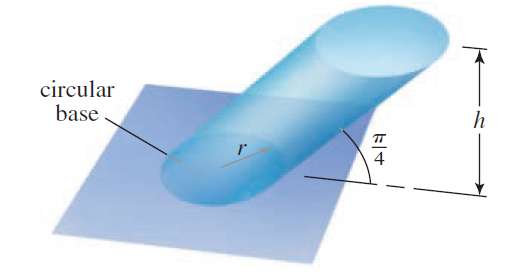
Use the general slicing method to find the volume of the following solids.A circular cylinder of radius r and height h whose axis is at an angle of π/4 to the base circular base т
Use the general slicing method to find the volume of the following solids.The tetrahedron (pyramid with four triangular faces), all of whose edges have length 4
Use the general slicing method to find the volume of the following solids.The pyramid with a square base 4 m on a side and a height of 2 m (Use calculus.)
The solid whose base is the triangle with vertices (0, 0), (2, 0), and (0, 2), and whose cross sections perpendicular to the base and parallel to the y-axis are semicircles
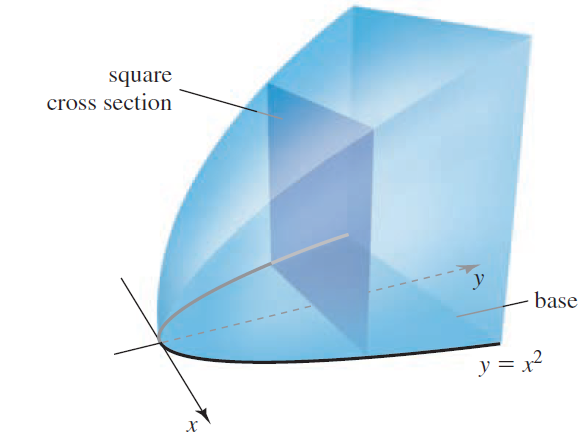
The solid whose base is the region bounded by y = x2 and the line y = 1, and whose cross sections perpendicular to the base and parallel to the x-axis are squares square cross section base y = x2
The solid with a semicircular base of radius 5 whose cross sections perpendicular to the base and parallel to the diameter are squares
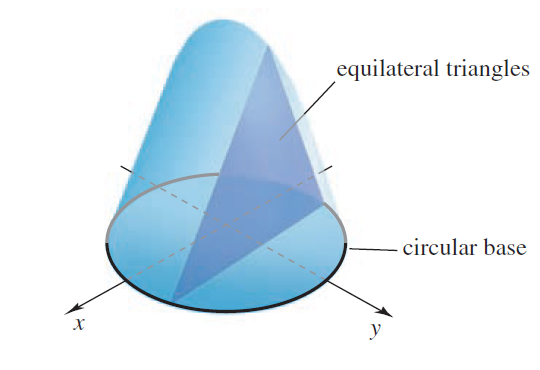
The solid with a circular base of radius 5 whose cross sections perpendicular to the base and parallel to the x-axis are equilateral triangles equilateral triangles circular base х
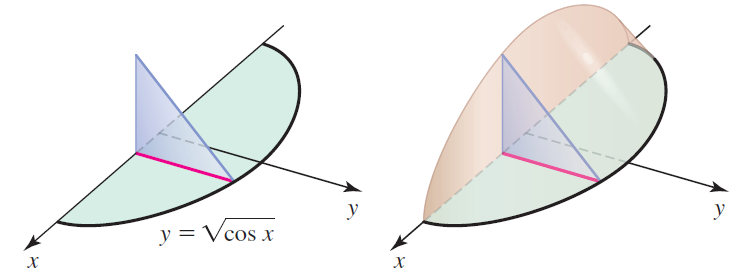
The solid whose base is the region bounded by the curve y = √cos x and the x-axis on [-π/2, π/2], and whose cross sections through the solid perpendicular to the x-axis are isosceles right triangles with a horizontal leg in the xy-plane and a vertical leg above the x-axis y y = Vcos x х х
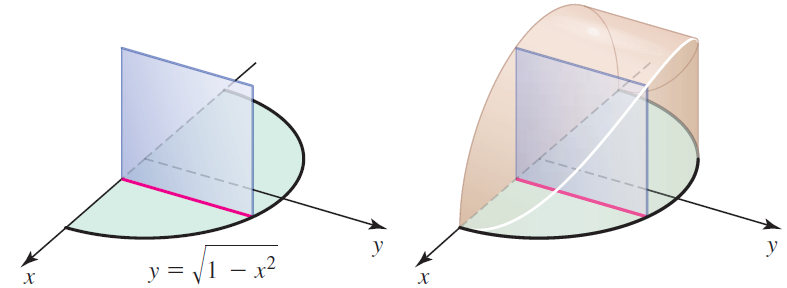
The solid whose base is the region bounded by the semicircle y = √1 - x2 and the x-axis, and whose cross sections through the solid perpendicular to the x-axis are squares y = /1 – x² х
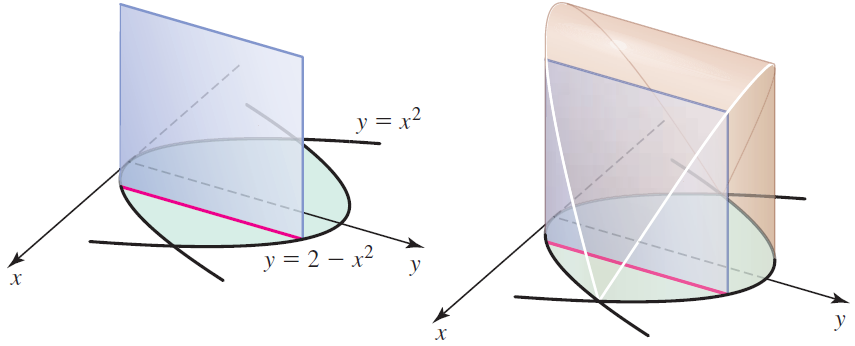
Use the general slicing method to find the volume of the following solids.The solid whose base is the region bounded by the curves y = x2 and y = 2 - x2, and whose cross sections through the solid perpendicular to the x-axis are squares y = x2 y = 2 – x2 х y
The region R bounded by the graph of y = f(x) ≥ 0 and the x-axis on [a, b] is revolved about the line y = -2 to form a solid of revolution whose cross sections are washers. What are the inner and outer radii of the washer at a point x in [a, b]?
Why is the disk method a special case of the general slicing method?
Showing 2200 - 2300
of 6775
First
16
17
18
19
20
21
22
23
24
25
26
27
28
29
30
Last
Step by Step Answers

 Get 50% OFF
Claim Now
Get 50% OFF
Claim Now