New Semester
Started
Get
50% OFF
Study Help!
--h --m --s
Claim Now
Question Answers
Textbooks
Find textbooks, questions and answers
Oops, something went wrong!
Change your search query and then try again
S
Books
FREE
Study Help
Expert Questions
Accounting
General Management
Mathematics
Finance
Organizational Behaviour
Law
Physics
Operating System
Management Leadership
Sociology
Programming
Marketing
Database
Computer Network
Economics
Textbooks Solutions
Accounting
Managerial Accounting
Management Leadership
Cost Accounting
Statistics
Business Law
Corporate Finance
Finance
Economics
Auditing
Tutors
Online Tutors
Find a Tutor
Hire a Tutor
Become a Tutor
AI Tutor
AI Study Planner
NEW
Sell Books
Search
Search
Sign In
Register
study help
mathematics
calculus early transcendentals
Calculus Early Transcendentals 2nd edition William L. Briggs, Lyle Cochran, Bernard Gillett - Solutions
Explain geometrically how the Trapezoid Rule is used to approximate a definite integral.
Explain geometrically how the Midpoint Rule is used to approximate a definite integral.
If the interval [4, 18] is partitioned into n = 28 subintervals of equal length, what is Δx?
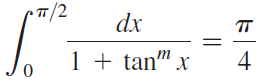
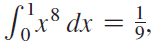
It is a fact that
It can be shown thata. Use a computer algebra system to confirm this result for n = 2, 3, 4, and 5.b. Evaluate the integrals with n = 10 and confirm the result.c. Using graphing and/or symbolic computation, determine whether the values of the integrals increase or decrease as n increases. -п/2
Evaluate the following integrals. Assume a and b are real numbers and n is an integer.∫ xn sin-1 x dx (Use integration by parts.)
Evaluate the following integrals. Assume a and b are real numbers and n is an integer.∫ x(ax + b)n dx (Use u = ax + b.)
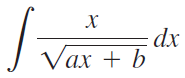
Evaluate the following integrals. Assume a and b are real numbers and n is an integer.(Use u2 = ax + b.) х dx J Vax + b ах
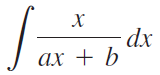
Evaluate the following integrals. Assume a and b are real numbers and n is an integer.(Use u = ax + b.) х ах + b
Let L(c) be the length of the parabola f(x) = x2 from x = 0 to x = c, where c ≥ 0 is a constant.a. Find an expression for L and graph the function.b. Is L concave up or concave down on [0, ∞]?c. Show that as c becomes large and positive, the arc length function increases as c2; that is, L(c)
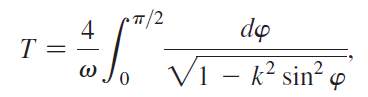
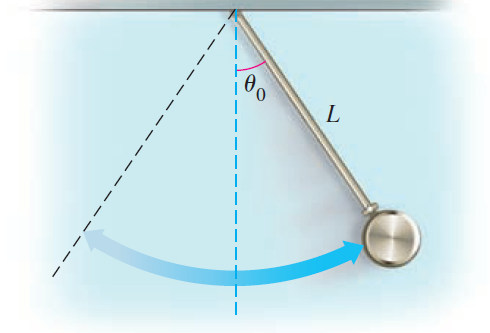
Consider a pendulum of length L meters swinging only under the influence of gravity. Suppose the pendulum starts swinging with an initial displacement of θ0 radians (see figure). The period (time to complete one full cycle) is given bywhere ω2 = g/L, g ≈ 9.8 m/s2 is the acceleration due to
Evaluate ∫ cos (ln x) dx two different ways:a. Use tables after first using the substitution u = ln x.b. Use integration by parts twice to verify your answer to part (a).
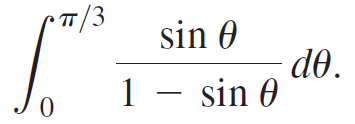
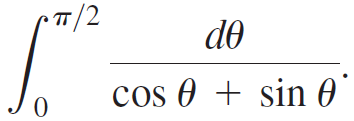
Evaluate
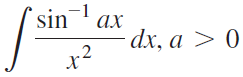
The following integrals may require more than one table lookup. Evaluate the integrals using a table of integrals; then check your answer with a computer algebra system. sin ax dx, a > 0 r2
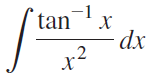
The following integrals may require more than one table lookup. Evaluate the integrals using a table of integrals; then check your answer with a computer algebra system. tan¬1 x - dx .2
The following integrals may require more than one table lookup. Evaluate the integrals using a table of integrals; then check your answer with a computer algebra system.∫ 4x cos-1 10x dx
The following integrals may require more than one table lookup. Evaluate the integrals using a table of integrals; then check your answer with a computer algebra system.∫ x sin-1 2x dx
Use the reduction formulas in a table of integrals to evaluate the following integrals.∫ sec4 4t dt
Use the reduction formulas in a table of integrals to evaluate the following integrals.∫ tan4 3y dy
Use the reduction formulas in a table of integrals to evaluate the following integrals.∫ p2 e-3p dp
Use the reduction formulas in a table of integrals to evaluate the following integrals.∫ x3 e2x dx
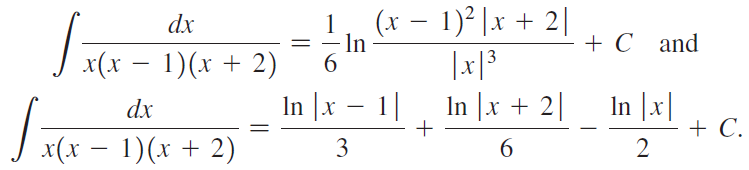
Resolve the apparent discrepancy between (x – 1)² |x + 2| 1 In 6. dx + C _and x(x – 1)(x + 2) |x|3 /+/3 In |x + 2| In |x| + C. In |x – 1| dx x(x – 1)(x + 2) 3 6. 2
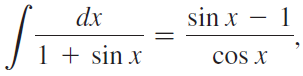
Using one computer algebra system, it was found that and using another computer algebra system, it was found that Reconcile the two answers. Vi dx sin x – 1 1 + sin x cos x 2 sin (x/2) dx 1 + sin x cos (x/2) + sin (x/2)'
Three different computer algebra systems give the following results:Explain how they can all be correct. 1 1 cosx 1 -2 dx Vx4 – 1. tan ,-1 cos 2
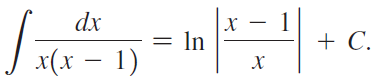
Determine whether the following statements are true and give an explanation or counterexample.a. It is possible that a computer algebra system says and a table of integrals says b. A computer algebra system working in symbolic mode could give the resultand a computer algebra system working in
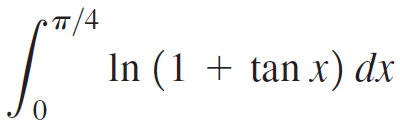
Use a computer algebra system to evaluate the following definite integrals. In each case, find an exact value of the integral (obtained by a symbolic method) and find an approximate value (obtained by a numerical method). Compare the results. 7/4 In (1 + tan x) dx Jo
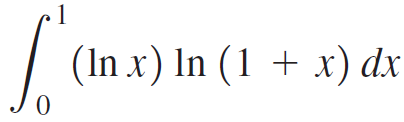
Use a computer algebra system to evaluate the following definite integrals. In each case, find an exact value of the integral (obtained by a symbolic method) and find an approximate value (obtained by a numerical method). Compare the results. 11 (In x) In (1 + x) dx
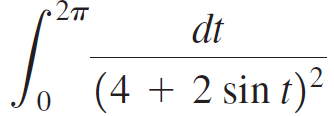
Use a computer algebra system to evaluate the following definite integrals. In each case, find an exact value of the integral (obtained by a symbolic method) and find an approximate value (obtained by a numerical method). Compare the results. •2T dt (4 + 2 sin t)²
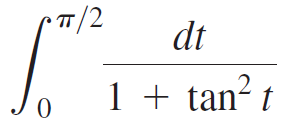
Use a computer algebra system to evaluate the following definite integrals. In each case, find an exact value of the integral (obtained by a symbolic method) and find an approximate value (obtained by a numerical method). Compare the results. TT/2 dt 1 + tan? t
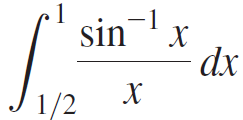
Use a computer algebra system to evaluate the following definite integrals. In each case, find an exact value of the integral (obtained by a symbolic method) and find an approximate value (obtained by a numerical method). Compare the results. sin x dx J 1/2
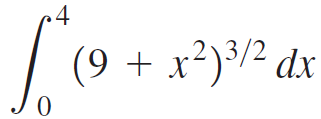
Use a computer algebra system to evaluate the following definite integrals. In each case, find an exact value of the integral (obtained by a symbolic method) and find an approximate value (obtained by a numerical method). Compare the results. .4 (9 + x²)/² dx
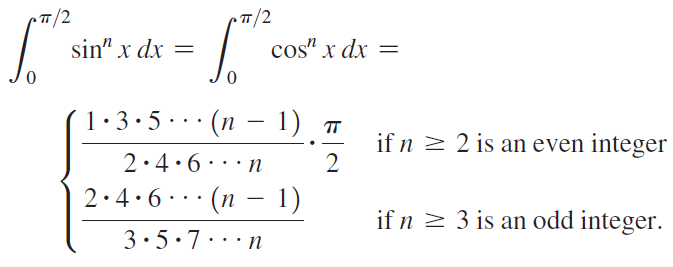
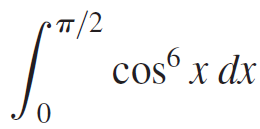
Use a computer algebra system to evaluate the following definite integrals. In each case, find an exact value of the integral (obtained by a symbolic method) and find an approximate value (obtained by a numerical method). Compare the results. /2 TT cosº x dx
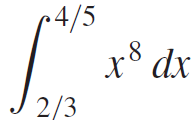
Use a computer algebra system to evaluate the following definite integrals. In each case, find an exact value of the integral (obtained by a symbolic method) and find an approximate value (obtained by a numerical method). Compare the results. 4/5 x° dx 8. 2/3
Use a computer algebra system to evaluate the following indefinite integrals. Assume that a is a positive real number.∫ (y2 + a2)-5/2 dy
Use a computer algebra system to evaluate the following indefinite integrals. Assume that a is a positive real number.∫ (a2 - x2)3/2 dx
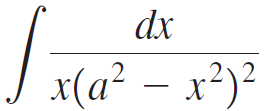
Use a computer algebra system to evaluate the following indefinite integrals. Assume that a is a positive real number. dx x(a² – x²)?
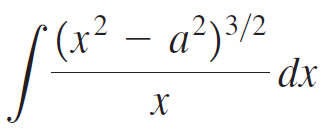
Use a computer algebra system to evaluate the following indefinite integrals. Assume that a is a positive real number. - азу92 (x² – a²)³/2 dx х
Use a computer algebra system to evaluate the following indefinite integrals. Assume that a is a positive real number.∫ (a2 - t2)-2 dt
Use a computer algebra system to evaluate the following indefinite integrals. Assume that a is a positive real number.∫ tan2 3x dx
Use a computer algebra system to evaluate the following indefinite integrals. Assume that a is a positive real number.∫ √4x2 + 36 dx
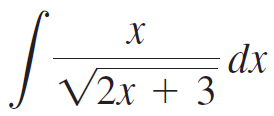
Use a computer algebra system to evaluate the following indefinite integrals. Assume that a is a positive real number. dx V2x + 3
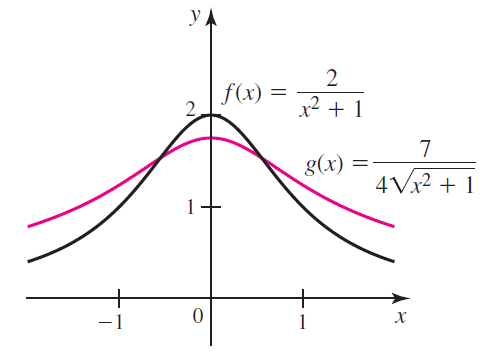
Use a table of integrals to solve the following problems.The graphs of are shown in the figure. Which is greater, the average value of f or that of g on the interval [-1, 1]? f(x) x² + 1 and g(x) 4VX2 + 1 2 f(x) x² + 1 g(x) 4Vx2 + 1 х
Use a table of integrals to solve the following problems.The region bounded by the graphs of y = π/2, y = sin-1 x, and the y-axis is revolved about the y-axis. What is the volume of the solid that is formed?
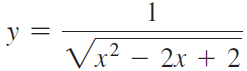
Use a table of integrals to solve the following problems.Find the area of the region bounded by the graph ofand the x-axis between x = 0 and x = 3. Vx? 2х + 2
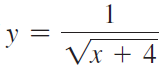
Use a table of integrals to solve the following problems.The region bounded by the graph of and the x-axis on the interval [0, 12] is revolved about the y-axis. What is the volume of the solid that is formed? 1 уз Vx + 4
Use a table of integrals to solve the following problems.The region bounded by the graph of y = x2√ln x and the x-axis on the interval [1, e] is revolved about the x-axis. What is the volume of the solid that is formed?
Use a table of integrals to solve the following problems.Find the length of the curve y = ex on the interval [0, ln 2].
Use a table of integrals to solve the following problems.Find the length of the curve y = x3/2 + 8 on the interval [0, 2].
Use a table of integrals to solve the following problems.Find the length of the curve y = x2/4 on the interval [0, 8].
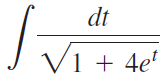
Use a table of integrals to determine the following indefinite integrals. These integrals require preliminary work, such as completing the square or changing variables, before they can be found in a table. dt | V1 + 4e'
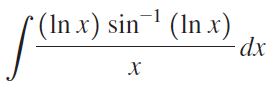
Use a table of integrals to determine the following indefinite integrals. These integrals require preliminary work, such as completing the square or changing variables, before they can be found in a table. * (In x) sin¯1 (In x) х
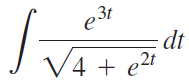
Use a table of integrals to determine the following indefinite integrals. These integrals require preliminary work, such as completing the square or changing variables, before they can be found in a table. dt V4 + e²+
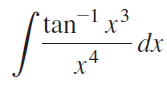
Use a table of integrals to determine the following indefinite integrals. These integrals require preliminary work, such as completing the square or changing variables, before they can be found in a table. tan¬x3 dx x4 -1
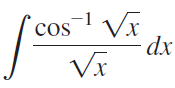
Use a table of integrals to determine the following indefinite integrals. These integrals require preliminary work, such as completing the square or changing variables, before they can be found in a table. `cos-1 Vx dx. Vr
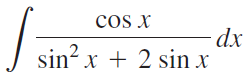
Use a table of integrals to determine the following indefinite integrals. These integrals require preliminary work, such as completing the square or changing variables, before they can be found in a table. cos x – dx sin x + 2 sin x
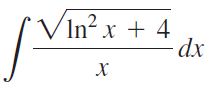
Use a table of integrals to determine the following indefinite integrals. These integrals require preliminary work, such as completing the square or changing variables, before they can be found in a table. In² x + 4 dx. х
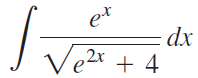
Use a table of integrals to determine the following indefinite integrals. These integrals require preliminary work, such as completing the square or changing variables, before they can be found in a table. et dx Vezr + 4 ,2x
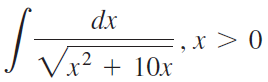
Use a table of integrals to determine the following indefinite integrals. These integrals require preliminary work, such as completing the square or changing variables, before they can be found in a table. dx :,x > 0 Vx? + 10x .2
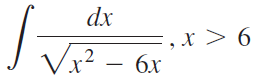
Use a table of integrals to determine the following indefinite integrals. These integrals require preliminary work, such as completing the square or changing variables, before they can be found in a table. dx -,x> 6 бх Vx? .2
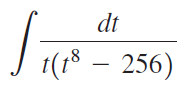
Use a table of integrals to determine the following indefinite integrals. These integrals require preliminary work, such as completing the square or changing variables, before they can be found in a table. dt 1(18 – 256)
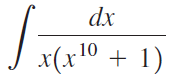
Use a table of integrals to determine the following indefinite integrals. These integrals require preliminary work, such as completing the square or changing variables, before they can be found in a table. dx x(x10 + 1)
Use a table of integrals to determine the following indefinite integrals. These integrals require preliminary work, such as completing the square or changing variables, before they can be found in a table.∫ √x2 - 4x + 8 dx
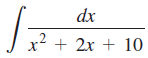
Use a table of integrals to determine the following indefinite integrals. These integrals require preliminary work, such as completing the square or changing variables, before they can be found in a table. dx x + 2x + 10
Use a table of integrals to determine the following indefinite integrals. These integrals require preliminary work, such as completing the square or changing variables, before they can be found in a table.∫ √x2 - 8x dx, x > 8
Use a table of integrals to determine the following indefinite integrals. These integrals require preliminary work, such as completing the square or changing variables, before they can be found in a table.∫ √x2 + 10x dx, x > 0
Use a table of integrals to determine the following indefinite integrals.∫ x2 e5x dx
Use a table of integrals to determine the following indefinite integrals.∫ ln2 x dx
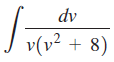
Use a table of integrals to determine the following indefinite integrals. dv v(v² + 8)
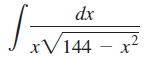
Use a table of integrals to determine the following indefinite integrals. dx xV 144
Use a table of integrals to determine the following indefinite integrals.∫ √4x2 - 9 dx, x > 3/2
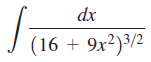
Use a table of integrals to determine the following indefinite integrals. dx J (16 + 9x²)3/2
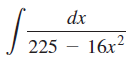
Use a table of integrals to determine the following indefinite integrals. dx 225 – 16x?
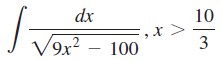
Use a table of integrals to determine the following indefinite integrals. dx 10 ,х х> 3 V9х2 - 100 3.
Use a table of integrals to determine the following indefinite integrals.∫ t√4t + 12 dt
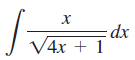
Use a table of integrals to determine the following indefinite integrals. :dx V4x + 1
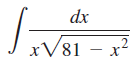
Use a table of integrals to determine the following indefinite integrals. dx rV81 – x²
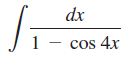
Use a table of integrals to determine the following indefinite integrals. dx 1 - cos 4x
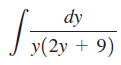
Use a table of integrals to determine the following indefinite integrals. dy y(2y + 9)
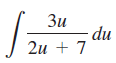
Use a table of integrals to determine the following indefinite integrals. Зи du 2и + 7 и
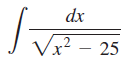
Use a table of integrals to determine the following indefinite integrals. dx Vx? – 25
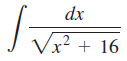
Use a table of integrals to determine the following indefinite integrals. dx Vx² + 16 .2
Use a table of integrals to determine the following indefinite integrals.∫ sin 3x cos 2x dx
Use a table of integrals to determine the following indefinite integrals.∫ cos-1 x dx
Is a reduction formula an analytical method or a numerical method? Explain.
Why might an integral found in a table differ from the same integral evaluated by a computer algebra system?
Does a computer algebra system give an exact result for an indefinite integral? Explain.
Give some examples of analytical methods for evaluating integrals.
Show that with the change of variables u = √tan x, the integral
One of the earliest approximations to π is 22/7. Verify that Why can you conclude that π < 22/7? x*(1 – x)* dx 1 + x² 22 т.
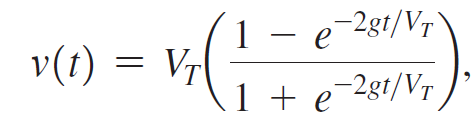
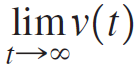
A skydiver has a downward velocity given bywhere t = 0 is the instant the skydiver starts falling, g ≈ 9.8 m/s2 is the acceleration due to gravity, and VT is the terminal velocity of the skydiver. a. Evaluate v(0) andand interpret these results.b. Graph the velocity function.c. Verify by
Three cars, A, B, and C, start from rest and accelerate along a line according to the following velocity functions:a. Which car travels farthest on the interval 0 ≤ t ≤ 1?b. Which car travels farthest on the interval 0 ≤ t ≤ 5?c. Find the position functions for each car assuming that each
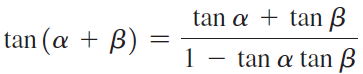
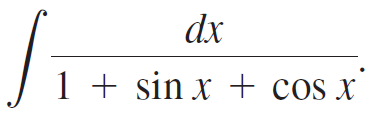
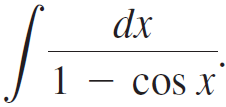
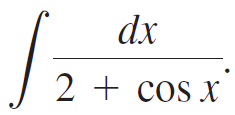
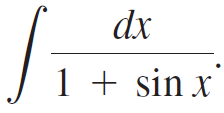
An integrand with trigonometric functions in the numerator and denominator can often be converted to a rational integrand using the substitution u = tan (x/2) or equivalently x = 2 tan-1 u. The following relations are used in making this change of variables.Evaluate и 2 du B: sin xх %— 2u |A:
An integrand with trigonometric functions in the numerator and denominator can often be converted to a rational integrand using the substitution u = tan (x/2) or equivalently x = 2 tan-1 u. The following relations are used in making this change of variables.Evaluate и 2 du B: sin xх %— 2u
An integrand with trigonometric functions in the numerator and denominator can often be converted to a rational integrand using the substitution u = tan (x/2) or equivalently x = 2 tan-1 u. The following relations are used in making this change of variables.Evaluate и 2 du B: sin xх %— 2u |A:
An integrand with trigonometric functions in the numerator and denominator can often be converted to a rational integrand using the substitution u = tan (x/2) or equivalently x = 2 tan-1 u. The following relations are used in making this change of variables.Evaluate и 2 du B: sin xх %— 2u |A:
An integrand with trigonometric functions in the numerator and denominator can often be converted to a rational integrand using the substitution u = tan (x/2) or equivalently x = 2 tan-1 u. The following relations are used in making this change of variables.Evaluate и 2 du B: sin xх %— 2u |A:
An integrand with trigonometric functions in the numerator and denominator can often be converted to a rational integrand using the substitution u = tan (x/2) or equivalently x = 2 tan-1 u. The following relations are used in making this change of variables.Evaluate и 2 du B: sin xх %— 2u |A:
An integrand with trigonometric functions in the numerator and denominator can often be converted to a rational integrand using the substitution u = tan (x/2) or equivalently x = 2 tan-1 u. The following relations are used in making this change of variables.Verify relation A by differentiating x =
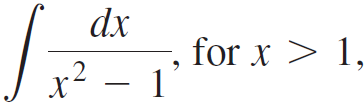
Evaluate in two ways: using partial fractions and a trigonometric substitution. Reconcile your two answers. dx for x > 1, x² – 1
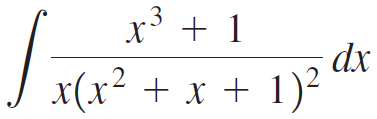
Refer to the summary box (Partial Fraction Decompositions) and evaluate the following integrals. 3 x’ + 1 dx x(x² + x + 1)-
Showing 2600 - 2700
of 6775
First
20
21
22
23
24
25
26
27
28
29
30
31
32
33
34
Last
Step by Step Answers

 Get 50% OFF
Claim Now
Get 50% OFF
Claim Now