New Semester
Started
Get
50% OFF
Study Help!
--h --m --s
Claim Now
Question Answers
Textbooks
Find textbooks, questions and answers
Oops, something went wrong!
Change your search query and then try again
S
Books
FREE
Study Help
Expert Questions
Accounting
General Management
Mathematics
Finance
Organizational Behaviour
Law
Physics
Operating System
Management Leadership
Sociology
Programming
Marketing
Database
Computer Network
Economics
Textbooks Solutions
Accounting
Managerial Accounting
Management Leadership
Cost Accounting
Statistics
Business Law
Corporate Finance
Finance
Economics
Auditing
Tutors
Online Tutors
Find a Tutor
Hire a Tutor
Become a Tutor
AI Tutor
AI Study Planner
NEW
Sell Books
Search
Search
Sign In
Register
study help
mathematics
calculus early transcendentals
Calculus Early Transcendentals 2nd edition William L. Briggs, Lyle Cochran, Bernard Gillett - Solutions
Determine whether the following equations are separable. If so, solve the given initial value problem.y'(t) = y(4t3 + 1), y(0) = 4
Determine whether the following equations are separable. If so, solve the given initial value problem.dy/dt = ty + 2, y(1) = 2
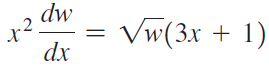
Find the general solution of the following equations. dw Vw(3x + 1) dx
Find the general solution of the following equations.y'(t) = ey/2 sin t
Find the general solution of the following equations.dy/dx = y(x2 + 1), where y > 0
Find the general solution of the following equations.dy/dt = 3t2/y
A fish hatchery has 500 fish at time t = 0, when harvesting begins at a rate of b fish/yr, where b > 0. The fish population is modeled by the initial value problemy'(t) = 0.1y - b, y(0) = 500 for t ≥ 0,where t is measured in years.a. Find the fish population for t ≥ 0 in terms of the
The amount of drug in the blood of a patient (in mg) due to an intravenous line is governed by the initial value problemy'(t) = -0.02y + 3, y(0) = 0 for t ≥ 0,where t is measured in hours.a. Find and graph the solution of the initial value problem.b. What is the steady-state level of the drug?c.
Solve the following problems.du/dx = 2u + 6, u(1) = 6
Solve the following problems.y'(t) = -2y - 4, y(0) = 0
Solve the following problems.dy/dx = -y + 2, y(0) = -2
Solve the following problems.y'(t) = 3y - 6, y(0) = 9
Find the general solution of the following equations.dy/dt = 2y + 6
Find the general solution of the following equations.y'(x) = -2y - 4
Find the general solution of the following equations.dy/dx = -y + 2
Find the general solution of the following equations.y'(t) = 3y - 4
Solve the following problems.dy/dx = 3 cos 2x + 2 sin 3x, y(π/2) = 8
Solve the following problems.y'(t) = (2t2 + 4)/t, y(1) = 2
Solve the following problems.dy/dt = 8e-4t + 1, y(0) = 5
Solve the following problems.y'(t) = 3t2 - 4t + 10, y(0) = 20
Verify that the given function y is a solution of the initial value problem that follows it.y = 1/4 (e2x - e-2x); y"(x) - 4y = 0, y(0)= 0, y'(0) = 1
Verify that the given function y is a solution of the initial value problem that follows it.y = -3 cos 3t; y"(t) + 9y = 0, y(0) = -3, y'(0) = 0
Verify that the given function y is a solution of the initial value problem that follows it.y = 8t6 - 3; ty'(t) - 6y = 18, y(1) = 5
Verify that the given function y is a solution of the initial value problem that follows it.y = 16e2t - 10; y'(t) - 2y = 20, y(0) = 6
Verify that the given function y is a solution of the differential equation that follows it. Assume that C, C1, and C2 are arbitrary constants.y = C1e-x + C2ex; y"(x) - y = 0
Verify that the given function y is a solution of the differential equation that follows it. Assume that C, C1, and C2 are arbitrary constants.y = C1 sin 4t + C2 cos 4t; y"(t) + 16y = 0
Verify that the given function y is a solution of the differential equation that follows it. Assume that C, C1, and C2 are arbitrary constants.y = Ct-3; ty'(t) + 3y = 0
Verify that the given function y is a solution of the differential equation that follows it. Assume that C, C1, and C2 are arbitrary constants.y = Ce-5t; y'(t) + 5y = 0
Explain how to sketch the direction field of the equation y'(t) = F(t, y), where F is given.
Explain how to solve a separable differential equation of the form g(y) y'(t) = h(t).
Is the equation t2y'(t) = (t + 4)/y2 separable?
What is a separable first-order differential equation?
If the general solution of a differential equation is y = Ce-3t + 10, what is the solution that satisfies the initial condition y(0) = 5?
How many arbitrary constants appear in the general solution of y"(t) + 9y(t) = 10?
Is y"(t) + 9y(t) = 10 linear or nonlinear?
What is the order of y"(t) + 9y(t) = 10?
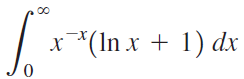
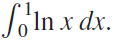
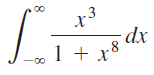
Evaluate the following integrals.
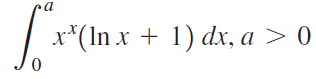
Evaluate the following integrals. |ronя x*(In x + 1) dx, a > 0
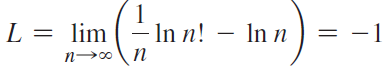
Show that in the following steps.a. Note that n! = n(n - 1)(n - 2) · · · · 1 and use ln (ab) = ln a + ln b to show that b. Identify the limit of this sum as a Riemann sum for Integrate this improper integral by parts and reach the desired conclusion. |L = lim - In n! – In n
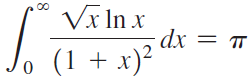
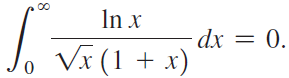
Show that in the following steps.a. Integrate by parts with u = √x ln x.b. Change variables by letting y = 1/x.c. Show that (and that both integrals converge). Conclude that d. Evaluate the remaining integral using the change of variables z = √x. 00 Vĩ In x т dx = (1 + x)² In x In x dx dx
The gamma function is defined by for p not equal to zero or a negative integer.a. Use the reduction formulato show that (p factorial).b. Use the substitution x = u2 and the fact that to show that Гр) %3D Jохр- Те dx, xP-le* dx, = p | xP-\e* dx, for p = 1, 2, 3, . . xPe¯* dx =
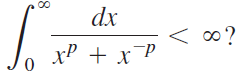
For what values of p > 0 is dx 0o ? < хP + x Р
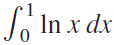
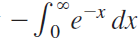
Compute using integration by parts. Then explain why(an easier integral) gives the same result. So In x dx - So e * dx
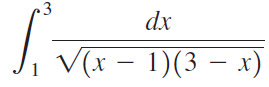
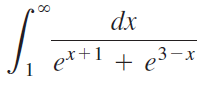
Evaluate the following improper integralsa.b. dx J, V(x - 1)(3 – x) dx e*+1 + e3-
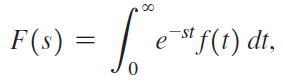
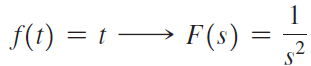
A powerful tool in solving problems in engineering and physics is the Laplace transform. Given a function f(t), the Laplace transform is a new function F(s) defined by
A powerful tool in solving problems in engineering and physics is the Laplace transform. Given a function f(t), the Laplace transform is a new function F(s) defined by
A powerful tool in solving problems in engineering and physics is the Laplace transform. Given a function f(t), the Laplace transform is a new function F(s) defined by
A powerful tool in solving problems in engineering and physics is the Laplace transform. Given a function f(t), the Laplace transform is a new function F(s) defined by
A powerful tool in solving problems in engineering and physics is the Laplace transform. Given a function f(t), the Laplace transform is a new function F(s) defined by
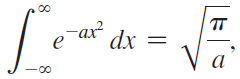
An important function in statistics is the Gaussian (or normal distribution, or bell-shaped curve), f(x) = e-ax2. a. Graph the Gaussian for a = 0.5, 1, and 2.b. Given thatcompute the area under the curves in part (a).c. Complete the square to evaluate where a > 0, b, and c are real numbers.
The nucleus of an atom is positively charged because it consists of positively charged protons and uncharged neutrons. To bring a free proton toward a nucleus, a repulsive force F(r) = kqQ/r2 must be overcome, where q = 1.6 × 10⁻¹⁹ C (coulombs) is the charge on the proton, k = 9 × 10⁹ N-m2/C2, Q
The work required to launch an object from the surface of Earth to outer space is given by where R = 6370 km is the approximate radius of Earth, F(x) = GMm/x2 is the gravitational force between Earth and the object, G is the gravitational constant, M is the mass of Earth, m is the mass of the
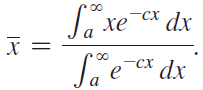
Let R be the region between the curves y = e-cx and y = -e-cx on the interval (a, ∞), where a ≥ 0 and c > 0. The center of mass of R is located at where (The profile of the Eiffel Tower is modeled by the two exponential curves; see the Guided Project The exponential Eiffel Tower.)a. For a =
The average time until a computer chip fails (see Exercise 84) is Find this value.Data from Exercise 84Suppose the probability that a particular computer chip fails after a hours of operation is |0.00005 [te-0.00005f dt. -0.00005t dt. 0.00005 /
Suppose the probability that a particular computer chip fails after a hours of operation isa. Find the probability that the computer chip fails after 15,000 hr of operation.b. Of the chips that are still operating after 15,000 hr, what fraction of these will operate for at least another 15,000
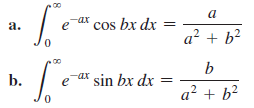
Let a > 0 and b be real numbers. Use integration to confirm the following identities. 00 cos bx dx -ах a. a? + b2 b. e a* sin bx dx -ах a? + b?
Water is drained from a 3000-gal tank at a rate that starts at 100 gal>hr and decreases continuously by 5%>hr. If the drain is left open indefinitely, how much water drains from the tank? Can a full tank be emptied at this rate?
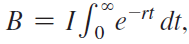
Imagine that today you deposit $B in a savings account that earns interest at a rate of p% per year compounded continuously (Section 6.9). The goal is to draw an income of $I per year from the account forever. The amount of money that must be deposited is where r = p/100. Suppose you find an
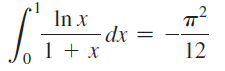
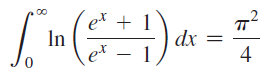
Use numerical methods or a calculator to approximate the following integrals as closely as possible. The exact value of each integral is given.
Use numerical methods or a calculator to approximate the following integrals as closely as possible. The exact value of each integral is given. et + 1 In т dx et 4
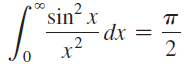
Use numerical methods or a calculator to approximate the following integrals as closely as possible. The exact value of each integral is given. si 00 ´sin² x т dx .2 x²
Use numerical methods or a calculator to approximate the following integrals as closely as possible. The exact value of each integral is given. 7/2 сп/2 T In 2 In (sin x) dx In (cos x) dx
Let R be the region bounded by the graph of f(x) = x-p and the x-axis, for x ≥ 1. a. Let S be the solid generated when R is revolved about the x-axis. For what values of p is the volume of S finite?b. Let S be the solid generated when R is revolved about the y-axis. For what values of p is
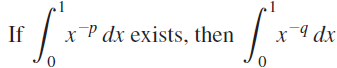
Let R be the region bounded by the graph of f(x) = x-p and the x-axis, for 0 < x ≤ 1. a. Let S be the solid generated when R is revolved about the x-axis. For what values of p is the volume of S finite?b. Let S be the solid generated when R is revolved about the y-axis. For what values of
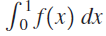
Consider the family of functions f(x) = 1/xp, where p is a real number. For what values of p does the integralexist? What is its value? SoS(x) dx
Let a > 0 and let R be the region bounded by the graph of y = e-ax and the x-axis on the interval [b, ∞].a. Find A(a, b), the area of R as a function of a and b.b. Find the relationship b = g(a) such that A(a, b) = 2.c. What is the minimum value of b (call it b*) such that when b > b*, A(a,
Let A(a) denote the area of the region bounded by y = e-ax and the x-axis on the interval [0, ∞]. Graph the function A(a), for 0 < a < ∞. Describe how the area of the region decreases as the parameter a increases.
Let R be the region bounded by the graphs of y = e-ax and y = e-bx, for x ≥ 0, where a > b > 0. Find the area of R.
Let R be the region bounded by the graphs of y = x-p and y = x-q, for x ≥ 1, where q > p > 1. Find the area of R.
Graph the integrands and then evaluate and compare the values of e* dx. dx and ox² e хе
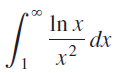
Use integration by parts to evaluate the following integrals. 00 In x x2 х
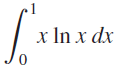
Use integration by parts to evaluate the following integrals. х In x dx Jo
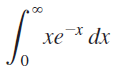
Use integration by parts to evaluate the following integrals. 00 хе * dx Jo
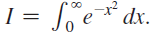
Use the Trapezoid Rule to approximate with R = 2, 4, and 8. For each value of R, take n = 4, 8, 16, and 32, and compare approximations with successive values of n. Use these approximations to approximate rR -x dx х ал 0. I= Joe* dx.
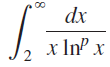
For what values of p does the integralexist and what is its value (in terms of p)? dx x Inº x
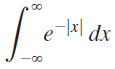
Use symmetry to evaluate the following integrals.a.b. 00 |x|- dx ° 00 +3 dx ∞ 1 + x° -0-
What is wrong with this calculation? – In 1 = 0 In |x| In 1 =
Determine whether the following statements are true and give an explanation or counterexample. a. If f is continuous and 0 < f(x) < g(x) on the interval (0, ∞), andexists.b.c.exists, where q > p.d.exists, where q > p.e.exists, for p > -1/3. -Го | g(x) dx = M < ∞, then
Suppose that the rate at which a company extracts oil is given by r(t) = r0e-kt, where r0 = 107 barrels/yr and k = 0.005 yr-1. Suppose also the estimate of the total oil reserve is 2 × 10⁹ barrels. If the extraction continues indefinitely, will the reserve be exhausted?
An object moves on a line with velocity v(t) = 10/(t + 1)2 mi/hr, for t ≥ 0. What is the maximum distance the object can travel?
Water is drained from a swimming pool at a rate given by R(t) = 100 e-0.05t gal/hr. If the drain is left open indefinitely, how much water drains from the pool?
When a drug is given intravenously, the concentration of the drug in the blood is Ci(t) = 250e-0.08t, for t ≥ 0. When the same drug is given orally, the concentration of the drug in the blood is Co(t) = 200(e-0.08t - e-1.8t), for t ≥ 0. Compute the bioavailability of the drug.
Find the volume of the described solid of revolution or state that it does not exist.The region bounded by f(x) = -ln x and the x-axis on the interval [0, 1] is revolved about the x-axis.
Find the volume of the described solid of revolution or state that it does not exist.The region bounded by f(x) = tan x and the x-axis on the interval [0, π/2] is revolved about the x-axis.
Find the volume of the described solid of revolution or state that it does not exist.The region bounded by f(x) = (x + 1)-3/2 and the x-axis on the interval (-1, 1) is revolved about the line y = -1.
Find the volume of the described solid of revolution or state that it does not exist.The region bounded by f(x) = (4 - x)-1/3 and the x-axis on the interval [0, 4] is revolved about the y-axis.
Find the volume of the described solid of revolution or state that it does not exist.The region bounded by f(x) = (x2 - 1)-1/4 and the x-axis on the interval [1, 2] is revolved about the y-axis.
Find the volume of the described solid of revolution or state that it does not exist.The region bounded by f(x) = (x - 1)-1/4 and the x-axis on the interval [1, 2] is revolved about the x-axis.
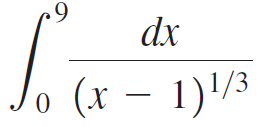
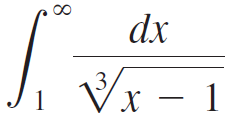
Evaluate the following integrals or state that they diverge. dx (x – 1)/3
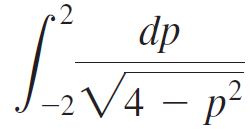
Evaluate the following integrals or state that they diverge. .2 dp V4 – p²
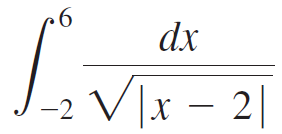
Evaluate the following integrals or state that they diverge. 6. dx VIx – 2| -2
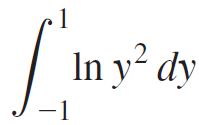
Evaluate the following integrals or state that they diverge. In y² dy -1
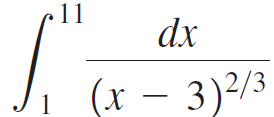
Evaluate the following integrals or state that they diverge. 11 dx (х — 3)2/3 1
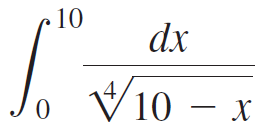
Evaluate the following integrals or state that they diverge. 10 dx V10 – x 4,
Evaluate the following integrals or state that they diverge. S. dx Vx – 1
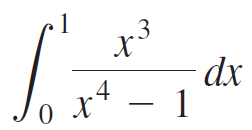
Evaluate the following integrals or state that they diverge. †3 x4 - 1
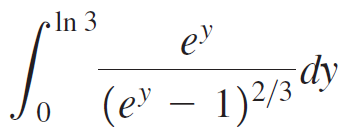
Evaluate the following integrals or state that they diverge. In 3 (e» – 1)2/3dv Jo
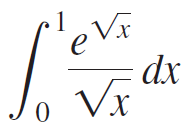
Evaluate the following integrals or state that they diverge. dx Vx
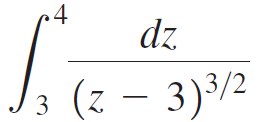
Evaluate the following integrals or state that they diverge. dz (z 3)3/2 Z. 3
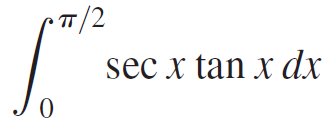
Evaluate the following integrals or state that they diverge. T/2 sec x tan x dx
Showing 2400 - 2500
of 6775
First
18
19
20
21
22
23
24
25
26
27
28
29
30
31
32
Last
Step by Step Answers

 Get 50% OFF
Claim Now
Get 50% OFF
Claim Now