New Semester
Started
Get
50% OFF
Study Help!
--h --m --s
Claim Now
Question Answers
Textbooks
Find textbooks, questions and answers
Oops, something went wrong!
Change your search query and then try again
S
Books
FREE
Study Help
Expert Questions
Accounting
General Management
Mathematics
Finance
Organizational Behaviour
Law
Physics
Operating System
Management Leadership
Sociology
Programming
Marketing
Database
Computer Network
Economics
Textbooks Solutions
Accounting
Managerial Accounting
Management Leadership
Cost Accounting
Statistics
Business Law
Corporate Finance
Finance
Economics
Auditing
Tutors
Online Tutors
Find a Tutor
Hire a Tutor
Become a Tutor
AI Tutor
AI Study Planner
NEW
Sell Books
Search
Search
Sign In
Register
study help
mathematics
calculus early transcendentals
Calculus Early Transcendentals 2nd edition William L. Briggs, Lyle Cochran, Bernard Gillett - Solutions
A tsunami is an ocean wave often caused by earthquakes on the ocean floor; these waves typically have long wavelengths, ranging between 150 to 1000 km. Imagine a tsunami traveling across the Pacific Ocean, which is the deepest ocean in the world, with an average depth of about 4000 m. Explain why
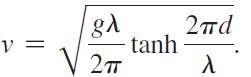
a. Confirm that the linear approximation to f(x) = tanh x at a = 0 is L(x) = x.b. Recall that the velocity of a surface wave on the ocean is In fluid dynamics, shallow water refers to water where the depth-to-wavelength ratio d/λ < 0.05. Use your answer to part (a) to explain why the shallow
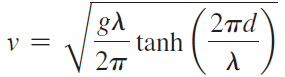
Use Exercise 69 to do the following calculations. a. Find the velocity of a wave where λ = 50 m and d = 20 m.b. Determine the depth of the water if a wave with λ = 15 m is traveling at v = 4.5 m/s.Data from Exercise 69The velocity of a surface wave on the ocean is given by (Example 8).
The velocity of a surface wave on the ocean is given by (Example 8). Use a graphing utility or root finder to approximate the wavelength λ of an ocean wave traveling at v = 7 m/s in water that is d = 10 m deep. 2πd tanh 2п
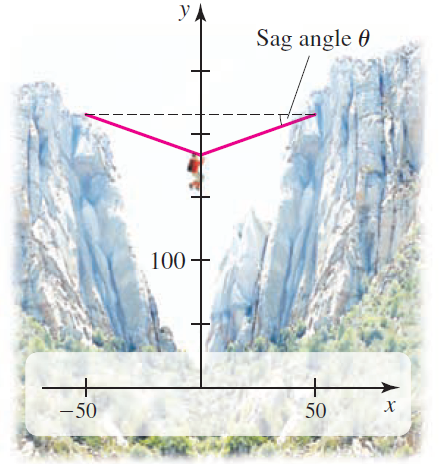
Imagine a climber clipping onto the rope described in Example 7 and pulling himself to the rope’s midpoint. Because the rope is supporting the weight of the climber, it no longer takes the shape of the catenary y = 200 cosh(x/200). Instead, the rope (nearly) forms two sides of an isosceles
A power line is attached at the same height to two utility poles that are separated by a distance of 100 ft; the power line follows the curve f(x) = a cosh(x/a). Use the following steps to find the value of a that produces a sag of 10 ft midway between the poles. Use a coordinate system that places
Show that the arc length of the catenary y = cosh x over the interval [0, a] is L = sinh a.
The portion of the curve y = 17/15 - cosh x that lies above the x-axis forms a catenary arch. Find the average height of the arch above the x-axis.
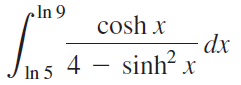
Evaluate the following definite integrals. Use Theorem 6.10 to express your answer in terms of logarithms. In 9 cosh x dx 4 - sinh? x In 5
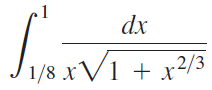
Evaluate the following definite integrals. Use Theorem 6.10 to express your answer in terms of logarithms. dx 1/8 xV1 + x2/3
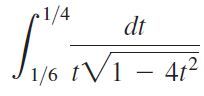
Evaluate the following definite integrals. Use Theorem 6.10 to express your answer in terms of logarithms. r1/4 dt Jvo iVI – 41? 1/6
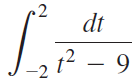
Evaluate the following definite integrals. Use Theorem 6.10 to express your answer in terms of logarithms. dt , 1² – 9 +2 -2
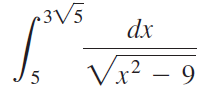
Evaluate the following definite integrals. Use Theorem 6.10 to express your answer in terms of logarithms. • 3V5 dx Vx? – 9 5
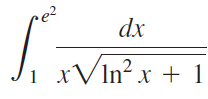
Evaluate the following definite integrals. Use Theorem 6.10 to express your answer in terms of logarithms. •e? dx xVIn? x + 1
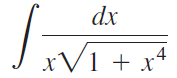
Determine the following indefinite integrals. dx xV1 + x4
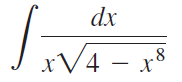
Determine the following indefinite integrals. dx xV4 .8
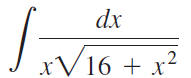
Determine the following indefinite integrals. dx xV16 + x²
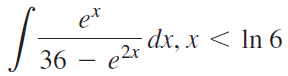
Determine the following indefinite integrals. et dx, x < In 6 e2x 36 –
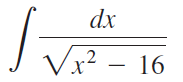
Determine the following indefinite integrals. dx Vx? .2 16
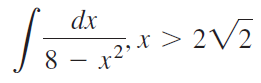
Determine the following indefinite integrals. dx > 2V2 8 – x2'*
Find the derivatives of the following functions.f(u) = sinh-1 (tan u)
Find the derivatives of the following functions.f(x) = x sinh-1 x - √x2 + 1
Find the derivatives of the following functions.f(x) = csch-1 (2/x)
Find the derivatives of the following functions.f(v) = sinh-1 v2
Find the derivatives of the following functions.f(t) = 2 tanh-1 √t
Find the derivatives of the following functions.f(x) = cosh-1 4x
a. Sketch the graphs of the functions f and g and find the x-coordinate of the points at which they intersect.b. Compute the area of the region described.f(x) = sinh x, g(x) = tanh x; the region bounded by the graphs of f, g, and x = ln 3
a. Sketch the graphs of the functions f and g and find the x-coordinate of the points at which they intersect.b. Compute the area of the region described.f(x) = sech x, g(x) = tanh x; the region bounded by the graphs of f, g, and the y-axis
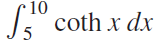
Prove the formula ∫ coth x dx = ln |sinh x| + C of Theorem 6.9.
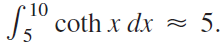
a. Use a graphing utility to sketch the graph of y = coth x and then explain why b. Evaluate
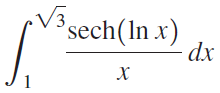
Evaluate the following integrals two ways.a. Simplify the integrand first and then integrate.b. Change variables (let u = ln x), integrate, and then simplify your answer. Verify that both methods give the same answer. V3 3 sech(In x) dx
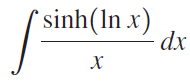
Evaluate the following integrals two ways.a. Simplify the integrand first and then integrate.b. Change variables (let u = ln x), integrate, and then simplify your answer. Verify that both methods give the same answer. `sinh(ln x) dx
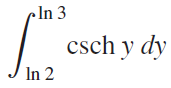
Evaluate each definite integral. In 3 csch y dy In 2
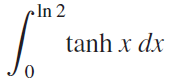
Evaluate each definite integral. In 2 tanh x dx
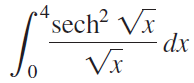
Evaluate each definite integral. sech? V dx VI
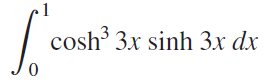
Evaluate each definite integral. cosh³ 3x sinh 3x dx
Determine each indefinite integral.∫ sinh2 x dx. Use an identity.
Determine each indefinite integral.∫ tanh2 x dx. Use an identity.
Determine each indefinite integral.∫ coth2 x csch2 x dx
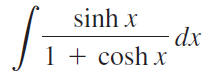
Determine each indefinite integral. sinh x dx 1 + cosh x
Determine each indefinite integral.∫ sech2 x tanh x dx
Determine each indefinite integral.∫ cosh 2x dx
Compute dy/dx for the following functions.y = x/csch x
Compute dy/dx for the following functions.y = x2 cosh2 3x
Compute dy/dx for the following functions.y = x tanh x
Compute dy/dx for the following functions.y = ln sech 2x
Compute dy/dx for the following functions.y = √coth 3x
Compute dy/dx for the following functions.y = tanh2 x
Compute dy/dx for the following functions.y = -sinh3 4x
Compute dy/dx for the following functions.y = cosh2 x
Compute dy/dx for the following functions.y = sinh 4x
Derive the following derivative formulas given that d/dx(cosh x) = sinh x and d/dx(sinh x) = cosh x.d/dx(csch x) = -csch x coth x
Derive the following derivative formulas given that d/dx(cosh x) = sinh x and d/dx(sinh x) = cosh x.d/dx(sech x) = -sech x tanh x
Derive the following derivative formulas given that d/dx(cosh x) = sinh x and d/dx(sinh x) = cosh x.d/dx(coth x) = -csch2 x
Use the given identity to verify the related identity.Use the identity cosh(x + y) = cosh x cosh y + sinh x sinh y to verify the identity cosh 2x = cosh2 x + sinh2 x.
Use the given identity to verify the related identity.Use the identity cosh 2x = cosh2 x + sinh2 x to verify the identities cosh 2x + 1 cosh 2x cosh x and sinh?x
Use the given identity to verify the related identity.Use the fundamental identity cosh2 x - sinh2 x = 1 to verify the identity coth2 x - 1 = csch2 x.
Verify each identity using the definitions of the hyperbolic functions.2 sinh(ln (sec x)) = sin x tan x
Verify each identity using the definitions of the hyperbolic functions.cosh 2x = cosh2 x + sinh2 x. Begin with the right side of the equation.
Verify each identity using the definitions of the hyperbolic functions.tanh(-x) = -tanh x
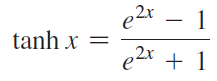
Verify each identity using the definitions of the hyperbolic functions. e2x – 1 tanh x = ,2x e2* + 1
How does the graph of the catenary y = a cosh (x/a) change as a > 0 increases?
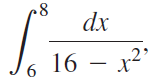
When evaluating the definite integral why must you choose the antiderivative 1/4 coth-1 x/4 rather than 1/4 tanh-1 x/4? dx ' 16 — х2 6.
On what interval is the formula d/dx (tanh-1 x) = 1/(x2 - 1) valid?
A calculator has a built-in sinh-1 x function, but no csch-1 x function. How do you evaluate csch-1 5 on such a calculator?
What is the domain of sech-1 x? How is sech-1 x defined in terms of the inverse hyperbolic cosine?
Express sinh-1 x in terms of logarithms.
How are the derivative formulas for the hyperbolic functions and the trigonometric functions alike? How are they different?
What is the fundamental identity for hyperbolic functions?
Sketch the graphs of y = cosh x, y = sinh x, and y = tanh x (include asymptotes), and state whether each function is even, odd, or neither.
State the definition of the hyperbolic cosine and hyperbolic sine functions.
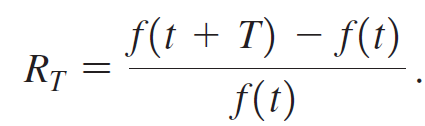
Define the relative growth rate of the function f over the time interval T to be the relative change in f over an interval of length T:Show that for the exponential function y(t) = y0ekt, the relative growth rate RT is constant for any T; that is, choose any T and show that RT is constant for all
The same exponential growth function can be written in the forms y(t) = y0ekt, y(t) = y0(1 + r)t, and y(t) = y02t/T2. Write k as a function of r, r as a function of T2, and T2 as a function of k.
A quantity grows exponentially according to y(t) = y0ekt. What is the relationship between m, n, and p such that y(p) = √y(m)y(n)?
The owner of a clothing store understands that the demand for shirts decreases with the price. In fact, she has developed a model that predicts that at a price of $x per shirt, she can sell D(x) = 40e-x/50 shirts in a day. It follows that the revenue (total money taken in) in a day is R(x) = xD(x)
The burning of fossil fuels releases greenhouse gases (roughly 60% carbon dioxide) into the atmosphere. In 2010, the United States released approximately 5.8 billion metric tons of carbon dioxide (Environmental Protection Agency estimate), while China released approximately 8.2 billion metric tons
Suppose the cells of a tumor are idealized as spheres each with a radius of 5 μm (micrometers). The number of cells has a doubling time of 35 days. Approximately how long will it take a single cell to grow into a multi-celled spherical tumor with a volume of 0.5 cm3 (1 cm = 10,000 μm)?
A model for the startup of a runner in a short race results in the velocity function v(t) = a(1 - e-t/c), where a and c are positive constants and v has units of m/s.a. Graph the velocity function for a = 12 and c = 2. What is the runner’s maximum velocity?b. Using the velocity in part (a) and
An object moves in a straight line, acted on by air resistance, which is proportional to its velocity; this means its acceleration is a(t) = -kv(t). The velocity of the object decreases from 1000 ft/s to 900 ft/s over a distance of 1200 ft. Approximate the time required for this deceleration to
Suppose the acceleration of an object moving along a line is given by a(t) = -kv(t), where k is a positive constant and v is the object’s velocity. Assume that the initial velocity and position are given by v(0) = 10 and s(0) = 0, respectively.a. Use a(t) = v'(t) to find the velocity of the
The U.S. government reports the rate of inflation (as measured by the Consumer Price Index) both monthly and annually. Suppose that for a particular month, the monthly rate of inflation is reported as 0.8%. Assuming that this rate remains constant, what is the corresponding annual rate of
Bankers use the law of 70, which says that if an account increases at a fixed rate of p%/yr, its doubling time is approximately 70/p. Explain why and when this statement is true.
Starting at the same time and place, Abe and Bob race, running at velocities u(t) = 4/(t + 1) mi/hr and v(t) = 4e-t/2 mi/hr, respectively, for t ≥ 0. a. Who is ahead after t = 5 hr? After t = 10 hr?b. Find and graph the position functions of both runners. Which runner can run only a finite
City A has a current population of 500,000 people and grows at a rate of 3%/yr. City B has a current population of 300,000 and grows at a rate of 5%/yr. a. When will the cities have the same population?b. Suppose City C has a current population of y0 < 500,000 and a growth rate of p >
Prove that the doubling time for an exponentially increasing quantity is constant for all time.
A quantity increases according to the exponential function y(t) = y0ekt. What is the tripling time for the quantity? What is the time required for the quantity to increase p-fold?
Determine whether the following statements are true and give an explanation or counterexample.a. A quantity that increases at 6%/yr obeys the growth function y(t) = y0e0.06t.b. If a quantity increases by 10%/yr, it increases by 30% over 3 years.c. A quantity decreases by one-third every month.
Roughly 12,000 Americans are diagnosed with thyroid cancer every year, which accounts for 1% of all cancer cases. It occurs in women three times as frequently as in men. Fortunately, thyroid cancer can be treated successfully in many cases with radioactive iodine, or I-131. This unstable form of
Uranium-238 (U-238) has a half-life of 4.5 billion years. Geologists find a rock containing a mixture of U-238 and lead, and determine that 85% of the original U-238 remains; the other 15% has decayed into lead. How old is the rock?
The half-life of C-14 is about 5730 yr. a. Archaeologists find a piece of cloth painted with organic dyes. Analysis of the dye in the cloth shows that only 77% of the C-14 originally in the dye remains. When was the cloth painted?b. A well-preserved piece of wood found at an archaeological
The pressure of Earth’s atmosphere at sea level is approximately 1000 millibars and decreases exponentially with elevation. At an elevation of 30,000 ft (approximately the altitude of Mt. Everest), the pressure is one-third the sea-level pressure. At what elevation is the pressure half the
A large die-casting machine used to make automobile engine blocks is purchased for $2.5 million. For tax purposes, the value of the machine can be depreciated by 6.8% of its current value each year.a. What is the value of the machine after 10 years?b. After how many years is the value of the
Devise an exponential decay function that fits the following data; then answer the accompanying questions. Be sure to identify the reference point (t = 0) and units of time.The population of Michigan decreased from 9.94 million in 2000 to 9.88 million in 2010. Use an exponential model to predict
Devise an exponential decay function that fits the following data; then answer the accompanying questions. Be sure to identify the reference point (t = 0) and units of time.China’s one-child policy was implemented with a goal of reducing China’s population to 700 million by 2050 (from 1.2
Devise an exponential decay function that fits the following data; then answer the accompanying questions. Be sure to identify the reference point (t = 0) and units of time.The drug Valium is eliminated from the bloodstream with a half-life of 36 hr. Suppose that a patient receives an initial dose
Devise an exponential decay function that fits the following data; then answer the accompanying questions. Be sure to identify the reference point (t = 0) and units of time.A drug is eliminated from the body at a rate of 15%/hr. After how many hours does the amount of drug reach 10% of the initial
Devise an exponential decay function that fits the following data; then answer the accompanying questions. Be sure to identify the reference point (t = 0) and units of time.The homicide rate decreases at a rate of 3%/yr in a city that had 800 homicides/yr in 2010. At this rate, when will the
Starting in 2010 (t = 0), the rate at which oil is consumed by a small country increases at a rate of 1.5%/yr, starting with an initial rate of 1.2 million barrels/yr. a. How much oil is consumed over the course of the year 2010 (between t = 0 and t = 1)?b. Find the function that gives the
Texas had the largest increase in population of any state in the United States from 2000 to 2010. During that decade, Texas grew from 20.9 million in 2000 to 25.1 million in 2010. Use an exponential growth model to predict the population of Texas in 2025.
On the first day of the year (t = 0), a city uses electricity at a rate of 2000 MW. That rate is projected to increase at a rate of 1.3% per year. a. Based on these figures, find an exponential growth function for the power (rate of electricity use) for the city.b. Find the total energy (in
Showing 2900 - 3000
of 6775
First
23
24
25
26
27
28
29
30
31
32
33
34
35
36
37
Last
Step by Step Answers

 Get 50% OFF
Claim Now
Get 50% OFF
Claim Now