New Semester
Started
Get
50% OFF
Study Help!
--h --m --s
Claim Now
Question Answers
Textbooks
Find textbooks, questions and answers
Oops, something went wrong!
Change your search query and then try again
S
Books
FREE
Study Help
Expert Questions
Accounting
General Management
Mathematics
Finance
Organizational Behaviour
Law
Physics
Operating System
Management Leadership
Sociology
Programming
Marketing
Database
Computer Network
Economics
Textbooks Solutions
Accounting
Managerial Accounting
Management Leadership
Cost Accounting
Statistics
Business Law
Corporate Finance
Finance
Economics
Auditing
Tutors
Online Tutors
Find a Tutor
Hire a Tutor
Become a Tutor
AI Tutor
AI Study Planner
NEW
Sell Books
Search
Search
Sign In
Register
study help
mathematics
calculus early transcendentals
Calculus Early Transcendentals 2nd edition William L. Briggs, Lyle Cochran, Bernard Gillett - Solutions
The region bounded by the curves y = 2x and y = x2 is revolved about the y-axis. Give an integral for the volume of the solid that is generated.
The region bounded by the curves y = 2x and y = x2 is revolved about the x-axis. Give an integral for the volume of the solid that is generated.
A solid has a circular base and cross sections perpendicular to the base are squares. What method should be used to find the volume of the solid?
Suppose a cut is made through a solid object perpendicular to the x-axis at a particular point x. Explain the meaning of A(x).
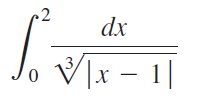
Evaluate the following integrals analytically. dx VIx – 1|
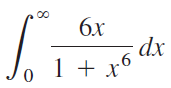
Evaluate the following integrals analytically. 00 6x dx 1 + x6
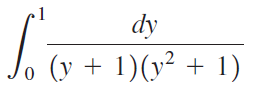
Evaluate the following integrals analytically. dy (y + 1)(y² + 1)
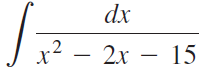
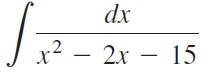
Evaluate the following integrals analytically. dx x² – 2x – 15
Evaluate the following integrals analytically. dx x² – 2x – 15
Evaluate the following integrals analytically.∫ sinh-1 x dx
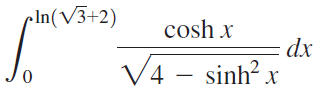
Evaluate the following integrals analytically. eIn(V3+2) cosh x dx V4 - sinh? x
Evaluate the following integrals analytically.∫ x2 cosh x dx
Evaluate the following integrals analytically.∫ sech2 x sinh x dx
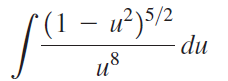
Evaluate the following integrals analytically. - u²)5/2 du ,8'
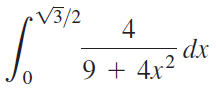
Evaluate the following integrals analytically. V3/2 9 + 4x2
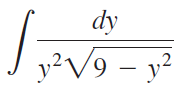
Evaluate the following integrals analytically. dy y?V9 – y?
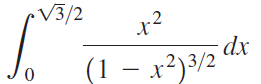
Evaluate the following integrals analytically. •V3/2 x2 dx (1 – x²)3/2
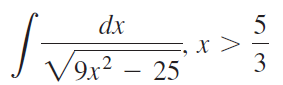
Evaluate the following integrals analytically. dx х V9x² – 25 Л
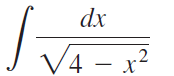
Evaluate the following integrals analytically. dx V4 – x²
Evaluate the following integrals analytically.∫ tan4 u du
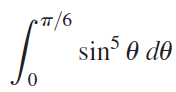
Evaluate the following integrals analytically. sin 0 d0
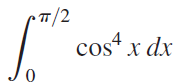
Evaluate the following integrals analytically. • T7/2 cost x dx cos4.
Evaluate the following integrals analytically.∫ sec5 z tan z dz
Evaluate the following integrals analytically.∫ sin 3x cos6 3x dx
Evaluate the following integrals analytically.∫ cos2 4θ dθ
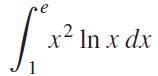
Evaluate the following integrals analytically. In x dx x²
Evaluate the following integrals analytically.∫ ex sin x dx
Evaluate the following integrals analytically.∫ x2 cos x dx
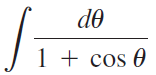
Evaluate the following integrals analytically. do 1 + cos 0
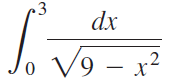
Evaluate the following integrals. .3 dx 9 – x
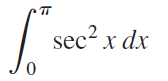
Evaluate the following integrals. TT | sec2 x dx
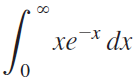
Evaluate the following integrals. dx xe
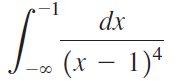
Evaluate the following integrals. dx (x – 1)4 -00
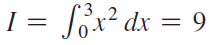
Let andconsider the Trapezoid Rule (T(n)) and the Midpoint Rule (M(n)) approximations to I.a. Compute T(6) and M(6).b. Compute T(12) and M(12). 1 = Sox² dx = 9
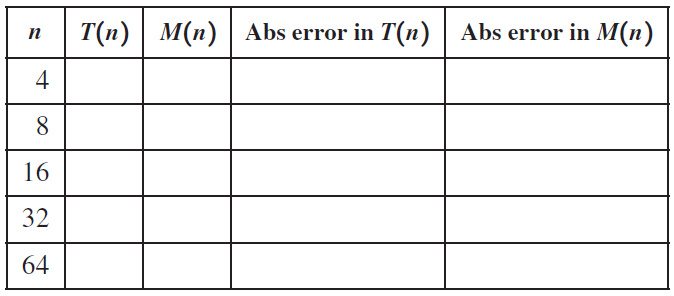
Letand note that I = 0.a. Complete the following table with Trapezoid Rule (T(n)) and Midpoint Rule (M(n)) approximations to I for various values of n.b. Fill in the error columns with the absolute errors in the approximations in part (a).c. How do the errors in T(n) decrease as n doubles in
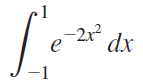
Use a computer algebra system to approximate the value of the following integrals. -2x2 dx -1
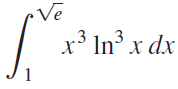
Use a computer algebra system to approximate the value of the following integrals. Ve x' In x dx
Use a table of integrals to evaluate the following integrals.∫ sec5 x dx
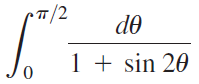
Use a table of integrals to evaluate the following integrals. • 7/2 do 1 + sin 20
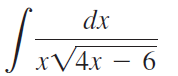
Use a table of integrals to evaluate the following integrals. dx xV4x – 6 X°
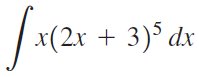
Use a table of integrals to evaluate the following integrals. |че. x(2х + 3)5 dx
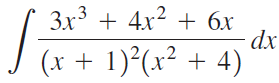
Use partial fractions to evaluate the following integrals. 3x³ + 4x2 + 6x dx (x + 1)²(x² + 4)
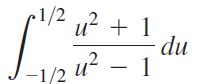
Use partial fractions to evaluate the following integrals. •1/2 ,2 u + 1 du -1/2 U~ – 1
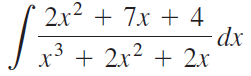
Use partial fractions to evaluate the following integrals. 2x2 + 7x + 4 –dx x' + 2x2 + 2x .3
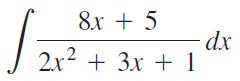
Use partial fractions to evaluate the following integrals. 8х + 5 dx 2x2 + 3x + 1
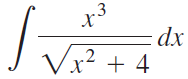
Evaluate the following integrals using a trigonometric substitution. x3 dx /x² + 4 Vx?
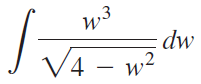
Evaluate the following integrals using a trigonometric substitution. dw V4 – w²
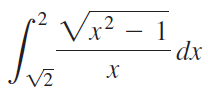
Evaluate the following integrals using a trigonometric substitution. Vx² – 1 .2 V2
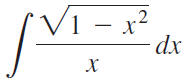
Evaluate the following integrals using a trigonometric substitution. Vī 1- х? dx. .2 х
Evaluate the following trigonometric integrals.∫ tan3 θ sec3 θ dθ
Evaluate the following trigonometric integrals.∫ csc2 x cot x dx
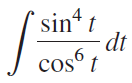
Evaluate the following trigonometric integrals. sin t dt cos° t 4
Evaluate the following trigonometric integrals.∫ tan3 θ dθ
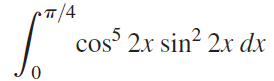
Evaluate the following trigonometric integrals. T/4 cos 2x sin? 2x dx
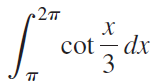
Evaluate the following trigonometric integrals. -2т х cot – dx 3 TT
Use integration by parts to evaluate the following integrals.∫ x sinh x dx
Use integration by parts to evaluate the following integrals.∫ x tan-1 x dx
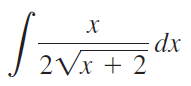
Use integration by parts to evaluate the following integrals. х dx 2Vx + 2
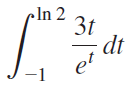
Use integration by parts to evaluate the following integrals. cln 2 3t dt et -1
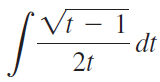
Use the methods introduced in Section 7.1 to evaluate the following integrals.Let u = √t - 1. Vi - I – 1 dt 2t
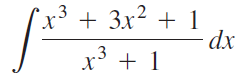
Use the methods introduced in Section 7.1 to evaluate the following integrals. ^x³ + 3x² + 1 dx x' + 1
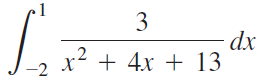
Use the methods introduced in Section 7.1 to evaluate the following integrals. 3 dx -2 x² + 4x + 13
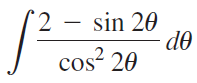
Use the methods introduced in Section 7.1 to evaluate the following integrals. 2 – sin 20 - sin do cos? 20
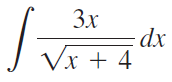
Use the methods introduced in Section 7.1 to evaluate the following integrals. Зх dx Vx + 4
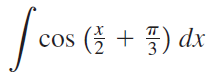
Use the methods introduced in Section 7.1 to evaluate the following integrals. (( + ) dx cos
Determine whether the following statements are true and give an explanation or counterexample.a. The integral ∫ x2e2x dx can be evaluated using integration by parts.b. To evaluate the integral analytically, it is best to use partial fractions.c. One computer algebra system produces ∫ 2 sin x
Consider the logistic equationwith P(0) > 0. Show that the solution curve is concave down for 150 < P < 300 and concave up for 0 < P < 150 and P > 300. for t > 0, P'(t) = 0.1P( 1 300
Consider the general first-order initial value problem y'(t) = ay + b, y(0) = y0, for t ≥ 0, where a, b, and y0 are real numbers.a. Explain why y = -b/a is an equilibrium solution and corresponds to horizontal line segments in the direction field.b. Draw a representative direction field in the
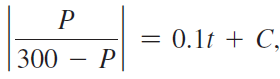
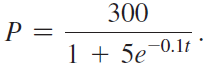
Consider the solution of the logistic equation.a. From the general solution show that the initial condition P(0) = 50 implies that C = -ln 5.b. Solve for P and show that P = 0.1t + C, 300 – P 300 P = 1 + 5e¬0.1t
An endowment is an investment account in which the balance ideally remains constant and withdrawals are made on the interest earned by the account. Such an account may be modeled by the initial value problem B'(t) = aB - m for t ≥ 0, with B(0) = B0. The constant a reflects the annual interest
The growth of cancer tumors may be modeled by the Gompertz growth equation. Let M(t) be the mass of the tumor for t ≥ 0. The relevant initial value problem iswhere a and K are positive constants and 0 < M0 < K.a. Graph the growth rate function R1M2 = -aM ln M/K assuming a = 1 and K = 4. For
The reaction of chemical compounds can often be modeled by differential equations. Let y(t) be the concentration of a substance in reaction for t ≥ 0 (typical units of y are moles/L). The change in the concentration of the substance, under appropriate conditions, is dy/dt = -kyn, where k
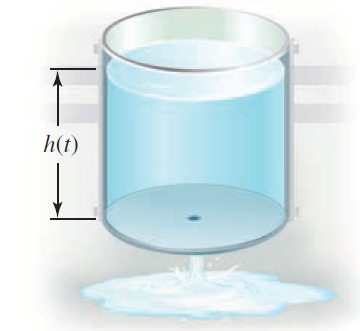
An open cylindrical tank initially filled with water drains through a hole in the bottom of the tank according to Torricelli’s Law (see figure). If h(t) is the depth of water in the tank for t ≥ 0, then Torricelli’s Law implies h'(t) = 2k√h, where k is a constant that includes the
Using the background given in Exercise 62, assume the resistance is given by f(v) = -Rv, where R > 0 is a drag coefficient (an assumption often made for a heavy medium such as water or oil).a. Show that the equation can be written in the form v'(t) = g - bv, where b = R/m.b. For what (positive)
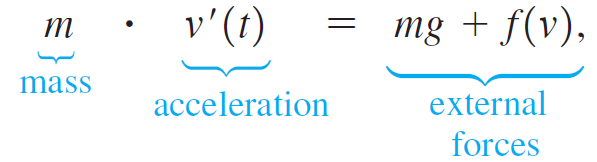
An object in free fall may be modeled by assuming that the only forces at work are the gravitational force and resistance (friction due to the medium in which the object falls). By Newton’s second law (mass × acceleration = the sum of the external forces), the velocity of the object satisfies
Sociologists model the spread of rumors using logistic equations. The key assumption is that at any given time, a fraction y of the population, where 0 ≤ y ≤ 1, knows the rumor, while the remaining fraction 1 - y does not. Furthermore, the rumor spreads by interactions between those who know
Let y(t) be the population of a species that is being harvested. Consider the harvesting model y'(t) = 0.008y - h, y(0) = y0, where h > 0 is the annual harvesting rate and y0 is the initial population of the species.a. If y0 = 2000, what harvesting rate should be used to maintain a constant
Solve the following problems using the method of your choice.w'(t) = 2t cos2 w, w(0) = π/4
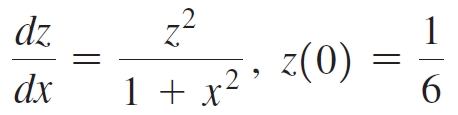
Solve the following problems using the method of your choice. .2 dz z(0) 6. 1 + x2 dx ||
Solve the following problems using the method of your choice.dp/dt = p + 1/t2, p(1) = 3
Solve the following problems using the method of your choice.u'(t) = 4u - 2, u(0) = 4
A differential equation of the form y'(t) = F(y) is said to be autonomous (the function F depends only on y). The constant function y = y0 is an equilibrium solution of the equation provided F(y0) = 0 (because then y'(t) = 0, and the solution remains constant for all t). Note that equilibrium
A differential equation of the form y'(t) = F(y) is said to be autonomous (the function F depends only on y). The constant function y = y0 is an equilibrium solution of the equation provided F(y0) = 0 (because then y'(t) = 0, and the solution remains constant for all t). Note that equilibrium
A differential equation of the form y'(t) = F(y) is said to be autonomous (the function F depends only on y). The constant function y = y0 is an equilibrium solution of the equation provided F(y0) = 0 (because then y'(t) = 0, and the solution remains constant for all t). Note that equilibrium
A differential equation of the form y'(t) = F(y) is said to be autonomous (the function F depends only on y). The constant function y = y0 is an equilibrium solution of the equation provided F(y0) = 0 (because then y'(t) = 0, and the solution remains constant for all t). Note that equilibrium
A differential equation of the form y'(t) = F(y) is said to be autonomous (the function F depends only on y). The constant function y = y0 is an equilibrium solution of the equation provided F(y0) = 0 (because then y'(t) = 0, and the solution remains constant for all t). Note that equilibrium
A differential equation of the form y'(t) = F(y) is said to be autonomous (the function F depends only on y). The constant function y = y0 is an equilibrium solution of the equation provided F(y0) = 0 (because then y'(t) = 0, and the solution remains constant for all t). Note that equilibrium
Determine whether the following statements are true and give an explanation or counterexample.a. The general solution of y'(t) = 20y is y = e20t.b. The functions y = 2e-2t and y = 10e-2t do not both satisfy the differential equation y' + 2y = 0.c. The equation y'(t) = ty + 2y + 2t + 4 is not
Use the window [-2, 2] × [-2, 2] to sketch a direction field for the following equations. Then sketch the solution curve that corresponds to the given initial condition.y'(t) = sin y, y(-2) = 1/2
Use the window [-2, 2] × [-2, 2] to sketch a direction field for the following equations. Then sketch the solution curve that corresponds to the given initial condition.y'(x) = sin x, y(-2) = 2
Use the window [-2, 2] × [-2, 2] to sketch a direction field for the following equations. Then sketch the solution curve that corresponds to the given initial condition.y'(t) = y - 3, y(0) = 1
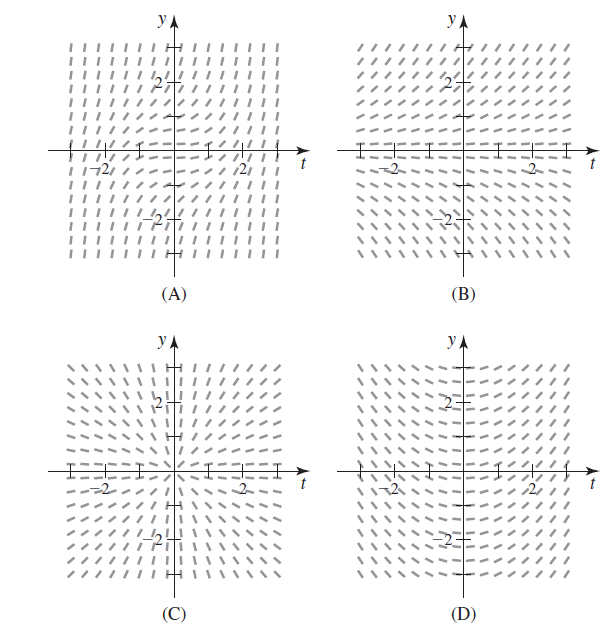
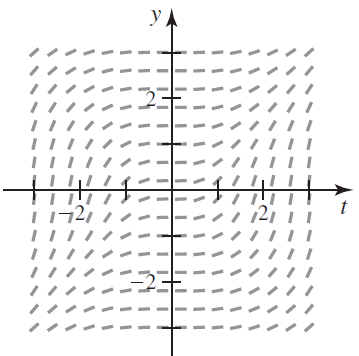
Match equations a–d with the direction fields A–D.a. y'(t) = t/2 b. y'(t) = y/2c. y'(t) = (t2 + y2)/2 d. y'(t) = y/t Ул УА 2דוו (B) (A) Ул (C) (D)
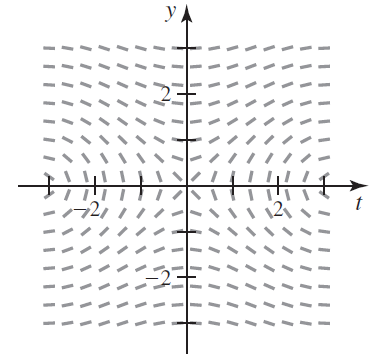
A differential equation and its direction field are given. Sketch a graph of the solution that results with each initial condition.y'(t) = sin t/y,y(-2) = -2 and y(-2) = 2 YA
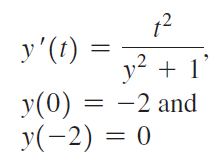
A differential equation and its direction field are given. Sketch a graph of the solution that results with each initial condition. y'(t) = y- + 1 = -2 and y(-2) = 0 y(0) УА 2ר! 121
When an infected person is introduced into a closed and otherwise healthy community, the number of people who become infected with the disease (in the absence of any intervention) may be modeled by the logistic equationwhere k is a positive infection rate, A is the number of people in the
A community of hares on an island has a population of 50 when observations begin at t = 0. The population for t ≥ 0 is modeled by the initial value problema. Find and graph the solution of the initial value problem.b. What is the steady-state population? dP P(0) = 50. 0.08P dt 200
Determine whether the following equations are separable. If so, solve the given initial value problem.y'(t) = 2e3y - t, y(0) = 0
Determine whether the following equations are separable. If so, solve the given initial value problem.dy/dx = ex - y, y(0) = ln 3
Determine whether the following equations are separable. If so, solve the given initial value problem.(sec x) y'(x) = y3, y(0) = 3
Determine whether the following equations are separable. If so, solve the given initial value problem.y'(t) = et/2y , y(ln 2) = 1
Showing 2300 - 2400
of 6775
First
17
18
19
20
21
22
23
24
25
26
27
28
29
30
31
Last
Step by Step Answers

 Get 50% OFF
Claim Now
Get 50% OFF
Claim Now