New Semester
Started
Get
50% OFF
Study Help!
--h --m --s
Claim Now
Question Answers
Textbooks
Find textbooks, questions and answers
Oops, something went wrong!
Change your search query and then try again
S
Books
FREE
Study Help
Expert Questions
Accounting
General Management
Mathematics
Finance
Organizational Behaviour
Law
Physics
Operating System
Management Leadership
Sociology
Programming
Marketing
Database
Computer Network
Economics
Textbooks Solutions
Accounting
Managerial Accounting
Management Leadership
Cost Accounting
Statistics
Business Law
Corporate Finance
Finance
Economics
Auditing
Tutors
Online Tutors
Find a Tutor
Hire a Tutor
Become a Tutor
AI Tutor
AI Study Planner
NEW
Sell Books
Search
Search
Sign In
Register
study help
mathematics
calculus early transcendentals
Calculus Early Transcendentals 2nd edition William L. Briggs, Lyle Cochran, Bernard Gillett - Solutions
By reduction formula 4 Graph the following functions and find the area under the curve on the given interval.f(x) = (4 + x2)1/2, [0, 2] (sec u tan u + In sec u + tan u|) + C. 2 sec u du
By reduction formula 4 Graph the following functions and find the area under the curve on the given interval.f(x) = (9 - x2)-2, [0, 3/2] (sec u tan u + In sec u + tan u|) + C. 2 sec u du
On the interval [0, 2], the graphs of f(x) = x2/3 and g(x) = x2(9 - x2)-1/2 have similar shapes.a. Find the area of the region bounded by the graph of f and the x-axis on the interval [0, 2].b. Find the area of the region bounded by the graph of g and the x-axis on the interval [0, 2].c. Which
Find the length of the curve y = ax2 from x = 0 to x = 10, where a > 0 is a real number.
Graph the function f(x) = (16 + x2)-3/2 and find the area of the region bounded by the curve and the x-axis on the interval [0, 3].
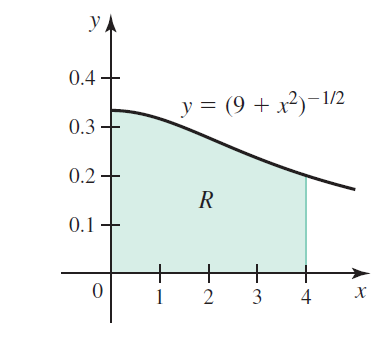
Consider the function f(x) = (9 + x2)-1/2 and the region R on the interval [0, 4] (see figure).a. Find the area of R.b. Find the volume of the solid generated when R is revolved about the x-axis.c. Find the volume of the solid generated when R is revolved about the y-axis. УЛ 0.4 y = (9 +
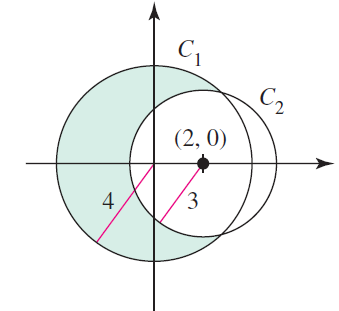
A lune is a crescent-shaped region bounded by the arcs of two circles. Let C1 be a circle of radius 4 centered at the origin. Let C2 be a circle of radius 3 centered at the point (2, 0). Find the area of the lune (shaded in the figure) that lies inside C1 and outside C2. C, C2 (2, 0) 4.
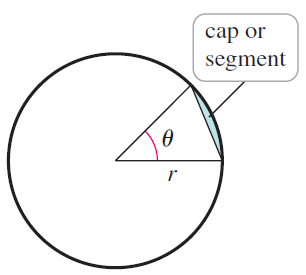
Use two approaches to show that the area of a cap (or segment) of a circle of radius r subtended by an angle u is given byAseg = 1/2 r2(θ - sin θ).a. Find the area using geometry (no calculus).b. Find the area using calculus. cap or segment Ө
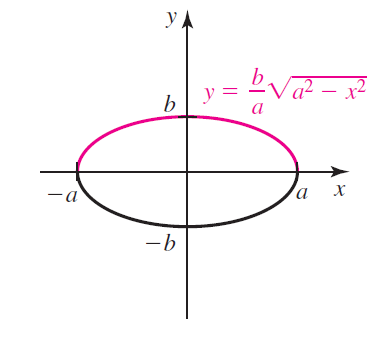
The upper half of the ellipse centered at the origin with axes of length 2a and 2b is described by y = b/a √a2 - x2 (see figure). Find the area of the ellipse in terms of a and b. y, bVa? x y = х -a -b
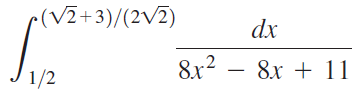
Evaluate the following integrals. •(V2+3)/(2V2) dx 8x + 11 8x2 1/2
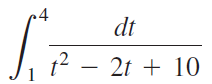
Evaluate the following integrals. dt t² – 2t + 10
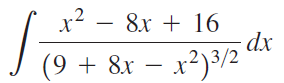
Evaluate the following integrals. x2 – 8x + 16 dx (9 + 8r – x²)³/2 “
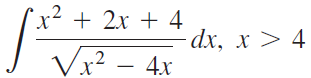
Evaluate the following integrals. .2 x² + 2x + 4 ·dx, x > 4 4x Vx² – 4x .2
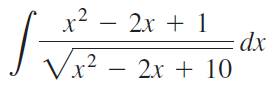
Evaluate the following integrals. .2 х* x? – 2x + 1 dx Vx? - 2x + 10
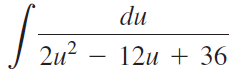
Evaluate the following integrals. du 2u? 12u + 36
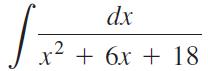
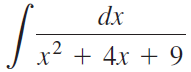
Evaluate the following integrals. dx x² + 6x + 18
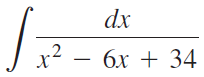
Evaluate the following integrals. dx бх x² – 6x + 34
Determine whether the following statements are true and give an explanation or counterexample.a. If x = 4 tan θ, then csc θ = 4/x.b. The integraldoes not have a finite real value.c. The integraldoes not have a finite real value.d. The integralcannot be evaluated using a trigonometric
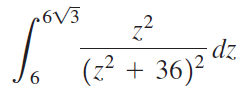
Evaluate the following definite integrals. .6V3 z? dz (z² + 36)² 6.
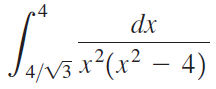
Evaluate the following definite integrals. dx 4/V3 x²(x² – 4)
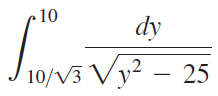
Evaluate the following definite integrals. 10 dy J 10/V3 Vy² – 25
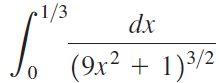
Evaluate the following definite integrals. •1/3 dx (9x² + 1)³/2
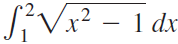
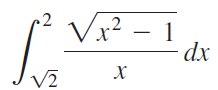
Evaluate the following definite integrals. Vx? – 1 dx .2 V2
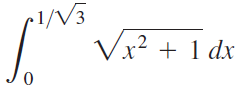
Evaluate the following definite integrals. 1/V3 Vx² + 1 dx .2
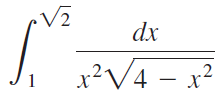
Evaluate the following definite integrals. V2 dx X²V4 – x²
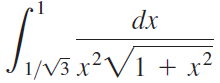
Evaluate the following definite integrals. dx 1/V3 x²V1 + x² .2
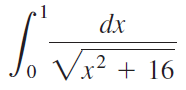
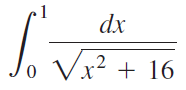
Evaluate the following definite integrals. dx Vx² + 16
Evaluate the following definite integrals. dx Vx² + 16
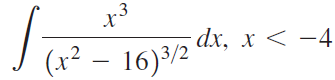
Evaluate the following integrals. x3 dх, х < —4 16)3/2* .2
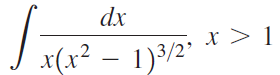
Evaluate the following integrals. dx x > 1 1)3/2" x(x² – 1)3/2"
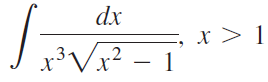
Evaluate the following integrals. dx =, x> 1 x³Vx? – 1
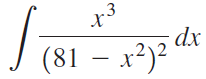
Evaluate the following integrals. V (81 – x²)²
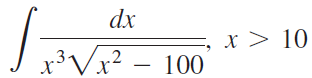
Evaluate the following integrals. dx x > 10| X³VX² – 100 ³Vx?
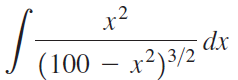
Evaluate the following integrals. dx (100 – x²)³/2
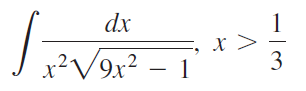
Evaluate the following integrals. 1 dx x²V9x? – 1 3
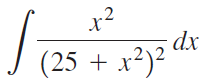
Evaluate the following integrals. x2 dx (25 + x²)2
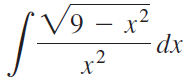
Evaluate the following integrals. V9 – x² dx '9 - .2
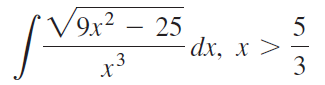
Evaluate the following integrals. V9x? 9x² 25 5 dx, х > 3 х
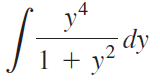
Evaluate the following integrals. y4 1 + ,2
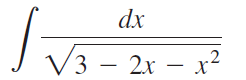
Evaluate the following integrals. dx V3 – 2x – x?
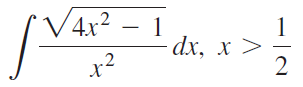
Evaluate the following integrals. V4x² dх, х > x2
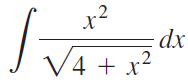
Evaluate the following integrals. x² :dx /4 + x?
Evaluate the following integrals.∫ √9 - 4x2 dx
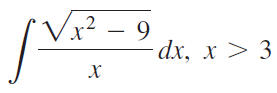
Evaluate the following integrals. Vx? – 9 dx, x > 3
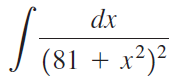
Evaluate the following integrals. dx (81 + x²)²
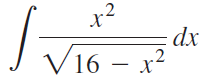
Evaluate the following integrals. dx 16 – x
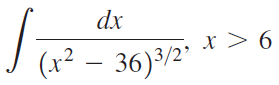
Evaluate the following integrals. 6 (х? " style="" class="fr-fic fr-dib"> dx (x² – 36)³/2" х> 6 (х?
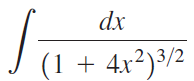
Evaluate the following integrals. dx + 4x²)$/2 .2\3/2
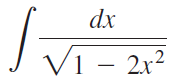
Evaluate the following integrals. dx V1 – 2r² 2x2
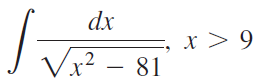
Evaluate the following integrals. dx x > 9 Vx² – 81 .2
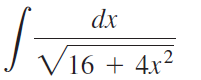
Evaluate the following integrals. dx V16 + 4x²
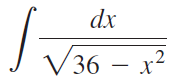
Evaluate the following integrals. dx V36 – x2
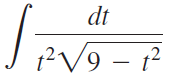
Evaluate the following integrals. dt ?V9 - ? .2 42- 6.
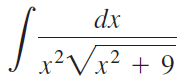
Evaluate the following integrals. dx ;?Vx² + 9 х
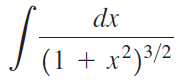
Evaluate the following integrals. dx (1 + x²)³/2
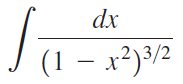
Evaluate the following integrals. dx (1 — х3)92 3/2
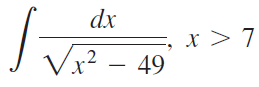
Evaluate the following integrals. dx x > 7 V x² – 49
Evaluate the following integrals.∫ √64 - x2 dx
Evaluate the following integrals.∫ (36 - 9x2)-3/2 dx
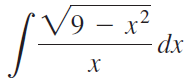
Evaluate the following integrals. /9 – dx .2
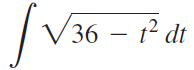
Evaluate the following integrals. – t² dt V36
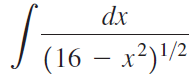
Evaluate the following integrals. dx (16 — х3)12
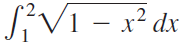
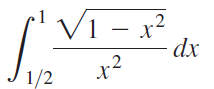
Evaluate the following integrals. VI - x? dx Г. .2 / 1/2
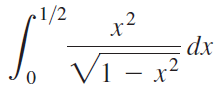
Evaluate the following integrals. .1/2 x2 dx VI - x² 1 –
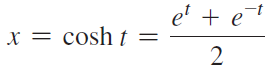
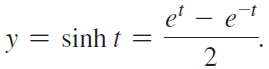
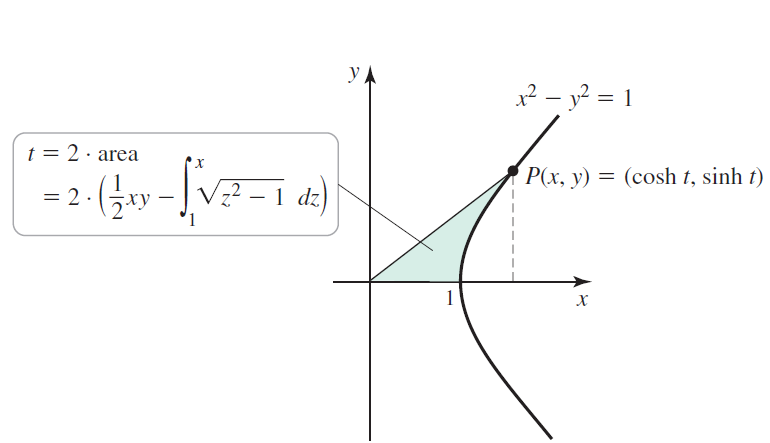
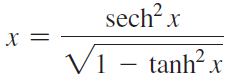
Complete the following steps to prove that when the x- and y-coordinates of a point on the hyperbola x2 - y2 = 1 are defined as cosh t and sinh t, respectively, where t is twice the area of the shaded region in the figure, x and y can be expressed asand a. Explain why twice the area of the shaded
Use the substitution u = xr to show that and 0 < x < 1. dx sechx' + C, for r > 0 -1 xV1 – x²r
Recall that the inverse hyperbolic tangent is defined as y = tanh-1 x ⇔ x = tanh y, for -1 < x < 1 and all real y. Solve x = tanh y for y to express the formula for tanh-1 x in terms of logarithms.
Use the result of Exercise 108 to find the arc length of f(x) = ln |tanh (x/2)| on [ln 2, ln 8].Data from Exercise 108Carry out the following steps to derive the formula ∫ csch x dx = ln |tanh (x/2)| + C (Theorem 6.9).
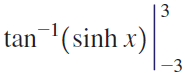
There are several ways to express the indefinite integral of sech x.a. Show that ∫ sech x dx = tan-1 (sinh x) + C (Theorem 6.9).Writeand then make a change of variables.b. Show that ∫ sech x dx = sin-1 (tanh x) + C. Show that and then make a change of variables.c. Verify that ∫ sech x dx
a. The definition of the inverse hyperbolic cosine is y = cosh-1 x ⇔ x = cosh y, for x ≥ 1, 0 ≤ y < ∞. Use implicit differentiation to show that b. Differentiate sinh-1 x = ln (x + √x2 + 1) to show that d/dx (sinh-1 x) = 1/√x2 + 1. :(cosh¯x) = 1/Vx² – 1. dx
Show that cosh-1 (cosh x) = |x| by using the formula cosh-1 t = ln (t + √t2 - 1) and by considering the cases x ≥ 0 and x < 0.
Verify the following identities.sinh(x + y) = sinh x cosh y + cosh x sinh y
Verify the following identities.cosh(x + y) = cosh x cosh y + sinh x sinh y
Verify the following identities.cosh(sinh-1 x) = √x2 + 1, for all x
Verify the following identities.sinh(cosh-1 x) = √x2 - 1, for x ≥ 1
When the catenary y = a cosh (x/a) is revolved about the x-axis, it sweeps out a surface of revolution called a catenoid. Find the area of the surface generated when y = cosh x on [-ln 2, ln 2] is rotated around the x-axis.
Hyperbolic functions are useful in solving differential equations (Section 7.9). Show that the functions y = A sinh kx and y = B cosh kx, where A, B, and k are constants, satisfy the equation y"(x) - k2y(x) = 0.
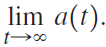
a. Find the acceleration a(t) = v'(t) of a falling body whose velocity is given in part (a) of Exercise 96.b. ComputeExplain your answer as it relates to terminal velocity (Exercise 97).Data from Exercise 96Refer to Exercise 95, which gives the position function for a falling body. Use m = 75 kg
Refer to Exercises 95 and 96.a. Compute a jumper’s terminal velocity, which is defined as b. Find the terminal velocity for the jumper in Exercise 96 (m = 75 kg and k = 0.2).c. How long does it take any falling object to reach a speed equal to 95% of its terminal velocity? Leave your answer in
Refer to Exercise 95, which gives the position function for a falling body. Use m = 75 kg and k = 0.2. a. Confirm that the base jumper’s velocity t seconds after jumping is b. How fast is the BASE jumper falling at the end of a 10 s delay?c. How long does it take the BASE jumper to reach a
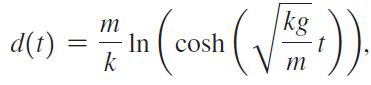
When an object falling from rest encounters air resistance proportional to the square of its velocity, the distance it falls (in meters) after t seconds is given bywhere m is the mass of the object in kilograms, g = 9.8 m/s2 is the acceleration due to gravity, and k is a physical constant.a. A BASE
Use Newton’s method to find all local extreme values of f(x) = x sech x.
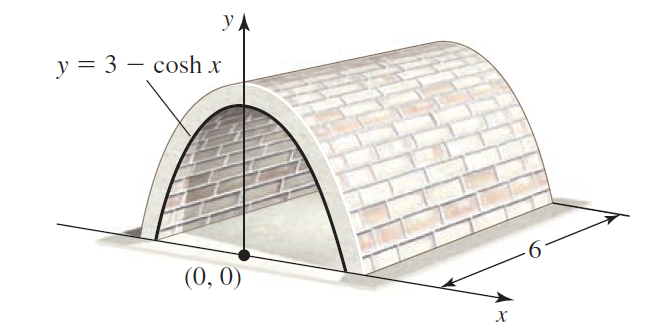
Find the volume interior to the inverted catenary kiln (an oven used to fire pottery) shown in the figure. УА y = 3 – cosh x (0, 0) х
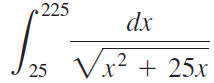
Evaluate the following integrals.. √x2 + 25x = √x√x + 25. 225 dx Vx² + 25x 25
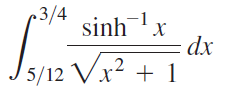
Evaluate the following integrals. •3/4 sinhx dx / 5/12 Vx² + 1 I + z*^
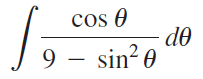
Evaluate the following integrals. cos 0 do 9 – sin? 0 sir
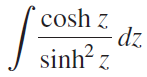
Evaluate the following integrals. cosh z dz sinh z
The linear function ℓ(x) = mx + b, for finite m ≠ 0, is a slant asymptote of f(x) if a. Use a graphing utility to make a sketch that shows ℓ(x) = x is a slant asymptote of f(x) = x tanh x. Does f have any other slant asymptotes?b. Provide an intuitive argument showing that f(x) = x tanh x
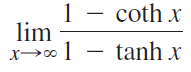
Use l’Hôpital’s Rule to evaluate the following limits. coth x lim x→o1 – tanh x X-
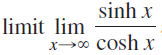
Explain why l’Hôpital’s Rule fails when applied to the limit and then find the limit another way. sinh x limit lim x→0 cosh x
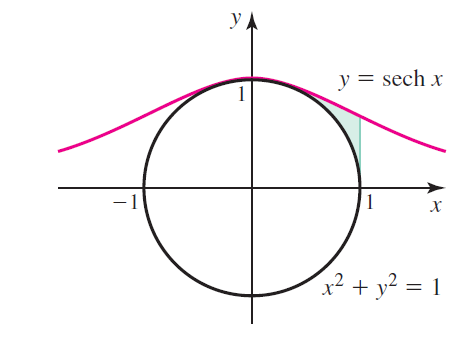
Compute the volume of the solid of revolution that results when the region in Exercise 81 is revolved about the x-axis.Data from Exercise 81Find the area of the region bounded by y = sech x, x = 1, and the unit circle. УА y = sech x 1 х ?+ y² = 1
Find the area of the region bounded by y = sech x, x = 1, and the unit circle. УА y = sech x 1 х ?+ y² = 1
Find the x-coordinate of the point(s) of inflection of f(x) = sech x. Report exact answers in terms of logarithms (use Theorem 6.10).
Find the x-coordinate of the point(s) of inflection of f(x) = tanh2 x.
a. Show that the critical points of f(x) = cosh x/x satisfy x = coth x.b. Use a root finder to approximate the critical points of f.
Find the critical points of the functionf(x) = sinh2 x cosh x.
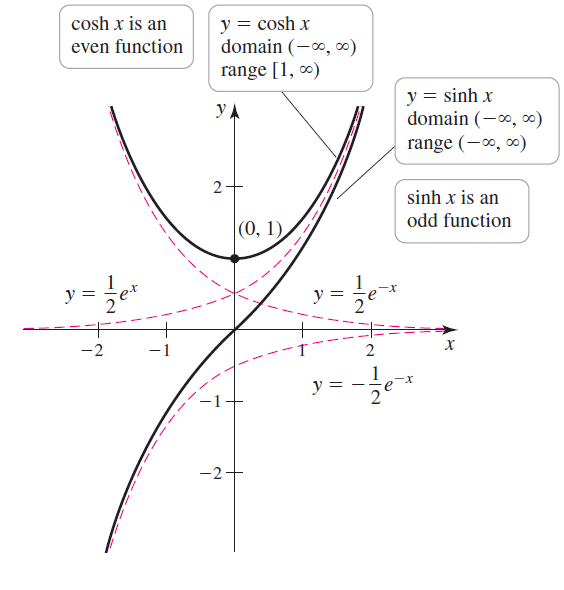
The graph of f(x) = sinh x is shown in Figure 6.92. Use calculus to find the intervals of increase and decrease for f, and find the intervals on which f is concave up and concave down to confirm that the graph is correct. y = cosh x domain (-∞, ∞) cosh x is an even function range [1, ∞) y =
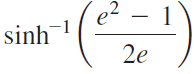
Evaluate each expression without using a calculator or state that the value does not exist. Simplify answers to the extent possible.a. cosh 0 b. tanh 0 c. csch 0 d. sech(sinh 0)e. coth(ln 5)f. sinh(2ln 3) g. cosh2 1 h. sech-1 (ln 3)i. cosh-1 (17/8)j. 1 sinh
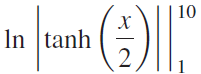
Use a calculator to evaluate each expression or state that the value does not exist. Report answers accurate to four decimal places.a. coth 4 b. tanh-1 2 c. csch-1 5d.e.f.g. csch x. 2 1/2 ON 10 In tanh
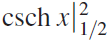
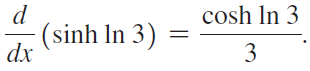
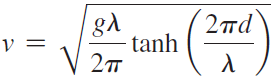
Determine whether the following statements are true and give an explanation or counterexample.a.b.c. Differentiating the velocity equation for an ocean wave results in the acceleration of the wave.d. ln (1 + √2) = -ln (-1 + √2).e. cosh In 3 (sinh In 3) |dx 3 d (sinh x) dx (cosh x) dx cosh x
Showing 2800 - 2900
of 6775
First
22
23
24
25
26
27
28
29
30
31
32
33
34
35
36
Last
Step by Step Answers

 Get 50% OFF
Claim Now
Get 50% OFF
Claim Now