New Semester
Started
Get
50% OFF
Study Help!
--h --m --s
Claim Now
Question Answers
Textbooks
Find textbooks, questions and answers
Oops, something went wrong!
Change your search query and then try again
S
Books
FREE
Study Help
Expert Questions
Accounting
General Management
Mathematics
Finance
Organizational Behaviour
Law
Physics
Operating System
Management Leadership
Sociology
Programming
Marketing
Database
Computer Network
Economics
Textbooks Solutions
Accounting
Managerial Accounting
Management Leadership
Cost Accounting
Statistics
Business Law
Corporate Finance
Finance
Economics
Auditing
Tutors
Online Tutors
Find a Tutor
Hire a Tutor
Become a Tutor
AI Tutor
AI Study Planner
NEW
Sell Books
Search
Search
Sign In
Register
study help
mathematics
calculus early transcendentals
Calculus Early Transcendentals 2nd edition William L. Briggs, Lyle Cochran, Bernard Gillett - Solutions
A cylinder with height 8 m and radius 3 m is filled with water and must be emptied through an outlet pipe 2 m above the top of the cylinder.a. Compute the work required to empty the water in the top half of the tank.b. Compute the work required to empty the (equal amount of) water in the lower half
A glass has circular cross sections that taper (linearly) from a radius of 5 cm at the top of the glass to a radius of 4 cm at the bottom. The glass is 15 cm high and full of orange juice. How much work is required to drink all the juice through a straw if your mouth is 5 cm above the top of the
A 10-kg mass is attached to a spring that hangs vertically and is stretched 2 m from the equilibrium position of the spring. Assume a linear spring with F(x) = kx. a. How much work is required to compress the spring and lift the mass 0.5 m?b. How much work is required to stretch the spring and
Hooke’s law is applicable to idealized (linear) springs that are not stretched or compressed too far. Consider a nonlinear spring whose restoring force is given by F(x) = 16x - 0.1x3, for |x| ≤ 7.a. Graph the restoring force and interpret it.b. How much work is done in stretching the
Two bars of length L have densitiesa. For what values of L is bar 1 heavier than bar 2?b. As the lengths of the bars increase, do their masses increase without bound? Explain. P1(x) = 4e¬* and p2(x) = 6e¯2*, for 0 < x< L. -2x
Determine whether the following statements are true and give an explanation or counterexample.a. The mass of a thin wire is the length of the wire times its average density over its length.b. The work required to stretch a linear spring (that obeys Hooke’s law) 100 cm from equilibrium is the same
A diving pool that is 4 m deep and full of water has a viewing window on one of its vertical walls. Find the force on the following windows.The window is a circle, with a radius of 0.5 m, tangent to the bottom of the pool.
A diving pool that is 4 m deep and full of water has a viewing window on one of its vertical walls. Find the force on the following windows.The window is a square, 0.5 m on a side, with the lower edge of the window 1 m from the bottom of the pool.
A diving pool that is 4 m deep and full of water has a viewing window on one of its vertical walls. Find the force on the following windows.The window is a square, 0.5 m on a side, with the lower edge of the window on the bottom of the pool.
A large building shaped like a box is 50 m high with a face that is 80 m wide. A strong wind blows directly at the face of the building, exerting a pressure of 150 N/m2 at the ground and increasing with height according to P(y) = 150 + 2y, where y is the height above the ground. Calculate the total
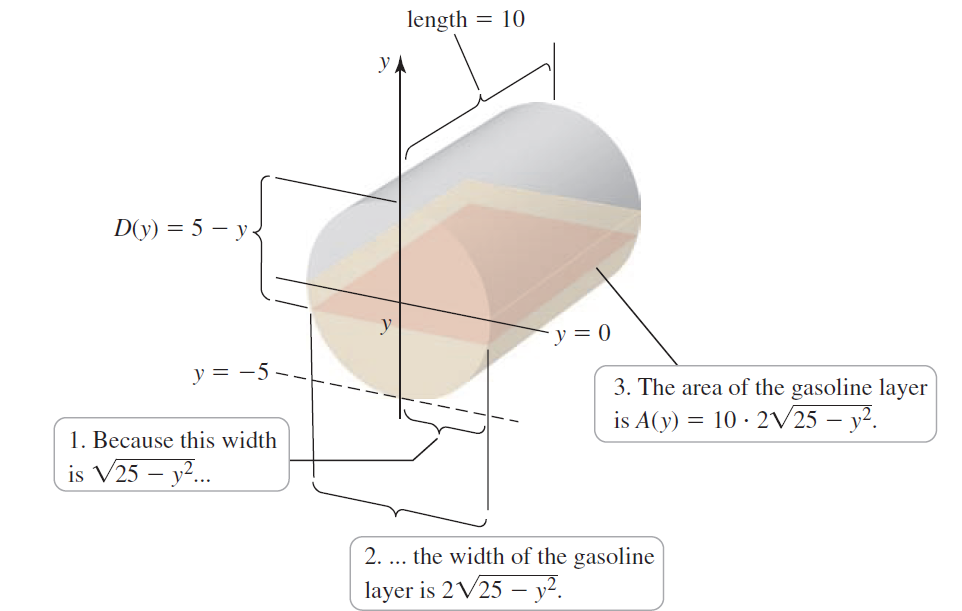
Determine the force on a circular end of the tank in Figure 6.76 if the tank is full of gasoline. The density of gasoline is ρ = 737 kg/m3. length = 10 D(y) = 5 – y{ y = 0 y = -5 3. The area of the gasoline layer 10 · 2V25 – y?. is A(y) = 1. Because this width is V25 – y?. 2. ... the width
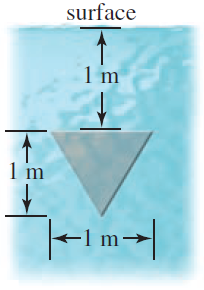
A plate shaped like an isosceles triangle with a height of 1 m is placed on a vertical wall 1 m below the surface of a pool filled with water (see figure). Compute the force on the plate. surface -Im-|
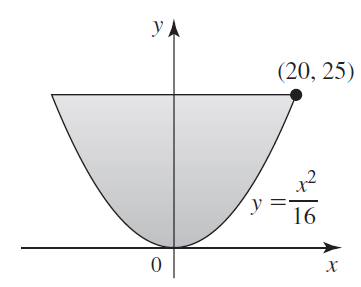
The lower edge of a dam is defined by the parabola y = x2/16 (see figure). Use a coordinate system with y = 0 at the bottom of the dam to determine the total force on the dam. Lengths are measured in meters. Assume the water level is at the top of the dam. УА (20, 25) 16 х
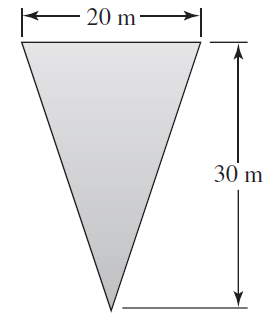
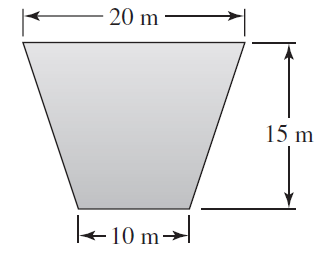
The following figures show the shape and dimensions of small dams. Assuming the water level is at the top of the dam, find the total force on the face of the dam. 20 m– 30 m
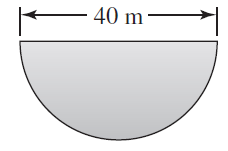
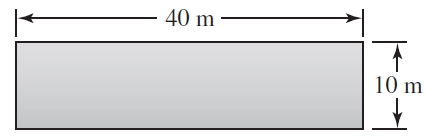
The following figures show the shape and dimensions of small dams. Assuming the water level is at the top of the dam, find the total force on the face of the dam. 40 m-
The following figures show the shape and dimensions of small dams. Assuming the water level is at the top of the dam, find the total force on the face of the dam. 20 m 15 m le 10 m-
The following figures show the shape and dimensions of small dams. Assuming the water level is at the top of the dam, find the total force on the face of the dam. 40 m – 10 m
An inverted cone is 2 m high and has a base radius of 1/2 m. If the tank is full, how much work is required to pump the water to a level 1 m above the top of the tank?
Suppose the tank in Example 4 is full of water (rather than half full of gas). Determine the work required to pump all the water to an outlet pipe 15 m above the bottom of the tank.
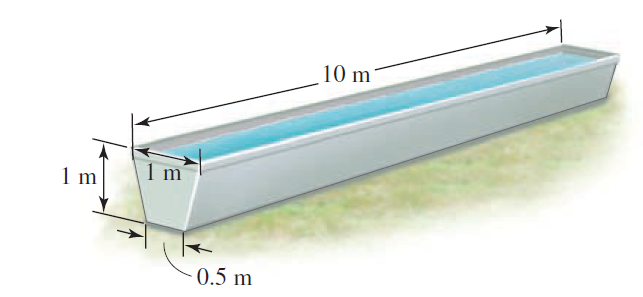
A cattle trough has a trapezoidal cross section with a height of 1 m and horizontal sides of length 1/2 m and 1 m. Assume the length of the trough is 10 m (see figure).a. How much work is required to pump the water out of the trough (to the level of the top of the trough) when it is full?b. If the
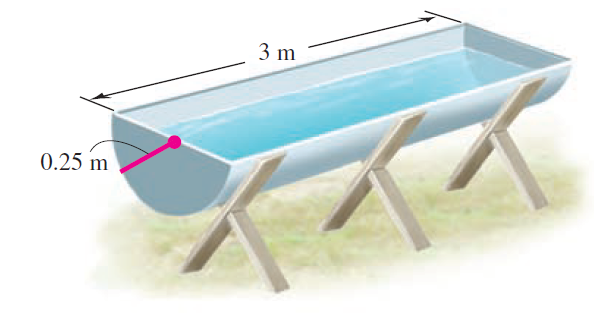
A water trough has a semicircular cross section with a radius of 0.25 m and a length of 3 m (see figure).a. How much work is required to pump the water out of the trough when it is full?b. If the length is doubled, is the required work doubled? Explain.c. If the radius is doubled, is the required
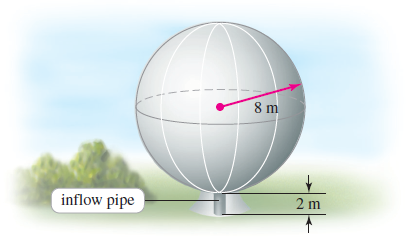
An empty spherical water tank with a radius of 8 m has its lowest point 2 m above the ground. A pump is used to move water from a source on the ground into the tank. a. How much work is done by the pump to fill the tank if all the water is pumped into the tank through an inflow pipe that runs
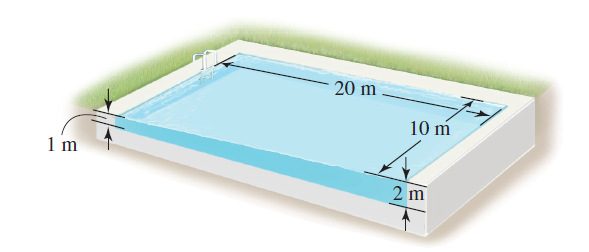
A swimming pool is 20 m long and 10 m wide, with a bottom that slopes uniformly from a depth of 1 m at one end to a depth of 2 m at the other end (see figure). Assuming the pool is full, how much work is required to pump the water to a level 0.2 m above the top of the pool? 20 m 10 m 2 m
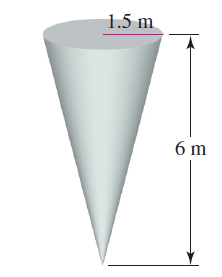
A water tank is shaped like an inverted cone with height 6 m and base radius 1.5 m (see figure). a. If the tank is full, how much work is required to pump the water to the level of the top of the tank and out of the tank?b. Is it true that it takes half as much work to pump the water out of
If the water in the swimming pool in Exercise 27 is 2 m deep, then how much work is required to pump all the water to a level 3 m above the bottom of the pool?Data from Exercise 27A swimming pool has the shape of a box with a base that measures 25 m by 15 m and a uniform depth of 2.5 m. How much
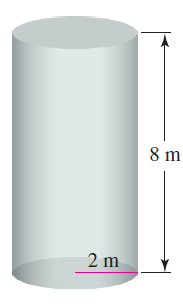
Suppose the water tank in Exercise 28 is half full of water. Determine the work required to empty the tank by pumping the water to a level 2 m above the top of the tank.Data from Exercise 28A cylindrical water tank has height 8 m and radius 2 m (see figure). 8 m 2 m
A cylindrical water tank has height 8 m and radius 2 m (see figure). a. If the tank is full of water, how much work is required to pump the water to the level of the top of the tank and out of the tank?b. Is it true that it takes half as much work to pump the water out of the tank when it is
A swimming pool has the shape of a box with a base that measures 25 m by 15 m and a uniform depth of 2.5 m. How much work is required to pump the water out of the pool when it is full?
A spring has a restoring force given by F(x) = 25x. Let W(x) be the work required to stretch the spring from its equilibrium position (x = 0) to a variable distance x. Find and graph the work function. Compare the work required to stretch the spring x units from equilibrium to the work required to
Calculate the work required to stretch the following springs 1.25 m from their equilibrium positions. Assume Hooke’s law is obeyed.a. A spring that requires 100 J of work to be stretched 0.5 m from its equilibrium positionb. A spring that requires a force of 250 N to be stretched 0.5 m from its
Calculate the work required to stretch the following springs 0.4 m from their equilibrium positions. Assume Hooke’s law is obeyed.a. A spring that requires a force of 50 N to be stretched 0.1 m from its equilibrium position b. A spring that requires 2 J of work to be stretched 0.1 m from its
Calculate the work required to stretch the following springs 0.5 m from their equilibrium positions. Assume Hooke’s law is obeyed.a. A spring that requires a force of 50 N to be stretched 0.2 m from its equilibrium position b. A spring that requires 50 J of work to be stretched 0.2 m from
A heavy-duty shock absorber is compressed 2 cm from its equilibrium position by a mass of 500 kg. How much work is required to compress the shock absorber 4 cm from its equilibrium position? (A mass of 500 kg exerts a force (in newtons) of 500 g, where g ≈ 9.8 m/s2.)
A spring on a horizontal surface can be stretched and held 0.5 m from its equilibrium position with a force of 50 N.a. How much work is done in stretching the spring 1.5 m from its equilibrium position?b. How much work is done in compressing the spring 0.5 m from its equilibrium position?
Suppose a force of 15 N is required to stretch and hold a spring 0.25 m from its equilibrium position.a. Assuming the spring obeys Hooke’s law, find the spring constant k.b. How much work is required to compress the spring 0.2 m from its equilibrium position?c. How much additional work is
Suppose a force of 30 N is required to stretch and hold a spring 0.2 m from its equilibrium position.a. Assuming the spring obeys Hooke’s law, find the spring constant k.b. How much work is required to compress the spring 0.4 m from its equilibrium position?c. How much work is required to stretch
How much work is required to move an object from x = 1 to x = 3 (measured in meters) in the presence of a force (in N) given by F(x) = 2/x2 acting along the x-axis?
How much work is required to move an object from x = 0 to x = 3 (measured in meters) in the presence of a force (in N) given by F(x) = 2x acting along the x-axis?
Find the mass of the following thin bars with the given density function. if 0 < x < 1 - {ir2 - x) if1
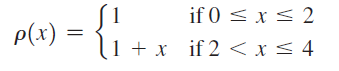
Find the mass of the following thin bars with the given density function. {;. if 0 < x < 2 P(x) + x if 2 < x< 4
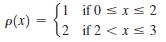
Find the mass of the following thin bars with the given density function. Si if 0 sxs 2 p(x) = 12 if 2
Find the mass of the following thin bars with the given density function.ρ(x) = x√2 - x2; for 0 ≤ x ≤ 1
Find the mass of the following thin bars with the given density function.ρ(x) = 5e-2x; for 0 ≤ x ≤ 4
Find the mass of the following thin bars with the given density function.ρ(x) = 2 - x/2; for 0 ≤ x ≤ 2
Find the mass of the following thin bars with the given density function.ρ(x) = 1 + x3; for 0 ≤ x ≤ 1
Find the mass of the following thin bars with the given density function.ρ(x) = 1 + sin x; for 0 ≤ x ≤ π
Explain why you integrate in the vertical direction (parallel to the acceleration due to gravity) rather than the horizontal direction to find the force on the face of a dam.
What is the pressure on a horizontal surface with an area of 2 m2 that is 4 m underwater?
Why is integration used to find the total force on the face of a dam?
Why is integration used to find the work required to pump water out of a tank?
Why is integration used to find the work done by a variable force?
How much work is required to move an object from x = 0 to x = 5 (measured in meters) in the presence of a constant force of 5 N acting along the x-axis?
Explain how to find the mass of a one-dimensional object with a variable density ρ.
Suppose a 1-m cylindrical bar has a constant density of 1 g/cm for its left half and a constant density 2 g/cm for its right half. What is its mass?
Suppose f is a nonnegative function with a continuous first derivative on [a, b]. Let L equal the length of the graph of f on [a, b] and let S be the area of the surface generated by revolving the graph of f on [a, b] about the x-axis. For a positive constant C, assume the curve y = f(x) + C is
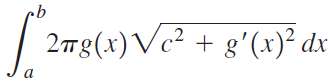
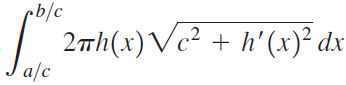
Let f be a nonnegative function with a continuous first derivative on [a, b] and suppose that g(x) = cf(x) and h(x) = f(cx), where c > 0. When the curve y = f(x) on [a, b] is revolved about the x-axis, the area of the resulting surface is A. Evaluate the following integrals in terms of A and
Show that the surface area of the frustum of a cone generated by revolving the line segment between (a, g(a)) and (b, g(b)) about the x-axis is π(g(b) + g(a))ℓ, for any linear function g(x) = cx + d that is positive on the interval [a, b], where / is the slant height of the frustum.
In the design of solid objects (both artificial and natural), the ratio of the surface area to the volume of the object is important. Animals typically generate heat at a rate proportional to their volume and lose heat at a rate proportional to their surface area. Therefore, animals with a low SAV
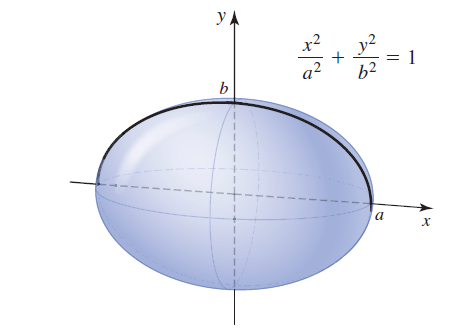
If the top half of the ellipse x2/a2 +y2/b2 = 1 is revolved about the x-axis, the result is an ellipsoid whose axis along the x-axis has length 2a, whose axis along the y-axis has length 2b, and whose axis perpendicular to the xy-plane has length 2b. We assume that 0 < b < a (see figure). Use
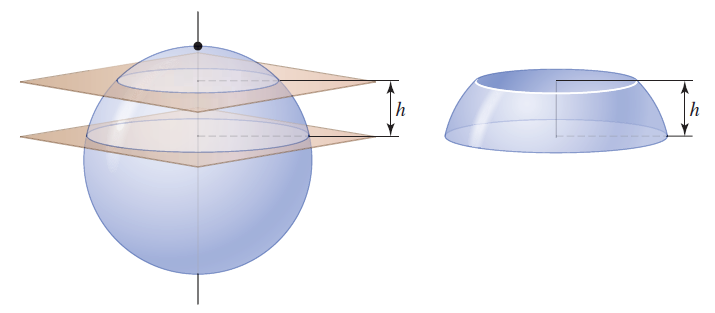
Suppose a sphere of radius r is sliced by two horizontal planes h units apart (see figure). Show that the surface area of the resulting zone on the sphere is 2πrh, independent of the location of the cutting planes. h
When the circle x2 + (y - a)2 = r2 on the interval [-r, r] is revolved about the x-axis, the result is the surface of a torus, where 0 < r < a. Show that the surface area of the torus is S = 4π2ar.
Consider the upper half of the astroid described by x2/3 + y2/3 = a2/3, where a > 0 and |x| ≤ a. Find the area of the surface generated when this curve is revolved about the x-axis. Use symmetry. Note that the function describing the curve is not differentiable at 0. However, the surface area
The volume of a cone of radius r and height h is one-third the volume of a cylinder with the same radius and height. Does the surface area of a cone of radius r and height h equal one-third the surface area of a cylinder with the same radius and height? If not, find the correct relationship.
Consider the following curves on the given intervals.a. Write the integral that gives the area of the surface generated when the curve is revolved about the x-axis.b. Use a calculator or software to approximate the surface area.y = tan x on [0, π/4]
Consider the following curves on the given intervals.a. Write the integral that gives the area of the surface generated when the curve is revolved about the x-axis.b. Use a calculator or software to approximate the surface area.y = ln x2 on [1, √e]
Consider the following curves on the given intervals.a. Write the integral that gives the area of the surface generated when the curve is revolved about the x-axis.b. Use a calculator or software to approximate the surface area.y = cos x on [0, π/2]
Consider the following curves on the given intervals.a. Write the integral that gives the area of the surface generated when the curve is revolved about the x-axis.b. Use a calculator or software to approximate the surface area.y = x5 on [0, 1]
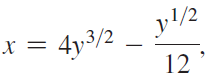
Use the method of your choice to determine the area of the surface generated when the following curves are revolved about the indicated axis.for 1 ≤ y ≤ 4; about the y-axis 1/2 х 4y3/2 12
Use the method of your choice to determine the area of the surface generated when the following curves are revolved about the indicated axis.x = √12y - y2, for 2 ≤ y ≤ 10; about the y-axis
Determine whether the following statements are true and give an explanation or counterexample. a. If the curve y = f(x) on the interval [a, b] is revolved about the y-axis, the area of the surface generated isb. If f is not one-to-one on the interval [a, b], then the area of the surface
The part of the curve y = 1/2 ln (2x + √4x2 - 1) between the points (1/2 , 0) and (17/16, ln 2)
Find the area of the surface generated when the given curve is revolved about the y-axis.The part of the curve y = 4x - 1 between the points (1, 3) and (4, 15)
Find the area of the surface generated when the given curve is revolved about the y-axis.y = x2/4, for 2 ≤ x ≤ 4
Find the area of the surface generated when the given curve is revolved about the y-axis.y = (3x)1/3, for 0 ≤ x ≤ 8/3
A 1.5-mm layer of paint is applied to one side of the following surfaces. Find the approximate volume of paint needed. Assume that x and y are measured in meters.The spherical zone generated when the upper portion of the circle x2 + y2 = 100 on the interval [-8, 8] is revolved about the x-axis
Find the area of the surface generated when the given curve is revolved about the x-axis.y = √5x - x2 on [1, 4]
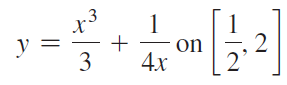
Find the area of the surface generated when the given curve is revolved about the x-axis. x3 y = 3 2 on 2° 4x
Find the area of the surface generated when the given curve is revolved about the x-axis. x4 on [1, 2] 4x2
Find the area of the surface generated when the given curve is revolved about the x-axis. Не* + e 2) on [-2. 2] -2х
Find the area of the surface generated when the given curve is revolved about the x-axis.y = √4x + 6 on [0, 5]
Find the area of the surface generated when the given curve is revolved about the x-axis. x/2 y = x3/2 on [1, 2] 3
Find the area of the surface generated when the given curve is revolved about the x-axis.y = x3 on [0, 1]
Find the area of the surface generated when the given curve is revolved about the x-axis.y = 8√x on [9, 20]
Find the area of the surface generated when the given curve is revolved about the x-axis.y = 12 - 3x on [1, 3]
Find the area of the surface generated when the given curve is revolved about the x-axis.y = 3x + 4 on [0, 6]
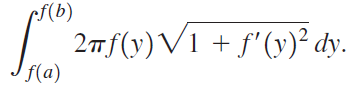
Suppose g is positive and differentiable on [c, d]. The curve x = g(y) on [c, d] is revolved about the y-axis. Explain how to find the area of the surface that is generated.
Suppose f is positive and differentiable on [a, b]. The curve y = f(x) on [a, b] is revolved about the x-axis. Explain how to find the area of the surface that is generated.
A frustum of a cone is generated by revolving the graph of y = 4x on the interval [2, 6] about the x-axis. What is the area of the surface of the frustum?
What is the area of the curved surface of a right circular cone of radius 3 and height 4?
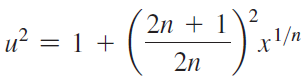
Johann Bernoulli (1667–1748) evaluated the arc length of curves of the form y = x(2n + 1)/2n, where n is a positive integer, on the interval [0, a].a. Write the arc length integral.b. Make the change of variables to obtain a new integral with respect to u.c. Use the Binomial Theorem to expand
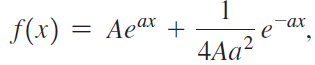
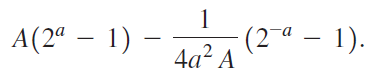
a. Show that the arc length integral for the functionwhere a > 0 and A > 0, may be integrated using methods you already know.b. Verify that the arc length of the curve y = f(x) on the interval [0, ln 2] is f(x) = Aeªx + —ах 4Aa² A(2ª – 1) - (2ª – 1). 2~a 4a? A
Suppose a curve is described by y = f(x) on the interval [-b, b], where f' is continuous on [-b, b]. Show that if f is symmetric about the origin ( f is odd) or f is symmetric about the y-axis ( f is even), then the length of the curve y = f(x) from x = -b to x = b is twice the length of the curve
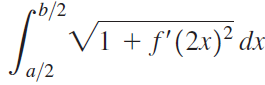
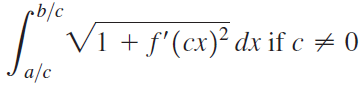
Suppose the graph of f on the interval [a, b] has length L, where f' is continuous on [a, b]. Evaluate the following integrals in terms of L.a.b. b/2 |/ Vi + f'(2x)² dx a/2 pb/c Vi + f'(cx)² dx if c # 0 a/c
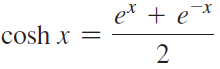
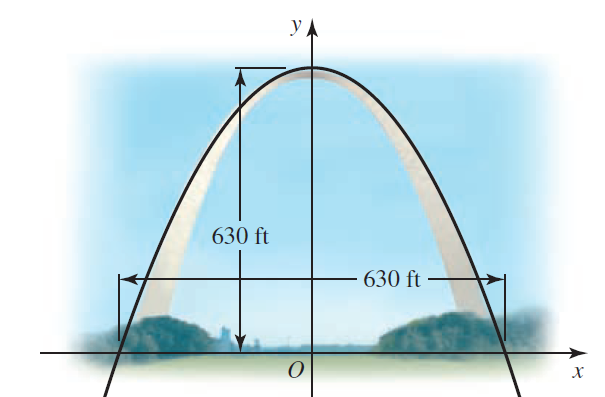
The shape of the Gateway Arch in St. Louis (with a height and a base length of 630 ft) is modeled by the function y = -630 cosh (x/239.2) + 1260, where |x| ≤ 315, and x and y are measured in feet (see figure). The function cosh x is the hyperbolic cosine, defined byEstimate the length of the
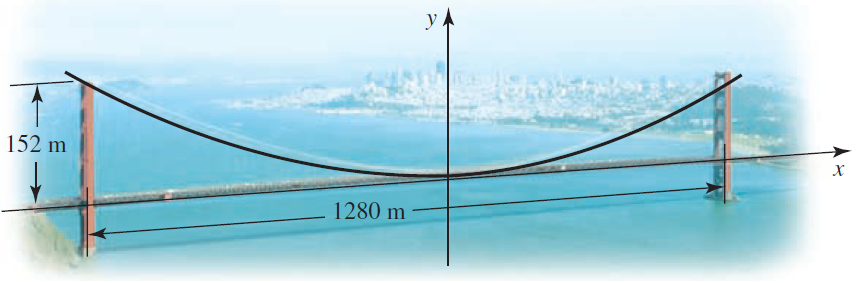
The profile of the cables on a suspension bridge may be modeled by a parabola. The central span of the Golden Gate Bridge (see figure) is 1280 m long and 152 m high. The parabola y = 0.00037x2 gives a good fit to the shape of the cables, where |x| ≤ 640, and x and y are measured in meters.
Write the integral that gives the length of the curve on the interval [0, π]. y = f(x) = Jo sin t dt
Which curve has the greater length on the interval [-1, 1], y = 1 - x2 or y = cos(πx/2)?
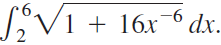
Find a curve that passes through the point (1, 5) and has an arc length on the interval [2, 6] given by /1 + 16x¬6 dx. 2
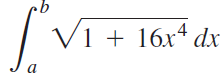
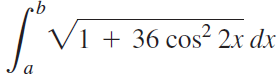
What differentiable functions have an arc length on the interval [a, b] given by the following integrals? Note that the answers are not unique. Give a family of functions that satisfy the conditions.a.b. V1 + 16x4 dx Vi+ 36 сos? 2х dx
Consider the segment of the line y = mx + c on the interval [a, b]. Use the arc length formula to show that the length of the line segment is (b - a)√1 + m2. Verify this result by computing the length of the line segment using the distance formula.
Showing 3100 - 3200
of 6775
First
25
26
27
28
29
30
31
32
33
34
35
36
37
38
39
Last
Step by Step Answers

 Get 50% OFF
Claim Now
Get 50% OFF
Claim Now






![x4 on [1, 2] 4x2](https://dsd5zvtm8ll6.cloudfront.net/si.question.images/images/question_images/1551/7/2/0/1635c7d5ee3b580e1551702892214.jpg)
![Не* + e 2) on [-2. 2] -2х](https://dsd5zvtm8ll6.cloudfront.net/si.question.images/images/question_images/1551/7/2/0/1465c7d5ed2702c71551702874848.jpg)
![x/2 y = x3/2 on [1, 2] 3](https://dsd5zvtm8ll6.cloudfront.net/si.question.images/images/question_images/1551/7/1/9/8275c7d5d930f0311551702555541.jpg)