New Semester
Started
Get
50% OFF
Study Help!
--h --m --s
Claim Now
Question Answers
Textbooks
Find textbooks, questions and answers
Oops, something went wrong!
Change your search query and then try again
S
Books
FREE
Study Help
Expert Questions
Accounting
General Management
Mathematics
Finance
Organizational Behaviour
Law
Physics
Operating System
Management Leadership
Sociology
Programming
Marketing
Database
Computer Network
Economics
Textbooks Solutions
Accounting
Managerial Accounting
Management Leadership
Cost Accounting
Statistics
Business Law
Corporate Finance
Finance
Economics
Auditing
Tutors
Online Tutors
Find a Tutor
Hire a Tutor
Become a Tutor
AI Tutor
AI Study Planner
NEW
Sell Books
Search
Search
Sign In
Register
study help
mathematics
college algebra graphs and models
College Algebra With Modeling And Visualization 6th Edition Gary Rockswold - Solutions
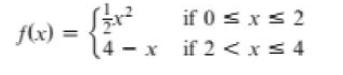
Graph y = f(x). Is f continuous? S=x² f(x) = if 0 ≤ x ≤ 2 -x if2 < x≤ 4
Solve (x2 - 1)/(x + 2) ≥ 0.
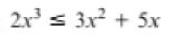
Solve the polynomial inequality. (a) Symbolically and (b) Graphically. Use interval notation to write the solution set. 2x³ = 3x² + 5x
The monthly cost of driving a car is $200 for maintenance plus $0.25 a mile. Write a formula for a function C that calculates the monthly cost of driving a car x miles. Evaluate C(2000) and interpret the result.
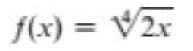
Use transformations of the graphs of y = √x, y = 3√x, or y = 4√x to graph y = f(x). f(x) = √2x
Use transformations of the graphs of y = √x, y = 3√x, or y = 4√x to graph y = f(x). f(x)=√x + 3+2
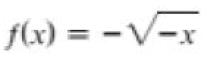
Use transformations of the graphs of y = √x, y = 3√x, or y = 4√x to graph y = f(x). f(x) = -√-x
If possible, sketch a graph that satisfies the following conditions.A cubic function with one real zero, two nonreal complex zeros, and a negative leading coefficient
If possible, sketch a graph that satisfies the following conditions.A quadratic function with one real zero and one non-real complex zero
If possible, sketch a graph that satisfies the following conditions.A fourth-degree function with two real zeros, two non-real complex zeros, and a negative leading coefficient
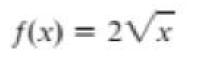
Use transformations of the graphs of y = √x, y = 3√x, or y = 4√x to graph y = f(x). f(x) = 2√x
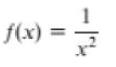
Graph f and identify any asymptotes. f(x) 1
Write a formula f(x) for a rational function so that its graph has the specified asymptotes.Vertical: x = -3; horizontal: y = 1
If possible, sketch a graph that satisfies the following conditions.A cubic function with only nonreal complex zeros
Use transformations of the graphs of y = √x, y = 3√x, or y = 4√x to graph y = f(x). f(x)=√x + 1
State the domain of f(x) = 2x - 5/ x2 - 3x - 4. Find any vertical or horizontal asymptotes.
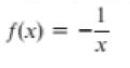
Graph f and identify any asymptotes. x 음 (x)/
If possible, sketch a graph that satisfies the following conditions.A fourth-degree function with only nonreal complex zeros and a positive leading coefficient
Write a formula f(x) for a rational function so that its graph has the specified asymptotes.Vertical: x = 4; horizontal: y = -3
Write a formula f(x) for a rational function so that its graph has the specified asymptotes.Vertical: x = -2 and x = 4; horizontal: y = 5
If possible, sketch a graph that satisfies the following conditions.A cubic polynomial function with three real zeros and two nonreal complex zeros
At noon, one runner is heading south at 8 miles per hour and is located 2 miles north of a second runner, who is heading west at 7 miles per hour. Approximate the distance between the runners to the nearest tenth of a mile at 12:30 P.M.
If possible, sketch a graph that satisfies the following conditions.A fourth-degree function with four real zeros and two nonreal complex zeros
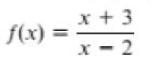
Complete the following. (a) Find the domain of f. (b) Graph f in an appropriate viewing rectangle. (c) Find any horizontal or vertical asymptotes. (d) Sketch a graph of f that includes any asymptotes. f(x) = x + 3 x-2
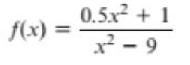
Complete the following. (a) Find the domain of f. (b) Graph f in an appropriate viewing rectangle. (c) Find any horizontal or vertical asymptotes. (d) Sketch a graph of f that includes any asymptotes. f(x): 0.5x2 + 1 ²-9
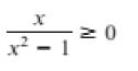
Solve the rational inequality (a) Symbolically and (b) Graphically. 0 =
Solve the rational inequality (a) Symbolically and (b) Graphically. 1 >0 V
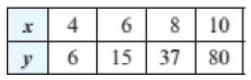
Find a quadratic function in the form f(x) = a(x - h)2 + k that models the data in the table. Graph y = f(x) and the data if a graphing calculator is available. 68 8 10 80 4 y 6 15 37
Solve the rational inequality (a) Symbolically and (b) Graphically. 1 X
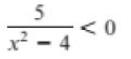
Solve the rational inequality (a) Symbolically and (b) Graphically. 5 x²-4
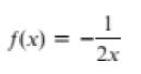
Graph f and identify any asymptotes. f(x) = 1 2x
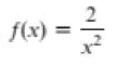
Graph f and identify any asymptotes. f(x) = 2
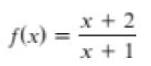
Graph y = f(x). You may want to use division, factoring, or transformations as an aid. Show all asymptotes and "holes." f(x) = x + 2 x + 1
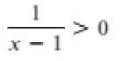
Solve the rational inequality 1 x-1 V >0
According to one model, the rate at which an animal's heart beats varies with its weight. Smaller animals tend to have faster pulses, whereas larger animals tend to have slower pulses. The table lists average pulse rates in beats per minute (bpm) for animals with various weights in pounds (lb). Use
In the compound interest formula A = P(1 + r/n)nt, we can think of P as the present value of an investment and A as the future value of an investment after t years. For example, if you were saving for college and needed a future value of A dollars, then P would represent the amount needed in an
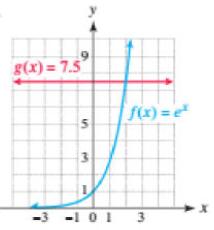
The graphical and symbolic representations off and g are shown. (a) Use the graph to solve f(x) = g(x). (b) Solve f(x) = g(x) symbolically. g(x)=7.5 5 3 f(x)=e² -3 -1 0 1 3
Find the average rate of change of f(x) = ln x from x to x + 0.001 for each value of x. Round your answers to two decimal places. (a) x = 1 (b) x = 2 (c) x = 3 (d) x = 4
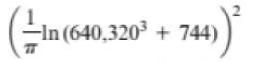
Try to decide if the expression is precisely an integer. (In (6 -In (640,320³ + 744)
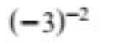
Simplify the expression without a calculator. 2-3
If possible, sketch a graph of a polynomial that satisfies the conditions. Let a be the leading coefficient.Degree 4 with four turning points
If possible, sketch a graph of a polynomial that satisfies the conditions. Let a be the leading coefficient.Degree 5 and symmetric with respect to the y-axis
Use a calculator to approximate each pair of expressions to the nearest thousandth. Then state which property of logarithms this calculation illustrates. log 4 + log 7, log 28
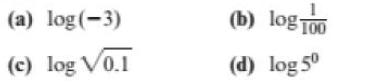
Evaluate each expression by hand, if possible. (a) log(-3) (c) log V0.1 (b) log 100 (d) log 5⁰
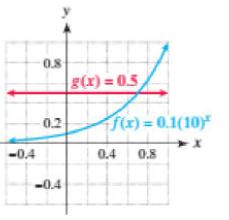
The graphical and symbolic representations off and g are shown. (a) Use the graph to solve f(x) = g(x). (b) Solve f(x) = g(x) symbolically. -0.4 0.8 -0.2 -0.4 g(x)=0.5 f(x)=0.1(10) 0.4 0.8 -X
Let f(x) compute the height in feet of a rocket after x seconds of upward flight. (a) Explain what f-1(x) computes. (b) Interpret the solution to the equation f(x) = 5000. (c) Explain how to solve the equation in part (b) using f-1(x).
In the compound interest formula A = P(1 + r/n)nt, we can think of P as the present value of an investment and A as the future value of an investment after t years. For example, if you were saving for college and needed a future value of A dollars, then P would represent the amount needed in an
Show that any exponential function in the form f(x) = Cax can be written as f(x) = Cekx. That is, write k in terms of a. Use your method to write g(x) = 2x in the form ekx for some k.
Try to decide if the expression is precisely an integer. eV163
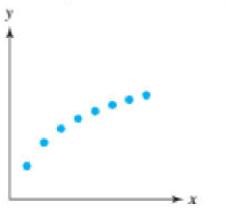
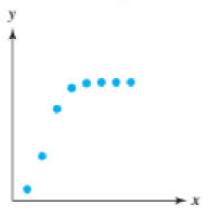
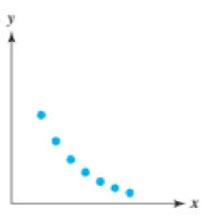
Select an appropriate type of modeling function for the data shown in the graph. Choose from the following. i. Exponential ii. Logarithmic iii. Logistic
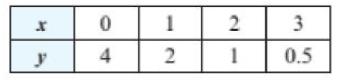
Find values for C and a so that f(x) = Cax models the data in the table. 0 y 4 1 2 2 1 3 0.5
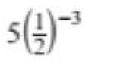
Simplify the expression without a calculator. z-(E−)
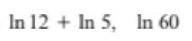
Use a calculator to approximate each pair of expressions to the nearest thousandth. Then state which property of logarithms this calculation illustrates. In 12+ In 5, In 60
If the principal is $1200 and the interest rate is 9.5% compounded monthly, calculate the account balance after 4 years. Determine the balance if the interest is compounded continuously.
In the compound interest formula A = P(1 + r/n)nt, we can think of P as the present value of an investment and A as the future value of an investment after t years. For example, if you were saving for college and needed a future value of A dollars, then P would represent the amount needed in an
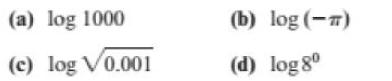
Evaluate each expression by hand, if possible. (a) log 1000 (c) log V0.001 (b) log (-) (d) log 8⁰
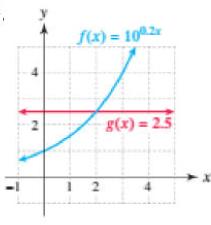
The graphical and symbolic representations off and g are shown. (a) Use the graph to solve f(x) = g(x). (b) Solve f(x) = g(x) symbolically. 4 f(x) = 102x 2 g(x)=2.5 x
If f(3) = 2 and g(2) = 5, (g ° f)(3) = ________.
State the inverse action or actions.Opening a window
If the graph of f lies entirely in quadrants I and II, in which quadrant(s) does the graph of f-1 lie?
Select an appropriate type of modeling function for the data shown in the graph. Choose from the following. i. Exponential ii. Logarithmic iii. Logistic
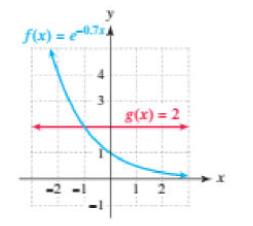
The graphical and symbolic representations off and g are shown. (a) Use the graph to solve f(x) = g(x). (b) Solve f(x) = g(x) symbolically. f(x) = -0.7x4 g(x)=2 2
Evaluate each of the following logarithms by hand. (a) log, 36 (b) log V10+ log 0.01 (c) In 1/12
Let f(x) = x2 + 3x - 2 and g(x) = 3x - 1. Find each expression. (a) (f + g)(x) (b) (f/g)(x) (c) (f ° g)(x)
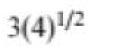
Simplify the expression without a calculator. 3(4)1/2
According to one model, the future increases in average global temperatures (due to car- bon dioxide levels exceeding 280 parts per million) can be estimated using T = 6.5 In (C/280), where C is the concentration of atmospheric carbon dioxide in parts per million (ppm) and T is in degrees
Combine the expression 1/2 ln x - 3 ln y + In z as a logarithm of a single expression.
In the compound inter- est formula A = P(1 + r/n)nt, we can think of P as the present value of an investment and A as the future value of an investment after t years. For example, if you were saving for college and needed a future value of A dollars, then P would represent the amount needed in an
Use a calculator to approximate each pair of expressions to the nearest thousandth. Then state which property of logarithms this calculation illustrates. In 72 In 8, In 9
Evaluate each expression by hand, if possible. (a) log 10 (c) 20 log 0.1 (b) log 10,000 (d) log 10+ log 0.001
Simplify the expression without a calculator. E- (7) s
Compare each average rate of change of In x to x. Determine what the pattern is. Make a generalization.
State the inverse action or actions.Climbing up a ladder
Select an appropriate type of modeling function for the data shown in the graph. Choose from the following. i. Exponential ii. Logarithmic iii. Logistic
Evaluate each expression by hand, if possible. (a) log 100 (c) 5 log 0.01 (b) log 1,000,000 (d) log0.1 log 1000
Explain what log215 represents. Is it equal to an integer?
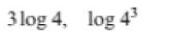
Use a calculator to approximate each pair of expressions to the nearest thousandth. Then state which property of logarithms this calculation illustrates. 3 log 4, log 4³
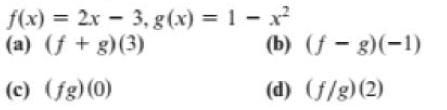
Use f(x) and g(x) to evaluate each expression symbolically. f(x)=2x-3, g(x) = 1 = x² (a) (f + g)(3) (c) (fg)(0) (b) (f- g)(-1) (d) (f/g)(2)
Use a calculator to approximate each pair of expressions to the nearest thousandth. Then state which property of logarithms this calculation illustrates. 10 log 2, log 1024
If f(x) = x2 and g(x) = 4x, (f ° g)(x) = _______.
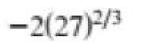
Simplify the expression without a calculator. -2(27)2/3
Complete the following. Round your answers to two decimal places. (a) Find the average rate of change of f(x) = ex from x to x + 0.001 for the given x. (b) Approximate f(x) = ex for the given x. (c) Compare your answers in parts (a) and (b).x = 0
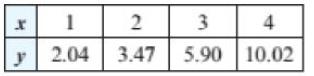
Make a scatterplot of the data. Then find an exponential, logarithmic, or logistic function f that best models the data. r 1 y 2.04 2 3.47 3 5.90 4 10.02
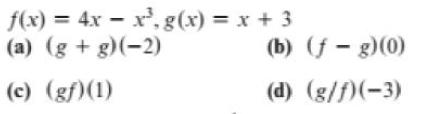
Use f(x) and g(x) to evaluate each expression symbolically. f(x) = 4x = x², g(x) = x + 3 (a) (g + g)(-2) (c) (gf)(1) (b) (f- g)(0) (d) (g/f)(-3)
The temperature T of a cooling object in degrees Fahrenheit after x minutes is given by T = 80 + 120(0.9)x. (a) What happens to T after a long time? (b) After how long is the object's temperature 100°F?
Use a calculator to approximate each pair of expressions to the nearest thousandth. Then state which property of logarithms this calculation illustrates. log 100- log 20, log 5
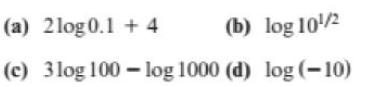
Evaluate each expression by hand, if possible. (a) 2log0.1 +4 (c) 3log 100-log 1000 (d) (b) log 10¹/2 log (-10)
Complete the following. Round your answers to two decimal places. (a) Find the average rate of change of f(x) = ex from x to x + 0.001 for the given x. (b) Approximate f(x)= ex for the given x. (c) Compare your answers in parts (a) and (b).x = -2
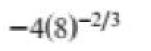
Simplify the expression without a calculator. -4(8)-2/3
If f(x) calculates the number of square feet in x square yards and g(x) calculates the cost in dollars of x square feet of carpet, what does (g º f)(x) calculate?
Expand the expression. If possible, write your answer without exponents. log₂ab
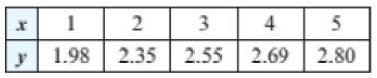
Make a scatterplot of the data. Then find an exponential, logarithmic, or logistic function f that best models the data. x 1 y 1.98 2 2.35 3 2.55 4 2.69 5 2.80
The population of California in millions x years after 2010 is modeled by P(x) = 37.3e0.01x. (a) Evaluate P(2). Interpret this result. (b) Find the y-intercept on the graph of y = P(x). Interpret this result. (c) Estimate the annual percent increase in the population of
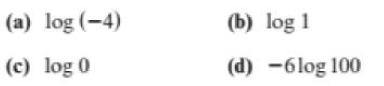
Evaluate each expression by hand, if possible. (a) log (-4) (c) log 0 (b) log 1 (d) -6log 100
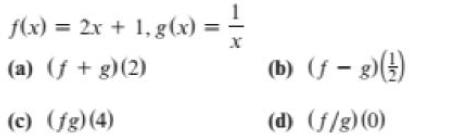
Use f(x) and g(x) to evaluate each expression symbolically. f(x) = 2x + 1, g(x) (a) (f + g)(2) (c) (fg) (4) (b) (f-g)(1) (d) (f/g)(0)
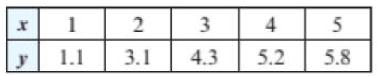
Make a scatterplot of the data. Then find an exponential, logarithmic, or logistic function f that best models the data. x 1 1.1 2 3.1 3 4.3 4 5.2 5 5.8
If f(x) calculates the number of days in x hours and g(x) calculates the number of years in x days, what does (g ° f)(x) calculate?
Complete the following. Round your answers to two decimal places. (a) Find the average rate of change of f(x) = ex from x to x + 0.001 for the given x. (b) Approximate f(x)= ex for the given x. (c) Compare your answers in parts (a) and (b).x = -0.5
Describe verbally the inverse of the statement. Then express both the given statement and its inverse symbolically.Add 2 to x.
Graph f(x) = 3√x and y = x. Then graph y = f-1(x).
Showing 7700 - 7800
of 13634
First
71
72
73
74
75
76
77
78
79
80
81
82
83
84
85
Last
Step by Step Answers

 Get 50% OFF
Claim Now
Get 50% OFF
Claim Now