New Semester
Started
Get
50% OFF
Study Help!
--h --m --s
Claim Now
Question Answers
Textbooks
Find textbooks, questions and answers
Oops, something went wrong!
Change your search query and then try again
S
Books
FREE
Study Help
Expert Questions
Accounting
General Management
Mathematics
Finance
Organizational Behaviour
Law
Physics
Operating System
Management Leadership
Sociology
Programming
Marketing
Database
Computer Network
Economics
Textbooks Solutions
Accounting
Managerial Accounting
Management Leadership
Cost Accounting
Statistics
Business Law
Corporate Finance
Finance
Economics
Auditing
Tutors
Online Tutors
Find a Tutor
Hire a Tutor
Become a Tutor
AI Tutor
AI Study Planner
NEW
Sell Books
Search
Search
Sign In
Register
study help
mathematics
college algebra graphs and models
College Algebra With Modeling And Visualization 6th Edition Gary Rockswold - Solutions
Does (x - 3)2 + (y - 5)2 = 0 represent the equation of a circle? If not, describe the graph of this equation.
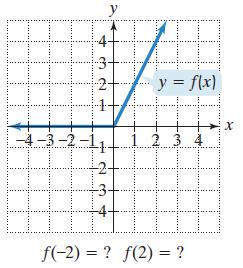
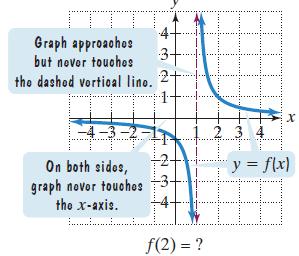
In Exercises 77–92, use the graph to determinea. The function’s domain;b. The function’s range;c. The x-intercepts, if any;d. The y-intercept, if any;e. The missing function values, indicated by question marks, below each graph. TH -4-3-2 10 432 y IT y = f(x) 1 2 3 DIIIIIIIII f(-2) = ? f(2)=
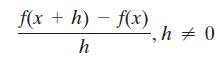
In Exercises 71–92, find and simplify the difference quotient f(x +h)-f(x) h -, h = 0
In Exercises 81–94, begin by graphing the absolute value function, f(x) = |x|. Then use transformations of this graph to graph the given function. g(x) = -x + 4 + 1
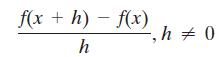
In Exercises 71–92, find and simplify the difference quotient f(x +h)-f(x) h -, h = 0
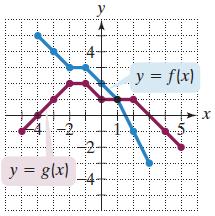
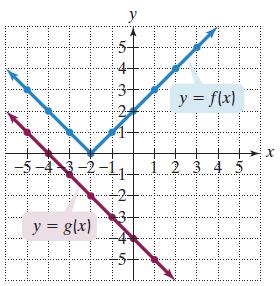
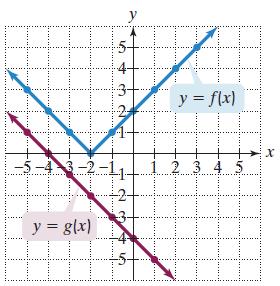
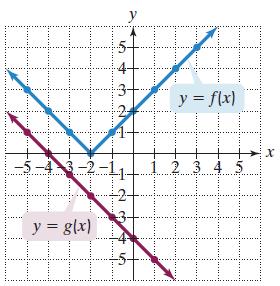
Use the graphs of f and g to solve Exercises 83–90. Graph f - g. y = g(x) HH y .y = f(x) # X
In Exercises 81–94, begin by graphing the absolute value function, f(x) = |x|. Then use transformations of this graph to graph the given function. g(x) = -x + 4 + 2
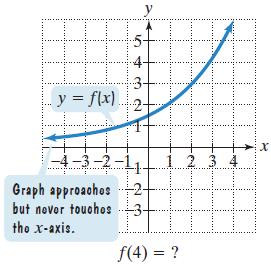
In Exercises 77–92, use the graph to determinea. The function’s domain;b. The function’s range;c. The x-intercepts, if any;d. The y-intercept, if any;e. The missing function values, indicated by question marks, below each graph. II y = f(x). -4-3-2-3 Graph approaches but never touchos the
In Exercises 87–90, determine whether each statement makes sense or does not make sense, and explain your reasoning.I’m working with the linear function f(x) = 3x + 5 and I do not need to find f -1 in order to determine the value of (f ° f -1)(17).
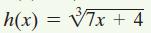
In Exercises 89–90, express the given function h as a composition of two functions f and g so that h(x) = (f ° g)(x) h(x) = √7x + 4
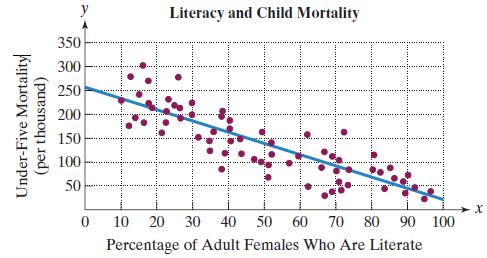
Shown, again, is the scatter plot that indicates a relationship between the percentage of adult females in a country who are literate and the mortality of children under five. Also shown is a line that passes through or near the points. Find a linear function that models the data by finding the
In Exercises 86–89, determine whether each statement makes sense or does not make sense, and explain your reasoning.My graph of (x - 2)2 + (y + 1)2 = 16 is my graph of x2 + y2 = 16 translated two units right and one unit down.
In Exercises 91–92, find f(g(x)) and g(f(x)) and determine whether each pair of functions f and g are inverses of each other. 3 1 5 f(x) = ²x + — and g(x) = x − 2 - 5 2 3
In Exercises 91–94, use the graphs of f and g to evaluate each composite function.(f ° g)(-1) -5-4-3-2 D 3-2- y = g(x) CO y Z PI y = f(x) 2 3 4 X
In Exercises 87–90, determine whether each statement makes sense or does not make sense, and explain your reasoning.When finding the inverse of a function, I interchange x and y, which reverses the domain and range between the function and its inverse.
In Exercises 77–92, use the graph to determinea. The function’s domain;b. The function’s range;c. The x-intercepts, if any;d. The y-intercept, if any;e. The missing function values, indicated by question marks, below each graph. Graph approaches but never touches the dashod vortical
In Exercises 89–90, express the given function h as a composition of two functions f and g so that h(x) = (f ° g)(x).h(x) = (x2 + 2x - 1)4
In Exercises 81–94, begin by graphing the absolute value function, f(x) = |x|. Then use transformations of this graph to graph the given function. h(x) = 2x + 4)
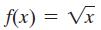
In Exercises 71–92, find and simplify the difference quotient f(x) = √x Vx
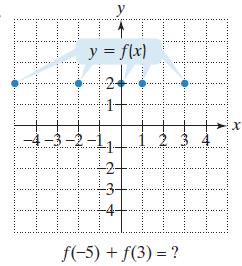
In Exercises 77–92, use the graph to determinea. The function’s domain;b. The function’s range;c. The x-intercepts, if any;d. The y-intercept, if any;e. The missing function values, indicated by question marks, below each graph. 4:0 -4-3- y y = f(x) II (IIIIIIIII f(-5) + f(3) = ? X
In Exercises 90–93, determine whether each statement is true or false. If the statement is false, make the necessary change(s) to produce a true statement.The equation of the circle whose center is at the origin with radius 16 is x2 + y2 = 16.
In Exercises 91–92, find f(g(x)) and g(f(x)) and determine whether each pair of functions f and g are inverses of each other. f(x) = 2 5x and g(x) = 2 - x 5
In Exercises 87–90, determine whether each statement makes sense or does not make sense, and explain your reasoning.I used vertical lines to determine if my graph represents a one-to-one function.
In Exercises 81–94, begin by graphing the absolute value function, f(x) = |x|. Then use transformations of this graph to graph the given function. h(x) = 2x + 3|
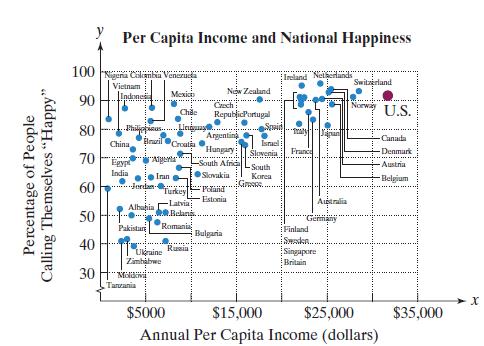
Just as money doesn’t buy happiness for individuals, the two don’t necessarily go together for countries either. However, the scatter plot does show a relationship between a country’s annual per capita income and the percentage of people in that country who call themselves “happy.”Draw a
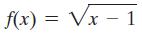
In Exercises 71–92, find and simplify the difference quotient f(x)=√x - 1
In Exercises 91–94, use the graphs of f and g to evaluate each composite function.(f ° g)(1) -5-4-3-2 D 3-2- y = g(x) CO y Z PI y = f(x) 2 3 4 X
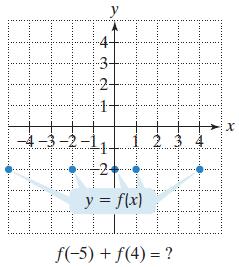
In Exercises 77–92, use the graph to determinea. The function’s domain;b. The function’s range;c. The x-intercepts, if any;d. The y-intercept, if any;e. The missing function values, indicated by question marks, below each graph. -4-3-2- CO y y = f(x) TANPA CIO f(-5) + f(4) = ? X
In Exercises 90–93, determine whether each statement is true or false. If the statement is false, make the necessary change(s) to produce a true statement.The graph of (x - 3)2 + (y + 5)2 = 36 is a circle with radius 6 centered at (-3, 5).
In Exercises 91–94, determine whether each statement is true or false. If the statement is false, make the necessary change(s) to produce a true statement.The inverse of {(1, 4), (2, 7)} is {(2, 7), (1, 4)}.
In Exercises 81–94, begin by graphing the absolute value function, f(x) = |x|. Then use transformations of this graph to graph the given function. g(x) = 2x + 4] + 1 +4
In Exercises 91–94, use the graphs of f and g to evaluate each composite function. (g ° f)(0) -5-4-3-2 D 3-2- y = g(x) CO y Z PI y = f(x) 2 3 4 X
In Exercises 90–93, determine whether each statement is true or false. If the statement is false, make the necessary change(s) to produce a true statement.The graph of (x - 4) + (y + 6) = 25 is a circle with radius 5 centered at (4, -6).
In Exercises 91–94, determine whether each statement is true or false. If the statement is false, make the necessary change(s) to produce a true statement.The function f(x) = 5 is one-to-one.
The functions in Exercises 93–95 are all one-to-one. For each function,a. Find an equation for f -1(x), the inverse function.b. Verify that your equation is correct by showing that f(f -1(x)) = x and f -1(f(x)) = x.f(x) = 4x - 3
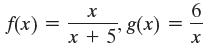
In Exercises 67–74, finda. (f ° g)(x)b. The domain of f ° g. f(x)= = X x + 5' 8(x) = 6 X
In Exercises 90–93, determine whether each statement is true or false. If the statement is false, make the necessary change(s) to produce a true statement.The graph of (x - 3)2 + (y + 5)2 = -36 is a circle with radius 6 centered at (3, -5).
In Exercises 91–94, determine whether each statement is true or false. If the statement is false, make the necessary change(s) to produce a true statement.If f(x) = 3x, then f -1(x) = 1/3x.
What is the slope of a line and how is it found?
In Exercises 67–72, use intercepts to graph each equation.3x + 5y + 15 = 0
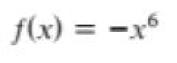
Complete each of the following for f(x). (a) If possible, evaluate f(0) and f(-2). (b) Sketch a graph of f. Give the domain and range. (c) Over what interval(s) is the graph of y = f(x) increasing? Decreasing? (d) As x→ -∞ f(x) (e) As x→ ∞ f(x) (f) Does f(x) = f(-x)? Is function f odd
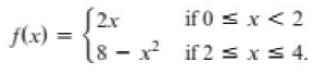
Let f(x) be given by(a) Sketch a graph of f. Is f continuous on its domain? (b) Evaluate f(1) and f(3). (c) Solve the equation f(x) = 2. f(x) = (2x 18-x² if 0 ≤ x < 2 if2 ≤ x ≤ 4.
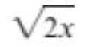
Use positive exponents to rewrite. V2x
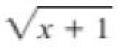
Use positive exponents to rewrite. Vx+1
Complete the following. (a) Graph y = f(x) in the standard viewing rectangle. (b) Approximate the coordinates of each turning point.(c) Estimate any local extrema. f(x) = 12x + 3x²
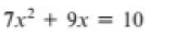
Solve the equation. 7x² + 9x = 10
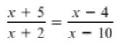
Find all real solutions. Check your results. x + 5 x+ 2 x-4 x 10
Solve the equation. 3x²/3 + 5x¹/3-2=0
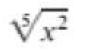
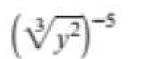
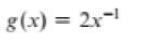
Use positive exponents to rewrite.
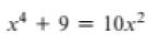
Solve the equation. x² + 9 = 10x²
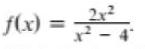
Let(a) Find the domain of f. (b) Identify any horizontal or vertical asymptotes. (c) Graph f with a graphing calculator. (d) Sketch a graph off that includes all asymptotes. j(x) = 2+4
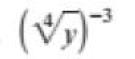
Use positive exponents to rewrite. (۸)
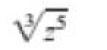
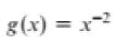
Use positive exponents to rewrite. V
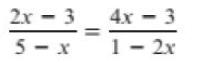
Solve the equation. 2x - 3 5-x 4x - 3 1 - 2x
Solve the equation. √5 + 2x + 4 = x + 5
Use positive exponents to rewrite. (A)
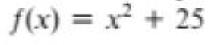
Complete the following. (a) Find all complex zeros of f(x). (b) Write the complete factored form of f(x). f(x) = x² + 25
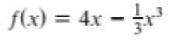
Complete the following. (a) Graph y = f(x) in the standard viewing rectangle. (b) Approximate the coordinates of each turning point.(c) Estimate any local extrema. fx) = 4x — -x =
Complete the following. (a) Find all complex zeros of f(x). (b) Write the complete factored form of f(x). f(x) = x² + 11
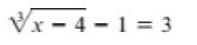
Solve the equation. x-4-1-3
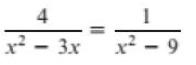
Find all real solutions. Check your results. 4 x² - 3x = 1 x² - 9
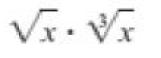
Use positive exponents to rewrite. Vx. Vx
Use graphing to factor f(x). f(x) = 2x³ + 7x² + 2x - 3
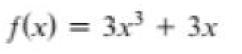
Complete the following. (a) Find all complex zeros of f(x). (b) Write the complete factored form of f(x). f(x) = 3x³ + 3x
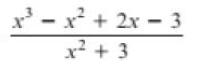
Divide the expression. X x³²-x² + 2x - 3 x² + 3
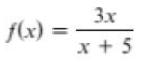
Find any horizontal or vertical asymptotes. f(x) = 3x x + 5
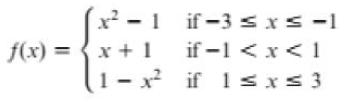
Graph the function f. Is f continuous on its domain? Evaluate f(1). ²-1 f(x) = x + 1 1-x² if-3 ≤x≤-1 if -1 < x < 1 if 1≤x≤3
Complete the following. (a) Identify where f(x) is undefined or f(x) = 0. (b) Solve f(x) > 0. (c) Solve f(x) < 0. 6 y = f(x) 12
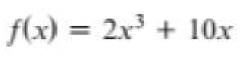
Complete the following. (a) Find all complex zeros of f(x). (b) Write the complete factored form of f(x). f(x) = 2x³ + 10x
Use transformations of the graphs of y = √x, y = 3√x, or y = 4√x to graph y = f(x). f(x)=√x - 1+1
Find all real solutions. Check your results. 2 x². 2x || 3
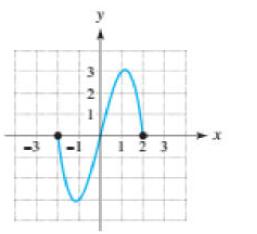
Use the graph off to estimate the (a) Local extrema and (b) Absolute extrema. 3 30 123 x
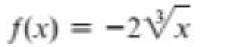
Use transformations of the graphs of y = √x, y = 3√x, or y = 4√x to graph y = f(x). f(x) = -2√x
Solve 1/2x (4 - x) + 1 = 3/2x - 5. Is this equation either an identity or a contradiction?
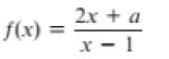
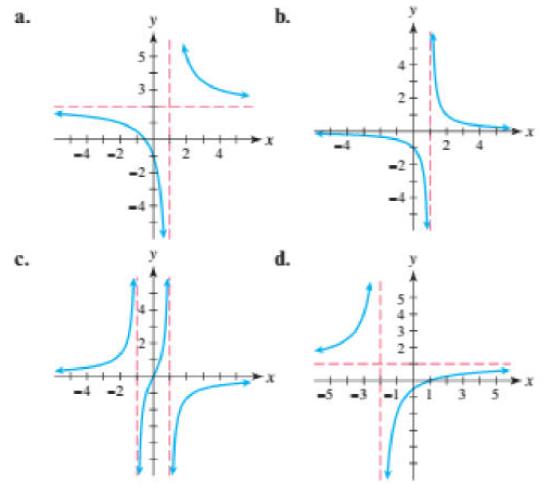
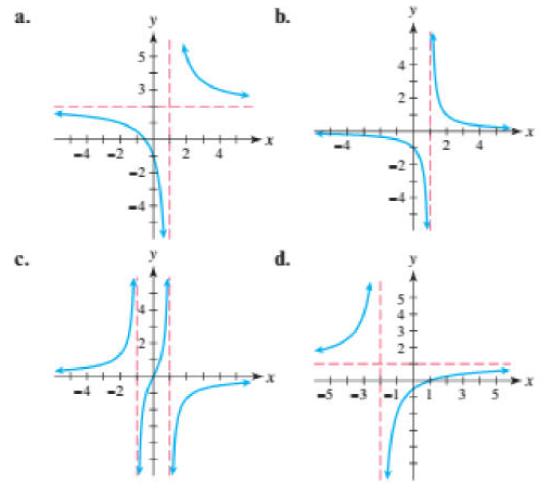
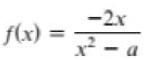
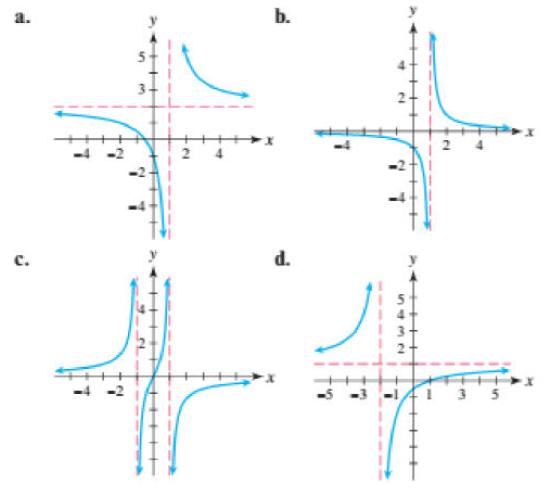
Let a be a positive constant. Match f(x) with its graph (a-d) without using a calculator. f(x) = 2x + a x-1
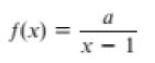
Let a be a positive constant. Match f(x) with its graph (a-d) without using a calculator. f(x) = x-1
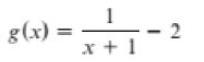
Graph y = g(x) by hand. g(x) = 1 x+1 - 2
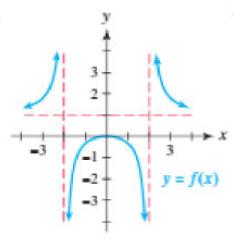
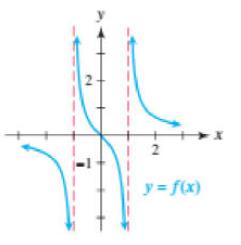
Complete the following. (a) Identify where f(x) is undefined or f(x) = 0. (b) Solve f(x) > 0. (c) Solve f(x) < 0. 32 3 y = f(x)
Complete the following. (a) Identify where f(x) is undefined or f(x) = 0. (b) Solve f(x) > 0. (c) Solve f(x) < 0. 2 2 y = f(x) X
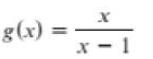
Graph y = g(x) by hand. g(x) =
Let a be a positive constant. Match f(x) with its graph (a-d) without using a calculator. f(x) = -2x a
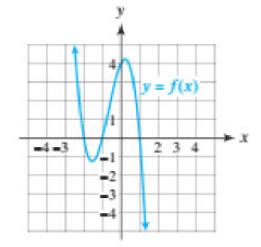
Use the graph to write the complete factored form of the cubic polynomial f(x). 4 y = f(x) 234
Write a complete factored form of a quintic (degree 5) polynomial f(x) that has zeros -2 and 2 with multiplicities 2 and 3, respectively.
Use transformations of the graphs of y = √x, y = 3√x, or y = 4√x to graph y = f(x). f(x) = I-X-A
A quintic (degree 5) function f with real coefficients has leading coefficient 1/2 and zeros -2, i, and -2i. Write f(x) in complete factored form and expanded form.
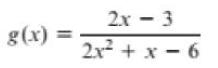
Graph y = g(x) by hand. g(x) = 2x - 3 2x²+x-6
Write 3 + 4i / 1 - i in standard form.
Find all complex solutions, to x4 - 25 = 0.
Graph y = g(x) by hand. g(x)=2x-1
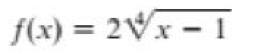
Use transformations of the graphs of y = √x, y = 3√x, or y = 4√x to graph y = f(x). f(x) = 2√x - 1
Graph y = g(x) by hand. 7- x = (x)8
Write 3√x5 using rational exponents. Evaluate the expression for x = 8.
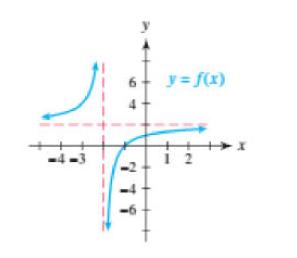
Sketch a graph of a function f with vertical asymptote x = -2 and horizontal asymptote y = 2.
Write a formula f(x) for a rational function so that its graph has the specified asymptotes.Vertical: x = ±3; horizontal: y = 0
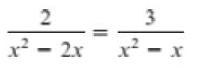
Solve the equation 3x/x - 2 = 2, symbolically, graphically and numerically.
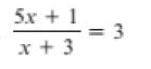
Solve the equation. Check your results. 5x + 1 x+3 3
Two liters of a 35% sulfuric acid solution need to be diluted to a 20% solution. How many liters of a 12% sulfuric acid solution should be mixed with the 2-liter solution?
Give an example of a polynomial function that has only nonreal complex zeros and a polynomial function that has only real zeros. Explain how to determine graphically if a function has only nonreal complex zeros.
Round-trip airline tickets to Hawaii are regularly $800, but for each additional ticket purchased the price is reduced by $5. For example, I ticket costs $800, 2 tickets cost 2(795) = $1590, and 3 tickets cost 3(790) = $2370. (a) Write a quadratic function C that gives the total cost of
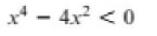
Solve the polynomial inequality. Use interval notation to write the solution set. x² - 4x²
Showing 8000 - 8100
of 13634
First
74
75
76
77
78
79
80
81
82
83
84
85
86
87
88
Last
Step by Step Answers

 Get 50% OFF
Claim Now
Get 50% OFF
Claim Now