New Semester
Started
Get
50% OFF
Study Help!
--h --m --s
Claim Now
Question Answers
Textbooks
Find textbooks, questions and answers
Oops, something went wrong!
Change your search query and then try again
S
Books
FREE
Study Help
Expert Questions
Accounting
General Management
Mathematics
Finance
Organizational Behaviour
Law
Physics
Operating System
Management Leadership
Sociology
Programming
Marketing
Database
Computer Network
Economics
Textbooks Solutions
Accounting
Managerial Accounting
Management Leadership
Cost Accounting
Statistics
Business Law
Corporate Finance
Finance
Economics
Auditing
Tutors
Online Tutors
Find a Tutor
Hire a Tutor
Become a Tutor
AI Tutor
AI Study Planner
NEW
Sell Books
Search
Search
Sign In
Register
study help
mathematics
precalculus 1st
Calculus For Scientists And Engineers Early Transcendentals 1st Edition William L Briggs, Bernard Gillett, Bill L Briggs, Lyle Cochran - Solutions
Compute the first partial derivatives of the following functions. f(x, y) = ln (1 + e)
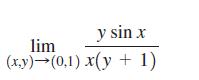
Use the method of your choice to evaluate the following limits. y sin x lim (x,y) (0.1) x(y + 1)
The following functions have exactly one isolated peak or one isolated depression (one local maximum or minimum). Use a graphing utility to approximate the coordinates of the peak or depression. 2 f(x, y) = x²y² - 8x² - y² + 6
Compute the first partial derivatives of the following functions. f(x, y) = 1 tan¹ (x² + y²)
Consider the following functions f, points P, and unit vectors u.a. Compute the gradient of f and evaluate it at P.b. Find the unit vector in the direction of maximum increase of f at P.c. Find the rate of change of the function in the direction of maximum increase at P.d. Find the directional
Compute the first partial derivatives of the following functions. f(x, y) = 1- cos (2(x + y)) + cos² (x + y)
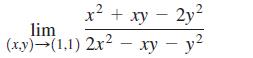
Use the method of your choice to evaluate the following limits. x² + xy - 2y² lim (x,y) (1,1) 2x² - xy - y²
The following functions have exactly one isolated peak or one isolated depression (one local maximum or minimum). Use a graphing utility to approximate the coordinates of the peak or depression. g(x, y) = = (x²-x-2)(y² + 2y)
The following functions have exactly one isolated peak or one isolated depression (one local maximum or minimum). Use a graphing utility to approximate the coordinates of the peak or depression. h(x, y) = 1 e-(x² + y²²-2x)
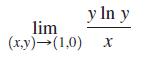
Use the method of your choice to evaluate the following limits. lim (x,y) →(1,0) y ln y X
Compute the first partial derivatives of the following functions. h(x, y, z) = (1 + x + 2y)²
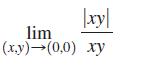
Use the method of your choice to evaluate the following limits. |xy| lim (x,y) →(0,0) xy
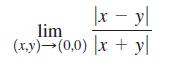
Use the method of your choice to evaluate the following limits. |x - yl lim (x,y) (0,0) |x + yl
The following functions have exactly one isolated peak or one isolated depression (one local maximum or minimum). Use a graphing utility to approximate the coordinates of the peak or depression. p(x, y) = 2 + |x-1| + y - 1|
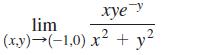
Use the method of your choice to evaluate the following limits. xyey lim 2 (x,y) (-1,0) x² + y²
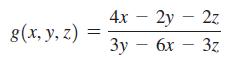
Compute the first partial derivatives of the following functions. g(x, y, z) = 4x - 2y – 2z зу - бх 6x - 3z
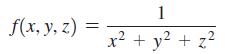
Find an equation for the family of level surfaces corresponding to f. Describe the level surfaces. f(x, y, z) = 1 2 2 2 x² + y² + z²
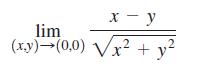
Limits at (0, 0) may be easier to evaluate by converting to polar coordinates. Remember that the same limit must be obtained as r → 0 along all paths to (0, 0). Evaluate the following limits or state that they do not exist. x - y lim 2 (x,y) (0,0) √x² + y²
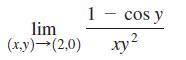
Use the method of your choice to evaluate the following limits. lim (x,y) → (2.0) 1 - cos y 2 xy²
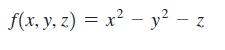
Find an equation for the family of level surfaces corresponding to f. Describe the level surfaces. f(x, y, z) = x² - y² - z
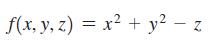
Find an equation for the family of level surfaces corresponding to f. Describe the level surfaces. 2 f(x, y, z) = x² + y² - z
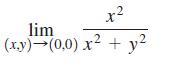
Limits at (0, 0) may be easier to evaluate by converting to polar coordinates. Remember that the same limit must be obtained as r → 0 along all paths to (0, 0). Evaluate the following limits or state that they do not exist. x² lim (x,y) (0,0) x² + y² 2
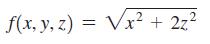
Find an equation for the family of level surfaces corresponding to f. Describe the level surfaces. f(x, y, z) = √x² + 2z²
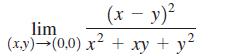
Limits at (0, 0) may be easier to evaluate by converting to polar coordinates. Remember that the same limit must be obtained as r → 0 along all paths to (0, 0). Evaluate the following limits or state that they do not exist. (x - y)² lim 2 (x,y) (0,0) x² + xy + y² 2
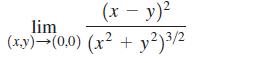
Limits at (0, 0) may be easier to evaluate by converting to polar coordinates. Remember that the same limit must be obtained as r → 0 along all paths to (0, 0). Evaluate the following limits or state that they do not exist. (x - y)² lim (x,y) →(0,0) (x² + y²)³/2
Find the domains of the following functions. Specify the domain mathematically and then describe it in words or with a sketch. f(x, y, z) = ln (z - x² - y² + 2x + 3)
Find the domains of the following functions. Specify the domain mathematically and then describe it in words or with a sketch. g(x, y, z) 10 2 x² (y + 2)x+ yz
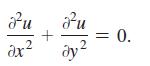
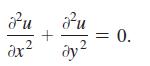
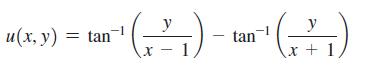
A classical equation of mathematics is Laplace’s equation, which arises in both theory and applications. It governs ideal fluid flow, electrostatic potentials, and the steady state distribution of heat in a conducting medium. In two dimensions, Laplace’s equation isShow that the following
Find the domains of the following functions. Specify the domain mathematically and then describe it in words or with a sketch. f(x, y) = sin¹ (x - y)²
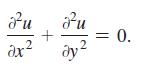
A classical equation of mathematics is Laplace’s equation, which arises in both theory and applications. It governs ideal fluid flow, electrostatic potentials, and the steady state distribution of heat in a conducting medium. In two dimensions, Laplace’s equation isShow that the following
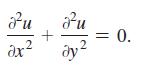
A classical equation of mathematics is Laplace’s equation, which arises in both theory and applications. It governs ideal fluid flow, electrostatic potentials, and the steady state distribution of heat in a conducting medium. In two dimensions, Laplace’s equation isShow that the following
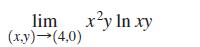
Evaluate the following limits. lim x²y ln xy (x,y) →(4,0)
A classical equation of mathematics is Laplace’s equation, which arises in both theory and applications. It governs ideal fluid flow, electrostatic potentials, and the steady state distribution of heat in a conducting medium. In two dimensions, Laplace’s equation isShow that the following
Find the domains of the following functions. Specify the domain mathematically and then describe it in words or with a sketch. h(x, y, z) = Vz² √2² xz + yz - xy
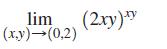
Evaluate the following limits. lim (x,y) →(0,2) (2xy)¹
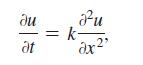
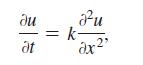
The flow of heat along a thin conducting bar is governed by the one-dimensional heat equation (with analogs for thin plates in two dimensions and for solids in three dimensions)where u is a measure of the temperature at a location x on the bar at time t and the positive constant k is related to the
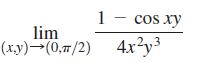
Evaluate the following limits. 1 cos xy lim (x,y) (0,7/2) 4x²y³
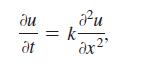
The flow of heat along a thin conducting bar is governed by the one-dimensional heat equation (with analogs for thin plates in two dimensions and for solids in three dimensions)where u is a measure of the temperature at a location x on the bar at time t and the positive constant k is related to the
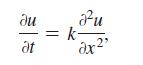
The flow of heat along a thin conducting bar is governed by the one-dimensional heat equation (with analogs for thin plates in two dimensions and for solids in three dimensions)where u is a measure of the temperature at a location x on the bar at time t and the positive constant k is related to the
The flow of heat along a thin conducting bar is governed by the one-dimensional heat equation (with analogs for thin plates in two dimensions and for solids in three dimensions)where u is a measure of the temperature at a location x on the bar at time t and the positive constant k is related to the
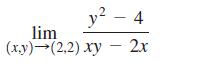
Evaluate the following limits. y²-4 2x lim (x,y) → (2,2) xy
Compute the directional derivative of the following functions at the given point P in the direction of the given vector. Be sure to use a unit vector for the direction vector. f(x, y) = 3x² + 2y + 5; P(1, 2); (-3,4)
Find the following derivatives. Z., and Z., where z = xy - 2x + 3y, x = cos s, and y = sin t
Sketch a graph of the following functions. In each case identify the surface, and state the domain and range of the function. = V₁-x² - y² F(x, y) = 2
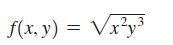
Find the first partial derivatives of the following functions. f(x, y) = √x²y³
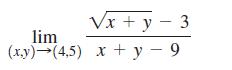
Evaluate the following limits. lim (x,y) (4,5) √x + y − 3 x + y - 9
Find the following derivatives. w, and wt, where w = z=s-t X-Z y + z x = s + t, y = st, and
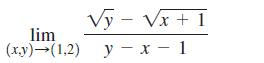
Evaluate the following limits. Vy - √x + 1 lim (x,y) (1.2) y-x-1
Compute the directional derivative of the following functions at the given point P in the direction of the given vector. Be sure to use a unit vector for the direction vector. h(x, y) = ex-y; P(In 2, In 3); (1, 1)
Sketch a graph of the following functions. In each case identify the surface, and state the domain and range of the function. G(x, y) = V1 + x² + y²
Compute the directional derivative of the following functions at the given point P in the direction of the given vector. Be sure to use a unit vector for the direction vector. P(x, y) = ln (4 + x² + y²); P(−1, 2); (2,1)
Find the following derivatives. W, W, and w, where w = z = rt √x² + y² + 2²₁ x = st, y = rs, and
Sketch a graph of the following functions. In each case identify the surface, and state the domain and range of the function. √x² + y² H(x, y) = √x² x2 2
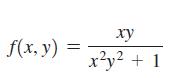
At what points of R2 are the following functions continuous? f(x, y) = ху x²y² + 1
Graph several level curves of the following functions using the given window. Label at least two level curves with their z-values. z = 3 cos (2x + y); [-2,2] × [-2,2]
Compute the directional derivative of the following functions at the given point P in the direction of the given vector. Be sure to use a unit vector for the direction vector. f(x, y) = x/(x - y); P(4,1); (-1,2)
Consider the following functions and points P.a. Find the unit vectors that give the direction of steepest ascent and steepest descent at P.b. Find a vector that points in a direction of no change in the function at P. 2 f(x, y) = x² - 4y² – 9; P(1,-2)
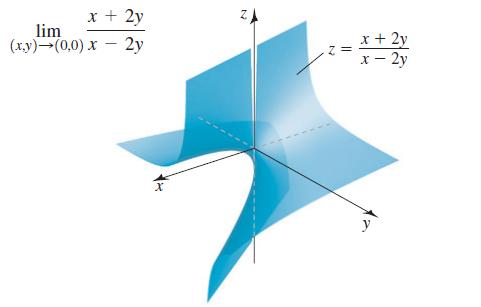
Use the Two-Path Test to prove that the following limits do not exist. x + 2y lim (x,y) (0,0) x 2y X Z= x + 2y x - 2y y
Sketch a graph of the following functions. In each case identify the surface, and state the domain and range of the function. P(x, y) 2 √x² + y² - 1
Sketch a graph of the following functions. In each case identify the surface, and state the domain and range of the function. g(x, y) = y³ + 1
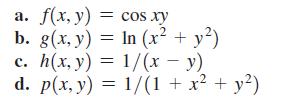
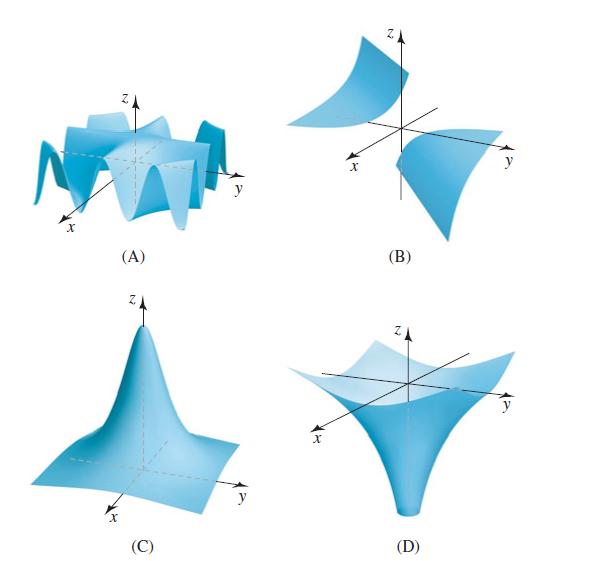
Match functions a–d with surfaces A–D in the figure. a. f(x, y) = cos xy b. g(x, y) = c. h(x, y) = d. p(x, y) = ln (x² + y²) 1/(x - y) 1/(1 + x² + y²)
Consider the following functions and points P.a. Find the unit vectors that give the direction of steepest ascent and steepest descent at P.b. Find a vector that points in a direction of no change in the function at P. f(x, y) = x² + 4xy - y²; P(2, 1)
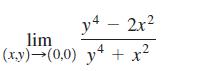
Use the Two-Path Test to prove that the following limits do not exist. y4 - 2x² lim (x,y) (0,0) y + x²
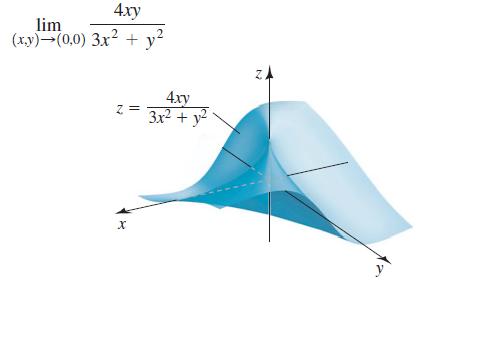
Use the Two-Path Test to prove that the following limits do not exist. 4xy lim (x,y) (0,0) 3x² + y² 4xy Z = 3x² + y² x
Consider the following functions and points P.a. Find the unit vectors that give the direction of steepest ascent and steepest descent at P.b. Find a vector that points in a direction of no change in the function at P. f(x, y) = x4 – x²y + y² + 6; P(−1, 1)
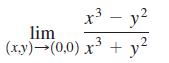
Use the Two-Path Test to prove that the following limits do not exist. x² - y² lim (x,y) →(0,0) x² + y² 2
Consider the following functions and points P.a. Find the unit vectors that give the direction of steepest ascent and steepest descent at P.b. Find a vector that points in a direction of no change in the function at P. p(x, y) 2 V20 + x² + 2xy - y²; P(1,2)
Graph several level curves of the following functions using the given window. Label at least two level curves with their z-values. z = x² + y²; [-4,4] × [-4,4]
Consider the following functions and points P.a. Find the unit vectors that give the direction of steepest ascent and steepest descent at P.b. Find a vector that points in a direction of no change in the function at P. F(x, y) = ex²/²-²¹/2; P(-1, 1)
Consider the following functions and points P.a. Find the unit vectors that give the direction of steepest ascent and steepest descent at P.b. Find a vector that points in a direction of no change in the function at P. f(x, y) = 2 sin (2x - 3y); P(0, π)
Given the following equations, evaluate dy/dx. Assume that each equation implicitly defines y as a differentiable function of x. x²2y² - 1 = 0
Graph several level curves of the following functions using the given window. Label at least two level curves with their z-values. z = x - y²; [0,4] × [-2,2]
Graph several level curves of the following functions using the given window. Label at least two level curves with their z-values. z = 2xy; [-2,2] × [-2,2] Z
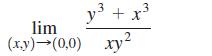
Use the Two-Path Test to prove that the following limits do not exist. lim (x,y) →(0,0) y³ + x³ xy2
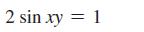
Given the following equations, evaluate dy/dx. Assume that each equation implicitly defines y as a differentiable function of x. 2 sin xy = 1
Given the following equations, evaluate dy/dx. Assume that each equation implicitly defines y as a differentiable function of x. 2 x3 + 3xy² - ys = 0 - =
Graph several level curves of the following functions using the given window. Label at least two level curves with their z-values. 2 Vx² + 4y²; [-8,8] × [-8, 8]
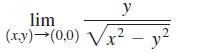
Use the Two-Path Test to prove that the following limits do not exist. lim y 2 X (x,y) (0,0) √x² - y²
At what points of R2 are the following functions continuous? 2 f(x, y) = x² + 2xy - y³
Given the following equations, evaluate dy/dx. Assume that each equation implicitly defines y as a differentiable function of x. yey2 = 0
Graph several level curves of the following functions using the given window. Label at least two level curves with their z-values. z = ex²-2²; [-2,2] × [-2,2] Z
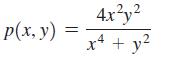
At what points of R2 are the following functions continuous? p(x, y) = 2 4x²y² x² + y²
Given the following equations, evaluate dy/dx. Assume that each equation implicitly defines y as a differentiable function of x. √x² + 2xy + y² = 3
Graph several level curves of the following functions using the given window. Label at least two level curves with their z-values. z = √/25 - x² - y²; [−6, 6] × [−6, 6] 2
Verify that fxy = fyx for the following functions. f(x, y) = 2x³ + 3y² + 1
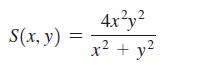
At what points of R2 are the following functions continuous? S(x, y) = 2 4x²y² x² + y²
Given the following equations, evaluate dy/dx. Assume that each equation implicitly defines y as a differentiable function of x. y ln (x² + y² + 4) = 3
Graph several level curves of the following functions using the given window. Label at least two level curves with their z-values. 2 z = Vy - x² = 1; [-5,5] x [-5,5]
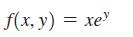
Verify that fxy = fyx for the following functions. f(x,y) = xe
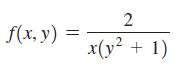
At what points of R2 are the following functions continuous? f(x, y) 2 2 x(y² + 1)
Verify that fxy = fyx for the following functions. f(x, y) = = cos xy
Verify that fxy = fyx for the following functions. f(x, y) = ex+y
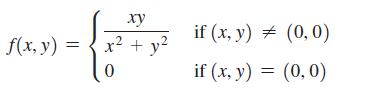
At what points of R2 are the following functions continuous? f(x, y) xy x² + y² 0 if (x, y) = (0,0) if (x, y) = (0,0)
Verify that fxy = fyx for the following functions. 3x²y-¹-2x-¹y² f(x, y) = 3x2y
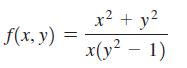
At what points of R2 are the following functions continuous? f(x, y) = x² + y² x(x² - 1)
Find the indicated derivative in two ways:a. Replace x and y to write z as a function of t and differentiate.b. Use the Chain Rule. z' (t), where z H X + 1 , x = 1² + 2t, and y = t³ - 2 y
Verify that fxy = fyx for the following functions. f(x, y) = √xy
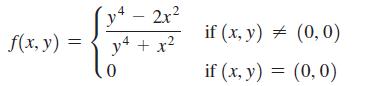
At what points of R2 are the following functions continuous? f(x, y) = 4 2x² y4 + x² 0 if (x, y) = (0,0) if (x, y) = (0,0)
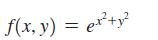
At what points of R2 are the following functions continuous? f(x, y) = ex²+y²
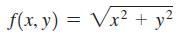
At what points of R2 are the following functions continuous? 2 f(x, y) = √x² + y²
Showing 900 - 1000
of 8578
First
3
4
5
6
7
8
9
10
11
12
13
14
15
16
17
Last
Step by Step Answers

 Get 50% OFF
Claim Now
Get 50% OFF
Claim Now