New Semester
Started
Get
50% OFF
Study Help!
--h --m --s
Claim Now
Question Answers
Textbooks
Find textbooks, questions and answers
Oops, something went wrong!
Change your search query and then try again
S
Books
FREE
Study Help
Expert Questions
Accounting
General Management
Mathematics
Finance
Organizational Behaviour
Law
Physics
Operating System
Management Leadership
Sociology
Programming
Marketing
Database
Computer Network
Economics
Textbooks Solutions
Accounting
Managerial Accounting
Management Leadership
Cost Accounting
Statistics
Business Law
Corporate Finance
Finance
Economics
Auditing
Tutors
Online Tutors
Find a Tutor
Hire a Tutor
Become a Tutor
AI Tutor
AI Study Planner
NEW
Sell Books
Search
Search
Sign In
Register
study help
mathematics
precalculus 1st
Calculus For Scientists And Engineers Early Transcendentals 1st Edition William L Briggs, Bernard Gillett, Bill L Briggs, Lyle Cochran - Solutions
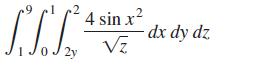
Evaluate the following integrals, changing the order of integration if needed. 0J2y 4 sin x² Vz - dx dy dz
Evaluate the following integrals, changing the order of integration if needed. [.." yz5 (1 + x + y² + zº)² dx dz. dy 0 0
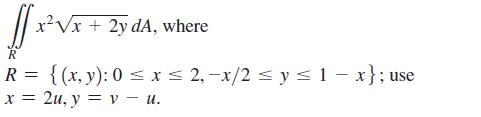
To evaluate the following integrals carry out these steps.a. Sketch the original region of integration R in the xy-plane and the new region S in the uv-plane using the given change of variables.b. Find the limits of integration for the new integral with respect to u and v.c. Compute the Jacobian.d.
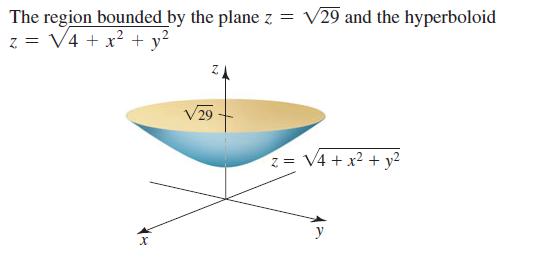
Use cylindrical coordinates to find the volume of the following solid regions. The region bounded by the plane z = √29 and the hyperboloid z = √4 + x² + y² X √29- z = √4 + x² + y² y
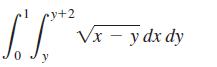
Evaluate the following integrals using a change of variables of your choice. Sketch the original and new regions of integration, R and S. ry+2 Jo Jy √x - y dx dy
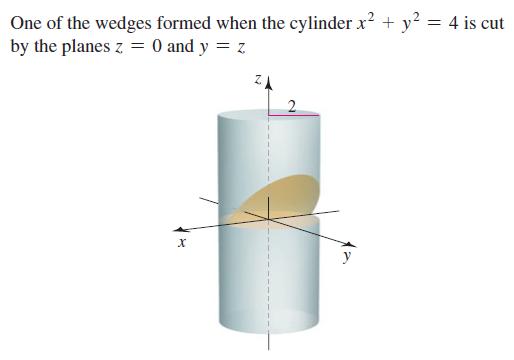
Find the volume of the following solids. One of the wedges formed when the cylinder x² + y² = 4 is cut by the planes z = 0 and y = z X 2
Use cylindrical coordinates to find the volume of the following solid regions.The solid cylinder whose height is 4 and whose base is the disk {(r, 0): 0 ≤ r ≤ 2 cos 0}
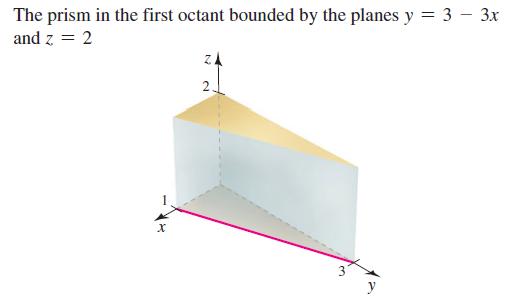
Find the volume of the following solids. The prism in the first octant bounded by the planes y = 3 - 3x and z = 2 X ZA 2 3 e
Evaluate the following integrals using a change of variables of your choice. Sketch the original and new regions of integration, R and S. y - J( + 2 + 1)² y 2x R by y - x = 1, y = x=2, y + 2x = 0, and y + 2x = 4 dA, where R is the parallelogram bounded
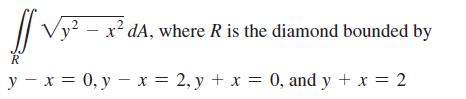
Evaluate the following integrals using a change of variables of your choice. Sketch the original and new regions of integration, R and S. Vy² - x² dA, where R is the diamond bounded by R y - x = 0, y = x = 2, y + x = 0, and y + x = 2
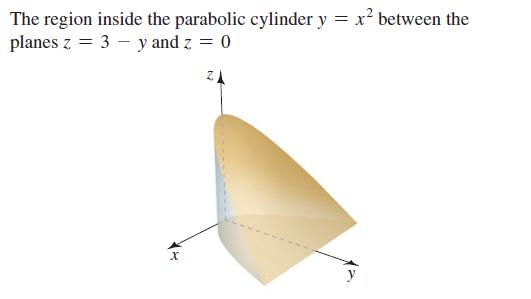
Find the volume of the following solids. The region inside the parabolic cylinder y = x² between the planes z = 3 - y and z = 0 Z
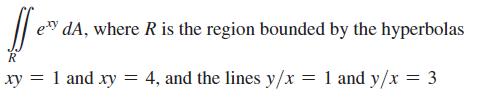
Evaluate the following integrals using a change of variables of your choice. Sketch the original and new regions of integration, R and S. JS e dA, where R is the region bounded by the hyperbolas xy 1 and xy = 4, and the lines y/x = 1 and y/x = 3 =
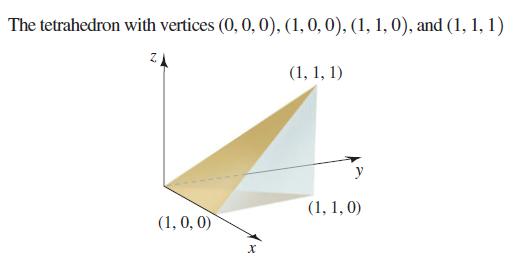
Find the volume of the following solids. The tetrahedron with vertices (0, 0, 0), (1, 0, 0), (1, 1, 0), and (1, 1, 1) (1, 1, 1) (1, 0, 0) (1, 1, 0)
Evaluate the following integrals using a change of variables of your choice. Sketch the original and new regions of integration, R and S. (x - y) √x - 2y dA, where R is the triangular region bounded by y = 0, x - 2y = 0, and x - y = 1 R
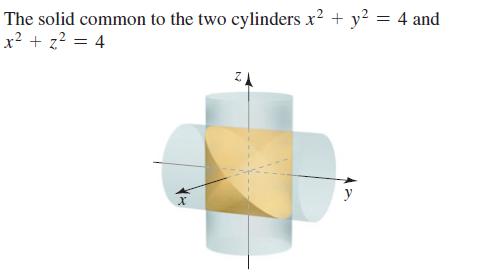
Find the volume of the following solids. The solid common to the two cylinders x² + y² = 4 and x² + z² = 4 x
Evaluate the Jacobians J(u, v, w) for the following transformations. x = v + w₁y = u +w, z = u + v
Evaluate the following integrals using a change of variables of your choice. Sketch the original and new regions of integration, R and S. If y xy dA, where R is the region bounded by the hyperbolas R xy = 1 and xy = 4, and the lines y = 1 and y = 3
Evaluate the Jacobians J(u, v, w) for the following transformations. x = u + v = w₁y = uv + w, z = −u + v + w
Evaluate the following integrals in spherical coordinates. I (x² + y² + z²)5/2 dV; D is the unit ball. D
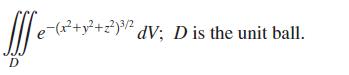
Evaluate the following integrals in spherical coordinates. [fe-(3²+3² +299²6 D e-(x² + y² +2²) ³/² dV; D is the unit ball.
Use cylindrical coordinates to find the volume of the following solid regions.The region in the first octant bounded by the cylinder r = 1, and the planes z = x and z = 0.
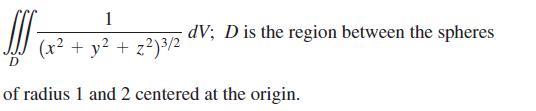
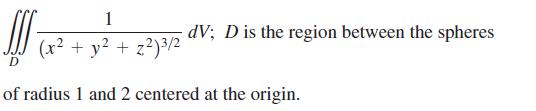
Evaluate the following integrals in spherical coordinates. D 1 (x² + y² + z²)³/2 dV; D is the region between the spheres of radius 1 and 2 centered at the origin.
Use cylindrical coordinates to find the volume of the following solid regions.The region bounded by the cylinders r = 1 and r = 2, and the planes z = 4 - x - y and z = 0
Evaluate the Jacobians J(u, v, w) for the following transformations. x = vw, y = uw, z = u² - v²
Use a change of variables to evaluate the following integrals. If xy xy dV; D is bounded by the planes y - x = 0, D y = x= 2,z - y = 0, z - y = 1, z = 0, and z = 3.
Evaluate the following integrals in spherical coordinates. D 1 (x² + y² + z²)³/2 dV; D is the region between the spheres of radius 1 and 2 centered at the origin.
Evaluate the Jacobians J(u, v, w) for the following transformations. u = x - y, v = x= z₂w = y + z (Solve for x, y, and z first.)
The functions f(x) = ax2, where a > 0, are concave up for all x. Graph these functions for a = 1, 5, and 10, and discuss how the concavity varies with a. How does a change the appearance of the graph?
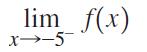
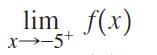
Suppose Find g(x) = f(1-x), for all x, lim f(x) = 4, and lim_f(x) = 6. x→1+ x-1
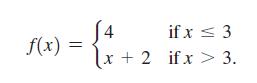
SupposeCompute f(x): 4 if x ≤ 3 x + 2 if x > 3.
Explain why lim x-3 x² - 7x + 12 x - 3 lim (x - 4). x-3
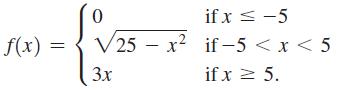
LetCompute the following limits or state that they do not exist.a.b.c.d.e.f. f(x) 0 √25x² 3x if x = -5 if-5 < x < 5 if x ≥ 5.
Find functions f and g such that lim f(x) = 0 and lim (f(x) g(x)) x→1 x→1 = 5.
Sketch the region of integration and evaluate the following integrals, using the method of your choice. JS Vx² + y² dA; R = {(x, y): 0 ≤ y ≤ x ≤ 1} R
Evaluate the following integrals. [[ (x (x + y) dA; R is the region bounded by y = 1/x and R y = 5/2 - x.
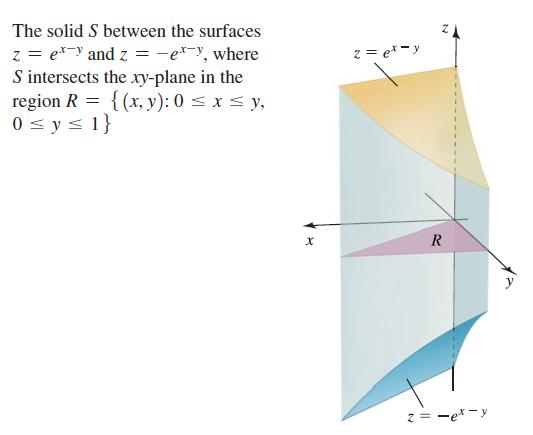
Find the volume of the following solid regions. The solid S between the surfaces z = ey and z = -exy, where S intersects the xy-plane in the region R = {(x, y): 0 ≤ x ≤ y, 0 ≤ y ≤ 1} X z = ex-y R z=-ex-y
Evaluate the following integrals. JJ x sec² y dA; R = {(x, y): 0 ≤ y ≤ x²,0 ≤ x ≤ √/2} R
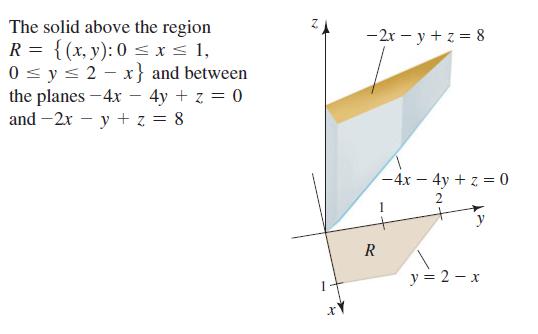
Find the volume of the following solid regions. The solid above the region R = {(x, y): 0 ≤ x ≤ 1, 0 ≤ y ≤ 2-x} and between the planes - 4x - 4y + z = 0 and-2x = y + z = 8 xY -2x -y +z = 8 R -4x - 4y + z = 0 2 y = 2 - x
Evaluate the following integrals. R ху 1 + x² + y² 5dA; R = {(x, y): 0 ≤ y ≤ x₂ 0 ≤ x ≤ 2}
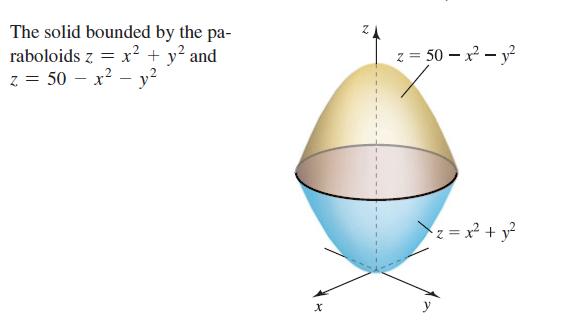
Find the volume of the following solid regions. The solid bounded by the pa- raboloids z = x² + y² and z = 50 x² - y² x N z=50-x² - y² z = x² + y²
Evaluate the following integrals. If yda y dA; R = {(x, y): 0 ≤ y ≤ secx, 0≤x≤ π/3} R
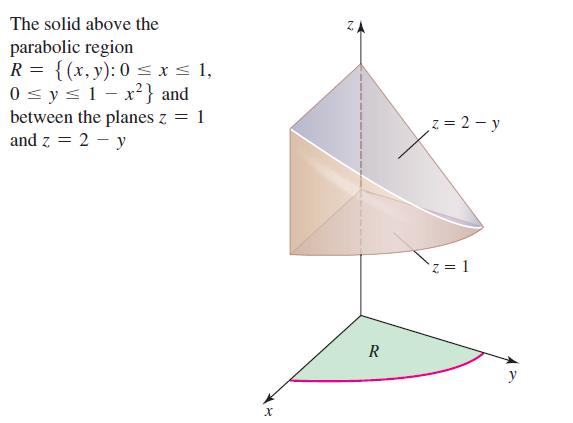
Find the volume of the following solid regions. The solid above the parabolic region R = {(x, y): 0 ≤ x ≤ 1, 0 ≤ y ≤ 1-x²} and between the planes z = 1 and z = 2 - y X N R z = 2-y z=1
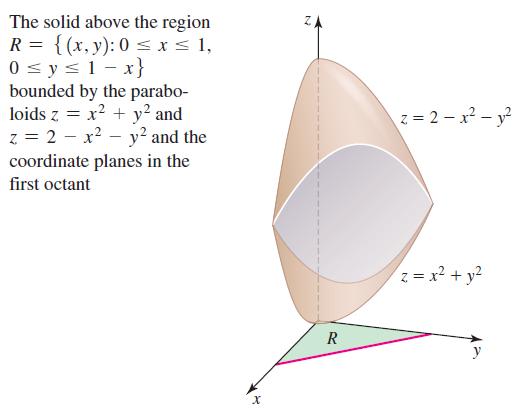
Find the volume of the following solid regions. The solid above the region R = {(x, y): 0 ≤ x ≤ 1, 0 ≤ y ≤ 1-x} bounded by the parabo- x² + y² and loids z = z = 2x² - y² and the coordinate planes in the first octant X N R 2=2-x² - y² z = x² + y²
Improper integrals arise in polar coordinates when the radial coordinate r becomes arbitrarily large. Under certain conditions, these integrals are treated in the usual way:Use this technique to evaluate the following integrals. ,00 b ["[*2(1.0) r dr ds = lim " ["2(6.0) e de do. g(r, g(r, r dr a a
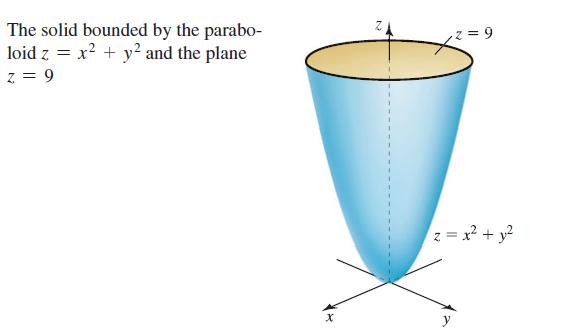
Find the volume of the following solid regions. The solid bounded by the parabo- loid z = x² + y² and the plane z = 9 X 9 z = x² + y² y
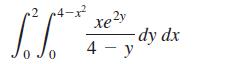
The following integrals can be evaluated only by reversing the order of integration. Sketch the region of integration, reverse the order of integration, and evaluate the integral. 4-x² S 0 JO xe²y 4- y dy dx
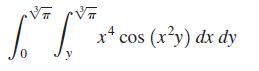
The following integrals can be evaluated only by reversing the order of integration. Sketch the region of integration, reverse the order of integration, and evaluate the integral. "A "A" 1. L. *. 0 y x+cos (x²y) dx dy
Improper integrals arise in polar coordinates when the radial coordinate r becomes arbitrarily large. Under certain conditions, these integrals are treated in the usual way:Use this technique to evaluate the following integrals. ,00 b ["[*2(1.0) r dr ds = lim " ["2(6.0) e de do. g(r, g(r, r dr a a
Improper integrals arise in polar coordinates when the radial coordinate r becomes arbitrarily large. Under certain conditions, these integrals are treated in the usual way:Use this technique to evaluate the following integrals. ,00 b ["[*2(1.0) r dr ds = lim " ["2(6.0) e de do. g(r, g(r, r dr a a
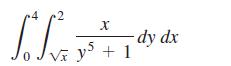
The following integrals can be evaluated only by reversing the order of integration. Sketch the region of integration, reverse the order of integration, and evaluate the integral. 2 X 5 o √ √x y² + 1 Vx dy dx
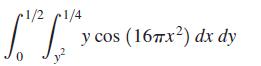
The following integrals can be evaluated only by reversing the order of integration. Sketch the region of integration, reverse the order of integration, and evaluate the integral. 1/2 1/4 TORSK y cos (167x2) dx dy
Improper integrals arise in polar coordinates when the radial coordinate r becomes arbitrarily large. Under certain conditions, these integrals are treated in the usual way:Use this technique to evaluate the following integrals. ,00 b ["[*2(1.0) r dr ds = lim " ["2(6.0) e de do. g(r, g(r, r dr a a
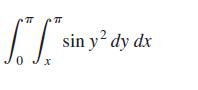
The following integrals can be evaluated only by reversing the order of integration. Sketch the region of integration, reverse the order of integration, and evaluate the integral. 0 TT TT π x sin y² dy dx
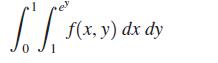
Reverse the order of integration in the following integrals. S.S. f(x, y) dx dy 0 1
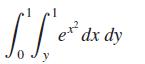
The following integrals can be evaluated only by reversing the order of integration. Sketch the region of integration, reverse the order of integration, and evaluate the integral. S.S, 0 Jy e.t² dx dy
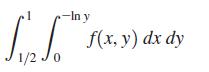
Reverse the order of integration in the following integrals. 1/2 JO -In y f(x, y) dx dy
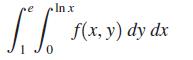
Reverse the order of integration in the following integrals. S.S. Inx f(x, y) dy dx
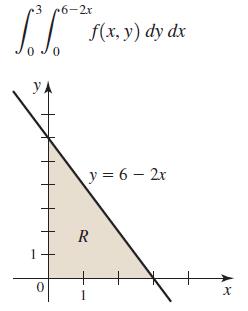
Reverse the order of integration in the following integrals. S.S. 3 6-2x 0 0 0 f(x, y) dy dx y = 6 - 2x R 1
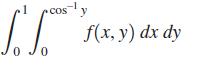
Reverse the order of integration in the following integrals. cos-¹y S.S. 0 f(x, y) dx dy
Sketch the region of integration and evaluate the following integrals, using the method of your choice. J √x² + y² dA; R = {(x, y): 1 ≤ x² + y² ≤ 4} R
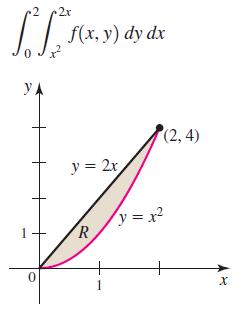
Reverse the order of integration in the following integrals. УА 0 -2x f(x, y) dy dx y = 2x R + 1 (2,4) y=x² X
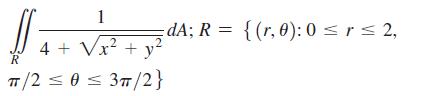
Sketch the region of integration and evaluate the following integrals, using the method of your choice. 1 4 + √x² + y² R π/2 ≤ 0 ≤ 3π/2} dA; R = {(r, 0): 0 ≤ r ≤ 2,
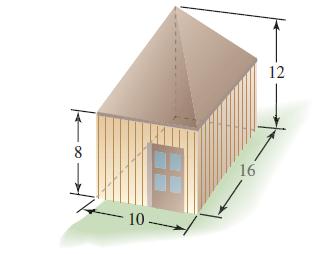
Propose a method based on Riemann sums to approximate the volume of the shed shown in the figure (the peak of the roof is directly above the rear corner of the shed). Carry out the method and provide an estimate of the volume. 8 HHHHHH 10. 16 12
Sketch the region of integration and evaluate the following integrals, using the method of your choice. x - y x² + y² + 1 centered at the origin. dA; R is the region bounded by the unit circle
Sketch the regions of integration and evaluate the following integrals. SSR x² y dA; R is bounded by y = 0, y = √x, and y = x - 2.
Sketch the region of integration and evaluate the following integrals, using the method of your choice. 16-2 LIV (16x² - y2) dx dy -40
Sketch the regions of integration and evaluate the following integrals. SR3x² dA; R is bounded by y = 0, y = 2x + 4, and y = x³.
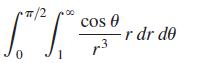
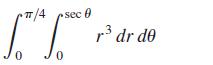
Sketch the region of integration and evaluate the following integrals, using the method of your choice. π/4 sec 0 15¹* 1.*** 0 0 r³ dr de
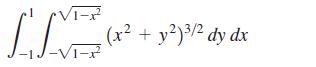
Sketch the region of integration and evaluate the following integrals, using the method of your choice. LIVE (²+² (x² + y²)³/² dy dx 1J-VI-
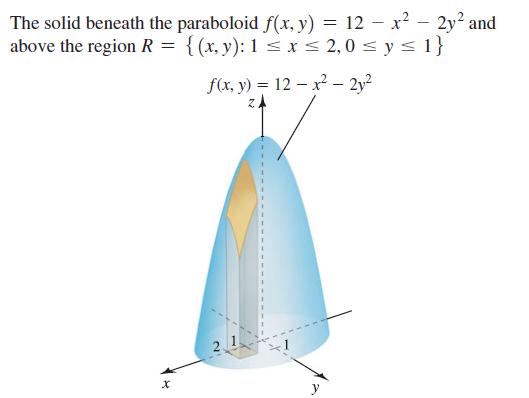
Find the volume of the following solids. The solid beneath the paraboloid f(x, y) = 12x²2y² and above the region R = {(x, y): 1 ≤ x ≤ 2,0 ≤ y ≤ 1} X f(x, y) = 12-x² - 21² ZA
Find the volume of the following solids. Let R = {(x, y): 0 ≤ x ≤ π,0 ≤ y ≤ a}. For what values of a, with 0 ≤ a ≤ π, is JJR sin (x + y) dA equal to 1?
Sketch the regions of integration and evaluate the following integrals. 3xy dA; R is bounded by y = 2 - x, y = 0, and x = 4 - y² in the first quadrant.
Sketch the regions of integration and evaluate the following integrals. JR (x + y) dA; R is bounded by y = |x| and y = 4.
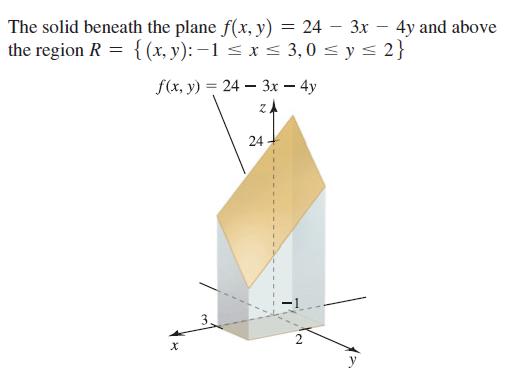
Find the volume of the following solids. The solid beneath the plane f(x, y) = 24 - 3x - 4y and above the region R = {(x, y): -1 ≤ x ≤ 3,0 ≤ y ≤ 2} f(x, y) = 24-3x - 4y ZA X 24 IN
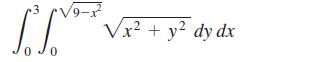
Sketch the region of integration and evaluate the following integrals, using the method of your choice. √9-1² 2 .. √x² + y² dy dx 0 0
Sketch the regions of integration and evaluate the following integrals. SR 12y dA; R is bounded by y = 2 - x, y = √x, and y = 0.
Sketch the regions of integration and evaluate the following integrals. Ry² dA; R is bounded by y = 1, y = 1 - x, and y = x - 1.
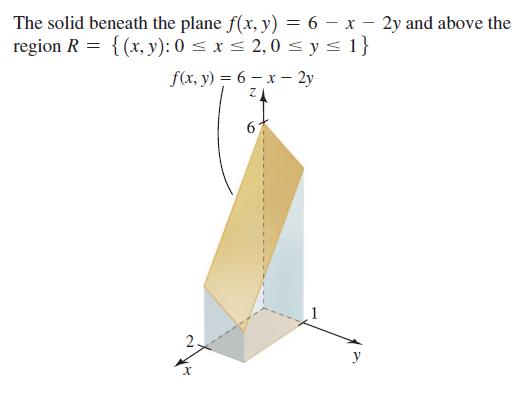
Find the volume of the following solids. The solid beneath the plane f(x, y) = 6 x - 2y and above the region R = {(x, y): 0 ≤ x ≤ 2,0 ≤ y ≤ 1} f(x, y) = 6 x - 2y X 6* y
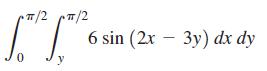
Sketch the region of integration and evaluate the following integrals as they are written. •π/2 π/2 1²1.06. y 6 sin (2x - 3y) dx dy
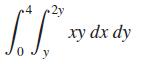
Sketch the region of integration and evaluate the following integrals as they are written. S.S. y 2y xy dx dy
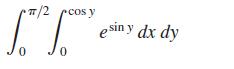
Sketch the region of integration and evaluate the following integrals as they are written. 0 π/2 cos y 100 esin y dx dy
Evaluate the following iterated integrals. 0 Jo x³y²x²y³ dy dx
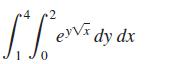
Evaluate the following iterated integrals. 2 ["Seve 1J0 evvx dy dx
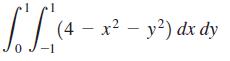
Draw the solid region whose volume is given by the following double integrals. Then find the volume of the solid. SL (4 -1 (4 − x² - y²) dx dy
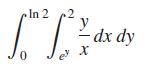
Sketch the region of integration and evaluate the following integrals as they are written. 0 In 2 ² ²² X e - dx dy
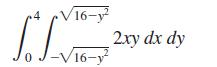
Sketch the region of integration and evaluate the following integrals as they are written. 16-y² J-√16-y²2 2xy dx dy
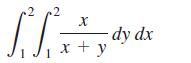
Evaluate the following iterated integrals. 2 .2 X [Sixty 1 1 x + y dy dx
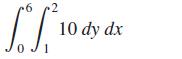
Draw the solid region whose volume is given by the following double integrals. Then find the volume of the solid. 2 SS 0 1 10 dy dx
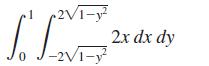
Sketch the region of integration and evaluate the following integrals as they are written. 2√1-y² 0 J-2V1-y2² 2x dx dy
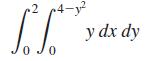
Sketch the region of integration and evaluate the following integrals as they are written. 2 p4-² S 0 y dx dy
Rewrite the following integrals using the indicated order of integration and then evaluate the resulting integral. S.S. 0 JO VI-VI-2 0 dy dz dx in the order dz dy dx
Find the average squared distance between the points ofand the point (3, 3). R = {(x, y): 0 ≤ x ≤ 3,0 ≤ y ≤ 3}
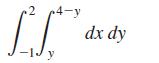
Sketch the region of integration and evaluate the following integrals as they are written. -2 4-y -1Jy dx dy
Rewrite the following integrals using the indicated order of integration and then evaluate the resulting integral. S.S. 0 0 16-12 0 16-12- dy dz dx in the order dx dy dz
Rewrite the following integrals using the indicated order of integration and then evaluate the resulting integral. √4-y² TIS 0 -20 dz dy dx in the order dy dz dx
Find the average squared distance between the points ofand the origin. R = {(x, y): -2 ≤ x ≤ 2,0 ≤ y ≤ 2}
Compute the average value of the following functions over the region R. f(x, y) = e; R = {(x, y): 0 ≤ x ≤ 6,0 ≤ y ≤ In 2}
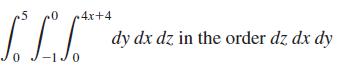
Rewrite the following integrals using the indicated order of integration and then evaluate the resulting integral. 0 4x+4 dy dx dz in the order dz dx dy
Compute the average value of the following functions over the region R. f(x, y) = sin x sin y; R = {(x, y): 0 ≤ x ≤ π,0 ≤ y ≤ π}
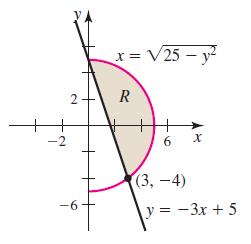
Write an iterated integral of a continuous function f over the region R shown in the figure. -2 2 -6 x = √25 - y² R 6 X (3,-4) y=-3x + 5
Showing 500 - 600
of 8578
1
2
3
4
5
6
7
8
9
10
11
12
13
14
15
Last
Step by Step Answers

 Get 50% OFF
Claim Now
Get 50% OFF
Claim Now