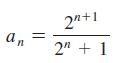
New Semester
Started
Get
50% OFF
Study Help!
--h --m --s
Claim Now
Question Answers
Textbooks
Find textbooks, questions and answers
Oops, something went wrong!
Change your search query and then try again
S
Books
FREE
Study Help
Expert Questions
Accounting
General Management
Mathematics
Finance
Organizational Behaviour
Law
Physics
Operating System
Management Leadership
Sociology
Programming
Marketing
Database
Computer Network
Economics
Textbooks Solutions
Accounting
Managerial Accounting
Management Leadership
Cost Accounting
Statistics
Business Law
Corporate Finance
Finance
Economics
Auditing
Tutors
Online Tutors
Find a Tutor
Hire a Tutor
Become a Tutor
AI Tutor
AI Study Planner
NEW
Sell Books
Search
Search
Sign In
Register
study help
mathematics
precalculus 1st
Calculus For Scientists And Engineers Early Transcendentals 1st Edition William L Briggs, Bernard Gillett, Bill L Briggs, Lyle Cochran - Solutions
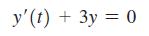
Find the general solution of the following differential equations. y' (t) + 3y = 0
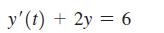
Find the general solution of the following differential equations. y' (t) + 2y = 6
Find the general solution of the following differential equations. p'(x) = 4p + 8
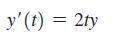
Find the general solution of the following differential equations. y' (t) = 2ty
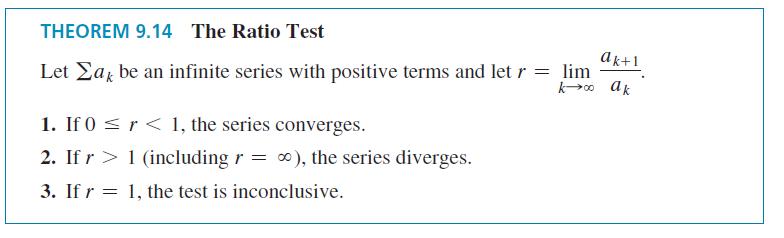
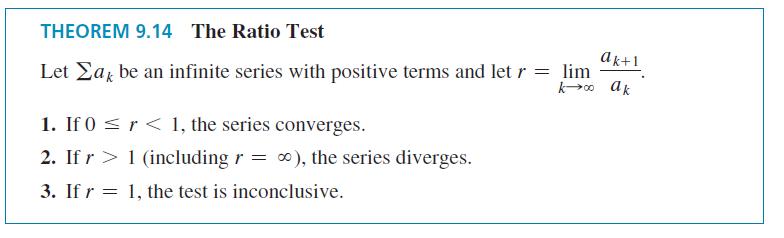
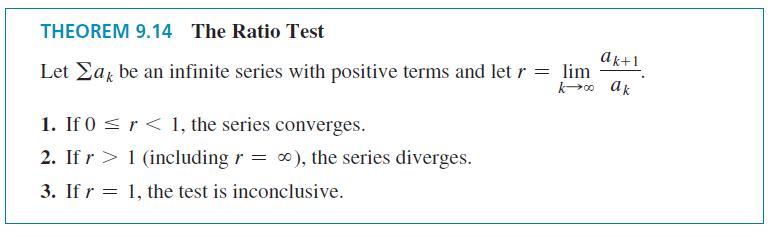
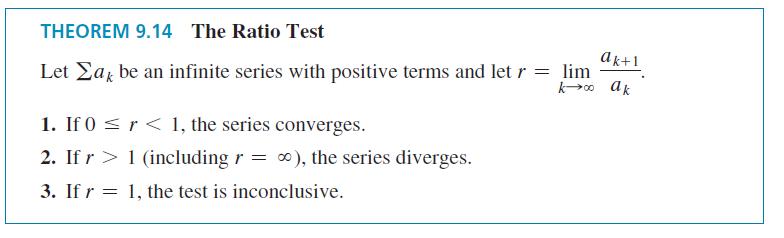
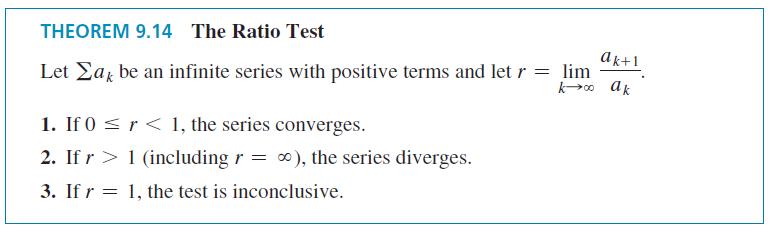
Use the Ratio Test to determine whether the following series converge.Data from in Ratio Test 00 k=1 k!
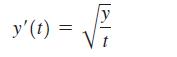
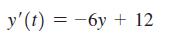
Find the general solution of the following differential equations. y'(t) =
Explain how the growth rate function determines the solution of a population model.
Use the Ratio Test to determine whether the following series converge.Data from in Ratio Test 8 00 2k | k=1k!
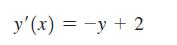
Find the general solution of the following equations. y'(x) = -y + 2
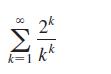
Use the Ratio Test to determine whether the following series converge.Data from in Ratio Test 00 k=1 2k kk
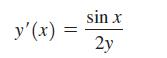
Find the general solution of the following differential equations. y'(x) = sin x 2y
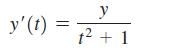
Find the general solution of the following differential equations. y'(t) y +2 1² + 1
Find the general solution of the following equations. y'(x) + 2y = -4
What is a carrying capacity? Mathematically, how does it appear on the graph of a population function?
Use the Ratio Test to determine whether the following series converge.Data from in Ratio Test 8 k=1 k² 2 4k
Explain how the growth rate function can be decreasing while the population function is increasing.
Use the Ratio Test to determine whether the following series converge.Data from in Ratio Test 00 ke k k=1
Explain how a stirred tank reaction works.
Is the differential equation that describes a stirred tank reaction (as developed in this section) linear or nonlinear? What is its order?
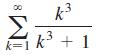
Use the Divergence Test to determine whether the following series diverge or state that the test is inconclusive.Data from in Divergence Test k³ k=1k³ + 1
Describe the solution curves in a predator-prey model in the FH-plane.
Describe the behavior of the two populations in a predator-prey model as functions of time.
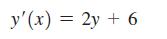
Find the general solution of the following equations. y'(x) = 2y + 6
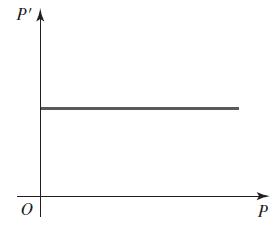
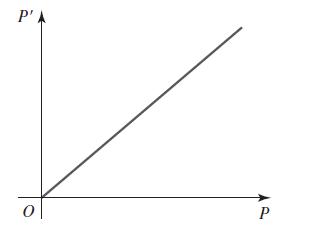
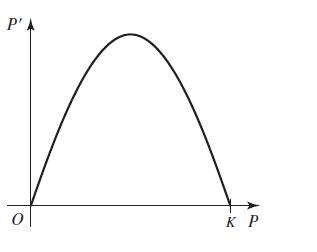
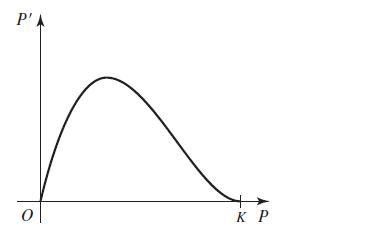
Make a sketch of the population function (as a function of time) that results from the following growth rate functions. Assume the population at time t = 0 begins at some positive value. P'A 0 P
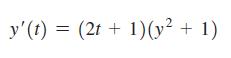
Find the general solution of the following differential equations. y' (t) = (2t + 1) (y² + 1)
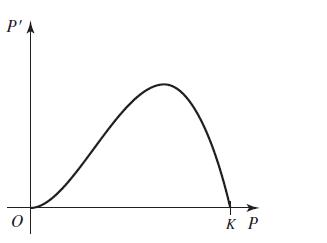
Make a sketch of the population function (as a function of time) that results from the following growth rate functions. Assume the population at time t = 0 begins at some positive value. P' 0 P
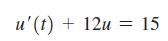
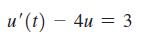
Find the general solution of the following equations. u' (t) + 12u = 15
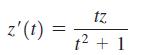
Find the general solution of the following differential equations. z' (t) tz 1² + 1 2 -
Make a sketch of the population function (as a function of time) that results from the following growth rate functions. Assume the population at time t = 0 begins at some positive value. P' 0 K P
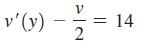
Find the general solution of the following equations. v'(y) V --2/2 = 14
Make a sketch of the population function (as a function of time) that results from the following growth rate functions. Assume the population at time t = 0 begins at some positive value. P' K P
Find the solution of the following initial value problems. y' (t) = -3y + 9, y(0) = 4
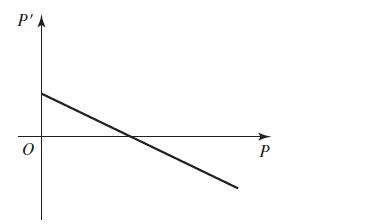
Make a sketch of the population function (as a function of time) that results from the following growth rate functions. Assume the population at time t = 0 begins at some positive value. P'A P
Find the solution of the following initial value problems. Q'(t) = Q 8, Q(1) = 0
Make a sketch of the population function (as a function of time) that results from the following growth rate functions. Assume the population at time t = 0 begins at some positive value. ΡΑ Ο K P
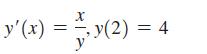
Find the solution of the following initial value problems. X y'(x) = -— , y(2) = y = 4
Write a logistic equation with the following parameter values. Then solve the initial value problem and graph the solution. Let r be the natural growth rate, K the carrying capacity, and P0 the initial population. r = 0.2, K = 300, Po = 50
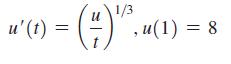
Find the solution of the following initial value problems. u' (t) 1/3 (-)' , u(1) = 8
Write a logistic equation with the following parameter values. Then solve the initial value problem and graph the solution. Let r be the natural growth rate, K the carrying capacity, and P0 the initial population. r = 0.4, K = 5500, Po = 100
Find the solution of the following initial value problems. y'(x) = 4x csc y, y(0) TT/2
Use the method of Example 1 to find a logistic function that describes the following populations. Graph the population function.The population increases from 200 to 600 in the first year and eventually levels off at 2000.Data from in Example 1 EXAMPLE 1 Designing a logistic model Wildlife
Find the solution of the following initial value problems. s' (t) 1 2s(t + 2)' s(-1) = 4, t≥ −1 5, 5 (-1)
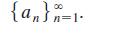
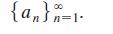
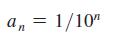
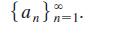
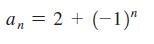
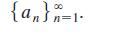
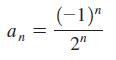
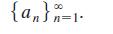
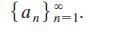
Write the first four terms of the sequence {a}=1- n n=1.
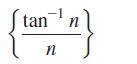
Find the limit of the following sequences or determine that the limit does not exist. -1 tan n n
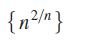
Find the limit of the following sequences or determine that the limit does not exist. {u/zu}
Evaluate the following geometric sums. 1 3 + 5 25 + 9 125 243 15,625
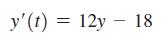
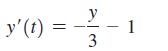
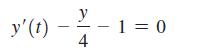
Find the equilibrium solution of the following equations, make a sketch of the direction field, for t ≥ 0, and determine whether the equilibrium solution is stable. The direction field needs to indicate only whether solutions are increasing or decreasing on either side of the equilibrium
Find the equilibrium solution of the following equations, make a sketch of the direction field, for t ≥ 0, and determine whether the equilibrium solution is stable. The direction field needs to indicate only whether solutions are increasing or decreasing on either side of the equilibrium
Use the method of Example 1 to find a logistic function that describes the following populations. Graph the population function.The population increases from 50 to 60 in the first month and eventually levels off at 150.Data from in Example 1 EXAMPLE 1 Designing a logistic model Wildlife biologists
Find the solution of the following initial value problems. 0'(x) 4x cos² 0, 0(0) = π/4
Find the equilibrium solution of the following equations, make a sketch of the direction field, for t ≥ 0, and determine whether the equilibrium solution is stable. The direction field needs to indicate only whether solutions are increasing or decreasing on either side of the equilibrium
Find the equilibrium solutions of the following equations and determine whether each solution is stable or unstable. y' (t) = y(2-y)
Find the equilibrium solution of the following equations, make a sketch of the direction field, for t ≥ 0, and determine whether the equilibrium solution is stable. The direction field needs to indicate only whether solutions are increasing or decreasing on either side of the equilibrium
Find the equilibrium solution of the following equations, make a sketch of the direction field, for t ≥ 0, and determine whether the equilibrium solution is stable. The direction field needs to indicate only whether solutions are increasing or decreasing on either side of the equilibrium
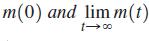
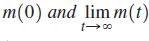
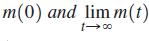
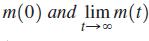
For each of the following stirred tank reactions, carry out the following analysis.a. Write an initial value problem for the mass of the substance.b. Solve the initial value problem and graph the solution to be sure thatare correct.A 500-L tank is initially filled with pure water. A copper sulfate
Find the equilibrium solution of the following equations, make a sketch of the direction field, for t ≥ 0, and determine whether the equilibrium solution is stable. The direction field needs to indicate only whether solutions are increasing or decreasing on either side of the equilibrium
Find the equilibrium solutions of the following equations and determine whether each solution is stable or unstable. y'(t) = y(3 + y) (y – 5)
Find the equilibrium solutions of the following equations and determine whether each solution is stable or unstable. y' (t) = sin 2 y, for y < T
The following initial value problems model the payoff of a loan. In each case, solve the initial value problem, for t ≥ 0, graph the solution, and determine the first month in which the loan balance is zero. B' (t) = 0.005B 500, B(0) = 50,000
The following initial value problems model the payoff of a loan. In each case, solve the initial value problem, for t ≥ 0, graph the solution, and determine the first month in which the loan balance is zero. B' (t) = 0.01B - 750, B(0) 750, B(0) = 45,000
For each of the following stirred tank reactions, carry out the following analysis.a. Write an initial value problem for the mass of the substance.b. Solve the initial value problem and graph the solution to be sure thatare correct.A 1500-L tank is initially filled with a solution that contains
The following initial value problems model the payoff of a loan. In each case, solve the initial value problem, for t ≥ 0, graph the solution, and determine the first month in which the loan balance is zero. B'(t) = 0.0075B 1500, B(0) = 100,000 -
Find the equilibrium solutions of the following equations and determine whether each solution is stable or unstable. y' (t) = y³y²– 2y
For each of the following stirred tank reactions, carry out the following analysis.a. Write an initial value problem for the mass of the substance.b. Solve the initial value problem and graph the solution to be sure thatare correct.A one-million-liter pond is contaminated and has a concentration of
The following initial value problems model the payoff of a loan. In each case, solve the initial value problem, for t ≥ 0, graph the solution, and determine the first month in which the loan balance is zero. B'(t) = 0.004B - 800, B(0) = 40,000
For each of the following stirred tank reactions, carry out the following analysis.a. Write an initial value problem for the mass of the substance.b. Solve the initial value problem and graph the solution to be sure thatare correct.A 2000-L tank is initially filled with a sugar solution with a
The population of a rabbit community is governed by the initial value problema. Find the equilibrium solutions.b. Find the population, for all times t ≥ 0.c. What is the carrying capacity of the population?d. What is the population when the growth rate is a maximum? P'(1) = 0.2 P(1 P 10).
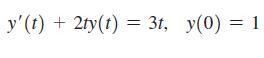
A special class of first-order linear equations have the form a(t)y' (t) + a' (t)y(t) = f(t), where a and fare given functions of t. Notice that the left side of this equation can be written as the derivative of a product, so the equation has the formTherefore, the equation can be solved by
A special class of first-order linear equations have the form a(t)y' (t) + a' (t)y(t) = f(t), where a and fare given functions of t. Notice that the left side of this equation can be written as the derivative of a product, so the equation has the formTherefore, the equation can be solved by
A special class of first-order linear equations have the form a(t)y' (t) + a' (t)y(t) = f(t), where a and fare given functions of t. Notice that the left side of this equation can be written as the derivative of a product, so the equation has the formTherefore, the equation can be solved by
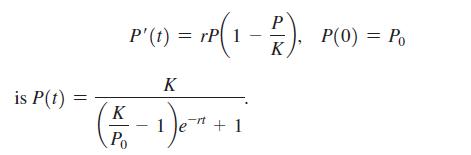
Use separation of variables to show that the solution of the initial value problem is P(t) = P'(1) = rp(1 rP K K (P-1) ²₁. Po + 1 P K P(0) = Po
A special class of first-order linear equations have the form a(t)y' (t) + a' (t)y(t) = f(t), where a and fare given functions of t. Notice that the left side of this equation can be written as the derivative of a product, so the equation has the formTherefore, the equation can be solved by
Consider the general first-order linear equation y'(t) + a(t)y(t) = f(t). This equation can be solved, in principle, by defining the integrating factor p(t) = exp(∫ a(t) dt). Here is how the integrating factor works. Multiply both sides of the equation by p (which is always positive) and show
Consider the general first-order linear equation y'(t) + a(t)y(t) = f(t). This equation can be solved, in principle, by defining the integrating factor p(t) = exp(∫ a(t) dt). Here is how the integrating factor works. Multiply both sides of the equation by p (which is always positive) and show
Consider a loan repayment plan described by the initial value problemwhere the amount borrowed is B(0) = + $40,000, the monthly payments are $600, and B(t) is the unpaid balance in the loan.a. Find the solution of the initial value problem and explain why B is an increasing function.b. What is the
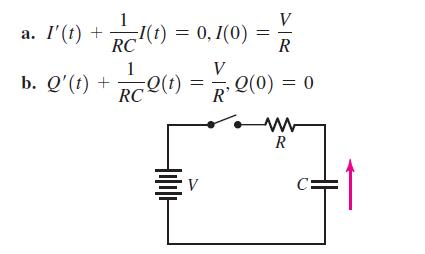
Suppose a battery with voltage V is connected in series to a capacitor (a charge storage device) with capacitance C and a resistor with resistance R. As the charge Q in the capacitor increases, the current I across the capacitor decreases according to the following initial value problems. Solve
Consider the general first-order linear equation y'(t) + a(t)y(t) = f(t). This equation can be solved, in principle, by defining the integrating factor p(t) = exp(∫ a(t) dt). Here is how the integrating factor works. Multiply both sides of the equation by p (which is always positive) and show
Consider the general first-order linear equation y'(t) + a(t)y(t) = f(t). This equation can be solved, in principle, by defining the integrating factor p(t) = exp(∫ a(t) dt). Here is how the integrating factor works. Multiply both sides of the equation by p (which is always positive) and show
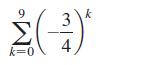
Evaluate the following geometric sums. 8 100 k Σ3* k=0
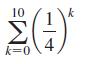
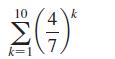
Evaluate the following geometric sums. 10 k=0 K
A 100-L tank is filled with pure water when an inflow pipe is opened and a sugar solution with a concentration of 20 gm/L flows into the tank at a rate of 0.5 L/min. The solution is thoroughly mixed and flows out of the tank at a rate of 0.5 L/min.a. Find the mass of sugar in the tank at all times
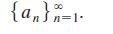
Write the first four terms of the sequence {a}=1- n n=1.
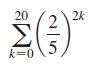
Evaluate the following geometric sums. 20 k=0 Ult 2k
Write the first four terms of the sequence {a}=1- n n=1.
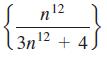
Find the limit of the following sequences or determine that the limit does not exist. 12 п 3n12 + 4 +4.
Write the first four terms of the sequence {a}=1- n n=1.
Evaluate the following geometric sums. All k=0 Alw k
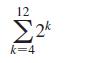
Evaluate the following geometric sums. 12 15 Σ2* k=4
Write the first four terms of the sequence {a}=1- n n=1.
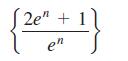
Find the limit of the following sequences or determine that the limit does not exist. 2e" + 1 en
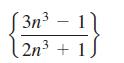
Find the limit of the following sequences or determine that the limit does not exist. 3n³ - 1 2n³ + 1
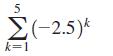
Evaluate the following geometric sums. 5 Σ(-2.5)* k=1
Evaluate the following geometric sums. 6 k=0 71 k
Write the first four terms of the sequence {a}=1- n n=1.
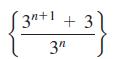
Find the limit of the following sequences or determine that the limit does not exist. 3+1 + 3 3″
Write the first four terms of the sequence {a}=1- n n=1.
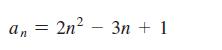
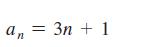
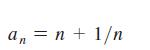
Write the first four terms of the sequence an = n + 1/n
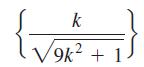
Find the limit of the following sequences or determine that the limit does not exist. k {VOR 2 V9k² + 1
Evaluate the following geometric sums. 10 k=1 +1 k
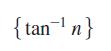
Find the limit of the following sequences or determine that the limit does not exist. {tan ¹n}
Showing 1400 - 1500
of 8578
First
8
9
10
11
12
13
14
15
16
17
18
19
20
21
22
Last
Step by Step Answers

 Get 50% OFF
Claim Now
Get 50% OFF
Claim Now