New Semester
Started
Get
50% OFF
Study Help!
--h --m --s
Claim Now
Question Answers
Textbooks
Find textbooks, questions and answers
Oops, something went wrong!
Change your search query and then try again
S
Books
FREE
Study Help
Expert Questions
Accounting
General Management
Mathematics
Finance
Organizational Behaviour
Law
Physics
Operating System
Management Leadership
Sociology
Programming
Marketing
Database
Computer Network
Economics
Textbooks Solutions
Accounting
Managerial Accounting
Management Leadership
Cost Accounting
Statistics
Business Law
Corporate Finance
Finance
Economics
Auditing
Tutors
Online Tutors
Find a Tutor
Hire a Tutor
Become a Tutor
AI Tutor
AI Study Planner
NEW
Sell Books
Search
Search
Sign In
Register
study help
mathematics
precalculus 1st
Calculus For Scientists And Engineers Early Transcendentals 1st Edition William L Briggs, Bernard Gillett, Bill L Briggs, Lyle Cochran - Solutions
Find the first partial derivatives of the following functions. f(x, y, z) = xy + xz + yz
Find the indicated derivative for the following functions. az/ap, where z = x/y, x = p + q, and y = p - q
Find the first partial derivatives of the following functions. g(x, y, z) = 2x²y3xz4+10y2z 2
At what points of R2 are the following functions continuous? g(x, y) = ln (x - y)
At what points of R2 are the following functions continuous? f(x, y) = sin xy
Find the indicated derivative for the following functions. dw/dt, where w = xyz, x = 214, y = 3t¹, and z = 4t-3
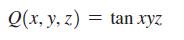
Find the first partial derivatives of the following functions. Q(x, y, z) = tan xyz
Find the first partial derivatives of the following functions. h(x, y, z) = cos (x + y + z)
Find the indicated derivative for the following functions. aw/ax, where w = cos z cos x cos y + sin x sin y, and z = x + y
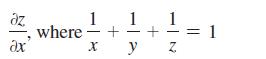
Find the indicated derivative for the following functions. az ax where 1 X + 1 y + 1 - Z 1
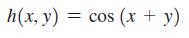
At what points of R2 are the following functions continuous? = cos (x + y) h(x, y) =
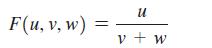
Find the first partial derivatives of the following functions. F(u, v, w) u v + w
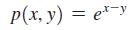
At what points of R2 are the following functions continuous? p(x, y) || ex-y
Find the indicated derivative for the following functions. az/ax, where xy - z = 1.
Find the domain of the following functions. If possible, give a description of the domains (for example, all points outside a sphere of radius 1 centered at the origin). f(x, y, z) = 2xyz - 3xz + 4yz
Find the first partial derivatives of the following functions. G(r, s, t) = √rs + rt + st
At what points of R2 are the following functions continuous? f(x, y) = ln (x² + y²) In
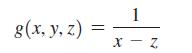
Find the domain of the following functions. If possible, give a description of the domains (for example, all points outside a sphere of radius 1 centered at the origin). g(x, y, z) = 1 X-Z
Find the first partial derivatives of the following functions. g(w, x, y, z) = cos = cos (w + x) sin (y - z)
Find the first partial derivatives of the following functions. f(w, x, y, z) = w²xy² + xy³z²
At what points of R2 are the following functions continuous? 2 f(x, y) = √4x² - y²
Find the domain of the following functions. If possible, give a description of the domains (for example, all points outside a sphere of radius 1 centered at the origin). p(x, y, z)=√x² + y² + z² - 9
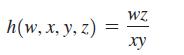
Find the first partial derivatives of the following functions. h(w, x,y,z) = ZM ху
At what points of R2 are the following functions continuous? g(x, y) = √x² + y² - 9 2
Find the domain of the following functions. If possible, give a description of the domains (for example, all points outside a sphere of radius 1 centered at the origin). Q(x, y, z) 10 2 2 1 + x² + y² + 4z²
Find the domain of the following functions. If possible, give a description of the domains (for example, all points outside a sphere of radius 1 centered at the origin). f(x, y, z)= Vy - z
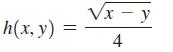
At what points of R2 are the following functions continuous? h(x, y) = √x - y 4
Find the first partial derivatives of the following functions. F(w, x, y, z) = w√x + 2y + 3z
Consider each of the following surfaces and the point P on the surface.a. Find the gradient of f.b. Let C' be the path of steepest descent on the surface beginning at P and let C be the projection of C' on the xy-plane. Find an equation of C in the xy-plane. f(x, y) = 4 + x (a plane); P(4, 4, 8)
Find the domain of the following functions. If possible, give a description of the domains (for example, all points outside a sphere of radius 1 centered at the origin). F(x, y, z)= Vy - x²
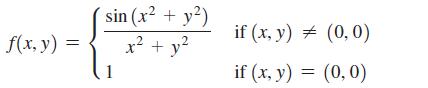
At what points of R2 are the following functions continuous? f(x, y) sin (x² + y²) 2 x² + y² if (x, y) = (0,0) if (x, y) = (0,0)
Consider each of the following surfaces and the point P on the surface.a. Find the gradient of f.b. Let C' be the path of steepest descent on the surface beginning at P and let C be the projection of C' on the xy-plane. Find an equation of C in the xy-plane. f(x, y) = y + x (a plane); P(2, 2, 4)
At what points of R2 are the following functions continuous? f(x, y) = 1 - cos (x² + y²) x² + y² if (x, y) = (0,0) if (x, y) = (0,0)
Find the domain of the following functions. If possible, give a description of the domains (for example, all points outside a sphere of radius 1 centered at the origin). 2 2 f(w, x, y, z) = V1 - w² 1-w²x² - y² - W N 2
Consider each of the following surfaces and the point P on the surface.a. Find the gradient of f.b. Let C' be the path of steepest descent on the surface beginning at P and let C be the projection of C' on the xy-plane. Find an equation of C in the xy-plane. f(x, y) = 4x² - 2y²; P(1, 1, 1)
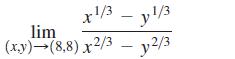
Evaluate the following limits. x¹/3 - yl/3 lim (x,y) (8,8) x2/3-y2/3
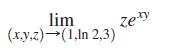
Evaluate the following limits. lim (x,y,z)→(1,In 2,3) zety
Consider each of the following surfaces and the point P on the surface.a. Find the gradient of f.b. Let C' be the path of steepest descent on the surface beginning at P and let C be the projection of C' on the xy-plane. Find an equation of C in the xy-plane. f(x, y) = y + x ¹; P(1, 2, 3)
Evaluate the following limits. lim (x,y,z)→(0,1,0) In e¹² (1+y)
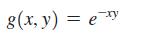
a. Determine the domain and range of the following functions.b. Graph each function using a graphing utility. Be sure to experiment with the window and orientation to give the best perspective of the surface. g(x, y) = exy
Consider the following functions f, points P, and unit vectors u.a. Compute the gradient of f and evaluate it at P.b. Find the unit vector in the direction of maximum increase of f at P.c. Find the rate of change of the function in the direction of maximum increase at P.d. Find the directional
Evaluate the following limits. yz - xy - xz - x² lim (x,y,z)→(1,1,1) yz + xy + xz - y²
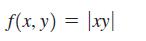
a. Determine the domain and range of the following functions.b. Graph each function using a graphing utility. Be sure to experiment with the window and orientation to give the best perspective of the surface. f(x, y) = |xy|
Evaluate the following limits. x - √xz - √xy + Vyz lim (xy.z) (1,1,1) xVxz + √xy - Vyz
a. Determine the domain and range of the following functions.b. Graph each function using a graphing utility. Be sure to experiment with the window and orientation to give the best perspective of the surface. p(x, y) = 1 |x-1| + y + 1 −
Consider the following functions f, points P, and unit vectors u.a. Compute the gradient of f and evaluate it at P.b. Find the unit vector in the direction of maximum increase of f at P.c. Find the rate of change of the function in the direction of maximum increase at P.d. Find the directional
Functions Differentiate the following functions. r(t) = (cost, t², sin t)
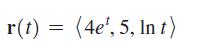
Functions Differentiate the following functions. r(t) = (4e¹, 5, In t)
Functions Differentiate the following functions. r(t) = (2t³,6Vt, 3/t)
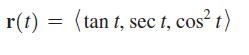
Functions Differentiate the following functions. r(t) = (tan t, sect, cos² t)
Functions Differentiate the following functions. r(t) = (te, t ln t, t cos t)
Functions Differentiate the following functions. r(t) = ((t + 1)¹, tan¹t, In (t + 1))
Functions Differentiate the following functions. r(t) = = (4,3 cos 2t, 2 sin 3t)
Functions Differentiate the following functions. r(t) = (e¹, 2e-4e²¹)
Compute the dot product of the vectors u and v, and find the angle between the vectors. u = (3, 4,0) and v = (0,4,5)
Compute the dot product of the vectors u and v, and find the angle between the vectors. = i and v = i + V3j u =
Compute the dot product of the vectors u and v, and find the angle between the vectors. u = √2i + √2 j and v = -√2i - √2j
LetCompute the derivative of the following functions. u(t) = 2t³i + (t² − 1)j – 8k and v(t) = e¹i + 2e¹¹j - e²¹k.
What is the magnitude of the cross product of two parallel vectors?
Compute the dot product of the vectors u and v, and find the angle between the vectors. u = 4i + 3j and v = 4i - 6j
Compute the dot product of the vectors u and v, and find the angle between the vectors. = (-10, 0, 4) and v = (1,2,3)
Graph the curves described by the following functions, indicating the direction of positive orientation. Try to anticipate the shape of the curve before using a graphing utility. r(t) = 4 cos tj + 16 sin tk, for 0 ≤t≤ 2π
Compute the dot product of the vectors u and v, and find the angle between the vectors. u (3,-5, 2) and v = (-9,5, 1)
Compute the dot product of the vectors u and v, and find the angle between the vectors. u = 2i - 3k and v = i + 4j + 2k
LetCompute the derivative of the following functions. u(t) = 2t³i + (t² − 1)j – 8k and v(t) = e¹i + 2e¹¹j - e²¹k.
Compute the dot product of the vectors u and v, and find the angle between the vectors. u i 4j - 6k and v = 2i - 4j + 2k = −
Graph the curves described by the following functions, indicating the direction of positive orientation. Try to anticipate the shape of the curve before using a graphing utility. r(t) 2 cos ti + 2 sin tj + 2k, for 0 ≤ t ≤ 2π
LetCompute the derivative of the following functions. u(t) = 2t³i + (t² − 1)j – 8k and v(t) = e¹i + 2e¹¹j - e²¹k.
LetCompute the derivative of the following functions. u(t) = 2t³i + (t² − 1)j – 8k and v(t) = e¹i + 2e¹¹j - e²¹k.
Graph the curves described by the following functions, indicating the direction of positive orientation. Try to anticipate the shape of the curve before using a graphing utility. r(t) t cos ti t sin tj + tk, for 0 ≤ t ≤ 6T
Graph the curves described by the following functions, indicating the direction of positive orientation. Try to anticipate the shape of the curve before using a graphing utility. r(t) = cos ti+j+ sin tk, for 0 ≤ t ≤ 2π
For the given vectors u and v, calculate projvu and scalvu. = (5, 0, 15) and v = (0,4,-2)
LetCompute the derivative of the following functions. u(t) = 2t³i + (t² − 1)j – 8k and v(t) = e¹i + 2e¹¹j - e²¹k.
Graph the curves described by the following functions, indicating the direction of positive orientation. Try to anticipate the shape of the curve before using a graphing utility. r(t) = e ¹/20 sin ti + et/20 cos tj + tk, for 0 ≤ t < ∞
Graph the curves described by the following functions, indicating the direction of positive orientation. Try to anticipate the shape of the curve before using a graphing utility. r(t) = 4 sin ti + 4 cos tj + e/10k, for 0 ≤ t < ∞
Graph the curves described by the following functions, indicating the direction of positive orientation. Try to anticipate the shape of the curve before using a graphing utility. r(t) = et/10i + 3 cos tj + 3 sin tk, for 0 ≤ t < ∞
For the given vectors u and v, calculate projvu and scalvu. u = 5i + j - 5 k and v = i + j - 2 k
LetCompute the derivative of the following functions. u(t) = 2t³i + (t² − 1)j – 8k and v(t) = e¹i + 2e¹¹j - e²¹k.
For the given vectors u and v, calculate projvu and scalvu. u = i + 4j + 7k and v= 2i - 4j + 2k
Compute the following derivatives. [(3t² i + √tj − 2t¯¹k). (cos ti+ sin 2tj - 3tk)] dt
Compute the following derivatives. d [(t³i + 6j − 2√tk) × (3ti - 12t²j - 6t-²k)] dt
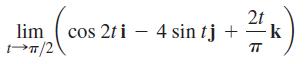
Evaluate the following limits. lim cos 2ti 4 sin tj + 1π/2 2t -k TT
Compute the following derivatives. d [t²(i + 2j − 2tk) · (e¹i + 2e¹j − 3e¯¹k)] dt
Compute the following derivatives. d -[(t³i – 2tj – 2k) × (ti – t²j – t³k)] - - dt
Compute r"(t) and r"'(t) for the following functions. r(t) = Vt + 4i + t ¡¡ — e¯¹¹k t + 1
Evaluate the following limits. lim (2e¹i +6e¹j - 4e-²¹k) t→In 2
Evaluate the following limits. lim ei 2t t + 1 j + tan ¹tk
Evaluate the following limits. t lim 1-21²2² +1 -i-4e¹ sint j + 1 √4t + 1 k
Compute the indefinite integral of the following functions. r(t) = (1³3t, 2t - 1, 10)
Evaluate the following limits. lim 1-0 sin t t i - et - 1 t -j + cost + 1²/2 - 1 2 -k
Evaluate the following limits. tan t lim 1-0 t i - 3t sin t + vt + 1 k
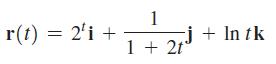
Compute the indefinite integral of the following functions. r(t) = 2¹i + 1 1 + 2t j + In tk
Compute the indefinite integral of the following functions. r(t) = te¹i + t sin t²j 21 √₁² + 4 k
Find the function r that satisfies the given condition. r'(t) = (0, 2, 2t); r(1) = (4,3,-5)
Compute the indefinite integral of the following functions. r(t) = e³ti + 1 1 + 1² j 1 =k /2t
Find the function r that satisfies the given condition. r' (t) = (e¹, sin t, sec² t); r(0) = (2,2,2)
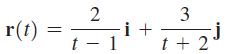
Find the domains of the following vector-valued functions. r(t) 2 t - 1 i+ 3 t + 2 -j
Find the function r that satisfies the given condition. r' (t) = (e²¹, 12e-¹, 1- 2e¹); r(0) = (1, 1, 1)
Find the function r that satisfies the given condition. r' (t) = (1, 2t, 3t²); r(1) =(4,3,-5)
Find the function r that satisfies the given condition. r' (t) = (Vt, cos nt, 4/t); r(1) = (2, 3, 4)
Showing 1000 - 1100
of 8578
First
4
5
6
7
8
9
10
11
12
13
14
15
16
17
18
Last
Step by Step Answers

 Get 50% OFF
Claim Now
Get 50% OFF
Claim Now